Home / 0580_m24_qp_22

Question 1:

1: E1.15

A night bus runs from 21 50 to 05 18 the next day. Work out the number of hours and minutes that the night bus runs.

▶️Answer/Explanation

7h 28min

From $21:50$ to midnight $(00:00)$
$60$ minutes $= 1$ hour,
$
22:00 – 21:50 = 10 \text{ minutes}
$
Then from $22:00$ to $00:00$ is $2$ hours.
Total time in the first part $2$ hours $10$ minutes.

midnight $(00:00)$ to $05:18$
 5 hours 18 minutes.

Total time
Hours $2 + 5 = 7$ hours
Minutes $10 + 18 = 28$ minutes

The night bus runs for 7 hours and 28 minutes.

Question 2:

2: E1.4

Calculate $\sqrt{5.76}+2.8^3$.

▶️Answer/Explanation

24.352

$
\sqrt{5.76} = 2.4
$
$
2.8^3 = 2.8 \times 2.8 \times 2.8
$
$
2.8 \times 2.8 = 7.84
$
$
7.84 \times 2.8 = 21.952
$

$
2.4 + 21.952 = 24.352
$

Question 3:

3: E2.2

Simplify $4 m+7 k-m+3 k$.

▶️Answer/Explanation

$3m+10k$

Divide equation in two part and then add

$4m-m=3m$——(1)

$7k+3k=10k$——(2)

Add both now,

$3m+10k$

Question 4:

4: E5.4

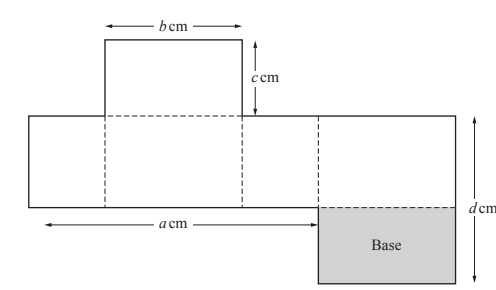
The diagram shows the net of a cuboid with its base shaded.
The length of the cuboid is 10 cm, its width is 4cm and its height is 5cm.
Write down the values of each of a, b, c and d.

▶️Answer/Explanation

Ans;

4 a = 18 b = 10 c = 4 d = 9
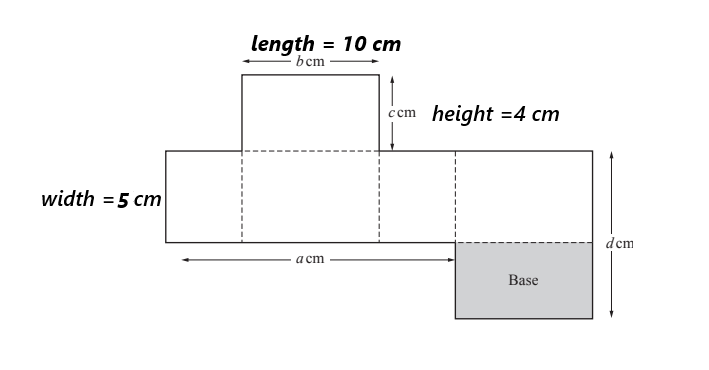
$\text{d = width + height }$

$\text{d = 5+4 = 9 cm }$

$\text{ c= height = 4 cm}$

$\text{ b= length = 10 cm}$

$\text{ a= b+2c }\Rightarrow \text{10 cm+8 cm = 18 cm}$

Question 5:

5(a): E9.4
5(b): E8.1

There are 20 cars in a car park and 3 of the cars are blue.

(a) James wants to draw a pie chart to show this information.
Find the angle of the sector for the blue cars in this pie chart.

(b) One of the 20 cars is picked at random.
Find the probability that this car is not blue.

▶️Answer/Explanation

(a)  54

(b) $\frac{17}{20}$

The total angle in a circle is 360°, and there are 20 cars in total. Since 3 of the cars are blue

$
\text{Angle for blue cars} = \frac{\text{Number of blue cars}}{\text{Total number of cars}} \times 360°
$

$
= \frac{3}{20} \times 360°
$

$
= 54°
$

Part (b)

If there are 3 blue cars out of 20,

the number of non-blue cars is

$
20 – 3 = 17
$

The probability of picking a non-blue car is the ratio of non-blue cars to the total number of cars

$
P(\text{Not blue}) = \frac{17}{20}
$

Question 6:

6: E7.2

Write $\vec{AB}$ as a column vector.

▶️Answer/Explanation

$\binom{-10}{3}$

$
\vec{AB} = \mathbf{B} – \mathbf{A}
$

\( \mathbf{A} = (7, 1) \)
\( \mathbf{B} = (-3, 4) \)

$
\vec{AB} = (-3 – 7, \ 4 – 1)
$

$
\vec{AB} = (-10, 3)
$

$
\vec{AB} = \begin{bmatrix} -10 \\ 3 \end{bmatrix}
$

Question 7:

7: E9.2

As the temperature increases, the number of people who go swimming increases.
Write down the type of correlation that this statement describes.

▶️Answer/Explanation

Ans :

Positive

This statement is a positive correlation.

In a positive correlation, as one variable increases (temperature), the other variable also increases (the number of people swimming).

Question 8:

8(a): E2.7
8(b): E2.7

8 (a) The nth term of a sequence is  n$^{2}$-3.
Find the first three terms of this sequence.

(b) These are the first five terms of a different sequence.
1 3 9 27 81

Find the nth term of this sequence.

▶️Answer/Explanation

Ans :

8(a) −2 1 6

8(b)  $3^{n-1}$

(a)

$n^2 – 3$

 For \( n = 1 \):
\( 1^2 – 3 = 1 – 3 = -2 \)

 For \( n = 2 \):
\( 2^2 – 3 = 4 – 3 = 1 \)

 For \( n = 3 \):
\( 3^2 – 3 = 9 – 3 = 6 \)

So, the first three terms are:

$-2, 1, 6$

(b)

$1, 3, 9, 27, 81$

This sequence is multiplying by 3 each time, so it’s a geometric sequence.

The nth term formula for a geometric sequence is:

$a_n = a \cdot r^{n-1}$

\( a = 1 \) (the first term)
\( r = 3 \) (common ratio)

the nth term is

$a_n = 1 \cdot 3^{n-1} = 3^{n-1}$

Question 9:

9: E3.5

The line $y = 2x- 5$ intersects the line $y = 3$ at the point P.
Find the coordinates of the point P.

▶️Answer/Explanation

(4,3)

the y-coordinates are the same at the point of intersection

substitute \( y = 3 \)

$
3 = 2x – 5
$

$
2x = 3 + 5
$

$
2x = 8
$

$
x = 4
$

$
y = 3
$

the coordinates of point \( P \)

$(4,3)$

Question 10:

10: E5.2

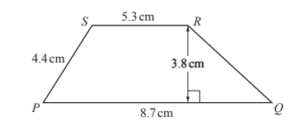
The diagram shows a trapezium PQRS.
Calculate the area of the trapezium.

………………………………….. cm2

▶️Answer/Explanation

Ans :

26.6

$
\text{Area} = \frac{1}{2} \times (a + b) \times h
$

\( a = 8.7 \, \text{cm} \) (length of base PQ)
\( b = 5.3 \, \text{cm} \) (length of top SR)
\( h = 3.8 \, \text{cm} \) (height)
$
\text{Area} = \frac{1}{2} \times (8.7 + 5.3) \times 3.8
$
$
= \frac{1}{2} \times 14 \times 3.8
$
$
= 7 \times 3.8
$
$
= 26.6 \, \text{cm}^2
$

Question 11:

11: E1.4

Without using a calculator, work out  $1 \frac{1}{4}+\frac{5}{6}$

You must show all your working and give your answer as a fraction in its simplest form.

▶️Answer/Explanation

$\frac{25}{12}$

$
1 \frac{1}{4} + \frac{5}{6}
$

$
1 \frac{1}{4} = \frac{4}{4} + \frac{1}{4} = \frac{5}{4}
$

$
\frac{5}{4} + \frac{5}{6}
$

The denominators are 4 and 6. The lowest common denominator (LCD) is 12.

$
\frac{5}{4} = \frac{5 \times 3}{4 \times 3} = \frac{15}{12}
$

$
\frac{5}{6} = \frac{5 \times 2}{6 \times 2} = \frac{10}{12}
$
add the numerators

$
\frac{15}{12} + \frac{10}{12} = \frac{15 + 10}{12} = \frac{25}{12}
$

Question 12:

12: E8.2

Farid spins a three-sided spinner with sides labelled A, B and C.
The probability that the spinner lands on C is 0.35 .
Farid spins the spinner 40 times.
Calculate the number of times he expects the spinner to land on C.

▶️Answer/Explanation

Ans :

14

$
\text{Expected frequency} = \text{Probability} \times \text{Number of trials}
$

Probability of landing on C = 0.35
Number of spins = 40
$
= 0.35 \times 40
$
$
= 14
$

Question 13:

13: E4.6

The bearing of B from A is 107°.
Calculate the bearing of A from B.

▶️Answer/Explanation

Ans :

287

Bearings are measured clockwise from North and always given as 3-digit angles.

The bearing of B from A is 107°.

Bearings in a straight line are 180° apart

$
107^\circ + 180^\circ = 287^\circ
$

Question 14:

14: E1.12

A train, 1750 metres long, is travelling at 55km/h.
Calculate how long it will take for the whole train to completely cross a bridge that is 480 metres long.
Give your answer in seconds, correct to the nearest second.

……………………………………….. s

▶️Answer/Explanation

Ans :

146 cao

The total distance is the length of the train and the length of the bridge

$
\text{Total Distance} = 1750 + 480 = 2230 \text{ metres}
$
$
1 \text{ km/h} = \frac{1000}{3600} = \frac{5}{18} \text{ m/s}
$
$
\text{Speed} = 55 \times \frac{5}{18} = \frac{275}{18} \approx 15.28 \text{ m/s}
$
$
\text{Time} = \frac{\text{Total Distance}}{\text{Speed}}
$
$
\text{Time} = \frac{2230}{15.28} \approx 145.93 \text{ seconds}
$

Question 15:

15(a)(i): E7.1
15(a)(ii): E7.1
15(b): E7.1
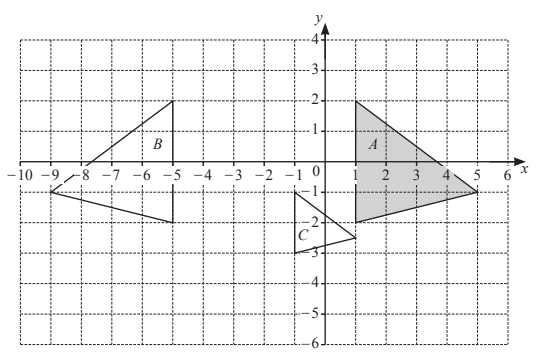
(a) Describe fully the single transformation that maps
(i) triangle A onto triangle B

(ii) triangle A onto triangle C.

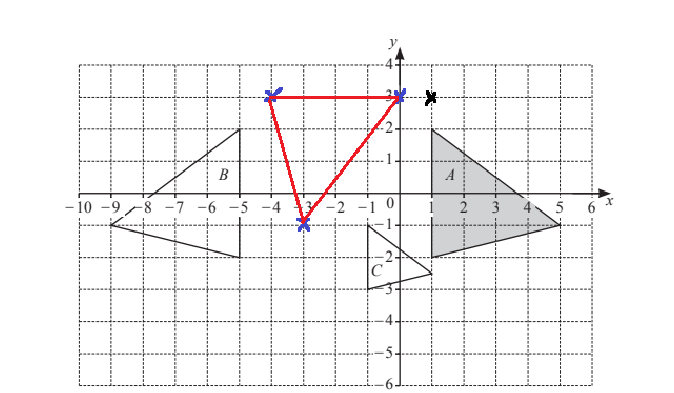
(b) Draw the image of triangle A after a rotation, 90° clockwise, about (1 ,  3).

▶️Answer/Explanation

Ans :

15(a)(i) reflection
               x = −2

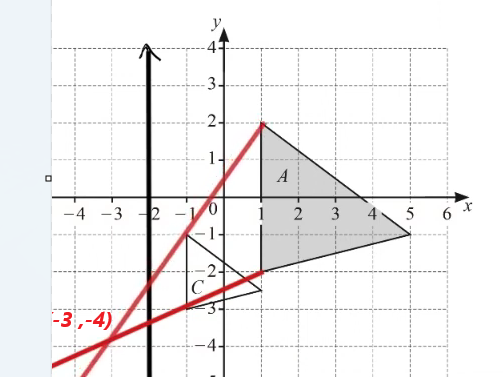
15(a)(ii) enlargement
         $\left \lfloor sf\right \rfloor\frac{1}{2}$         (−3, -4)

(a) (i) Reflection about $x=-2$
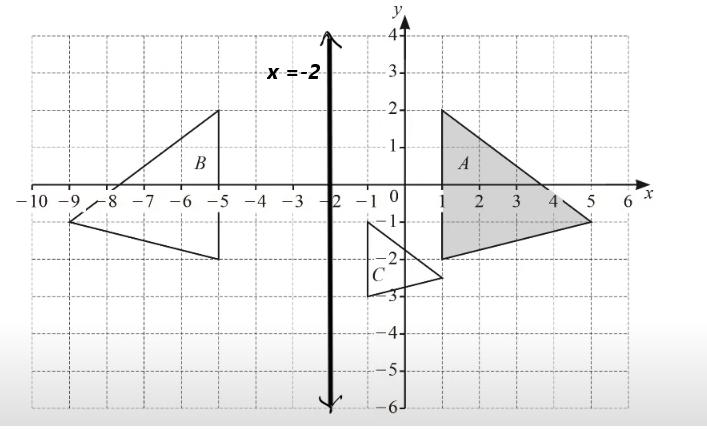
(ii)

Enlargement with factor of $\frac{2}{4}$
(b)
Question 16:

16: E1.2

$x$ is an integer.

$\mathcal{E} = \{x : 1 \leq x \leq 10\}$

$P = \{x : x \text{ is an even number}\}$

$Q = \{x : x \text{ is a multiple of } 5\}$
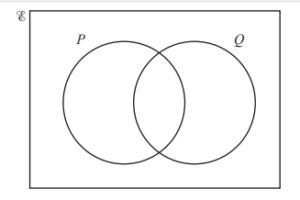
Complete the Venn diagram.

▶️Answer/Explanation

Ans :
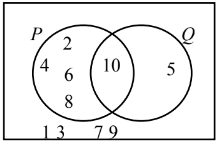
Universal set \( \mathcal{E} \)
$
\mathcal{E} = \{ 1, 2, 3, 4, 5, 6, 7, 8, 9, 10 \}
$

Set \( P \) (even numbers)
$
P = \{ 2, 4, 6, 8, 10 \}
$

Set \( Q \) (multiples of 5)
$
Q = \{ 5, 10 \}
$

Union (\( P \cup Q \)):
$
P \cup Q = \{ 2, 4, 5, 6, 8, 10 \}
$

Intersection (\( P \cap Q \)):
$
P \cap Q = \{ 10 \}
$
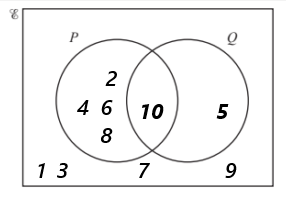
Question 17:

17: E9.3

The height of each of 200 people is measured.
The table shows the results.

Calculate an estimate of the mean height.

▶️Answer/Explanation

Ans :

138.425

The midpoint is the average of the lower and upper class boundaries.

 \( 100 < h \leq 120 \implies \text{Midpoint} = \frac{100 + 120}{2} = 110 \)
 \( 120 < h \leq 130 \implies \text{Midpoint} = \frac{120 + 130}{2} = 125 \)
 \( 130 < h \leq 150 \implies \text{Midpoint} = \frac{130 + 150}{2} = 140 \)
 \( 150 < h \leq 190 \implies \text{Midpoint} = \frac{150 + 190}{2} = 170 \)
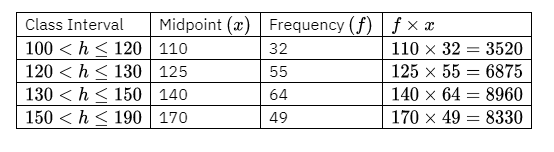
Total frequency = \( 32 + 55 + 64 + 49 = 200 \)
Total of \( f \times x \) = \( 3520 + 6875 + 8960 + 8330 = 27,685 \)
$
\text{Estimated Mean} = \frac{\sum(f \times x)}{\sum f} = \frac{27,685}{200} = 138.43 \text{ cm}
$

Question 18:

18: E1.3

Find the highest common factor (HCF) of 28x$^{5}$ and 98x$^{3}$

▶️Answer/Explanation

Ans :

14x$^{3}$

Prime factorization:
\( 28 = 2^2 \times 7 \)
\( 98 = 2 \times 7^2 \)

The HCF of 28 and 98 is the product of the smallest powers of common prime factors
$
\text{HCF of } 28 \text{ and } 98 = 2^1 \times 7^1 = 14
$
$
\text{HCF of } x^5 \text{ and } x^3 = x^3
$
$
\text{HCF} = 14x^3
$

Question 19:

19: E5.3

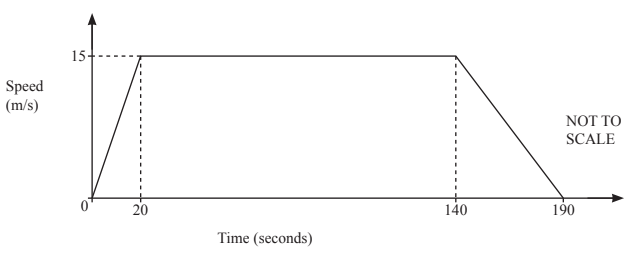
The speed–time graph shows information about a bus journey.
Calculate the total distance travelled by the bus.

……………………………………… m 

▶️Answer/Explanation

Ans :

2325

1. Acceleration phase (0 to 20 seconds, triangle)
Base = 20 s, Height = 15 m/s
Area = \( \frac{1}{2} \times 20 \times 15 = 150 \, \text{m} \)

2. Constant speed phase (20 to 140 seconds, rectangle)
Length = 140 -20 = 120 s, Height = 15 m/s
Area = \( 120 \times 15 = 1800 \, \text{m} \)

3. Deceleration phase (140 to 190 seconds, triangle)
Base = 190-  140 = 50 s, Height = 15 m/s
Area = \( \frac{1}{2} \times 50 \times 15 = 375 \, \text{m} \)

Total distance
$
150 + 1800 + 375 = 2325 \, \text{m}
$

Question 20:

20: E6.5

Calculate the area of triangle ABC.

▶️Answer/Explanation

Ans :

5.36 or 5.360 to 5.361

$
\text{Area} = \frac{1}{2}ab \sin(C)
$

Side \( a = 4.9 \, \text{cm} \)
Side \( b = 5.6 \, \text{cm} \)
Angle \( C = 23^\circ \)
$
\text{Area} = \frac{1}{2}(4.9)(5.6)\sin(23^\circ)
$
$
\sin(23^\circ) \approx 0.3907
$
$
\text{Area} = \frac{1}{2} \times 4.9 \times 5.6 \times 0.3907
$
$
= \frac{1}{2} \times 10.717 \approx 5.36 \, \text{cm}^2
$

Question 21:

21(a): E1.7
21(b): E1.7

(a)  $\sqrt[5]{3}=3^{h}$
Write down the value of h.

h = ………………………………………… 

(b) Simplify $\left ( 4x^{3} \right )^{3}$.

………………………………………….

▶️Answer/Explanation

Ans :

21(a)  $\frac{1}{5}oe$

21(b)  64x$^{9}$

(a)
$
\sqrt[5]{3} = 3^h
$
$
\sqrt[n]{a} = a^{1/n}
$
$
3^{1/5}
$
$
h = \frac{1}{5}
$

(b)
$
(4x^3)^3
$
$
(a \cdot b)^n = a^n \cdot b^n
$
$
= 4^3 \cdot (x^3)^3
$
$
= 64 \cdot x^{9}
$

Question 22

22: E2.8

 y is inversely proportional to the square of (x+3 )  .

When x = 5, y = 0.375 .
Find y in terms of x.

y = …………………………………………

▶️Answer/Explanation

Ans :

$\left [ y= \right ]\frac{24}{(x+3)^{2}}$ oe final answer

\( y \) is inversely proportional to the square of \( (x + 3) \).
$
y = \frac{k}{(x + 3)^2}
$

\( k \) = constant of proportionality

\( x = 5 \)
\( y = 0.375 \)

$
0.375 = \frac{k}{(5 + 3)^2}
$
$
0.375 = \frac{k}{8^2}
$
$
0.375 = \frac{k}{64}
$
$
k = 24
$
$
y = \frac{24}{(x + 3)^2}
$

Question 23:

23(a): E6.4
23(b): E6.4

(a) On the axes, sketch the graph of y= cosx, for 0° $\leqslant x\leqslant360^{0}$
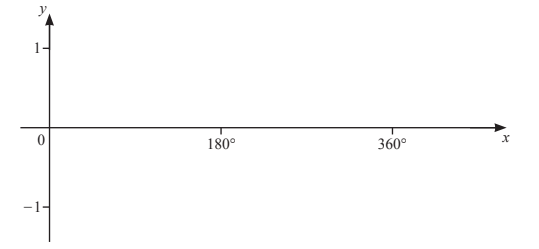
(b) Solve the equation cos x = 0.294 for 0° $\leqslant x\leqslant360^{0}$

x = ……………… or x = ………………

▶️Answer/Explanation

Ans :

23(a)
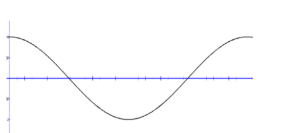
Correct sketch to go through (0, 1), close to (360, 1) and reasonably close to (180, –1)

23(b)

72.9 and 287.1

(a)
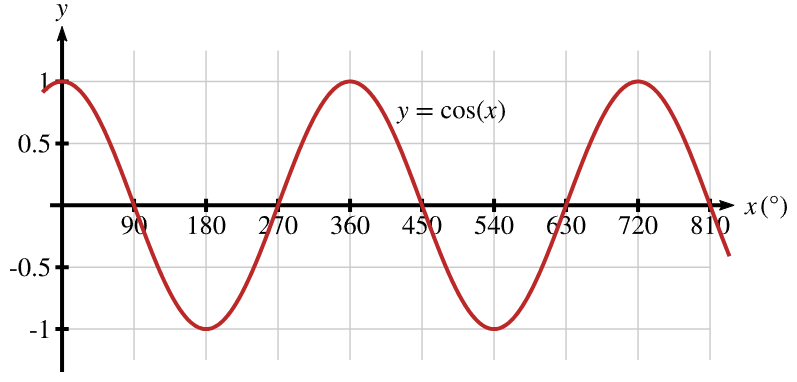
(b)

$
\cos(x) = 0.294 \quad \text{for} \quad 0^\circ \leq x \leq 360^\circ
$

$
x = \cos^{-1}(0.294)
$
$
x \approx 72.91^\circ
$

The cosine function is positive in Quadrants I and IV

Quadrant I: \( x = 72.91^\circ \)
Quadrant IV: \( x = 360^\circ – 72.91^\circ = 287.09^\circ \)

Question 24:

24: E2.5

$x^{2}-16x+a$ can be written in the form (x+b)$^{2}$ .
Find the value of a and the value of b.

a = …………………………………………
b = …………………………………………

▶️Answer/Explanation

Ans :

$\left [ a= \right]64$

$\left [ b= \right]-8$

$
x^2 – 16x + a = (x + b)^2
$

$
(x + b)^2 = x^2 + 2bx + b^2
$

$
x^2 – 16x + a = x^2 + 2bx + b^2
$

Linear term: \( 2b = -16 \implies b = -8 \)
Constant term: \( b^2 = a \implies (-8)^2 = a = 64 \)

\( a = 64 \)
\( b = -8 \)

Question 25:

25: E8.3

A bag contains 2 green buttons, 5 red buttons and 6 blue buttons.
Two buttons are taken at random from the bag without replacement.
Calculate the probability that the two buttons are different colours.

▶️Answer/Explanation

Ans :

$\frac{2}{3}$  

Green: 2
Red: 5
Blue: 6
Total number of buttons = \( 2 + 5 + 6 = 13 \)

selecting 2 buttons out of 13

$
\text{Total outcomes} = \binom{13}{2} = \frac{13 \times 12}{2} = 78
$

Both Green: Choose 2 out of 2 green buttons

$
\binom{2}{2} = 1
$

Both Red: Choose 2 out of 5 red buttons
$
\binom{5}{2} = \frac{5 \times 4}{2} = 10
$
Both Blue: Choose 2 out of 6 blue buttons
$
\binom{6}{2} = \frac{6 \times 5}{2} = 15
$

Total same-color outcomes:

$
1 + 10 + 15 = 26
$

Outcomes with different colors = Total outcomes – Same-color outcomes

$
78 – 26 = 52
$
$
\text{Probability} = \frac{52}{78}
$
$
= \frac{2}{3}
$

Question 26:

26: E3.7

A is the point (6, 1) and B is the point (2, 7).
Find the equation of the perpendicular bisector of AB.
Give your answer in the form y =mx+ c.

y = ………………………………………….

▶️Answer/Explanation

Ans :

$y=\frac{2}{3}x+\frac{4}{3}$ final answer

The midpoint formula

$
M = \left( \frac{x_1 + x_2}{2}, \frac{y_1 + y_2}{2} \right)
$

A(6, 1) and B(2, 7)

$
M = \left( \frac{6 + 2}{2}, \frac{1 + 7}{2} \right)
$
$
M = (4, 4)
$

The gradient formula

$
m = \frac{y_2 – y_1}{x_2 – x_1}
$
$
m = \frac{7 – 1}{2 – 6} = \frac{6}{-4} = -\frac{3}{2}
$

The gradient of the perpendicular bisector is the negative reciprocal of the gradient of AB

$
m_{\text{perp}} = -\frac{1}{m} = -\frac{1}{-\frac{3}{2}} = \frac{2}{3}
$

$
y – y_1 = m(x – x_1)
$

Midpoint (4, 4) and the perpendicular gradient \(\frac{2}{3}\)

$
y – 4 = \frac{2}{3}(x – 4)
$
$
y – 4 = \frac{2}{3}x – \frac{8}{3}
$
$
y = \frac{2}{3}x – \frac{8}{3} + 4
$
$
y = \frac{2}{3}x + \frac{4}{3}
$

Scroll to Top