Question1
1(a): C1.1
1(b): C1.1
(a) Write down all the factors of $18.$
(b) Write down the reciprocal of $8.$
▶️Answer/Explanation
(a): $1, 2, 3, 6, 9, 18$
(b): $\frac{1}{8}$ or $0.125$
(a)
Factors are numbers that divide 18 exactly without leaving a remainder.
$
\text{Factors of 18: } 1, 2, 3, 6, 9, 18
$
(b)
The reciprocal of a number is what you multiply by to get 1 in other words, flip the fraction.
$
\text{Reciprocal of 8} = \frac{1}{8}
$
Question2
2(a): C4.2
2(b): C4.2

(a) Draw a line perpendicular to the line AB.
(b) Measure the line AB in centimetres.
▶️Answer/Explanation
(a): Accurate ruled perpendicular line
(b): $7.4$
(a)
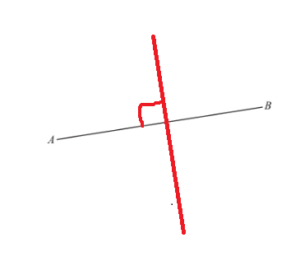
Use a protractor or a set square.
Place the tool so you measure a 90° angle to line AB.
Draw the perpendicular line through the desired point or midpoint.
(b)
Use a ruler.
Place the ruler carefully along line AB.
Read the length in centimetres.
Question3
3: C4.5
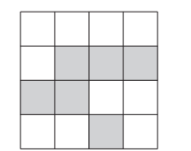
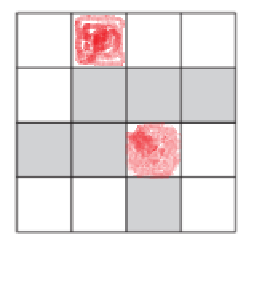
Shade two squares so that the diagram has rotational symmetry of order $4.$
▶️Answer/Explanation
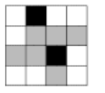
Pattern looks the same after rotating by 90°, 180°, and 270°.
Question4
4(a): C1.6
4(b): C1.11
Kai and Ava each have a piece of wood $57$cm long.
(a) Kai cuts his piece into $4$ equal length parts.
Find the length of one part.
(b) Ava cuts her piece into two parts and the lengths are in the ratio $5 :1 $.
Find the length of the longer part.
▶️Answer/Explanation
(a): $14.25$
(b): $47.5$
a)
He cuts it into 4 equal parts.
$
\frac{57}{4} = 14.25 \text{ cm}
$
one part is 14.25 cm long.
(b)
She cuts her piece in the ratio $5:1.$
The total ratio parts add
$
5 + 1 = 6
$
The length of one part is
$
\frac{57}{6} = 9.5 \text{ cm}
$
The longer part
$
5 \times 9.5 = 47.5 \text{ cm}
$
Question5
5: C4.6

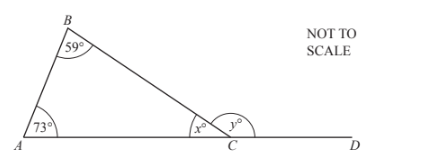
In the diagram, $ABC$ is a triangle and $ACD$ is a straight line.
Find the value of $x$ and the value of $y.$
▶️Answer/Explanation
$x = 48$, $y = 132$
The angles in a triangle add up to 180°
$
\angle A + \angle B + \angle C = 180^\circ
$
$
73^\circ + 59^\circ + \angle x = 180^\circ
$
$
\angle x = 180^\circ – 132^\circ = 48^\circ
$
Angles on a straight line add up to 180°.
$
x + y = 180^\circ – \angle x= 180^\circ – 48^\circ = 132^\circ
$
Question6
6: C1.9
Find the temperature that is $8°C$ colder than $-5°C$.
▶️Answer/Explanation
$-13$
If the temperature is $-5^\circ \mathrm{C}$ and it gets $8^\circ \mathrm{C}$ colder
$
-5^\circ \mathrm{C} – 8^\circ \mathrm{C} = -13^\circ \mathrm{C}
$
The temperature would be $-13^\circ \mathrm{C}$
Question7
7: C1.1
There are two prime numbers in this list.
$27\quad47\quad57\quad61\quad75\quad93$
Work out the sum of these two prime numbers.
▶️Answer/Explanation
$108$
27 → Not prime (Divisible by 3 and 9)
47 → Prime
57 → Not prime (Divisible by 3)
61 → Prime
75 → Not prime (Divisible by 3 and 5)
93 → Not prime (Divisible by 3)
The two prime numbers are 47 and 61
Sum of the prime numbers
$
47 + 61 = 108
$
Question8
8(a): C9.4
8(b): C9.4
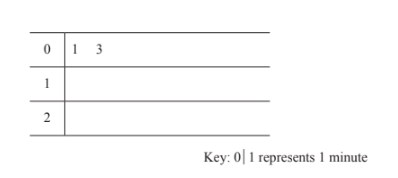
On ten days, Stefan records the number of minutes he has to wait for a train.
$1\quad3\quad12\quad5\quad4\quad23\quad5\quad24\quad11\quad8$
(a) Complete the stem-and-leaf diagram to show this information.
(b) Find the median.
▶️Answer/Explanation
(a)
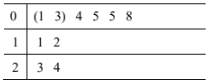
(b): $6.5$
(a)
The data
$
1, 3, 12, 5, 4, 23, 5, 24, 11, 8
$
sort the data in ascending order
$
1, 3, 4, 5, 5, 8, 11, 12, 23, 24
$
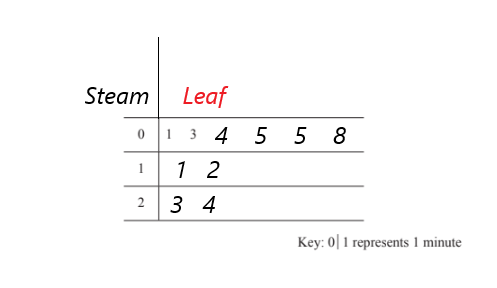
(b)
There are 10 data points (even number), so the median is the average of the 5th and 6th values in the ordered list
$
1, 3, 4, 5, 5, 8, 11, 12, 23, 24
$
The 5th value is 5, and the 6th value is 8.
Median:
$
\text{Median} = \frac{5 + 8}{2} = \frac{13}{2} = 6.5
$
Question9
9: C4.3
The scale drawing shows the positions of town $A$ and town $B.$
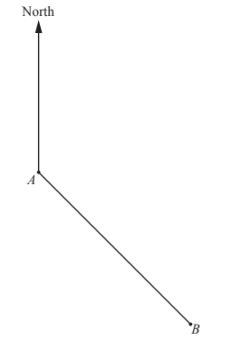
Measure the bearing of town $B$ from town $A$.
▶️Answer/Explanation
$135$
Place your protractor
Position the protractor at town A.
Align the 0° line of the protractor with the north direction, which is typically indicated by a vertical line pointing upwards.
Measure the angle in a clockwise direction from the north line to the line connecting town A to town B.
Bearings should always be expressed as 3-digit numbers.
Question10N
10: C5.4
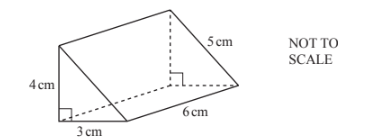
The diagram shows a right-angled triangular prism.
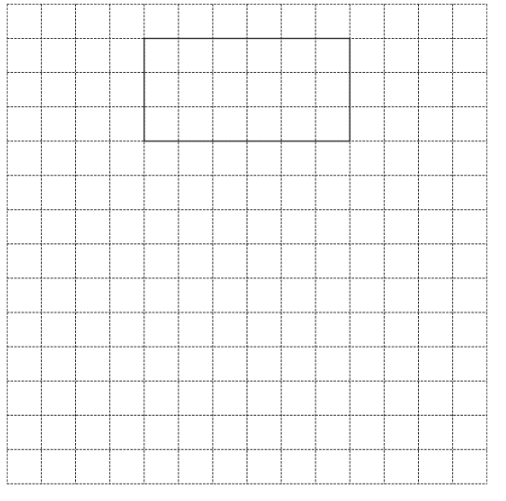
On the $l$ cm$^{2}$ grid, complete the net of this prism.
One face has been drawn for you.
▶️Answer/Explanation
Fully correct net
Question11
11: C1.10
The distance from town $A$ to town $B$ on a map is $3.5$cm.
The scale on the map is $1 : 250 000$.
Find the actual distance, in kilometres, from town $A$ to town $B.$
▶️Answer/Explanation
$8.75$
$
\text{Actual Distance} = \text{Distance on map} \times \text{Scale factor}
$
The scale is given as 1 : 250,000, meaning 1 cm on the map = 250,000 cm in reality.
$
\text{Actual Distance} = 3.5 \times 250,000
$
$
= 875,000 \text{ cm}
$
Since 100,000 cm = 1 km
$
875,000 \div 100,000 = 8.75 \text{ km}
$
Question12
12: C8.1
A spinner is spun. The possible outcomes are A, B, C or D.
The probability of spinning A, C or D is shown in the table.
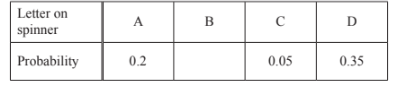
Complete the table.
▶️Answer/Explanation
$0.4$
In probability, the sum of all probabilities must equal $1.$
$
0.2 + x+0.05 + 0.35 = 1
$
$
0.2+ 0.35 + 0.05= 0.60
$
$
0.60 + x = 1
$
$
x = 0.40
$
Question13
13(a): C1.2
13(b): C1.2
$\mathcal{E}=\{x:1\leqslant x\leqslant20\}$
$E=\{$even numbers$\}$
$M=\{$multiples of 5$\}$
$(\mathbf{a})$ Find n$(M).$
$(\mathbf{b})$ Find the elements in the set $E\cap M.$
▶️Answer/Explanation
(a): $4$
(b): $10, 20$
$
\mathcal{E} = \{ x : 1 \leq x \leq 20 \}
$
\( E \) = even numbers within this range → \( \{ 2, 4, 6, 8, 10, 12, 14, 16, 18, 20 \} \)
\( M \) = multiples of 5 within this range → \( \{ 5, 10, 15, 20 \} \)
(a)
The number of elements in set \( M \)
$
M = \{ 5, 10, 15, 20 \}
$
$
n(M) = 4
$
(b)
The intersection of \( E \) and \( M \) includes elements that are both even and multiples of 5
$
E \cap M = \{ 10, 20 \}
$
Question14
14: C1.4
Without using a calculator, work out $\frac{4}{7}\div1\frac{5}{21}$
You must show all your working and give your answer as a fraction in its simplest form.
▶️Answer/Explanation
$\frac{4}{7} \times \frac{21}{26}$ or $\frac{12}{21} \div \frac{26}{21}$ (with common denominator). $\frac{6}{13}$
$
1\frac{5}{21} = \frac{21}{21} + \frac{5}{21} = \frac{26}{21}
$
$
\frac{4}{7} \div \frac{26}{21} = \frac{4}{7} \times \frac{21}{26}
$
$
= \frac{4 \times 21}{7 \times 26} = \frac{84}{182}
$
The GCD of 84 and 182 is 2.
$
= \frac{84 \div 2}{182 \div 2} = \frac{42}{91}
$
42 and 91 common factor of 7
$
= \frac{42 \div 7}{91 \div 7} = \frac{6}{13}
$
Question15
15(a): C7.1
15(b): C7.1
15(c): C3.1
$F$ is the point $(1,-4),$ $\overrightarrow{FG} = \begin{pmatrix} 8\\ – 3\end{pmatrix}$and $\overrightarrow {GH}=\begin{pmatrix}-12\\35\end{pmatrix}.$
Find
$(\mathbf{a})$ $3\overrightarrow{FG}$
$( \mathbf{b} )$ $\overrightarrow {FG}+ \overrightarrow {GH}$
$( \mathbf{c} )$ the coordinates of the point $G.$
▶️Answer/Explanation
(a): $\begin{pmatrix} 24 \\ -9 \end{pmatrix}$
(b): $\begin{pmatrix} -4 \\ 32 \end{pmatrix}$
(c): $(9, -7)$
(a)
$
3 \overrightarrow{FG} = 3 \times \begin{pmatrix} 8 \\ -3 \end{pmatrix} = \begin{pmatrix} 24 \\ -9 \end{pmatrix}
$
(b)
$
\overrightarrow{FG} + \overrightarrow{GH} = \begin{pmatrix} 8 \\ -3 \end{pmatrix} + \begin{pmatrix} -12 \\ 35 \end{pmatrix} = \begin{pmatrix} 8 + (-12) \\ -3 + 35 \end{pmatrix}
$
$
= \begin{pmatrix} -4 \\ 32 \end{pmatrix}
$
(c)
The position vector rule
$
G = F + \overrightarrow{FG}
$
The coordinates of \( F(1, -4) \) and the vector \( \overrightarrow{FG} = \begin{pmatrix} 8 \\ -3 \end{pmatrix} \)
$
G = (1 + 8, -4 + (-3))
$
$
= (9, -7)
$
Question16
16: C1.5
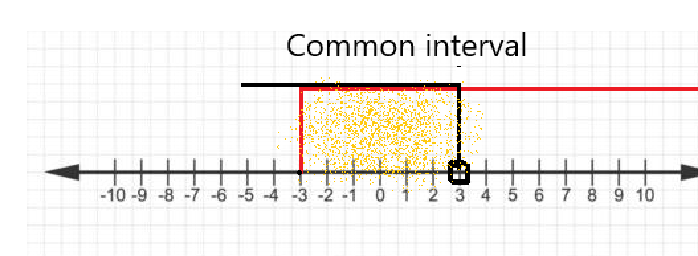
$x$ is an integer where $x\geqslant-3$ and $x<3.$
Write down all the possible values of $x$
▶️Answer/Explanation
$-3, -2, -1, 0, 1, 2$
$
x \geq -3 \quad \text{and} \quad x < 3
$
$
x = -3, -2, -1, 0, 1, 2
$
Question17
17: C4.6
Find the size of an interior angle of a regular $15-$sided polygon
▶️Answer/Explanation
$156$
$
\text{Interior angle} = \frac{(n – 2) \times 180^\circ}{n}
$
For a 15-sided polygon
$
= \frac{(15 – 2) \times 180^\circ}{15}
$
$
= \frac{13 \times 180^\circ}{15}
$
$
= \frac{2340^\circ}{15}
$
$
= 156^\circ
$
Question18
18(a): C1.8
18(b): C1.8
(a) Write $45 000$ in standard form
(b) Calculate $6.75\times10^{-3}\times4.2\times10^{5}$
Give your answer in standard form.
▶️Answer/Explanation
(a): $4.5 \times 10^4$
(b): $2.835 \times 10^3$
(a)
Standard form is write as
$
A \times 10^n
$
Where \( 1 \leq A < 10 \).
For 45,000
$
= 4.5 \times 10^4
$
(b)
\( 6.75 \times 10^{-3} \times 4.2 \times 10^5 \)
$
(6.75 \times 4.2) \times (10^{-3} \times 10^5)
$
$
6.75 \times 4.2 = 28.35
$
$
10^{-3} \times 10^5 = 10^{2}
$
$
= 28.35 \times 10^2
$
$
= 2.835 \times 10^3
$
Question19
19: C2.4
Simplify. $18x^{12}\div3x^3$
▶️Answer/Explanation
$6x^9$
$
18x^{12} \div 3x^3
$
Divide the coefficients and subtract the exponents using the law of exponents
$
= \frac{18}{3} \times x^{12-3}
$
$
= 6x^9
$
Question20
20: C1.11
\(\begin{aligned}&\text{Buses at a station go to the port or to the town.}\\&\text{Buses leave every 28 minutes for the port.}\\&\text{Buses leave every 48 minutes for the town leave the station together.}\\&\text{Find the next time when a bus for the port and a bus for the town leave the station together.}\end{aligned}\)
▶️Answer/Explanation
$1554$ or $3:54$ pm
Port buses leave every 28 minutes
Town buses leave every 48 minutes
$
28 = 2^2 \times 7
$
$
48 = 2^4 \times 3
$
$
\mathrm{LCM}(28, 48) = 2^4 \times 3 \times 7 = 16 \times 3 \times 7 = 336
$
336 minutes is the next time they leave together.
$
336 \div 60 = 5 \text{ hours and } 36 \text{ minutes}
$
Question21
21: C4.4

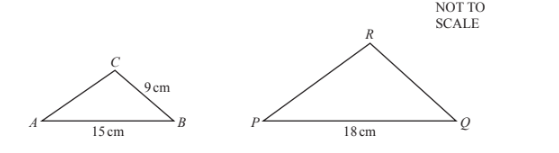
Triangle $ABC$ is similar to triangle $PQR.$
Calculate $QR.$
▶️Answer/Explanation
$10.8$
Triangles \( ABC \) and \( PQR \) are similar, their corresponding side lengths are proportional.
The corresponding sides a
\( AB \leftrightarrow PQ \)
\( BC \leftrightarrow QR \)
\( AC \leftrightarrow PR \)
\( AB = 15 \, \mathrm{cm} \), \( PQ = 18 \, \mathrm{cm} \)
\( BC = 9 \, \mathrm{cm} \)
$
\frac{AB}{PQ} = \frac{BC}{QR}
$
$
\frac{15}{18} = \frac{9}{QR}
$
$
15 \times QR = 18 \times 9
$
$
15 \times QR = 162
$
$
QR = \frac{162}{15}
$
$
QR = 10.8 \, \mathrm{cm}
$
Question22
22(a): C6.2
22(b): C6.2
(a)
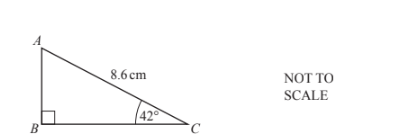
The diagram shows a right-angled triangle $ABC.$
Calculate $AB.$
(b)
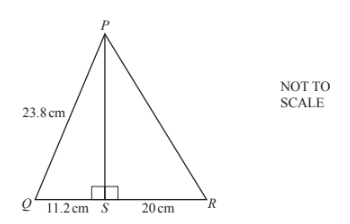
The diagram shows right-angled triangles $PQS$ and $PRS.$
$PQ=23.8$cm$, $QS=11.2~cm~ and ~SR=20cm$.
Calculate $PR.$
▶️Answer/Explanation
(a): $5.75$ or $5.754$ to $5.755$
(b): $29$
(a)
$
\sin(42^\circ) = \frac{AB}{AC}
$
$
\sin(42^\circ) = \frac{AB}{8.6}
$
$
AB = 8.6 \times \sin(42^\circ)
$
$
\sin(42^\circ) \approx 0.6691
$
$
AB \approx 8.6 \times 0.6691
$
$
AB \approx 5.75 \, \mathrm{cm}
$
(b)
\( PQ = 23.8 \, \mathrm{cm} \)
\( QS = 11.2 \, \mathrm{cm} \)
By Pythagoras’ Theorem
$
PQ^2 = PS^2 + QS^2
$
$
(23.8)^2 = PS^2 + (11.2)^2
$
$
566.44 = PS^2 + 125.44
$
$
PS^2 = 566.44 – 125.44
$
$
PS^2 = 441
$
$
PS = 21 \, \mathrm{cm}
$
\( PS = 21 \, \mathrm{cm} \)
\( SR = 20 \, \mathrm{cm} \)
Again, use Pythagoras’ Theorem
$
PR^2 = PS^2 + SR^2
$
$
PR^2 = (21)^2 + (20)^2
$
$
PR^2 = 441 + 400
$
$
PR^2 = 841
$
$
PR = \sqrt{841}
$
$
PR = 29 \, \mathrm{cm}
$
Question23
23(a): C1.10
23(b): C1.10
$( \mathbf{a} )$ The mass, $m$ kilograms, of object $A$ is $350$kg, correct to the nearest 10 kg.
Complete this statement about the value of $m.$
$\mathbf{(b)}$ The mass of object $B$ is $348$ kg, correct to the nearest kilogram.
Show that the mass of object $B$ may be more than the mass of object $A.$
▶️Answer/Explanation
(a): $345$, $355$
(b): Any correct response e.g. A could be $345$
(a)
The mass of object A is 350 kg, correct to the nearest 10 kg.
The range of values for m will be within 5 kg above and below 350 kg.
$345 \leq m < 355$
(b)
The mass of object B is 348 kg, correct to the nearest 1 kg.
The range of values for object B is
$347.5 \leq m < 348.5$
The maximum possible mass of object A is 354.99 kg (just under 355).
The minimum possible mass of object B is 347.5 kg, but the maximum possible mass of object B is 348.5 kg.