Home / 0580_s23_qp_23

Question1

Q1
(a) E4.5
(b) E4.5
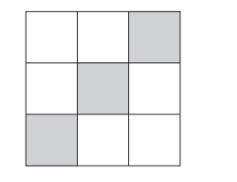
(a) Complete the statement.
The diagram has rotational symmetry of order …………………… . [1]
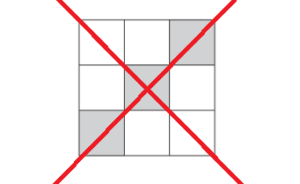
(b) On the diagram, draw all the lines of symmetry.

▶️Answer/Explanation

(a) $2$

(b) correctly showed

Detailed Solution

(a)

Rotational symmetry: The shape has rotational symmetry of order 2, meaning it looks the same when rotated 180° and 360°.

(b) 
Question 2

Q2 E1.15

A film lasts for $2$ hours $50$ minutes.
The film ends at 23  05.

Find the time the film starts.

▶️Answer/Explanation

$20 ~15$ or $8:15$ pm

Detailed Solution

The film ends at 23:05, and it lasts for 2 hours 50 minutes.

$
23:05 – 50 \text{ minutes} = 22:15
$
$
22:15 – 2 \text{ hours} = 20:15
$
The film starts at 20:15 (8:15 PM).

Question3

Q3 E5.4

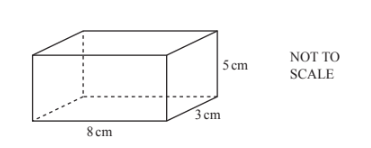
Find the total surface area of the cuboid.

▶️Answer/Explanation

$158$

Detailed Solution

$
\text{Total Surface Area (TSA)} = 2(lb + bh + hl)
$

\( l = 8 \, \mathrm{cm} \) (length)
\( b = 3 \, \mathrm{cm} \) (breadth/width)
\( h = 5 \, \mathrm{cm} \) (height)
$
\text{TSA} = 2(8(3) + 3(5) + 5(8))
$
$
= 2(24 + 15 + 40)
$
$
= 2(79)
$
$
= 158 \, \mathrm{cm^2}
$

Question4

Q4 E2.5

$$\nu=u-9.8t$$

Find the value of $\nu$ when $u= 4$ and $t= – 7.$

▶️Answer/Explanation

$72.6$

Detailed Solution

$
\nu = u – 9.8t
$

Substituting \( u = 4 \) and \( t = -7 \)

$
\nu = 4 – 9.8(-7)
$
$
= 4 + 68.6
$
$
= 72.6
$

Question5

Q5 E2.2

Simplify $d^8\div d^2.$

▶️Answer/Explanation

$d^6$

Detailed Solution

Use the rule of indices

$
d^8 \div d^2 = d^{8-2} = d^6
$

Question6

Q6 E1.13

At the end of the day, a shopkeeper has 12 tins of cat food left This is $\frac{3}{13}$ of the number he had at the beginning of the day Calculate the number of tins he had at the beginning of the day

▶️Answer/Explanation

$52$

Detailed Solution

$
\frac{3}{13} \text{ of the total tins } = 12
$

Let the total number of tins at the beginning be \( x \)

$
\frac{3}{13} x = 12
$
$
x = 12 \times \frac{13}{3}
$
$
x = \frac{156}{3}
$
$
x = 52
$

Question7

Q7
(a) E8.3
(b) E8.3

A spinner has five sides.
Each side is painted red, blue, green, yellow or orange.
The table shows some of the probabilities of the spinner landing on each colour.
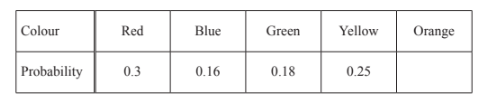
(a) Complete the table. 
(b) Dan spins the spinner once.
Find the probability that the spinner lands on red or blue.

▶️Answer/Explanation

(a): $0.11$

(b): $0.46$

Detailed Solution

(a)
Sum of total probabilities 1.
$
0.3 + 0.16 + 0.18 + 0.25 = 0.89
$
$
1 – 0.89 = 0.11
$
The probability for orange is 0.11.

(b)
$
P(\text{Red or Blue}) = P(\text{Red}) + P(\text{Blue}) = 0.3 + 0.16 = 0.46
$

So, the probability is 0.46.

Question8

Q8 E7.1
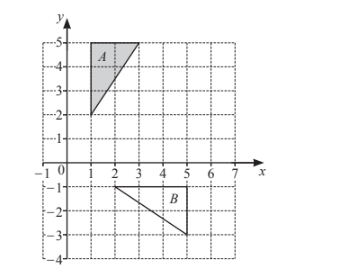
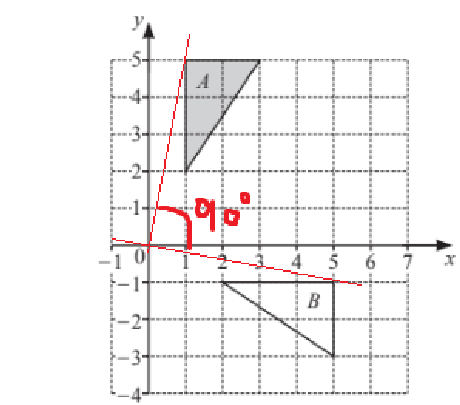
Describe fully the single transformation that maps triangle $A$ onto triangle $B$.

▶️Answer/Explanation

 Rotation, $(0,0)$, $90^\circ$ clockwise
Question9

Q9
(a) E9.4
(b) E9.4

The distance–time graph shows information about Kai’s journey from home to the office.
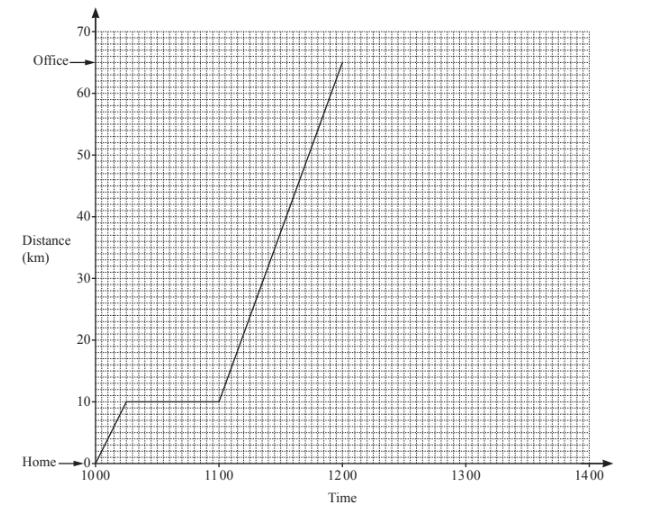
(a) Calculate the average speed, in km/h, for Kai’s journey from home to the office.

(b) When Kai arrives at the office, he finds his meeting is cancelled. He immediately returns home at a constant speed of $50$km/h.
Complete the distance–time graph to show his journey home.

▶️Answer/Explanation

(a): $32.5$

(b): Correct ruled line from $(12 00, 65)$ to $(13 18, 0)$

Detailed Solution

$
\text{Average speed} = \frac{\text{Total distance}}{\text{Total time}}
$

From the graph:
Total distance traveled = 65 km
Start time = 10:00
End time = 12:00
Total time = \( 12:00 – 10:00 = 2 \) hours

$
\text{Average speed} = \frac{65}{2} = 32.5 \text{ km/h}
$

(b)
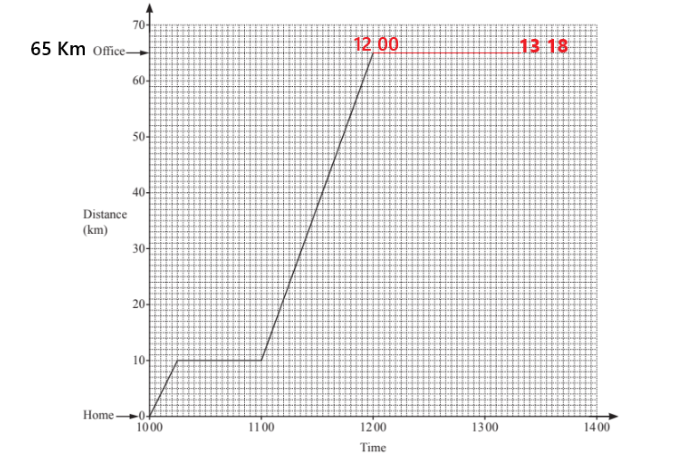
Kai’s return speed = 50 km/h
Initial position at (12:00, 65 km)
Final position at (home, 0 km)

$
\text{Time} = \frac{\text{Distance}}{\text{Speed}} = \frac{65}{50} = 1.3 \text{ hours} = 1 \text{ hour } 18 \text{ minutes}
$

Return starts at 12:00
End time = 12:00 + 1 hour 18 minutes = 13:18

Question10

Q10 E1.4

Without using a calculator, work out $5\frac{11}{12}+2\frac{1}{4}$. You must show all your working and give your answer as a mixed number in its simplest form.

▶️Answer/Explanation

 $\frac{k}{12} + \frac{27}{12}$ or $\frac{71}{12} + \frac{c}{12}$. 

Detailed Solution

\( 5 \frac{11}{12} \)
Multiply the whole number by the denominator, then add the numerator
$
5 \times 12 + 11 = 60 + 11 = 71
$
$
5 \frac{11}{12} = \frac{71}{12}
$

2. \( 2 \frac{1}{4} \)
Multiply the whole number by the denominator, then add the numerator
$
2 \times 4 + 1 = 8 + 1 = 9
$
$
2 \frac{1}{4} = \frac{9}{4}
$

The denominators are 12 and 4. The least common denominator (LCD) is 12.
$
\frac{9}{4} = \frac{9 \times 3}{4 \times 3} = \frac{27}{12}
$
$
\frac{71}{12} + \frac{27}{12} = \frac{71 + 27}{12} = \frac{98}{12}
$
Divide both the numerator and denominator by their GCD (2)
$
\frac{98}{12} = \frac{49}{6}
$
$
49 \div 6 = 8 \text{ remainder } 1
$
$
\frac{49}{6} = 8 \frac{1}{6}
$

Question11

Q11
(a) E1.2
(b) E1.2

(a)\(\begin{aligned}\mathrm{(a)}&\varepsilon=\{a,b,e,g,l,m,o,r,t,y\}\\&P=\{a,b,e,g,l,r\}\\&Q=\{e,g,m,o,r,t,y\}\end{aligned}\)
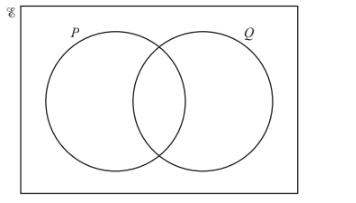
 

Complete the Venn diagram.

(b)
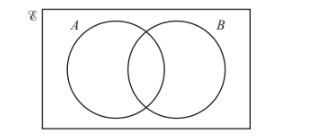
\(\text{Shade the region}~A^{\prime}\cap B.\)

▶️Answer/Explanation
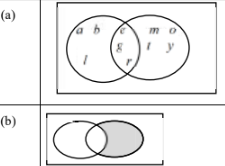
Detailed Solution

(a)

Elements in \( P \) only: \( \{a, b, l\} \)
Elements in \( Q \) only: \( \{m, o, t, y\} \)
Elements in intersection \( P \cap Q \)): \( \{e, g, r\} \)

(b)

\( A^{\prime} \) (A complement) represents everything outside set \( A \).
\( B \) represents everything inside set \( B \).
The intersection \( A^{\prime} \cap B \) includes the part of \( B \) that is not in \( A \).

Question12

Q12 E7.4

The position vector of $A$ is$\binom {5}{3} $and $\overrightarrow{BA}=\binom {4}{8}$
Show that $\left|\overrightarrow{OB}\right|=5.1$, correct to 1 decimal place

▶️Answer/Explanation

$\sqrt{1^2 + (-5)^2}$.

Detailed Solution

$ \overrightarrow{OA} = \binom{5}{3} $
$ \overrightarrow{BA} = \binom{4}{8} $

$
\overrightarrow{OB} = \overrightarrow{OA} – \overrightarrow{BA}
$
$
\binom{x}{y} = \binom{5}{3} – \binom{4}{8}
$
$
\overrightarrow{OB} = \binom{5-4}{3-8} = \binom{1}{-5}
$
$
\left| \overrightarrow{OB} \right| = \sqrt{1^2 + (-5)^2}
$
$
= \sqrt{1 + 25} = \sqrt{26}
$
$
\sqrt{26} \approx 5.10
$

Question13

Q13 E1.3

Calculate $\sqrt{42}+3^{0.4}$

▶️Answer/Explanation

$8.03$ or $8.032$ to $8.033$

Detailed Solution

$
\sqrt{42} + 3^{0.4}
$
$
\sqrt{42} \approx 6.48
$

$
3^{0.4} = \sqrt[5]{3^2}
$
$
3^{0.4} \approx 1.55
$
Adding both
$
6.48 + 1.55 = 8.03
$

Question14

Q14 E1.4

Write $0.581$ as a fraction.
You must show all your working and give your answer in its simplest form

▶️Answer/Explanation

 $581.81… – 5.81…$ which simplifies to $\frac{32}{55}$

Detailed Soution

Let \( x = 0.58181\ldots \)

Multiply both sides by 100 to shift the repeating part

$
100x = 58.18181\ldots
$
$
100x – x = 58.18181\ldots – 0.58181\ldots
$
$
99x = 57.6
$
$
57.6 = \frac{576}{10} = \frac{288}{5}
$

Thus,
$
x = \frac{288}{495}
$
$
x = \frac{32}{55}
$

Question15

Q15 E1.17

The number of trees in a forest is decreasing exponentially at a rate of $1.75\%$ per year
Eleven years ago there were $980$ trees

Calculate the number of trees in the forest now Give your answer correct to the nearest integer.

▶️Answer/Explanation

$807$

Detailed Solution

Initial number of trees: $ P_0 = 980 $
Rate of decrease: $r = 1.75\% = 0.0175 $
Time: $ t = 11 \text{ years} $

Exponential decay formula:
$
P = P_0 e^{-rt}
$
$
P = 980 \times e^{-0.0175 \times 11}
$
$
P = 980 \times e^{-0.1925}
$
$
P \approx 980 \times 0.825
$
$
P \approx 808.5
$

Question16

Q16 E5.4

The volume of a cylinder is $1970$ cm$^{3}$ The height of the cylinder is $12.8$cm. Calculate the radius of the cylinder.

▶️Answer/Explanation

$7.00$ or $6.998$ to $7.002$

Detailed Solution

Volume of cylinder: $V = 1970 \text{ cm}^3$

Height of cylinder: $h = 12.8 \text{ cm}$

Formula for volume of a cylinder$V = \pi r^2 h$

$
1970 = \pi r^2 (12.8)
$
$
r^2 = \frac{1970}{\pi \times 12.8}
$
$
r^2 = \frac{1970}{40.2125}
$
$
r^2 \approx 49
$
$
r \approx 7 \text{ cm}
$

Question17

Q17 E2.5

Rearrange the formula to make $m$ the subject.

$$R=\frac{2(m-k)}m$$

▶️Answer/Explanation

$m = \frac{2k}{(2-R)}$ or $m = \frac{-2k}{(R-2)}$

Detailed Solution

$
R = \frac{2(m – k)}{m}
$

Multiply both sides by \( m \)
$
R m = 2(m – k)
$
$
R m = 2m – 2k
$
$
R m – 2m = -2k
$
$
m(R – 2) = -2k
$
$
m = \frac{-2k}{R – 2}
$

Question18

Q18 E2.8

$y$ is inversely proportional to the cube root of $(x+5).$
${\mathrm{When~}x=3,y=12.}$

Find $y$ when $x=22.$

▶️Answer/Explanation

$8$

Detailed Solution

$
y \propto \frac{1}{\sqrt[3]{(x+5)}}
$
$
y = \frac{k}{\sqrt[3]{(x+5)}}
$
Substituting \( x = 3, y = 12 \):
$
12 = \frac{k}{\sqrt[3]{(3+5)}}
$
$
12 = \frac{k}{\sqrt[3]{8}}
$
$
12 = \frac{k}{2}
$
$
k = 24
$

For \( x = 22 \)
$
y = \frac{24}{\sqrt[3]{(22+5)}}
$
$
y = \frac{24}{\sqrt[3]{27}}
$
$
y = \frac{24}{3}
$
$
y = 8
$

Question19

Q19 E2.5

\(\begin{aligned}&\text{Solve the equation}\quad x^2+5x-7=0.\\&\text{You must show all your working and give your answers correct to 2 decimal places.}\end{aligned}\)

▶️Answer/Explanation

 $\frac{-5 \pm \sqrt{5^2 – 4 \times 1 \times -7}}{2 \times 1}$. $-6.14$ and $1.14$

Detailed Solution

$
x^2 + 5x – 7 = 0
$

Quadratic formula
$
x = \frac{-b \pm \sqrt{b^2 – 4ac}}{2a}
$

\( a = 1 \), \( b = 5 \), \( c = -7 \)
$
x = \frac{-5 \pm \sqrt{5^2 – 4(1)(-7)}}{2(1)}
$
$
x = \frac{-5 \pm \sqrt{25 + 28}}{2}
$
$
x = \frac{-5 \pm \sqrt{53}}{2}
$
$
x = \frac{-5 \pm 7.28}{2}
$
$
x = \frac{-5 + 7.28}{2} = \frac{2.28}{2} = 1.14
$
$
x = \frac{-5 – 7.28}{2} = \frac{-12.28}{2} = -6.14
$

Question20

Q20
(a) E2.13
(b) E2.13
(c) E2.13

$$\mathrm{f}(x)=6x-7\quad\mathrm{g}(x)=x^{-3}$$

$( \mathbf{a} )$ Find f$(x+2).$

Give your answer in its simplest form.

$( \mathbf{b} )$ Find f$^{- 1}( x)$ .

$( \mathbf{c} )$ Find $x$ when g$(x)=$f(22).

▶️Answer/Explanation

(a): $6x + 5$

(b): $\frac{x+7}{6}$ or $\frac{x}{6} + \frac{7}{6}$

(c): $\frac{1}{5}$ or $0.2$

Detailed Solution

(a)
$
\text{Given: } \mathrm{f}(x) = 6x – 7
$
$
\mathrm{f}(x+2) = 6(x+2) – 7
$
$
= 6x + 12 – 7
$
$
= 6x + 5
$

(b)
\( \mathrm{f}^{-1}(x) \)
$
y = 6x – 7
$
$
x = 6y – 7
$
$
6y = x + 7
$
$
y = \frac{x+7}{6}
$
$
\mathrm{f}^{-1}(x) = \frac{x+7}{6}
$

(c)
$ \mathrm{g}(x) = x^{-3}$
\( \mathrm{g}(x) = \mathrm{f}(22) \)
$
\mathrm{f}(22) = 6(22) – 7
$
$
= 132 – 7 = 125
$
$
\mathrm{g}(x) = x^{-3} = 125
$
$
x^{-3} = 125
$
$
x = 125^{-\frac{1}{3}}
$
$
x = \frac{1}{5}
$

Question21

Q21 E2.3

Simplify.

$$\frac{2x^2+5x-12}{4x^2-9}$$

▶️Answer/Explanation

 $\frac{x+4}{2x+3}$

Detailed Solution

$
\frac{2x^2+5x-12}{4x^2-9}
$
Factorize numerator
$
2x^2 + 5x – 12 = (2x – 3)(x + 4)
$
Factorize denominator:
$
4x^2 – 9 = (2x – 3)(2x + 3)
$

$
\frac{(2x – 3)(x + 4)}{(2x – 3)(2x + 3)}
$
Cancel \( (2x – 3) \)
$
\frac{x + 4}{2x + 3}
$

Question22

Q22 E2.7

These are the first four terms of a sequence

$2.75\quad6\quad11.25\quad20$

The $n$th term of this sequence is $\frac{1}{4}n^3+an^2+bn.$

Calculate the value of $a$ and the value of $b.$

▶️Answer/Explanation

 $a = \frac{1}{2}$, $b = 3$

Sequence
$
2.75, \quad 6, \quad 11.25, \quad 20
$

$
T_n = \frac{1}{4}n^3 + a n^2 + b n
$

\( n = 1 \)
$
\frac{1}{4} (1)^3 + a(1)^2 + b(1) = 2.75
$
$
\frac{1}{4} + a + b = 2.75
$
$
a + b = 2.75 – 0.25 = 2.5
$

\( n = 2 \)
$
\frac{1}{4} (2)^3 + a(2)^2 + b(2) = 6
$
$
\frac{1}{4} (8) + 4a + 2b = 6
$
$
2 + 4a + 2b = 6
$
$
4a + 2b = 4
$

1. \( a + b = 2.5 \)
2. \( 4a + 2b = 4 \)
From (1):
$
b = 2.5 – a
$

Substituting into (2)
$
4a + 2(2.5 – a) = 4
$
$
4a + 5 – 2a = 4
$
$
2a = -1
$
$
a = -0.5
$
Substituting \( a = -0.5 \) into \( b = 2.5 – a \):
$
b = 2.5 + 0.5 = 3
$

$
a = -0.5, \quad b = 3
$

Question23

Q23 E1.10

A train travels between two stations.
The distance between the stations is $220$ km, correct to the nearest kilometre.
The speed of the train is $125$ km/h, correct to the nearest $5$ km/h.
Calculate the upper bound for the time the journey takes.
Give your answer in hours and minutes.

▶️Answer/Explanation

$1$h $48$ min

Detailed Solution

Distance (220 km, nearest km)
$
\text{Lower Bound} = 219.5 \text{ km}, \quad \text{Upper Bound} = 220.5 \text{ km}
$

Speed (125 km/h, nearest 5 km/h)
$
\text{Lower Bound} = 122.5 \text{ km/h}, \quad \text{Upper Bound} = 127.5 \text{ km/h}
$
$
\text{Time} = \frac{\text{Distance}}{\text{Speed}}
$

Maximize time we will use the upper bound for distance and the **lower bound for speed**:
$
\text{Upper Bound for Time} = \frac{220.5}{122.5}
$
$
= 1.8 \text{ hours}
$
$
1.8 \times 60 = 108 \text{ minutes} = 1 \text{ hour } 48 \text{ minutes}
$

Scroll to Top