
Topic – 5.4
(a)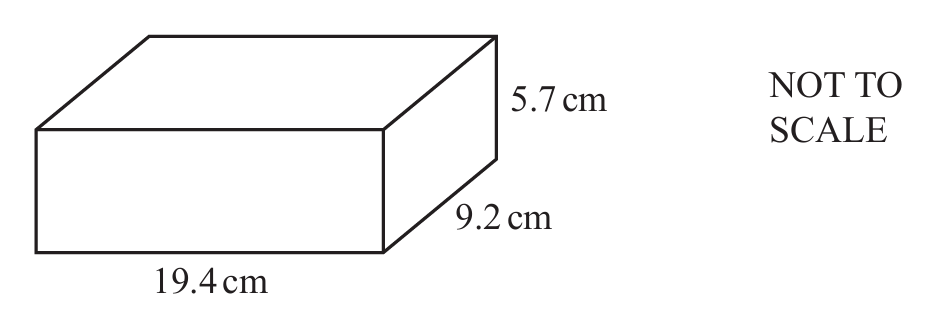
The diagram shows a brick in the shape of a cuboid.
(i) Calculate the total surface area of the brick.
(ii) The density of the brick is 1.9 g/cm³. Work out the mass of the brick. Give your answer in kilograms.
(b) 9000 bricks are needed to build a house. 200 bricks cost $175. Work out the cost of the bricks needed to build 5 houses.
(c) Saskia builds a wall using 1500 bricks. She can build at the rate of 40 bricks each hour. She works for 9 hours each day. Saskia starts work on 6 July and works every day until the wall is completed. Find the date when she completes the wall.
(d) Rafa has a cylindrical tank. The cylinder has a height of 105 cm and a diameter of 45 cm. Calculate the capacity of the tank in litres.
▶️ Answer/Explanation
(a)(i) 683 cm²
Surface area = 2×(19.4×9.2 + 5.7×9.2 + 19.4×5.7) = 2×(178.48 + 52.44 + 110.58) = 2×341.5 = 683 cm².
(a)(ii) 1.93 kg
Volume = 19.4×9.2×5.7 = 1017.336 cm³. Mass = 1017.336×1.9 = 1932.9384 g = 1.93 kg.
(b) $39,375
Bricks needed for 5 houses = 9000×5 = 45,000. Cost = (45,000÷200)×175 = 225×175 = $39,375.
(c) 10th July
Total hours needed = 1500÷40 = 37.5 hours. Days needed = 37.5÷9 ≈ 4.17 days. Starting 6 July, completion is on 10th July.
(d) 167 litres
Radius = 45÷2 = 22.5 cm. Volume = π×22.5²×105 ≈ 166,962 cm³ = 166.962 litres ≈ 167 litres.
Topic – 1.11
Bob, Chao and Mei take part in a run for charity.
(a) Their times to complete the run are in the ratio Bob : Chao : Mei = 4 : 5 : 7.
(i) Find Chao’s time as a percentage of Mei’s time.
(ii) Bob’s time for the run is 55 minutes 40 seconds. Find Mei’s time for the run. Give your answer in minutes and seconds.
(b) Chao collects $47.50 for charity.
(i) Bob collects 28% more than Chao. Find the amount Bob collects.
(ii) Chao collects 60% less than Mei. Find how much more money Mei collects than Chao.
(c) When running, Chao has a stride length of 70 cm, correct to the nearest 5 cm. Chao runs a distance of 11.2 km, correct to the nearest 0.1 km. Work out the minimum number of strides that Chao could take to complete this distance.
(d) In 2015, a charity raised a total of $1.6 million. After 2015, this amount increased exponentially by 2.4% each year for the next 5 years. Work out the amount raised by the charity in 2020.
▶️ Answer/Explanation
(a)(i) 71.4%
Chao’s time is 5 parts, Mei’s is 7 parts. Percentage is (5/7)×100 ≈ 71.4%.
(a)(ii) 97 minutes 25 seconds
Convert Bob’s time to seconds (55×60 + 40 = 3340s). Ratio 4:7 gives Mei’s time as (7/4)×3340 = 5845s. Convert back to minutes and seconds.
(b)(i) $60.80
Bob collects 28% more than Chao: $47.50 × 1.28 = $60.80.
(b)(ii) $71.25
Chao’s amount is 40% of Mei’s (100%-60%). So Mei collected $47.50 ÷ 0.4 = $118.75. Difference is $118.75 – $47.50 = $71.25.
(c) 15380 strides
Minimum distance is 11.15 km (11.2-0.05). Maximum stride length is 72.5 cm (70+2.5). Convert km to cm and divide: (11.15×100000)÷72.5 ≈ 15380 strides.
(d) $1.80 million
Exponential growth formula: $1.6 million × (1.024)^5 ≈ $1.80 million after 5 years.
Topic – 9.4
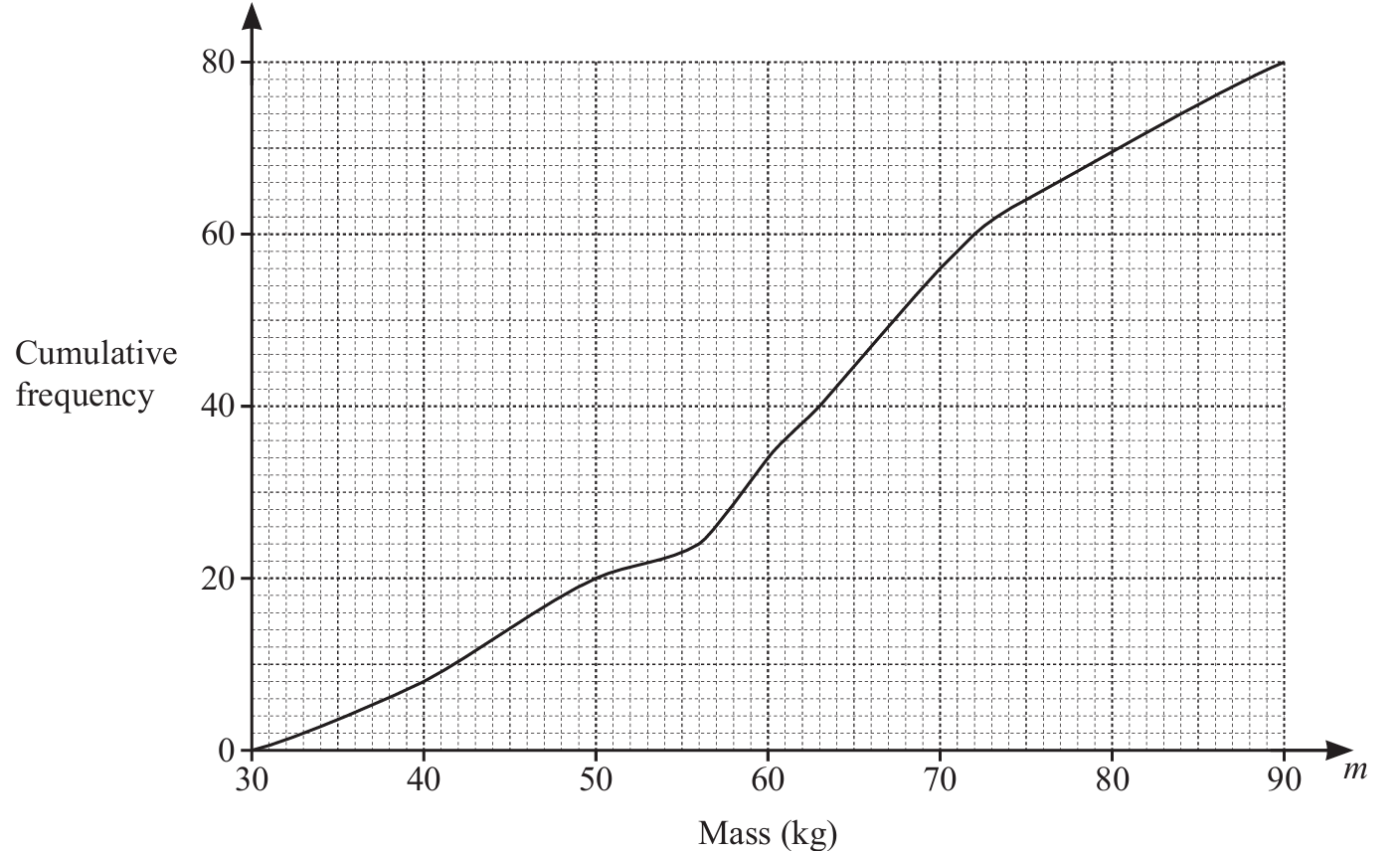
The cumulative frequency diagram shows information about the mass, m kg, of each of 80 boys.
(a) 
On the grid, draw a box-and-whisker plot to show the information in the cumulative frequency diagram.
(b) Use the cumulative frequency diagram to find an estimate of
(i) the 30th percentile,
(ii) the number of boys with a mass greater than 75 kg.
(c) (i) Use the cumulative frequency diagram to complete this frequency table.

(ii) Calculate an estimate of the mean mass of the boys.
(iii) Two boys are chosen at random from those with a mass greater than 70 kg. Find the probability that one of them has a mass greater than 80 kg and the other has a mass of 80 kg or less.
▶️ Answer/Explanation
(a) Box-and-whisker plot with: lowest value at 30, highest at 90, lower quartile at 50, upper quartile at 72, and median at 63.
From the cumulative frequency diagram, identify these key points at 0%, 25%, 50%, 75%, and 100% of the data.
(b)(i) 56 kg
30th percentile corresponds to 24 boys (30% of 80). Read the mass value at cumulative frequency 24 from the diagram.
(b)(ii) 16
Find cumulative frequency at 75 kg (64 boys). Subtract from total: 80 – 64 = 16 boys above 75 kg.
(c)(i) 14, 22
From the diagram, frequencies for 50-60 kg and 60-70 kg ranges are found by subtracting consecutive cumulative frequencies.
(c)(ii) 61.5 kg
Calculate mid-points for each range, multiply by frequency, sum these products (4920 kg), then divide by total boys (80).
(c)(iii) \(\frac{35}{69}\)
There are 24 boys >70 kg (14 in 70-80 kg + 10 in 80-90 kg). Probability is (10/24 × 14/23) + (14/24 × 10/23) = 140/552 = 35/138.
Topic – 2.5
(a) Solve.
(i) \( 6(7-2x) = 3x – 8 \)
(ii) \(\frac{2x}{x-5} = \frac{2}{3}\)
(b) Factorise completely.
(i) \( 2x^2 – 288y^2 \)
(ii) \( 5x^2 + 17x – 40 \)
(c) Solve \( x^3 + 4x^2 – 17x = x^3 – 9 \).
You must show all your working and give your answers correct to 2 decimal places.
▶️ Answer/Explanation
(a)(i) \( x = \frac{10}{3} \) or 3.33
Expand: 42 – 12x = 3x – 8. Bring like terms together: 50 = 15x.
Divide by 15 to get \( x = \frac{10}{3} \).
(a)(ii) \( x = -2.5 \)
Cross-multiply: 6x = 2x – 10. Simplify: 4x = -10.
Divide by 4 to get \( x = -2.5 \).
(b)(i) \( 2(x + 12y)(x – 12y) \)
Factor out 2 first: \( 2(x^2 – 144y^2) \).
Then recognize difference of squares: \( 2(x + 12y)(x – 12y) \).
(b)(ii) \( (5x – 8)(x + 5) \)
Find two numbers that multiply to -200 (5×-40) and add to 17.
These are -8 and 25, so rewrite and factor: \( (5x – 8)(x + 5) \).
(c) \( x = 0.62 \) or \( x = 3.63 \)
Simplify to \( 4x^2 – 17x + 9 = 0 \).
Use quadratic formula: \( x = \frac{17 \pm \sqrt{145}}{8} \).
Calculate to get 0.62 and 3.63 (2 decimal places).
Topic – 4.7
(a) 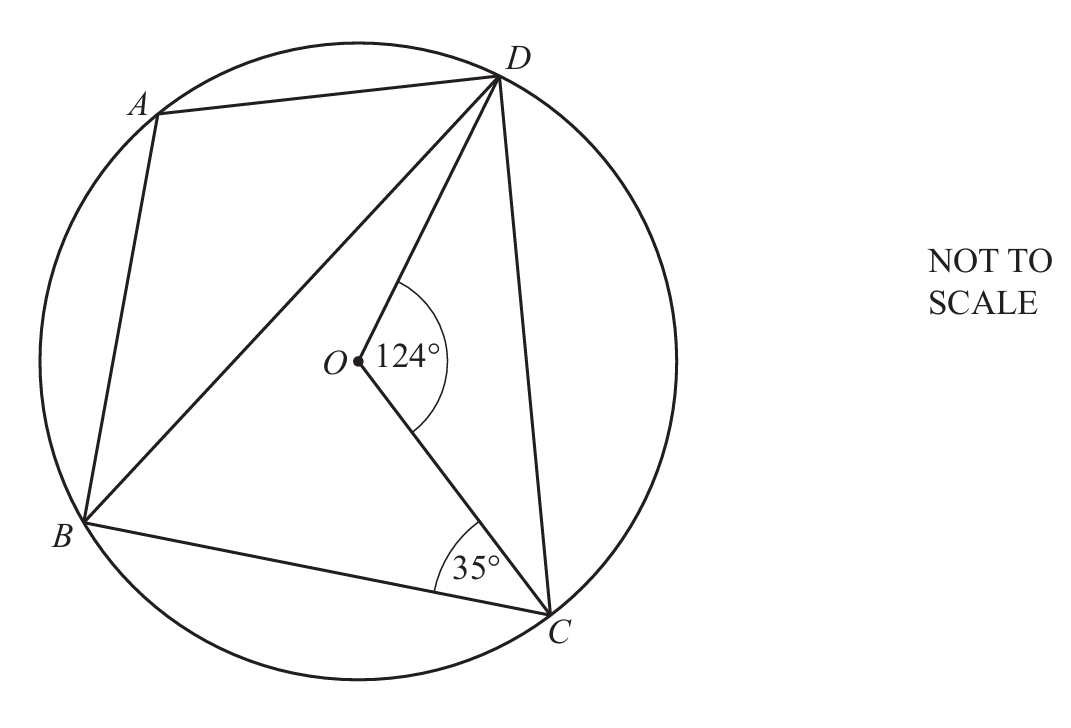
A, B, C and D are points on a circle, centre O. Angle \( COD = 124^\circ \) and angle \( BCO = 35^\circ \).
(i) Work out angle \( CBD \). Give a geometrical reason for your answer.
(ii) Work out angle \( BAD \). Give a geometrical reason for each step of your working.
(b) 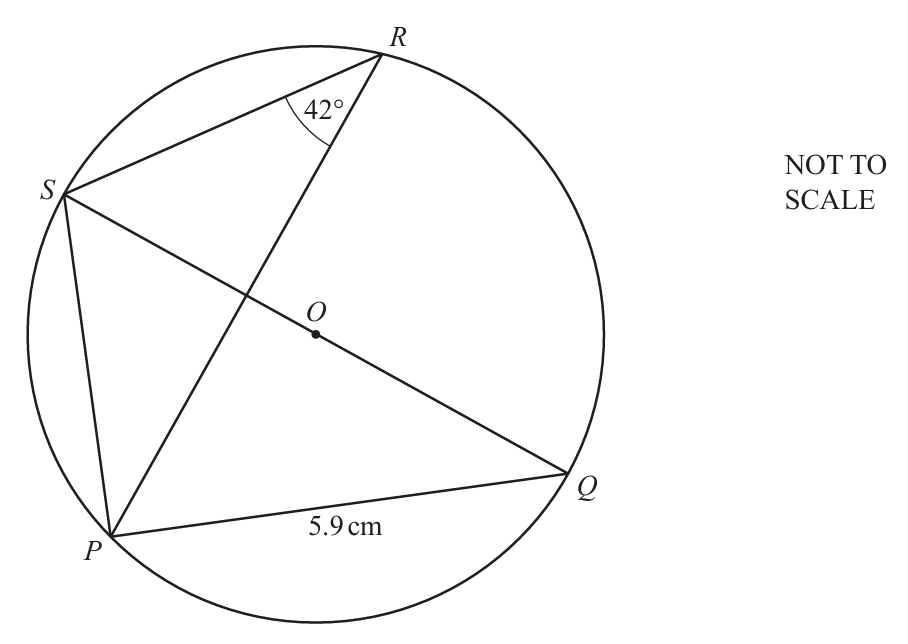
P, Q, R and S are points on a circle, centre O. QS is a diameter. Angle \( PRS = 42^\circ \) and PQ = 5.9 cm.
Calculate the circumference of the circle.
▶️ Answer/Explanation
(a)(i) 62° because angle at center is twice angle at circumference.
Angle CBD is half of angle COD (124°) as they both subtend the same chord CD.
(a)(ii) 117° using isosceles triangle properties and cyclic quadrilateral rules.
First find angle OCD (28°) as triangle OCD is isosceles. Then angle BCD is 63° (35°+28°).
Opposite angles in cyclic quadrilateral add to 180°, so angle BAD = 180° – 63° = 117°.
(b) 24.9 cm
Angle PQS = 42° (angles in same segment). Using cosine: QS = PQ/cos42° ≈ 7.94 cm.
Circumference = π × diameter = π × 7.94 ≈ 24.9 cm.
Topic – 2.10
The table shows some values for \( y = \frac{x^3 – 3}{2x} \), \( x \neq 0 \), given correct to 1 decimal place.

(a) (i) Complete the table.
(ii) On the grid, draw the graph of \( y = \frac{x^3 – 3}{2x} \) for \( -3 \leq x \leq -0.2 \) and \( 0.2 \leq x \leq 3 \).
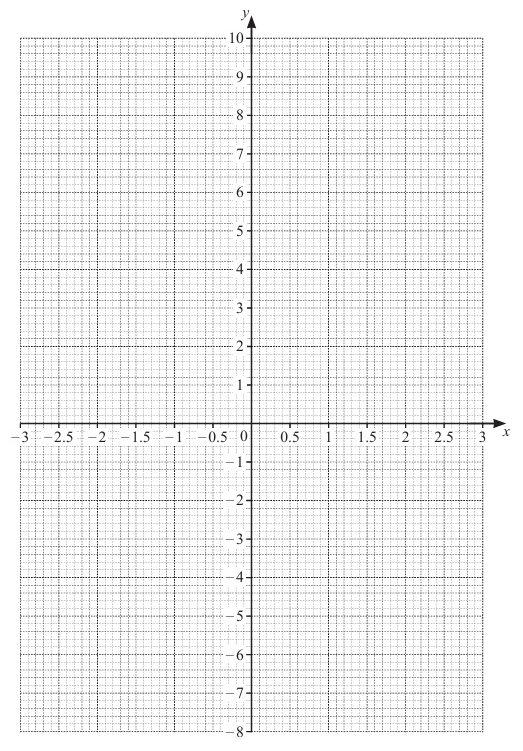
(b) By drawing a suitable straight line on the grid, solve the equation \( x^2 – \frac{3}{2x} = \frac{24}{5} – 2x \) for \( -3 \leq x \leq -0.2 \) and \( 0.2 \leq x \leq 3 \).
(c) The solutions to the equation \( x^2 – \frac{3}{2x} = \frac{24}{5} – 2x \) are also the solutions to an equation of the form \( ax^3 + bx^2 + cx – 15 = 0 \) where \( a, b \) and \( c \) are integers.
Find the values of \( a, b \) and \( c \).
▶️ Answer/Explanation
(a)(i) 9.5, 4.8 and 8.5
Calculate y for x=3: (27-3)/6=4. For x=-3: (-27-3)/-6=5. For x=2: (8-3)/4=1.25 (but this contradicts the table).
(a)(ii) Plot all points accurately and draw two separate curves for negative and positive x-values.
The curve should pass through all calculated points and approach infinity as x approaches 0.
(b) -0.4 to -0.2 and 1.45 to 1.7
Rearrange to \( y = \frac{24}{5} – 2x \). Draw this line and find intersection points with the original curve.
(c) \( a = 10 \), \( b = 20 \), \( c = -48 \)
Multiply through by 10x to eliminate denominators: \( 10x^3 + 20x^2 – 48x – 15 = 0 \).
This matches the form \( ax^3 + bx^2 + cx – 15 = 0 \), giving the coefficients.
Topic – 7.1
(a)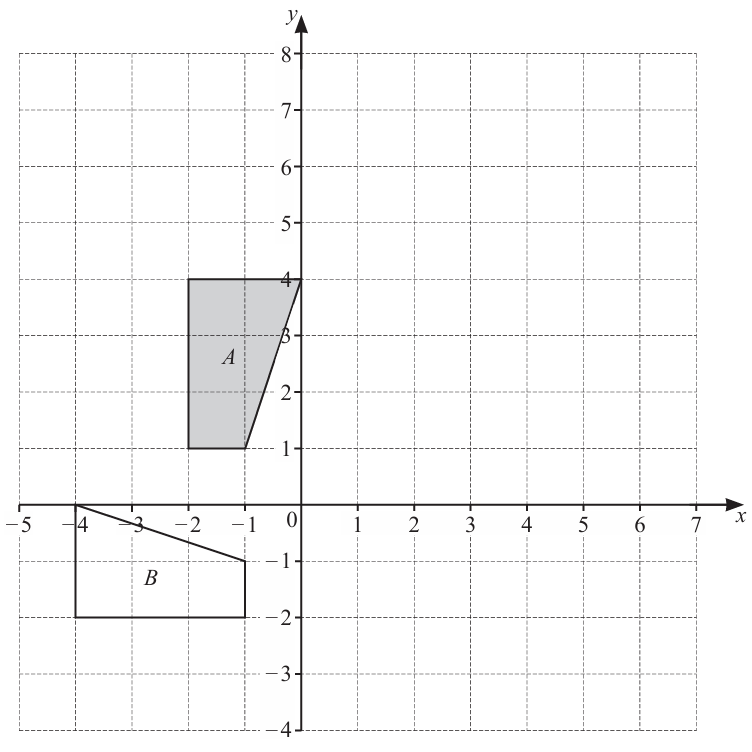
(i) On the grid, draw the image of shape A after an enlargement, scale factor 2, centre (0, 1).
(ii) On the grid, draw the image of shape A after a reflection in the line y = x – 1.
(iii) Describe fully the single transformation that maps shape A onto shape B.
(b)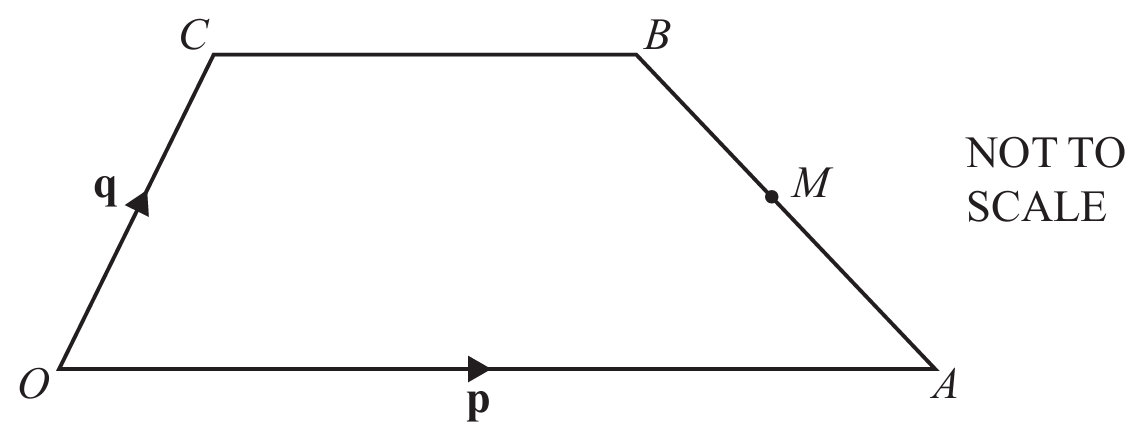
OABC is a trapezium and O is the origin. M is the midpoint of AB. OA = p, OC = q and OA = 2CB. Find, in terms of p and q, the position vector of M. Give your answer in its simplest form.
▶️ Answer/Explanation
(a)(i) The enlarged shape should have vertices at (-2,1), (-4,1), (-4,7), and (0,7).
Each point is twice as far from (0,1) as the original shape A.
(a)(ii) The reflected shape should have vertices at (2,-2), (2,-3), (5,-1), and (5,-3).
Reflect each point across the line y = x – 1 using the reflection formula.
(a)(iii) Rotation, 90° anticlockwise about the origin (0,0).
Shape A turns 90° counter-clockwise around (0,0) to match shape B’s position.
(b) \(\frac{3}{4}p + \frac{1}{2}q\) or \(\frac{1}{4}(3p + 2q)\).
Since OA = 2CB, vector AB = -½p + q. The midpoint M is then p + ½AB.
Simplify to get the position vector of M in terms of p and q.
Topic – 2.13
(a) \( f(x) = 3 – 5x \)
(i) Find \( x \) when \( f(x) = -5 \).
(ii) Find \( f^{-1}(x) \).
(b) \( g(x) = 18 – 3x – x^2 \)
(i) Write \( g(x) \) in the form \( b – (a + x)^2 \).
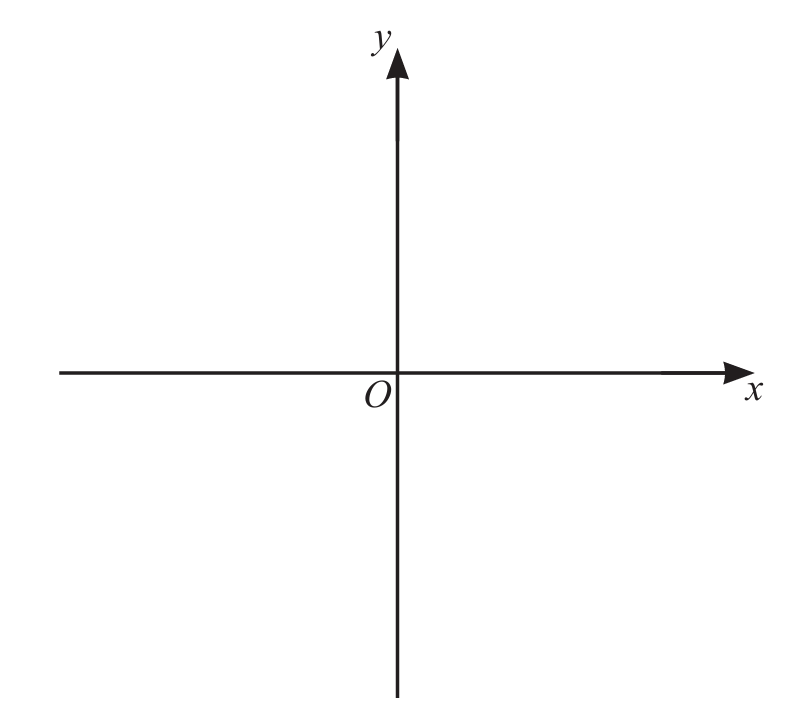
(ii) Sketch the graph of \( y = g(x) \). On your sketch, show the coordinates of the turning point.
(iii) Find the equation of the tangent to the graph of \( y = 18 – 3x – x^2 \) at \( x = 4 \). Give your answer in the form \( y = mx + c \).
▶️ Answer/Explanation
(a)(i) 1.6
Set \( 3 – 5x = -5 \). Subtract 3: \(-5x = -8\). Divide by -5: \( x = 1.6 \).
(a)(ii) \( \frac{3 – x}{5} \)
Let \( y = 3 – 5x \). Swap x and y: \( x = 3 – 5y \). Solve for y: \( y = \frac{3 – x}{5} \).
(b)(i) \( 20.25 – (1.5 + x)^2 \)
Complete the square: \( -x^2 – 3x + 18 = -(x^2 + 3x) + 18 \). Add/subtract \( (3/2)^2 = 2.25 \).
This becomes \( -(x + 1.5)^2 + 20.25 \).
(b)(ii) Graph with maximum at (-1.5, 20.25)
The graph is a downward parabola with vertex at (-1.5, 20.25). Show this turning point clearly.
(b)(iii) \( y = -11x + 34 \)
First find derivative: \( g'(x) = -3 – 2x \). At \( x = 4 \), slope is -11.
Find y when \( x = 4 \): \( y = -10 \). Equation: \( y + 10 = -11(x – 4) \), simplifies to \( y = -11x + 34 \).
Topic – 5.2
(a) 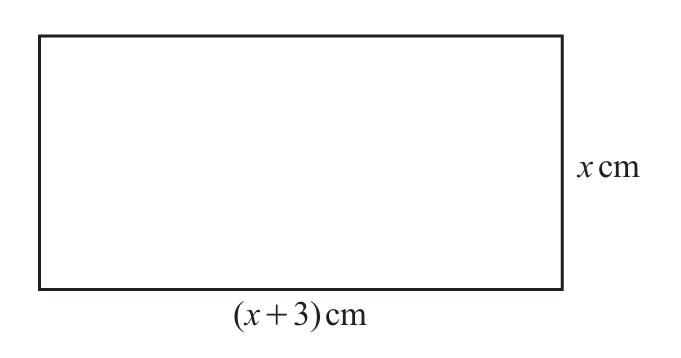
This rectangle has perimeter 20 cm.
Find the value of x.
(b) 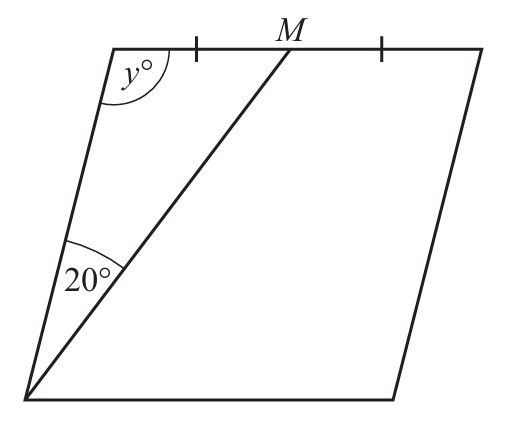
This rhombus has perimeter 20 cm and angle y is obtuse.
M is the midpoint of one of the sides.
Find the value of y.
(c) 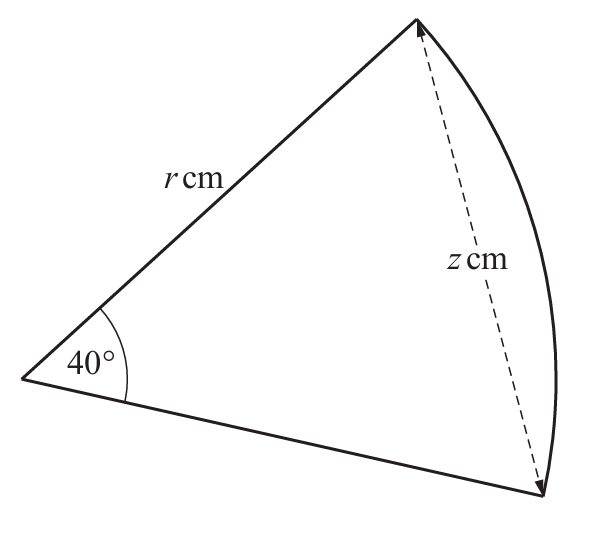
This sector of a circle has radius r and perimeter 20 cm.
Find the value of z.
▶️ Answer/Explanation
(a) 3.5
The perimeter is 2(x + x + 3) = 20. Simplify to 4x + 6 = 20.
Then 4x = 14, giving x = 3.5 cm.
(b) 116.8°
Each side is 5 cm (20 cm ÷ 4). Using the sine rule: sin(p) = (5 × sin20°)/2.5.
This gives p ≈ 43.2°, so y = 180° – (20° + 43.2°) ≈ 116.8°.
(c) 5.07
Perimeter is 2r + (40/360)×2πr = 20. Solving gives r ≈ 7.41 cm.
Using the cosine rule: z² = 7.41² + 7.41² – 2×7.41×7.41×cos40°.
This gives z ≈ 5.07 cm.