
Topic – C1.16
Helga buys some items to do some knitting.
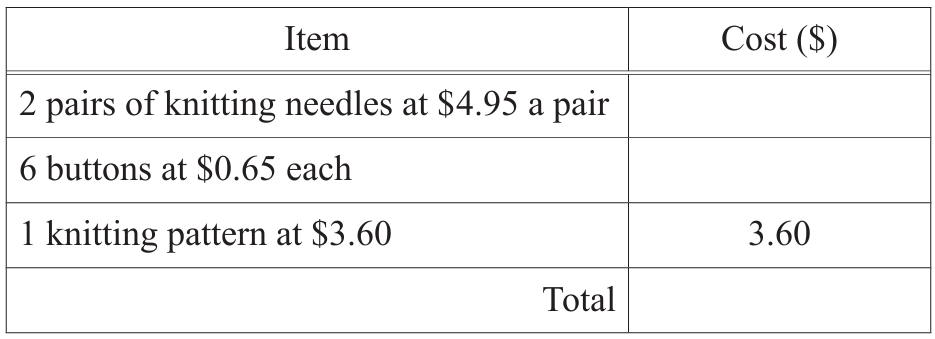
(a) Complete Helga’s bill from one shop.
(b) Helga also buys 8 balls of wool from another shop.
Each ball costs \$3.12.
Helga pays with a \$50 note.
Work out the amount of change she receives.
(c) Helga knits some squares.
Each square is either white, pink or blue.
The number of squares are in the ratio
white : pink : blue = 5 : 3 : 2
30 squares are blue.
Show that Helga knits 150 squares.
(d) Helga uses some of the squares to make a rectangular blanket. The blanket is 6 squares long and 4 squares wide.
(i) Calculate the percentage of the 150 squares she uses to make this blanket.
(ii) Each square has side length 15 cm. Work out the perimeter of this blanket. Give your answer in metres.
▶️ Answer/Explanation
(a) Knitting needles: 2 × \$4.95 = \$9.90
Buttons: 6 × \$0.65 = \$3.90
Total: \$9.90 + \$3.90 + \$3.60 = \$17.40
(b) Cost of wool: 8 × \$3.12 = \$24.96
Change: \$50 – \$24.96 = \$25.04
(c) Blue squares ratio part is 2, which equals 30 squares.
So 1 ratio part = 15 squares. Total squares = 15 × (5+3+2) = 150.
(d)(i) Squares used: 6 × 4 = 24. Percentage: (24/150) × 100 = 16%
(d)(ii) Dimensions: 6×15cm = 90cm and 4×15cm = 60cm.
Perimeter: 2×(90+60) = 300cm = 3m
Topic – C7.1
Triangles A, B and C are shown on the grid.
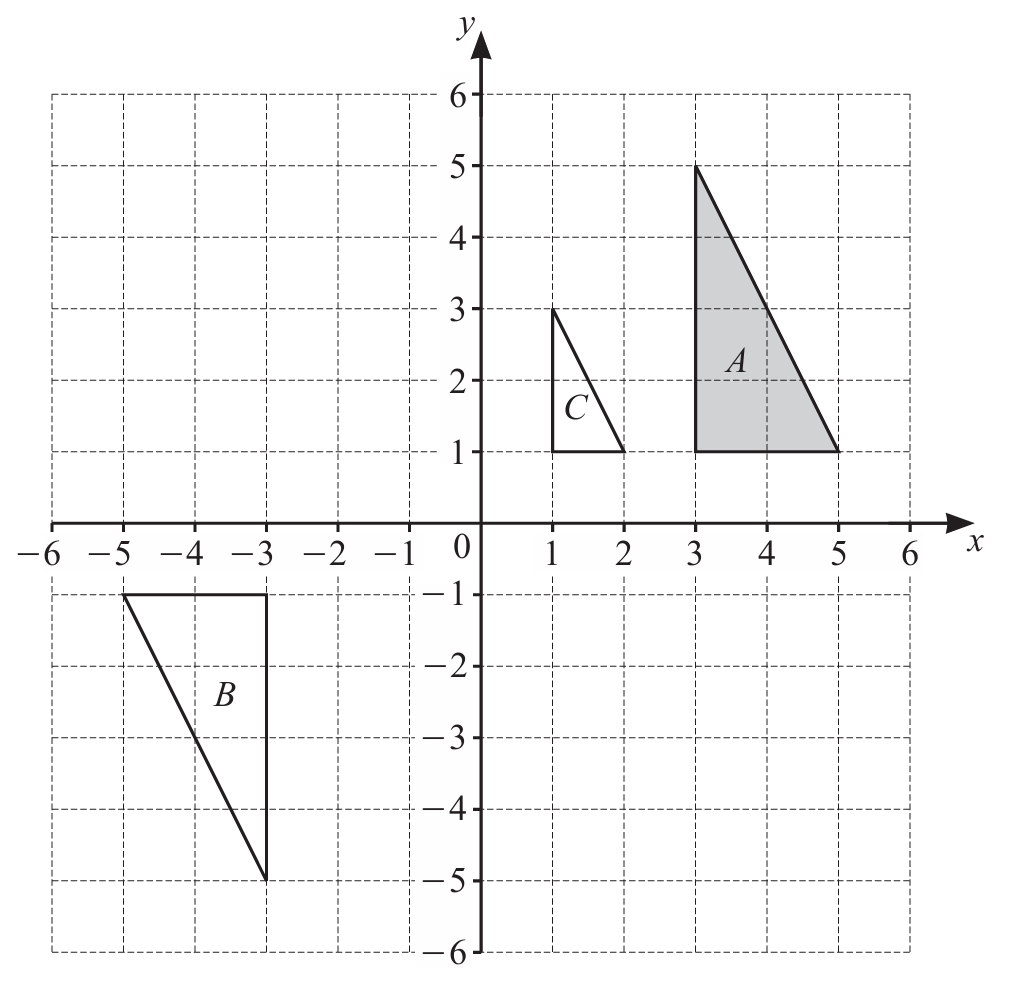
(a) Describe fully the single transformation that maps
(i) triangle A onto triangle B,
(ii) triangle A onto triangle C.
(b) On the grid,
(i) reflect triangle A in the line y = 0,
(ii) translate triangle A by the vector $\begin{pmatrix} -7 \\ 1 \end{pmatrix}$.
▶️ Answer/Explanation
2(a)(i): Rotation 180° about the origin (0,0)
Triangle B is exactly opposite A through the center point.
2(a)(ii): Enlargement with scale factor 0.5 about (-1,1)
Triangle C is half the size of A and positioned differently.
2(b)(i): The reflected triangle should have coordinates (3,-1), (5,-1), (3,-5)
This is achieved by flipping triangle A over the x-axis (y=0 line).
2(b)(ii): The translated triangle should have coordinates (-4,2), (-2,2), (-4,6)
Each point of triangle A is moved 7 units left and 1 unit up.
Topic – C1.15
Miguel works in an office.
(a) It takes Miguel 40 minutes to drive to work.
(i) He leaves home at 07.45. What time does he arrive at work?
(ii) Miguel drives to work at an average speed of 57 km/h. Show that he drives 38 km.
(b) White paper costs w cents per sheet and pink paper costs p cents per sheet.
Miguel uses 56 sheets of white paper and 21 sheets of pink paper.
Write down an expression, in terms of w and p, for the total cost, in cents, of the paper he uses.
(c) Miguel has a closed box of pens.
The box is in the shape of a cuboid measuring 20 cm by 12 cm by 7 cm.
Calculate the surface area of the box.
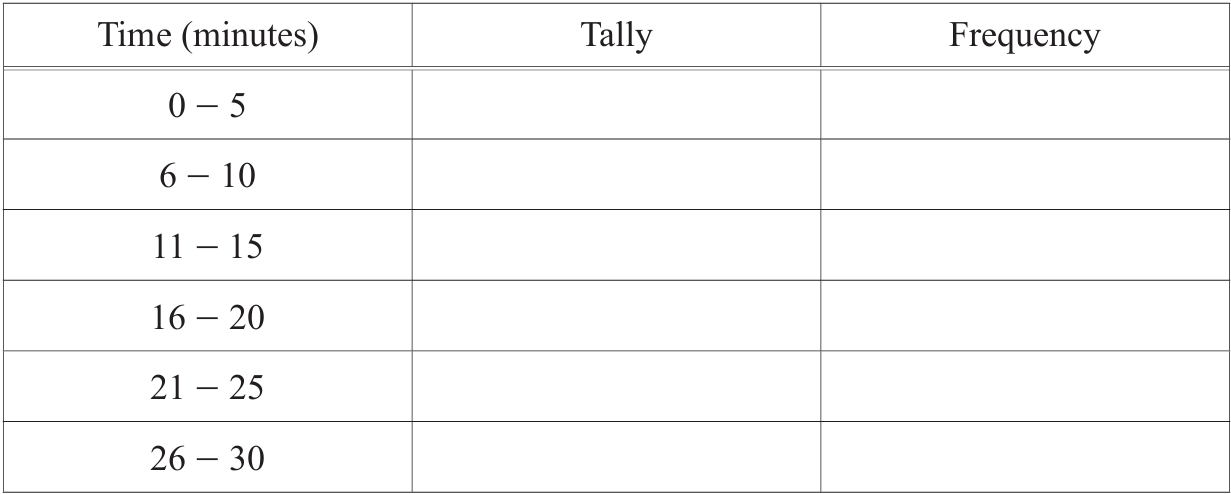
(d) Miguel records the length of time of each telephone call he receives, correct to the nearest minute.
7 15 6 28 8 21 17 19 20 12
11 19 12 3 20 23 14 9 4 18
(i) Complete the frequency table.
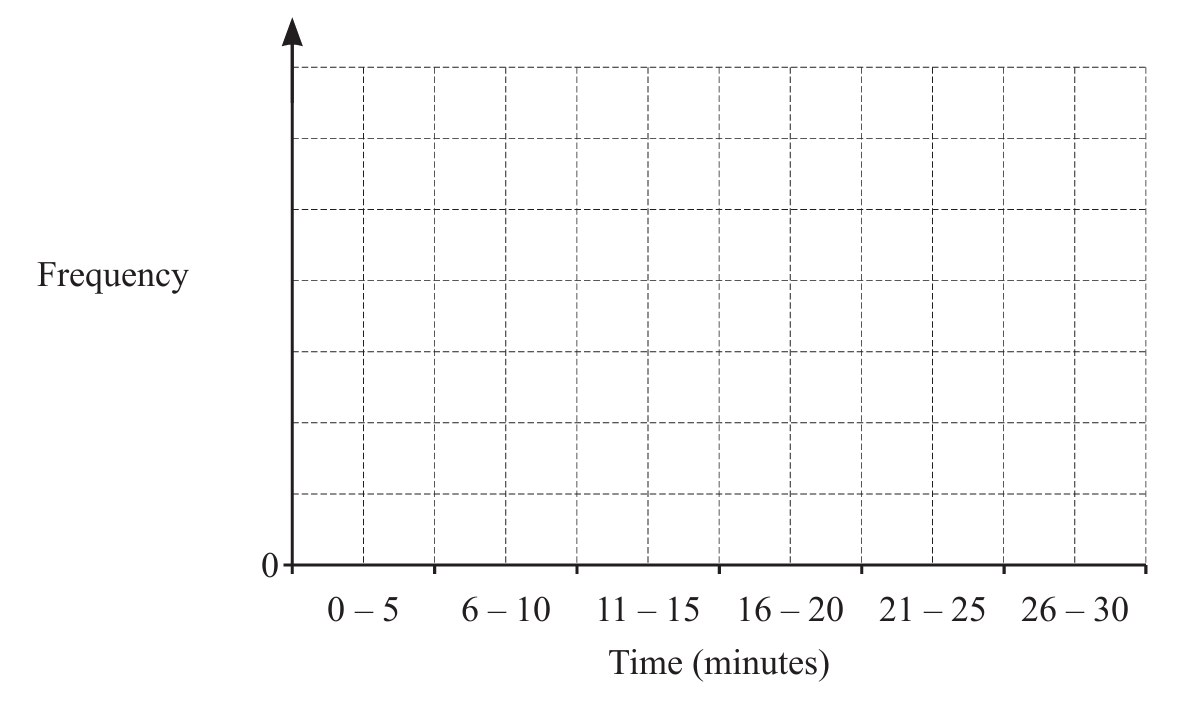
(ii) Draw a bar chart to show this information.
Complete the scale on the frequency axis.
(iii) Use the bar chart to write down the modal group.
▶️ Answer/Explanation
3(a)(i): 08:25
Adding 40 minutes to 07:45 gives 08:25.
3(a)(ii): 38 km
Distance = Speed × Time = 57 km/h × (40/60)h = 38 km.
3(b): 56w + 21p
Total cost is (number of white sheets × cost) plus (number of pink sheets × cost).
3(c): 928 cm²
Surface area = 2×(20×12 + 20×7 + 12×7) = 2×(240+140+84) = 928 cm².
3(d)(i): Frequencies: 2, 4, 5, 6, 2, 1
Counted calls in each time range (0-5, 6-10, etc.).
3(d)(ii): Bar chart
Vertical axis shows frequency, horizontal shows time ranges, bars drawn to correct heights.
3(d)(iii): 16-20
This group has the highest bar (6 calls), making it the mode.
Topic – C1.1
(a) Find
(i) a multiple of 3 between 70 and 80,
(ii) a factor of 63 between 5 and 10,
(iii) a cube number between 60 and 90,
(iv) the reciprocal of 7.
(b) Work out $\frac{2}{7}$ of 84.
(c) Find the value of
(i) $\sqrt[3]{3375}$,
(ii) $12^0$.
(d) Rana hires a car.
The cost is \$74 per day plus a delivery cost of \$17.50.
Rana pays a total of \$461.50.
Calculate the number of days that Rana hires the car.
(e) A train to town A leaves a station every 25 minutes.
A train to town B leaves the same station every 45 minutes.
Both trains leave at 08:00.
Find the next time both trains leave together.
▶️ Answer/Explanation
(a)(i) 72, 75 or 78 (any one of these)
(a)(ii) 7 or 9 (any one of these)
(a)(iii) 64 (since 4×4×4=64)
(a)(iv) $\frac{1}{7}$ or 0.1428… (reciprocal means 1 divided by the number)
(b) 24 (calculated as $\frac{2}{7}×84$)
(c)(i) 15 (because 15×15×15=3375)
(c)(ii) 1 (any number to the power of 0 equals 1)
(d) 6 days (First subtract delivery cost: \$461.50 – \$17.50 = \$444. Then divide by daily rate: \$444 ÷ \$74 = 6)
(e) 11:45 (LCM of 25 and 45 is 225 minutes = 3 hours 45 minutes. Adding to 08:00 gives 11:45)
Topic – C9.3
(a) The table shows the number of items sold to each of 60 customers in a shop.
| Number of items sold | Frequency |
|---|---|
| 0 | 3 |
| 1 | 6 |
| 2 | 12 |
| 3 | 8 |
| 4 | 14 |
| 5 | 10 |
| 6 | 3 |
| 7 | 4 |
(i) Find the range.
(ii) Calculate the mean.
(iii) Find the probability that a customer picked at random buys more than 4 items.
(b) Carlotta buys a bicycle.
(i) The length, \( l \) cm, of the bicycle is 96 cm, correct to the nearest centimetre.
Complete this statement about the value of \( l \): …… \( \leq l < \) ……
(ii) The diameter of each bicycle wheel is 46 cm.
Carlotta rides the bicycle a distance of 1.4 km.
Calculate the number of complete revolutions that a wheel makes during this journey.
▶️ Answer/Explanation
5(a)(i) Ans: 7
The range is the difference between the highest and lowest values. Here it’s 7 – 0 = 7.
5(a)(ii) Ans: 3.43
Mean = (0×3 + 1×6 + 2×12 + 3×8 + 4×14 + 5×10 + 6×3 + 7×4) ÷ 60 = 206 ÷ 60 ≈ 3.43.
5(a)(iii) Ans: 17/60
Customers buying more than 4 items: 10 (for 5) + 3 (for 6) + 4 (for 7) = 17. Probability = 17/60.
5(b)(i) Ans: 95.5 ≤ l < 96.5
When rounded to nearest cm, 96 cm means the actual length is between 95.5 cm and 96.5 cm.
5(b)(ii) Ans: 968
Circumference = π × 46 cm ≈ 144.513 cm. Total distance = 1.4 km = 140,000 cm. Number of revolutions = 140,000 ÷ 144.513 ≈ 968.6, so 968 complete revolutions.
Topic – C4.6
(a) 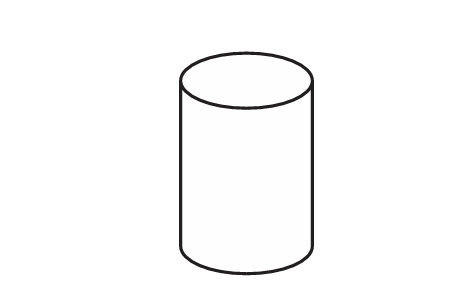
Write down the mathematical name of this solid.
(b) 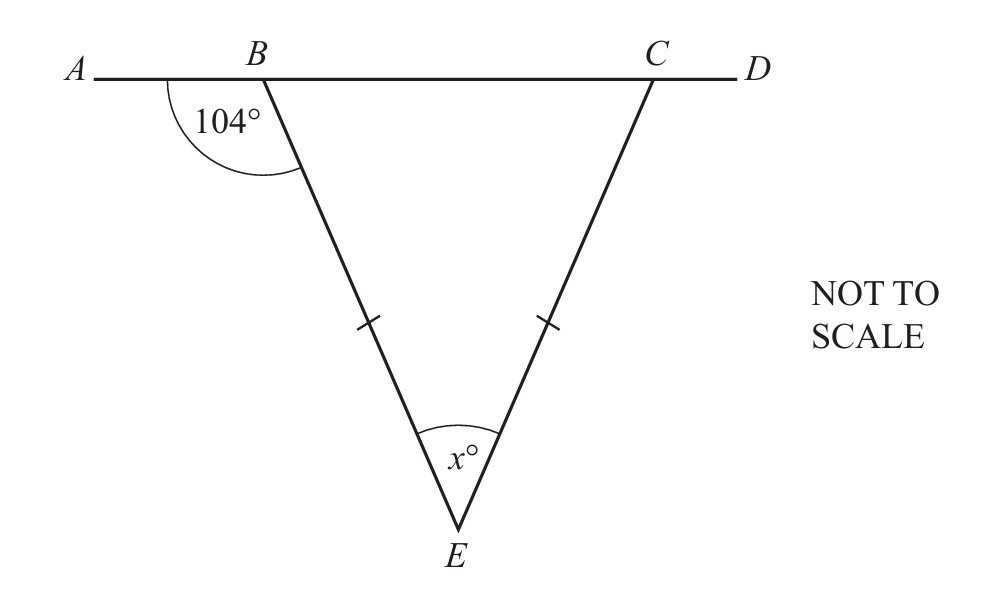
The diagram shows triangle BCE and a straight line ABCD.
BE = CE and angle ABE = 104°.
Find the value of x.
(c) Work out the size of one interior angle of a regular polygon with 15 sides.
(d) 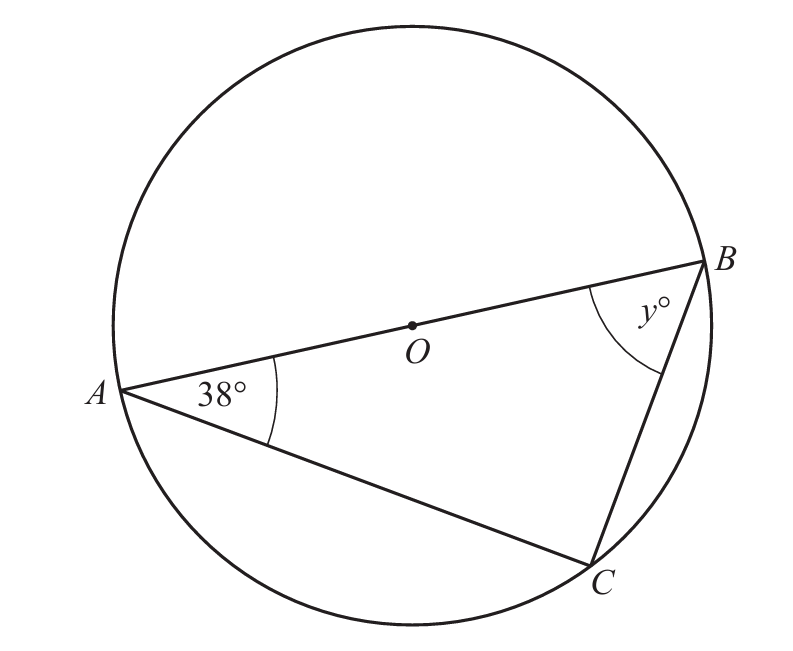
A, B and C are points on a circle, centre O.
(i) Write down the mathematical name of the line BC.
(ii) Draw a tangent to the circle at point B.
(iii) The area of the circle is 245.5 cm². Calculate AB.
(iv) Find the value of y.
▶️ Answer/Explanation
(a) Ans: Cylinder
The solid shown is a cylinder as it has two circular bases and a curved surface.
(b) Ans: 28
Since BE = CE, triangle BCE is isosceles. Angle ABE is 104°, so angle CBE = 180° – 104° = 76°.
In triangle BCE, x = (180° – 76°)/2 = 28°.
(c) Ans: 156°
For a regular 15-sided polygon, each interior angle = (15-2)×180°/15 = 13×12° = 156°.
(d)(i) Ans: Chord
BC is a straight line joining two points on the circumference, so it’s called a chord.
(d)(ii) Ans: The tangent should be drawn perpendicular to the radius OB at point B.
(d)(iii) Ans: 17.7 cm
First find radius: r = √(245.5/π) ≈ 8.84 cm. AB is the diameter, so AB = 2×8.84 ≈ 17.7 cm.
(d)(iv) Ans: 52°
Angle at circumference is half the central angle. Angle ACB is 90° (angle in semicircle).
So y = 180° – 90° – 38° = 52°.
Topic – C2.2
(a) Simplify.
$5g – 3h – 7g + 6h$
(b) $j = 4k + 7m$
Find the value of $j$ when $k = -5$ and $m = 6$.
(c) Factorise completely.
$14x^3 + 49x$
(d) Solve.
$8(3t – 9) = 108$
(e) (i) $9^{24} ÷ 9^w = 9^5$
Find the value of $w$.
(ii) $4x^2 = 256$
Find the value of $x$.
(f) Ranjit’s age is $x$ years.
Suzi’s age is 3 times Ranjit’s age.
Juan’s age is 4 years more than Suzi’s age.
The total of their ages is 46 years.
Use this information to write down an equation and solve it to find the value of $x$.
▶️ Answer/Explanation
(a) Ans: $-2g + 3h$
Combine like terms: $(5g – 7g) + (-3h + 6h)$.
This simplifies to $-2g + 3h$.
(b) Ans: 22
Substitute values: $j = 4(-5) + 7(6) = -20 + 42$.
Final calculation gives $j = 22$.
(c) Ans: $7x(2x^2 + 7)$
Factor out the greatest common factor, which is $7x$.
This leaves $7x(2x^2 + 7)$ as the fully factorised form.
(d) Ans: 7.5
First expand: $24t – 72 = 108$.
Then solve: $24t = 180$ leading to $t = 7.5$.
(e)(i) Ans: 19
Using exponent rules: $24 – w = 5$.
Solving gives $w = 19$.
(e)(ii) Ans: 8
Divide both sides by 4: $x^2 = 64$.
Square root gives $x = 8$ (positive solution).
(f) Ans: 6
Set up equation: $x + 3x + (3x + 4) = 46$.
Combine terms: $7x + 4 = 46$.
Solve to find $x = 6$ years.
Topic – C3.1
(a) Given vectors a = $\begin{pmatrix} -3 \\ 5 \end{pmatrix}$ and b = $\begin{pmatrix} 7 \\ -4 \end{pmatrix}$, work out:
(i) 4a
(ii) 2a – b
(b) 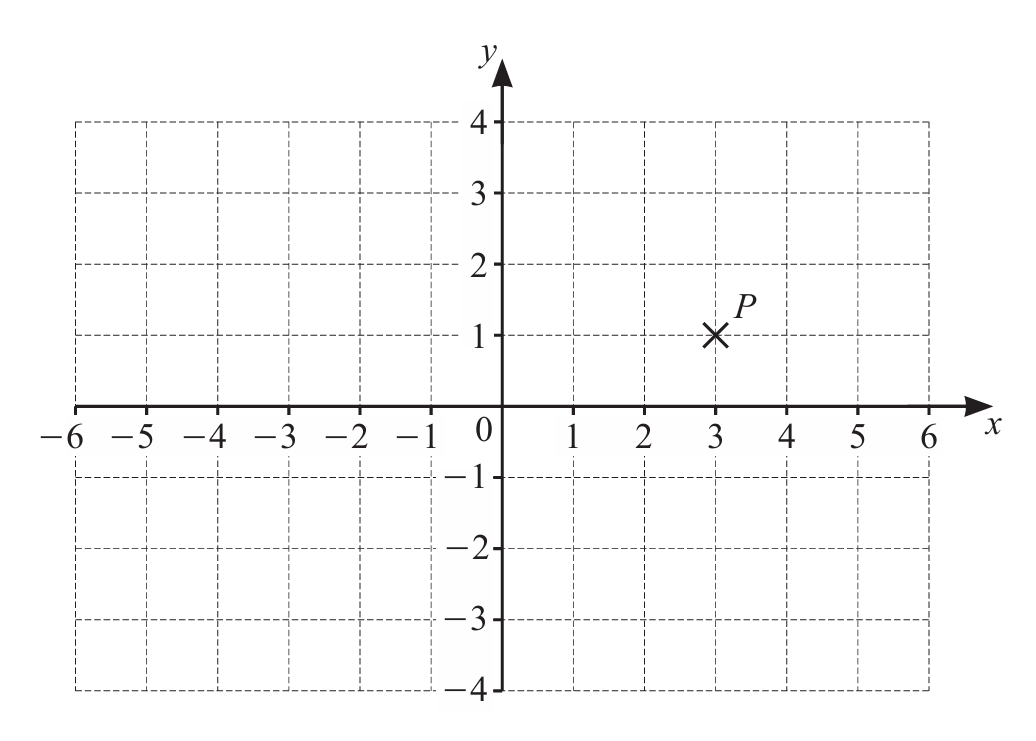
(i) Write down the coordinates of point P shown on the grid.
(ii) On the grid, plot point Q at (-4, 2).
(iii) Given \( \overrightarrow{PR}\) = $\begin{pmatrix} -2 \\ 1 \end{pmatrix}$, plot point R on the grid.
(iv) On the grid, draw the line y = 3.
(c) 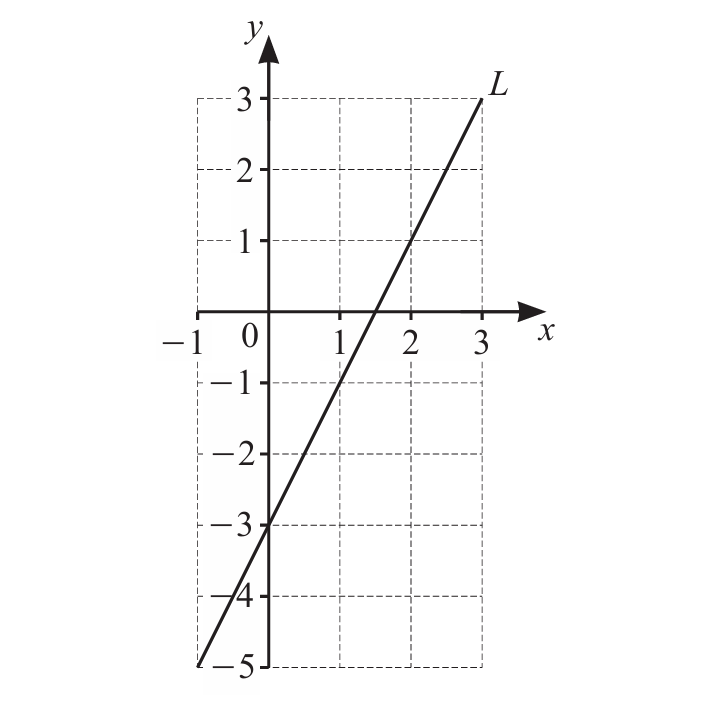
For line L shown on the grid:
(i) Find its equation in the form y = mx + c.
(ii) Write down the equation of a line parallel to line L.
▶️ Answer/Explanation
8(a)(i): $\begin{pmatrix} -12 \\ 20 \end{pmatrix}$
Multiply each component of a by 4: 4×(-3) = -12 and 4×5 = 20.
8(a)(ii): $\begin{pmatrix} -13 \\ 14 \end{pmatrix}$
First calculate 2a = (-6,10), then subtract b = (7,-4) to get (-13,14).
8(b)(i): (3, 1)
The coordinates of P are read directly from the grid as (3,1).
8(b)(ii): Q plotted at (-4,2)
Point Q is located 4 units left and 2 units up from the origin.
8(b)(iii): R plotted at (1,2)
Starting from P(3,1), add PR = (-2,1) to get R at (1,2).
8(b)(iv): Horizontal line through y=3
Draw a straight horizontal line crossing the y-axis at 3.
8(c)(i): y = 2x – 3
The line passes through (0,-3) and has a gradient of 2 (rise/run = 2/1).
8(c)(ii): y = 2x + k (where k ≠ -3)
Any line with the same gradient (2) but different y-intercept is parallel.
Topic – C1.16
(a) Sami buys a new car.
(i) She pays a deposit of \$2250 and 36 equal monthly payments of \$437.50.
Show that she pays a total amount of \$18 000.
(ii) Sami later sells the car for \$13 680.
Calculate the percentage loss.
(b) Sami invests \$12 750 for 6 years at a rate of 1.8% per year compound interest.
Calculate the value of her investment at the end of the 6 years.
▶️ Answer/Explanation
9(a)(i):
Total payment = Deposit + Monthly payments = \$2250 + (36 × \$437.50)
= \$2250 + \$15,750 = \$18,000
9(a)(ii):
Loss = Initial cost – Selling price = \$18,000 – \$13,680 = \$4,320
Percentage loss = (4320/18000) × 100 = 24%
9(b):
Using compound interest formula: A = P(1 + r/100)n
A = 12750(1 + 0.018)6 = 12750 × 1.1129 ≈ \$14,190.47