
Topic – 5.4
(a) Calculate the volume of
(i) a solid cylinder with radius 6 cm and height 14 cm.
(ii) a solid hemisphere with radius 6 cm.
[The volume, V, of a sphere with radius r is V = \(\frac{4}{3}\pi r^3\).]
(b) 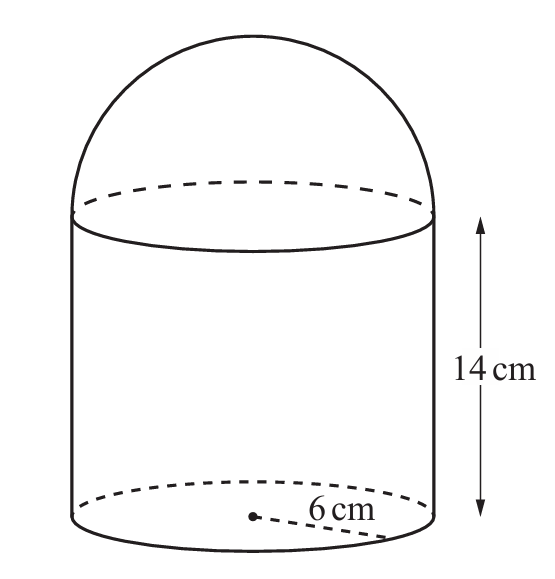
The cylinder and hemisphere in part (a) are joined to form the solid in the diagram.
The solid is made of steel and 1 cm³ of steel has a mass of 7.85 g.
(i) Show that 1 cm³ of steel has a mass of 0.00785 kg.
(ii) Calculate the total mass of the solid.
(c) 2000 cm³ of iron is melted down and some of it is used to make 50 spheres with radius 2 cm.
(i) Calculate the percentage of iron that is left over.
[The volume, V, of a sphere with radius r is V = \(\frac{4}{3}\pi r^3\).]
(ii) The iron left over is then made into a cube.
Calculate the length of an edge of the cube.
(d) A solid cone has radius 3R cm and slant height 9R cm.
A solid cylinder has radius x cm and height 7x cm.
The total surface area of the cone is equal to the total surface area of the cylinder.
Given that R = kx, find the value of k.
[The curved surface area, A, of a cone with radius r and slant height l is A = πrl.]
▶️ Answer/Explanation
(a)(i) 1584 cm³
Volume of cylinder = πr²h = π × 6² × 14 = 1584 cm³ (using π = 3.142).
(a)(ii) 452 cm³
Volume of hemisphere = ½ × (4/3)πr³ = ½ × (4/3) × π × 6³ = 452 cm³.
(b)(i) 0.00785 kg
Convert grams to kilograms: 7.85 g = 7.85 ÷ 1000 = 0.00785 kg.
(b)(ii) 16.0 kg
Total volume = 1584 + 452 = 2036 cm³. Mass = 2036 × 0.00785 = 15.98 ≈ 16.0 kg.
(c)(i) 16.2%
Volume of 50 spheres = 50 × (4/3)π × 2³ = 1675.5 cm³. Leftover = 2000 – 1675.5 = 324.5 cm³. Percentage = (324.5/2000) × 100 = 16.2%.
(c)(ii) 6.87 cm
Cube root of leftover volume: ∛324.5 ≈ 6.87 cm.
(d) k = 2/3
Cone surface area = π(3R)² + π(3R)(9R) = 36πR². Cylinder surface area = 2πx² + 2πx(7x) = 16πx². Set equal: 36πR² = 16πx² → R/x = √(16/36) = 2/3.
Topic – 1.4
(a) Write
(i) 2994.99 correct to the nearest 10,
(ii) 0.983 correct to 1 decimal place,
(iii) 2090 correct to 2 significant figures.
(b) Write down a prime number between 90 and 100.
(c) Write 2-6 as a fraction.
(d) Write 0.007 01 in standard form.
(e) Simplify \( 1.5 \times 10^x + 1.5 \times 10^{x-1} \) giving your answer in standard form.
(f) Write 0.37 as a fraction.
You must show all your working.
▶️ Answer/Explanation
(a)(i) 2990
Look at the units digit (4.99) which rounds up the tens digit from 4 to 5.
(a)(ii) 1.0
The second decimal (8) rounds up the first decimal (9) to 10, which becomes 1.0.
(a)(iii) 2100
The third digit (9) rounds up the second digit (0) to 1, giving 2100.
(b) 97
The only prime numbers between 90 and 100 are 97 (as 91=7×13, 93=3×31, 99=9×11).
(c) \(\frac{1}{64}\)
Negative exponents mean reciprocal: \(2^{-6} = \frac{1}{2^6} = \frac{1}{64}\).
(d) \(7.01 \times 10^{-3}\)
Move decimal point 3 places right and use negative exponent for small numbers.
(e) \(1.65 \times 10^x\)
Factor out \(1.5 \times 10^{x-1}\): \(1.5 \times 10^{x-1}(10 + 1) = 1.5 \times 11 \times 10^{x-1}\).
Simplify to \(16.5 \times 10^{x-1} = 1.65 \times 10^x\).
(f) \(\frac{34}{99}\)
Let \(x = 0.\overline{37}\). Then \(100x = 37.\overline{37}\).
Subtract: \(99x = 37\), so \(x = \frac{37}{99}\).
Topic – 2.6
(a) 
Write down the inequality shown by the number line.
(b) -3 ≤ 2x + 3 < 9
(i) Solve the inequality.
(ii) Write down all the integer values of x that satisfy the inequality.
(c) Solve the equations.
(i) \( 3(3-x) – \frac{2(x+2)}{5} = 1 \)
(ii) \( \frac{5}{x+3} = \frac{3}{x+5} \)
▶️ Answer/Explanation
(a) -2 < x ≤ 4
The open circle at -2 means x > -2, and the closed circle at 4 means x ≤ 4.
(b)(i) -3 ≤ x < 3
Subtract 3 from all parts: -6 ≤ 2x < 6. Then divide by 2: -3 ≤ x < 3.
(b)(ii) -3, -2, -1, 0, 1, 2
These are all integers between -3 (included) and 3 (not included).
(c)(i) x = 2
Multiply all terms by 5: 45-15x – 2x-4 = 5. Combine like terms: 41-17x = 5.
Then -17x = -36 → x = 36/17 ≈ 2.117 (exact form).
(c)(ii) x = -8
Cross-multiply: 5(x+5) = 3(x+3). Expand: 5x+25 = 3x+9.
Subtract 3x: 2x+25 = 9. Subtract 25: 2x = -16 → x = -8.
Topic – 1.17
(a) (i) Zak invests $500 at a rate of 2% per year simple interest.
Calculate the value of Zak’s investment at the end of 5 years.
(ii) Yasmin invests $500 at a rate of 1.8% per year compound interest.
Calculate the value of Yasmin’s investment at the end of 5 years.
(iii) Zak and Yasmin continue with these investments.
How many more complete years is it before the value of Yasmin’s investment is greater than the value of Zak’s investment?
(b) Xavier buys a car for $2500.
The value of the car decreases exponentially at a rate of 10% each year.
Calculate the value of Xavier’s car at the end of 5 years.
Give your answer correct to the nearest dollar.
(c) The number of a certain type of bacteria increases exponentially at a rate of r% each day.
After 22 days, the number of this bacteria has doubled.
Find the value of r.
▶️ Answer/Explanation
(a)(i) $550
Simple interest formula: Principal + (Principal × rate × time). Calculation: $500 + ($500 × 0.02 × 5) = $550.
(a)(ii) $546.65
Compound interest formula: Principal × (1 + rate)^time. Calculation: $500 × (1 + 0.018)^5 ≈ $546.65.
(a)(iii) 8 years
Zak’s investment grows linearly: $550 + ($10/year). Yasmin’s grows exponentially. After 13 total years (8 more), Yasmin’s $546.65 × (1.018)^8 ≈ $629.51 exceeds Zak’s $550 + $80 = $630.
(b) $1476
Exponential decay formula: Initial × (1 – rate)^time. Calculation: $2500 × (0.90)^5 ≈ $1476.22, rounded to nearest dollar.
(c) 3.2
Doubling means (1 + r/100)^22 = 2. Solving: r ≈ 100 × (2^(1/22) – 1) ≈ 3.20%.
Topic – 9.4
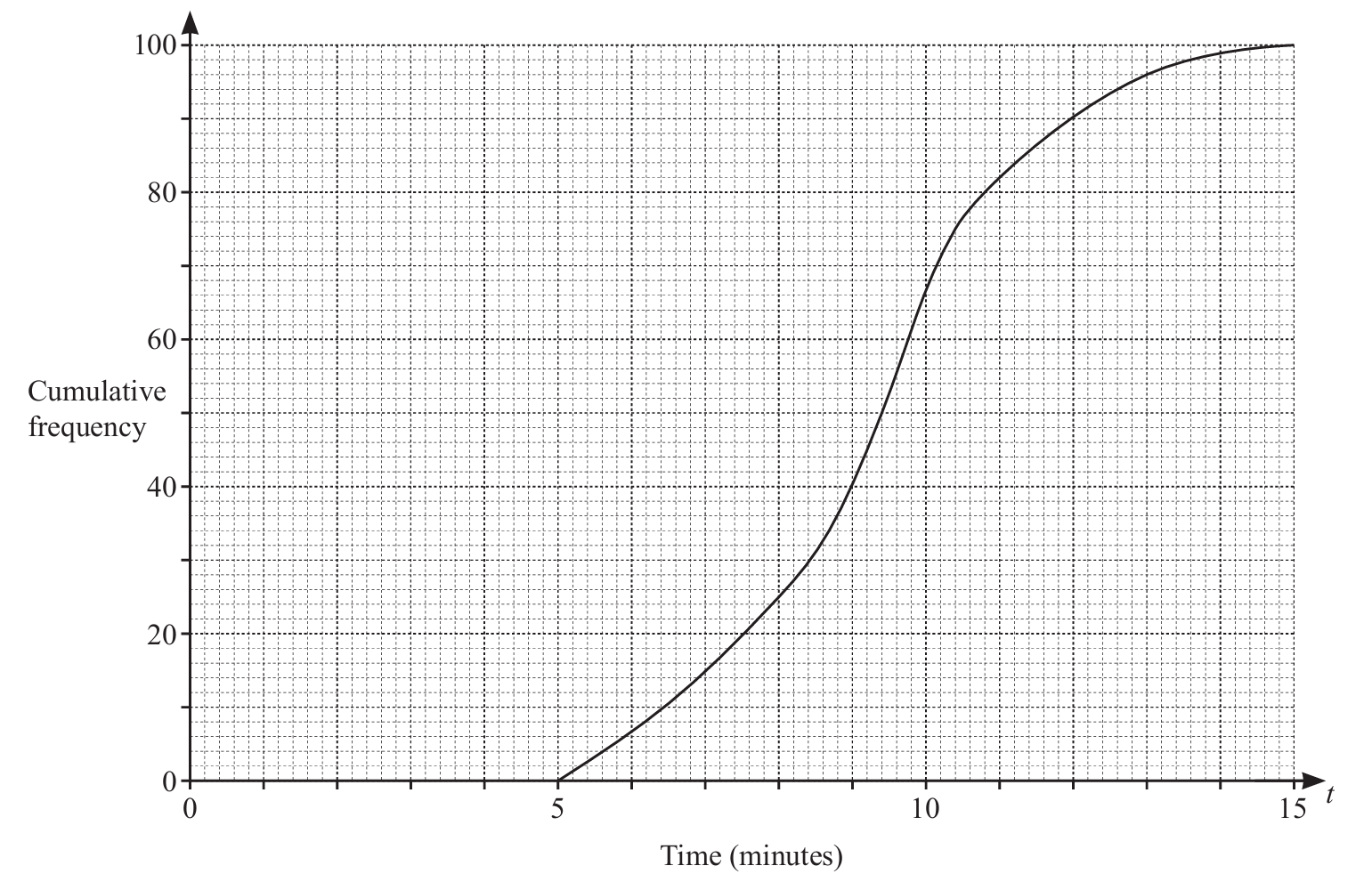
(a) 100 students each record the time, t minutes, taken to eat a pizza.
The cumulative frequency diagram shows the results.
Find an estimate of
(i) the median,
(ii) the interquartile range,
(iii) the number of students taking more than 11 minutes to eat a pizza.
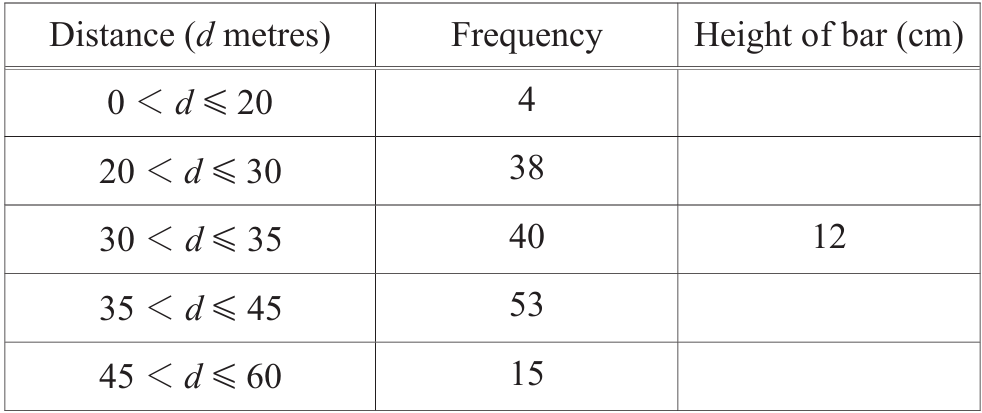
(b) 150 students each record how far they can throw a tennis ball.
The table shows the results.
| Distance (d metres) | 0 < d ≤ 20 | 20 < d ≤ 30 | 30 < d ≤ 35 | 35 < d ≤ 45 | 45 < d ≤ 60 |
|---|---|---|---|---|---|
| Frequency | 4 | 38 | 40 | 53 | 15 |
(i) Calculate an estimate of the mean.
(ii) A histogram is drawn to show this information.
The height of the bar representing 30 < d ≤ 35 is 12 cm.
Calculate the height of each of the other bars.
(iii) Two students are chosen at random.
Find the probability that they both threw the ball more than 45 m.
▶️ Answer/Explanation
(a)(i) 9.4 minutes
The median is the 50th percentile. From the cumulative frequency diagram, this corresponds to 9.4 minutes.
(a)(ii) 2.4 minutes
Interquartile range = Upper quartile (10.4 minutes) – Lower quartile (8 minutes) = 2.4 minutes.
(a)(iii) 18 students
100 – 82 = 18 students took more than 11 minutes (82 students took ≤11 minutes).
(b)(i) 34.65 metres
Using midpoints: (10×4 + 25×38 + 32.5×40 + 40×53 + 52.5×15) ÷ 150 = 5197.5 ÷ 150 = 34.65 m.
(b)(ii) Heights: 0.3 cm, 5.7 cm, 12 cm, 7.95 cm, 1.5 cm
Frequency density = frequency ÷ class width. For 30-35m: 40÷5 = 8 units/cm. Scaling factor = 12÷8 = 1.5. Other heights: frequency density × 1.5.
(b)(iii) 7/745
Probability = (15/150) × (14/149) = 7/745 ≈ 0.0094 or 0.94% chance both threw >45m.
Topic – 7.2
(a) \( p = \begin{pmatrix} 2 \\ 3 \end{pmatrix} \) \( q = \begin{pmatrix} -1 \\ 1 \end{pmatrix} \)
Find
(i) 3q,
(ii) \( p – q \),
(iii) \( |p| \).
(b) B is the point (2, 7) and \( \overrightarrow{AB} = \begin{pmatrix} -4 \\ 6 \end{pmatrix} \).
Find the coordinates of A.
(c) 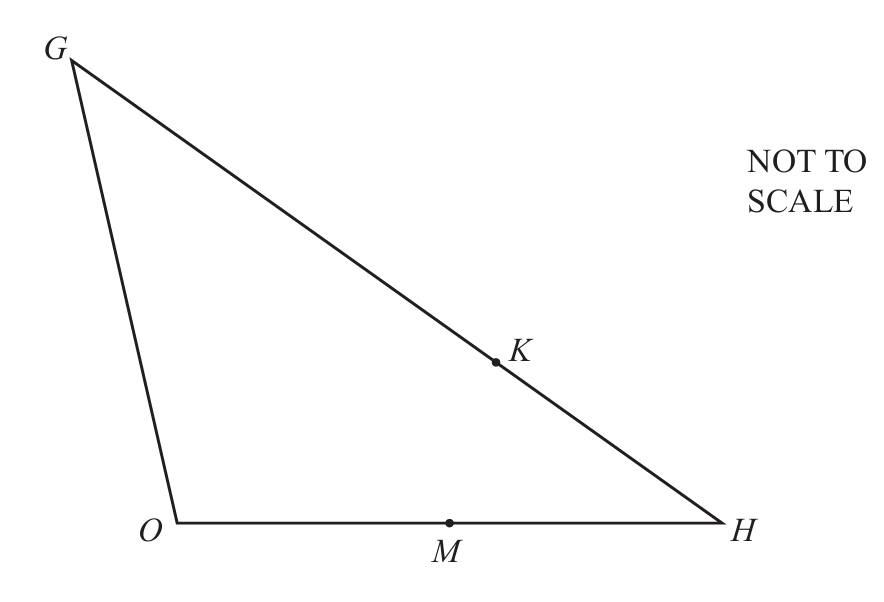
In triangle OGH, M is the midpoint of OH and K divides GH in the ratio 5:2.
\( \overrightarrow{OG} = g \) and \( \overrightarrow{OH} = h \).
Find \( \overrightarrow{MK} \) in terms of g and h.
Give your answer in its simplest form.
▶️ Answer/Explanation
(a)(i) \( \begin{pmatrix} -3 \\ 3 \end{pmatrix} \)
Multiply each component of q by 3: \( 3 \times \begin{pmatrix} -1 \\ 1 \end{pmatrix} = \begin{pmatrix} -3 \\ 3 \end{pmatrix} \).
(a)(ii) \( \begin{pmatrix} 3 \\ 2 \end{pmatrix} \)
Subtract corresponding components: \( \begin{pmatrix} 2-(-1) \\ 3-1 \end{pmatrix} = \begin{pmatrix} 3 \\ 2 \end{pmatrix} \).
(a)(iii) 3.61 or \( \sqrt{13} \)
Use the magnitude formula: \( \sqrt{2^2 + 3^2} = \sqrt{4 + 9} = \sqrt{13} \approx 3.61 \).
(b) (6, 1)
To find A, subtract the vector AB from B’s coordinates: \( (2 – (-4), 7 – 6) = (6, 1) \).
(c) \( \frac{2}{7}g + \frac{3}{14}h \)
First find M (midpoint of OH): \( \frac{h}{2} \). Then find K’s position: \( g + \frac{5}{7}(h – g) \). Finally, \( \overrightarrow{MK} = K – M = \frac{2}{7}g + \frac{3}{14}h \).
Topic – 2.13
f(x) = 10 – x; g(x) = \(\frac{2}{x}\), \(x \neq 0\); h(x) = 2x; j(x) = 5 – 2x
(a) (i) Find g\(\left(\frac{1}{2}\right)\).
(ii) Find hg\(\left(\frac{1}{2}\right)\).
(b) Find x when f(x) = 7.
(c) Find x when g(x) = h(3).
(d) Find j-1(x).
(e) Write f(x) + g(x) + 1 as a single fraction in its simplest form.
(f) \(\left( f(x) \right)^2 – ff(x) = ax^2 + bx + c\)
Find the values of \(a, b\) and \(c\).
(g) Find \(x\) when h-1(x) = 10.
▶️ Answer/Explanation
(a)(i) 4
Substitute x = 1/2 into g(x): g(1/2) = 2 ÷ (1/2) = 4.
(a)(ii) 16
First find g(1/2) = 4 from part (i). Then h(4) = 24 = 16.
(b) x = 3
Set f(x) = 7: 10 – x = 7. Solve for x: x = 10 – 7 = 3.
(c) \(\frac{1}{4}\)
First calculate h(3) = 23 = 8. Set g(x) = 8: 2/x = 8. Solve for x: x = 2/8 = 1/4.
(d) \(\frac{5 – x}{2}\)
Let y = j(x) = 5 – 2x. Swap x and y: x = 5 – 2y. Solve for y: 2y = 5 – x → y = (5 – x)/2.
(e) \(\frac{11x – x^2 + 2}{x}\)
Combine terms: (10 – x) + (2/x) + 1 = (11 – x + 2/x). Convert to single fraction: (11x – x2 + 2)/x.
(f) a = 1, b = -21, c = 100
First expand (f(x))2 = (10 – x)2 = 100 – 20x + x2. Then find ff(x) = f(10 – x) = 10 – (10 – x) = x. Subtract: (100 – 20x + x2) – x = x2 – 21x + 100.
(g) 1024
h-1(x) = 10 means x = h(10). Calculate h(10) = 210 = 1024.
Topic – 6.5
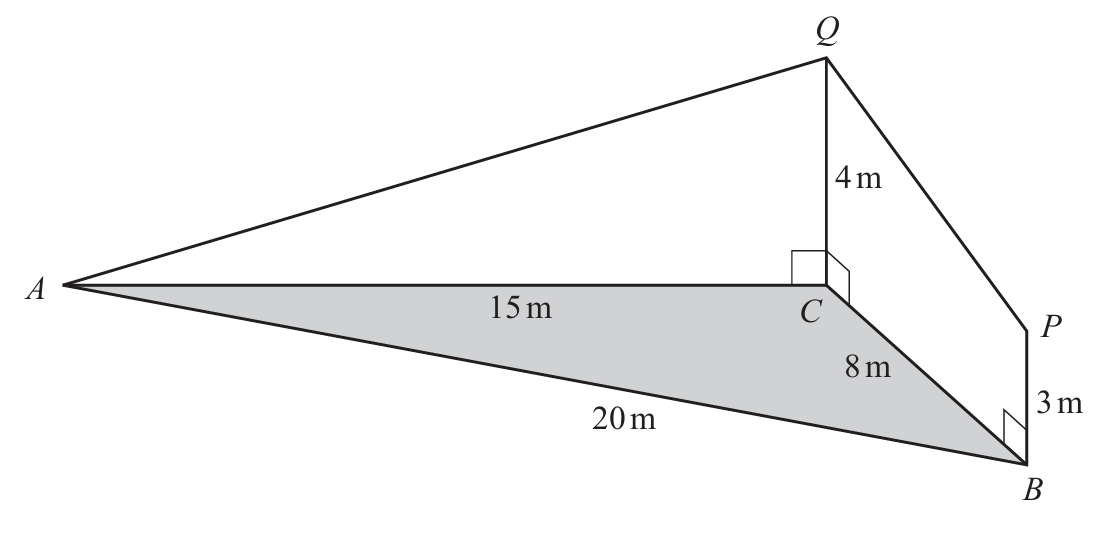
The diagram shows triangle ABC on horizontal ground.
AC = 15 m, BC = 8 m and AB = 20 m.
BP and CQ are vertical poles of different heights.
BP = 3 m and CQ = 4m.
AQ and PQ are straight wires.
(a) Show that angle ACB = 117.5°, correct to 1 decimal place.
(b) Calculate the area of triangle ABC.
(c) Calculate the length of AQ.
(d) Calculate the angle of elevation of Q from P.
(e) Another straight wire connects A to the midpoint of PQ.
Calculate the angle between this wire and the horizontal ground.
▶️ Answer/Explanation
(a) Using cosine rule: cos(ACB) = (15² + 8² – 20²)/(2×15×8) = -111/240 ≈ -0.4625
ACB = cos⁻¹(-0.4625) ≈ 117.5° (to 1 d.p.)
(b) Area = ½ × 15 × 8 × sin(117.5°) ≈ 53.2 m²
Using the formula for area of triangle with two sides and included angle.
(c) AQ is the hypotenuse of right triangle ACQ.
AQ = √(AC² + CQ²) = √(15² + 4²) ≈ 15.5 m
(d) Vertical difference = CQ – BP = 4 – 3 = 1 m
Horizontal distance = BC = 8 m. Angle = tan⁻¹(1/8) ≈ 7.1°
(e) Midpoint height = (3 + 4)/2 = 3.5 m
First find AQ ≈ 15.5 m from (c). Then angle = tan⁻¹(3.5/15.5) ≈ 11.5°
Topic – 2.5
(a) 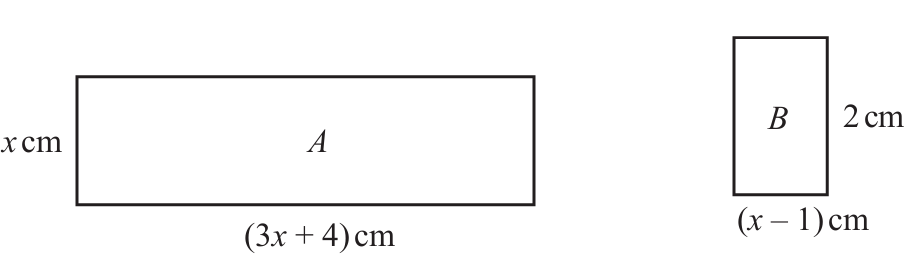
The total of the areas of rectangles A and B is 20 cm².
(i) Show that \( 3x^2 + 6x – 22 = 0 \).
(ii) Solve the equation \( 3x^2 + 6x – 22 = 0 \), giving your answers correct to 4 significant figures. You must show all your working.
(iii) Find the perimeter of rectangle B.
(b) 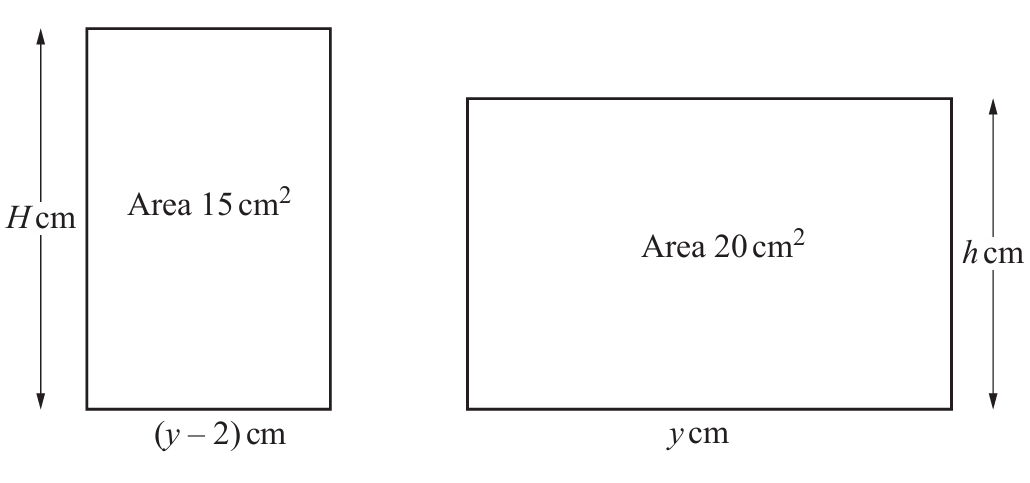
The diagram shows two rectangles where \( H – h = 1 \).
By forming a quadratic equation and factorising, find the value of \( y \).
▶️ Answer/Explanation
(a)(i)
Area of A = x(3x + 4)
Area of B = 2(x – 1)
Total area: x(3x + 4) + 2(x – 1) = 20
Expand: 3x² + 4x + 2x – 2 = 20
Simplify: 3x² + 6x – 22 = 0
(a)(ii) -3.887 and 1.887
Using quadratic formula: x = [-6 ± √(36 + 264)]/6
x = [-6 ± √300]/6 = [-6 ± 10√3]/6
Simplify: x = -1 ± (5√3)/3
Calculate: x ≈ -3.887 or x ≈ 1.887
(a)(iii) 5.77 cm
Using positive x value (1.887):
Dimensions of B: (1.887 – 1) = 0.887 cm and 2 cm
Perimeter = 2(0.887 + 2) ≈ 5.77 cm
(b) 5
From areas: H = 15/(y-2) and h = 20/y
Given H – h = 1: 15/(y-2) – 20/y = 1
Multiply through by y(y-2): 15y – 20(y-2) = y(y-2)
Simplify: -5y + 40 = y² – 2y → y² + 3y – 40 = 0
Factor: (y+8)(y-5) = 0 → y = 5 (positive solution)
Topic – 2.10
(a) 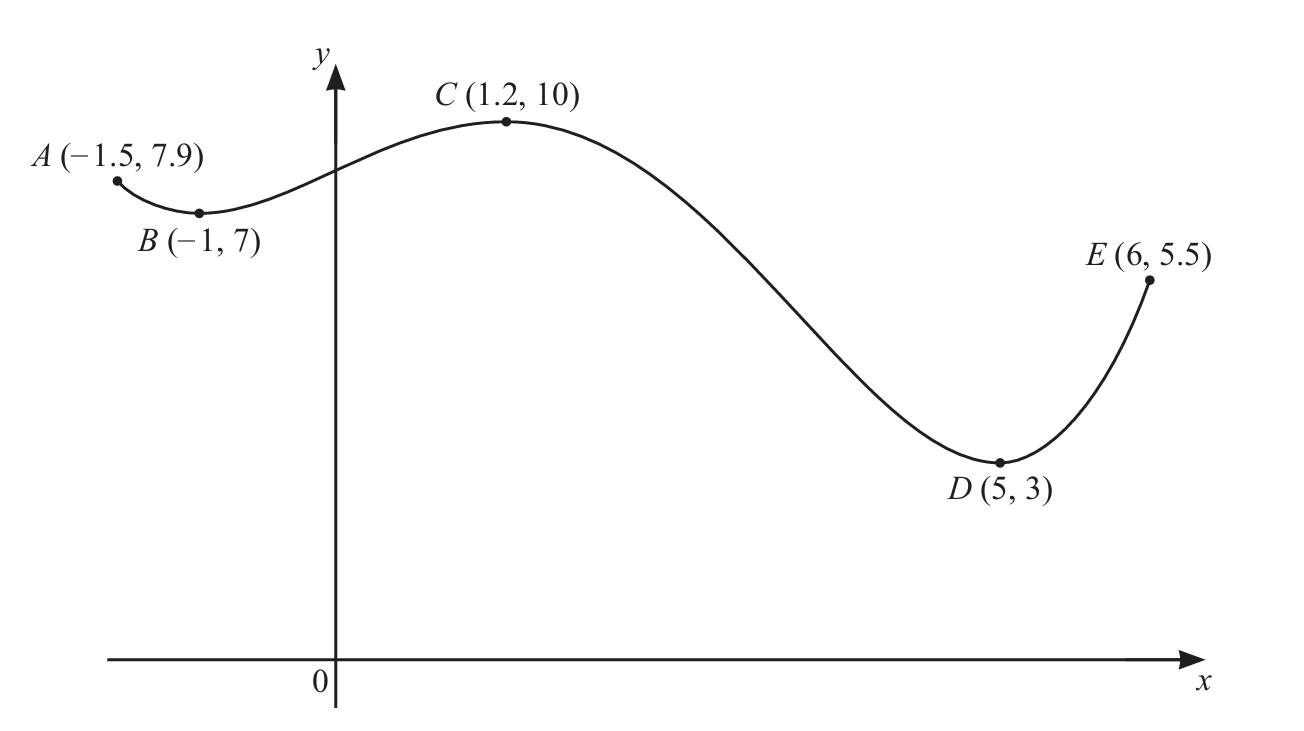
The diagram shows a sketch of the graph of y = f(x) for -1.5 ≤ x ≤ 6.
The coordinates of five points on the graph of y = f(x) are shown on the diagram.
(i) f(x) = k has two solutions in the interval -1.5 ≤ x ≤ 6.
Write down a possible integer value of k.
(ii) f(x) = j has no solutions in the interval -1.5 ≤ x ≤ 6 when j < a or j > b.
Find the maximum value of a and the minimum value of b.
(b) Find the coordinates of the two stationary points on the graph of y = x⁶ – 6x⁵.
You must show all your working.
▶️ Answer/Explanation
(a)(i) 4 or 5 or 7 or 8 or 9
Looking at the graph, any horizontal line at these y-values would intersect the curve exactly twice within the given interval.
(a)(ii) a = 3, b = 10
The maximum value of a is the minimum y-value (3 at point D), and the minimum value of b is the maximum y-value (10 at point C).
(b) (0, 0) and (5, -3125)
First find the derivative: dy/dx = 6x⁵ – 30x⁴.
Set derivative to zero: 6x⁵ – 30x⁴ = 0 → 6x⁴(x – 5) = 0.
Solutions are x = 0 and x = 5.
Find y-values: when x=0, y=0; when x=5, y=5⁶ – 6×5⁵ = 15625 – 18750 = -3125.