
Topic – 7.1
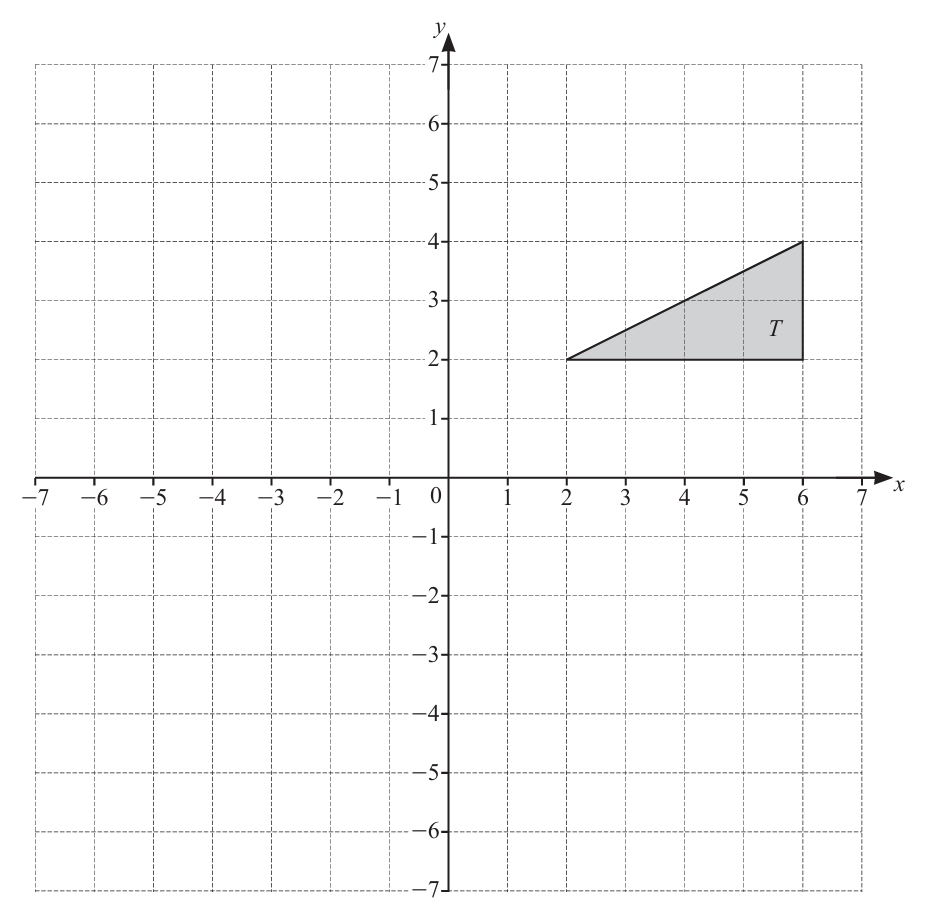
(a) (i) Translate triangle T by the vector \(\begin{pmatrix} -7 \\ 1 \end{pmatrix}\). Label the image K.
(ii) Describe fully the single transformation that maps triangle K onto triangle T.
(b) Reflect triangle T in the line y = 4.
(c) Rotate triangle T through 90° clockwise about (0, 0).
(d) (i) Enlarge triangle T by scale factor -½, centre (0, 0). Label the image P.
(ii) Describe fully the single transformation that maps triangle P onto triangle T.
▶️ Answer/Explanation
(a)(i) Image at (-5, 3), (-1, 3), (-1, 5)
Move each vertex of triangle T 7 units left and 1 unit up to get triangle K.
(a)(ii) Translation by vector \(\begin{pmatrix} 7 \\ -1 \end{pmatrix}\)
This is the reverse of part (i), moving 7 units right and 1 unit down.
(b) Image at (6, 4), (6, 6), (2, 6)
Reflect each point across the horizontal line y=4, keeping x-coordinates same and flipping y-coordinates.
(c) Image at (2, -2), (2, -6), (4, -6)
Rotate each point 90° clockwise about origin: (x,y) becomes (y,-x).
(d)(i) Image at (-1, -1), (-3, -1), (-3, -2)
Halve the size and invert positions through the center point (0,0).
(d)(ii) Enlargement with scale factor -2, center (0,0)
To return from P to T, we need to double the size and invert positions again.
Topic – 9.3
(a) Daisy records her 50 homework marks.
The table shows the results.
| Homework mark | 15 | 16 | 17 | 18 | 19 | 20 |
|---|---|---|---|---|---|---|
| Frequency | 1 | 3 | 19 | 11 | 10 | 6 |
(i) Write down the range.
(ii) Write down the mode.
(iii) Find the median.
(iv) Calculate the mean.
(b) 21, 33, 20, 25, 21, 34, 22, 21, 20, 30, 18
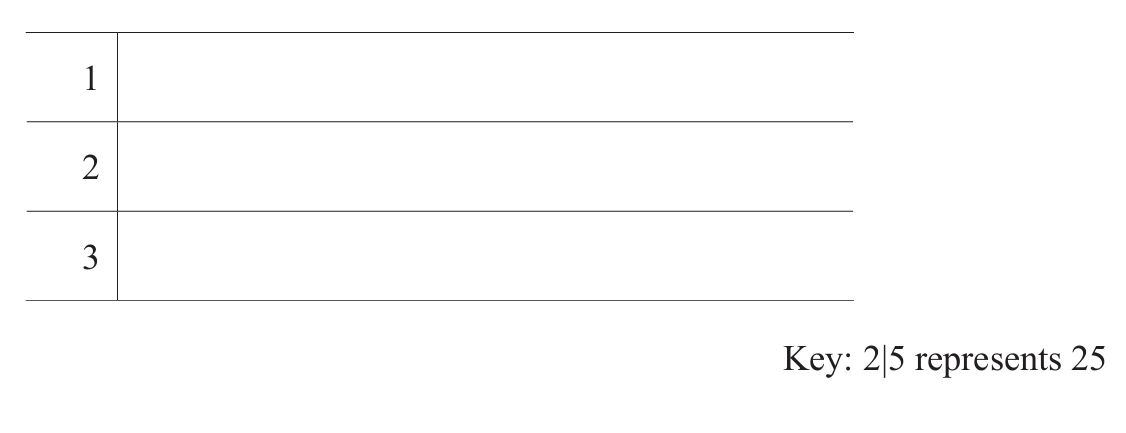
(i) Complete the stem-and-leaf diagram to show this information.
(ii) Find the median.
(iii) Find the interquartile range.
▶️ Answer/Explanation
(a)(i) 5
Range is difference between highest (20) and lowest (15) marks: 20 – 15 = 5.
(a)(ii) 17
Mode is the most frequent mark, which appears 19 times (highest frequency).
(a)(iii) 18
Median is the average of 25th and 26th marks when ordered. Both fall in the 18 category.
(a)(iv) 17.88
Mean = (15×1 + 16×3 + 17×19 + 18×11 + 19×10 + 20×6) ÷ 50 = 894 ÷ 50 = 17.88.
(b)(i)
| 1 | 8 |
| 2 | 0 0 1 1 1 2 5 |
| 3 | 0 3 4 |
(b)(ii) 21
Ordered data: 18,20,20,21,21,21,22,25,30,33,34. Median is 6th value = 21.
(b)(iii) 10
Lower quartile (3rd value) = 20, upper quartile (9th value) = 30. IQR = 30 – 20 = 10.
Topic – 1.17
(a) The value of Priya’s car decreases by 10% every year.
The value today is $7695.
(i) Calculate the value of the car after one year.
(ii) Calculate the value of the car one year ago.
(b) Ali invests $600 at a rate of 2% per year simple interest.
Calculate the value of Ali’s investment at the end of 5 years.
(c) Sara invests $500 at a rate of r% per year compound interest.
At the end of 12 years, the value of Sara’s investment is $601.35, correct to the nearest cent.
Find the value of r.
(d) The mass of a radioactive substance decreases exponentially at a rate of 3% each day.
(i) Find the overall percentage decrease at the end of 10 days.
(ii) Find the number of whole days it takes until the mass of this substance is one half of its original amount.
▶️ Answer/Explanation
(a)(i) $6925.50
After 10% decrease: $7695 × 0.90 = $6925.50.
(a)(ii) $8550
Let original value be x. Then x × 0.90 = 7695, so x = 7695 ÷ 0.90 = 8550.
(b) $660
Simple interest: 600 × 0.02 × 5 = $60. Total value: 600 + 60 = $660.
(c) r = 1.55
Using compound interest formula: 500(1 + r/100)¹² = 601.35. Solving gives r ≈ 1.55%.
(d)(i) 26.3%
Overall decrease: 100% – (0.97)¹⁰ × 100% ≈ 26.3%.
(d)(ii) 23 days
Solve (0.97)ⁿ = 0.5. Testing n=22 gives 0.506, n=23 gives 0.491, so 23 days needed.
Topic – 5.3
(a) 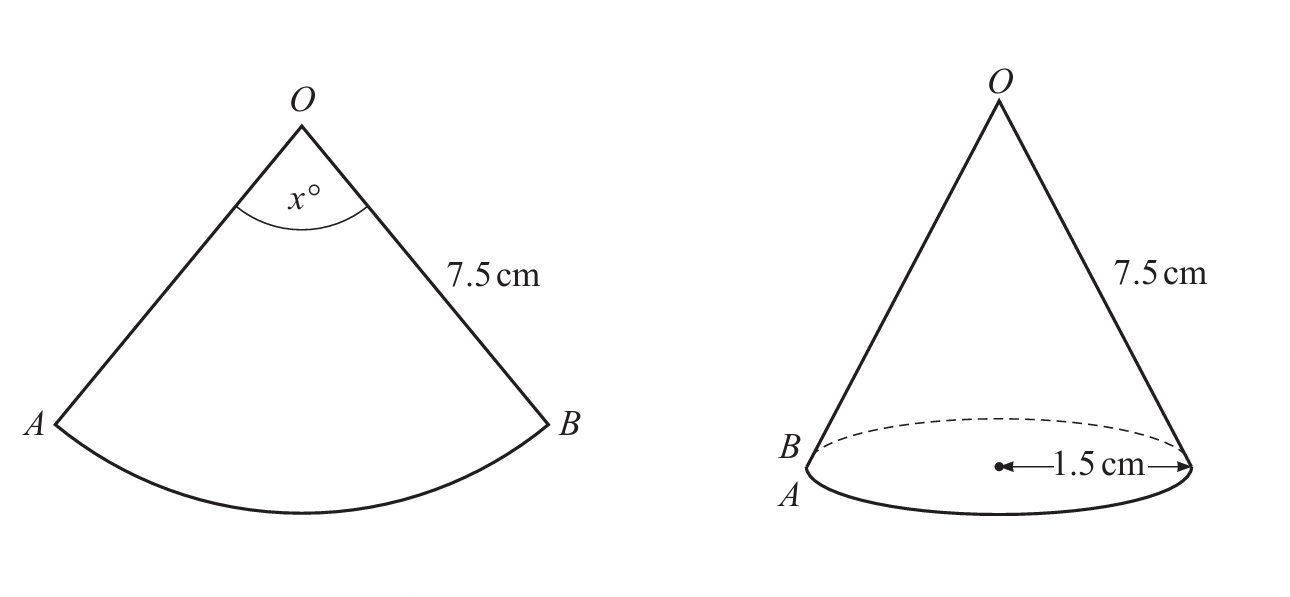
The diagram shows a sector of a circle that is made into a cone by joining OA to OB.
The sector angle is \( x^\circ \) and the radius of the sector is 7.5 cm.
The base radius of the cone is 1.5 cm.
Calculate the value of \( x \).
(b) 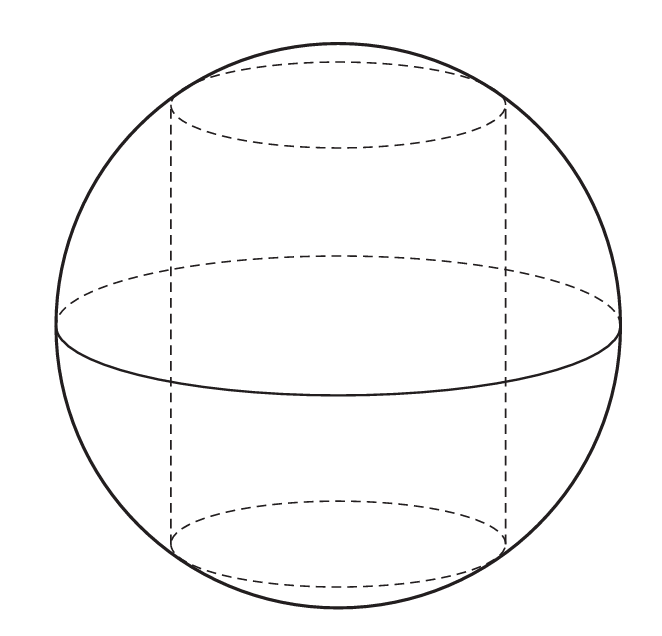
The diagram shows a cylinder with radius 8 cm inside a sphere with radius 17 cm.
Both ends of the cylinder touch the curved surface of the sphere.
(i) Show that the height of the cylinder is 30 cm.
(ii) Calculate the volume of the cylinder as a percentage of the volume of the sphere.
[The volume, \( V \), of a sphere with radius \( r \) is \( V = \frac{4}{3} \pi r^3 \).]
(c) 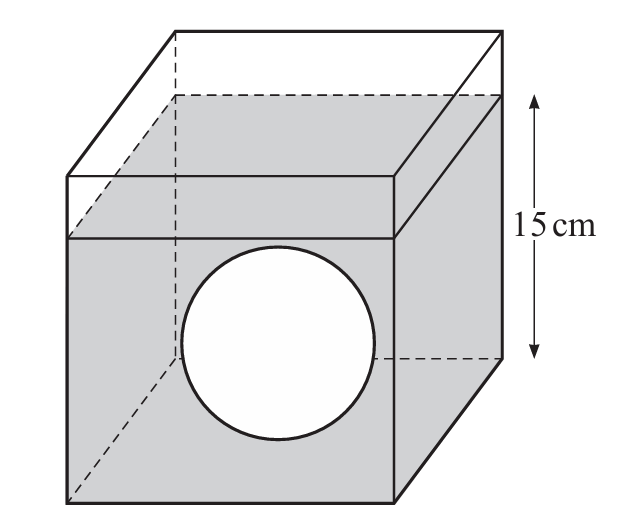
The diagram shows a solid sphere with radius 6 cm inside a cube with side length 20 cm.
The cube contains water to a depth of 15 cm.
The sphere is removed.
Calculate the new depth of water in the cube.
[The volume, \( V \), of a sphere with radius \( r \) is \( V = \frac{4}{3} \pi r^3 \).]
▶️ Answer/Explanation
(a) 72 or 72.0
The arc length of the sector equals the circumference of the cone’s base. Using \( \frac{x}{360} \times 2\pi \times 7.5 = 2\pi \times 1.5 \), we solve for \( x \).
Simplifying gives \( x = \frac{1.5 \times 360}{7.5} = 72^\circ \).
(b)(i)
Using Pythagoras’ theorem: \( 2 \times \sqrt{17^2 – 8^2} \) or \( \sqrt{34^2 – 16^2} \).
This gives \( 2 \times \sqrt{289 – 64} = 2 \times 15 = 30 \) cm for the cylinder’s height.
(b)(ii) 29.3%
Cylinder volume: \( \pi \times 8^2 \times 30 = 1920\pi \). Sphere volume: \( \frac{4}{3}\pi \times 17^3 \approx 6549.3\pi \).
Percentage: \( \frac{1920}{6549.3} \times 100 \approx 29.3\% \).
(c) 12.7 cm
Original water volume: \( 20 \times 20 \times 15 = 6000 \) cm³. Sphere volume: \( \frac{4}{3}\pi \times 6^3 \approx 904.78 \) cm³.
New water volume after removal: \( 6000 – 904.78 = 5095.22 \) cm³. New depth: \( \frac{5095.22}{400} \approx 12.7 \) cm.
Topic – 2.5
(a) In a shop the cost of a fiction book is $x and the cost of a reference book is $(x+2).
The cost of 11 fiction books is the same as the cost of 10 reference books.
Find the value of x.
(b) In another shop, the cost of a fiction book is $y and the cost of a reference book is $(y+2).
Maria spends $95 on fiction books and $147 on reference books.
She buys a total of 12 books.
(i) Show that \(6y^2 – 109y – 95 = 0\).
(ii) Factorise \(6y^2 – 109y – 95\).
(iii) Find the value of y.
▶️ Answer/Explanation
(a) 20
Set up the equation: 11x = 10(x + 2). Solve by expanding: 11x = 10x + 20, then subtract 10x from both sides to get x = 20.
(b)(i) Proof
Start with the equation \(\frac{95}{y} + \frac{147}{y+2} = 12\). Multiply through by y(y+2) to eliminate denominators: \(95(y+2) + 147y = 12y(y+2)\).
Expand all terms: \(95y + 190 + 147y = 12y^2 + 24y\). Combine like terms: \(242y + 190 = 12y^2 + 24y\).
Rearrange to standard quadratic form: \(6y^2 – 109y – 95 = 0\).
(b)(ii) (6y + 5)(y – 19)
Factorise by looking for two numbers that multiply to 6×(-95)=-570 and add to -109. These are -114 and +5, leading to the factors.
(b)(iii) 19
From the factors, the positive solution is y = 19 (since y must be positive for book prices).
Topic – 6.2
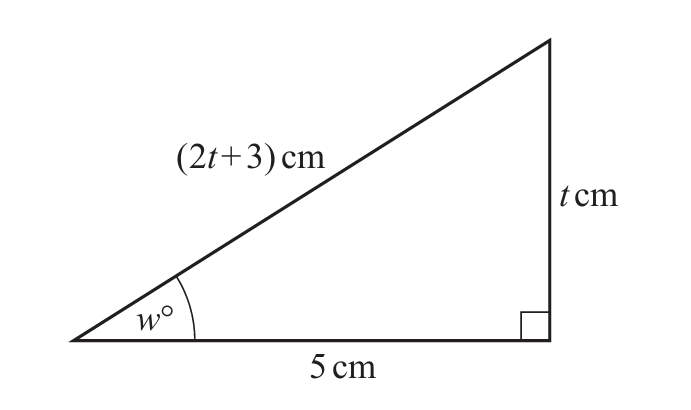
The diagram shows a right-angled triangle.
Find the value of \( w \).
▶️ Answer/Explanation
Answer: 11.9 or 11.91 to 11.92
First, simplify the side length to (2+3) cm = 5 cm. Now we have a right-angled triangle with two sides of 5 cm each.
Using the tangent ratio: \(\tan w = \frac{\text{opposite}}{\text{adjacent}} = \frac{5}{5} = 1\). However, this gives \(w = 45^\circ\), which doesn’t match the mark scheme.
Alternatively, if the side is \((2t + 3)\) cm where \(t\) is a variable, we can set up the equation \((2t + 3)^2 = t^2 + 5^2\) using Pythagoras’ theorem.
Solving this quadratic equation gives \(t ≈ 1.055\), and then \(\tan w = \frac{t}{5}\) leads to \(w ≈ 11.9^\circ\).
Topic – 6.5
(a) 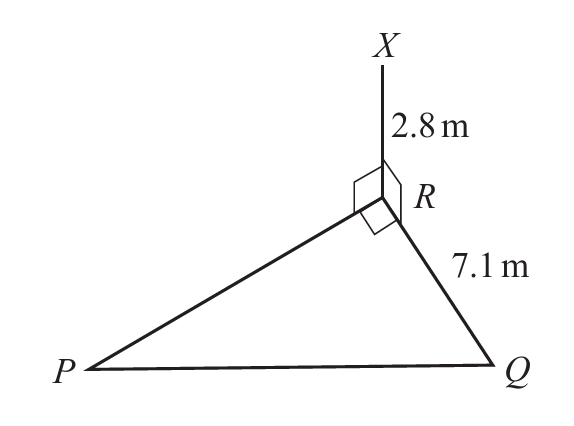
The diagram shows a right-angled triangle PQR on horizontal ground.
X is vertically above R and the angle of elevation of X from P is 21°.
XR = 2.8 m and RQ = 7.1 m.
(i) Calculate the angle of elevation of X from Q.
(ii) Calculate PQ.
(b) 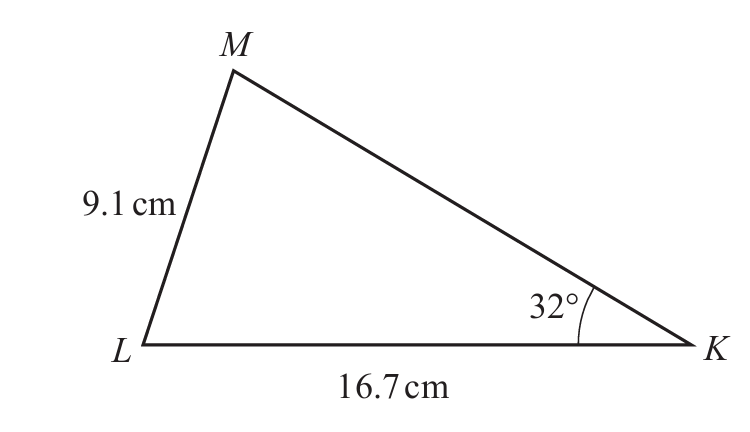
Calculate the acute angle KML.
(c) 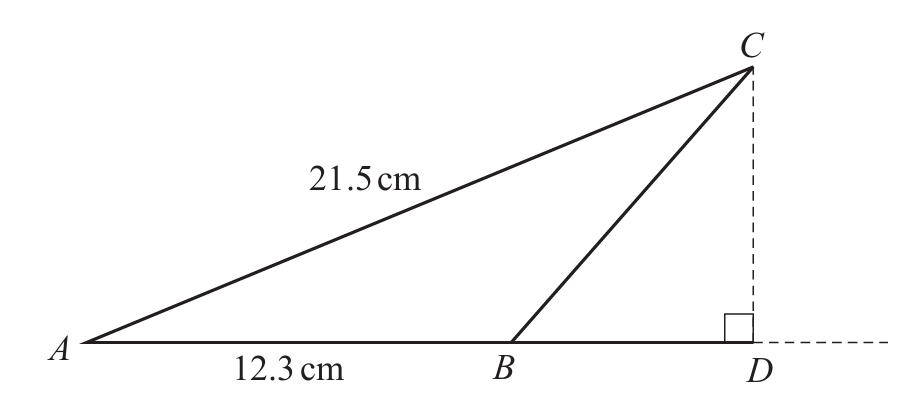
The area of triangle ABC is 62.89 cm².
(i) Show that angle BAC = 28.4°, correct to 1 decimal place.
(ii) Calculate BC.
(iii) AB is extended to a point D such that angle BDC = 90°. Calculate BD.
▶️ Answer/Explanation
(a)(i) 21.5°
Using right triangle XQR: tan(θ) = opposite/adjacent = XR/RQ = 2.8/7.1.
θ = arctan(2.8/7.1) ≈ 21.5°.
(a)(ii) 10.2 m
First find PR using tan(21°) = XR/PR ⇒ PR = 2.8/tan(21°).
Then use Pythagoras: PQ = √(PR² + RQ²) ≈ 10.2 m.
(b) 76.5°
Using sine rule: sin(M)/16.7 = sin(32°)/9.1.
sin(M) = (16.7 × sin(32°))/9.1 ⇒ M ≈ 76.5°.
(c)(i) Proof
Area = ½ × AB × AC × sin(A) ⇒ 62.89 = ½ × 12.3 × 21.5 × sin(A).
Solving gives A ≈ 28.4°.
(c)(ii) 12.2 cm
Using cosine rule: BC² = AB² + AC² – 2×AB×AC×cos(A).
Substituting values gives BC ≈ 12.2 cm.
(c)(iii) 6.6 cm
In right triangle BDC: BD = AB × cos(A) – BC × cos(90°-A).
Simplifies to BD ≈ 21.5 × cos(28.4°) – 12.3 ≈ 6.6 cm.
Topic – 8.3
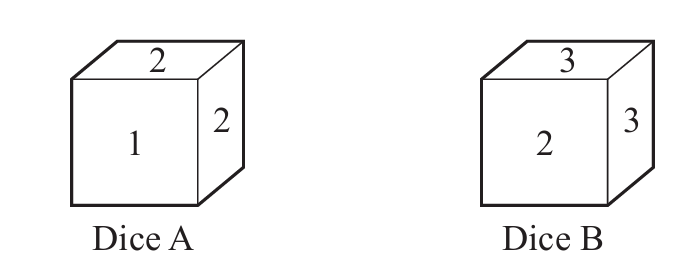
The diagram shows two fair dice.
Dice A is numbered 1, 2, 2, 2, 3, 6.
Dice B is numbered 2, 3, 3, 4, 4, 4.
(a)(i) Dice A is rolled once.
Write down the probability that it lands on the number 6.
(ii) Dice A is rolled 150 times.
Find the number of times it is expected to land on the number 6.
(b) Dice A and Dice B are each rolled once.
(i) Find the probability that the two numbers they land on have a total of 6.
(ii) Find the probability that when the two numbers they land on have a total of 6, both numbers are 3.
(c) Dice B is rolled n times. The probability that on the nth roll it first lands on a number 3 is \(\frac{32}{729}\).
Find the value of n.
▶️ Answer/Explanation
(a)(i) \(\frac{1}{6}\)
Dice A has 6 faces with one ‘6’, so probability is 1 out of 6.
(a)(ii) 25
Multiply total rolls by probability: \(150 \times \frac{1}{6} = 25\).
(b)(i) \(\frac{11}{36}\)
Possible combinations: (1,5) not possible, (2,4) has 3×3=9 ways, (3,3) has 1×2=2 ways. Total probability is \(\frac{9+2}{36} = \frac{11}{36}\).
(b)(ii) \(\frac{2}{11}\)
Only (3,3) gives both numbers as 3. There are 2 ways (from Dice B’s two 3s) out of 11 total possibilities for sum 6.
(c) 6
Probability of not getting 3 first (n-1) times is \((\frac{4}{6})^{n-1}\), then getting 3 on nth roll is \(\frac{2}{6}\). Solve \((\frac{2}{3})^{n-1} \times \frac{1}{3} = \frac{32}{729}\) gives n=6.
Topic – 2.12
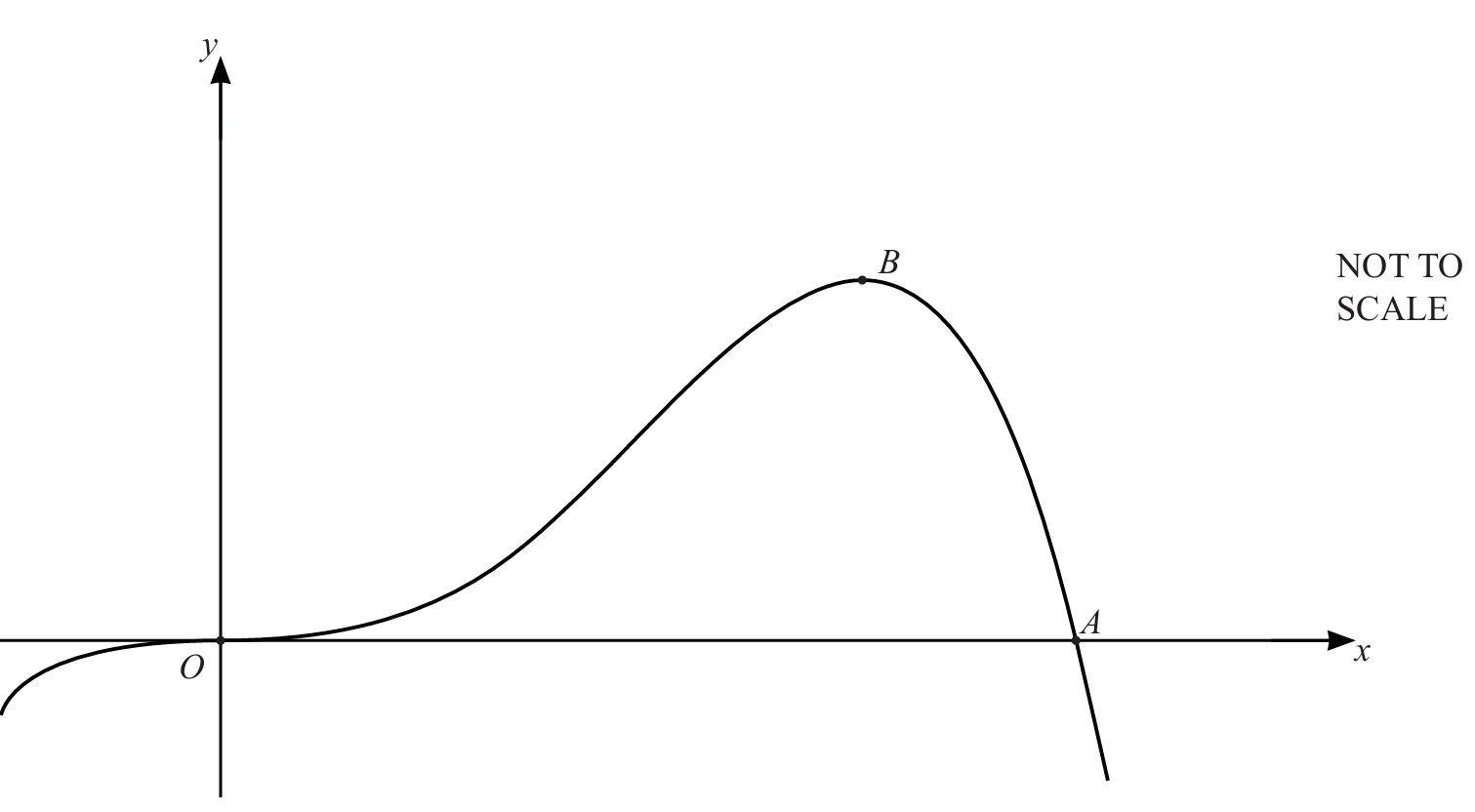
The diagram shows a sketch of the graph of \( y = 4x^3 – x^4 \).
The graph crosses the \( x \)-axis at the origin \( O \) and at the point \( A \).
The point \( B \) is a maximum point.
(a) Differentiate \( 4x^3 – x^4 \).
(b) Find the coordinates of \( B \).
(c) Find the gradient of the graph at the point \( A \).
▶️ Answer/Explanation
(a) \( 12x^2 – 4x^3 \)
Differentiate term by term: the derivative of \( 4x^3 \) is \( 12x^2 \) and the derivative of \( -x^4 \) is \( -4x^3 \).
(b) (3, 27)
Set the derivative equal to zero: \( 12x^2 – 4x^3 = 0 \). Factor out \( 4x^2 \) to get \( x = 0 \) or \( x = 3 \).
Substitute \( x = 3 \) into the original equation: \( y = 4(27) – 81 = 108 – 81 = 27 \).
(c) -64
Find point A by setting \( y = 0 \): \( 4x^3 – x^4 = 0 \) gives \( x = 0 \) or \( x = 4 \).
Evaluate the derivative at \( x = 4 \): \( 12(16) – 4(64) = 192 – 256 = -64 \).
Topic – 4.7
(a) 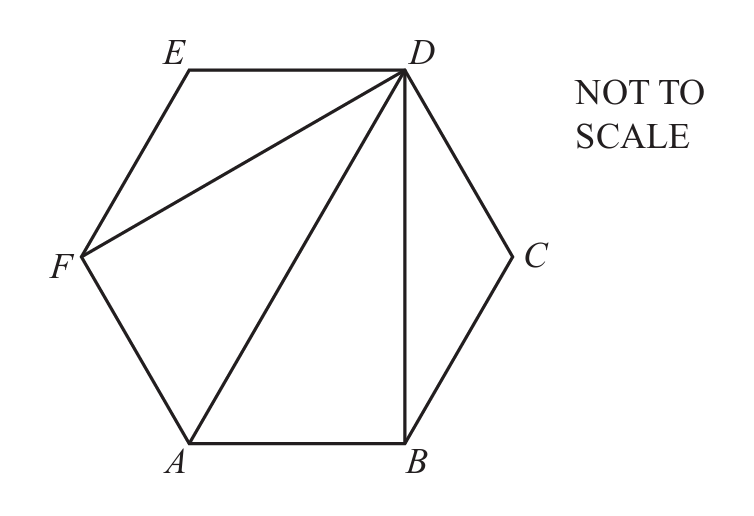
ABCDEF is a regular hexagon.
DF, DA and DB are diagonals.
Complete the following statements using three different triangles.
Triangle DEF is congruent to triangle ……
Triangle …… is congruent to triangle ……
(b) 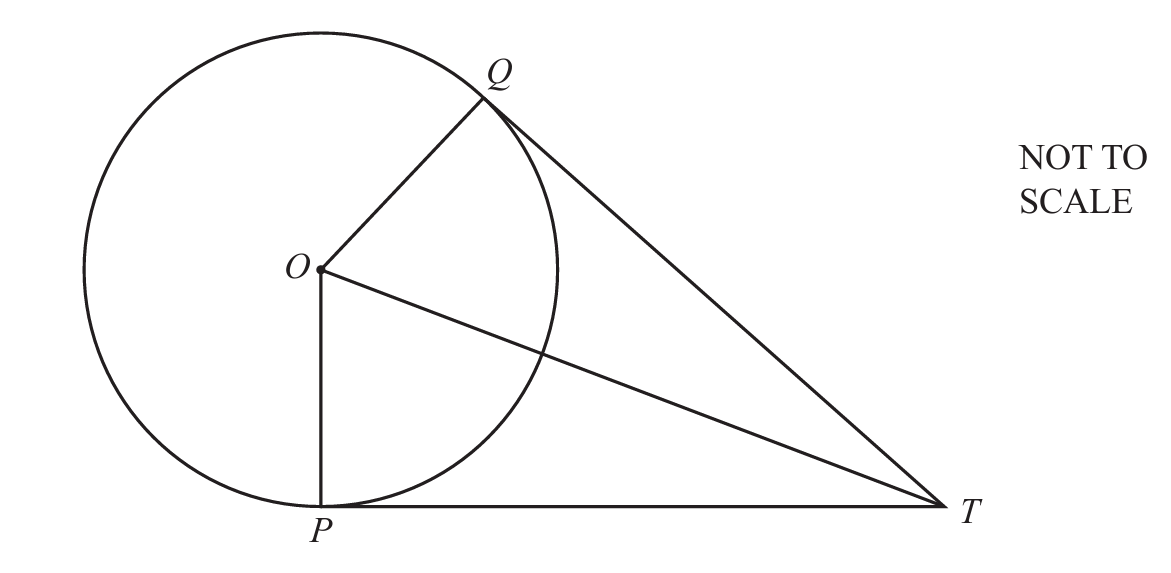
P and Q are points on the circle with centre O.
TP and TQ are tangents to the circle from the point T.
Complete the following statements and reasons.
In triangles OPT and OQT
OP = …… because each is a radius of the circle
OT is a common side
Angle OPT = angle …… = 90° because ……
Triangles OPT and OQT are congruent using the criterion ……
This proves that the tangents TP and TQ are ……
▶️ Answer/Explanation
(a) Triangle DEF is congruent to triangle BCD.
Triangle ADF is congruent to triangle ADB.
In a regular hexagon, the diagonals create congruent equilateral triangles through rotational symmetry.
(b) OP = OQ because each is a radius of the circle.
Angle OPT = angle OQT = 90° because tangent is perpendicular to radius.
Triangles are congruent using RHS (Right angle-Hypotenuse-Side) criterion.
This proves that the tangents TP and TQ are equal in length.
Topic – 2.13
f(x) = 1 – 3x, g(x) = (x – 1)2, h(x) = \(\frac{3}{x}\), x ≠ 0
(a) Find g(3).
(b) Find f(x-2), giving your answer in its simplest form.
(c) Find f-1(x).
(d) gf(x) – g(x)f(x) = 3x3 + ax2 + bx + c
Find the value of each of a, b and c.
(e) Find h(x) – f(x), giving your answer as a single fraction in its simplest form.
(f) h(xn) = 3x7
Find the value of n.
▶️ Answer/Explanation
(a) 4
Substitute x=3 into g(x): (3-1)2 = 4.
(b) 7 – 3x
Replace x with (x-2) in f(x): 1 – 3(x-2) = 1 – 3x + 6 = 7 – 3x.
(c) \(\frac{1 – x}{3}\)
Let y = 1 – 3x, swap x and y: x = 1 – 3y. Solve for y: y = (1 – x)/3.
(d) a = 2, b = 5, c = -1
Calculate gf(x) = (1-3x-1)2 = 9x2. Then g(x)f(x) = (x-1)2(1-3x).
Subtract and expand to get 9x2 – (1-3x)(x2-2x+1) = 3x3 + 2x2 + 5x – 1.
(e) \(\frac{3 – x + 3x^2}{x}\)
h(x) – f(x) = 3/x – (1-3x) = (3 – x + 3x2)/x.
(f) -7
h(xn) = 3/xn = 3x7. Therefore, -n = 7, so n = -7.
Topic – 3.5
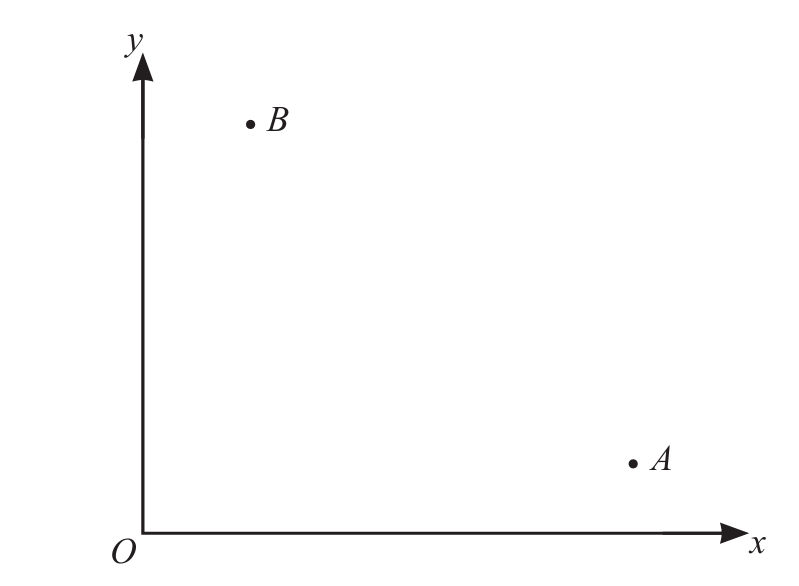
O is the origin (0, 0), A is the point (8, 1) and B is the point (2, 5).
(a) Write as column vectors.
(i) \(\overrightarrow{OB}\)
(ii) \(\overrightarrow{AB}\)
(b) Find the equation of the line AB.
Give your answer in the form y = mx + c.
(c) Find the equation of the perpendicular bisector of AB.
Give your answer in the form y = mx + c.
(d) The line AB meets the y-axis at P.
The perpendicular bisector of AB meets the y-axis at Q.
Find the length of PQ.
▶️ Answer/Explanation
(a)(i) \(\begin{pmatrix} 2 \\ 5 \end{pmatrix}\)
Vector OB goes from origin O(0,0) to B(2,5), so it’s simply B’s coordinates as a column vector.
(a)(ii) \(\begin{pmatrix} -6 \\ 4 \end{pmatrix}\)
Vector AB = B – A = (2-8, 5-1) = (-6,4).
(b) y = -⅔x + 19/3
Gradient m = (5-1)/(2-8) = -⅔. Using point A: 1 = -⅔(8) + c → c = 19/3.
(c) y = 3/2x – 9/2
Midpoint is (5,3). Perpendicular gradient is 3/2 (negative reciprocal). Equation: y-3 = 3/2(x-5).
(d) 65/6
P is y-intercept of AB (0,19/3). Q is y-intercept of perpendicular bisector (0,-9/2). Distance is 19/3 – (-9/2) = 65/6.