
Topic – 1.16
The table shows the amount received when exchanging $100 in some countries.
| Country | Amount received for $100 |
|---|---|
| Wales | 77.05 pounds |
| India | 7437.05 rupees |
| China | 671.20 yuan |
| Spain | 85.35 euros |
(a) Brad changes $250 to Indian rupees.
Calculate the amount he receives correct to the nearest rupee.
(b) Wang changes 5400 Chinese yuan into dollars.
Calculate how much he receives in dollars, correct to the nearest cent.
(c) Gretal lives in Spain and goes on holiday to Wales.
She spends 3500 euros in total on travel and hotels in the ratio
travel : hotels = 4 : 3
(i) Work out how much Gretal spends, in euros, on travel.
(ii) Work out how much she spends, in pounds, on hotels.
(iii) Gretal flies home to Spain.
The plane flies a distance of 2200 km, correct to the nearest 100 km.
The average speed of the plane is 740 km/h, correct to the nearest 20 km/h.
Calculate the lower bound of the time taken, in hours and minutes, for this flight.
▶️ Answer/Explanation
(a) 18593 rupees
First find the exchange rate: $100 = 7437.05 rupees. For $250, multiply by 2.5: 7437.05 × 2.5 = 18592.625, which rounds to 18593.
(b) $804.53
Exchange rate is $100 = 671.20 yuan. For 5400 yuan, divide by exchange rate: (5400 ÷ 671.20) × 100 = 804.53 dollars.
(c)(i) 2000 euros
Total parts = 4 (travel) + 3 (hotels) = 7. Travel amount = (4/7) × 3500 = 2000 euros.
(c)(ii) 1354.13 pounds
Hotel amount = 3500 – 2000 = 1500 euros. Convert to pounds: (1500 ÷ 85.35) × 77.05 = 1354.13 pounds.
(c)(iii) 2 hours 52 minutes
Lower bound distance = 2150 km, upper bound speed = 750 km/h. Time = distance/speed = 2150 ÷ 750 ≈ 2.8667 hours = 2h 52m.
Topic – 9.4
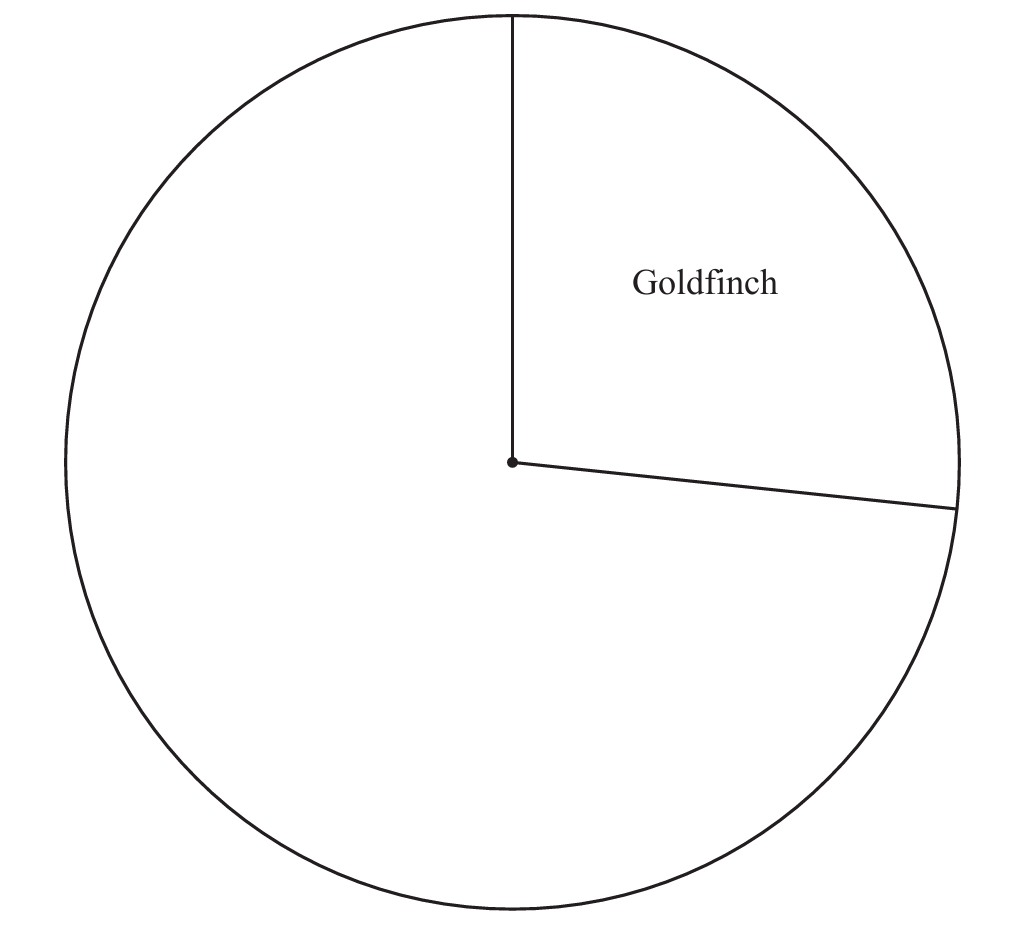
The table shows the number of each type of bird seen in a garden on Monday.
| Type of bird | Frequency | Pie chart sector angle |
|---|---|---|
| Goldfinch | 8 | 96° |
| Jay | 6 | |
| Starling | 11 | |
| Robin | 5 |
(a) Find the percentage of the birds that are Starlings.
(b) (i) In the table, complete the column for the pie chart sector angle.
(ii) Complete the pie chart to show the information in the table.
(c) On Tuesday, the number of Goldfinches seen in the garden increased by 262.5%.
Calculate the number of Goldfinches seen on Tuesday.
(d) One of the most common birds in the world is the Red-Billed Quelea which lives in Sub-Saharan Africa.
There are approximately 1500 million of these birds in this area.
(i) Write 1500 million in standard form.
(ii) The land area of Sub-Saharan Africa is approximately 21.2 million square kilometres.
Work out the average number of these birds per square kilometre.
▶️ Answer/Explanation
(a) 36.7% or 36.66% to 36.67%
Total birds = 8 + 6 + 11 + 5 = 30. Percentage of Starlings = (11/30) × 100 = 36.666…%.
(b)(i) 72°, 132°, and 60°
Each bird represents 96° ÷ 8 = 12°. Jay: 6 × 12° = 72°. Starling: 11 × 12° = 132°. Robin: 5 × 12° = 60°.
(b)(ii) Correct pie chart drawn
Using the calculated angles: Goldfinch (96°), Jay (72°), Starling (132°), Robin (60°).
(c) 29
Increase = 8 × (262.5/100) = 21. New total = 8 + 21 = 29 Goldfinches.
(d)(i) 1.5 × 10⁹
1500 million = 1,500,000,000 = 1.5 × 10⁹ in standard form.
(d)(ii) 70.8 or 70.75 birds/km²
Divide total birds by area: 1,500,000,000 ÷ 21,200,000 ≈ 70.7547 birds per km².
Topic – 7.1
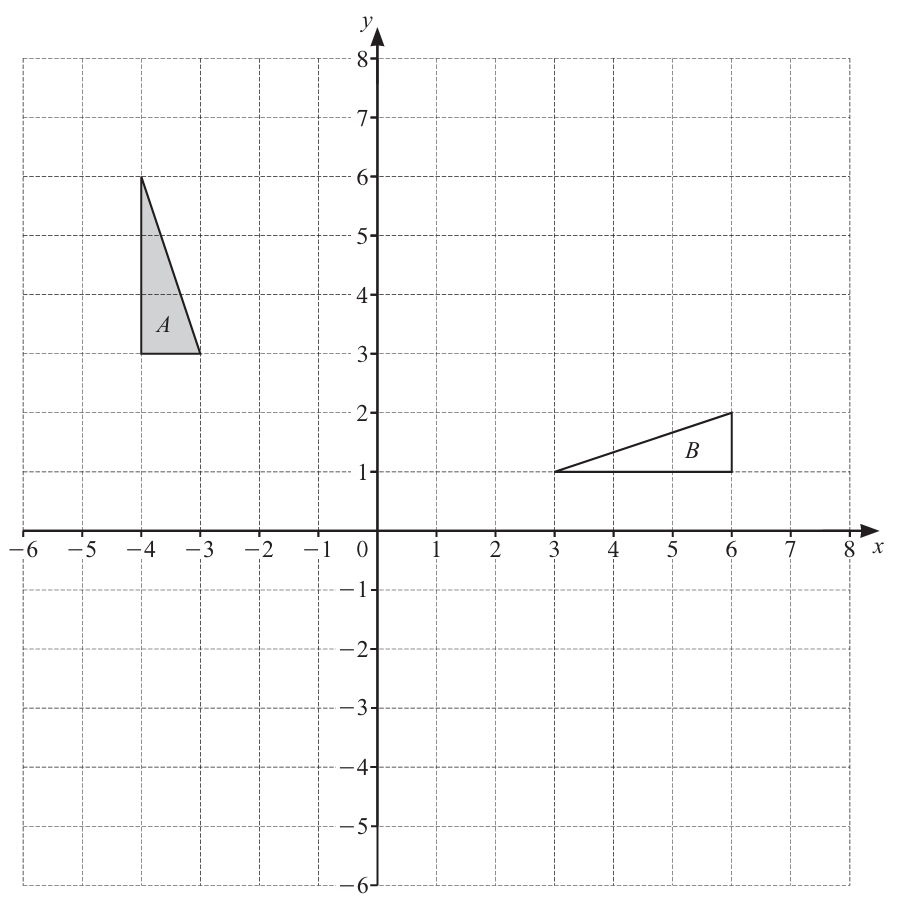
(a) Describe fully the single transformation that maps triangle \( A \) onto triangle \( B \).
(b) Draw the image of triangle \( A \) after
(i) a reflection in the line \( y = 1 \)
(ii) a translation by the vector \(\begin{pmatrix} 5 \\ -7 \end{pmatrix}\)
(iii) an enlargement, scale factor 2, centre (\(-4\), \(5\)).
▶️ Answer/Explanation
(a) Rotation 90° anticlockwise about the point (2, 7)
Triangle A is rotated 90 degrees counter-clockwise around the center point (2,7) to match the position of triangle B.
(b)(i) Image at (-4, -1), (-3, -1), (-4, -4)
Each point of triangle A is reflected across the horizontal line y=1, flipping the triangle vertically while maintaining equal distances from the mirror line.
(b)(ii) Image at (2, -4), (1, -4), (1, -1)
Every point of triangle A is moved right 5 units and down 7 units according to the translation vector (5,-7).
(b)(iii) Image at (-4, 7), (-4, 1), (-2, 1)
Triangle A is enlarged by scale factor 2 from the center point (-4,5), doubling all distances from this point while maintaining the shape.
Topic – 4.7
(a) Find the size of one interior angle of a regular 10-sided polygon.
(b) 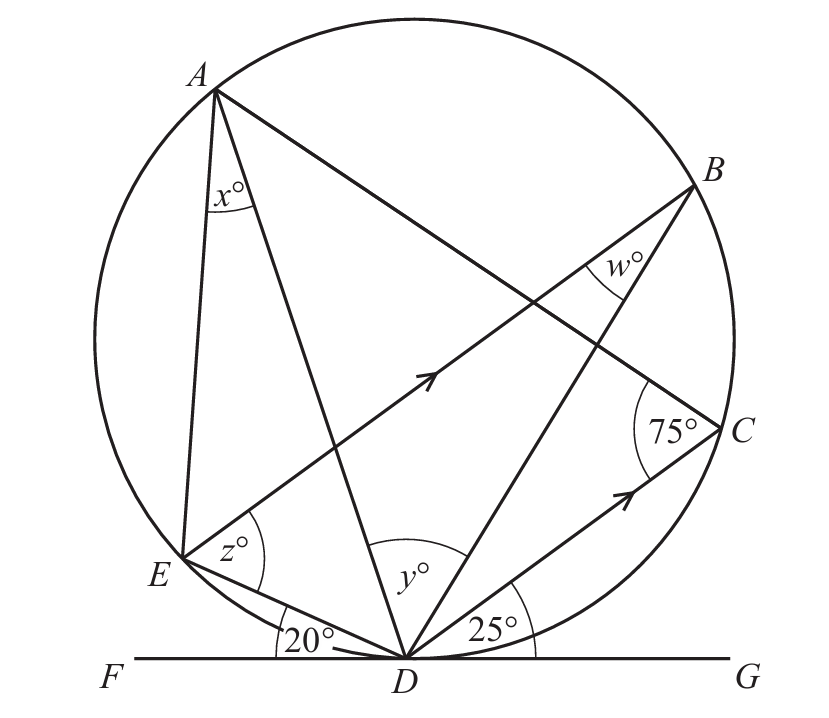
The points A, B, C, D and E lie on a circle.
FG is a tangent to the circle at D.
EB is parallel to DC.
Find the value of each of w, x, y and z.
▶️ Answer/Explanation
(a) 144°
For a regular 10-sided polygon, each interior angle equals (10-2)×180° ÷ 10 = 144°.
This comes from the formula (n-2)×180° for the sum of interior angles.
(b)
w = 20° (angle between tangent and chord equals angle in alternate segment)
x = 20° (alternate angles are equal as EB is parallel to DC)
y = 60° (angle at circumference is half angle at center, 180°-2×20°-60°=80°)
z = 45° (angles in triangle ADE: 180°-20°-25°-90°=45°)
The solution uses circle theorems including the alternate segment theorem and properties of parallel lines.
Topic – 9.7
Indira records the time taken for workers in her company to travel to work.
The table and the histogram each show part of this information.
| Time (t minutes) | 0 < t ≤ 10 | 10 < t ≤ 25 | 25 < t ≤ 40 | 40 < t ≤ 60 | 60 < t ≤ 80 |
|---|---|---|---|---|---|
| Frequency | 57 | 38 | 12 |
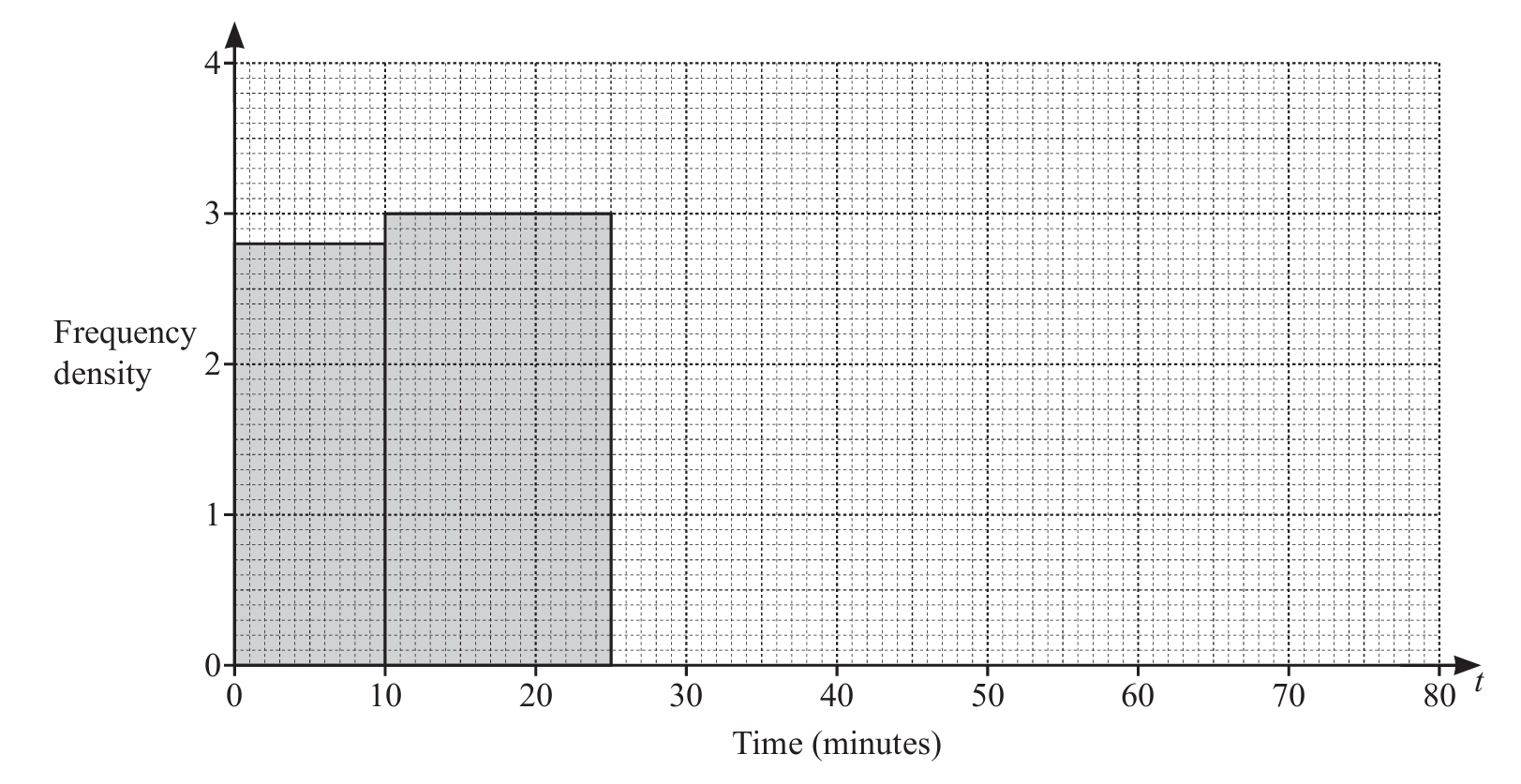
(a) Complete the table and the histogram.
(b) Calculate an estimate of the mean time.
(c) Rashid says:
‘The longest time that any of these workers take to travel to work is 80 minutes.’
Give a reason why Rashid may be wrong.
(d) Indira picks three workers at random from those who take longer than 25 minutes to travel to work.
Calculate the probability that one worker takes 60 minutes or less and the other two each take more than 60 minutes.
▶️ Answer/Explanation
(a) Table: 28 and 45 for first two intervals. Histogram: Bars completed with correct heights.
For the table, calculate frequencies using histogram area principles. For the histogram, ensure bar heights match frequency densities.
(b) 30.7 minutes
Calculate midpoints (5, 17.5, 32.5, 50, 70). Multiply by frequencies and sum (28×5 + 45×17.5 + 57×32.5 + 38×50 + 12×70). Divide by total frequency (180).
(c) The data is grouped, so exact values are unknown.
Since we only know the range (60-80 minutes), some workers might take slightly more than 80 minutes but are still recorded in this group.
(d) 1254/39697 (≈0.0316)
Total workers >25min = 107 (57+38+12). Probability = (95/107)×(12/106)×(11/105)×3, where 95 = workers ≤60min (57+38). The multiplication by 3 accounts for different orderings.
Topic – 2.13
f(x) = 5x – 3, g(x) = 64x, h(x) = \(\frac{2}{x+1}\), x ≠ -1
(a) Find the value of
(i) f(2)
(ii) gf(0.5).
(b) Find h-1(x).
(c) Find x when g(x) = \(\frac{1}{2^5}\).
(d) Write as a single fraction in its simplest form \(\frac{1}{f(x)} – h(x)\).
▶️ Answer/Explanation
(a)(i) 7
Substitute x=2 into f(x): 5(2) – 3 = 10 – 3 = 7.
(a)(ii) 1/8
First find f(0.5) = 5(0.5) – 3 = -0.5. Then g(-0.5) = 64-0.5 = 1/√64 = 1/8.
(b) \(h^{-1}(x) = \frac{2 – x}{x}\)
Set y = 2/(x+1), swap x and y: x = 2/(y+1). Solve for y: y+1 = 2/x → y = (2/x) – 1 = (2-x)/x.
(c) -5/6 or -0.833
Set 64x = 1/32. Write both as powers of 2: (26)x = 2-5. Equate exponents: 6x = -5 → x = -5/6.
(d) \(\frac{7 – 9x}{(5x – 3)(x + 1)}\)
Combine terms: 1/(5x-3) – 2/(x+1). Common denominator is (5x-3)(x+1).
Numerator becomes (x+1) – 2(5x-3) = x+1-10x+6 = 7-9x.
Topic – 2.10
(a) Complete the table of values for \( y = 3\cos 2x^\circ \).
Values are given correct to 1 decimal place.
| x | 0 | 10 | 20 | 30 | 40 | 45 | 50 | 60 | 70 | 80 | 90 |
| y | 3.0 | 2.8 | 2.3 | 1.5 | 0.5 | -0.5 | -2.3 | -3.0 |
(b) Draw the graph of \( y = 3\cos 2x^\circ \) for \( 0 \leq x \leq 90 \).
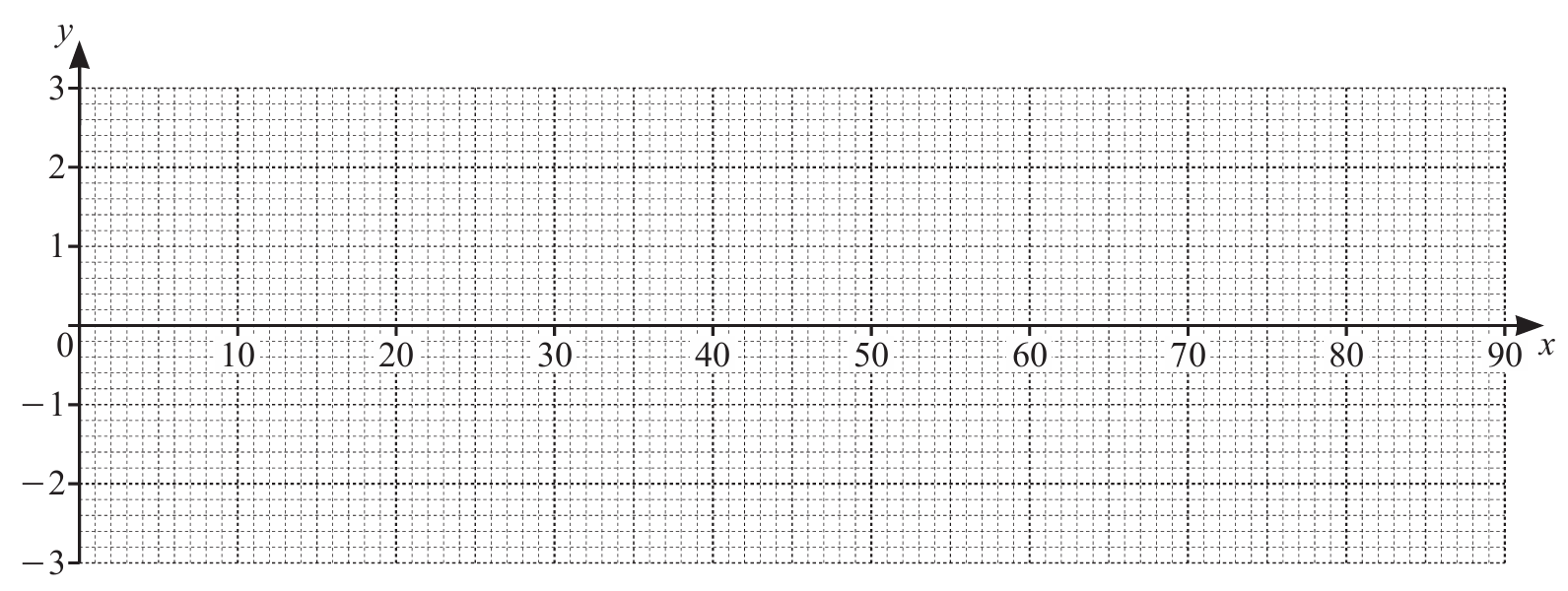
(c) Use your graph to solve the equation \( 3\cos 2x^\circ = -2 \) for \( 0 \leq x \leq 90 \).
(d) By drawing a suitable straight line, solve the equation \( 120 \cos 2x^\circ = 80 – x \) for \( 0 \leq x \leq 90 \).
▶️ Answer/Explanation
(a) Missing values: 0 (at x=0), -1.5 (at x=60), -2.8 (at x=80)
Calculate using y = 3cos(2x°). For x=60: 3cos(120°) = 3×(-0.5) = -1.5.
(b) Plot all points from the table and draw a smooth cosine curve through them.
The curve starts at (0,3), decreases to (45,0), continues to (90,-3).
(c) x ≈ 66° (accept 65° to 67°)
Find where the graph intersects y=-2. The cosine curve crosses -2 once in this range.
(d) x ≈ 34° (accept 32° to 36°)
Rearrange equation to \( \cos 2x^\circ = \frac{80 – x}{120} \). Multiply both sides by 3 to match original graph: \( y = 2 – \frac{x}{40} \). Plot this line and find intersection.
Topic – 5.3
(a) 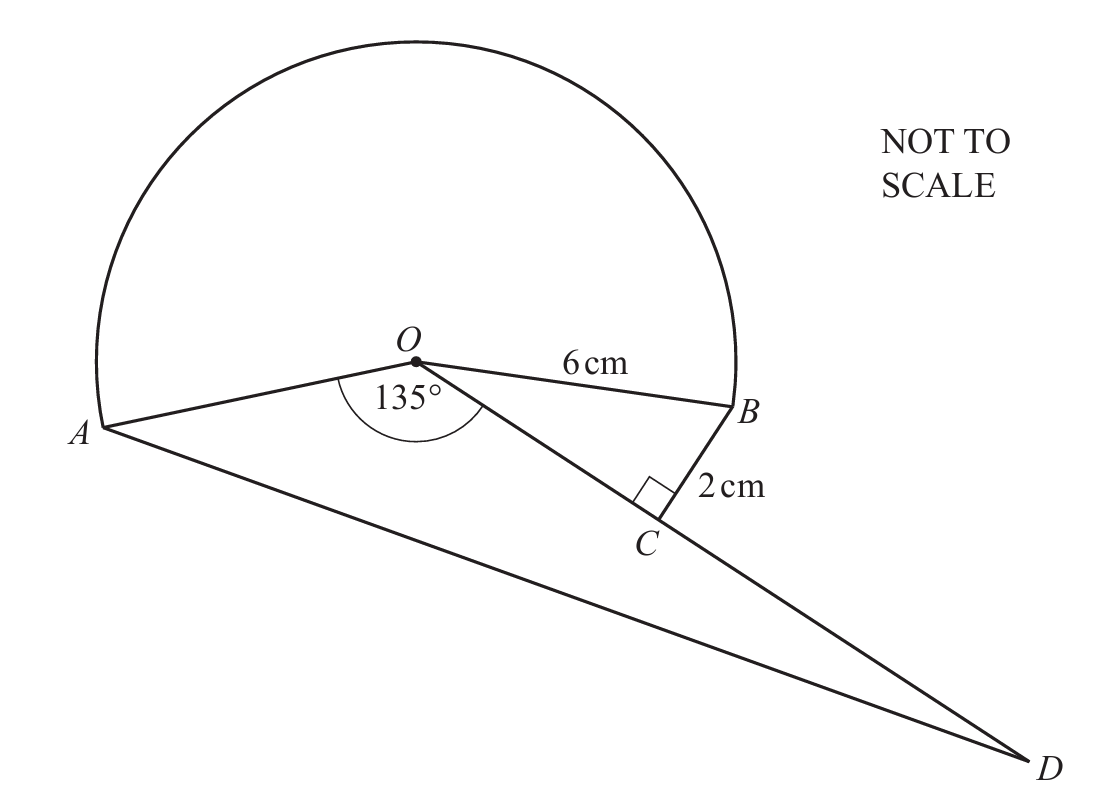
The diagram shows a shape made from a major sector AOB and triangles OBC and AOD.
OB = 6 cm, BC = 2 cm, obtuse angle AOC = 135° and angle BCO = 90°.
(i) Show that angle BOC = 19.5°, correct to 1 decimal place.
(ii) Calculate the area of the major sector AOB.
(iii) C is the midpoint of OD. Calculate AD.
(iv) Calculate the total area of the shape.
(b) A sector of a circle has radius 8 cm and area 160 cm².
A mathematically similar sector has radius 20 cm.
Calculate the area of the larger sector.
▶️ Answer/Explanation
(a)(i) Using right triangle trigonometry in triangle BOC: sin(BOC) = opposite/hypotenuse = BC/OB = 2/6. Therefore, angle BOC = sin⁻¹(1/3) ≈ 19.5°.
(a)(ii) 64.6 cm². First find sector angle: 360° – 135° – 19.5° = 205.5°. Then area = (205.5/360) × π × 6² ≈ 64.6 cm².
(a)(iii) 16.1 cm. First find OC using Pythagoras: √(6² – 2²) ≈ 5.66 cm, so OD = 11.32 cm. Then use cosine rule in triangle AOD: AD² = 6² + 11.32² – 2×6×11.32×cos(135°) ≈ 259, so AD ≈ √259 ≈ 16.1 cm.
(a)(iv) 94.2 cm². Sum of: sector area (64.6 cm²), triangle AOD area (0.5×6×11.32×sin135° ≈ 24 cm²), and triangle BOC area (0.5×2×5.66 ≈ 5.66 cm²).
(b) 1000 cm². The scale factor is 20/8 = 2.5. Area scales by 2.5² = 6.25. Therefore, larger sector area = 160 × 6.25 = 1000 cm².
Topic – 3.5
$A$ is the point (0, 2), $B$ is the point (3, 3) and $C$ is the point (4, 0).
(a) Determine if triangle $ABC$ is scalene, isosceles or equilateral.
You must show all your working.
(b) (i) Find the equation of the line $AC$.
Give your answer in the form $y = mx + c$.
(ii) Find the equation of the perpendicular bisector of $AC$.
Give your answer in the form $y = mx + c$.
(iii) $ABCD$ is a kite.
The point $D$ has coordinates $(w, 4w+1)$.
Find the coordinates of $D$.
▶️ Answer/Explanation
(a) Triangle is isosceles
Calculate distances: AB = √[(3-0)²+(3-2)²] = √10, AC = √[(4-0)²+(0-2)²] = √20, BC = √[(4-3)²+(0-3)²] = √10. Two sides equal means isosceles.
(b)(i) $y = -\frac{1}{2}x + 2$
Slope of AC = (0-2)/(4-0) = -1/2. Using point A (0,2): y-intercept is 2, so equation is y = -½x + 2.
(b)(ii) $y = 2x – 3$
Perpendicular slope is 2 (negative reciprocal). Midpoint of AC is (2,1). Using point-slope form: y-1 = 2(x-2) simplifies to y = 2x – 3.
(b)(iii) (-2, -7)
Since ABCD is a kite, D must satisfy the perpendicular bisector equation. Substitute D’s coordinates: 4w+1 = 2w-3 → 2w = -4 → w = -2. Then y-coordinate is 4(-2)+1 = -7.
Topic – 2.2
(a) Expand and simplify.
\( 4(2x-1)-6(3-x) \)
(b) Factorise completely.
(i) \( 6x^2y+9xy \)
(ii) \( 4x^2-y^2+8x+4y \)
(c) Antonio travels 100 km at an average speed of x km/h.
He then travels a further 150 km at an average speed of (x + 10) km/h.
The time taken for the whole journey is 4 hours 20 minutes.
(i) Show that \( 13x^2 – 620x – 3000 = 0 \).
(ii) Solve \( 13x^2 – 620x – 3000 = 0 \) to find the speed Antonio travels for the first 100 km of the journey.
You must show all your working and give your answer correct to 1 decimal place.
▶️ Answer/Explanation
(a) \(14x – 22\) or \(2(7x – 11)\)
First expand both brackets: \(8x – 4 – 18 + 6x\). Then combine like terms to get \(14x – 22\).
(b)(i) \(3xy(2x + 3)\)
Factor out the greatest common factor \(3xy\) from both terms to get the simplified form.
(b)(ii) \((2x + y)(2x – y + 4)\)
Group terms: \((4x^2 – y^2) + (8x + 4y)\). Factor difference of squares first, then common factor in second group.
(c)(i) Proof shown
\[ \frac{100}{x} + \frac{150}{x+10} = 4\frac{1}{3} \]
Combine fractions: \[ \frac{100(x+10)+150x}{x(x+10)} = \frac{13}{3} \]
Simplify numerator: \[ \frac{250x+1000}{x(x+10)} = \frac{13}{3} \]
Cross multiply and expand: \[ 750x + 3000 = 13x^2 + 130x \]
Rearrange terms: \[ 13x^2 – 620x – 3000 = 0 \]
(c)(ii) 52.1 km/h
Use quadratic formula with \(a=13\), \(b=-620\), \(c=-3000\). Calculate discriminant and find positive root, rounding to one decimal place.
Topic – 2.12
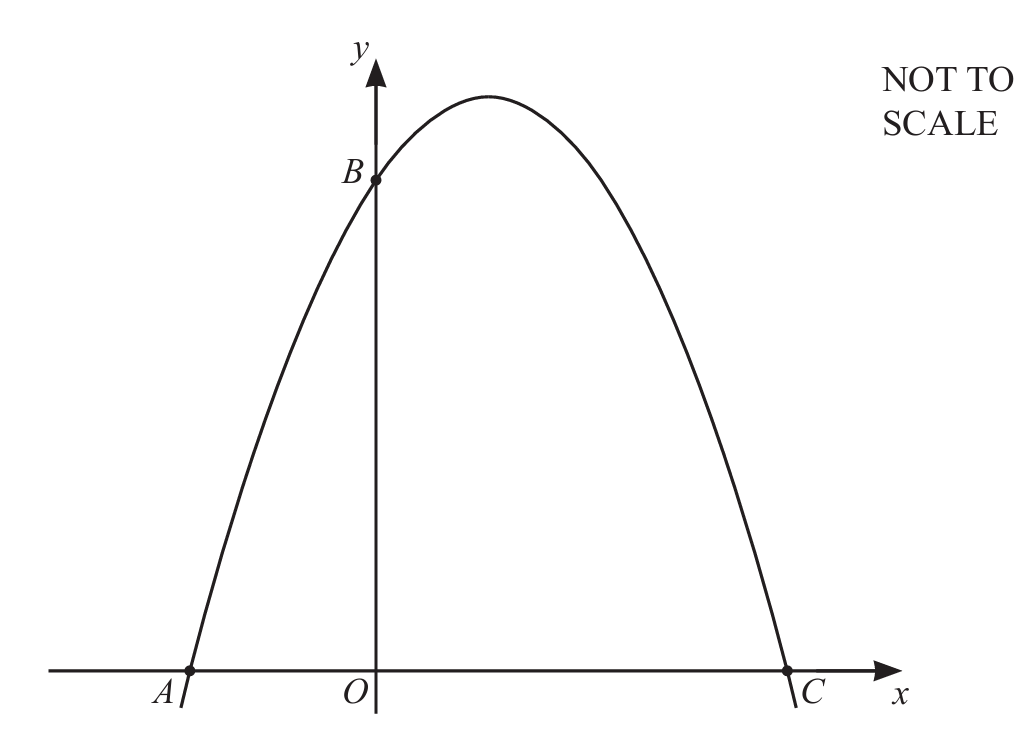
The diagram shows a sketch of \( y = 18 + 5x – 2x^2 \).
(a) Find the coordinates of the points \( A, B \) and \( C \).
(b) Differentiate \( 18 + 5x – 2x^2 \).
(c) Find the coordinates of the point on \( y = 18 + 5x – 2x^2 \) where the gradient is 17.
▶️ Answer/Explanation
(a) \( A = (-2, 0) \), \( B = (0, 18) \), \( C = (4.5, 0) \)
For \( A \) and \( C \), set \( y = 0 \) and solve \( -2x^2 + 5x + 18 = 0 \) to get x-intercepts. For \( B \), set \( x = 0 \) to get y-intercept.
(b) \( 5 – 4x \)
Differentiate each term: derivative of 18 is 0, \( 5x \) becomes 5, and \( -2x^2 \) becomes \( -4x \).
(c) \( (-3, -15) \)
Set derivative equal to 17: \( 5 – 4x = 17 \). Solve to get \( x = -3 \). Substitute back into original equation to find y-coordinate.