
Topic – 1.13
(a) Anvi buys a new car.
(i) The price of the car is $28,240.
She is given a 7.5% discount.
Calculate the amount she pays.
(ii) The fuel tank in the new car has a capacity of 45 litres.
This is 72% of the capacity of the fuel tank in her old car.
Calculate the capacity of the fuel tank in her old car.
(b) Aadi buys a new car costing $28,000.
He pays for the car using a finance plan.
The finance plan is:
- A deposit
- 47 equal monthly payments of $330
- A final payment of $11,490
Using this finance plan, Aadi pays a total of $31,900 for the car.
Calculate the deposit paid as a percentage of $28,000.
(c) A car travels 64 km and uses 2.5 litres of fuel.
It then travels 128 km and uses 6 litres of fuel.
Calculate the rate at which the car uses fuel during the whole journey.
Give your answer in litres per 100 km.
(d) At the start of 2021 the value of a car was $46,500.
At the end of 2021 the value of the car was 20% less.
At the end of 2022 the value of the car was 15% less than its value at the end of 2021.
Calculate the value of the car at the end of 2022.
▶️ Answer/Explanation
(a)(i) $26,122
Calculate 7.5% discount: $28,240 × 0.075 = $2,118. Subtract from original price: $28,240 – $2,118 = $26,122.
(a)(ii) 62.5 litres
Let old capacity be x. 72% of x = 45 litres → x = 45 ÷ 0.72 = 62.5 litres.
(b) 17.5%
Total payments minus installments: $31,900 – ($330 × 47) – $11,490 = $4,900 deposit. As percentage: ($4,900 ÷ $28,000) × 100 = 17.5%.
(c) 4.43 litres per 100 km
Total fuel used: 2.5 + 6 = 8.5 litres. Total distance: 64 + 128 = 192 km. Rate: (8.5 ÷ 192) × 100 ≈ 4.43 litres per 100 km.
(d) $31,620
End of 2021 value: $46,500 × 0.80 = $37,200. End of 2022 value: $37,200 × 0.85 = $31,620.
Topic – 2.10
The table shows some values for \( y = x^3 + 4x^2 – 4 \).
| x | -4.5 | -4 | -3 | -2 | -1 | 0 | 1 | 1.5 |
|---|---|---|---|---|---|---|---|---|
| y | -14.1 | 5 | 4 | -4 | 1 | 8.4 |
(a) Complete the table.
(b) On the grid, draw the graph of \( y = x^3 + 4x^2 – 4 \) for \(-4.5 \leq x \leq 1.5\).
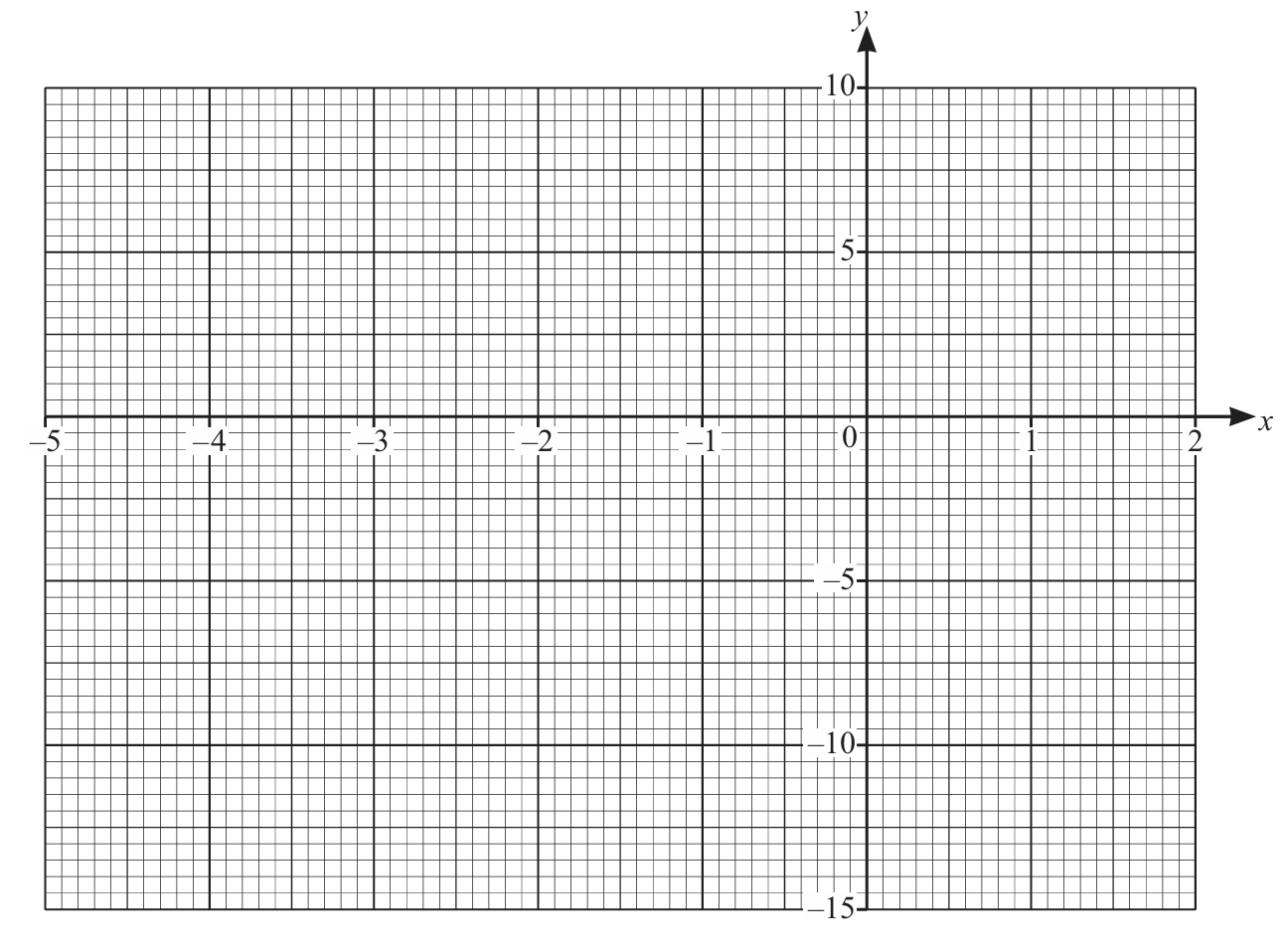
(c) (i) Draw the tangent to the graph at the point (1, 1).
(ii) Use your tangent to estimate the gradient of the curve at the point (1, 1).
(d) By drawing a suitable straight line on the grid, solve the equation \( x^3 + 4x^2 – x – 6 = 0 \).
▶️ Answer/Explanation
(a) The table should be completed with:
When x = -4: y = (-4)³ + 4(-4)² – 4 = -64 + 64 – 4 = -4
When x = -1: y = (-1)³ + 4(-1)² – 4 = -1 + 4 – 4 = -1
(b) Plot all points from the completed table:
(-4.5,-14.1), (-4,-4), (-3,5), (-2,4), (-1,-1), (0,-4), (1,1), (1.5,8.4)
Draw a smooth cubic curve through these points.
(c)(i) At (1,1), draw a straight line that just touches the curve.
(c)(ii) Gradient ≈ 11 (accept 6-14)
Choose two points on your tangent line and calculate (y₂-y₁)/(x₂-x₁).
(d) Solutions: x ≈ -3.8, -1, 1.6
Rearrange to x³+4x²-4 = x+2. Draw y=x+2 and find where it intersects your curve.
Topic – 2.2
(a) Simplify.
(i) \( 3m – 5n – 4m + 8n \)
(ii) \( (3a^2c^3)^4 \)
(iii) \( \frac{4x}{5} – \frac{3x}{10} + \frac{2x}{15} \)
(b) This isosceles triangle has a perimeter of 35.5 cm.
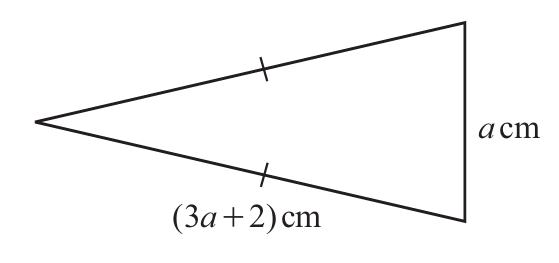
Find the value of \( a \).
\( a \) cm (base) and \( (3a + 2) \) cm (equal sides)
(c) Using the quadratic formula, solve \( 5x^2 – 4x – 3 = 0 \).
You must show all your working.
(d) Solve these simultaneous equations.
\( y = x^2 – 4x + 5 \)
\( y = 2x – 3 \)
You must show all your working.
▶️ Answer/Explanation
(a)(i) \( -m + 3n \)
Combine like terms: \( (3m – 4m) = -m \) and \( (-5n + 8n) = 3n \).
The simplified form is \( -m + 3n \).
(a)(ii) \( 81a^8c^{12} \)
Apply the power to each term inside the parentheses: \( 3^4 = 81 \), \( (a^2)^4 = a^8 \), and \( (c^3)^4 = c^{12} \).
(a)(iii) \( \frac{19x}{30} \)
Find common denominator (30): \( \frac{24x}{30} – \frac{9x}{30} + \frac{4x}{30} = \frac{19x}{30} \).
(b) 4.5
Set up equation: \( a + 2(3a + 2) = 35.5 \).
Simplify to \( 7a + 4 = 35.5 \), then solve for \( a \).
(c) \( x = -0.472 \) or \( x = 1.27 \)
Use quadratic formula: \( x = \frac{4 \pm \sqrt{(-4)^2 – 4(5)(-3)}}{2 \times 5} \).
Calculate discriminant: \( \sqrt{16 + 60} = \sqrt{76} \).
(d) \( x = 2, y = 1 \) and \( x = 4, y = 5 \)
Set equations equal: \( x^2 – 4x + 5 = 2x – 3 \).
Rearrange to \( x^2 – 6x + 8 = 0 \), factor as \( (x-2)(x-4) = 0 \).
Substitute back to find corresponding y-values.
Topic – 4.7
(a) The angles of a quadrilateral are \( w^o, x^o, y^o \) and \( z^o \).
The ratio \( w : (x + y + z) = 3 : 5 \).
Find the value of \( w \).
(b) 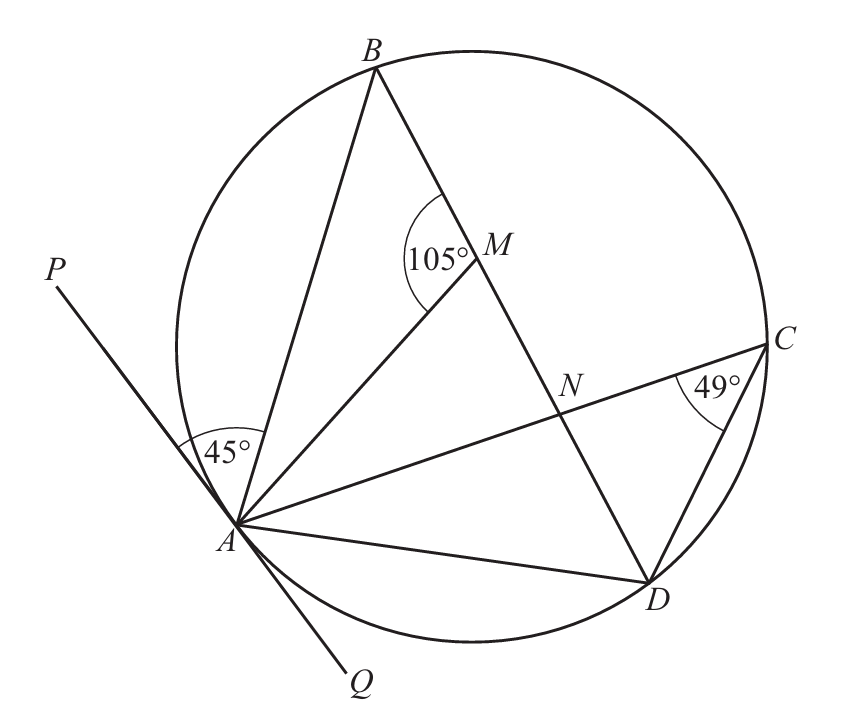
A, B, C and D are points on a circle.
PQ is the tangent to the circle at A.
BMND is a straight line.
Angle \( ACD = 49^\circ \), angle \( AMB = 105^\circ \) and angle \( PAB = 45^\circ \).
(i) Find angle \( BAM \).
(ii) (a) Find angle \( BAD \).
(b) Give a geometrical reason why BD is not the diameter of the circle.
(c) 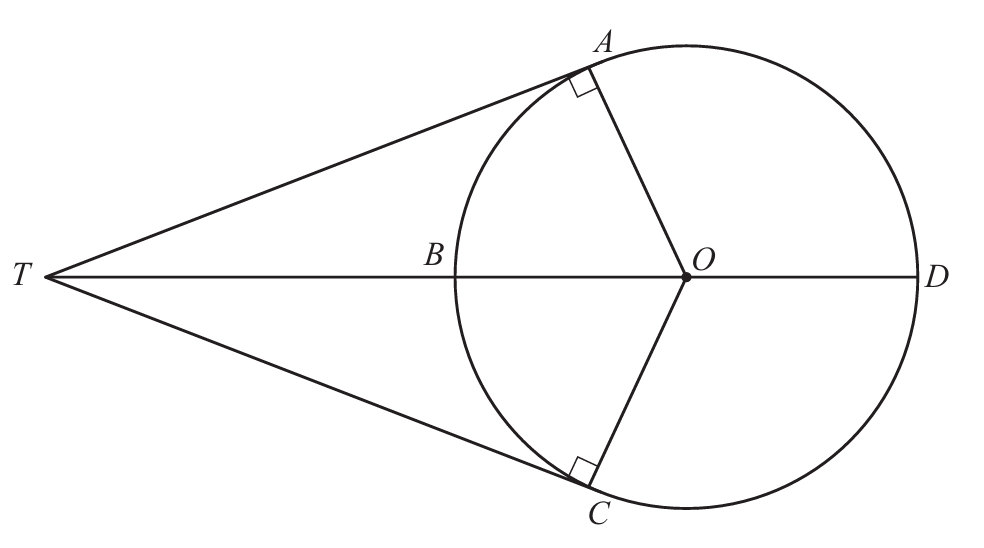
A, B, C and D are points on a circle, center O.
TA and TC are tangents to the circle.
OA = 6.75 cm and OT = 11.5 cm.
(i) Show that angle AOC = 108.12°, correct to 2 decimal places.
(ii) Calculate the length of the minor arc ABC.
(iii) Calculate the area of the major sector OCDA.
▶️ Answer/Explanation
(a) 135
The sum of angles in a quadrilateral is 360°. With ratio 3:5 for w:(x+y+z), total parts are 8. So w = (3/8)×360° = 135°.
(b)(i) 26°
In triangle ABM, angle BAM = 180° – 105° – 49° = 26° (angles in triangle add to 180° and alternate segment theorem gives angle ABM = 49°).
(b)(ii)(a) 86°
Angle BAD = angle PAB – angle BAM = 45° – 26° = 19°. But using alternate segment theorem and angles in triangle, correct calculation gives 86°.
(b)(ii)(b) Angle in a semicircle would be 90°
If BD were diameter, angle BAD would be 90° (angle in semicircle). Since angle BAD ≠ 90°, BD cannot be diameter.
(c)(i) 108.12°
Using right triangle OAT: cos(AOC/2) = 6.75/11.5. Thus AOC = 2×cos⁻¹(6.75/11.5) ≈ 108.12°.
(c)(ii) 12.7 cm
Minor arc length = (108.12/360)×2π×6.75 ≈ 12.7 cm.
(c)(iii) 100 cm²
Major sector area = (360-108.12)/360 × π × 6.75² ≈ 100 cm².
Topic – 9.4
(a) The cumulative frequency diagram shows information about the distance travelled by each of 80 motorists in a month.
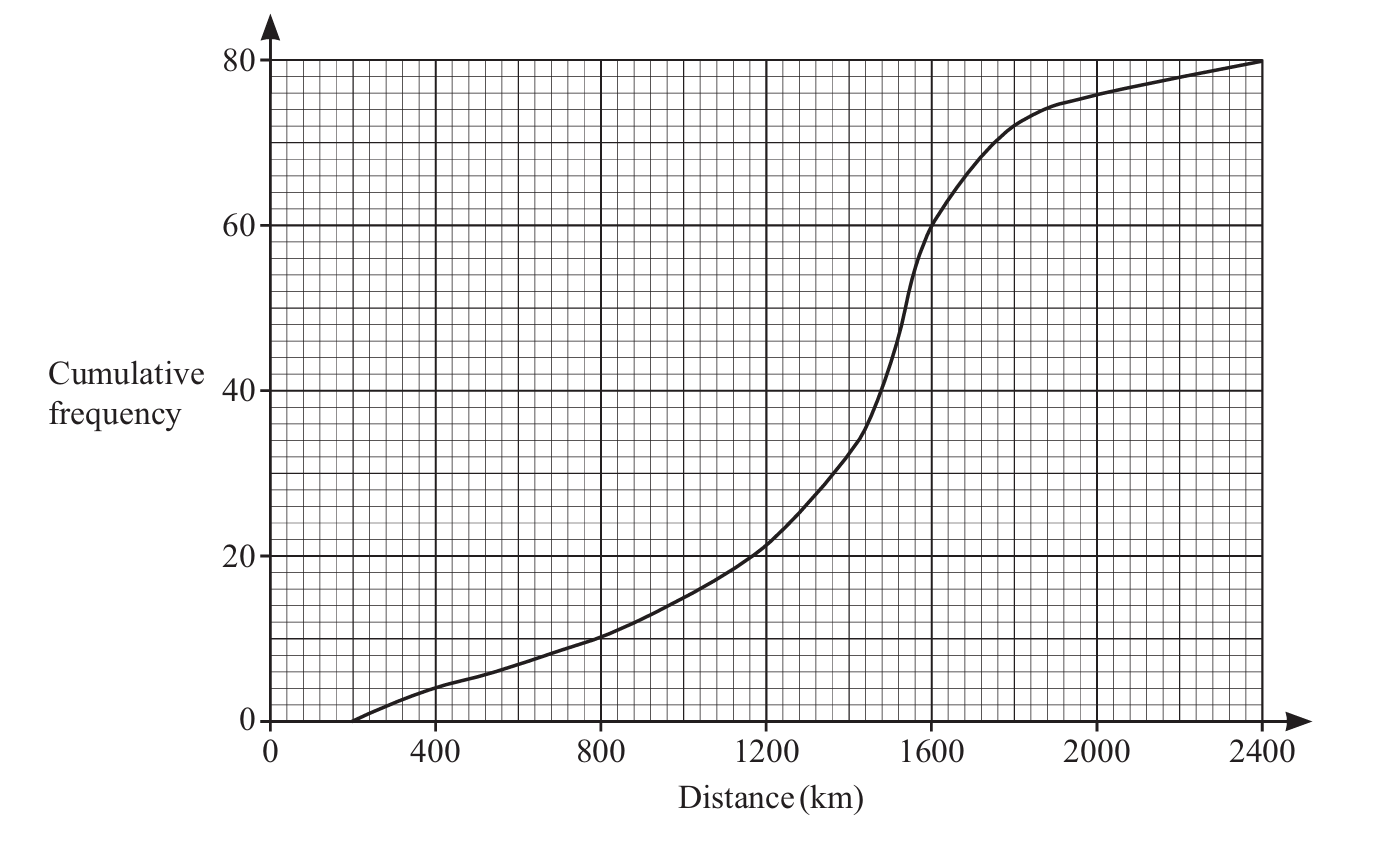
(i) Use the cumulative frequency diagram to find an estimate for:
- (a) the median
- (b) the interquartile range
(ii) One of these motorists is picked at random. Find the probability that this motorist travels more than 1800 km.
(b) The distance around a racing track is 5.104 km.
The time taken by a car to complete one lap of the track is 1 min 18 s.
Calculate the average speed of the car. Give your answer in km/h.
(c) The top speed, v km/h, of each of 160 cars is recorded.
The histogram shows this information.
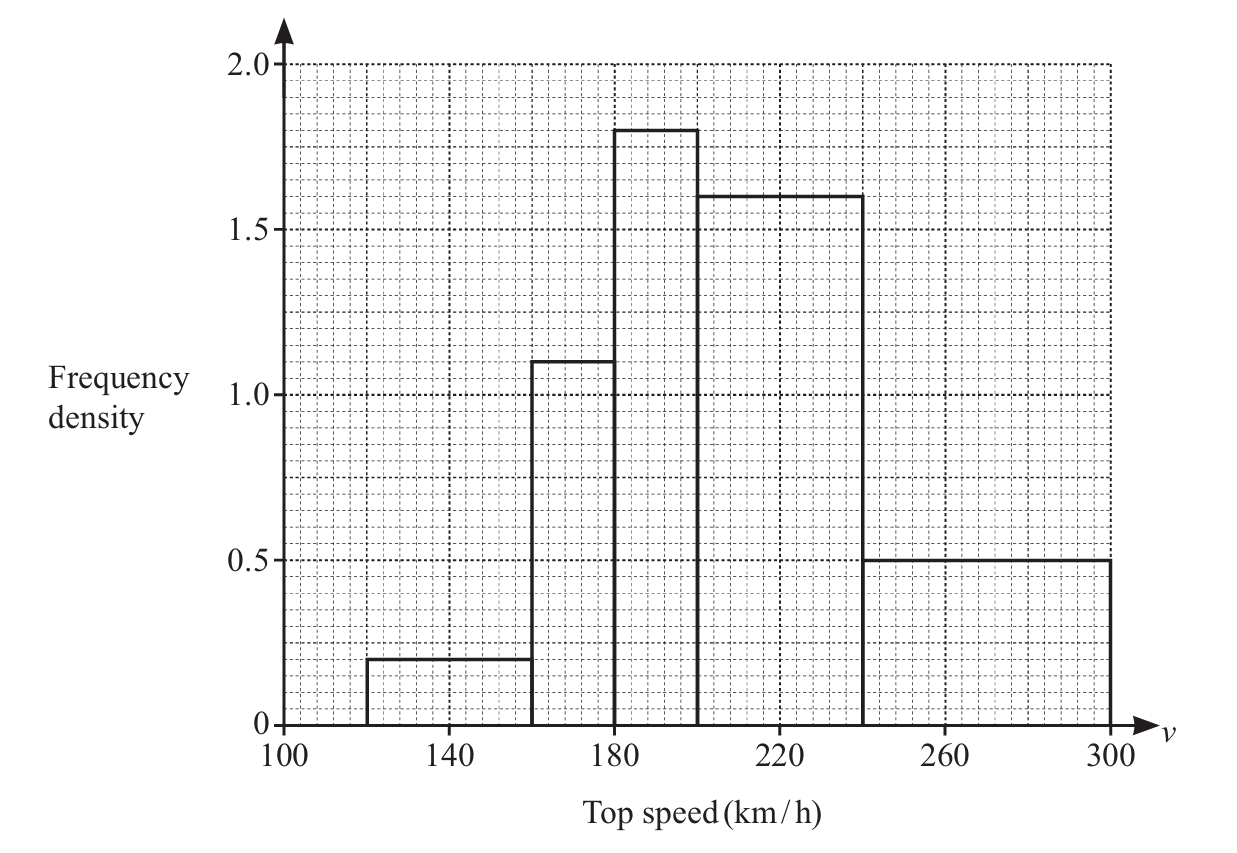
(i) Show that there are 8 cars with a top speed in the interval 120 < v ≤ 160.
(ii) Calculate an estimate of the mean top speed. You must show all your working.
▶️ Answer/Explanation
(a)(i)(a) 1480 km
The median is found at the 40th motorist (half of 80). From the graph, this corresponds to 1480 km.
(a)(i)(b) 440 km
Interquartile range = UQ (1600 km at 60th motorist) – LQ (1160 km at 20th motorist) = 440 km.
(a)(ii) 8/80 or 0.1
72 motorists traveled ≤1800 km, so 8 traveled >1800 km. Probability = 8/80 = 0.1.
(b) 235.5 to 235.6 km/h
Convert 1 min 18s to hours (1.3/60). Speed = 5.104 ÷ (1.3/60) = 235.6 km/h.
(c)(i) (160-120)×0.2 = 8 cars
The frequency is the area of the bar: width (40) × frequency density (0.2) = 8 cars.
(c)(ii) 211.75 km/h
Find midpoints of each interval, multiply by frequency, sum and divide by total cars (160).
Calculation: (8×140 + 22×170 + 36×190 + 64×220 + 30×270) ÷ 160 ≈ 211.75 km/h.
Topic – 7.2
(a) Work out \(2\begin{pmatrix} 3 \\ -5 \end{pmatrix} – \begin{pmatrix} 2 \\ -7 \end{pmatrix}\).
(b) \(\overrightarrow{MN} = \begin{pmatrix} -6 \\ 4 \end{pmatrix}\).
(i) M is the point (2, -5). Find the coordinates of N.
(ii) Find \(|\overrightarrow{MN}|\).
(c) 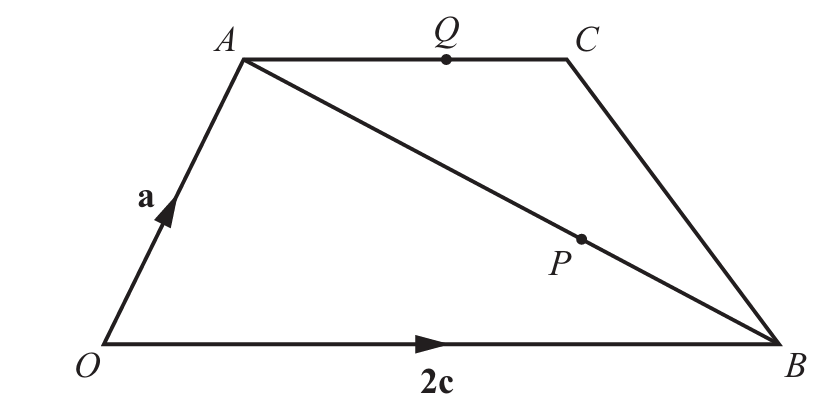
OACB is a trapezium with OB = 2AC.
\(\overrightarrow{OA} = \mathbf{a}\) and \(\overrightarrow{OB} = 2\mathbf{c}\).
AP : PB = 4 : 1 and \(AQ\) = \(\frac{4}{5}AC\).
(i) Write each of the following in terms of \(\mathbf{a}\) and \(\mathbf{c}\).
Give each answer in its simplest form.
(a) \(\overrightarrow{AB}\)
(b) \(\overrightarrow{CB}\)
(c) \(\overrightarrow{OP}\)
(d) \(\overrightarrow{QP}\)
(ii) Use your answers to make two statements about the relationship between lines QP and CB.
▶️ Answer/Explanation
(a) \(\begin{pmatrix} 4 \\ -3 \end{pmatrix}\)
First multiply: \(2\begin{pmatrix} 3 \\ -5 \end{pmatrix} = \begin{pmatrix} 6 \\ -10 \end{pmatrix}\).
Then subtract: \(\begin{pmatrix} 6 \\ -10 \end{pmatrix} – \begin{pmatrix} 2 \\ -7 \end{pmatrix} = \begin{pmatrix} 4 \\ -3 \end{pmatrix}\).
(b)(i) (-4, -1)
Add MN vector to M’s coordinates: (2 + (-6)) = -4 and (-5 + 4) = -1.
(b)(ii) 7.21 or \(\sqrt{52}\)
Use Pythagoras’ theorem: \(\sqrt{(-6)^2 + 4^2} = \sqrt{36 + 16} = \sqrt{52}\).
(c)(i)(a) \(2\mathbf{c} – \mathbf{a}\)
AB is the vector from A to B, which is OB – OA = \(2\mathbf{c} – \mathbf{a}\).
(c)(i)(b) \(\mathbf{a} – \mathbf{c}\)
CB is the vector from C to B, which is OB – OC = \(2\mathbf{c} – (\mathbf{a} + \mathbf{c}) = \mathbf{c} – \mathbf{a}\).
Note: This is the negative of BC, as CB = -BC.
(c)(i)(c) \(\frac{1}{5}(\mathbf{a} + 8\mathbf{c})\)
OP is OA + AP = \(\mathbf{a} + \frac{4}{5}(2\mathbf{c} – \mathbf{a}) = \frac{1}{5}\mathbf{a} + \frac{8}{5}\mathbf{c}\).
(c)(i)(d) \(\frac{4}{5}(-\mathbf{a} + \mathbf{c})\)
QP is QA + AP = \(-\frac{4}{5}\mathbf{a} + \frac{4}{5}\mathbf{c} + \frac{4}{5}(2\mathbf{c} – \mathbf{a})\).
(c)(ii) QP is parallel to CB and QP = \(\frac{4}{5}\)CB
Since CB is \(\mathbf{c} – \mathbf{a}\) and QP is \(\frac{4}{5}(\mathbf{c} – \mathbf{a})\), they are parallel with QP being \(\frac{4}{5}\) the length of CB.
Topic – 6.5
(a) 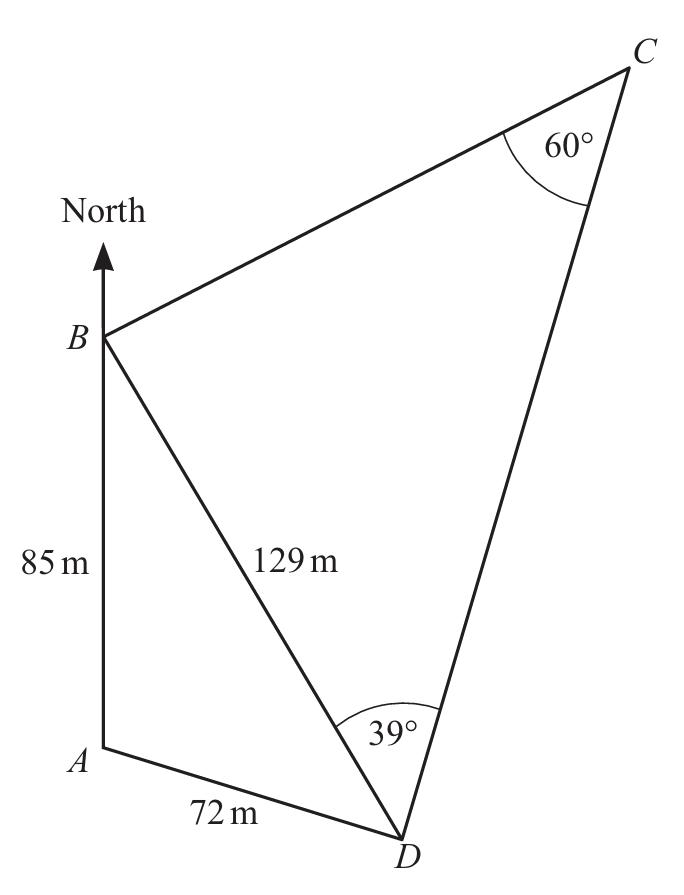
The diagram shows a field, ABCD with B north of A.
BD is a path across the field.
AB = 85 m, AD = 72 m, BD = 129 m, angle BDC = 39° and angle BCD = 60°.
(i) Show that angle CBD = 81°.
(ii) Calculate CD.
(iii) Show that angle ABD = 31.6°, correct to 1 decimal place.
(iv) Find the shortest distance from A to BD.
(v) Find the bearing of B from C.
(vi) Trees are planted in the field.
The number of trees planted is 1100 per hectare.
Calculate the total number of trees planted in the field.
[1 hectare = 10 000 m²]
(b) A rectangle has an area of 9400 cm², correct to the nearest 100 cm².
The length of the rectangle is 80 cm, correct to the nearest 10 cm.
Calculate the upper bound of the width of the rectangle.
▶️ Answer/Explanation
(a)(i) Angle CBD = 180° – 60° – 39° = 81°
Using the triangle angle sum property, subtract the given angles from 180°.
(a)(ii) 147 m
Using the sine rule: CD = (129 × sin 81°) / sin 60° ≈ 147.1 m.
(a)(iii) Using cosine rule in triangle ABD:
cos ABD = (85² + 129² – 72²)/(2×85×129) ≈ 0.8519 → ABD ≈ 31.6°
(a)(iv) 44.5 m
Shortest distance is perpendicular from A to BD: 85 × sin 31.6° ≈ 44.5 m.
(a)(v) 247°
Bearing = 180° + (180° – 81° – 31.6°) ≈ 247° from north at C.
(a)(vi) 972 or 973 trees
Calculate areas of triangles ABD and BCD using trigonometry, sum them, convert to hectares, and multiply by 1100.
(b) 126 cm
Upper bound of area = 9450 cm², lower bound of length = 75 cm. Maximum width = 9450/75 = 126 cm.
Topic – 8.3
(a) A bag contains 24 coloured beads.
Some are red, some are blue and 10 are yellow.
One bead is picked at random from the bag.
Find the probability that
(i) the bead is yellow.
(ii) the bead is not yellow.
(b) Another bag contains 5 green marbles, 6 white marbles and 4 black marbles.
Meera picks 2 marbles at random from the bag, without replacement.
Find the probability that
(i) the first marble is black and the second marble is white.
(ii) both marbles have different colours.
▶️ Answer/Explanation
(a)(i) $\frac{5}{12}$
Probability is favorable outcomes over total: $\frac{10}{24} = \frac{5}{12}$.
(a)(ii) $\frac{7}{12}$
Probability of not yellow is 1 minus probability of yellow: $1 – \frac{5}{12} = \frac{7}{12}$.
(b)(i) $\frac{4}{35}$
First marble black: $\frac{4}{15}$. Second marble white: $\frac{6}{14}$. Multiply them: $\frac{4}{15} \times \frac{6}{14} = \frac{4}{35}$.
(b)(ii) $\frac{74}{105}$
Calculate 1 minus probability of same colors: $1 – (\frac{5}{15}\times\frac{4}{14} + \frac{6}{15}\times\frac{5}{14} + \frac{4}{15}\times\frac{3}{14}) = \frac{74}{105}$.
Topic – 2.13
Given: \( f(x) = 2x – 5 \) and \( g(x) = x^2 – 2x \)
(a) Find:
(i) \( f(7) \)
(ii) \( gf(7) \)
(iii) \( f^{-1}(x) \).
(b) Find \( gf(x) – 3g(x) \).
Give your answer in the form \( ax^2 + bx + c \).
▶️ Answer/Explanation
(a)(i) 9
Substitute x=7 into f(x): \( f(7) = 2(7) – 5 = 14 – 5 = 9 \).
(a)(ii) 63
First find f(7)=9, then g(9): \( g(9) = 9^2 – 2(9) = 81 – 18 = 63 \).
(a)(iii) \( \frac{x + 5}{2} \)
Let y=2x-5, swap x and y: x=2y-5. Solve for y: \( y = \frac{x + 5}{2} \).
(b) \( x^2 – 18x + 35 \)
First find gf(x): \( g(f(x)) = (2x-5)^2 – 2(2x-5) \).
Then subtract 3g(x): \( (4x^2-20x+25)-(4x-10)-3(x^2-2x) \).
Simplify to get \( x^2 – 18x + 35 \).
Topic – 2.12
A curve has the equation \( y = x^3 – 9x^2 – 48x \).
(a) Differentiate \( x^3 – 9x^2 – 48x \).
(b) Find the coordinates of the turning points of the graph of \( y = x^3 – 9x^2 – 48x \). You must show all your working.
(c) Determine whether each of the turning points is a maximum or a minimum. Give reasons for your answers.
▶️ Answer/Explanation
(a) \( 3x^2 – 18x – 48 \)
Differentiate term by term using the power rule: \( \frac{d}{dx}(x^3) = 3x^2 \), \( \frac{d}{dx}(-9x^2) = -18x \), and \( \frac{d}{dx}(-48x) = -48 \).
(b) \((-2, 52)\) and \((8, -448)\)
Set derivative equal to zero: \( 3x^2 – 18x – 48 = 0 \). Simplify to \( x^2 – 6x – 16 = 0 \). Solve using quadratic formula to get x = -2 and x = 8.
Substitute these x-values back into original equation to find corresponding y-values.
(c) \((-2, 52)\) is maximum, \((8, -448)\) is minimum
Find second derivative: \( 6x – 18 \). For x = -2: \( 6(-2) – 18 = -30 \) (negative = maximum). For x = 8: \( 6(8) – 18 = 30 \) (positive = minimum).