
Topic – 1.11
Dinari sells fruit and vegetables.
(a) One day the mass of fruit and vegetables he sells is in the ratio
fruit : vegetables = 9 : 8
He sells 48 kg of vegetables.
Find the mass of the fruit he sells.
(b) On another day he receives $280 for the fruit and vegetables he sells.
The $280 is in the ratio
fruit : vegetables = $(c+3) : (c-1)$
Find the amount he receives from selling the fruit.
(c) In one week Dinari buys fruit and vegetables for $1620.
He sells the fruit and vegetables for $1750.
Calculate his percentage profit.
(d) In another week Dinari sells fruit and vegetables for $1738.
He makes a profit of 10%.
Calculate the amount he paid for the fruit and vegetables in that week.
▶️ Answer/Explanation
(a) 54 kg
Using the ratio 9:8, for 8 parts = 48 kg, so 1 part = 6 kg. Therefore, fruit (9 parts) = 9 × 6 = 54 kg.
(b) $142
Total parts = (c+3) + (c-1) = 2c + 2. Setting up the equation: (c+3)/(2c+2) × 280 gives c = 139. Then fruit amount = (139+3)/2 × 280 = $142.
(c) 8.02%
Profit = $1750 – $1620 = $130. Percentage profit = (130/1620) × 100 = 8.02%.
(d) $1580
Let cost price be x. Selling price = 110% of x = 1.1x = $1738. Therefore, x = 1738/1.1 = $1580.
Topic – 7.1
(a) A is the point (3, 7) and B is the point (-1, 5).
(i) Find the coordinates of the midpoint of the line AB.
(ii) Write \( \overrightarrow{AB}\) as a column vector.
(iii) \( \overrightarrow{AC}\) = \( \overrightarrow{3BA}\). Find the coordinates of C.
(b) 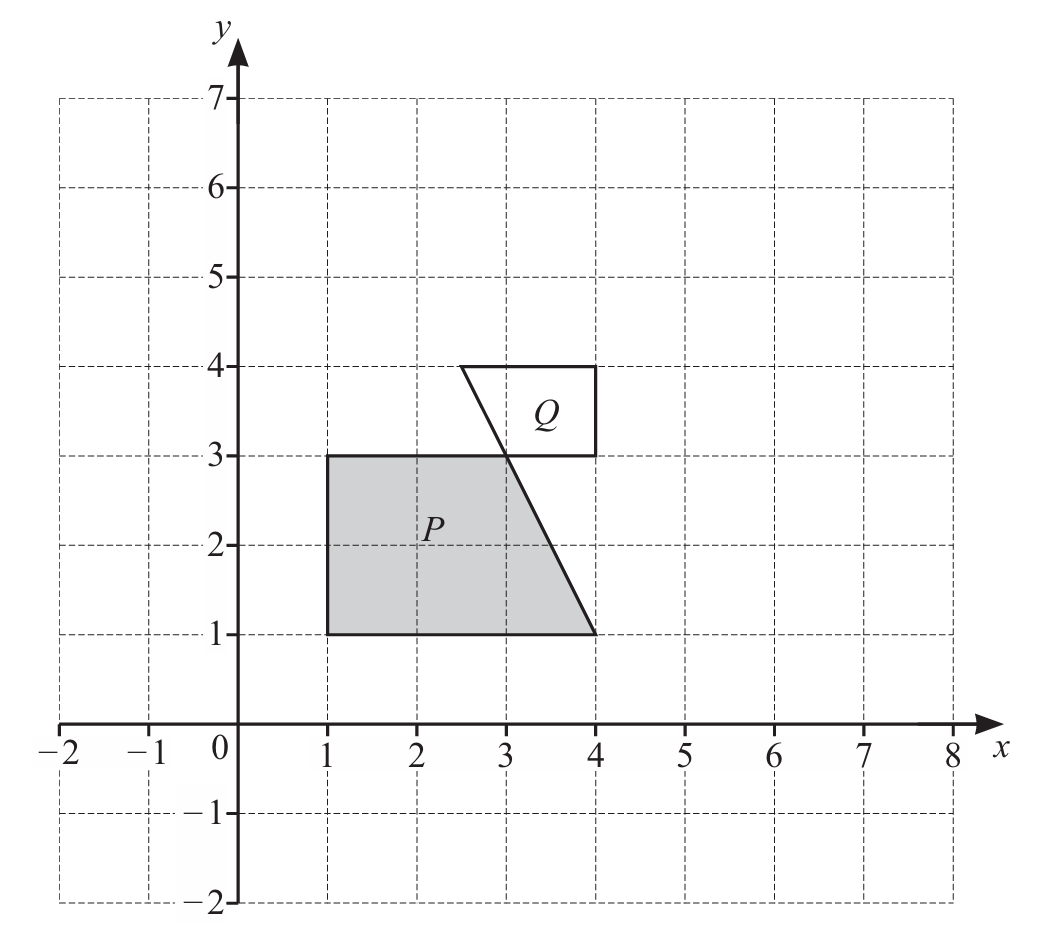
(i) Rotate shape P through 180° about the point (4, 1).
(ii) Reflect shape P in the line \(y = x + 2\).
(iii) Describe fully the single transformation that maps shape P onto shape Q.
▶️ Answer/Explanation
(a)(i) (1, 6)
Midpoint is average of x and y coordinates: ((3+(-1))/2, (7+5)/2) = (1, 6).
(a)(ii) \(\begin{pmatrix} -4 \\ -2 \end{pmatrix}\)
Subtract coordinates of A from B: (-1-3, 5-7) = (-4, -2).
(a)(iii) (15, 13)
BA is (4, 2). AC = 3BA = (12, 6). Add to A’s coordinates: (3+12, 7+6) = (15, 13).
(b)(i) Image at (4, 1), (5, -1), (7, -1), (7, 1)
Rotate each vertex 180° about (4,1) by changing signs of differences from center.
(b)(ii) Image at (1, 3), (-1, 3), (-1, 6), (1, 5)
Reflect each vertex in y = x + 2 by swapping x and y and adjusting for the line’s intercept.
(b)(iii) Enlargement with center (3, 3) and scale factor -½
Shape Q is half the size and inverted, so it’s a negative enlargement about the center point (3,3).
Topic – 1.16
(a) Ed invests $500 in an account paying r% per year simple interest.
At the end of 14 years the total amount in Ed’s account is $675.
Find the value of r.
(b) Eva invests $400 at a rate of 2.2% per year compound interest.
Calculate the total interest earned at the end of 11 years.
(c) Erin invests $700 at a rate of p% per month compound interest.
At the end of 21 years the value of Erin’s investment is $1074, correct to the nearest dollar.
Calculate the value of p.
▶️ Answer/Explanation
(a) r = 2.5
Simple interest formula: I = P × r × t. Total amount = $675 – $500 = $175 interest. Solving 500 × r × 14 = 175 gives r = 2.5%.
(b) $108.18
Compound interest formula: A = P(1 + r)^t. Calculation: 400 × (1.022)^11 ≈ 508.18. Subtract principal: 508.18 – 400 = $108.18 interest.
(c) p = 0.17
Monthly compounding over 21 years (252 months). Using A = P(1 + r)^n: 1074 = 700(1 + p/100)^252. Solving gives p ≈ 0.17% per month.
Topic – 5.4
(a) A box contains 50 cuboids.
Each cuboid has a mass of 135 g.
The total mass of the cuboids and the box is 7 kg.
Calculate the mass of the box. Give your answer in grams.
(b) A solid cube of side 4 cm is fixed to the base inside an empty cube of side 6 cm.
Water is poured into the larger cube until it reaches the top of the smaller cube.
Calculate the amount of water poured into the larger cube.
(c) 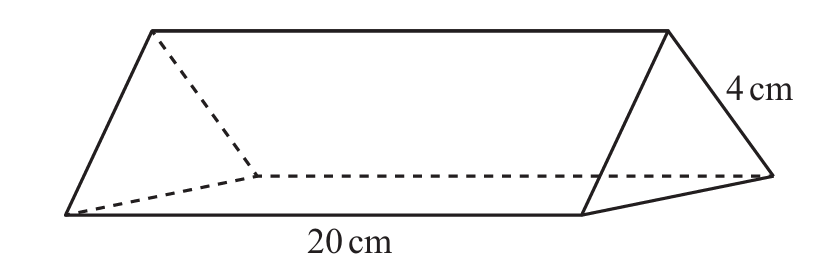
The diagram shows a solid triangular prism of length 20 cm.
The cross-section is an equilateral triangle with side length 4 cm.
The prism is made of wood with a density of 0.85 g/cm³.
Calculate the mass of the prism.
[Density = mass ÷ volume]
(d) 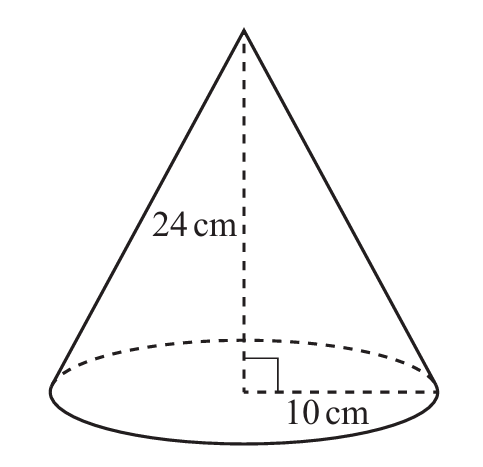
The diagram shows a solid cone with base radius 10 cm and height 24 cm.
(i) Show that the total surface area of the cone is 1131 cm², correct to the nearest cm².
[The curved surface area of a cone with base radius r and slant height l is A = πrl.]
(ii) The total surface area of the cone is painted.
- (a) The cost to paint the cone is $1.71. Calculate the cost to paint 1 cm² of the cone. Give your answer in cents.
- (b) One tin of paint has enough paint to cover 2.5 m². Calculate the number of these cones that can be painted completely using one tin of paint.
▶️ Answer/Explanation
(a) 250 g
First calculate total mass of cuboids: 50 × 135g = 6750g. Then subtract from total mass: 7000g – 6750g = 250g.
(b) 80 cm³
Calculate volume of large cube (6³ = 216cm³) minus volume of small cube (4³ = 64cm³). Water volume is 216 – (216 – 64) = 80cm³.
(c) 118 g
First find area of equilateral triangle: (√3/4)×4² = 6.928cm². Then volume: 6.928×20 = 138.56cm³. Mass is volume × density: 138.56×0.85 ≈ 118g.
(d)(i) 1131 cm²
Find slant height: √(10²+24²) = 26cm. Curved surface area: π×10×26 ≈ 816.8cm². Base area: π×10² ≈ 314.2cm². Total: 816.8+314.2 ≈ 1131cm².
(d)(ii)(a) 0.151 cents
Divide total cost by area: $1.71 ÷ 1131 ≈ $0.00151/cm², which is 0.151 cents/cm².
(d)(ii)(b) 22 cones
Convert 2.5m² to cm² (25000cm²). Divide by area per cone: 25000 ÷ 1131 ≈ 22.1, so 22 complete cones can be painted.
Topic – 1.12
(a) Naomi runs 100 m in 15 seconds.
Calculate Naomi’s average speed in kilometres per hour.
(b) Olav runs for 45 minutes at a speed of 9.5 km/h.
He then runs 8.1 km at a speed of 7.5 km/h.
Calculate Olav’s average speed for the whole run.
(c) A train has length p metres.
The train passes through a station of length q metres.
The speed of the train is v kilometres per hour.
Find an expression for the time the train takes to completely pass through the station.
Give your answer in seconds, in terms of p, q and v.
▶️ Answer/Explanation
(a) 24 km/h
Convert 100m to 0.1km and 15 seconds to 15/3600 hours. Speed = distance/time = 0.1/(15/3600) = 24 km/h.
(b) 8.32 km/h
First distance: 9.5×(45/60) = 7.125km. Total distance = 7.125+8.1 = 15.225km. Total time = 45/60 + 8.1/7.5 = 1.83 hours. Average speed = total distance/total time ≈ 8.32 km/h.
(c) \(\frac{18(p+q)}{5v}\) seconds
Total distance is p+q meters (0.001(p+q) km). Time in hours = distance/speed = 0.001(p+q)/v. Convert to seconds by multiplying by 3600, which simplifies to 18(p+q)/5v.
Topic – 2.2
(a) Simplify \(\frac{24u}{5y} \times \frac{10}{3u}\).
(b) Expand and simplify \((x-1)(x+2)(x+3)\).
(c) Solve the equation \(2x^2 + x – 5 = 0\).
You must show all your working and give your answers correct to 2 decimal places.
▶️ Answer/Explanation
(a) \(\frac{16}{y}\)
Multiply the numerators: \(24u \times 10 = 240u\). Multiply denominators: \(5y \times 3u = 15uy\).
Simplify the fraction \(\frac{240u}{15uy}\) by canceling common factors (15 and u) to get \(\frac{16}{y}\).
(b) \(x^3 + 4x^2 + x – 6\)
First multiply (x-1)(x+2) to get \(x^2 + x – 2\). Then multiply this result by (x+3) to get the final expanded form.
(c) \(x = -1.85\) or \(x = 1.35\)
Use the quadratic formula: \(x = \frac{-b \pm \sqrt{b^2 – 4ac}}{2a}\). Here a=2, b=1, c=-5.
Calculate discriminant: \(1 – 4(2)(-5) = 41\). Then find two solutions using the formula.
Topic – 5.2
(a)(i) 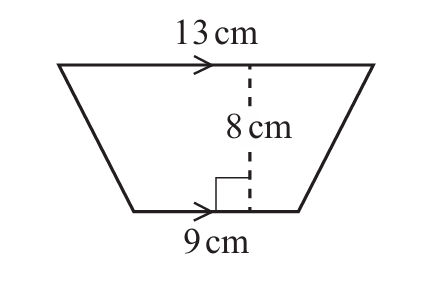
Calculate the area of the trapezium.
(ii) 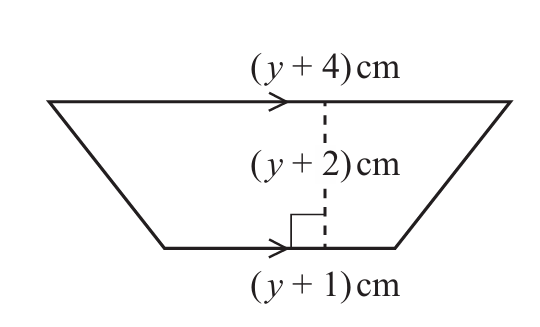
The area of this trapezium is 264 cm2.
- (a) Show that 2y2 + 9y – 518 = 0.
- (b) Solve 2y2 + 9y – 518 = 0 by factorisation to find the value of y.
(b) 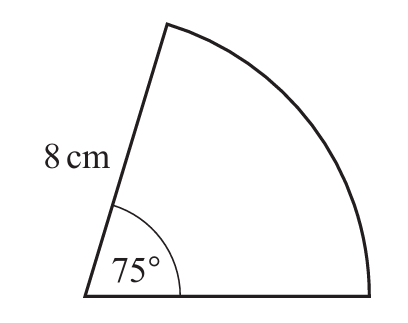
The diagram shows a sector of a circle with radius 8 cm and angle 75°.
Find the perimeter of the sector.
(c) 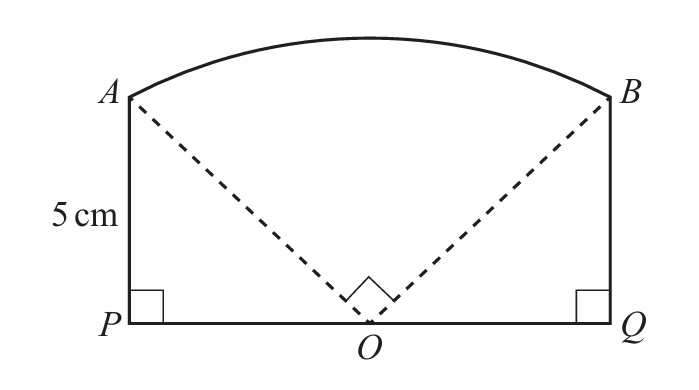
The diagram shows a shape ABQP made from three straight lines and an arc of a sector of a circle.
The sector has center O and angle 90°.
POQ is a straight line and AP = PO = OQ = QB = 5 cm.
Find the area of ABQP.
Give your answer in the form a + kπ.
▶️ Answer/Explanation
(a)(i) 88 cm2
Area of trapezium = ½ × (sum of parallel sides) × height.
Calculation: ½ × (9 + 13) × 8 = ½ × 22 × 8 = 88 cm2.
(a)(ii)(a)
Area formula: ½ × (y+4 + y+1) × (y+2) = 264.
Simplifies to: (2y+5)(y+2) = 528 → 2y2 + 9y + 10 = 528.
Final equation: 2y2 + 9y – 518 = 0.
(a)(ii)(b) y = 14
Factorize: (2y + 37)(y – 14) = 0.
Valid solution is y = 14 since length can’t be negative.
(b) 26.5 cm
Perimeter = 2 radii + arc length.
Arc length = (75/360) × 2π × 8 ≈ 10.47 cm.
Total perimeter = 8 + 8 + 10.47 ≈ 26.5 cm.
(c) 25 + \(\frac{25}{2}\pi\) cm2
Total area = area of sector + area of two triangles.
Sector area = ¼ × π × 102 = 25π/2 cm2.
Triangles area = 2 × (½ × 5 × 5) = 25 cm2.
Topic – 9.4
Guillaume measures the speed of each of 100 cars.
The results are shown in the table.
| Speed (v km/h) | 30 < v ≤ 40 | 40 < v ≤ 45 | 45 < v ≤ 50 | 50 < v ≤ 70 |
|---|---|---|---|---|
| Frequency | 15 | 20 | 35 | 30 |
(a) Guillaume draws a pie chart for this data. Calculate the angle for the interval 45 < v ≤ 50.
(b) Calculate an estimate of the mean speed.
(c) Complete the histogram to show the data in the table.
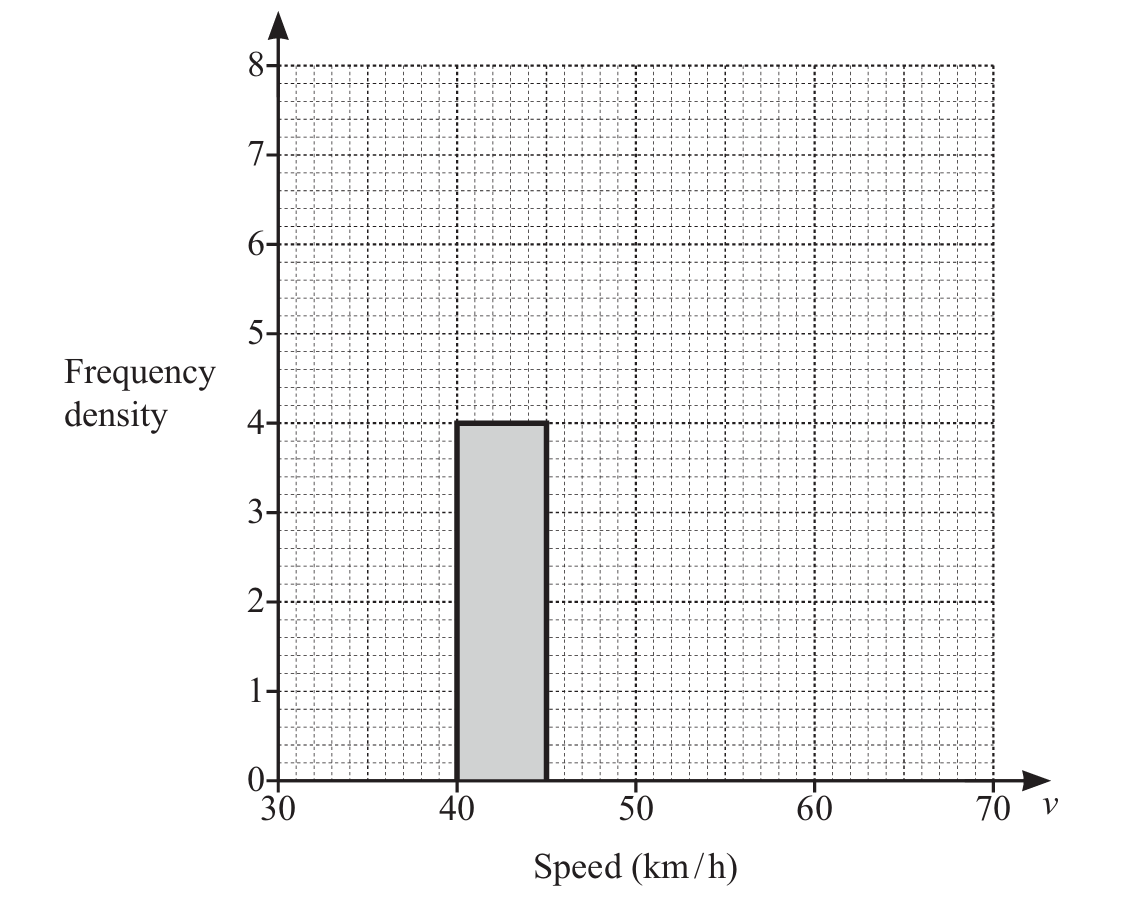
▶️ Answer/Explanation
(a) 126°
For the 45-50 km/h interval (frequency 35), calculate angle as (35/100) × 360° = 126°.
(b) 48.375 km/h
Use midpoints: 35, 42.5, 47.5, 60 km/h. Multiply by frequencies and sum: (15×35 + 20×42.5 + 35×47.5 + 30×60) = 4837.5. Divide by total frequency (100) to get mean.
(c) Histogram with correct widths and heights:
Frequency densities: 1.5 (30-40), 4 (40-45), 7 (45-50), 1.5 (50-70). Widths represent class intervals, heights represent frequency density (frequency/class width).
Topic – 8.3
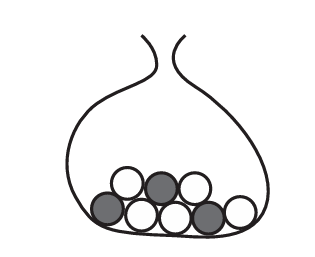
A bag contains 5 white balls and 3 black balls.
(a)(i) Marwan picks a ball from the bag at random and then replaces it.
Find the probability that the ball is white.
(ii) Naomi picks a ball from the bag at random and then replaces it.
She repeats this 120 times.
Find the number of times the ball is expected to be white.
(b) Oscar picks a ball from the bag at random.
He replaces it and then picks a second ball from the bag at random.
(i) Find the probability that the balls are the same colour.
(ii) Find the probability that the balls are not the same colour.
(c) Priya picks 3 of the 8 balls from the bag at random without replacement.
Find the probability that she picks two white balls and one black ball.
▶️ Answer/Explanation
(a)(i) $\frac{5}{8}$
There are 5 white balls out of 8 total balls, so probability is $\frac{5}{8}$.
(a)(ii) 75
Multiply the probability by number of trials: $120 \times \frac{5}{8} = 75$ expected white balls.
(b)(i) $\frac{17}{32}$
Probability of both white: $\frac{5}{8} \times \frac{5}{8} = \frac{25}{64}$. Both black: $\frac{3}{8} \times \frac{3}{8} = \frac{9}{64}$. Add them together.
(b)(ii) $\frac{15}{32}$
Subtract same-color probability from 1: $1 – \frac{17}{32} = \frac{15}{32}$.
(c) $\frac{15}{28}$
Number of ways to choose 2 white from 5: $\binom{5}{2} = 10$. Choose 1 black from 3: $\binom{3}{1} = 3$. Total ways: $\binom{8}{3} = 56$. Probability: $\frac{10 \times 3}{56} = \frac{15}{28}$.
Topic – 2.12
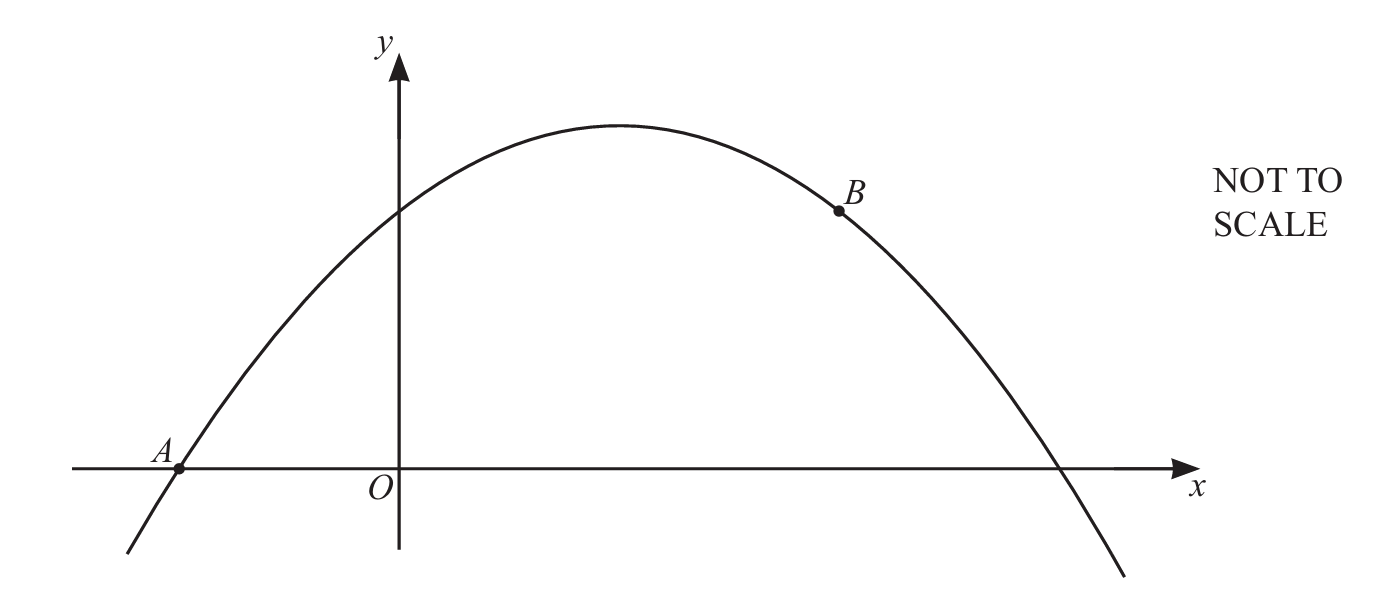
The diagram shows a sketch of the graph of \( y = 3 + 2x – x^2 \).
A is the point (-1, 0) and B is the point (2, 3).
(a) Find the derivative of \(3 + 2x – x^2\).
(b) (i) Show that the equation of the tangent at A is \( y = 4x + 4 \).
(ii) The line L is perpendicular to the line \( y = 4x + 4 \).
The line L passes through the point B.
Find the equation of the line L.
Give your answer in the form \( y = mx + c \).
(c) Find the coordinates of the maximum point on the graph of \( y = 3 + 2x – x^2 \).
▶️ Answer/Explanation
(a) \( 2 – 2x \)
Differentiate each term: derivative of 3 is 0, derivative of 2x is 2, and derivative of -x² is -2x.
(b)(i) The gradient at A (-1,0) is found by substituting x=-1 into the derivative: 2-2(-1)=4. Using point-slope form: y-0=4(x+1) gives y=4x+4.
(b)(ii) \( y = -\frac{1}{4}x + \frac{7}{2} \)
The perpendicular slope is -1/4. Using point B (2,3): 3=(-1/4)(2)+c gives c=7/2.
(c) (1, 4)
Set derivative equal to 0: 2-2x=0 gives x=1. Substitute into original equation: y=3+2(1)-(1)²=4.
Topic – 2.13
\(f(x) = 2x+5\) \(g(x) = 1 – 2x\) \(h(x) = \frac{1}{x + 1}, x\neq -1\) \(j(x) = 2^{x}\)
(a) Find g(-3).
(b) Find f(x)g(x) + fg(x) + 1.
Give your answer in its simplest form.
(c) Find \(g^{-1}(x)\).
(d) Find hh(1).
(e) Simplify \(\frac{1}{f(x)} – h(x)\).
Give your answer as a single fraction in its simplest form.
(f) Find \(x\) when \(j(x) = \frac{1}{32}\).
(g) Find \(x\) when \(j^{-1}(x) = 0\).
▶️ Answer/Explanation
(a) 7
Substitute x = -3 into g(x): g(-3) = 1 – 2(-3) = 1 + 6 = 7.
(b) \(-4x^2 – 12x + 13\)
First find f(x)g(x) = (2x + 5)(1 – 2x) = 2x – 4x² + 5 – 10x = -4x² – 8x + 5.
Then find fg(x) = f(1 – 2x) = 2(1 – 2x) + 5 = 7 – 4x.
Combine them: -4x² – 8x + 5 + 7 – 4x + 1 = -4x² – 12x + 13.
(c) \(\frac{1 – x}{2}\)
Let y = g(x) = 1 – 2x. Swap x and y and solve for y: x = 1 – 2y → 2y = 1 – x → y = \(\frac{1 – x}{2}\).
(d) \(\frac{2}{3}\)
First find h(1) = \(\frac{1}{1 + 1} = \frac{1}{2}\). Then find hh(1) = h(\(\frac{1}{2}\)) = \(\frac{1}{\frac{1}{2} + 1} = \frac{2}{3}\).
(e) \(\frac{-x – 4}{(2x + 5)(x + 1)}\)
\(\frac{1}{2x + 5} – \frac{1}{x + 1}\). Find common denominator: \(\frac{(x + 1) – (2x + 5)}{(2x + 5)(x + 1)} = \frac{-x – 4}{(2x + 5)(x + 1)}\).
(f) -5
Set \(2^x = \frac{1}{32}\). Since \(\frac{1}{32} = 2^{-5}\), x must be -5.
(g) 1
Find inverse of j(x): \(j^{-1}(x) = \log_2 x\). Set \(\log_2 x = 0\), which means \(x = 2^0 = 1\).
Topic – 6.5
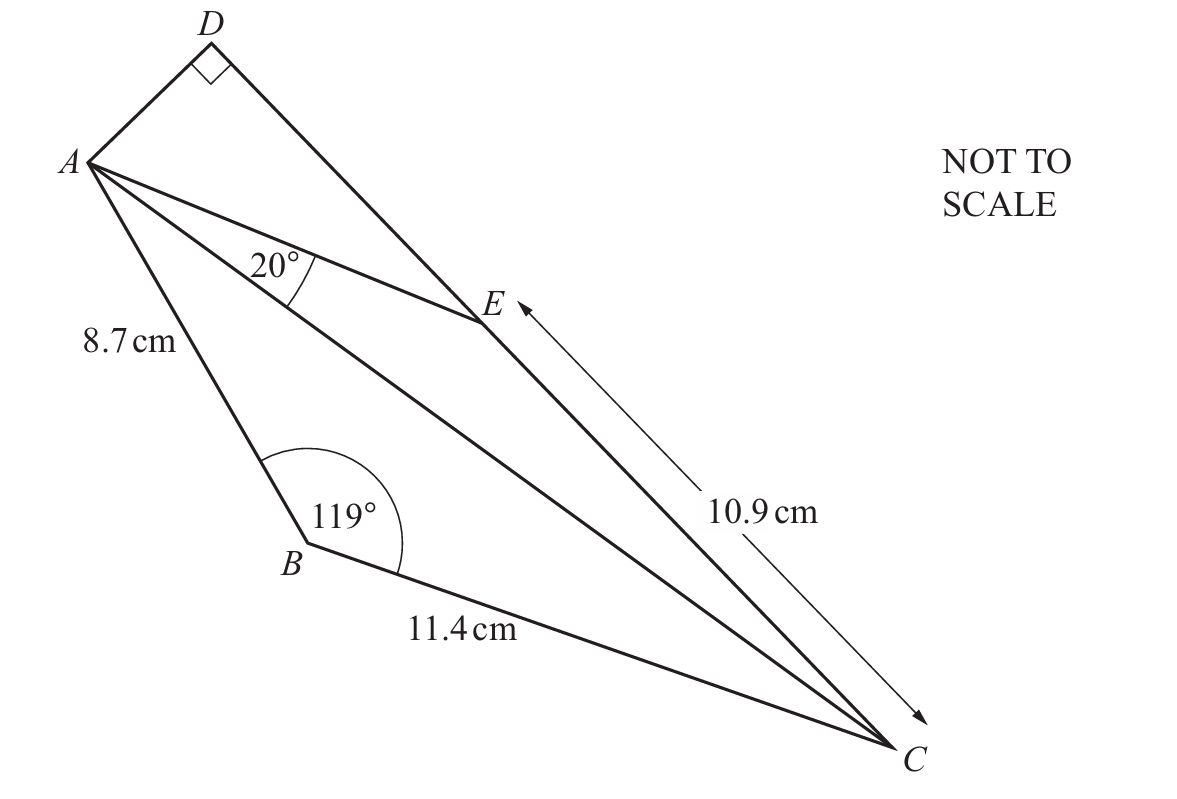
ABCD is a quadrilateral and E is a point on CD.
AB = 8.7 cm, BC = 11.4 cm and CE = 10.9 cm.
Angle ADE = 90°, angle ABC = 119° and angle CAE = 20°.
(a) Show that AC = 17.37 cm, correct to 2 decimal places.
(b) Angle AEC is obtuse. Calculate angle ACE.
(c) Calculate the perimeter of quadrilateral ABCD.
▶️ Answer/Explanation
(a) Using the cosine rule in triangle ABC:
AC² = 8.7² + 11.4² – 2×8.7×11.4×cos(119°)
AC = √301.83 = 17.37 cm (to 2 d.p.)
(b) 13.0°
Using the sine rule in triangle ACE: sin(ACE)/10.9 = sin(20°)/17.37
ACE = arcsin(0.225) = 13.0° (since AEC is obtuse)
(c) 40.9 cm
Find AD using right triangle ADE: AD = AC×sin(ACE) = 3.9 cm
Find CD using cosine rule: CD = 13.6 cm. Perimeter = AB + BC + CD + AD = 40.9 cm