Question
The diagram show a test-tube containing pond water. The green colour is caused by microorganisms that have chloroplasts.
Which characteristics of living organisms are shown?
A excretion, growth and movement
B movement, nutrition and sensitivity
C nutrition, reproduction and respiration
D reproduction, sensitivity and growth
Answer/Explanation
Ans : B
Question
Which term means a group of organisms that can reproduce to produce fertile offspring?
A genus
B kingdom
C population
D species
Answer/Explanation
Ans : D
Question
Which group of characteristics describes a mammal?
| has body hair | produces milk | controls body temperature | produces live young | |
| A | yes | yes | yes | yes |
| B | yes | no | yes | yes |
| C | no | yes | no | no |
| D | no | no | no | no |
Answer/Explanation
Ans : A
Question
Two types of cell, one animal and one plant, were examined using a light microscope.
Which row shows the correct combination of structures that would be observed in the cells?
Answer/Explanation
Ans : B
Question
The heart, arteries, veins and capillaries work together.
Which level of organisation is shown by these structures working together?
A a tissue
B an organ
C an organism
D an organ system
Answer/Explanation
Ans : D
Question
The diagram shows a cell. The diameter of the cell in the diagram is 18 mm.
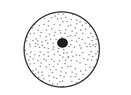
The actual diameter of the cell is 0.05 mm.
What is the magnification of the diagram?
A ×0.003 B ×0.9 C ×360 D ×36 000
Answer/Explanation
Ans : C
Question
The diagram shows a cross-section through a leaf.
Which arrow shows the direction of diffusion of carbon dioxide on a sunny day?
Answer/Explanation
Ans : D
Question
The diagram shows a plant cell which has lost water to its surroundings by osmosis.
Which part is the partially permeable membrane?
Answer/Explanation
Ans : C
Question
Which row is correct for a positive food test for vitamin C?
| colour of the food test reagent at the start | heat required | final colour of the food test reagent | |
| A | colourless | yes | purple |
| B | blue | no | colourless |
| C | colourless | no | blue |
| D | blue | yes | orange |
Answer/Explanation
Ans : B
Question
What controls the speed of chemical reactions in all living cells?
A enzymes
B hormones
C ions
D vitamins
Answer/Explanation
Ans : A
Question
The table shows some properties of enzyme molecules.
Which row is a correct description of enzymes?
| chemical elements present | effect of changing temperature | enzyme activity | |
| A | C, H and O only | can increase reaction rate | enzyme can be reused |
| B | C, H and O only | has no effect | enzyme is used up |
| C | C, H, O and N | can increase reaction rate | enzyme can be reused |
| D | C, H, O and N | can decrease reaction rate | enzyme is used up |
Answer/Explanation
Ans : C
Question
A piece of foil was placed over one green and white leaf on a plant.
The plant was placed under a bright light for 24 hours and then tested for starch with iodine
solution.
Which diagram shows the areas of the leaf that would stain blue-black with iodine solution?
Answer/Explanation
Ans : A
Question
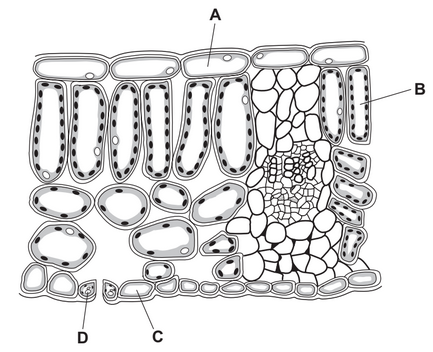
The diagram shows a cross-section of a leaf.
Which labelled cell is a guard cell?
Answer/Explanation
Ans : D
Question
Which condition can be caused by a lack of fibre in the diet?
A constipation
B obesity
C scurvy
D starvation
Answer/Explanation
Ans : A
Question
Which structure has a large surface area for the absorption of digested food?
A alveolus
B ileum
C liver
D pancreas
Answer/Explanation
Ans : B
Question
In which part of the alimentary canal do both chemical digestion and mechanical digestion take
place?
A colon
B duodenum
C mouth
D oesophagus
Answer/Explanation
Ans : C
Question
The diagrams show stages in the passage of water through a plant.
Which arrow shows water moving in the form of water vapour?
Answer/Explanation
Ans : B
Question
Which molecules are transported by the phloem?
A cellulose
B glycogen
C starch
D sugar
Answer/Explanation
Ans : D
Question
The diagram shows a section through the heart.
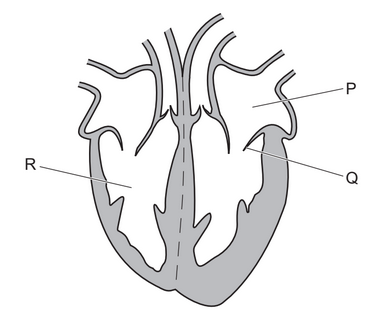
What is the function of the structure labelled Q?
A It controls the amount of blood leaving the heart.
B It increases the pressure in part R.
C It prevents backflow of blood into part P.
D It prevents blood flowing into the vena cava.
Answer/Explanation
Ans : C
Question
Which blood vessel returns blood from the lungs to the heart?
A aorta
B pulmonary artery
C pulmonary vein
D renal vein
Answer/Explanation
Ans : C
Question
What is an example of a transmissible disease?
A an STI
B chronic obstructive pulmonary disease (COPD)
C coronary heart disease
D dental decay
Answer/Explanation
Ans : A
Question
Compared with inspired air, which description of expired air is correct?
A It has less oxygen and less carbon dioxide.
B It has less oxygen and more carbon dioxide.
C It has more oxygen and less carbon dioxide.
D It has more oxygen and more carbon dioxide.
Answer/Explanation
Ans : B
Question
Which row shows the features of the gas exchange surface in humans?
| Surface area | thickness | |
| A | large | thick |
| B | large | thin |
| C | small | thick |
| D | small | thin |
Answer/Explanation
Ans : B
Question
Yeast is placed inside a container full of a glucose solution with no air.
Which word equation summarises the process that takes place inside the container?
A glucose → alcohol + carbon dioxide
B glucose → lactic acid
C glucose + oxygen → carbon dioxide + water
D glucose + oxygen → alcohol
Answer/Explanation
Ans : A
Question
Which process uses energy released in respiration?
A diffusion
B evaporation
C growth
D osmosis
Answer/Explanation
Ans : C
Question
The graph shows the rates of sweat production and urine production at different environmental
temperatures.
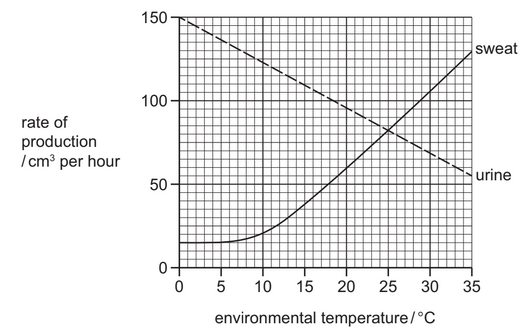
Which statement is correct?
A As the temperature increases, the rates of sweat and urine production increase.
B As the temperature increases, the rate of urine production increases.
C At 250 C the rates of sweat and urine production are the same.
D Urine and sweat production are directly proportional to environmental temperature.
Answer/Explanation
Ans : C
Question
Which numbered parts form the central nervous system?
A 1 only B 1 and 2 C 2 and 3 D 3 only
Answer/Explanation
Ans : B
Question
The diagram shows a section through the eye of an octopus. Octopuses have eyes that are
similar in structure and function to human eyes.
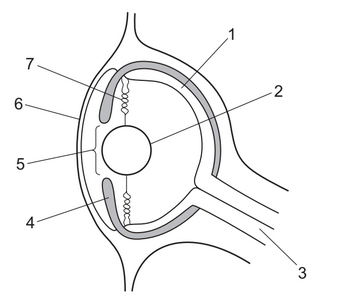
Which row identifies the structures of the octopus eye?
| pupil | cornea | lens | iris | |
| A | 4 | 6 | 7 | 3 |
| B | 5 | 1 | 2 | 3 |
| C | 4 | 1 | 7 | 5 |
| D | 5 | 6 | 2 | 4 |
Answer/Explanation
Ans : D
Question
The diagram shows a seedling that has been placed in a pot of soil.
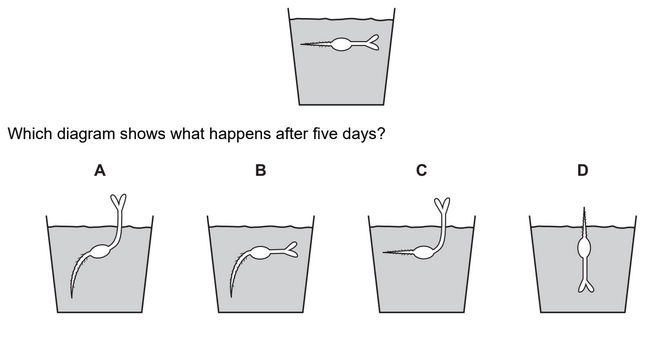
Answer/Explanation
Ans : A
Question
What is the definition of a drug?
A any illegal substance taken into the body
B any substance taken into the body
C any substance taken into the body that modifies or affects chemical reactions in the body
D any substance taken into the body which is not a medicine
Answer/Explanation
Ans : C
Question
Which statement about reproduction is correct?
A All living species can reproduce asexually.
B Gametes are needed for asexual reproduction.
C Only organisms that are separated from other organisms of the same species can reproduce
asexually.
D Some organisms reproduce asexually and sexually.
Answer/Explanation
Ans : D
Question
Fertilization is the fusion of which parts of two cells?
A cell walls
B cytoplasm
C nuclei
D vacuoles
Answer/Explanation
Ans : C
Question
Which row shows the conditions required for germination?
Answer/Explanation
Ans : D
Question
The pedigree diagram shows the inheritance of a genetic disease in a family.
Answer/Explanation
Ans : B
Question
The photograph shows two wind-pollinated flowers.
Answer/Explanation
Ans : C
Question
A scientist studied wild birds that lived by a lake. He observed that one bird species had a beak
that was adapted to extract small insects from the water.
Which process would have occurred in the development of this specialised beak?
A genetic engineering
B natural selection
C selective breeding
D fossilisation
Answer/Explanation
Ans : B
Question
The diagram shows three different types of organism in a food chain.
producer → organism 2 → organism 3Which statement is correct for this food chain?
A Organism 2 is a carnivore.
B Organism 2 is a secondary consumer.
C Organism 3 is a carnivore.
D Organism 3 is a tertiary consumer.
Answer/Explanation
Ans : C
Question
Which row shows the expected consequences of deforestation?
Answer/Explanation
Ans : C
Question
Gorillas are a type of large mammal. The graph shows the number of gorillas found in one region
of a country.
What could have caused the trend between 2000 and 2015?
A deforestation
B habitat destruction
C hunting ban
D disease
Answer/Explanation
Ans : C
