
▶️ Answer/Explanation
(a) haemoglobin
Explanation: Haemoglobin is the protein found in red blood cells that binds with oxygen to form oxyhaemoglobin, enabling the transport of oxygen from the lungs to tissues throughout the body.
(b) platelets
Explanation: Platelets are small cell fragments in the blood that play a crucial role in blood clotting by forming a plug at the site of injury and releasing chemicals that promote clot formation.
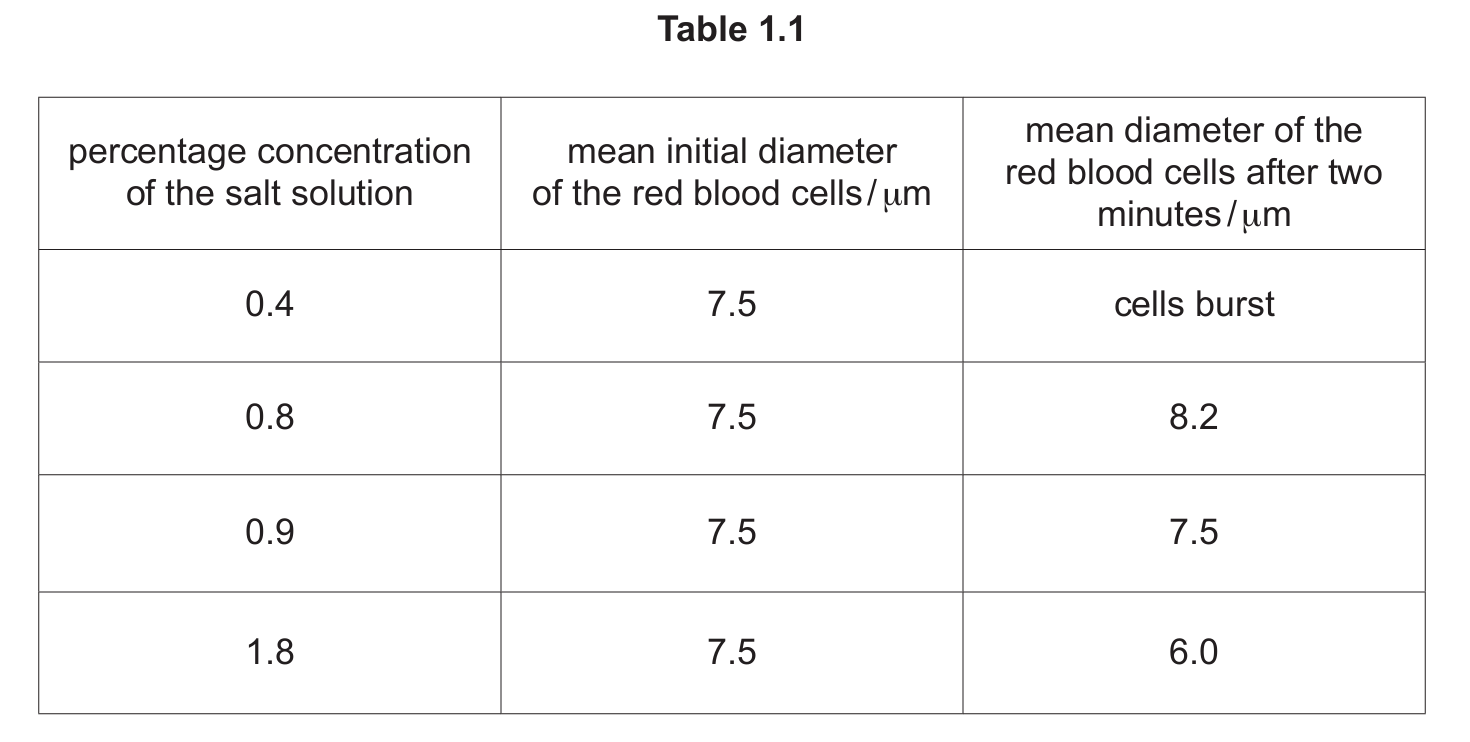
(c)(i) 9.3%
Working:
Initial diameter = 7.5 μm
Final diameter = 8.2 μm
Increase = 8.2 – 7.5 = 0.7 μm
Percentage increase = (0.7 / 7.5) × 100 = 9.333…% ≈ 9.3% (to 2 significant figures)
(c)(ii)
Explanation: The 1.8% salt solution has a lower water potential than the red blood cells. This causes water to move out of the cells by osmosis, across the partially permeable membrane, from an area of higher water potential (inside the cell) to lower water potential (the salt solution). As a result, the cells shrink, decreasing their mean diameter from 7.5 μm to 6.0 μm.
(c)(iii) The water potential of the red blood cells is the same as the 0.9% salt solution.
Explanation: When the water potential inside and outside the cell is equal, there is no net movement of water across the cell membrane. This isotonic condition means the cells neither gain nor lose water, so their diameter remains unchanged.
(d) Red blood cells do not have a rigid cell wall.
Explanation: In pure water, red blood cells take in water by osmosis and burst (lyse) because they lack a cell wall to prevent over-expansion. Plant cells have a rigid cell wall that resists the inward pressure of water, preventing bursting and instead making the cell turgid.
(e) Any two from:
- Transport of ions/sucrose (translocation)
- As a reactant in photosynthesis
- As a solvent for metabolic reactions
- Maintaining turgidity of cells (support)
- Medium for enzyme reactions
Explanation: Water is essential in plants for various functions. It acts as a transport medium in the xylem and phloem, is a raw material in photosynthesis, provides structural support through turgor pressure, and serves as a solvent for biochemical reactions.
▶️ Answer/Explanation
(a) An inherited (structural) feature that helps an organism to survive or reproduce in its environment.
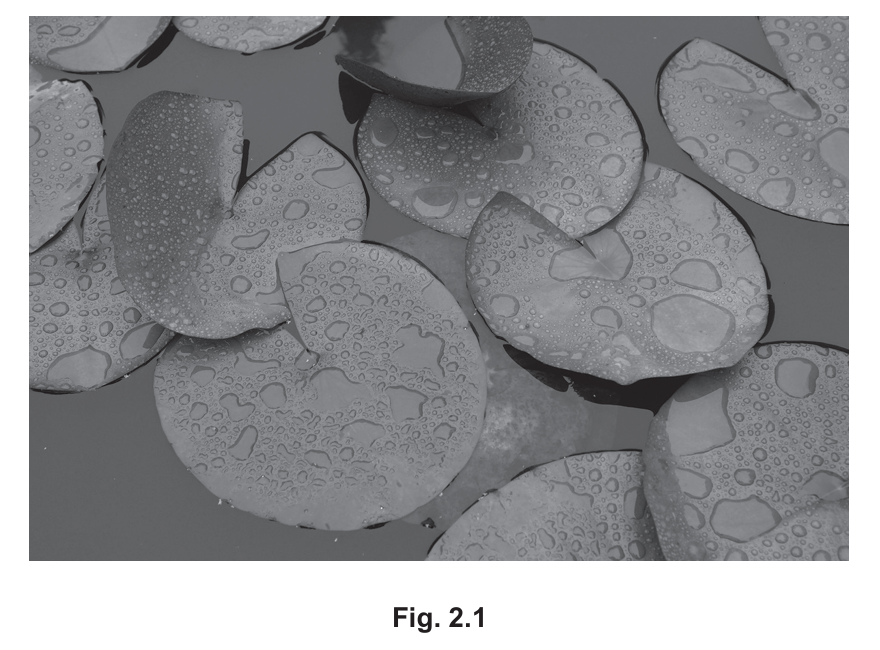
Explanation: Adaptive features are characteristics that organisms develop over generations through natural selection. These features enhance the organism’s ability to survive in its specific environment, such as the water lily’s floating leaves that allow it to thrive in aquatic conditions.
(b)(i)
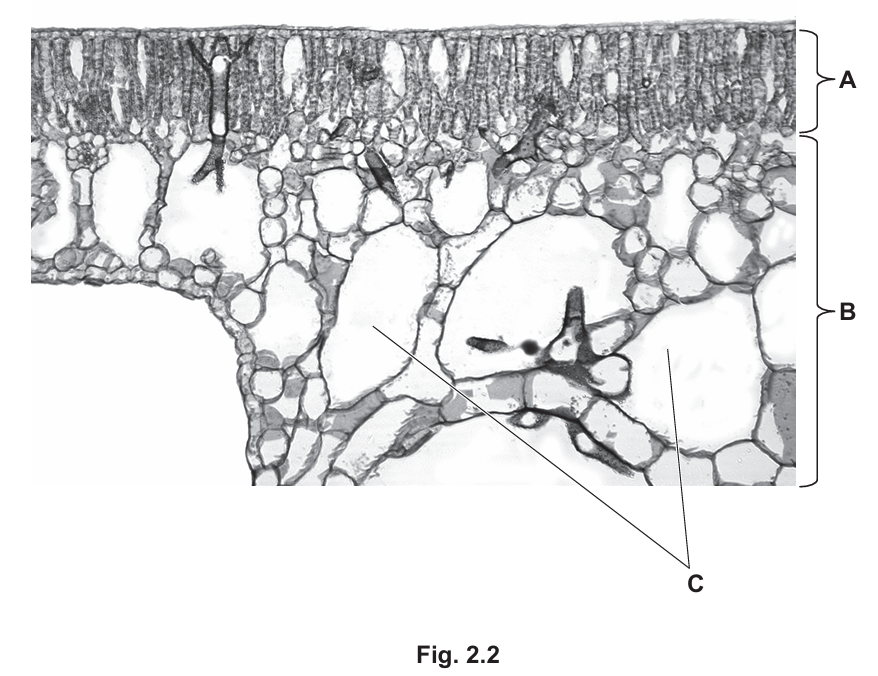
A – palisade mesophyll
B – spongy mesophyll
C – air spaces
Explanation: The palisade mesophyll (A) contains tightly packed chloroplast-rich cells for photosynthesis. The spongy mesophyll (B) has loosely arranged cells with air spaces (C) between them to facilitate gas exchange.
(b)(ii) The air spaces reduce the density of the leaf, allowing it to float on water and be near the surface where it can access light and carbon dioxide for photosynthesis.
Explanation: The extensive air spaces in water lily leaves serve multiple adaptive functions. They make the leaf buoyant, keeping it at the water’s surface where sunlight is abundant. This positioning also ensures access to atmospheric CO₂ for photosynthesis while the lower surface remains submerged.
(c)(i)
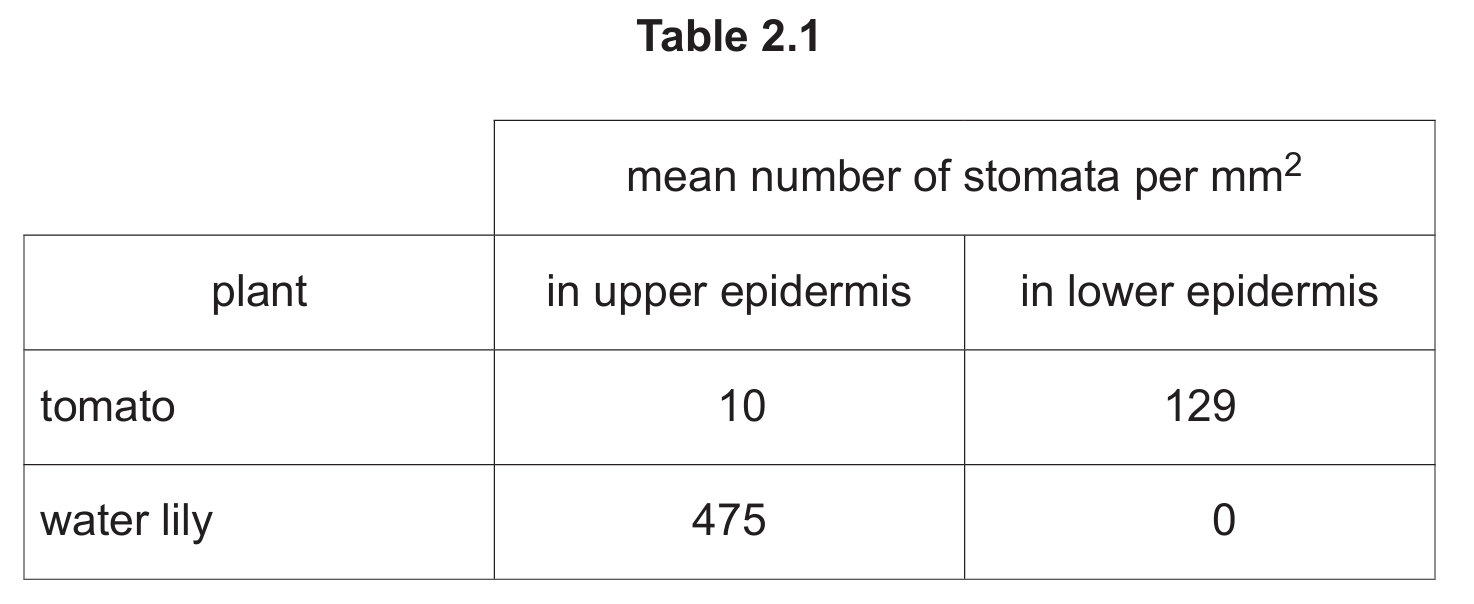
Tomato plants have more stomata on their lower epidermis (129/mm²) than upper epidermis (10/mm²), while water lilies have all stomata on the upper epidermis (475/mm²) and none on the lower epidermis.
Tomatoes reduce water loss by having most stomata on the shaded lower surface. Water lilies, floating on water, don’t need to conserve water and have stomata only on the upper surface exposed to air.
Explanation: Terrestrial plants like tomatoes evolved stomatal distribution to minimize water loss through transpiration, hence more stomata on the cooler, shaded lower surface. Hydrophytes like water lilies, with constant water supply, maximize gas exchange through numerous upper-surface stomata since their lower surface is underwater where stomata would be useless.
(c)(ii) Guard cells
Explanation: Guard cells are specialized kidney-shaped cells that flank each stoma. By changing their turgor pressure through osmotic water movement, they can open or close the stomatal pore, regulating gas exchange and transpiration.

▶️ Answer/Explanation
(a) X – vesicle (membrane); Y – synapse/synaptic gap
Explanation: In Fig. 3.2, X represents the membrane-bound vesicles that contain neurotransmitters, which are crucial for signal transmission between neurones. Y is the synaptic gap, the physical space between two neurones where neurotransmitters diffuse to carry the signal from one neurone to the next.
(b)
Explanation: Parkinson’s disease significantly impairs movement due to several neurological changes:
- Movement becomes slower and less coordinated because there are fewer vesicles containing neurotransmitters.
- The reduced number of neurotransmitters means fewer signals are transmitted across the synaptic gap.
- With fewer neurotransmitters binding to receptor proteins, the postsynaptic neurone receives weaker signals.
- This results in slower reflexes and difficulty initiating or controlling movements.
- The overall effect is impaired motor function, characteristic of Parkinson’s symptoms like tremors and rigidity.
(c)
- Nervous control is much faster than hormonal control, with responses occurring in milliseconds compared to seconds or minutes for hormones.
- Nervous control is localized to specific areas through neural pathways, while hormonal control has widespread effects throughout the body via the bloodstream.
Explanation: The nervous system uses electrical impulses that travel quickly along neurones, allowing for rapid responses. In contrast, hormones are chemical messengers that travel through the blood, resulting in slower but more sustained effects. Additionally, nervous control targets specific muscles or glands, whereas hormones can affect multiple target organs simultaneously.
(d)(i)
Explanation: The shape of receptor proteins is determined by:
- The specific sequence of bases in the gene/DNA that codes for the protein.
- This DNA sequence is transcribed into mRNA and translated into a specific sequence of amino acids.
- The amino acid sequence then folds into a unique three-dimensional shape that determines the protein’s function.
- This precise shape allows the receptor to bind specifically to certain neurotransmitters.
(d)(ii)
Explanation: Protein carriers in cell membranes have crucial roles:
- They actively transport specific molecules or ions across the membrane against concentration gradients.
- This process requires energy from ATP produced during respiration.
- They enable the movement of substances that cannot diffuse freely through the membrane.
- Examples include transporting glucose into cells or pumping sodium and potassium ions in nerve impulses.
▶️ Answer/Explanation
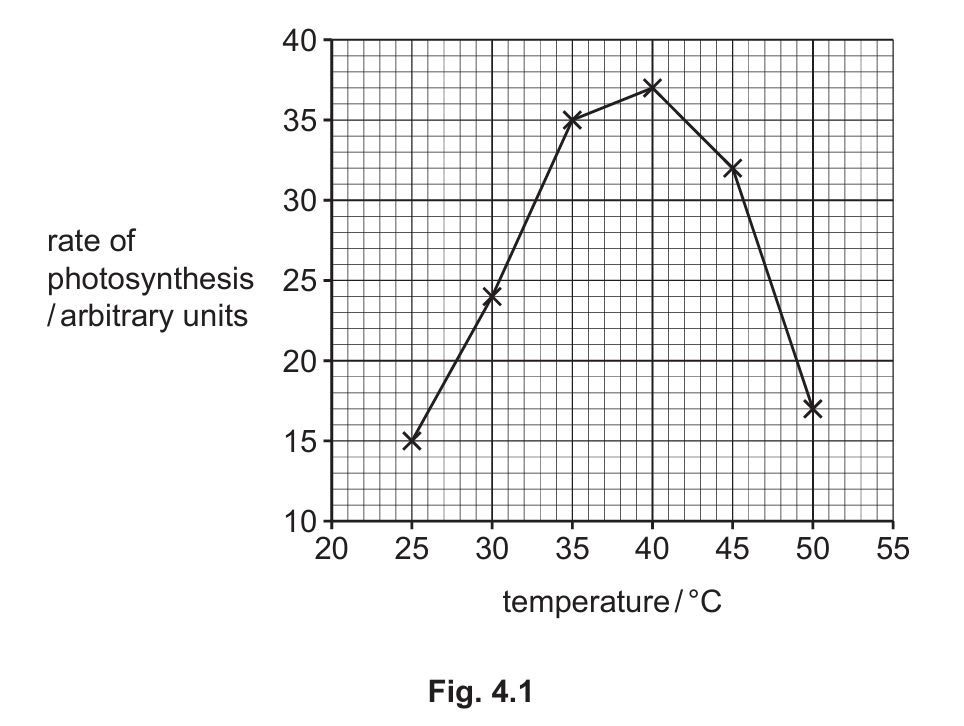
(a) 40 °C
Explanation: The optimum temperature is where the rate of photosynthesis is highest. From the graph, this occurs at 40 °C, as it is the peak point before the rate begins to decline.
(b)
Explanation: The graph shows an initial increase in the rate of photosynthesis as temperature rises, peaking at 40 °C, followed by a sharp decline. Here’s why:
- Before 40 °C: Increasing temperature boosts the kinetic energy of molecules, leading to more frequent collisions between enzymes and substrates. This forms more enzyme-substrate complexes, increasing the rate of photosynthesis. Temperature is the limiting factor here.
- At 40 °C: This is the optimum temperature where enzyme activity is highest, resulting in the maximum rate of photosynthesis.
- After 40 °C: Higher temperatures cause enzymes to denature. The active site changes shape, substrates no longer fit, and fewer enzyme-substrate complexes form. This reduces the rate of photosynthesis, eventually stopping it entirely.
(c)
Explanation: Carbon dioxide was supplied in excess to ensure it was not a limiting factor. By controlling this variable, the scientist could isolate the effect of temperature on the rate of photosynthesis. This way, any changes observed could be confidently attributed to temperature variations alone.
(d)
Explanation: Not all oxygen produced is released because some of it is used by the plant for aerobic respiration. Additionally, a portion may remain trapped in the air spaces within the leaf tissues.
(e)
Explanation: Chlorophyll plays two critical roles in photosynthesis:
- It absorbs light energy, primarily from the red and blue regions of the visible spectrum, which is essential for driving the photosynthetic process.
- It converts light energy into chemical energy, which is used to synthesize glucose from carbon dioxide and water. This conversion is the foundation of the food chain, as glucose serves as an energy source for the plant and other organisms.
▶️ Answer/Explanation
(a) oestrogen; progesterone
Explanation: The ovaries release two main hormones – oestrogen and progesterone. Oestrogen is responsible for the development of female secondary sexual characteristics and regulation of the menstrual cycle, while progesterone prepares the uterus for pregnancy and maintains the uterine lining.
(b) placenta
Explanation: The placenta is the specialized organ that forms during pregnancy to allow the transfer of antibodies and nutrients from the mother’s bloodstream to the fetus while keeping their blood supplies separate.
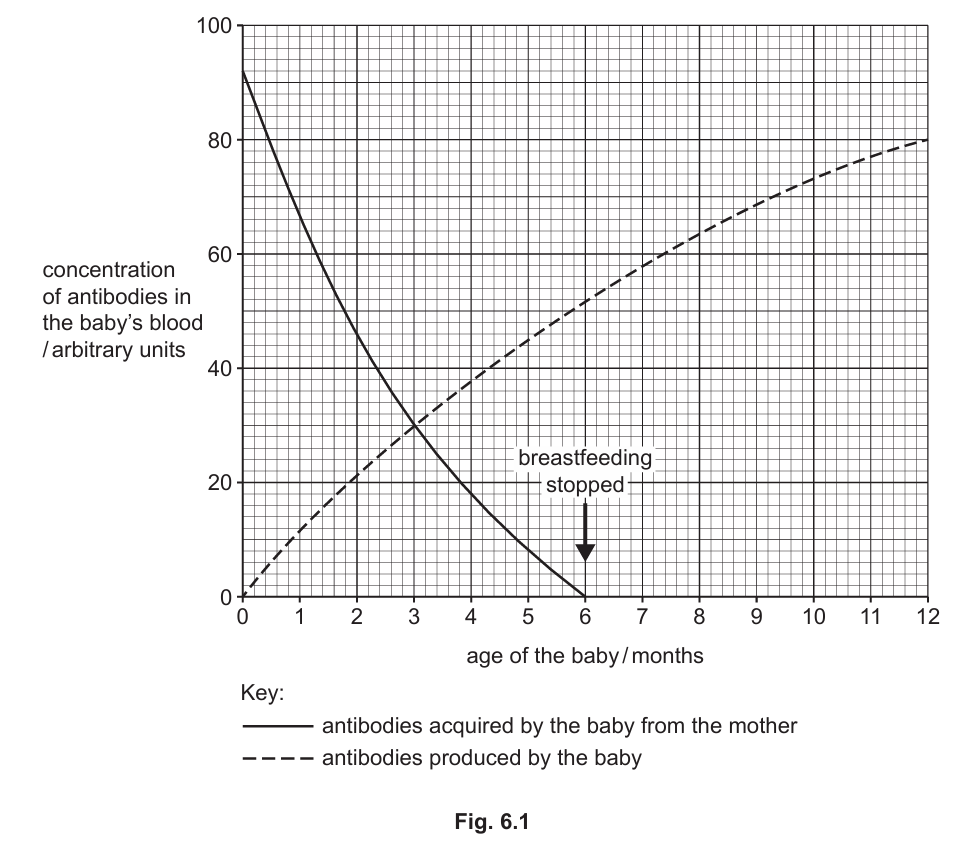
(c)(i) 6; lymphocytes; 56; 3
Explanation:
- The graph shows maternal antibodies decrease to zero by 6 months.
- Lymphocytes are the white blood cells that produce antibodies.
- At 4 months, the total antibodies (maternal + baby’s own) add up to 56 arbitrary units.
- The two lines intersect at 3 months when concentrations are equal.
(c)(ii) Any two from:
- Provides passive immunity by supplying maternal antibodies
- Contains all necessary nutrients for baby’s growth
- Helps protect against infections and diseases
- Creates bonding between mother and baby
- Is always at the right temperature and sterile
(c)(iii) Any two from:
- Antibodies received across placenta during pregnancy
- Vaccination (active immunity)
- Direct antibody injections (passive immunity)
- Natural infection leading to antibody production
(d) Key points:
- Each pathogen has unique surface antigens
- Antibodies have complementary shapes to specific antigens
- This allows precise binding to mark pathogens for destruction
- The specific shape enables the immune system to recognize and neutralize specific threats
(e) carbon, hydrogen, oxygen
Explanation: These three elements are common to all proteins, carbohydrates and fats. Proteins additionally contain nitrogen and sometimes sulfur, while carbohydrates and fats contain only C, H and O.