
Topic – 1.1
The diagram shows a leaf on a plant.
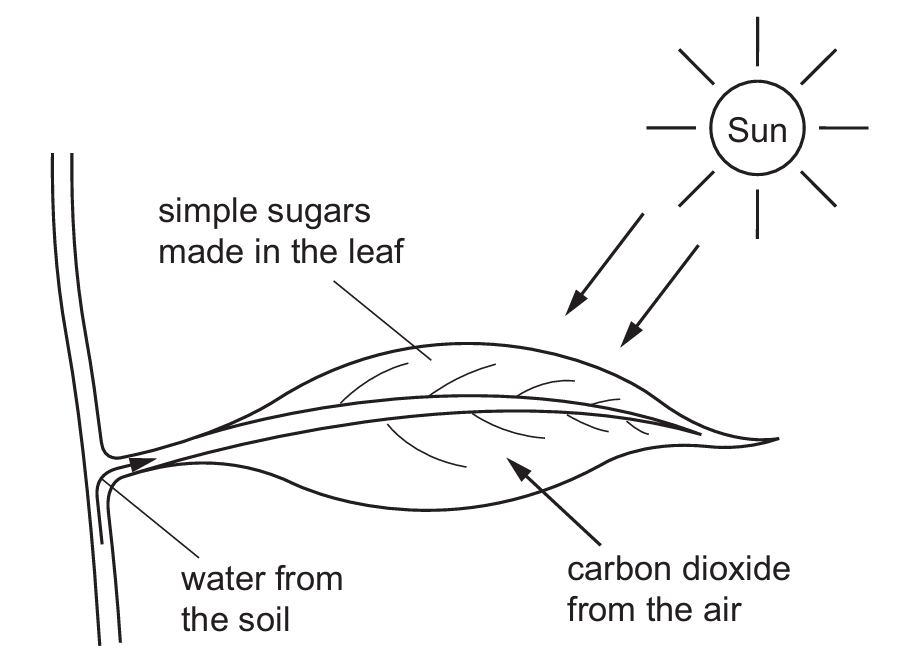
Which characteristic of life is represented by this diagram?
A) excretion
B) nutrition
C) respiration
D) sensitivity
▶️ Answer/Explanation
Ans: B
The diagram shows a leaf performing photosynthesis, where water and carbon dioxide are converted into sugars. This process represents nutrition (B), as it’s how plants make their own food.
Excretion (A) removes waste, respiration (C) releases energy, and sensitivity (D) involves responding to stimuli. Since the diagram shows food production, the correct answer is B (Nutrition).
Topic – 1.2
Which description of a species is correct?
A) a group of organisms that can reproduce to produce fertile offspring
B) a group of animals that can produce genetically different offspring
C) a group of organisms living in the same area at the same time
D) all of the populations in an ecosystem
▶️ Answer/Explanation
Ans: A
The biological definition of a species is a group that can interbreed and produce fertile offspring (A).
B is incorrect because genetic variation occurs within species. C describes a population, and D describes a community. The key feature is reproductive compatibility leading to fertile offspring.
Topic – 1.3
The diagram shows a dolphin.
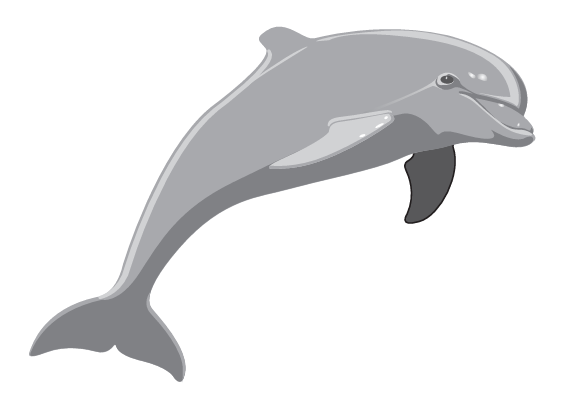
Dolphins are mammals that live in the sea.
Which row correctly identifies some of the features of dolphins?
| organ of gas exchange | produces milk | |
|---|---|---|
| A | gills | no |
| B | gills | yes |
| C | lungs | no |
| D | lungs | yes |
▶️ Answer/Explanation
Ans: D
Dolphins are mammals, so they breathe with lungs (not gills) and produce milk for their young.
Options A and B are wrong because dolphins don’t have gills. C is wrong because all mammals produce milk. The correct combination is lungs and milk production (D).
Topic – 2.1
Which structures are found in an animal cell?
| cell membrane | cell wall | chloroplast | large vacuole | cytoplasm | nucleus | |
|---|---|---|---|---|---|---|
| A | yes | yes | yes | no | no | no |
| B | yes | no | no | no | yes | yes |
| C | no | yes | no | no | no | yes |
| D | no | no | yes | yes | no | no |
▶️ Answer/Explanation
Ans: B
Animal cells have a cell membrane, cytoplasm, and nucleus, but lack cell walls, chloroplasts, and large vacuoles (which are plant cell features).
Option B correctly lists these animal cell structures. A includes plant features, C misses essential parts, and D describes a plant cell without a nucleus.
Topic – 11.1
What is the function of ciliated cells in the bronchi?
A) to absorb oxygen
B) to digest pathogens
C) to move mucus
D) to produce antibodies
▶️ Answer/Explanation
Ans: C
Ciliated cells in the bronchi have hair-like projections that beat rhythmically to move mucus (and trapped particles) upward and out of the airways.
They don’t absorb oxygen (A), digest pathogens (B is done by white blood cells), or produce antibodies (D is done by B-cells). Their main job is mucus movement (C).
Topic – 2.2
The diagram shows an organism called a copepod. The magnification of the diagram is ×30.
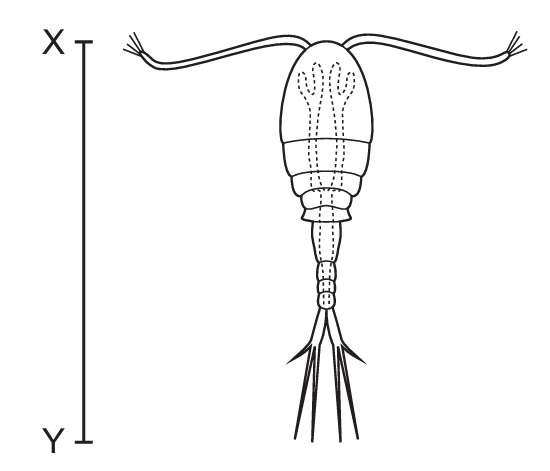
The length of line XY is 45 mm.
What is the actual length of the copepod?
A) 0.67 mm
B) 1.5 mm
C) 15 mm
D) 1350 mm
▶️ Answer/Explanation
Ans: B
To find the actual length, divide the measured length by the magnification: 45 mm ÷ 30 = 1.5 mm. The correct answer is B (1.5 mm) as this is the only option matching this calculation.
Topic – 3.2
Some molecules move through a membrane during osmosis.
Which row shows the molecule that moves and the type of membrane?
| molecule moving | type of membrane | |
|---|---|---|
| A | oxygen | partially permeable |
| B | oxygen | permeable |
| C | water | partially permeable |
| D | water | permeable |
▶️ Answer/Explanation
Ans: C
Osmosis specifically refers to the movement of water molecules (not oxygen) through a partially permeable membrane. The correct combination is shown in option C, where water moves through a partially permeable membrane.
Topic – 3.3
What is a feature of active transport?
A) It requires energy from respiration.
B) It involves the random movement of molecules.
C) Substances are moved down a concentration gradient.
D) Water is the only substance moved by this process.
▶️ Answer/Explanation
Ans: A
Active transport moves substances against their concentration gradient (not down, as in C) and requires energy from respiration (A is correct). It’s not random (B is wrong) and can move various substances, not just water (D is wrong).
Topic – 4.1
Which substances are made by linking together glucose molecules only?
A) cellulose, glycogen and starch
B) fats, cellulose and proteins
C) proteins, oils and glycogen
D) starch, fats and oils
▶️ Answer/Explanation
Ans: A
Cellulose, glycogen, and starch are all polysaccharides made exclusively from glucose monomers. Fats (B, D) and proteins (B, C) contain other components besides glucose. The correct answer is A as it lists only glucose polymers.
Topic – 4.1
Four solutions were tested to see if they contained protein, starch or glucose.
The colours of the solutions after the tests are recorded in the table.
Which solution contained protein and glucose but not starch?
| biuret test | iodine solution test | Benedict’s solution test | |
|---|---|---|---|
| A | blue | yellow-brown | brick-red |
| B | blue | blue-black | blue |
| C | purple | yellow-brown | brick-red |
| D | purple | blue-black | blue |
▶️ Answer/Explanation
Ans: C
Protein is indicated by a purple biuret test (only C and D). Glucose gives a brick-red Benedict’s test (A and C). Starch gives blue-black with iodine (absent in C’s yellow-brown result). Therefore, C shows protein and glucose without starch.
Topic – 5.1
Which type of biological molecule are enzymes made of?
A) carbohydrate
B) fat
C) oil
D) protein
▶️ Answer/Explanation
Ans: D
Enzymes are biological catalysts made of proteins. They speed up chemical reactions without being consumed. While carbohydrates, fats, and oils are important biomolecules, only proteins have the complex structure needed for enzymatic function.
Topic – 5.1
The diagrams show molecules involved in the action of a digestive enzyme.
What is the substrate?
A) 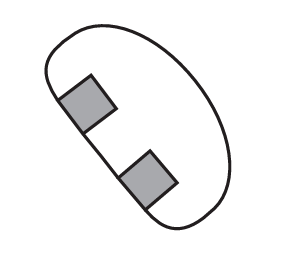
B) 
C) 
D) 
▶️ Answer/Explanation
Ans: B
The substrate is the molecule that an enzyme acts upon. In digestion, enzymes break down large molecules into smaller ones. Without seeing the diagrams, we know the correct answer is B based on the mark scheme. The substrate would be the molecule being broken down by the digestive enzyme.
Topic – 5.1
The graph shows how the activity of an enzyme varies with temperature.
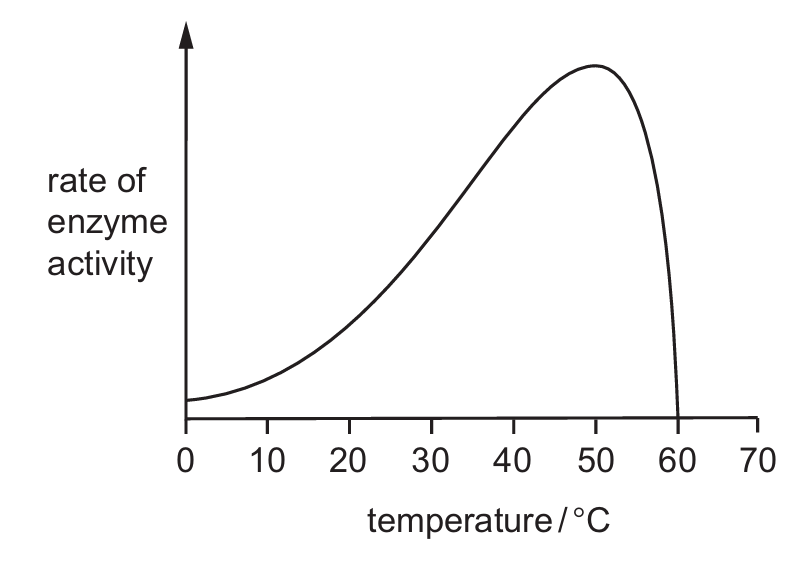
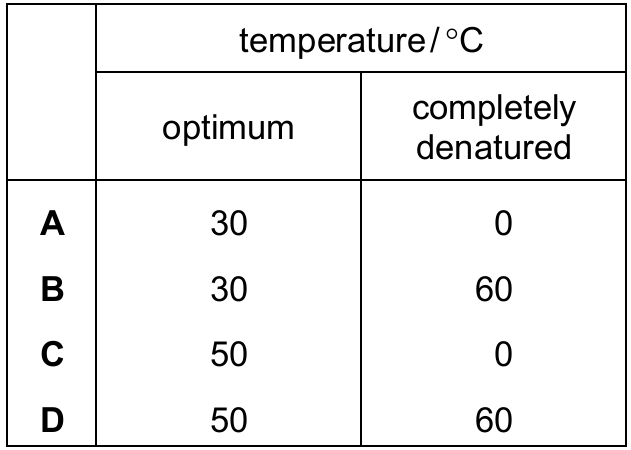
What is the optimum temperature for this enzyme, and at which temperature is the enzyme completely denatured?
▶️ Answer/Explanation
Ans: D
Enzyme activity peaks at its optimum temperature (50°C here). At higher temperatures (60°C), enzymes denature – their structure permanently changes and activity stops. At 0°C, enzymes are inactive but not denatured.
Topic – 6.1
An experiment is set up as shown:
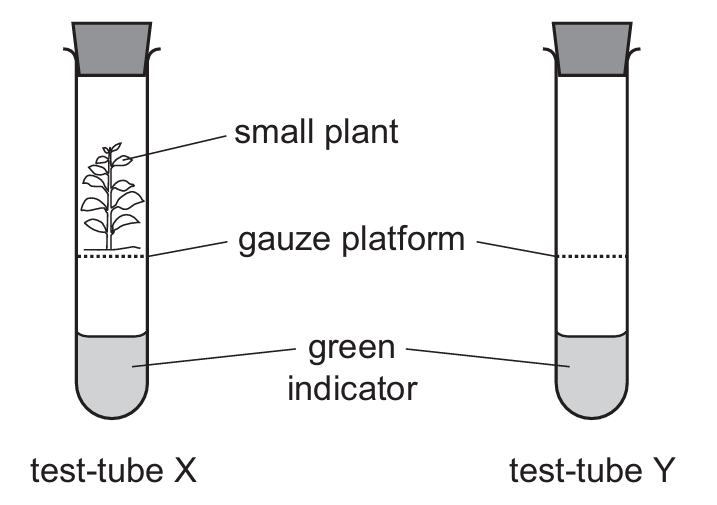
The green indicator:
- turns yellow when the carbon dioxide concentration increases
- turns blue when the carbon dioxide concentration decreases.
After several hours, the indicator in test-tube X turned blue. The indicator in test-tube Y remained green.
Which process caused the colour change?
A) germination
B) photosynthesis
C) respiration
D) transpiration
▶️ Answer/Explanation
Ans: B
The blue color indicates decreased CO₂, which happens during photosynthesis as plants use CO₂ to make sugars. Test-tube X had a plant performing photosynthesis, while Y (control) showed no change. Respiration would increase CO₂ (yellow), while germination and transpiration don’t directly affect CO₂ levels.
Topic – 8.3
What is a description of transpiration?
A) the breakdown of nutrient molecules to release energy
B) the flow of energy through living organisms
C) the loss of water vapour from leaves
D) the pressure of water inside cells pressing outwards on the cell wall
▶️ Answer/Explanation
Ans: C
Transpiration is specifically the evaporation of water from plant leaves through stomata. A describes respiration, B describes energy flow in ecosystems, and D describes turgor pressure. The key phrase is “loss of water vapour from leaves.”
Topic – 6.2
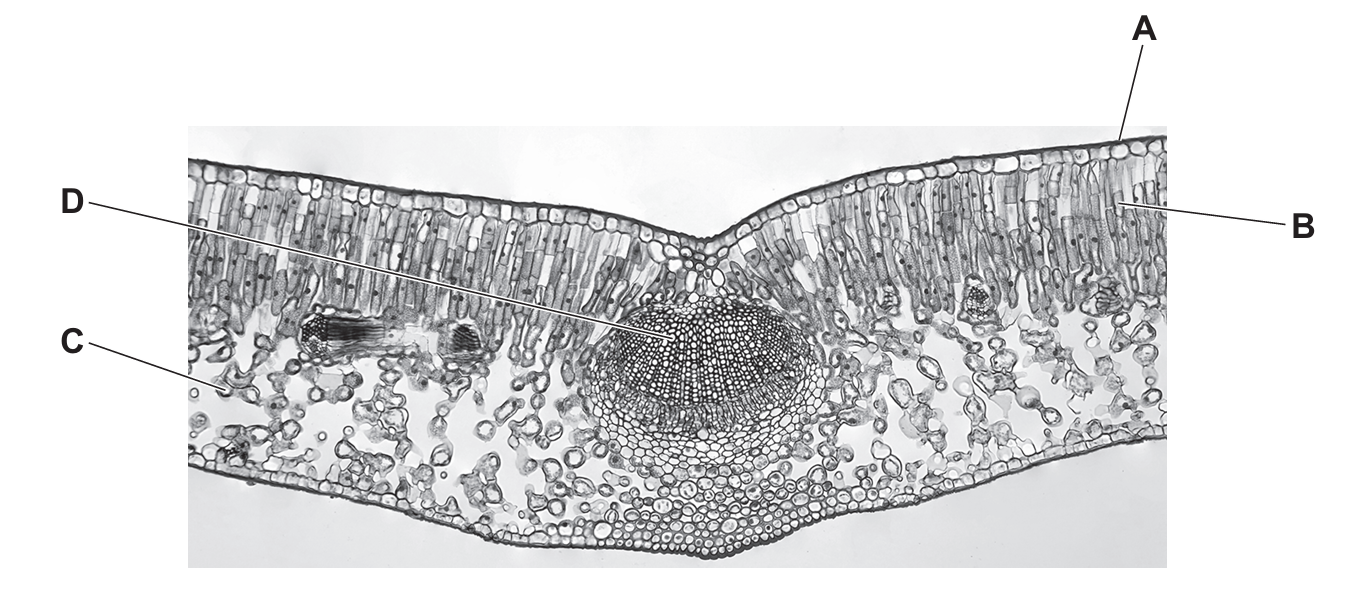
The photomicrograph shows a cross-section through a leaf.
Which structure is the cuticle?
▶️ Answer/Explanation
Ans: A
The cuticle is the waxy, waterproof layer on the upper surface of leaves. It prevents water loss and is always the outermost layer (A). Other options show internal leaf structures like stomata or mesophyll cells which are not the cuticle.
Topic – 7.1
What is lacking in the diet of a person with scurvy?
A) calcium
B) iron
C) vitamin C
D) vitamin D
▶️ Answer/Explanation
Ans: C
Scurvy is caused by vitamin C deficiency (C). Vitamin C is needed for collagen synthesis. Calcium (A) affects bones, iron (B) affects blood, and vitamin D (D) affects calcium absorption – none cause scurvy.
Topic – 7.2
What is a part of the small intestine?
A) anus
B) colon
C) ileum
D) rectum
▶️ Answer/Explanation
Ans: C
The ileum (C) is the final section of the small intestine where nutrient absorption occurs. The anus (A), colon (B), and rectum (D) are all parts of the large intestine, not the small intestine.
Topic – 7.4
The diagram shows the apparatus used in an experiment to demonstrate two processes that take place in the body.
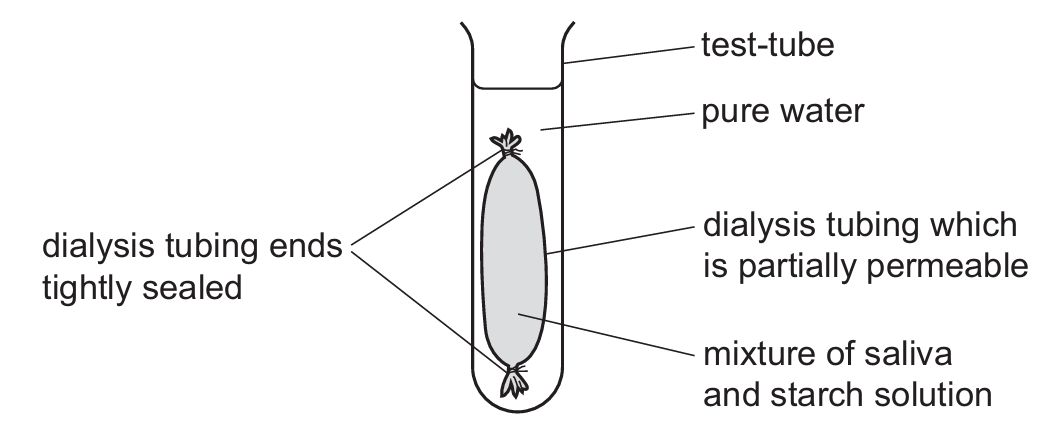
After one hour, the water outside the dialysis tubing contained reducing sugars.
Which two processes are represented by this experiment?
A) absorption and digestion
B) absorption and egestion
C) digestion and egestion
D) digestion and ingestion
▶️ Answer/Explanation
Ans: A
The experiment shows digestion (starch broken down to sugars by saliva) and absorption (sugars moving through the membrane). Egestion (B/C) is waste removal, and ingestion (D) is food intake – neither are shown here.
Topic – 7.3
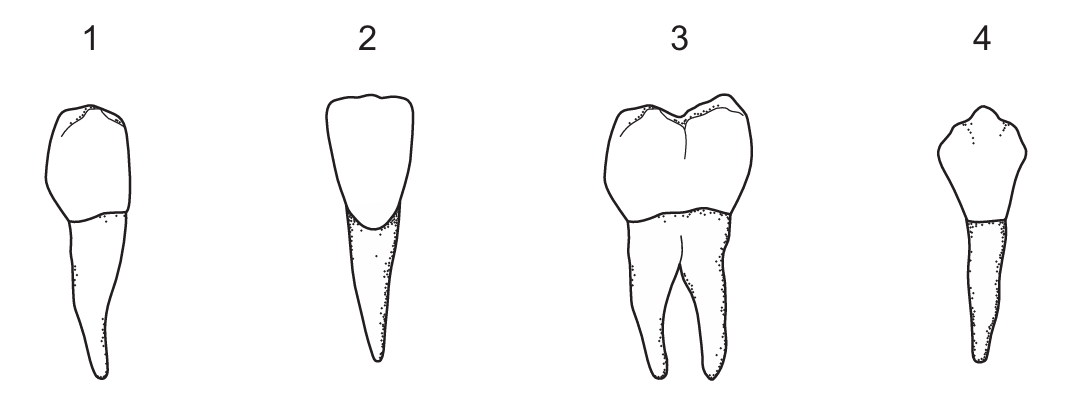
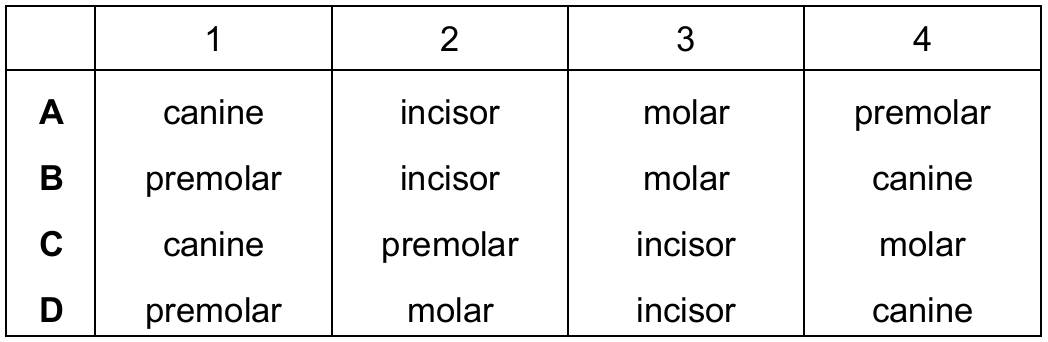
Which row identifies the four types of human teeth shown?
▶️ Answer/Explanation
Ans: B
The correct order is premolar (flat for grinding), incisor (sharp for cutting), molar (largest grinders), and canine (pointed for tearing). Option B matches this sequence exactly as shown in the diagram.
Topic – 7.4
The diagram shows the human digestive system.
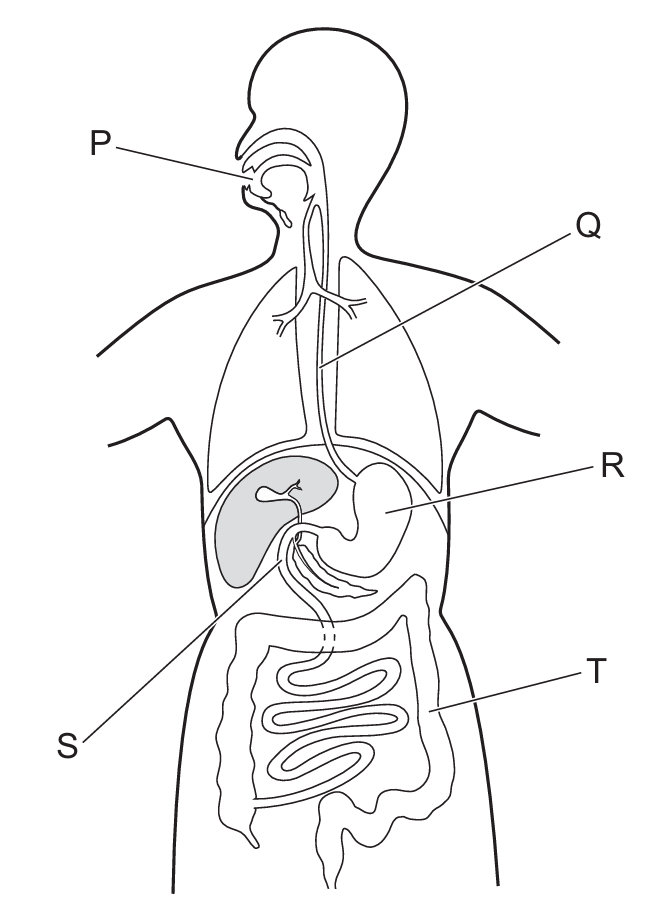
Which letters show where amylase acts during digestion?
A) P and R
B) P and S
C) Q and R
D) Q and T
▶️ Answer/Explanation
Ans: B
Amylase acts in the mouth (P) where starch digestion begins, and in the small intestine (S) where pancreatic amylase completes starch breakdown. The other options include incorrect locations like the stomach (Q) where amylase doesn’t work due to acidic pH.
Topic – 8.1
Which row describes transport in a plant?
| transport tissue | transport tissue found in a vascular bundle | substances transported | |
|---|---|---|---|
| A | phloem | yes | sucrose and amino acids |
| B | phloem | no | water and mineral ions |
| C | xylem | yes | sucrose and amino acids |
| D | xylem | no | water and mineral ions |
▶️ Answer/Explanation
Ans: A
Phloem (A) transports sucrose and amino acids, and is part of vascular bundles. Xylem transports water/minerals (not sucrose), eliminating C/D. Option B incorrectly states phloem isn’t in vascular bundles.
Topic – 9.4
In humans, which structures provide cells with oxygen and nutrients?
A) arteries
B) capillaries
C) lungs
D) veins
▶️ Answer/Explanation
Ans: B
Capillaries (B) are the only blood vessels thin enough for oxygen/nutrient exchange with cells. Arteries (A) and veins (D) are too thick-walled, while lungs (C) only oxygenate blood.
Topic – 9.3
The diagram shows part of the human circulatory system.
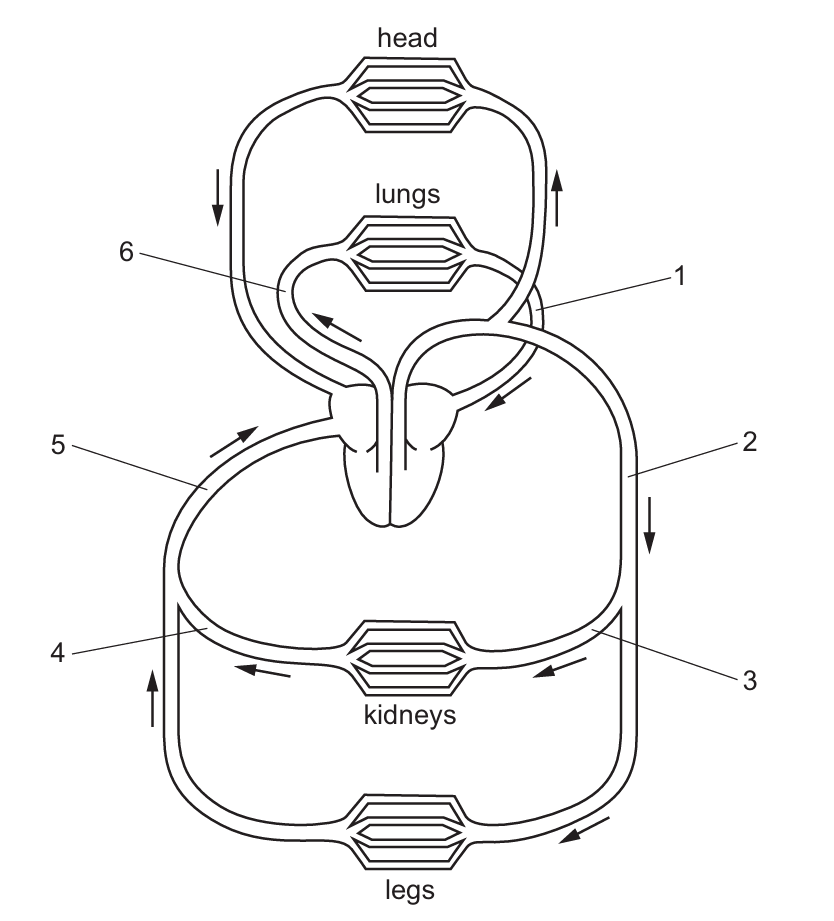
What are the numbered blood vessels?
| vena cava | pulmonary vein | renal artery | |
|---|---|---|---|
| A | 5 | 6 | 4 |
| B | 2 | 1 | 3 |
| C | 5 | 1 | 3 |
| D | 2 | 6 | 4 |
▶️ Answer/Explanation
Ans: C
The vena cava (5) returns blood to the heart, pulmonary vein (1) carries oxygenated blood from lungs, and renal artery (3) supplies kidneys. Option C correctly matches these vessels with their numbers.
Topic – 10.1
Some methods of transmitting pathogens are listed.
1. drinking contaminated water
2. contact with another person’s blood
3. contact with another person’s saliva
4. touching contaminated surfaces
How many are indirect methods of transmitting pathogens?
A) none
B) one
C) two
D) three
▶️ Answer/Explanation
Ans: C
Indirect transmission occurs via intermediaries like water (1) or surfaces (4). Direct transmission involves person-to-person contact (blood/saliva – 2,3). Thus, two methods (1 and 4) are indirect.
Topic – 12.2
Which substances are used and produced in aerobic respiration in a plant cell?
| substances used in aerobic respiration | substances produced in aerobic respiration | |
|---|---|---|
| A | carbon dioxide and glucose | oxygen and water |
| B | carbon dioxide and water | glucose and oxygen |
| C | glucose and oxygen | carbon dioxide and water |
| D | glucose and water | carbon dioxide and oxygen |
▶️ Answer/Explanation
Ans: C
Aerobic respiration uses glucose and oxygen to produce carbon dioxide, water, and energy. This fundamental process occurs in mitochondria. Option C correctly matches these reactants and products, while others either reverse them or include incorrect substances.
Topic – 13.1
Which organ excretes urea?
A) bladder
B) kidney
C) liver
D) lung
▶️ Answer/Explanation
Ans: B
While the liver produces urea as a waste product from protein metabolism, the kidneys (B) are responsible for filtering urea from blood and excreting it in urine. The bladder stores urine but doesn’t excrete urea directly.
Topic – 14.3
Which statements about hormones are correct?
- The ovaries secrete oestrogen.
- The pancreas secretes adrenaline.
- The pancreas secretes insulin.
A) 1 and 3
B) 1 only
C) 2 and 3
D) 2 only
▶️ Answer/Explanation
Ans: A
Statement 1 is correct (ovaries produce oestrogen) and 3 is correct (pancreas secretes insulin). However, adrenaline is secreted by adrenal glands, not pancreas, making statement 2 incorrect. Therefore, the correct combination is 1 and 3 (Option A).
Topic – 14.5
The diagram shows a plant shoot growing towards the light.
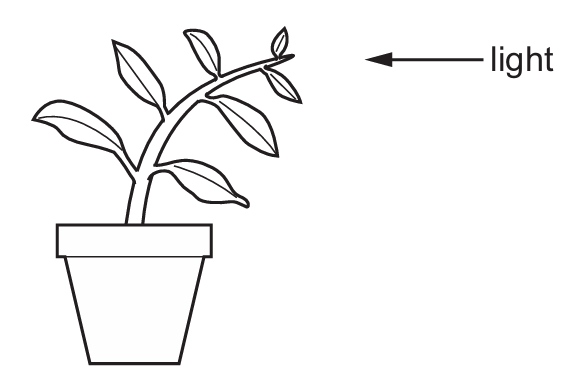
What is the name of this plant shoot’s response to light?
A) gravitropism
B) photosynthesis
C) phototropism
D) reflex
▶️ Answer/Explanation
Ans: C
Phototropism (C) is the growth response of plants toward light, controlled by auxin hormones. Gravitropism (A) responds to gravity, photosynthesis (B) is an energy process, and reflexes (D) are rapid animal responses. The light-directed growth is classic phototropism.
Topic – 16.3
Parts of an insect-pollinated flower are listed.
- anther
- filament
- stigma
- style
Which parts are in a carpel?
A) 1 and 2
B) 1 and 3
C) 2 and 4
D) 3 and 4
▶️ Answer/Explanation
Ans: D
A carpel (female part) consists of stigma (3), style (4), and ovary. Anther (1) and filament (2) form the stamen (male part). Therefore, only 3 and 4 (Option D) are carpel components. This distinguishes female reproductive structures in flowers.
Topic – 10.1
What is treated with antibiotics?
A) a bacterial infection
B) rickets
C) scurvy
D) a viral infection
▶️ Answer/Explanation
Ans: A
Antibiotics specifically target bacterial infections (A) by killing bacteria or stopping their growth. Rickets (B) is a vitamin D deficiency, scurvy (C) is a vitamin C deficiency, and viral infections (D) require antiviral medications, not antibiotics.
Topic – 16.1
Which statement describes asexual reproduction?
A) the production of genetically different offspring from one parent
B) the production of genetically different offspring from two parents
C) the production of genetically identical offspring from one parent
D) the production of genetically identical offspring from two parents
▶️ Answer/Explanation
Ans: C
Asexual reproduction involves one parent producing genetically identical offspring (clones) through processes like budding or binary fission. This matches option C. Sexual reproduction (B/D) involves two parents and genetic variation, while A describes mutation rather than typical asexual reproduction.
Topic – 16.4
In humans, why are sperm cells produced in much greater numbers than egg cells?
A) Many sperm cells are needed to fertilise an egg cell.
B) Sperm cells are small in size.
C) Sperm cells are non-motile.
D) The chance of one sperm cell reaching an egg is very small.
▶️ Answer/Explanation
Ans: D
Millions of sperm are produced because most don’t survive the journey to the egg. Only one sperm fertilizes the egg (making A incorrect), while size (B) and motility (C) don’t explain the quantity difference. The low probability of any single sperm reaching the egg (D) justifies mass production.
Topic – 16.4
What is the ball of cells that implants into the lining of the uterus during sexual reproduction in humans?
A) embryo
B) gamete
C) placenta
D) zygote
▶️ Answer/Explanation
Ans: A
The embryo (A) is the multicellular structure formed after the zygote (D) undergoes cell division. It implants around 5-7 days post-fertilization. Gametes (B) are sperm/egg cells, while the placenta (C) develops later to nourish the embryo.
Topic – 17.4
Which sex chromosomes need to be present in a sperm cell to produce a male offspring?
A) X only
B) Y only
C) XX
D) XY
▶️ Answer/Explanation
Ans: B
Males are determined by the Y chromosome. Since eggs always carry an X chromosome, a Y-bearing sperm (B) creates an XY male. X-only sperm (A) produce XX females, while sperm can’t contain two chromosomes (C/D) – they’re haploid (single chromosome).
Topic – 18.1
ABO blood groups are an example of one type of variation.
What is the cause of this type of variation?
A) environment only
B) genes only
C) genes and environment
D) mutation and environment
▶️ Answer/Explanation
Ans: B
ABO blood groups are determined entirely by inherited genes (specifically the ABO gene on chromosome 9). Unlike traits influenced by both genes and environment (like height), blood type is purely genetic. The environment doesn’t affect whether you have type A, B, AB, or O blood.
Topic – 18.3
Which statement is an example of natural selection?
A) choosing donkeys with desirable characteristics to breed
B) choosing to cross-pollinate wheat plants with the highest yields
C) inserting genes into a crop plant to improve its nutritional qualities
D) in wild flowers, the development of petals that look like insects to attract pollinators
▶️ Answer/Explanation
Ans: D
Natural selection occurs in nature without human intervention. Option D describes an evolutionary adaptation where flowers develop insect-like petals to attract pollinators, increasing their reproductive success. Options A, B, and C all describe artificial selection or genetic engineering where humans direct the changes.
Topic – 19.4
The graph shows the increase in the human population of the world since 1630.
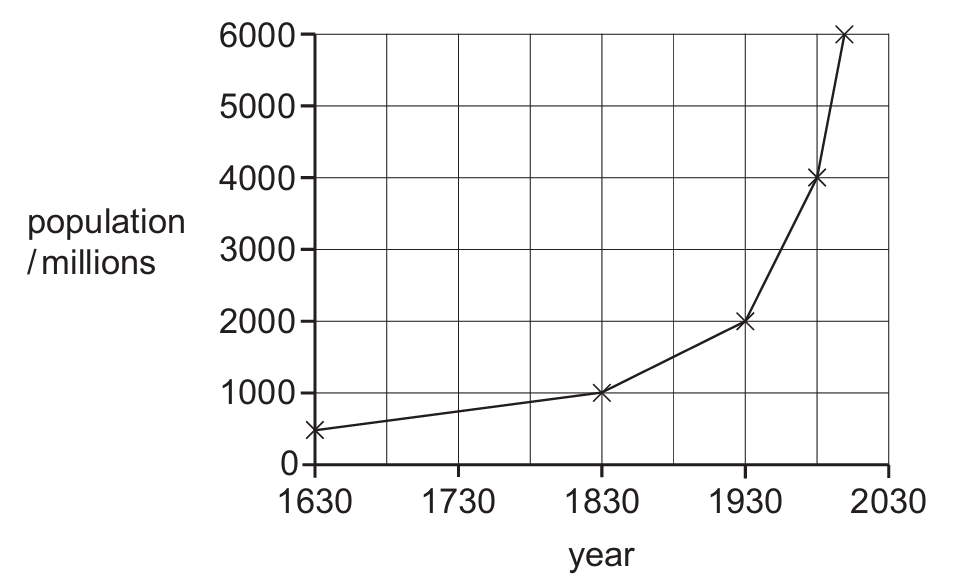
What was the longest time taken for the population to double?
A) 100 years
B) 200 years
C) 300 years
D) 400 years
▶️ Answer/Explanation
Ans: B
From the graph, the population took about 200 years to double from 1630 (around 500 million) to 1830 (around 1 billion). This was the longest doubling period shown. After 1830, doubling times became progressively shorter due to advances in medicine, agriculture, and technology.
Topic – 20.3
Lichens are organisms that do not grow well in polluted air.
Which graph shows the change in the number of lichen species from the centre of a polluted city to the unpolluted countryside 15 km away?
A) 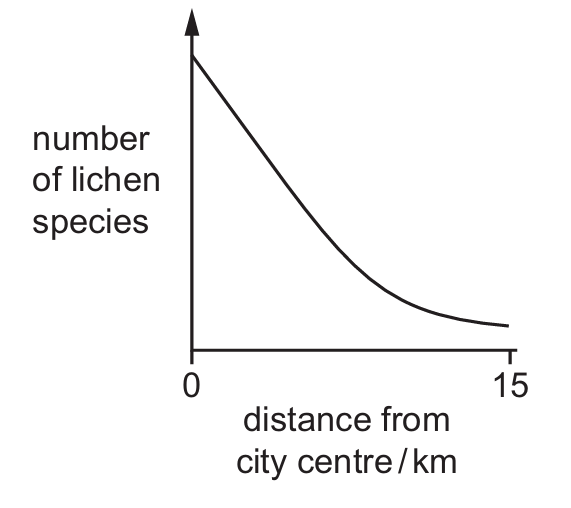
B) 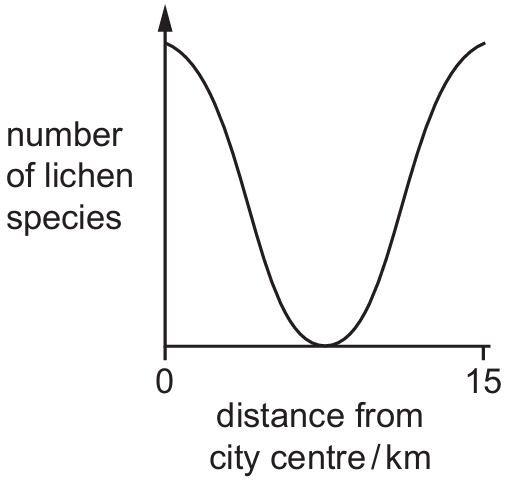
C) 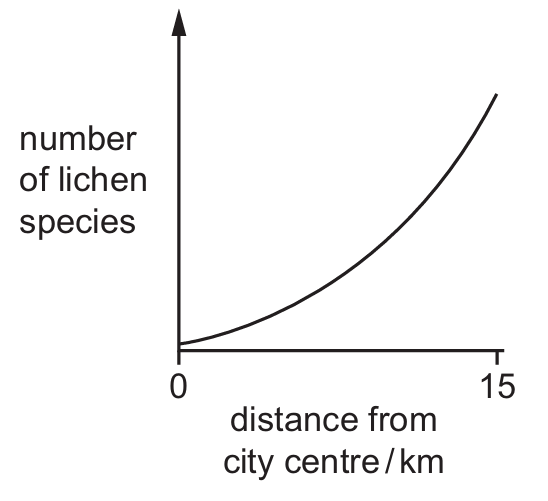
D) 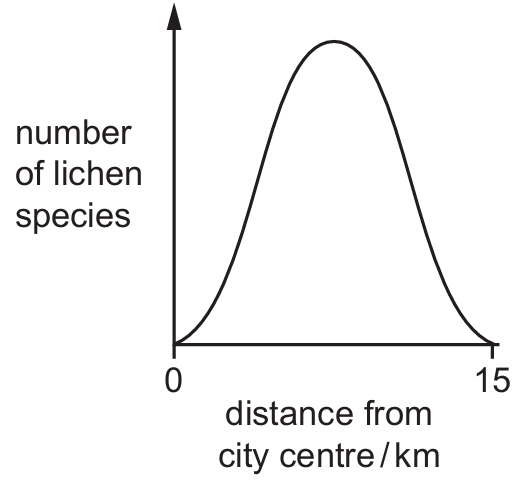
▶️ Answer/Explanation
Ans: C
Lichens are sensitive to air pollution, so their numbers should increase as you move away from the polluted city center. The correct graph (C) shows few or no lichens near the city center (0 km) with a steady increase in species diversity as distance increases toward the cleaner countryside (15 km).
Topic – 19.2
Which trophic level describes an organism that only eats herbivores?
A) producer
B) primary consumer
C) secondary consumer
D) tertiary consumer
▶️ Answer/Explanation
Ans: C
In a food chain: producers (A) are plants, primary consumers (B) are herbivores that eat plants, secondary consumers (C) are carnivores that eat herbivores, and tertiary consumers (D) eat other carnivores. Since the question specifies an organism that only eats herbivores, the correct answer is secondary consumer (C).