
Topic – 11.1
Which type of cell moves mucus?
A) Ciliated cell
B) egg cell
C) guard cell
D) root hair cell
▶️ Answer/Explanation
Ans: A
Ciliated cells (A) are specialized epithelial cells with hair-like structures called cilia that beat rhythmically to move mucus and trapped particles. This is crucial in respiratory tracts to clear debris.
Egg cells (B) are reproductive cells, guard cells (C) regulate stomata in plants, and root hair cells (D) absorb water. Only ciliated cells directly function in mucus movement.
Topic – 14.1
A student exposed a fly larva to light and temperature gradients.
They lit the area from one side and made one side of the area warmer than the other.
They traced the path of the fly larva’s movement.

Which statement describes the response of the fly larva?
A) The fly larva does not respond to temperature or light intensity.
B) The fly larva moves away from a higher temperature and a higher light intensity.
C) The fly larva moves away from a higher temperature and a higher light intensity.
D) The fly larva moves towards a higher temperature and away from a higher light intensity.
▶️ Answer/Explanation
Ans: D
The fly larva exhibits thermotaxis (movement towards warmth) and negative phototaxis (movement away from light). The diagram shows it moving towards the warmer side while avoiding brighter regions.
Option A is incorrect as the larva responds to both stimuli. Options B and C are identical and incorrect since the larva moves towards heat. Thus, D is correct, matching the observed behavior.
Topic – 1.3
The table shows the scientific names and the common names of four plants.
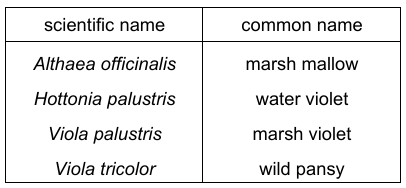
Which word is a genus name?
A) marsh
B) palustris
C) Viola
D) violet
▶️ Answer/Explanation
Ans: C
In binomial nomenclature, the first word represents the genus (capitalized) and the second word represents the species (lowercase). From the table, Viola palustris shows Viola (C) as the genus name.
Marsh (A) and violet (D) are common names, while palustris (B) is a species identifier. Therefore, the correct answer is C (Viola) as it follows the taxonomic convention for genus naming.
Topic – 1.3
The diagram shows an arthropod.
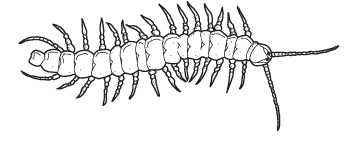
Which group does this arthropod belong to ?
A) arachnid
B) crustacean
C) insect
D) myriapod
▶️ Answer/Explanation
Ans: D
The arthropod in the diagram has a long, segmented body with many legs, characteristic of myriapods (e.g., centipedes/millipedes).
Arachnids (A) have 8 legs, crustaceans (B) are mostly aquatic, and insects (C) have 6 legs. Since the diagram matches the features of myriapods, the correct answer is D (Myriapod).
Topic – 2.1
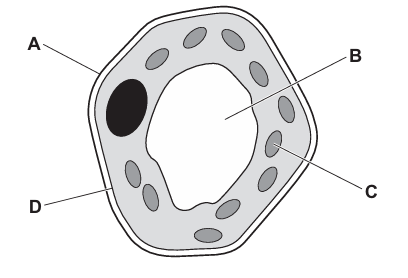
The diagram shows a plant cell.
Which letter indicates the location of the cell membrane?
▶️ Answer/Explanation
Ans: D
The cell membrane is a thin, semi-permeable layer surrounding the cytoplasm. In the diagram, it is located just inside the cell wall (a rigid outer layer). Letter D points to this boundary, distinguishing it from the nucleus (A), vacuole (B), or chloroplasts (C).
Since the membrane regulates material movement, the correct answer is D.
Topic – 2.2
Which magnification formula is correct?
A) magnification = actual size ÷ image size
B) magnification = actual size + image size
C) magnification = image size ÷ actual size
D) magnification = image size × actual size
▶️ Answer/Explanation
Ans: C
The correct formula for magnification is given by the ratio of the image size to the actual size, expressed as:
\[ \text{Magnification} = \frac{\text{Image Size}}{\text{Actual Size}} \]
Option C matches this formula, while the other options (A, B, D) incorrectly represent the relationship between image size and actual size. Thus, the correct answer is C.
Topic – 3.1
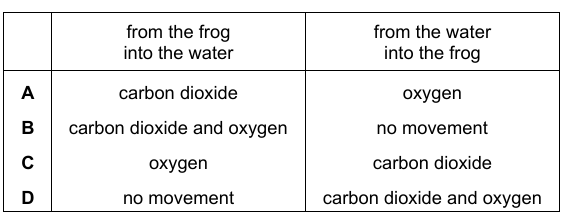
A frog is an animal. The skin of a frog is permeable to oxygen and carbon dioxide.
Which directions will have a net diffusion of oxygen and carbon dioxide when a frog swims in pond water?
▶️ Answer/Explanation
Ans: A
Frogs perform cutaneous respiration through their permeable skin. Oxygen (\(\text{O}_2\)) diffuses into the frog’s body from the water (high \(\text{O}_2\) concentration) to meet metabolic needs, while carbon dioxide (\(\text{CO}_2\)), a waste product, diffuses out (high \(\text{CO}_2\) concentration in tissues). Thus, the net directions are \(\text{O}_2\) inward and \(\text{CO}_2\) outward, matching option A.
Topic – 8.2
Which statement about plant support is correct?
A) The pressure of water inside the cells presses inwards on the cell walls.
B) The pressure of water inside the cells presses outwards on the cell walls.
C) The pressure of water outside the cells presses inwards on the cell walls.
D) The pressure of water outside the cells presses outwards on the cell walls.
▶️ Answer/Explanation
Ans: B
Plant cells maintain their rigidity due to turgor pressure, where water inside the vacuole presses outwards against the cell wall. This creates structural support, making option B correct.
Incorrect options: A (inward pressure would collapse the cell), C/D (external water pressure does not provide primary support). Thus, the answer is B.
Topic – 3.3
What is a correct statement about active transport?
A) Particles move into cells, using energy released by photosynthesis.
B) Particles move across a cell wall without using energy.
C) Particles move from a region of higher concentration to a region of lower concentration.
D) Particles move across a cell membrane, using energy released by respiration.
▶️ Answer/Explanation
Ans: D
Active transport involves the movement of particles against the concentration gradient (from low to high concentration), requiring energy (ATP) released by respiration. Option D correctly describes this process.
Option A is incorrect because photosynthesis produces glucose, not ATP for active transport. Option B describes passive transport, and Option C refers to diffusion, not active transport.
Topic – 4.1
A sample of food was tested with biuret reagent.
Which colour would be seen if the food sample contained protein?
A) blue-black
B) brick red
C) yellow-brown
D) purple
▶️ Answer/Explanation
Ans: D
The biuret test is used to detect proteins in a sample. When biuret reagent (a blue solution containing copper sulfate and sodium hydroxide) reacts with peptide bonds in proteins, it forms a violet/purple complex (D).
Blue-black (A) is for starch with iodine, brick red (B) appears in Benedict’s test for reducing sugars, and yellow-brown (C) is seen in Sudan III test for lipids. Since the question asks about protein detection, the correct answer is D (Purple).
Topic – 4.1
Which elements are found in fats?
A) carbon, hydrogen and iron
B) carbon, hydrogen and oxygen
C) carbon, hydrogen and nitrogen
D) carbon, oxygen and nitrogen
▶️ Answer/Explanation
Ans: B
Fats are composed of triglycerides, which consist of carbon (C), hydrogen (H), and oxygen (O) atoms. These elements form glycerol and fatty acids, the building blocks of fats.
Iron (A) is not part of fats, and nitrogen (C, D) is found in proteins, not fats. Thus, the correct answer is B (carbon, hydrogen, and oxygen).
Topic – 5.1
Which statements about enzymes are correct?
- Enzymes are biological catalysts
- Enzymes are carbohydrates
- Enzymes have an active site
A) 1 and 2
B) 1 and 3
C) 2 and 3
D) 3 only
▶️ Answer/Explanation
Ans: B
Statement 1 is correct: Enzymes are biological catalysts that speed up reactions without being consumed.
Statement 2 is incorrect: Enzymes are proteins, not carbohydrates.
Statement 3 is correct: Enzymes have an active site where substrates bind for catalysis.
Since only statements 1 and 3 are true, the correct answer is B (1 and 3).
Topic – 6.1
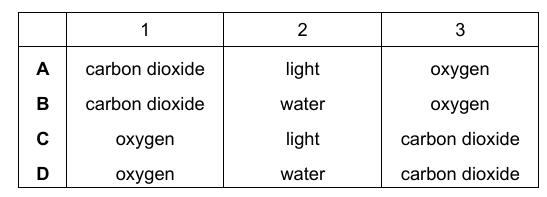
The equation for photosynthesis is shown.

Which words correctly complete gaps 1, 2 and 3?
▶️ Answer/Explanation
Ans: B
The photosynthesis equation is: \[ \text{CO}_2 + \text{H}_2\text{O} \xrightarrow{\text{light}} \text{C}_6\text{H}_{12}\text{O}_6 + \text{O}_2 \]
Gap 1 is carbon dioxide (reactant), Gap 2 is glucose (product), and Gap 3 is oxygen (byproduct). Option B matches this sequence.
Other options misplace the terms (e.g., A swaps glucose/oxygen, C/D include incorrect reactants like nitrogen). Thus, B is correct.
Topic – 4.1
Which carbohydrate is used to make cell walls?
A) cellulose
B) glycogen
C) starch
D) sucrose
▶️ Answer/Explanation
Ans: A
Cellulose (A) is the primary structural carbohydrate in plant cell walls, providing rigidity and support. It is a polysaccharide composed of glucose monomers linked by β-1,4-glycosidic bonds.
Glycogen (B) and starch (C) are energy storage molecules in animals and plants, respectively, while sucrose (D) is a disaccharide used for energy transport. Thus, the correct answer is A (Cellulose).
Topic – 6.2
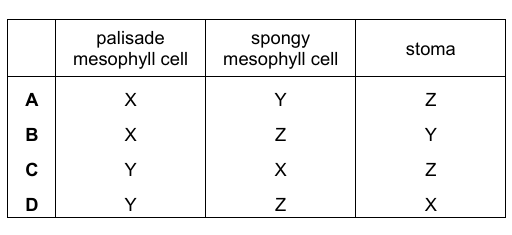
The diagram shows a cross-section of a leaf.
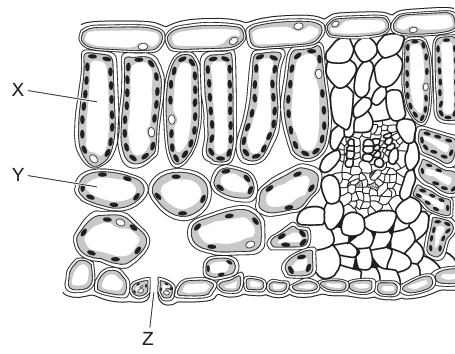
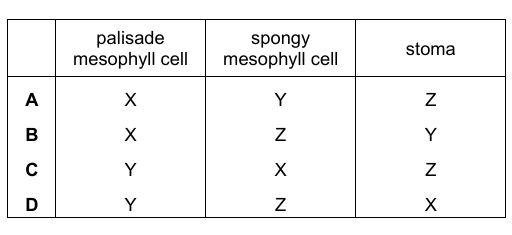
Which row shows the correct table?
▶️ Answer/Explanation
Ans: A
The diagram shows a leaf cross-section with palisade mesophyll (tightly packed cells for photosynthesis) and spongy mesophyll (loosely packed cells for gas exchange).
The upper epidermis is thin and transparent to allow light penetration, while the lower epidermis contains stomata for gas exchange. Only option A correctly matches these features.
Topic – 7.1
The table shows some of the nutrients found in yoghurt.

One serving size of yoghurt is 150g.
One of the nutrients in the yoghurt is required for healthy bones and teeth.
What is the mass of this nutrient in one serving of yoghurt?
A) 0.24g
B) 2.25g
C) 7.20g
D) 10.35g
▶️ Answer/Explanation
Ans: A
The nutrient essential for healthy bones and teeth is calcium. From the table, calcium content is 160 mg per 100g of yoghurt.
For a 150g serving, the mass of calcium is calculated as:
\[ \text{Mass of calcium} = \left(\frac{160\, \text{mg}}{100\, \text{g}}\right) \times 150\, \text{g} = 240\, \text{mg} = 0.24\, \text{g} \]
Thus, the correct answer is A (0.24g).
Topic – 7.2
The diagram shows the alimentary canal and some of the associated organs in a cat. The alimentary canal of a cat is similar to that of a human.
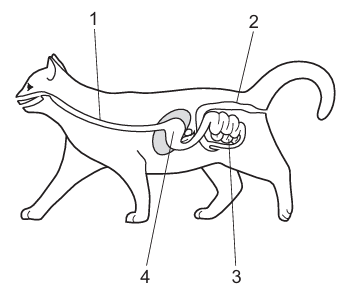
Which row identifies the structures labelled 1-4?
▶️ Answer/Explanation
Ans: B
The diagram shows key structures of the alimentary canal and associated organs. Based on anatomical knowledge:
- 1 is the stomach (digests food).
- 2 is the pancreas (secretes digestive enzymes).
3
- is the
small intestine
- (nutrient absorption).
- 4 is the liver (produces bile).
Option B correctly matches these labels, while the other options misidentify one or more structures. Thus, the correct answer is B.
Topic – 7.3
The diagram shows the four types of teeth in a human jaw.
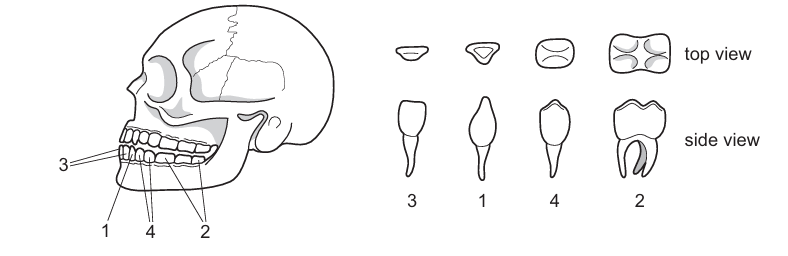
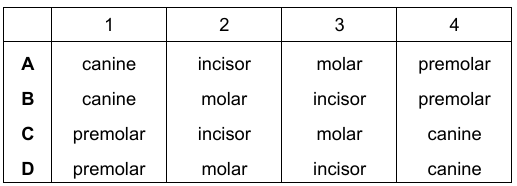
Which row correctly identifies all four types of teeth?
▶️ Answer/Explanation
Ans: B
The four types of teeth in humans are:
- Incisors (flat, chisel-shaped for cutting).
- Canines (pointed for tearing).
- Premolars (two cusps for crushing).
- Molars (broad surface for grinding).
From left to right in the diagram, the sequence matches B: Incisors → Canines → Premolars → Molars. The other options mislabel premolars/molars or invert the order.
Topic – 7.4
What are the products of protein digestion in the stomach?
A) amino acids
B) fatty acids
C) glycerol
D) proteases
▶️ Answer/Explanation
Ans: A
Proteins are broken down into amino acids during digestion. In the stomach, the enzyme pepsin hydrolyzes proteins into smaller peptides, which are later fully digested into amino acids in the small intestine.
Fatty acids (B) and glycerol (C) result from fat digestion, while proteases (D) are enzymes that catalyze protein breakdown, not the end product. Thus, the correct answer is A (amino acids).
Topic – 7.5
Where is water absorbed?
A) colon and small intestine
B) large intestine only
C) gall bladder and colon
D) small intestine only
▶️ Answer/Explanation
Ans: A
Water absorption occurs in both the small intestine and colon (large intestine). The small intestine absorbs most of the water from digested food, while the colon absorbs remaining water to form solid feces.
Option B is incorrect because the small intestine also absorbs water. Option C is wrong as the gall bladder stores bile, not water. Option D is incomplete since the colon also plays a role.
Topic – 8.1
The diagram shows a cross-section of a stem.
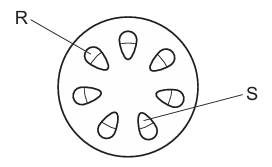
Which statement correctly describes the location and function of phloem?
A) Structure R is phloem and transports amino acids and starch.
B) Structure S is phloem and transports amino acids and starch.
C) Structure R is phloem and transports amino acids and sucrose.
D) Structure S is phloem and transports amino acids and sucrose.
▶️ Answer/Explanation
Ans: C
In a stem cross-section, phloem is typically located toward the outer side (Structure R), while xylem (Structure S) is found toward the center. Phloem transports organic nutrients, including amino acids and sucrose, but not starch, which is stored rather than transported.
Option A is incorrect because phloem does not transport starch. Option B is wrong because Structure S is xylem, not phloem. Option D is incorrect for the same reason. Thus, the correct answer is C (Structure R is phloem and transports amino acids and sucrose).
Topic – 8.3
Some environmental factors are listed.
- carbon dioxide concentration
- temperature
- oxygen concentration
- wind speed
Which factors directly affect the rate of transpiration?
A) 1 and 3
B) 1 and 4
C) 2 and 3
D) 2 and 4
▶️ Answer/Explanation
Ans: D
Transpiration is the loss of water vapor from plant leaves, primarily regulated by stomatal opening and environmental conditions. Temperature (2) increases transpiration by enhancing water evaporation, while wind speed (4) removes humid air, maintaining a steep water vapor gradient.
Carbon dioxide (1) and oxygen (3) concentrations affect photosynthesis and respiration but have minimal direct impact on transpiration. Thus, the correct factors are D (2 and 4).
Topic – 9.3
The diagram shows part of a blood vessel.

Which evidence in the diagram shows that it is a vein and not an artery?
A) There is a valve inside the blood vessel.
B) Blood is flowing in an upwards direction.
C) The blood vessel has a relatively small lumen.
D) The blood vessel has a relatively thick wall.
▶️ Answer/Explanation
Ans: A
Valves (A) are the key distinguishing feature of veins, as they prevent backflow of blood in low-pressure circulation. Arteries lack valves due to their high-pressure flow.
Blood flow direction (B) is irrelevant for classification. A small lumen (C) and thick walls (D) are characteristic of arteries, not veins. Thus, the presence of a valve confirms it’s a vein.
Topic – 9.4
The photomicrograph shows two blood cells.
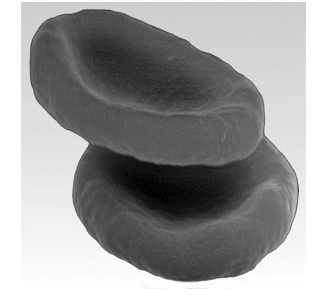
What is the function of these cells?
A) to carry out phagocytosis
B) to produce antibodies
C) to transport oxygen
D) to transport vitamins
▶️ Answer/Explanation
Ans: C
The photomicrograph shows red blood cells (erythrocytes), identifiable by their biconcave shape and lack of nuclei. Their primary function is to transport oxygen using the pigment hemoglobin.
Phagocytosis (A) is performed by white blood cells, antibody production (B) by lymphocytes, and vitamin transport (D) is not a primary role of erythrocytes. Thus, C is correct.
Topic – 11.1
Which row matches a gas in expired air with a substance that can be used to test for the presence of that gas?
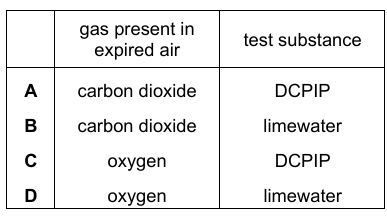
▶️ Answer/Explanation
Ans: B
Carbon dioxide (present in expired air) is tested using limewater, which turns from clear to milky when CO2 is bubbled through it. This matches row B.
Other options are incorrect because:
- Oxygen (A) is tested with a glowing splint (relights), not cobalt chloride paper (tests for water).
- Nitrogen (C) is not typically tested with hydrogen carbonate indicator (used for CO2 levels).
- Water vapor (D) is detected using cobalt chloride paper (blue to pink), not limewater.
Thus, B is the only correct match.
Topic – 12.3
Which graph shows how temperature affects the rate of anaerobic respiration in yeast?
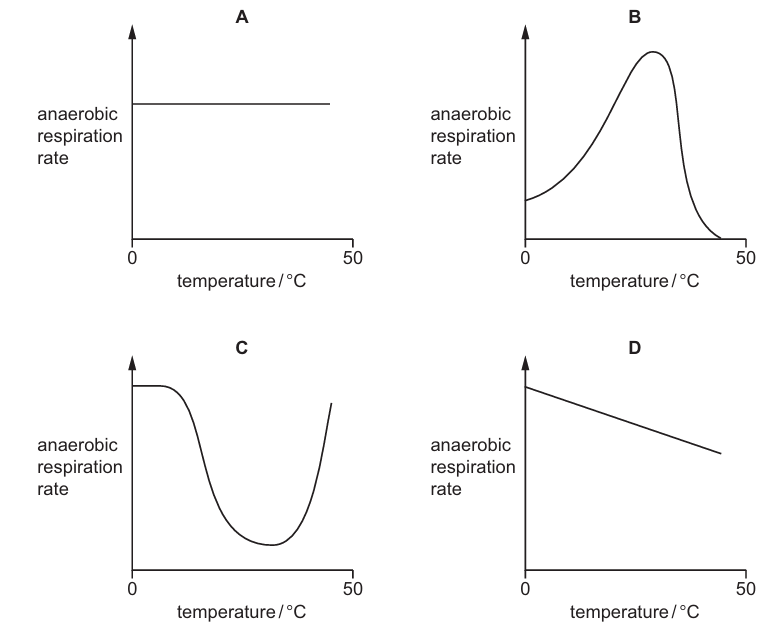
▶️ Answer/Explanation
Ans: B
The rate of anaerobic respiration in yeast increases with temperature up to an optimum (around 30–40°C), beyond which enzymes denature, causing a sharp decline.
Graph B correctly shows this trend: a rise to a peak followed by a rapid drop. Other graphs either plateau (A), show linearity (C), or incorrect trends (D).
Topic – 14.1
What is the pathway of a reflex arc from the receptor to the effector?
A) motor neurone → relay neurone → sensory neurone
B) motor neurone → sensory neurone → relay neurone
C) sensory neurone → motor neurone → relay neurone
D) sensory neurone → relay neurone → motor neurone
▶️ Answer/Explanation
Ans: D
A reflex arc follows a specific sequence:
- Sensory neurone: Carries impulses from the receptor to the central nervous system (CNS).
- Relay neurone: Connects sensory and motor neurones within the CNS.
- Motor neurone: Transmits impulses from the CNS to the effector (e.g., muscle or gland).
Thus, the correct pathway is D (sensory neurone → relay neurone → motor neurone).
Topic – 14.3
What is an effect of adrenaline secretion?
A) decreased breathing rate
B) decreased pupil diameter
C) development of secondary sexual characteristics
D) increased heart rate
▶️ Answer/Explanation
Ans: D
Adrenaline (epinephrine) is a hormone released during the “fight or flight” response. Its effects include:
- Increased heart rate (D) to pump more blood to muscles.
- Increased breathing rate (not decreased, so A is incorrect).
- Pupil dilation (not decreased diameter, so B is incorrect).
- Secondary sexual characteristics (C) are regulated by sex hormones, not adrenaline.
Thus, the correct answer is D (increased heart rate).
Topic – 14.5
What is phototropism?
A) absorbing mineral ions
B) absorbing water
C) directional growth in response to gravity
D) directional growth in response to light
▶️ Answer/Explanation
Ans: D
Phototropism is the directional growth of a plant in response to light, typically toward a light source (positive phototropism). This is mediated by the hormone auxin, which redistributes to the shaded side of the plant, causing cells to elongate and the plant to bend toward light.
Options A and B describe nutrient/water uptake (root functions), while C describes gravitropism. Thus, the correct answer is D.
Topic – 16.1
A gardener wants to grow some new plants that are identical to plants that she already has.
Which method of reproduction is used, and how many parents are needed for her to grow some new identical plants?

▶️ Answer/Explanation
Ans: A
To produce identical plants, the gardener must use asexual reproduction, where offspring are genetically identical to the single parent. Methods like cuttings, grafting, or runners (shown in the diagram) require only 1 parent.
Sexual reproduction (C/D) involves two parents and results in genetic variation, while asexual reproduction with two parents (B) is biologically impossible. Thus, the correct answer is A (Asexual reproduction, 1 parent).
Topic – 16.3
What must always be present for seeds to germinate?
A) chlorophyll
B) light
C) soil
D) water
▶️ Answer/Explanation
Ans: D
Water is essential for seed germination as it activates enzymes that break down stored food, initiates metabolic activity, and softens the seed coat for the embryo to emerge.
Chlorophyll (A) develops after germination, light (B) isn’t always required (some seeds germinate in darkness), and soil (C) is not mandatory as seeds can germinate without it (e.g., in moist paper towels).
Topic – 16.4
What is a flagellum?
A) a ball of cells that implants into the lining of the uterus
B) a cell structure that releases energy
C) a cell that forms after the sperm cell fuses with the egg cell
D) an adaptive feature used for movement of sperm cells
▶️ Answer/Explanation
Ans: D
A flagellum is a whip-like tail structure that enables movement in sperm cells (and some other microorganisms). It propels the sperm toward the egg during fertilization.
Option A describes an embryo, B refers to mitochondria, and C describes a zygote. Since the question asks about the flagellum’s function, the correct answer is D (an adaptive feature for sperm movement).
Topic – 17.1
Which word describes a fertilised cell?
A) acrosome
B) embryo
C) gamete
D) zygote
▶️ Answer/Explanation
Ans: D
A zygote (D) is the single-celled organism formed immediately after the fusion of male and female gametes during fertilization. It represents the first stage of a new individual’s development.
The acrosome (A) is a structure in sperm cells that helps penetrate the egg. A gamete (C) is an unfertilized reproductive cell (sperm or egg), and an embryo (B) develops from the zygote after cell division begins. Therefore, the correct term for a fertilized cell is D (zygote).
Topic – 16.5
Which secondary sexual characteristic is caused by both testosterone and oestrogen?
A) breast development
B) changes in body shape
C) growth of facial hair
D) sudden deepening of voice
▶️ Answer/Explanation
Ans: B
Changes in body shape (B) occur in both sexes during puberty under the influence of both hormones: testosterone promotes broader shoulders in males, while oestrogen causes wider hips in females.
Breast development (A) is oestrogen-dependent, while facial hair (C) and voice deepening (D) are testosterone-specific. Only body shape changes are mediated by both hormones.
Topic – 16.6
Some ways that diseases can be transmitted are listed.
- airborne droplets
- blood and needles
- food and drink
- unprotected sex
which ways can transmit HIV?
A) 1 and 3
B) 1 only
C) 2 and 4
D) 4 only
▶️ Answer/Explanation
Ans: C
HIV is transmitted through specific body fluids:
- 2. Blood and needles: Direct blood contact or contaminated needles can transmit HIV.
- 4. Unprotected sex: Sexual contact allows transmission through semen/vaginal fluids.
HIV cannot be transmitted through airborne droplets (1) or food/drink (3), eliminating options A, B, and D. Thus, C (2 and 4) is correct.
Topic – 17.1
What do genes code for?
A) fats
B) proteins
C) starch
D) sugars
▶️ Answer/Explanation
Ans: B
Genes contain DNA sequences that provide instructions for protein synthesis through the processes of transcription and translation. This is known as the central dogma of molecular biology.
While genes indirectly influence the production of other molecules (A, C, D), they directly code only for proteins (B). Proteins then perform various functions, including enzyme production that facilitates the synthesis of fats, starch, and sugars.
Therefore, the correct answer is B (proteins).
Topic – 17.4
When white-flowered pea plants are crossed with red-flowered pea plants, the offspring plants all have red flowers. If these offspring plants are crossed, the next generation of plants contains both red-flowered and white-flowered plants. Which statement explains this?
A) The allele for red flowers is dominant, and the offspring plants are heterozygous.
B) The allele for red flowers is dominant, and the offspring plants are homozygous.
C) The allele for red flowers is recessive, and the offspring plants are heterozygous.
D) The allele for red flowers is recessive, and the offspring plants are homozygous.
▶️ Answer/Explanation
Ans: A
1. First cross (P generation): All offspring having red flowers when crossed with white flowers shows red is dominant (white must be recessive).
2. Second cross (F1 generation): When these red-flowered offspring are crossed, both red and white flowers appear in a 3:1 ratio, proving the F1 plants were heterozygous (Rr).
3. Conclusion: Only option A correctly states that red is dominant and the F1 generation is heterozygous, explaining the observed inheritance pattern.
Topic – 18.2
What is a description of an adaptive feature?
A) an inherited characteristic that helps an organism to survive and reproduce
B) the differences between individuals of the same species
C) the genetic make-up of an organism
D) the transmission of information from generation to generation
▶️ Answer/Explanation
Ans: A
An adaptive feature is defined as:
- An inherited characteristic (passed down through genes)
- That enhances survival in a specific environment
- And improves reproductive success
Why other options are incorrect:
– B describes variation, not adaptation.
– C refers to genotype.
– D describes heredity, not adaptive traits.
Thus, the correct answer is A.
Topic – 19.2
Which diagram shows a pyramid of biomass for the food chain shown?
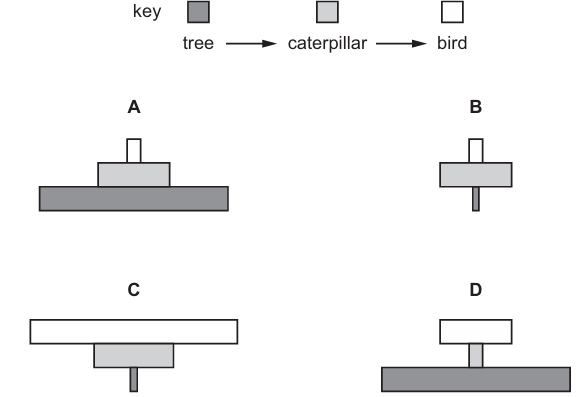
▶️ Answer/Explanation
Ans: A
A pyramid of biomass represents the total mass of organisms at each trophic level, which typically decreases as you move up the food chain due to energy loss (10% rule).
Key observations:
- Producers (plants) have the highest biomass.
- Primary consumers (herbivores) have less biomass than producers.
- Secondary consumers (carnivores) have the least biomass.
Option A correctly shows this decreasing pattern, while other options either invert the pyramid or show incorrect proportions.
Topic – 20.4
Which statement about conservation is correct?
A) Captive breeding programmes can be used to conserve endangered species.
B) Climate change is reducing the number of species that are endangered.
C) Habitat protection increases the number of species that are endangered.
D) Sustainable resources are those that are used more rapidly than they are replaced.
▶️ Answer/Explanation
Ans: A
Captive breeding programmes (A) are a well-established conservation method to increase populations of endangered species (e.g., California condor, black-footed ferret).
The other options are incorrect because:
- B: Climate change increases endangerment by disrupting ecosystems.
- C: Habitat protection reduces endangerment by preserving natural environments.
- D: Sustainable resources are replenished at or above their usage rate.
Thus, A is the only correct statement.