
Topic: 11.1
A living organism, X, can make its own food, get rid of toxic materials and detect and respond to stimuli.
What other four processes must organism X carry out to stay alive?
A) excretion, growth, movement, sensitivity
B) excretion, growth, nutrition, respiration
C) growth, movement, reproduction, respiration
D) movement, reproduction, respiration, sensitivity
▶️ Answer/Explanation
Ans: C
Organism X already performs nutrition (makes its own food), excretion (removes toxic materials), and sensitivity (responds to stimuli). The remaining essential life processes are growth, movement, reproduction, and respiration (C).
Option A includes sensitivity (already mentioned), B includes nutrition and excretion (already covered), and D includes sensitivity (redundant). Thus, the correct answer is C.
Topic: 1.2
The diagram shows an animal.

Using the key, which genus does the animal belong to?

▶️ Answer/Explanation
Ans: C
Following the dichotomous key step-by-step:
- The animal has no legs → Proceed to 2.
- It has no visible shell → Proceed to 3.
- The body is not segmented → Belongs to Genus C.
Thus, the correct answer is C.
Topic: 1.2
Which statement is true for all species of organisms?
A) A species is a group of organisms that are genetically identical.
B) A species is a group of organisms that produce fertile offspring.
C) A species is a group of organisms that reproduce both asexually and sexually.
D) A species is a group of organisms that reproduce by sexual means only.
▶️ Answer/Explanation
Ans: B
A species is defined as a group of organisms capable of interbreeding and producing fertile offspring (B). This is a fundamental concept in biology.
Option A is incorrect because genetic variation exists within a species. Option C is false as some species reproduce only asexually or sexually. Option D is incorrect because many species reproduce asexually. Thus, the correct answer is B.
Topic: 1.3
Which group of living organisms includes the myriapods?
A) arthropods
B) prokaryotes
C) protoctists
D) vertebrates
▶️ Answer/Explanation
Ans: A
Myriapods (e.g., centipedes and millipedes) belong to the phylum Arthropoda (A), characterized by segmented bodies and jointed legs. Prokaryotes (B) are unicellular organisms without nuclei, protoctists (C) are eukaryotic microbes, and vertebrates (D) have backbones. Since myriapods are arthropods, the correct answer is A (Arthropods).
Topic: 2.1
The diagram shows a liver cell.

Which features are present in this cell and also in most plant cells?
A) cell membrane and cytoplasm
B) cell membrane and sap vacuole
C) cell wall and cytoplasm
D) cell wall and sap vacuole
▶️ Answer/Explanation
Ans: A
Liver cells (animal cells) and plant cells share some common features, such as the cell membrane (controls what enters/leaves the cell) and cytoplasm (site of metabolic reactions). However, plant cells uniquely contain a cell wall (for rigidity) and a sap vacuole (for storage). Since the question asks for features present in both cell types, the correct answer is A (cell membrane and cytoplasm).
Topic: 1.3
A tick is a type of arachnid.
The length of an adult tick is 2.3 mm.
What is the length of the tick in micrometres?
A) 0.23 μm
B) 23 μm
C) 230 μm
D) 2300 μm
▶️ Answer/Explanation
Ans: D
To convert millimetres (mm) to micrometres (μm), we use the conversion factor \(1 \text{ mm} = 1000 \text{ μm}\).
Given the tick’s length is \(2.3 \text{ mm}\), multiplying by 1000 gives:
\(2.3 \times 1000 = 2300 \text{ μm}\).
Thus, the correct answer is D (2300 μm).
Topic: 3.2
Cylinders of potato tissue were left in different concentrations of sucrose solution for one hour. The graph shows the percentage change in the length of the potato cylinders after one hour.
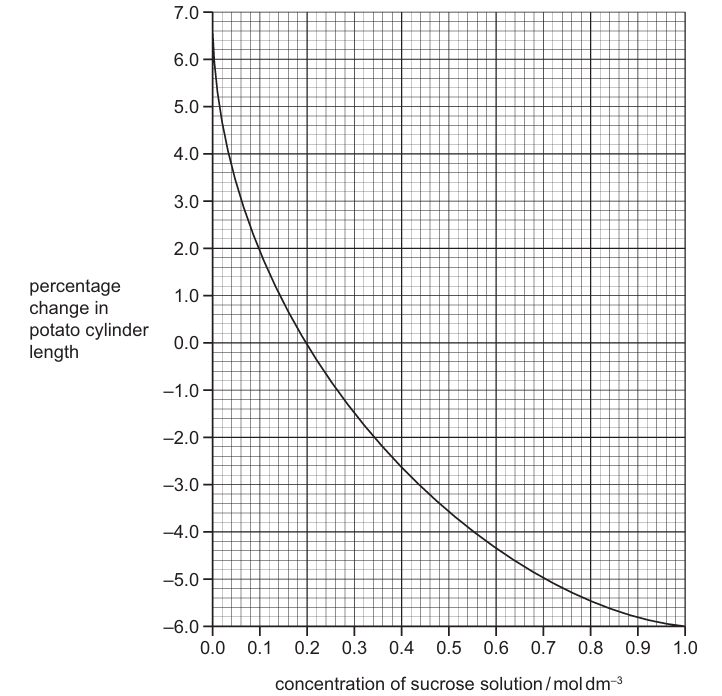
What can be concluded about the cells of the potato cylinders that were left in 0.2 mol dm–3 sucrose solution?
A) The cells in the potato cylinders became flaccid.
B) The cells in the potato cylinders became plasmolysed.
C) The net movement of water into the potato cells was equal to the net movement of water out of the potato cells.
D) The water potential of the potato cells was zero.
▶️ Answer/Explanation
Ans: C
At 0.2 mol dm–3 sucrose solution, the graph shows 0% change in length, indicating no net water movement. This means the potato cells are in equilibrium with the sucrose solution (C).
Flaccidity (A) occurs in hypotonic solutions, plasmolysis (B) in hypertonic solutions, and zero water potential (D) is not necessarily true here. Thus, the correct conclusion is C (Net water movement is balanced).
Topic: 4.1
Which statement about biological molecules is correct?
A) DNA molecules contain pairs of bases: A pairs with G and C pairs with T.
B) Fatty acids and glycerol molecules can be joined together to form proteins.
C) Glucose molecules can be joined together to make cellulose and glycogen.
D) Starch molecules are made of maltase.
▶️ Answer/Explanation
Ans: C
Option C is correct because glucose monomers polymerize to form polysaccharides like cellulose (plant cell walls) and glycogen (energy storage in animals).
Option A is incorrect as DNA base pairing follows Chargaff’s rules (A-T, C-G). Option B is wrong because fatty acids and glycerol form lipids, not proteins. Option D is false since starch is made of amylose/amylopectin, not maltase (an enzyme).
Topic: 5.1
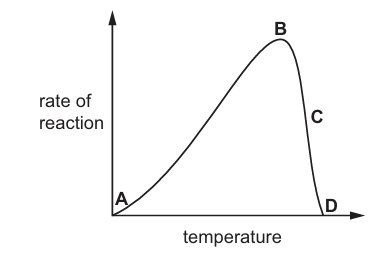
The graph shows how temperature affects an enzyme-controlled reaction.
Where on the graph do the enzyme and substrate molecules have the most kinetic energy?
▶️ Answer/Explanation
Ans: D
Kinetic energy of molecules increases with temperature. At point D, the temperature is the highest, meaning the enzyme and substrate molecules are moving the fastest and possess the most kinetic energy.
While the enzyme activity declines beyond the optimum temperature (due to denaturation), the kinetic energy continues to rise. Thus, the correct answer is D.
Topic: 6.1
Which substance is an energy store that is made in plant cells from the products of photosynthesis?
A) cellulose
B) glycogen
C) nectar
D) starch
▶️ Answer/Explanation
Ans: D
During photosynthesis, plants produce glucose, which is converted into starch (D) for long-term energy storage. Starch is insoluble and compact, making it ideal for storage in plant cells.
Cellulose (A) is a structural component of cell walls, glycogen (B) is an energy store in animals, and nectar (C) is a sugary fluid for attracting pollinators. Thus, the correct answer is D (Starch).
Topic: 7.1
Which nutrient is lacking when a person has scurvy?
A) calcium
B) iron
C) vitamin C
D) vitamin D
▶️ Answer/Explanation
Ans: C
Scurvy is a disease caused by vitamin C deficiency (C), which is essential for collagen synthesis. Without it, connective tissues weaken, leading to symptoms like bleeding gums and poor wound healing.
Calcium (A) affects bones, iron (B) relates to anemia, and vitamin D (D) impacts bone health. Since scurvy specifically results from vitamin C deficiency, the correct answer is C (vitamin C).
Topic: 7.2
The diagram shows part of the alimentary canal.

Which row correctly identifies the structures labelled J to M?

▶️ Answer/Explanation
Ans: A
From the diagram:
- J is the stomach (a muscular sac for digestion).
- K is the pancreas (an accessory organ secreting digestive enzymes).
- L is the small intestine (primary site for nutrient absorption).
- M is the large intestine (absorbs water and forms feces).
Only Option A matches these identifications. The other options mislabel the structures (e.g., B swaps pancreas and stomach, C misidentifies the small intestine, D incorrectly labels the large intestine).
Topic: 7.4
Which statement about enzymes in digestion is correct?
A) Amylase catalyses the breakdown of fats to fatty acids and glycerol.
B) Amylase catalyses the breakdown of oils to fatty acids and glucose.
C) Lipase catalyses the breakdown of fats to fatty acids and glycerol.
D) Lipase catalyses the breakdown of oils to fatty acids and glucose.
▶️ Answer/Explanation
Ans: C
The correct statement is:
- Lipase is the enzyme that breaks down fats (lipids) into fatty acids and glycerol.
- Amylase breaks down starch into maltose or glucose, not fats or oils.
Options A and B incorrectly assign fat/oil digestion to amylase. Option D incorrectly states that lipase produces glucose, which is false. Thus, C is the correct answer.
Topic: 7.5
The diagram shows a villus.
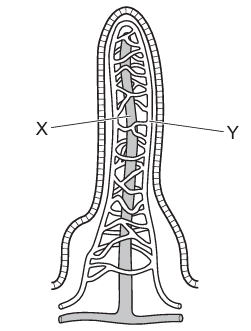
Which statement about absorption is correct?
A) Amino acids move into X.
B) Fatty acids move into X.
C) Cellulose moves into Y.
D) Maltose moves into Y.
▶️ Answer/Explanation
Ans: B
In the villus, fatty acids and glycerol are absorbed into the lacteals (X), which are part of the lymphatic system. This is because fats are transported as chylomicrons, which enter the lymphatic vessels before reaching the bloodstream.
Amino acids (A) and maltose (D) are absorbed into blood capillaries (Y), not lacteals. Cellulose (C) is not digested by humans and thus is not absorbed. Therefore, the correct answer is B (Fatty acids move into X).
Topic: 8.1
Which substance strengthens the walls of xylem vessels?
A) glycerol
B) glycogen
C) lignin
D) starch
▶️ Answer/Explanation
Ans: C
Lignin (C) is a rigid polymer deposited in the cell walls of xylem vessels, providing structural support and waterproofing. Glycerol (A) is a lipid, glycogen (B) and starch (D) are carbohydrates used for energy storage. Since lignin is the key reinforcing material in xylem, the correct answer is C (Lignin).
Topic: 3.2
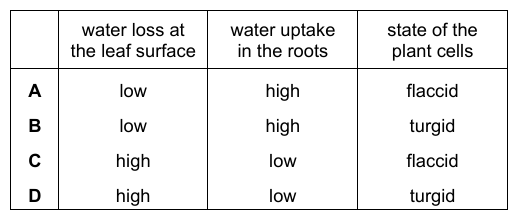
Which row explains why a plant wilts?
▶️ Answer/Explanation
Ans: C
Wilting occurs when a plant loses turgor pressure due to insufficient water in its cells. This happens when water uptake by roots (osmosis) is slower than water loss through transpiration. Row C correctly identifies this imbalance, while other rows describe unrelated processes (e.g., respiration, photosynthesis). Thus, the correct answer is C.
Topic: 8.4
Scientists investigated the movement of sucrose through a plant. They used carbon dioxide containing radioactive carbon, 14C.
They covered one leaf on a plant with a clear plastic bag containing 14CO2. After 24 hours, the plant was placed onto photographic film. The photographic film went black where the radioactive carbon was present. Diagram 1 shows the plant at the start of the experiment, and diagram 2 shows the photographic film at the end of the experiment.
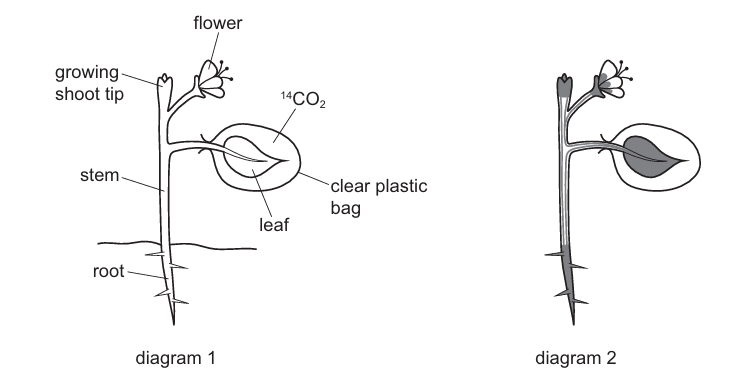
Which conclusions can be made from the experiment?
- Translocation occurs in upwards and downwards directions.
- The leaf and shoot tip are sources.
- The roots and flowers are sinks.
A) 1, 2 and 3
B) 1 and 2 only
C) 1 and 3 only
D) 2 and 3 only
▶️ Answer/Explanation
Ans: C
1. Translocation occurs in both directions (upwards and downwards): The radioactive carbon (14C) is detected in both the roots (downwards) and the shoot tip (upwards), confirming bidirectional movement of sucrose.
2. The leaf is a source, but the shoot tip is not: The covered leaf is the source of 14C-sucrose, while the shoot tip is a sink where sugars are used for growth.
3. Roots and flowers are sinks: The blackened film in roots and flowers indicates they are sinks, as they store or use the transported sucrose.
Thus, 1 and 3 are correct, making C the right answer.
Topic: 9.2
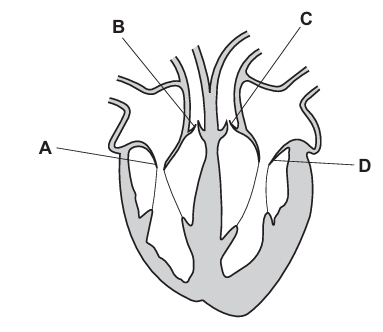
The diagram shows a section through the human heart.
Which valve is the right atrioventricular valve?
▶️ Answer/Explanation
Ans: A
The right atrioventricular (AV) valve, also known as the tricuspid valve, is located between the right atrium and right ventricle. In the diagram, it is labeled as A.
The other valves are:
– B: Pulmonary valve (exit of right ventricle)
– C: Left AV (bicuspid/mitral) valve
– D: Aortic valve (exit of left ventricle).
Since the question specifies the right AV valve, the correct answer is A.
Topic: 9.3
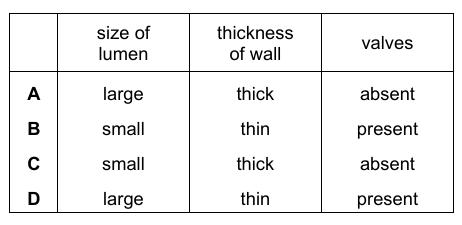
Which row shows the features of a blood vessel that transports blood at low pressure?
▶️ Answer/Explanation
Ans: D
Veins transport blood at low pressure and have thin walls (less muscle/elastic tissue) and valves to prevent backflow. These features match Row D.
Arteries (high pressure) have thick walls (A/B), while capillaries (C) lack valves and have minimal wall thickness. Thus, D is the correct representation of a low-pressure vessel (vein).
Topic: 9.4
The diagram shows a component of blood.

What is the name of this component?
A) lymphocyte
B) phagocyte
C) platelet
D) red blood cell
▶️ Answer/Explanation
Ans: B
The diagram depicts a phagocyte (B), a type of white blood cell that engulfs and digests pathogens. Its irregular shape and lobed nucleus are key identifying features.
Lymphocytes (A) are smaller with a large round nucleus, platelets (C) are tiny cell fragments, and red blood cells (D) are biconcave and lack a nucleus. Thus, the correct answer is B (Phagocyte).
Topic: 10.1
Which statement about immunity is correct?
A) Antibodies are present on the surface of pathogens.
B) Antibodies are produced by lymphocytes.
C) Antigens are produced by memory cells.
D) Antigens are produced by phagocytes.
▶️ Answer/Explanation
Ans: B
Lymphocytes (B cells) are specialized white blood cells that produce antibodies in response to antigens. This is a key mechanism of the adaptive immune system.
Antigens (not antibodies) are present on pathogens (A is incorrect). Memory cells store information about past infections but do not produce antigens (C is wrong). Phagocytes engulf pathogens but do not produce antigens (D is incorrect). Thus, the correct answer is B.
Topic: 11.1
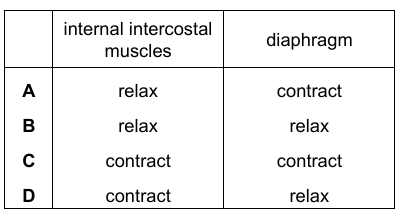
The intercostal muscles and diaphragm contract and relax during ventilation.
Which row shows the actions of muscles that result in the largest volume inside the thorax?
▶️ Answer/Explanation
Ans: A
The largest thoracic volume occurs during inspiration, when both the external intercostal muscles contract (lifting ribs up and out) and the diaphragm contracts (flattening downward). This dual action maximizes chest cavity expansion.
Option A correctly shows both muscles contracting simultaneously. Other options either show partial contraction (B, D) or relaxation (C), which produce smaller thoracic volumes during expiration or passive breathing.
Topic: 12.2
How many molecules of carbon dioxide, glucose, oxygen and water are there in the balanced chemical equation for aerobic respiration?

▶️ Answer/Explanation
Ans: C
The balanced chemical equation for aerobic respiration is:
C6H12O6 + 6O2 → 6CO2 + 6H2O + Energy
This shows:
- 1 molecule of glucose (C6H12O6).
- 6 molecules of oxygen (O2).
- 6 molecules of carbon dioxide (CO2).
- 6 molecules of water (H2O).
Only Option C matches these quantities. The other options either miscount the molecules or misrepresent the equation.
Topic: 13.1
Where is urea formed and excreted?
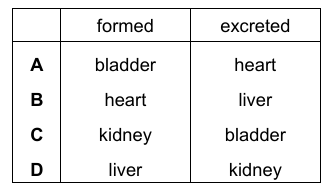
▶️ Answer/Explanation
Ans: D
Urea is formed and excreted through the following process:
- Formation: Urea is produced in the liver as a byproduct of protein metabolism (deamination of amino acids).
- Excretion: It is transported via the bloodstream to the kidneys, where it is filtered out and excreted in urine.
In the diagram, the correct labels for these organs are D (liver and kidneys). Other options (A, B, C) misrepresent either the site of formation or excretion.
Topic: 14.5
A growing seedling was pinned sideways onto a wooden board that was covered in wet blotting paper. The seedling was kept in a dark box. The diagram shows the seedling after 24 hours. Auxin had become concentrated on the lower side of the shoot and the root.

What can be concluded from this experiment about the effect of auxin on the seedling?
A) A high concentration of auxin stimulates cell elongation on the lower side of the root.
B) A high concentration of auxin stimulates cell elongation on the lower side of the shoot.
C) A low concentration of auxin stimulates cell elongation on the upper side of the shoot.
D) A low concentration of auxin stimulates cell elongation on the upper sides of the shoot and the root.
▶️ Answer/Explanation
Ans: B
The experiment demonstrates gravitropism, where auxin redistributes to the lower side of the shoot and root in response to gravity. In shoots, high auxin concentration stimulates cell elongation, causing upward bending (B).
In roots, high auxin inhibits elongation (making A incorrect). Options C and D are incorrect because auxin’s effect depends on concentration and tissue type—low concentration does not drive elongation in this context. Thus, the correct conclusion is B.
Topic: 15.1
Which statement describes a drug?
A) a substance that is produced in the body and alters the activity of target organs
B) a substance that is produced in the body and increases the rate of chemical reactions in the body
C) any substance taken into the body that modifies or affects chemical reactions in the body
D) any substance that helps the body maintain a constant internal environment
▶️ Answer/Explanation
Ans: C
A drug is defined as any substance (natural or synthetic) that, when introduced into the body, alters its physiological processes. Options A and B describe hormones, while D refers to homeostatic mechanisms. Only option C captures the broad, defining characteristic of drugs, making it the correct answer.
Topic: 16.3
The diagram shows a plant that is producing small plantlets.
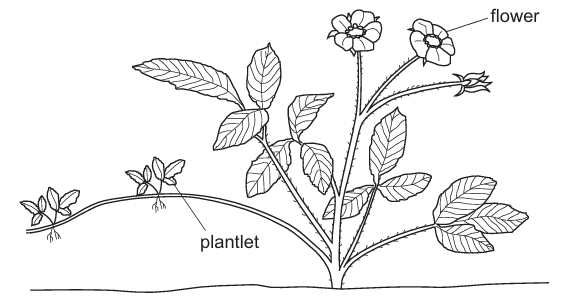
Which statement about the plantlets is correct?
A) They are genetically different from the parent plant.
B) They are genetically identical to the parent plant.
C) They are produced as a result of the fusion of nuclei.
D) They are produced by fertilising the flowers.
▶️ Answer/Explanation
Ans: B
The diagram depicts asexual reproduction through plantlets, a form of vegetative propagation. In this process, the plantlets are clones, meaning they are genetically identical to the parent plant (B). Options A, C, and D describe sexual reproduction, which involves genetic variation or fertilization—neither of which applies here. Thus, the correct answer is B.
Topic: 6.1
Which substance is an energy store that is made in plant cells from the products of photosynthesis?
A) cellulose
B) glycogen
C) nectar
D) starch
▶️ Answer/Explanation
Ans: D
During photosynthesis, plants produce glucose, which is converted into starch (D) for long-term energy storage in cells.
Cellulose (A) is a structural component of cell walls, not an energy store. Glycogen (B) is an energy store in animals, not plants. Nectar (C) is a sugary fluid for attracting pollinators but is not stored energy.
Thus, the correct answer is D (starch), as it is the primary energy storage polysaccharide in plants.
Topic: 16.6
The table shows the number of new HIV infections in 1990 and 2021 in one country.

Which statement could explain the change in the number of new HIV infections between 1990 and 2021?
A) Condoms, which prevent the transmission of STIs, increased in price between 1990 and 2021.
B) People in 2021 had more sexual partners.
C) Testing of donated blood for pathogens was introduced in 1990.
D) There was an increase in drug abuse between 1990 and 2021.
▶️ Answer/Explanation
Ans: C
The table shows a decrease in new HIV infections from 1990 to 2021. The most plausible explanation is C (Testing of donated blood for pathogens was introduced in 1990), as this would reduce transmission via blood transfusions.
Why not others?
– A: Higher condom prices would likely increase infections, not decrease them.
– B: More sexual partners would also likely increase transmission.
– D: Increased drug abuse (often involving shared needles) would raise HIV rates, not lower them.
Thus, C is the only option that aligns with the observed decline in infections.
Topic: 17.1
Where are amino acids assembled into protein molecules?
A) the DNA
B) the genes
C) the nucleus
D) the ribosomes
▶️ Answer/Explanation
Ans: D
Ribosomes (Option D) are the cellular structures where amino acids are assembled into proteins during translation. This process follows instructions from mRNA, which is transcribed from DNA.
DNA (A) stores genetic information, genes (B) are segments of DNA, and the nucleus (C) houses DNA but does not synthesize proteins. Thus, D (ribosomes) is the correct answer.
Topic: 17.2
The diagram shows the changes in the mass of DNA in one cell before, during and after mitosis.
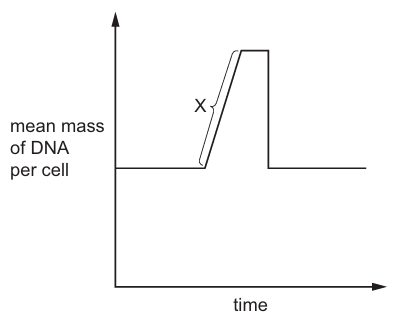
What is happening at X in the graph?
A) the cell is changing from haploid to diploid
B) the cell is dividing
C) DNA replication
D) reduction division
▶️ Answer/Explanation
Ans: C
At point X, the DNA mass doubles, indicating DNA replication (C) during the S-phase of the cell cycle. This ensures each daughter cell receives an identical copy of genetic material after mitosis.
Option A is incorrect as ploidy does not change during mitosis. Option B (cell division) occurs later when DNA mass halves, and D (reduction division) refers to meiosis, not mitosis. Thus, the correct answer is C (DNA replication).
Topic: 17.4
A woman who has blood group AB has a child with a man who has blood group B and is heterozygous. What is the chance of the child having blood group B?
A) 0%
B) 25%
C) 50%
D) 100%
▶️ Answer/Explanation
Ans: C
The mother has blood group AB (genotype: IAIB), and the father is heterozygous B (genotype: IBi). Using a Punnett square:
| IA | IB | |
| IB | IAIB (AB) | IBIB (B) |
| i | IAi (A) | IBi (B) |
Possible genotypes: IAIB (AB), IBIB (B), IAi (A), IBi (B). Out of 4 possibilities, 2 result in blood group B. Thus, the probability is 50% (C).
Topic: 18.2
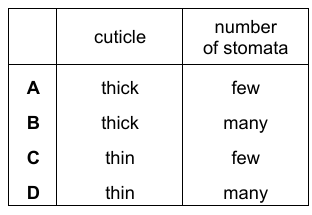
Plants are adapted to survive in different environments.
What are features of xerophytes?
▶️ Answer/Explanation
Ans: A
Xerophytes (desert plants) show adaptations to reduce water loss:
- Thick waxy cuticle (reduces transpiration)
- Sunken stomata (creates humid microclimate)
These features match option A. Other options incorrectly include:
- B: Thin cuticle (would increase water loss)
- C: Broad leaves (increase surface area for transpiration)
- D: No stomata (would prevent gas exchange)
Topic: 19.1
Which diagram correctly shows the flow of energy?

▶️ Answer/Explanation
Ans: A
In ecological systems, energy flows unidirectionally from the sun to producers (plants), then to consumers (herbivores, carnivores), and finally to decomposers. This flow is non-cyclic as energy is lost as heat at each trophic level.
Why Option A is correct:
- Shows a linear progression (sun → producer → consumer → decomposer).
- No energy is shown returning to previous levels (correct, as energy cannot be recycled).
Why other options are incorrect:
- B and C incorrectly show energy cycling back to the sun or producers.
- D reverses the flow direction, which violates thermodynamic laws.
Topic: 19.2
The diagram shows a food chain.

What is the correct pyramid of numbers for this food chain?

▶️ Answer/Explanation
Ans: A
The food chain shown is:
Grass → Grasshopper → Frog → Snake
A pyramid of numbers represents the quantity of organisms at each trophic level:
- Base (Producers): Grass is most numerous.
- Primary Consumers: Fewer grasshoppers than grass plants.
- Secondary Consumers: Even fewer frogs than grasshoppers.
- Tertiary Consumers: Snakes are the least numerous.
This forms a classic upright pyramid (Option A), as energy is lost at each trophic level, supporting fewer organisms.
Topic: 19.3
Acidic soils encourage the increase of anaerobic bacteria that cause denitrification.
How do acidic conditions affect the nitrogen cycle?
A) Ammonia will not enter the nitrogen cycle.
B) More nitrogen gas will be released from the soil.
C) The concentration of nitrates in the soil will increase.
D) The plants growing in the soil will produce more proteins.
▶️ Answer/Explanation
Ans: B
Acidic soils promote denitrification, where anaerobic bacteria convert nitrates (NO₃⁻) into nitrogen gas (N₂). This process reduces soil fertility by removing usable nitrogen compounds and releasing N₂ gas into the atmosphere (B).
Option A is incorrect because ammonia can still enter the cycle via decomposition. Option C is false as denitrification decreases nitrate levels. Option D is incorrect because less available nitrogen reduces protein synthesis in plants. Thus, the correct answer is B.
Topic: 12.2
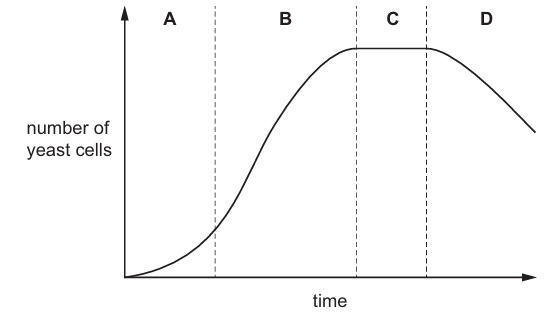
The graph shows the population of yeast over a period of time.
Which phase shows when the number of yeast cells dying is equal to the number of new yeast cells being produced?
▶️ Answer/Explanation
Ans: C
The stationary phase (C) occurs when the population growth levels off, indicating that the rate of cell division equals the rate of cell death. This happens due to limited resources and accumulation of waste products. The earlier exponential phase (B) shows rapid growth, while the decline phase (D) occurs when deaths exceed new cell formation.
The graph’s plateau at phase C visually represents this equilibrium between cell production and death.
Topic: 20.1
Wheat plants are often grown in large areas as a monoculture.
What is a negative environmental impact of this method of farming?
A) The variety of species in the area is reduced.
B) Fewer types of pesticide are needed.
C) Larger harvests can be produced.
D) Specialist machinery can be used.
▶️ Answer/Explanation
Ans: A
Monoculture farming involves growing a single crop species over a large area, which leads to biodiversity loss (A) as it eliminates habitats for other species. While options B, C, and D describe potential benefits or neutral aspects of monoculture, only A highlights a significant environmental drawback. The reduction in species variety disrupts ecosystems and makes them more vulnerable to pests and diseases.
Topic: 20.2
How will these natural processes be affected by deforestation?

▶️ Answer/Explanation
Ans: D
1. Transpiration decreases: Deforestation removes trees, reducing the number of leaves available for water vapor release, thus lowering transpiration rates.
2. Soil erosion increases: Tree roots no longer stabilize soil, making it vulnerable to being washed away by rain or wind.
3. Carbon dioxide in the atmosphere increases: Fewer trees mean less CO₂ absorption via photosynthesis, while decomposing cut trees release stored CO₂.
The diagram likely illustrates these interconnected effects, confirming D as the correct answer.
Topic: 21.3
The stages describe how genetic modification can be used to produce human insulin from bacteria.
- Cut bacterial plasmid DNA with restriction enzymes.
- Extract the gene for insulin from human DNA with restriction enzymes.
- Insert the recombinant plasmids into bacteria.
- Join human DNA to bacterial plasmid DNA using DNA ligase.
- Replicate bacteria containing recombinant plasmids.
Which sequence will lead to the production of human insulin by bacteria?

▶️ Answer/Explanation
Ans: A
The correct sequence for genetic modification to produce human insulin is:
- Cut plasmid DNA (Step 1)
- Extract insulin gene (Step 2)
- Join DNA using ligase (Step 4)
- Insert into bacteria (Step 3)
- Replicate bacteria (Step 5)
This matches sequence A (1 → 2 → 4 → 3 → 5) in the diagram.
Why this order? The plasmid must first be prepared (1), then the gene isolated (2), combined (4), inserted (3), and finally the bacteria grown (5) to produce insulin.