
Topic: 1.1 Characteristics of living organisms
What is a description of excretion?
A) a chemical reaction that releases energy
B) a permanent increase in size and dry mass
C) removal of waste products of metabolism
D) taking in materials for energy, growth and development
▶️ Answer/Explanation
Ans: C
Excretion is the process of removing metabolic waste products, such as carbon dioxide, urea, and excess water, from the body. Option C correctly defines excretion, while A refers to respiration, B describes growth, and D refers to nutrition.
Since excretion specifically involves the elimination of waste, the correct answer is C (Removal of waste products of metabolism).
Topic: 1.2 Concept and uses of classification systems
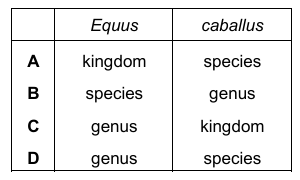
The scientific name for a domestic horse is Equus caballus.
Which row shows the two parts of the name using the binomial system?
▶️ Answer/Explanation
Ans: D
The binomial system consists of two parts: the genus name (Equus) and the species name (caballus). In scientific naming, the genus is always capitalized, while the species is lowercase. Option D correctly identifies these components.
The other options either reverse the order (A, B) or incorrectly classify the names (C). Thus, the correct answer is D.
Topic: 2.1 Cell structure
The diagram shows a type of plant cell.
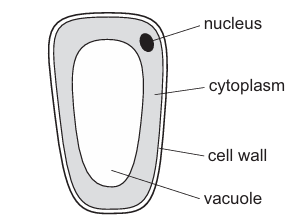
Where does this type of cell come from?
A) root
B) cuticle
C) palisade mesophyll
D) spongy mesophyll
▶️ Answer/Explanation
Ans: A
The diagram depicts a root hair cell, identifiable by its long, thin projection (root hair) that increases surface area for water and mineral absorption. Root hair cells are specifically found in the root (A) of plants.
The cuticle (B) is a waxy layer on leaves, while palisade (C) and spongy mesophyll (D) are leaf tissues involved in photosynthesis. Since root hair cells are exclusive to roots, the correct answer is A (Root).
Topic: 2.2 Size of specimens
What is the formula for calculating magnification?
A) \( \frac{\text{actual size}}{\text{image size}}\)
B) actual size × image size
C) \( \frac{\text{image size}}{\text{actual size}} \)
D) image size × actual size
▶️ Answer/Explanation
Ans: C
Magnification is calculated as the ratio of the image size to the actual size of the specimen. The correct formula is:
\[ \text{Magnification} = \frac{\text{image size}}{\text{actual size}} \]
Option C matches this formula. Option A inverts the ratio, while B and D incorrectly use multiplication. Thus, the answer is C.
Topic: 3.1 Diffusion
The diagram represents a substance moving across a cell membrane, using energy from respiration.

Which method of transport does the diagram represent?
A) active transport
B) diffusion
C) evaporation
D) osmosis
▶️ Answer/Explanation
Ans: A
The diagram shows a substance moving against the concentration gradient, which requires energy (from respiration). This process is active transport (A), as it involves the use of ATP to transport molecules.
Diffusion (B) and osmosis (D) are passive processes, while evaporation (C) is unrelated to cellular transport. Since energy is used, the correct answer is A (Active Transport).
Topic: 4.1 Biological molecules
Which food-testing reagent shows a positive result when it turns from blue to purple?
A) Benedict’s solution
B) biuret
C) ethanol
D) iodine solution
▶️ Answer/Explanation
Ans: B
The Biuret reagent (B) turns from blue to purple in the presence of proteins, indicating peptide bonds. Benedict’s solution (A) tests for reducing sugars (color change to brick-red), ethanol (C) is used for lipids (emulsion test), and iodine solution (D) detects starch (blue-black color). Thus, the correct answer is B (Biuret).
Topic: 5.1 Enzymes
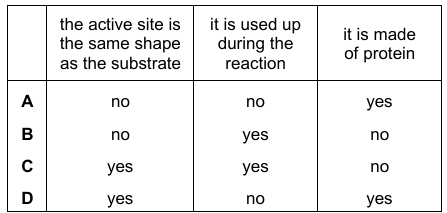
What are the characteristics of an enzyme?
▶️ Answer/Explanation
Ans: A
Enzymes are biological catalysts that speed up chemical reactions without being consumed. The image likely shows an enzyme-substrate complex, demonstrating the specificity of enzymes (characteristic A), where each enzyme binds only to particular substrates.
Other characteristics include being protein-based, sensitive to temperature/pH changes, and reusable. The correct answer focuses on the specificity aspect shown in the diagram.
Topic: 5.1 Enzymes
An enzyme in potato cells causes oxygen to be produced from the breakdown of hydrogen peroxide.
Cubes of potato tissue were placed in a hydrogen peroxide solution at different temperatures.
The number of bubbles of oxygen released per minute was counted at each temperature.
The table shows the results.

The results suggest the optimum temperature for the enzyme is between which two values?
A) 15 °C and 35 °C
B) 35 °C and 45 °C
C) 35 °C and 55 °C
D) 45 °C and 55 °C
▶️ Answer/Explanation
Ans: A
The optimum temperature for an enzyme is where it shows the highest activity. From the table, the maximum bubbles (indicating highest enzyme activity) occur at 35°C. At higher temperatures (45°C and 55°C), the bubble count decreases, suggesting enzyme denaturation. Thus, the optimum range lies between 15°C and 35°C (A), where activity rises toward its peak.
Options B, C, and D include temperatures where activity declines, making them incorrect.
Topic: 13.1 Excretion in humans
Which molecules contain nitrogen?
A) amino acids
B) fats
C) glucose
D) starch
▶️ Answer/Explanation
Ans: A
Amino acids (A) contain nitrogen as part of their amino group \((-\text{NH}_2)\). Fats (B), glucose (C), and starch (D) are composed of carbon, hydrogen, and oxygen only. Since nitrogen is a key component of amino acids, the correct answer is A.
Topic: 6.2 Leaf structure
The photomicrograph shows the lower surface of a leaf.
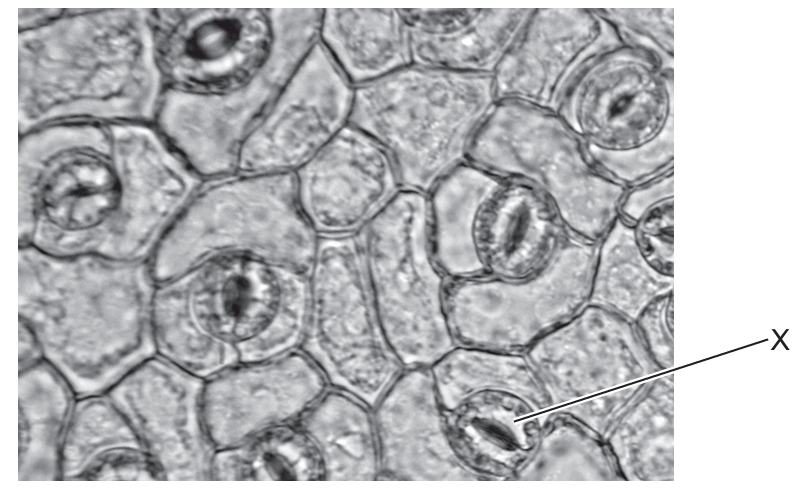
Which part of the leaf is labelled X?
A) guard cell
B) palisade cell
C) stoma
D) xylem vessel
▶️ Answer/Explanation
Ans: A
The structure labelled X is a guard cell (A), which regulates the opening and closing of stomata. Palisade cells (B) are found in the upper mesophyll, stomata (C) are pores, and xylem vessels (D) transport water. Since the image shows the lower leaf surface, the correct answer is A (Guard cell).
Topic: 7.4 Chemical digestion
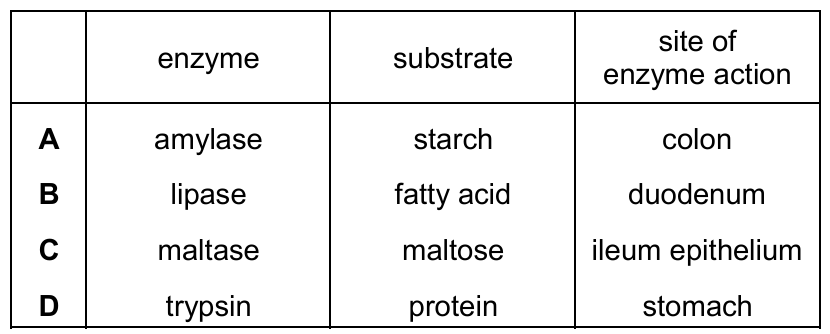
Which row shows the correct enzyme, its substrate and the site of enzyme action in the alimentary canal?
▶️ Answer/Explanation
Ans: C
Option C is correct because amylase breaks down starch (substrate) into maltose, and this occurs in the mouth (site of action).
Protease (A) acts on proteins, lipase (B) digests fats, and maltase (D) breaks down maltose. Since the question refers to starch digestion, the correct enzyme-substrate-site combination is C (amylase, starch, mouth).
Topic: 8.3 Transpiration
A student set up the experiment shown in the diagram on a hot and dry day. The air bubble moved towards the leafy shoot by 30 mm in 1 hour.

The student was asked to predict and explain the result that would have been obtained on a hot and humid day.
Which row is correct?

▶️ Answer/Explanation
Ans: B
On a hot and humid day, the rate of transpiration decreases because the air already contains high water vapor, reducing the water potential gradient between the leaf and the atmosphere. This results in a smaller movement of the air bubble compared to a hot and dry day.
Option B correctly states that the bubble would move less than 30 mm due to lower transpiration rate caused by reduced evaporation in humid conditions. The other options either incorrectly predict the bubble movement or misattribute the cause.
Topic: 8.4 Translocation
Which statement describes the process of translocation?
A) the movement of sucrose and amino acids in the xylem from the source to the sink
B) the movement of sucrose and water in the phloem from the sink to the source
C) the movement of sucrose and amino acids in the phloem from the source to the sink
D) the movement of water and amino acids in the xylem from the source to the sink
▶️ Answer/Explanation
Ans: C
Translocation is the transport of sucrose and amino acids in the phloem from source (photosynthetic tissues) to sink (growing or storage tissues).
Option A and D incorrectly mention xylem, which transports water and minerals. Option B reverses the direction (sink to source). Thus, the correct description is C.
Topic: 9.2 Heart
The diagram shows the human heart.
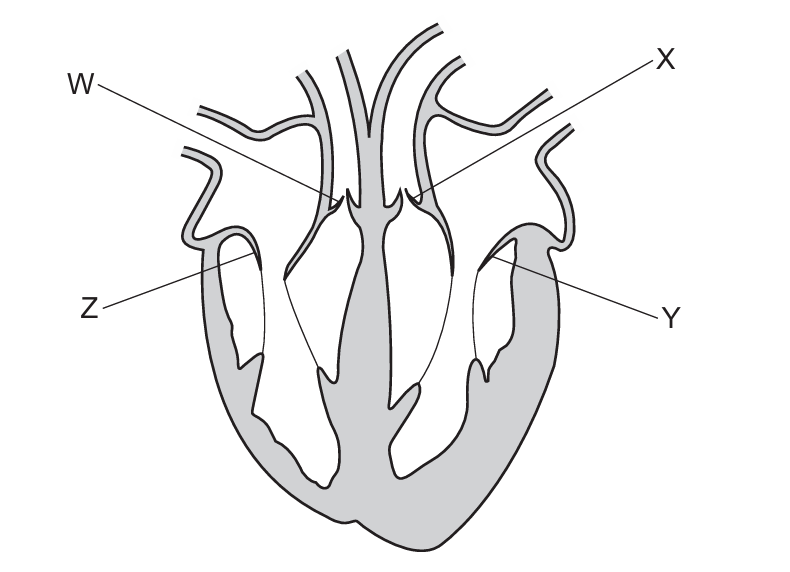
What are the semilunar valves?
A) W and X
B) W and Z
C) X and Y
D) Y and Z
▶️ Answer/Explanation
Ans: A
The semilunar valves are located at the exits of the heart’s ventricles, preventing backflow of blood into the heart. In the diagram, they are represented by W (pulmonary valve) and X (aortic valve).
Option B (W and Z) includes a non-valve structure, while options C (X and Y) and D (Y and Z) incorrectly identify atrioventricular valves (Y and Z). Since semilunar valves are specifically W and X, the correct answer is A (W and X).
Topic: 9.4 Blood
Which component of the blood transports hormones?
A) plasma
B) platelets
C) red blood cells
D) white blood cells
▶️ Answer/Explanation
Ans: A
Plasma (A) is the liquid component of blood and serves as the medium for transporting hormones, nutrients, and waste products throughout the body.
Platelets (B) are involved in clotting, red blood cells (C) carry oxygen, and white blood cells (D) are part of the immune system. Since hormones are dissolved and transported in plasma, the correct answer is A.
Topic: 10.1 Diseases and immunity
During the process of vaccination, what stimulates an immune response?
A) antibodies
B) antigens
C) lymphocytes
D) phagocytes
▶️ Answer/Explanation
Ans: B
Vaccines contain antigens (B), which are foreign molecules (e.g., weakened pathogens) that trigger the immune system to produce antibodies and memory cells.
Antibodies (A) are produced in response to antigens, while lymphocytes (C) and phagocytes (D) are immune cells that respond to antigens but are not the direct stimulators. Thus, the correct answer is B (Antigens).
Topic: 11.1 Gas exchange in humans
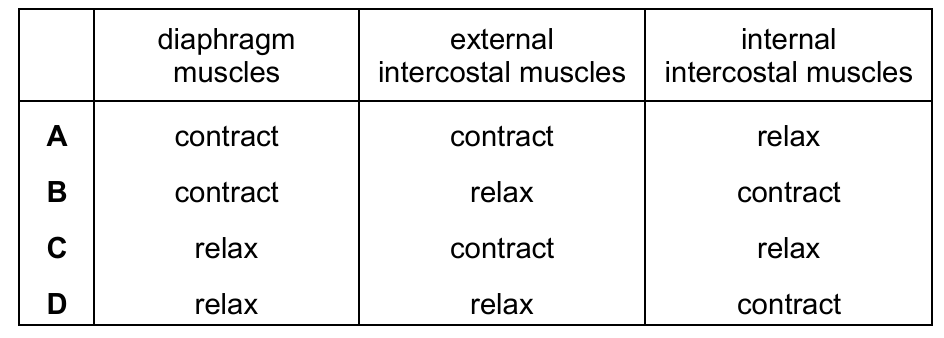
Muscles are responsible for the ventilation of the lungs during breathing.
Which row describes their action during the inspiration of air?
▶️ Answer/Explanation
Ans: A
During inspiration, the diaphragm contracts and flattens, while the external intercostal muscles contract to lift the ribs upward and outward. This increases the thoracic cavity volume, decreasing lung pressure, allowing air to rush in. The internal intercostal muscles (used in forced expiration) remain relaxed. Thus, the correct row is A.
Topic: 12.3 Anaerobic respiration
Which molecule is a product of anaerobic respiration in yeast?
A) \(C_{2}H_{5}OH\)
B) \(C_{6}H_{12}O_{6}\)
C) \(H_{2}O\)
D) \(O_{2}\)
▶️ Answer/Explanation
Ans: A
In yeast, anaerobic respiration (fermentation) produces ethanol (\(C_{2}H_{5}OH\)) and carbon dioxide as end products. The chemical equation is: \[ C_6H_{12}O_6 \rightarrow 2C_2H_5OH + 2CO_2 + \text{energy} \]
Glucose (\(C_6H_{12}O_6\)) is the reactant, water (\(H_2O\)) is produced in aerobic respiration, and oxygen (\(O_2\)) is consumed, not produced. Therefore, the correct answer is A (ethanol).
Topic: 13.1 Excretion in humans
In a kidney nephron, which substances are filtered out of the blood in the glomerulus?
A) glucose, protein, ions and water
B) glucose, protein, urea and water
C) glucose, ions, urea and water
D) ions, urea and water only
▶️ Answer/Explanation
Ans: C
The glomerulus filters small molecules like glucose, ions (e.g., Na+, K+), urea, and water from the blood, forming the glomerular filtrate. Proteins are too large to pass through the filtration barrier and are retained in the blood.
Option A and B incorrectly include protein, while D excludes glucose, which is filtered but later reabsorbed. Thus, the correct combination is C (glucose, ions, urea, and water).
Topic: 14.2 Sense organs
How many types of cone cells are there in the human eye?
A) 1
B) 2
C) 3
D) 4
▶️ Answer/Explanation
Ans: C
The human eye contains three types of cone cells (C), each sensitive to different wavelengths of light: red, green, and blue. These cones enable color vision, while rod cells detect low-light conditions. Since only three types of cones exist, the correct answer is C.
Topic: 14.5 Tropic responses
The diagram shows a plant shoot growing towards the light.
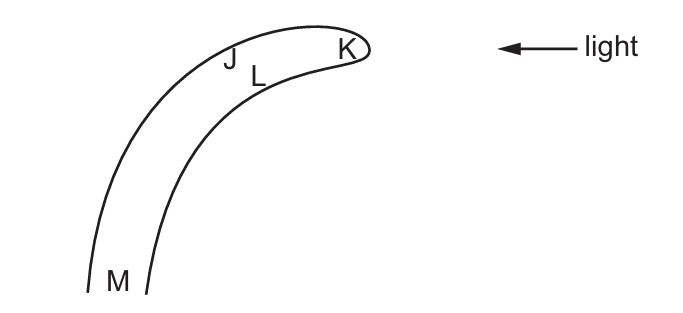
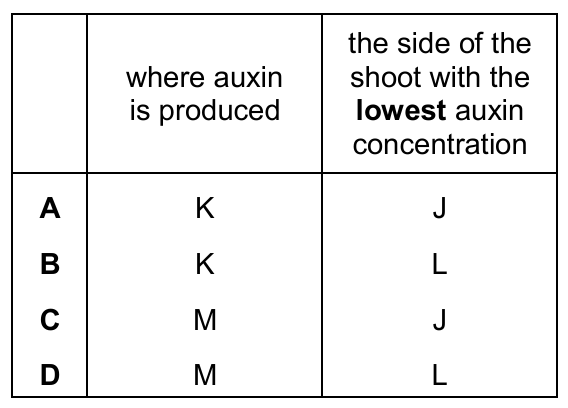
Which row describes where auxin is produced, and which side of the shoot has the lowest concentration of auxin?
▶️ Answer/Explanation
Ans: B
Auxin is produced in the shoot tip and accumulates on the shaded side of the shoot, promoting cell elongation and causing the shoot to bend towards light. The side exposed to light has the lowest auxin concentration.
In the table, row B correctly states auxin is produced at the shoot tip, and the side exposed to light has the lowest concentration, matching the phototropic response.
Topic – 15.1 Drugs
Which statement about antibiotics is correct?
A) Antibiotics are produced by memory cells.
B) Antibiotics are used to treat rickets.
C) Antibiotics are used to treat viral infections.
D) Antibiotics should only be used when essential.
▶️ Answer/Explanation
Ans: D
Option D is correct because antibiotics should be used only when necessary to prevent antibiotic resistance.
A is incorrect (antibiotics are produced by microorganisms, not memory cells). B is wrong (rickets is treated with vitamin D, not antibiotics). C is false (antibiotics target bacteria, not viruses). Thus, the correct statement is D.
Topic: 16.1 Asexual reproduction
The diagram shows a strawberry plant.
Which labelled part of the plant can only be produced by asexual reproduction?

▶️ Answer/Explanation
Ans: D
The runner (stolon) labelled D is a specialized stem that grows horizontally along the ground, producing new plantlets at its nodes. This is a form of asexual reproduction (vegetative propagation), where genetically identical offspring are formed without seeds.
Other labelled parts (A: flower, B: fruit, C: leaf) can be involved in sexual reproduction or are not reproductive structures. Thus, D is the correct answer as it exclusively represents asexual reproduction in strawberries.
Topic: 16.3 Sexual reproduction in plants
Which part of a flower can contain a pollen tube?
A) anther
B) filament
C) stamen
D) style
▶️ Answer/Explanation
Ans: D
The pollen tube grows from a pollen grain after pollination and travels through the style to deliver sperm cells to the ovule.
The anther (A) produces pollen, the filament (B) supports the anther, and the stamen (C) is the male reproductive organ (anther + filament). Only the style (D) provides a pathway for the pollen tube.
Topic: 20.4 Conservation
To avoid extinction of rare plant species, a botanical garden keeps a collection of seeds known as a seed bank.
Which condition will prevent these seeds germinating while they are in storage?
A) high humidity
B) high oxygen levels
C) low light intensity
D) low temperature
▶️ Answer/Explanation
Ans: D
Seed banks store seeds under low temperatures (D) to maintain dormancy and prevent germination. This slows metabolic activity, preserving seeds for long periods.
High humidity (A) can trigger germination or cause fungal growth, while oxygen (B) and light (C) are not primary inhibitors of germination in storage. Thus, the correct answer is D (low temperature), as it effectively maintains seed viability without allowing sprouting.
Topic: 16.5 Sex hormones in humans
The graph shows the changes to the thickness of the lining of the uterus during the menstrual cycle.
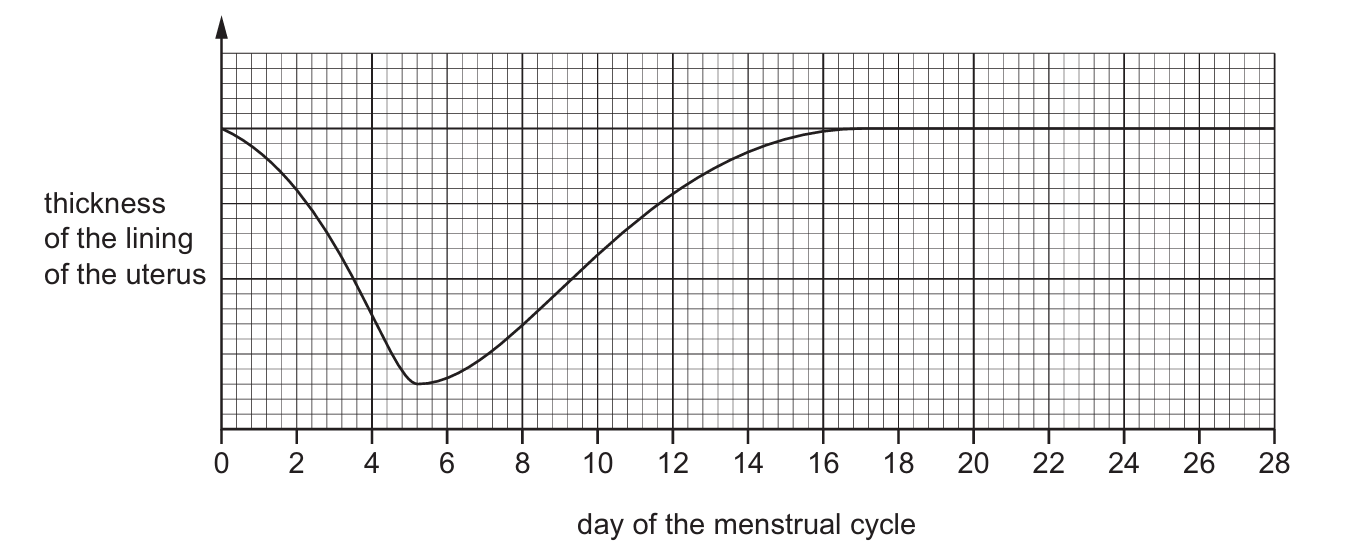
Which hormone is responsible for the change to the thickness of the lining of the uterus shown between days 5 and 16?
A) FSH
B) LH
C) Estrogen
D) progesterone
▶️ Answer/Explanation
Ans: C
Between days 5 and 16 of the menstrual cycle, estrogen (C) is the primary hormone responsible for the thickening of the uterine lining (endometrium). This prepares the uterus for potential implantation of a fertilized egg.
FSH (A) stimulates follicle development, LH (B) triggers ovulation, and progesterone (D) maintains the endometrium after ovulation. Since the graph shows the proliferative phase (days 5-14), where estrogen dominates, the correct answer is C.
Topic: 16.5 Sex hormones in humans
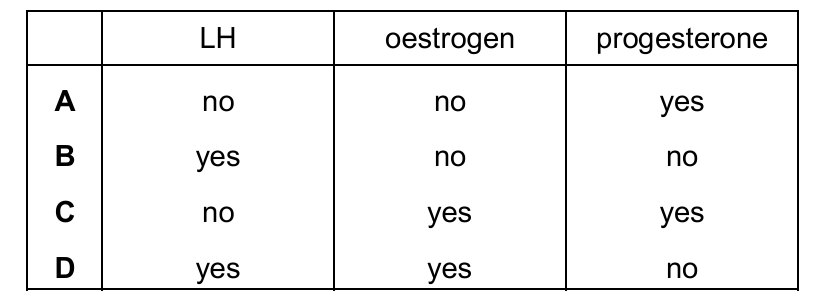
Which hormone concentrations are high during pregnancy?
▶️ Answer/Explanation
Ans: C
During pregnancy, the hormones progesterone and estrogen (C) remain at high levels to maintain the uterine lining and support fetal development.
FSH (A) and LH (B) are involved in the menstrual cycle and ovulation but decrease during pregnancy. Testosterone (D) is primarily a male hormone and does not play a significant role in pregnancy. Thus, the correct answer is C (Progesterone and estrogen).
Topic: 16.6 Sexually transmitted infections
By which route would an HIV infection not be transmissible?
A) blood
B) saliva
C) sharing needles for injections
D) semen
▶️ Answer/Explanation
Ans: B
HIV is transmitted through bodily fluids containing high viral loads, such as blood (A), semen (D), and vaginal fluids, as well as via shared needles (C). However, saliva (B) does not contain sufficient HIV particles to cause infection under normal circumstances, making it a non-transmissible route. Therefore, the correct answer is B (saliva).
Topic: 16.2 Sexual reproduction
Which description of a human gamete is correct?
A) a diploid cell with 23 chromosomes
B) a diploid cell with 46 chromosomes
C) a haploid cell with 23 chromosomes
D) a haploid cell with 46 chromosomes
▶️ Answer/Explanation
Ans: C
Human gametes (sperm and egg cells) are haploid, containing half the normal chromosome number (23 chromosomes) to maintain diploid number (46 chromosomes) after fertilization.
Option A is incorrect because diploid cells can’t have 23 chromosomes. Option B describes normal body cells, not gametes. Option D is impossible as haploid cells by definition contain half the diploid number. Therefore, C is the only correct description.
Topic: 17.3 Meiosis
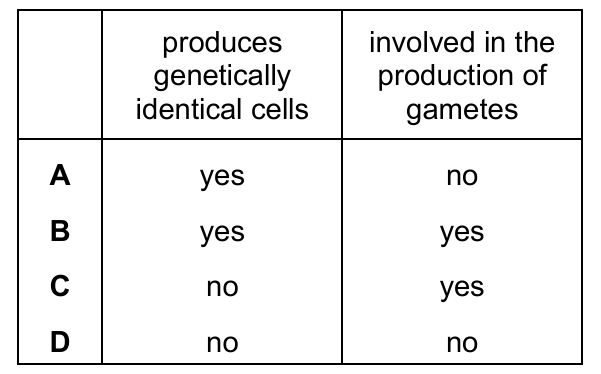
Which statements about meiosis are correct?
▶️ Answer/Explanation
Ans: C
Meiosis involves two divisions (Meiosis I and II), reducing the chromosome number by half to produce haploid gametes. The diagram likely highlights key features like crossing over (genetic variation) and independent assortment of homologous chromosomes.
Option C correctly identifies these critical aspects, while other options may misrepresent stages or outcomes of meiosis. The image confirms processes unique to meiosis, distinguishing it from mitosis.
Topic: 17.4 Monohybrid inheritance
A female parent who is heterozygous for red-green colour blindness has a female child with a red-green colour-blind male parent.
What is the chance of the female child being colour-blind?
A) 0%
B) 25%
C) 50%
D) 100%
▶️ Answer/Explanation
Ans: C
Red-green color blindness is an X-linked recessive trait. The heterozygous female (XNXn) carries one normal allele (XN) and one affected allele (Xn). The color-blind male parent contributes his affected X chromosome (Xn) to the female child.
Possible genotypes for the female child: XNXn (carrier) or XnXn (color-blind). The probability of inheriting Xn from both parents is 50%.
Thus, the correct answer is C (50%).
Topic: 17.4 Monohybrid inheritance
A pure-breeding plant with smooth stems was crossed with a heterozygous plant with hairy stems.
What will be the ratio of hairy to smooth stems in the resulting plants?
A) 1 hairy : 1 smooth
B) 1 hairy : 3 smooth
C) 3 hairy : 1 smooth
D) all hairy
▶️ Answer/Explanation
Ans: A
Let S represent the allele for smooth stems (recessive) and H for hairy stems (dominant).
Parental genotypes:
– Pure-breeding smooth: ss
– Heterozygous hairy: Hs
Punnett Square:
| | H | s |
|—|—|—|
| s | Hs | ss |
| s | Hs | ss |
Offspring ratio: 2 Hs (hairy) : 2 ss (smooth), simplifying to 1:1.
Thus, the correct answer is A (1 hairy : 1 smooth).
Topic: 18.2 Adaptive features
Which row shows the adaptive features of a xerophyte?
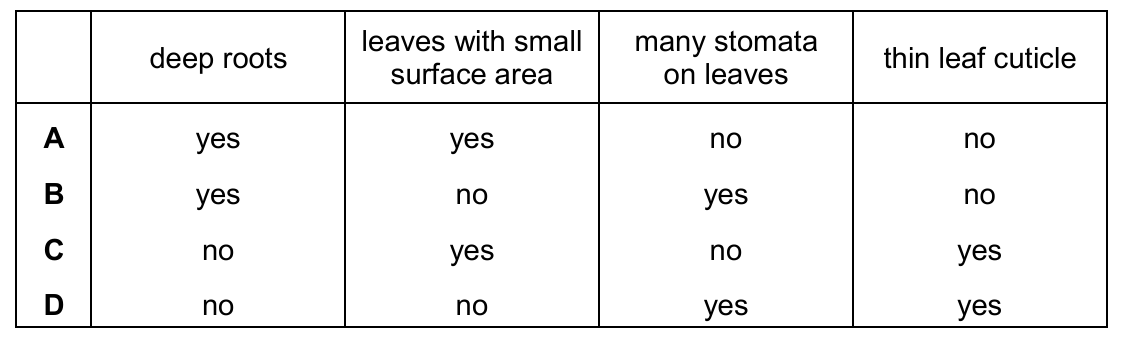
▶️ Answer/Explanation
Ans: A
Option A is correct because xerophytes (plants adapted to dry environments) have thick cuticles to reduce water loss and sunken stomata to minimize transpiration.
B describes a hydrophyte (aquatic plant), C refers to general leaf features, and D includes incorrect traits (broad leaves increase water loss). Thus, the correct adaptations for a xerophyte are shown in row A.
Topic: 19.2 Food chains and food webs
The diagram shows a marine food web.

At which trophic levels is the cod found?
A) primary consumer and secondary consumer
B) secondary consumer and tertiary consumer
C) secondary consumer only
D) tertiary consumer only
▶️ Answer/Explanation
Ans: B
In the given marine food web, the cod occupies two trophic levels:
- Secondary consumer: When it eats primary consumers like small fish or crustaceans.
- Tertiary consumer: When it preys on other secondary consumers.
Option B correctly identifies both roles. The cod cannot be a primary consumer (A) as it doesn’t eat producers, and options C/D are incomplete as they ignore one of its trophic levels.
Topic: 19.3 Nutrient cycles
The diagram shows part of the carbon cycle.
Which labelled arrow would have the balanced chemical equation
\(6CO_{2}\)+ \(6H_{2}O\) → \(C_{6}H_{12}O_{6}\) + \(6O_{2}\)?
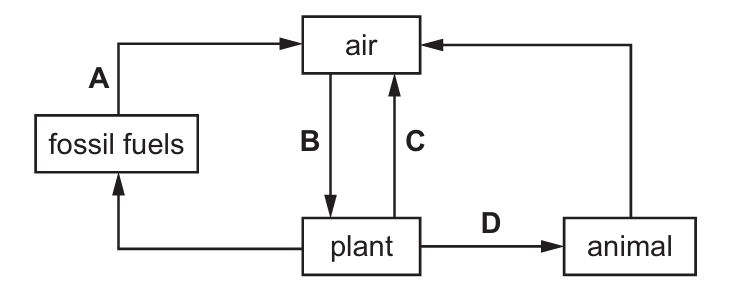
▶️ Answer/Explanation
Ans: B
The given equation represents photosynthesis, where plants convert \(CO_2\) and \(H_2O\) into glucose (\(C_6H_{12}O_6\)) and oxygen (\(O_2\)).
In the carbon cycle, this process removes \(CO_2\) from the atmosphere. Arrow B correctly shows this flow as it represents carbon dioxide being taken up by plants (or producers) from the atmosphere.
Other arrows likely represent different processes: A (respiration), C (decomposition), or D (combustion), which don’t match the photosynthesis equation.
Topic: 19.4 Populations
Which statement explains why there is a lag phase in a population graph?
A) The build-up of waste products limits population growth.
B) The low population size limits the birth rate.
C) The number of births is equal to the number of deaths.
D) The number of deaths is greater than the number of births.
▶️ Answer/Explanation
Ans: B
The lag phase occurs because the initial population is too small to reproduce rapidly. At this stage, individuals are adapting to their environment, and the low population size (B) limits the birth rate due to fewer potential mates and reproductive events.
Waste accumulation (A) affects later phases, while equal birth/death rates (C) would show zero growth, not a lag. If deaths exceeded births (D), the population would decline. Thus, the correct explanation is B (low population size limiting birth rate).
Topic: 20.3 Pollution
The flow chart describes the process of eutrophication.
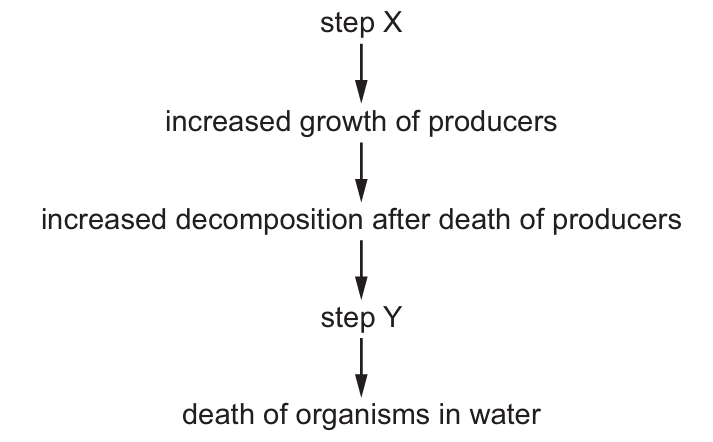
What should be at step X and step Y in the flow chart?
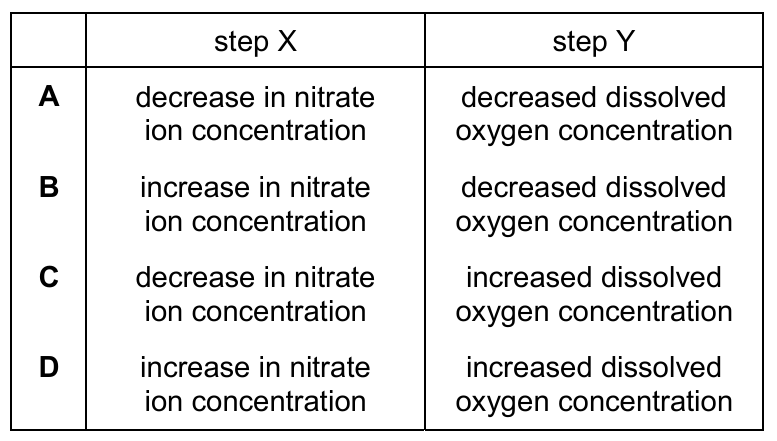
▶️ Answer/Explanation
Ans: B
The correct sequence for eutrophication is:
X: Increased nitrate/phosphate levels (from fertilizers/sewage)
Y: Death of aquatic organisms (due to oxygen depletion)
This matches option B. The process begins with nutrient enrichment (X), leading to algal blooms that block sunlight. When algae die, decomposers use up oxygen, causing hypoxia and organism death (Y).
Topic: 20.4 Conservation
How can fish stocks be conserved?
A) closed seasons
B) decreased mesh size
C) increased quotas
D) reduction in protected areas
▶️ Answer/Explanation
Ans: A
Closed seasons (A) help conserve fish stocks by prohibiting fishing during breeding periods, allowing populations to recover.
Decreased mesh size (B) would capture juvenile fish, increasing overfishing. Increased quotas (C) and reduced protected areas (D) would both lead to greater depletion of fish stocks. Therefore, the correct conservation method is A (Closed seasons).
Topic: 21.2 Biotechnology
Penicillin is produced in a fermenter by growing the fungus Penicillium. The graph shows how the mass of living Penicillium fungus and the concentration of penicillin change over time.
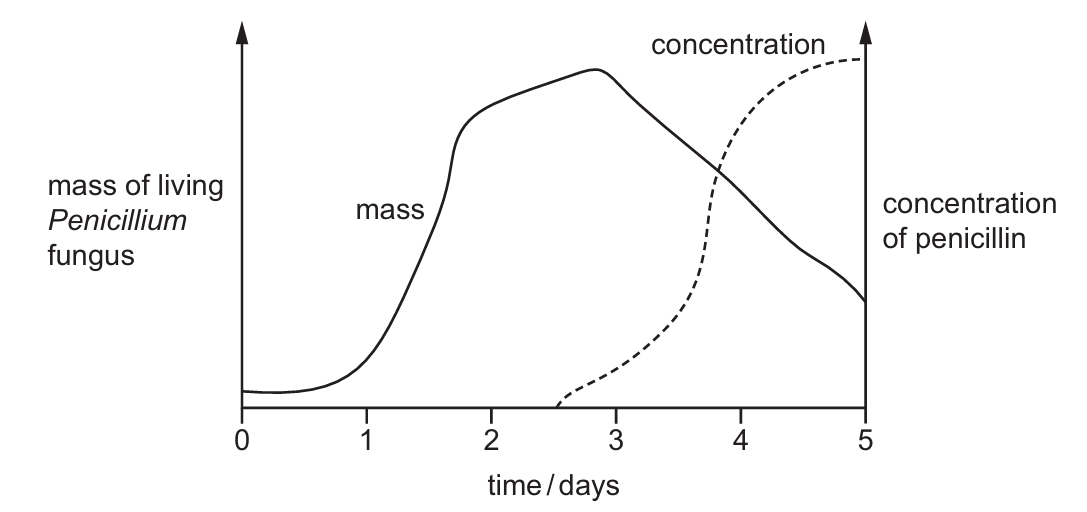
When is the best time to collect the penicillin?
A) at 1.5 days
B) at 3.0 days
C) at 3.5 days
D) at 5.0 days
▶️ Answer/Explanation
Ans: D
Penicillin is a secondary metabolite, meaning it is produced after the Penicillium fungus reaches the stationary phase of growth (when growth slows). The graph shows that penicillin concentration peaks at 5.0 days, while the fungal mass stabilizes. Earlier time points (A–C) represent active growth phases with lower penicillin yields. Thus, the optimal harvest time is D (5.0 days).
Topic: 21.3 Genetic modification
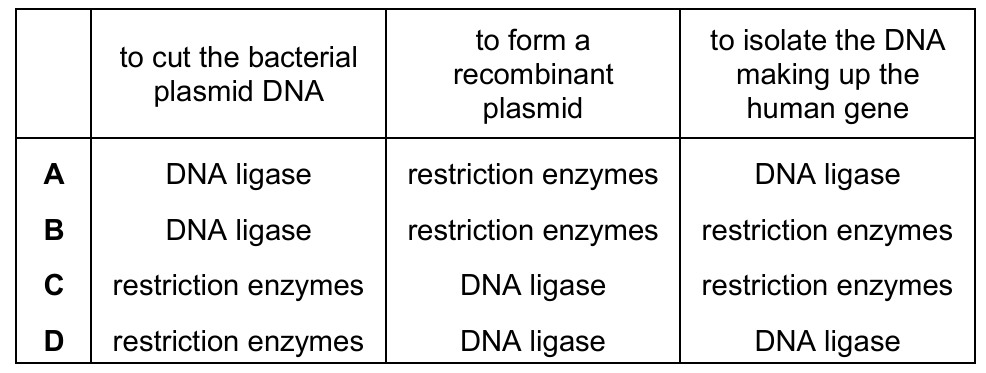
Which enzymes are required to produce human proteins, using genetic modification?
▶️ Answer/Explanation
Ans: C
The key enzymes needed for genetic modification to produce human proteins are:
- Restriction enzymes – Cut DNA at specific sequences to isolate the human gene
- DNA ligase – Joins the human gene into a plasmid vector
The diagram likely shows this process of gene insertion. While DNA polymerase (A) replicates DNA and reverse transcriptase (B) makes DNA from RNA, neither is essential for basic gene insertion. Proteases (D) break down proteins and aren’t used. Therefore, C (restriction enzymes and DNA ligase) is correct.