
Topic: 6.2 (Leaf Structure), 8.2 (Water Uptake), 19.3 (Nutrient Cycles)
Fig. 1.1 is a photomicrograph of a cross-section of part of a leaf.
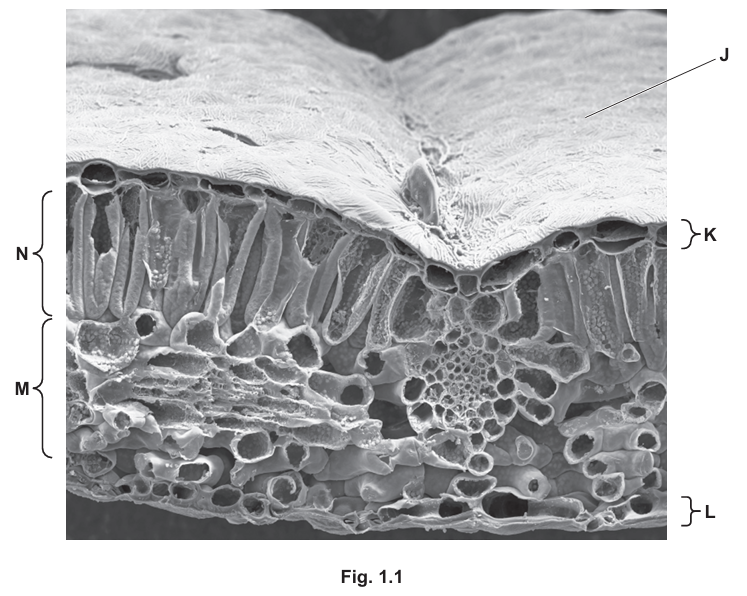
(a) (i) State the letter in Fig. 1.1 that identifies where:
gas exchange is controlled
most photosynthesis occurs
spongy mesophyll cells are found.
(ii) Draw a circle on Fig. 1.1 to identify a vascular bundle.
(iii) Translocation occurs in the vascular bundle.
State the names of two substances that are only moved by translocation.
(b) Explain how xylem vessels are adapted for their functions.
(c) Describe how water moves through a plant from the soil to the air spaces in a leaf.
(d) Explain why plants need nitrate ions.
▶️ Answer/Explanation
(a)(i) Gas exchange is controlled by L (stomata). Most photosynthesis occurs in N (palisade mesophyll). Spongy mesophyll cells are found in M.
(a)(ii) A vascular bundle contains xylem and phloem and appears as a distinct cluster in the leaf cross-section.
(a)(iii) Two substances moved by translocation are sucrose and amino acids.
(b) Xylem vessels are adapted by having thick lignified walls for support, no cell contents for uninterrupted water flow, and continuous tubes formed by end-to-end cell joining.
(c) Water moves via root hair cells (osmosis) → xylem (cohesion-tension) → mesophyll cells (diffusion) → air spaces (evaporation).
(d) Plants need nitrate ions to synthesize amino acids, which form proteins essential for growth and cellular functions.
Topic: 16.6 (Sexually Transmitted Infections), 14.3 (Hormones), 18.3 (Selection)
(a) Chlamydia is a sexually transmitted infection (STI) caused by a bacterium.
Fig. 2.1 shows the number of chlamydia cases in a country in 2018.
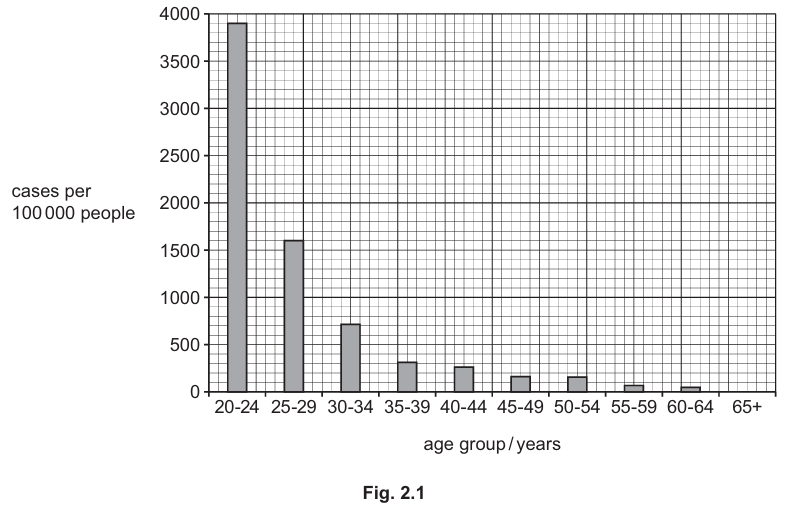
(a)(i) Calculate the percentage decrease in chlamydia cases between age groups 20–24 and 25–29.
Give your answer to two significant figures.
(a)(ii) Describe how the spread of STIs, such as chlamydia, can be controlled.
(b) Chlamydia can damage the reproductive system.
(b)(i) State the part of the female reproductive system that produces oestrogen.
(b)(ii) Describe the role of oestrogen at puberty.
(c) Complete the sentences about drug resistance and genetic variation:
Bacteria can be killed by drugs called …………………………………. . The development of resistant strains is an example of …………………………………. selection.
Resistant strains have gene mutations caused by random changes in the …………………………………. of DNA bases, forming new …………………………………. . Mutation rates increase due to …………………………………. radiation and chemicals.
In animals and plants, another source of genetic variation is nuclear division called …………………………………. .
▶️ Answer/Explanation
(a)(i) 59% decrease (to 2 s.f.).
Calculation: \(\frac{\text{Change}}{\text{Original}} \times 100 = \frac{110-45}{110} \times 100 \approx 59\%\).
(a)(ii) Control methods include:
• Condom use (barrier method).
• Regular screening/testing and contact tracing.
• Education on transmission/prevention.
• Antibiotic treatment for infected individuals.
(b)(i) Ovary produces oestrogen.
(b)(ii) Oestrogen at puberty:
• Triggers secondary sexual characteristics (e.g., breast growth).
• Initiates the menstrual cycle.
(c) Completed sentences:
• Antibiotics; natural selection.
• Sequence; alleles; ionising.
• Meiosis (source of genetic variation).
Topic: 10.1 (Diseases and Immunity), 1.3 (Genetic Modification)
(a) Fig. 3.1 shows the structure of the pathogen that causes cholera.
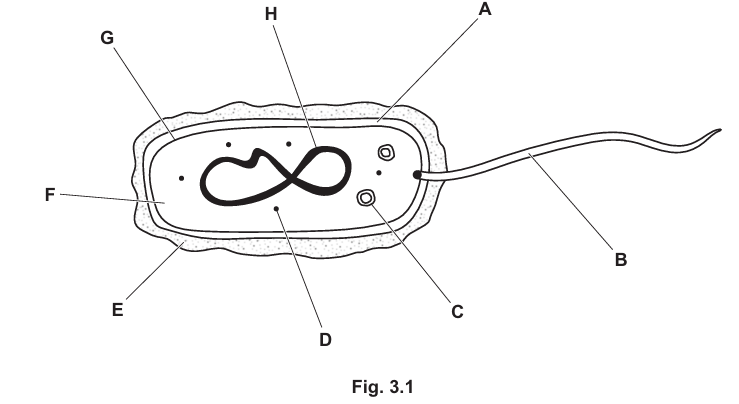
(a)(i) State the name of the kingdom that includes the pathogen shown in Fig. 3.1.
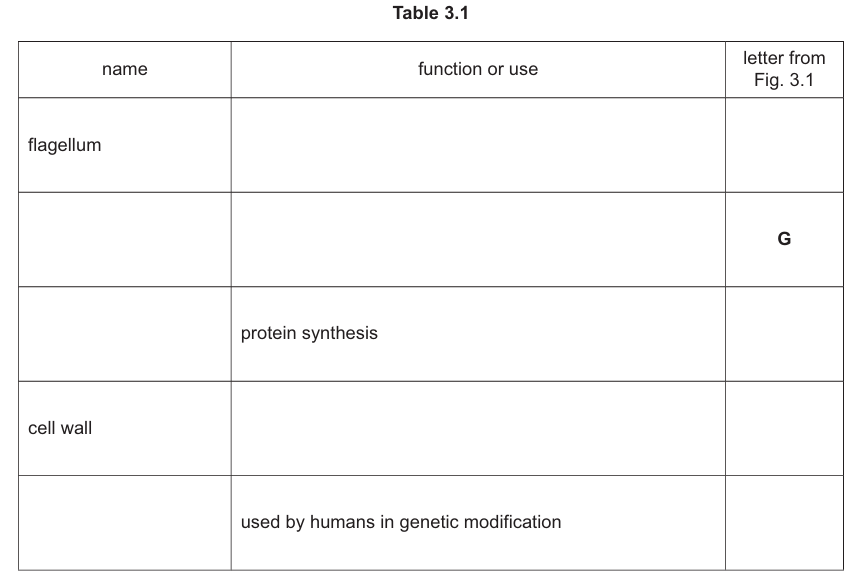
(a)(ii) Table 3.1 shows some of the names, functions or uses, and identifying letters of the parts labelled in Fig. 3.1.
Complete Table 3.1.
(b) Describe how a person becomes infected with cholera.
(c) People with cholera can become very dehydrated.
Explain how cholera causes dehydration.
(d) Vaccination can help to prevent the spread of diseases such as cholera.
Outline the process of vaccination and explain how it can prevent the spread of diseases.
▶️ Answer/Explanation
(a)(i) The pathogen belongs to the kingdom Prokaryotae (or Monera).
(a)(ii) Completed Table 3.1: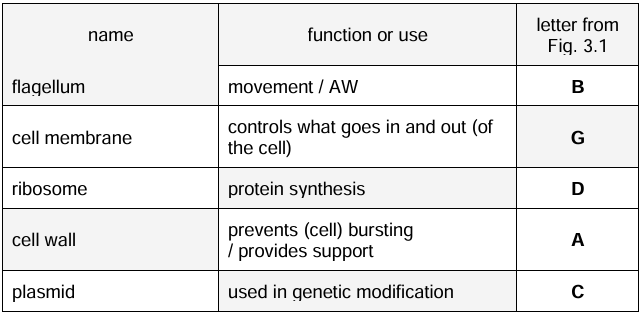
(b) Infection occurs by ingesting contaminated water/food containing the cholera bacterium (Vibrio cholerae).
(c) Cholera causes dehydration through:
1. Toxin production → chloride ion secretion into the small intestine.
2. Increased water potential in the intestine → osmotic water loss from blood.
3. Results in severe diarrhea and fluid depletion.
(d) Vaccination process:
1. Weakened/dead pathogen (or antigens) introduced.
2. Stimulates antibody production by lymphocytes.
3. Memory cells form for long-term immunity.
4. Prevents spread via herd immunity (reduced transmission).
Topic: 14.1 (Coordination and Response)
(a) Complete the sentence about the mammalian nervous system:
The ………………………………………….. nervous system consists of the brain and spinal cord, and the ………………………………………….. nervous system consists of the nerves outside the brain and spinal cord.
(b) Fig. 4.1 shows the parts of a reflex arc.

(b)(i) Put the parts listed in Fig. 4.1 into the correct sequence, and write the letters in the boxes. Two have been done for you.

(b)(ii) State two stimuli that are detected by the skin.
(b)(iii) The pupil reflex controls the amount of light that enters the eye.
State the name of an effector in the pupil reflex.
(c) Describe and explain how impulses are only passed in one direction from one neurone to the next.
▶️ Answer/Explanation
(a) The central nervous system consists of the brain and spinal cord, and the peripheral nervous system consists of the nerves outside the brain and spinal cord.
(b)(i) Correct sequence: 
Pathway: Stimulus → Receptor → Sensory neurone → Relay neurone → Motor neurone → Effector → Response.
(b)(ii) Two stimuli detected by skin:
1. Temperature changes (heat/cold).
2. Pressure/touch.
(b)(iii) Effector in pupil reflex: Circular muscles or radial muscles of the iris.
(c) Unidirectional impulse transmission occurs because:
1. Neurotransmitters are only released from the presynaptic neurone.
2. Receptors are only present on the postsynaptic neurone.
3. Synaptic vesicles fuse with the presynaptic membrane to release neurotransmitters into the synaptic cleft.
4. Neurotransmitters bind to complementary receptors, triggering an impulse in the next neurone.
Topic: 17.4 (Monohybrid Inheritance)
The gene for red-green colour vision is on the X chromosome. There are two alleles for this gene:
- The allele for normal colour vision (B) is dominant.
- The allele for red-green colour blindness (b) is recessive.
Fig. 5.1 shows a pedigree chart for a family with red-green colour blindness.
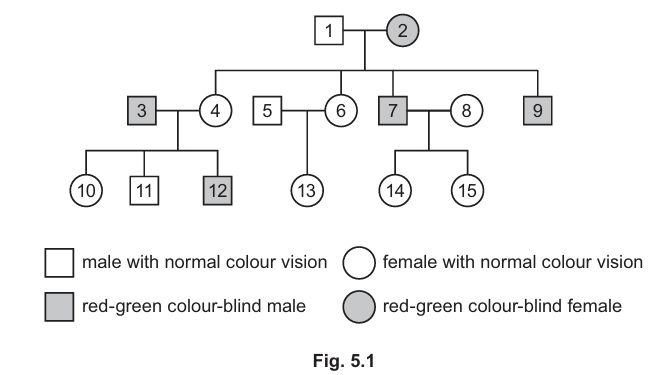
(a) Explain why all male children of parent 1 and parent 2 are red-green colour-blind.
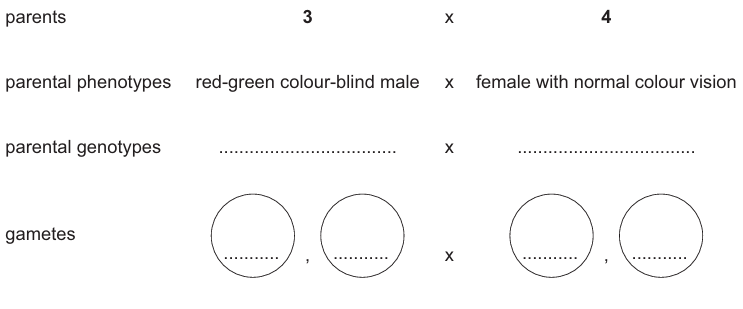
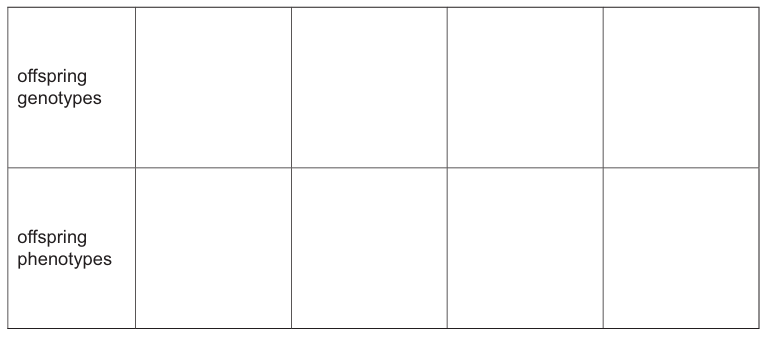
(b) Parent 4 is heterozygous for red-green colour blindness. Complete the genetic diagram to determine the probability that the offspring of parent 3 and parent 4 would be colour-blind.
Probability of offspring having red-green colour blindness: …………………………………..
▶️ Answer/Explanation
(a) All male children of parent 1 and parent 2 are colour-blind because:
- Parent 2 (mother) is homozygous recessive (\(X^bX^b\)).
- Males inherit their X chromosome from their mother and only need one recessive allele (\(X^b\)) to express the trait.
- Parent 1 (father) contributes a Y chromosome to male offspring, which lacks the gene.
(b) Genetic diagram:
Parental genotypes:
– Parent 3 (father): \(X^bY\) (colour-blind).
– Parent 4 (mother): \(X^BX^b\) (heterozygous carrier).
Gametes:
– Parent 3: \(X^b\) or \(Y\).
– Parent 4: \(X^B\) or \(X^b\).
Punnett Square:
Probability:
– 50% chance for sons to be colour-blind (\(X^bY\)).
– 0% chance for daughters to be colour-blind (all daughters are carriers \(X^BX^b\) or normal \(X^BX^B\)).
Final probability: 50% (only male offspring are considered for colour blindness).
Topic: 21.2 (Biotechnology)
Penicillin can be produced in fermenters.
(a) State the name of the type of organism that produces penicillin.
(b) Fig. 6.1 shows the change in biomass of the penicillin-producing organism grown in a fermenter under controlled conditions.
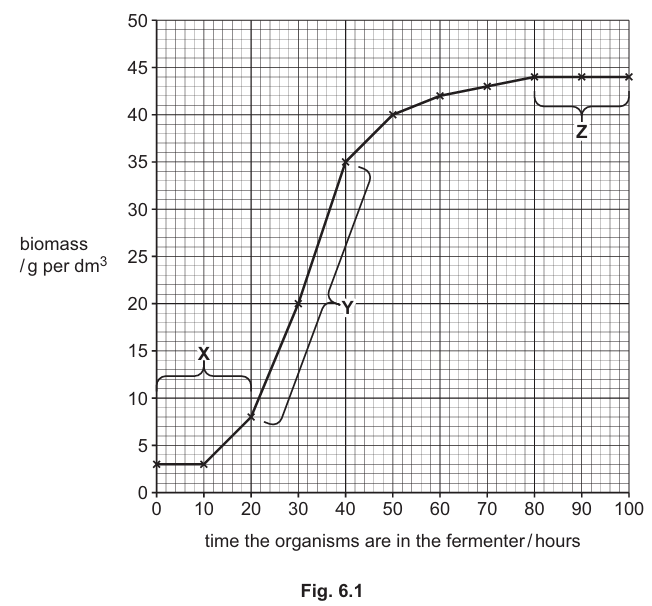
State the name of the growth stages of the organism, shown by the letters X, Y, and Z in Fig. 6.1.
(c) Fig. 6.2 is a diagram of a fermenter containing the penicillin-producing organisms.
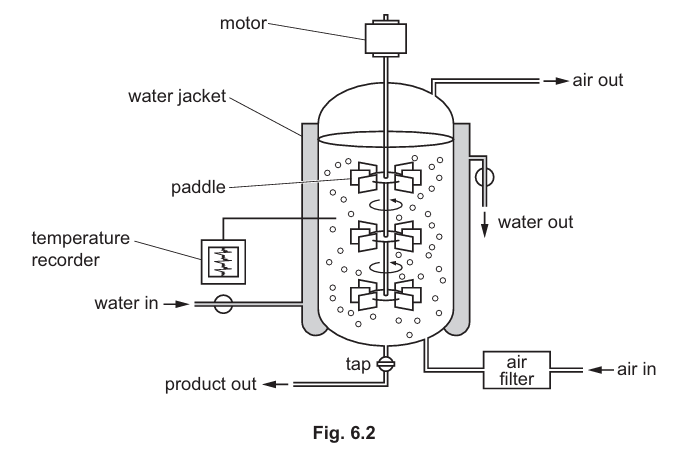
(i) Explain why air is supplied to the fermenter.
(ii) Explain why the temperature in the fermenter must be controlled.
(iii) State the role of the paddles in the fermenter.
(iv) Other than penicillin, state two commercial products made using fermenters.
▶️ Answer/Explanation
(a) The organism that produces penicillin is a fungus (specifically Penicillium).
(b) Growth stages in Fig. 6.1:
– X: Lag phase (slow growth as organisms adapt).
– Y: Log (exponential) phase (rapid growth).
– Z: Stationary phase (growth stabilizes as resources deplete).
(c)(i) Air is supplied for aerobic respiration of the fungus, providing oxygen for energy production.
(c)(ii) Temperature control is critical because:
– Enzymes in the fungus have an optimum temperature for activity.
– High temperatures can denature enzymes, reducing penicillin yield.
(c)(iii) Paddles:
– Mix nutrients and oxygen evenly.
– Maintain uniform temperature/pH throughout the fermenter.
(c)(iv) Other fermenter products:
1. Insulin (genetically modified bacteria).
2. Mycoprotein (fungal protein for food).