
Topic – 7.2
(a) Fig. 1.1 shows part of the human digestive system.

(i) Using label lines and the letters shown, identify on Fig. 1.1:
- the organ that produces bile and label it A
- the organ that stores bile and label it B.
(ii) Describe physical digestion.
(iii) State the names of two places where physical digestion occurs in the body.
(b) Bile is involved in fat digestion.
(i) Complete the sentences about fat digestion.
Bile is released into the ………… in the digestive system. Bile increases the surface area of fats and oils. This is called ………… . This increase in surface area increases the rate of ………… digestion using the enzyme …………. .
(ii) State the names of the products of fat digestion.
(c) Explain the role of bile in the breakdown of protein by trypsin.
▶️ Answer/Explanation
(a)(i) Ans: liver labelled A ; gall bladder labelled B
The liver produces bile, while the gall bladder stores and concentrates it before release into the small intestine.
(a)(ii) Ans: the breakdown of food into smaller pieces without chemical change to the food molecules.
Physical digestion involves mechanical processes like chewing and churning, reducing food size for easier chemical digestion.
(a)(iii) Ans: mouth ; stomach
Teeth chew food in the mouth, and stomach muscles churn food into chyme. The small intestine also mechanically mixes food with enzymes.
(b)(i) Ans: small intestine / duodenum ; emulsification ; chemical ; lipase
Bile enters the duodenum, emulsifying fats into smaller droplets. Lipase then chemically breaks these into fatty acids and glycerol.
(b)(ii) Ans: fatty acids and glycerol
Lipase hydrolyzes fats into these absorbable products, which are used for energy or stored.
(c) Ans: Bile neutralizes stomach acid, providing the alkaline pH (pH 8) required for trypsin to digest proteins effectively.
Trypsin works optimally in alkaline conditions. Bile ensures the acidic chyme from the stomach is neutralized, enabling protein digestion.
Topic – 8.4
Aphids are arthropods.
Aphids insert their mouthpieces into the phloem in the stem of a plant to feed.
An aphid is shown in Fig. 2.1.
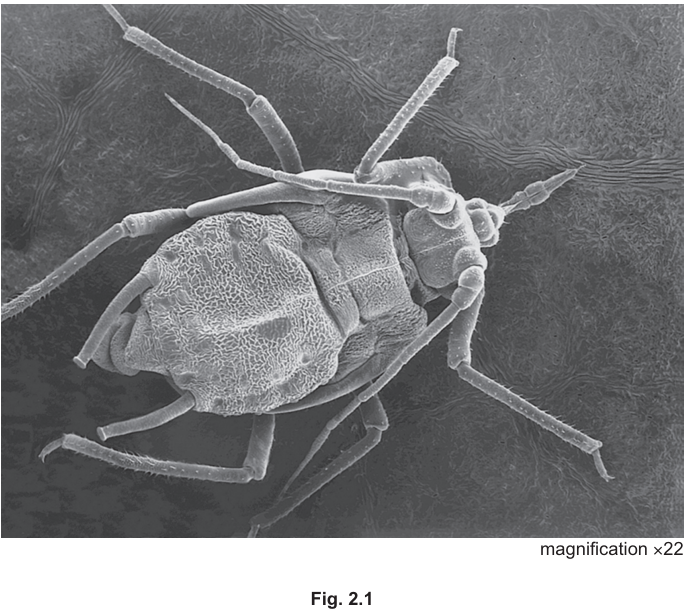
(a) (i) Identify two features visible in Fig. 2.1 that can be used to classify an aphid as an insect.
Fig. 2.2 is a diagram of a cross-section of a dicotyledonous stem.
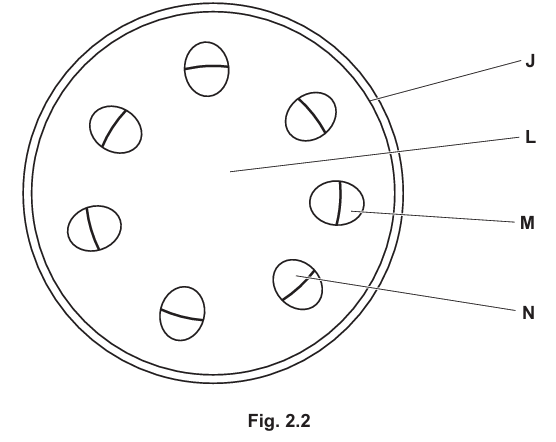
(ii) State the letter in Fig. 2.2 that identifies the structure from which aphids feed.
(iii) State the names of two nutrients transported in the phloem.
(b) Scientists investigated the effect of temperature on the rate of translocation.
The data are shown in Table 2.1.
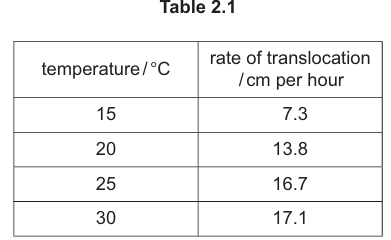
Calculate the percentage change in rate of translocation between 15 °C and 30 °C.
Give your answer to three significant figures.
(c) Fig. 2.3 shows a potato plant growing in the spring and then in the summer.
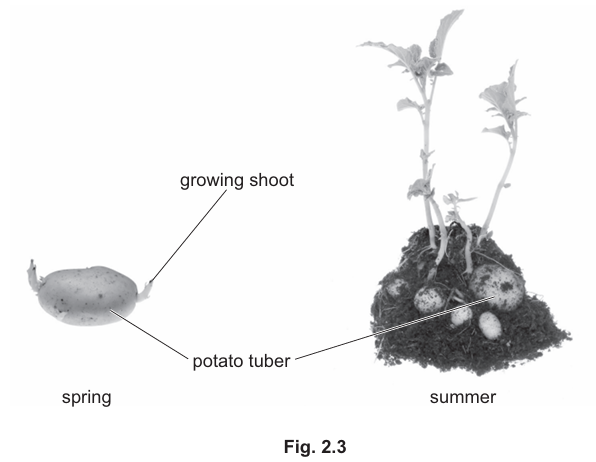
(i) Explain how translocation changes between spring and summer in the potato plant shown in Fig. 2.3.
Use the terms source and sink in your answer.
(ii) New tubers form on the potato plant in the summer. These tubers are genetically identical.
Identify the type of reproduction that the potato plant is using to form the tubers.
▶️ Answer/Explanation
(a)(i)
1: Three pairs of legs (insects have six legs).
2: One pair of antennae (used for sensing the environment).
(a)(ii)
M (phloem is labeled as M in Fig. 2.2, where aphids feed).
(a)(iii)
1: Sucrose (main carbohydrate transported in phloem).
2: Amino acids (organic nitrogen compounds for growth).
(b)
Percentage change = \(\left(\frac{4.7 – 2.0}{2.0}\right) \times 100 = 134\%\) (to 3 s.f.).
Calculation: Rate increases from 2.0 to 4.7, yielding a 134% rise.
(c)(i)
Spring: Tubers (sink) release stored sucrose to shoots (source) for growth.
Summer: Leaves (source) photosynthesize, sending sucrose to new tubers (sink) for storage.
(c)(ii)
Asexual reproduction (tubers are clones via vegetative propagation).
Topic – 10.1
(a) HIV can be transmitted from mother to infant.
Describe how the risk of a mother transmitting HIV to their infant can be reduced.
(b) (i) Scientists investigated the effect of breastfeeding on the chance of infants getting an infection.
They studied two groups of 100 infants. One group was breastfed and one group was not breastfed.
Table 3.1 shows the data.
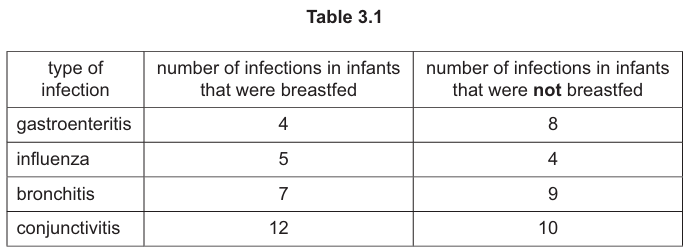
Using the data in Table 3.1, describe the effect of breastfeeding on the chance of getting an infection.
(ii) State the name of a blood cell involved in the immune response.
(iii) Describe how infants can gain passive immunity.
(iv) Describe how immunity gained by vaccination differs from passive immunity.
▶️ Answer/Explanation
(a) The risk of HIV transmission can be reduced by:
- Taking antiretroviral drugs during pregnancy and breastfeeding.
- Opting for a C-section delivery to avoid exposure during birth.
- Avoiding breastfeeding if safe alternatives are available.
Explanation: These measures minimize viral load and direct exposure, significantly lowering transmission risk.
(b)(i) Breastfeeding reduces infections:
- Gastroenteritis cases dropped from 18 (non-breastfed) to 4 (breastfed).
- Bronchitis decreased from 12 to 5 cases.
- No significant change in influenza/conjunctivitis rates.
Explanation: Breast milk contains antibodies that protect against specific pathogens, notably reducing gastrointestinal and respiratory infections.
(b)(ii) White blood cells (lymphocytes/phagocytes) are key to immune responses.
(b)(iii) Passive immunity in infants is gained through:
- Placental transfer of maternal antibodies during pregnancy.
- Breast milk, providing IgA antibodies post-birth.
Explanation: These antibodies offer temporary protection until the infant’s immune system matures.
3(b)(iv) Vaccination vs. passive immunity:
- Vaccination triggers active immunity (long-term, memory cell production).
- Passive immunity provides immediate but short-term protection (no memory cells).
Explanation: Active immunity involves the body’s own immune response, while passive immunity relies on externally acquired antibodies.
Topic – 12.3
Human muscle cells use anaerobic respiration during vigorous exercise.
(a) (i) State the word equation for anaerobic respiration in humans.
(ii) Compare the process of anaerobic respiration to aerobic respiration in human muscle cells.
(b) An athlete runs a race which lasts 60 seconds.
Fig. 4.1 shows the heart rate and breathing rate of the athlete during the race and as he recovers after the race.
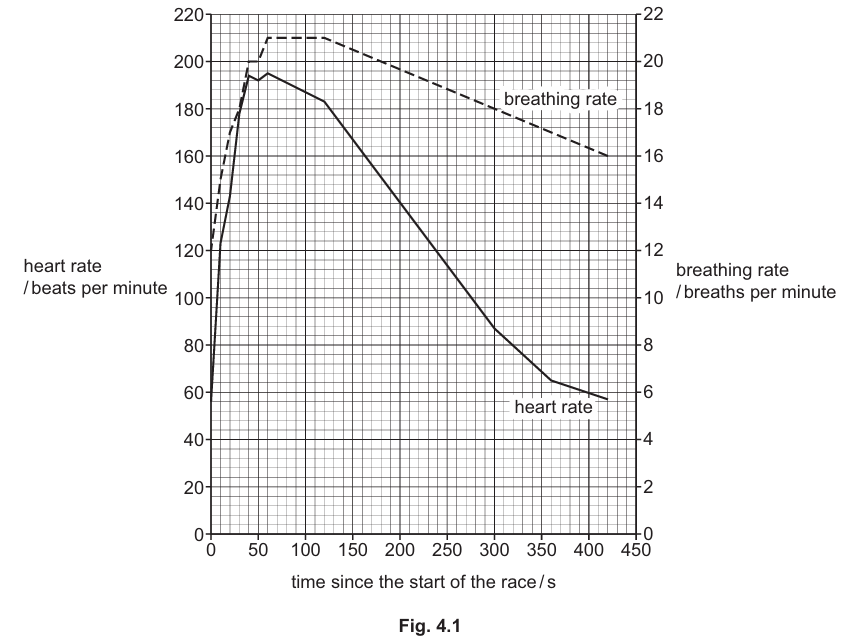
(i) The rate of breathing increases during the race in response to a change detected by the body.
Identify the stimulus in this response and state the organ that detects the stimulus.
(ii) Using the information in Fig. 4.1, calculate the rate of decrease in heart rate from 125 seconds to 260 seconds as the athlete recovers.
(iii) Explain the results shown in Fig. 4.1 from 60 seconds until 420 seconds.
▶️ Answer/Explanation
(a)(i) The word equation for anaerobic respiration in humans is: glucose → lactic acid. This occurs when oxygen is insufficient, such as during intense exercise.
(ii) Anaerobic respiration differs from aerobic respiration in that it:
- Does not require oxygen.
- Produces lactic acid instead of carbon dioxide and water.
- Releases less energy per glucose molecule.
- Occurs in the cytoplasm, not mitochondria.
Both processes use glucose as a substrate.
(b)(i) The stimulus is increased carbon dioxide concentration in the blood, detected by chemoreceptors in the brain (medulla oblongata).
(ii) The heart rate decreases from 125 s (180 bpm) to 260 s (140 bpm). The rate of decrease is: \[ \frac{180 – 140}{260 – 125} = \frac{40}{135} ≈ 0.296 \text{ beats per minute per second.} \]
(iii) After the race (60–420 s):
- Heart and breathing rates peak at 60 s and gradually decline.
- Oxygen debt is repaid as lactic acid is metabolized aerobically.
- Adrenaline levels decrease, reducing energy demand.
- Rates return to resting levels by 420 s.
Topic – 17.4
Feather colour in some breeds of chicken is an example of codominance in birds.
In this example, a chicken with white feathers and a chicken with black feathers can breed to produce offspring that have white feathers and black feathers.
The allele for black feathers is \(F^{B}\) and the allele for white feathers is \(F^{W}\).
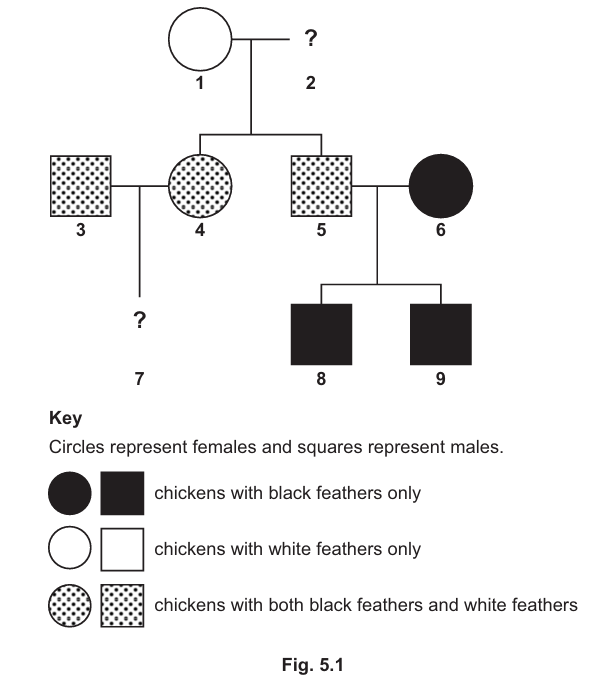
Fig. 5.1 is a pedigree diagram of a family of chickens.
(a) State the type of variation that is caused by genes only.
(b) State all the possible genotypes of chicken 2 and chicken 7 in Fig. 5.1.
(c) Complete the genetic diagram to show the results of a cross between chicken 5 and chicken 6 in Fig. 5.1.
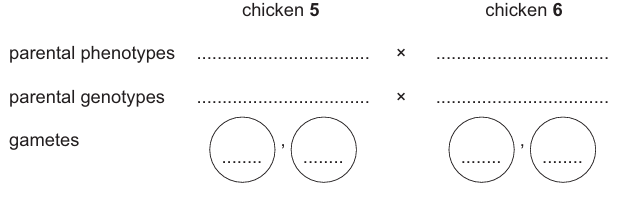
offspring genotypes ………… .
expected offspring phenotype percentage ………. .
(d) State one example of codominance in humans.
▶️ Answer/Explanation
(a) Discontinuous variation.
Discontinuous variation is caused solely by genetic differences, resulting in distinct categories (e.g., feather color in chickens).
(b) Chicken 2: \(F^{B}F^{B}\) or \(F^{B}F^{W}\) (black or black-and-white feathers).
Chicken 7: \(F^{W}F^{W}\), \(F^{B}F^{W}\), or \(F^{B}F^{B}\) (white, black-and-white, or black feathers).
Chicken 2 must carry at least one \(F^{B}\) allele (black phenotype). Chicken 7 can inherit any combination since its parents are \(F^{B}F^{W}\) and \(F^{W}F^{W}\).
(c) Offspring genotypes: 50% \(F^{B}F^{B}\) (black) and 50% \(F^{B}F^{W}\) (black-and-white).
Phenotype percentage: 50% black, 50% black-and-white.
Parental cross: \(F^{B}F^{W}\) × \(F^{B}F^{B}\). Gametes: \(F^{B}\), \(F^{W}\) × \(F^{B}\), \(F^{B}\). Punnett square yields equal probabilities for both genotypes.
(d) Example: ABO blood groups (codominance of \(I^{A}\) and \(I^{B}\) alleles).
In humans, codominance is seen when both alleles (e.g., \(I^{A}\) and \(I^{B}\)) are fully expressed in the phenotype (AB blood type).
Topic – 21.3
Some blood-clotting disorders can be inherited.
(a) (i) Describe what is meant by the term inheritance.
(ii) Describe the process of blood-clotting.
(b) Genetic modification has been used to produce human proteins.
One protein made in this way is factor VIIa which is used to treat some blood clotting disorders.
Fig. 6.1 shows part of the process.

(i) State the names of enzyme A and enzyme B in Fig. 6.1.
(ii) Explain why it is important that enzyme A is used to cut both the human DNA and the plasmid.
(iii) State what the letter C in Fig. 6.1 represents.
(iv) Explain why the contents of the fermenter in Fig. 6.1 are stirred constantly.
(v) Bacteria can be used to make complex molecules.
Describe two other reasons why bacteria are useful in biotechnology.
(vi) Describe two ways animal cells differ from bacterial cells.
(c) Crop plants such as soya can also be genetically modified.
Discuss the advantages and disadvantages of genetic modification of crop plants.
▶️ Answer/Explanation
(a)(i) Inheritance refers to the transmission of genetic information from parents to offspring, ensuring the continuity of traits across generations.
(a)(ii) Blood clotting involves platelets triggering the conversion of soluble fibrinogen into insoluble fibrin, forming a mesh that traps blood cells to stop bleeding.
(b)(i) A: Restriction enzyme; B: DNA ligase. These enzymes cut and join DNA strands, respectively, enabling genetic modification.
(b)(ii) Using the same restriction enzyme ensures complementary sticky ends, allowing human DNA and plasmid to bind seamlessly.
(b)(iii) C represents the recombinant plasmid, which contains the inserted human gene.
(b)(iv) Stirring ensures uniform distribution of nutrients and oxygen, promoting optimal bacterial growth and protein production.
(b)(v) Bacteria are useful because they reproduce rapidly and can be genetically manipulated easily, making them efficient for biotechnological applications.
(b)(vi) Animal cells have a nucleus and mitochondria, while bacterial cells lack these organelles and possess circular DNA.
(c) Advantages of GM crops include increased yield and pest resistance, while disadvantages involve ethical concerns and potential ecological disruption.
Final Answers:
(a)(i) transmission of genetic information from generation to generation ;
(a)(ii) any four from: involves platelets ; fibrinogen converted to fibrin ; (fibrinogen is) soluble to insoluble (fibrin) / fibrin is insoluble ; (fibrin) forms a, mesh AW ; traps blood cells ; AVP;
(b)(i) A: restriction enzyme ; B: (DNA) ligase ;
(b)(ii) forms sticky ends ; (sticky) ends will be complementary ;
(b)(iii) recombinant plasmid ;
(b)(iv) ensure even / uniform, distribution (of contents / AW) ;
(b)(v) any two from: presence of plasmids ; few / no, ethical concerns (in use of bacteria) ; rapid reproduction rate ; reproduce asexually / offspring are genetically identical ; small / do not need much space ; simple requirements to, grow / keep / AW ; same, genetic code / AW, as other organisms ; AVP ;
(b)(vi) animal cells have a nucleus ; mitochondria ; linear DNA ; no cell wall ; no plasmids ; AVP ;
(c) total of four from: max three advantages from: increased, yield / quantity ; increased nutritional, quality / content ; reduced use of fertiliser ; decrease damage from pests ; resistance to (insect) pests / (crops) produce insecticide / reduced use of insecticides ; resistance to, herbicides ; resistance to disease ; resistance to, salinity / cold / drought / AW ; max three disadvantages from: (genetically modified) seeds / plants, cost more (to farmer / consumer) ; (genetically modified) seeds, are sterile / need to be bought for each new crop ; (modified) genes may transfer into other (nearby) plants by cross pollination / AW ; ethical / religious, concerns about altering natural genomes / of consumers ; disruption of food chain by pest losing food source ; reduced genetic variability (of the crop) / (crop) less able to adapt to a change in the environment ;