
▶️ Answer/Explanation
(a)
- Organisms are classified into groups by the features (or characteristics) that they share. [Classification is based on morphology, anatomy, and DNA sequences.]
- The internationally agreed system for naming species is the binomial system. [Proposed by Carl Linnaeus, giving every organism a unique two-part name.]
- The scientific name of an organism is made up of the genus name and the species name. [The genus is capitalized, and the species is lowercase (e.g., Homo sapiens).]
(b)
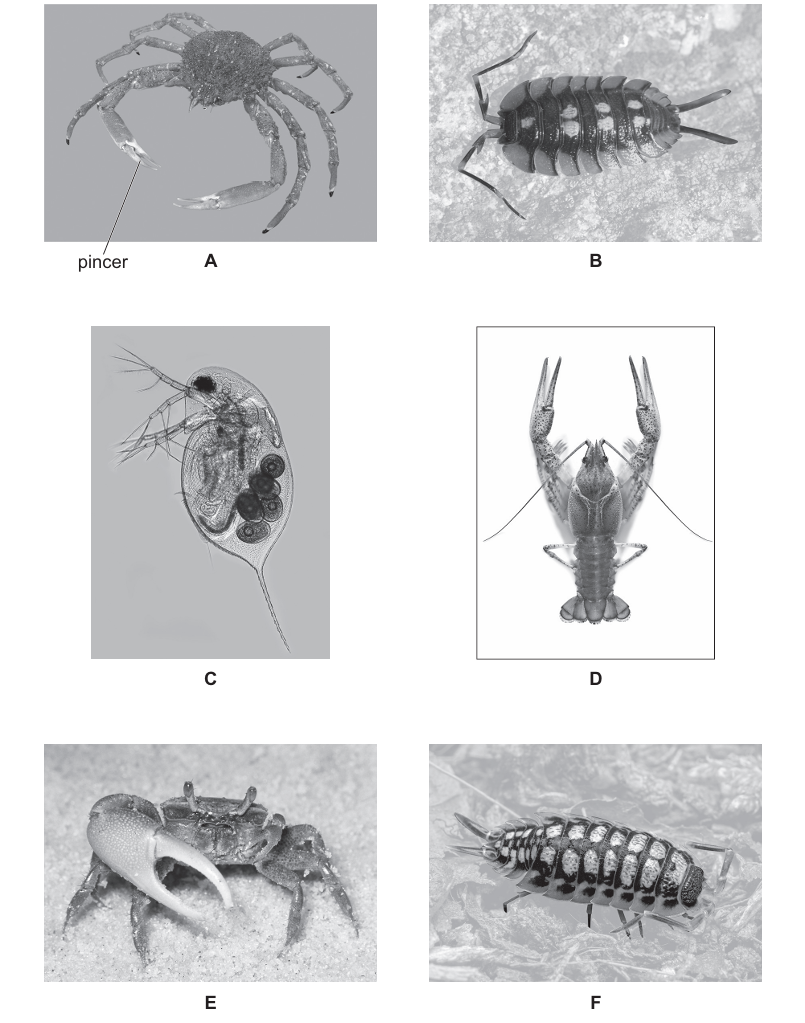
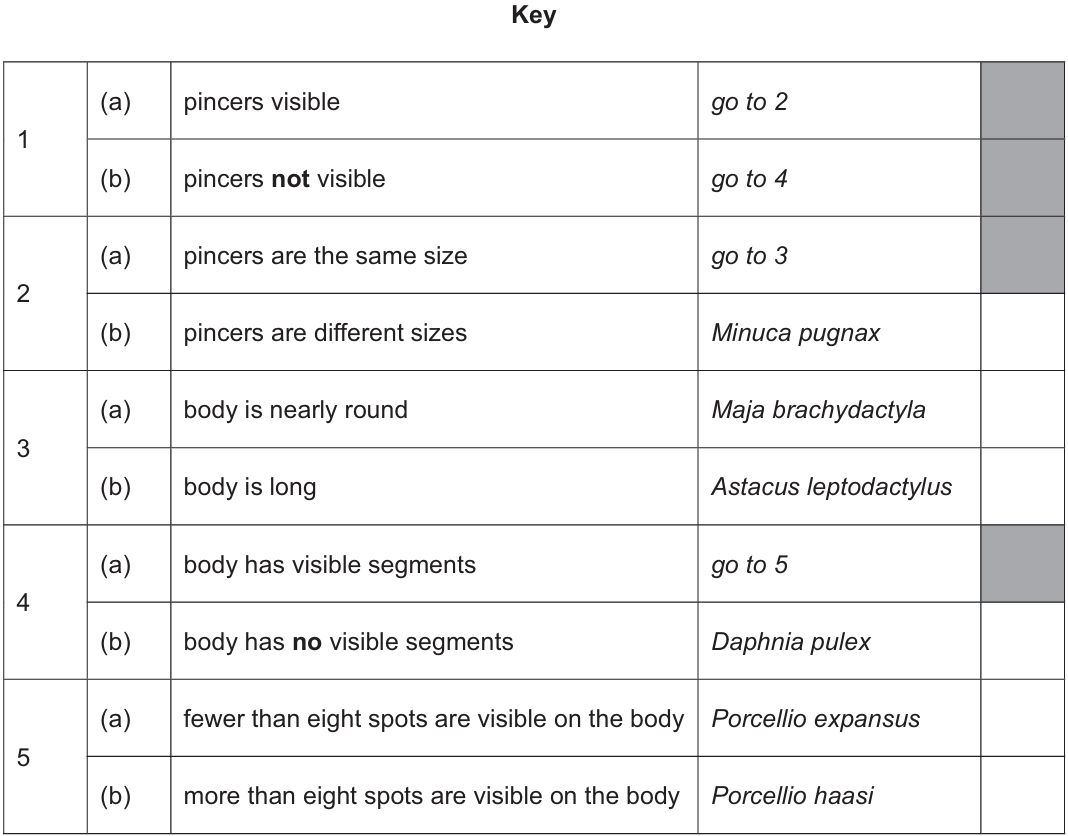
Using the dichotomous key to identify the crustaceans from the visual data:
| Step | Observation | Result/Species | Letter |
|---|---|---|---|
| 2(b) | Pincers visible + different sizes | Minuca pugnax | E |
| 3(a) | Pincers same size + round body | Maja brachydactyla | A |
| 3(b) | Pincers same size + long body | Astacus leptodactylus | D |
| 4(b) | No pincers + no visible segments | Daphnia pulex | C |
| 5(a) | No pincers + segments + <8 spots | Porcellio expansus | B |
| 5(b) | No pincers + segments + >8 spots | Porcellio haasi | F |
(c)
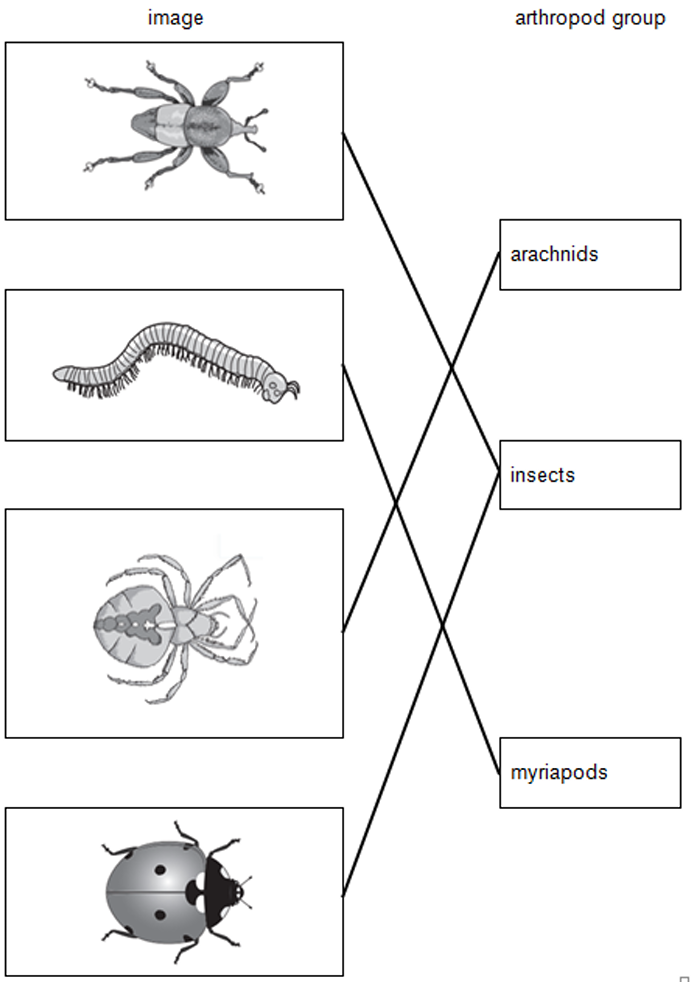
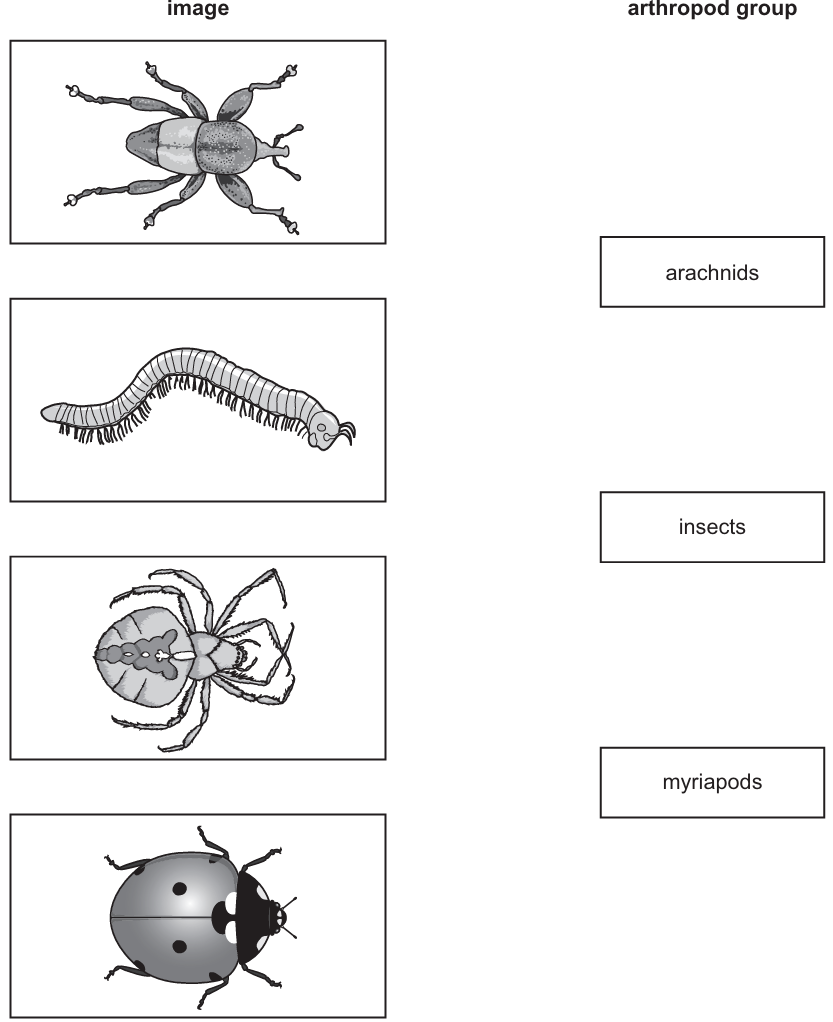
The arthropods are matched to their groups based on visible features:
- Beetle (Top Image): Has 3 pairs of legs and 3 body segments. It is an Insect.
- Millipede (Second Image): Has a long segmented body with many pairs of legs. It is a Myriapod.
- Spider (Third Image): Has 4 pairs of legs and 2 body parts (cephalothorax and abdomen). It is an Arachnid.
- Ladybug (Bottom Image): Has 3 pairs of legs and antennae. It is an Insect.
Correct Connections:
- Beetle → insects
- Millipede → myriapods
- Spider → arachnids
- Ladybug → insects

▶️ Answer/Explanation
(a) (i)
The cytoplasm: L
A ribosome: J
The structure that controls the activities of the cell: M
Explanation:
- L (Cytoplasm): This is the jelly-like substance filling the cell where metabolic reactions take place.
- J (Ribosomes): These are the small organelles (seen here as dots) responsible for protein synthesis.
- M (Nucleus): This is the large organelle containing genetic material (DNA), which controls the cell’s activities.
(a) (ii)
Structure K is a mitochondrion.
Explanation: Mitochondria are organelles responsible for aerobic respiration. They are identifiable in diagrams by their double membrane, with the inner membrane folded to form cristae.
(b)
Any one of the following: cell wall, chloroplast, or large permanent vacuole.
Explanation: Plant cells contain a cellulose cell wall for support, chloroplasts for photosynthesis, and a large permanent vacuole for maintaining turgor pressure. These structures are absent in animal cells (animal cells may have small, temporary vacuoles, but not large permanent ones).
(c)
\(\text{glucose} + \text{oxygen} \rightarrow \text{carbon dioxide} + \text{water}\)
Explanation: Aerobic respiration is the chemical reaction in cells that uses oxygen to break down nutrient molecules (glucose) to release energy. Carbon dioxide and water are produced as waste products.
▶️ Answer/Explanation
(a)
Answer: Coordination / regulation (of body functions).
The nervous system is responsible for detecting stimuli, processing information, and coordinating the body’s response to ensure survival and proper functioning.
(b) (i)
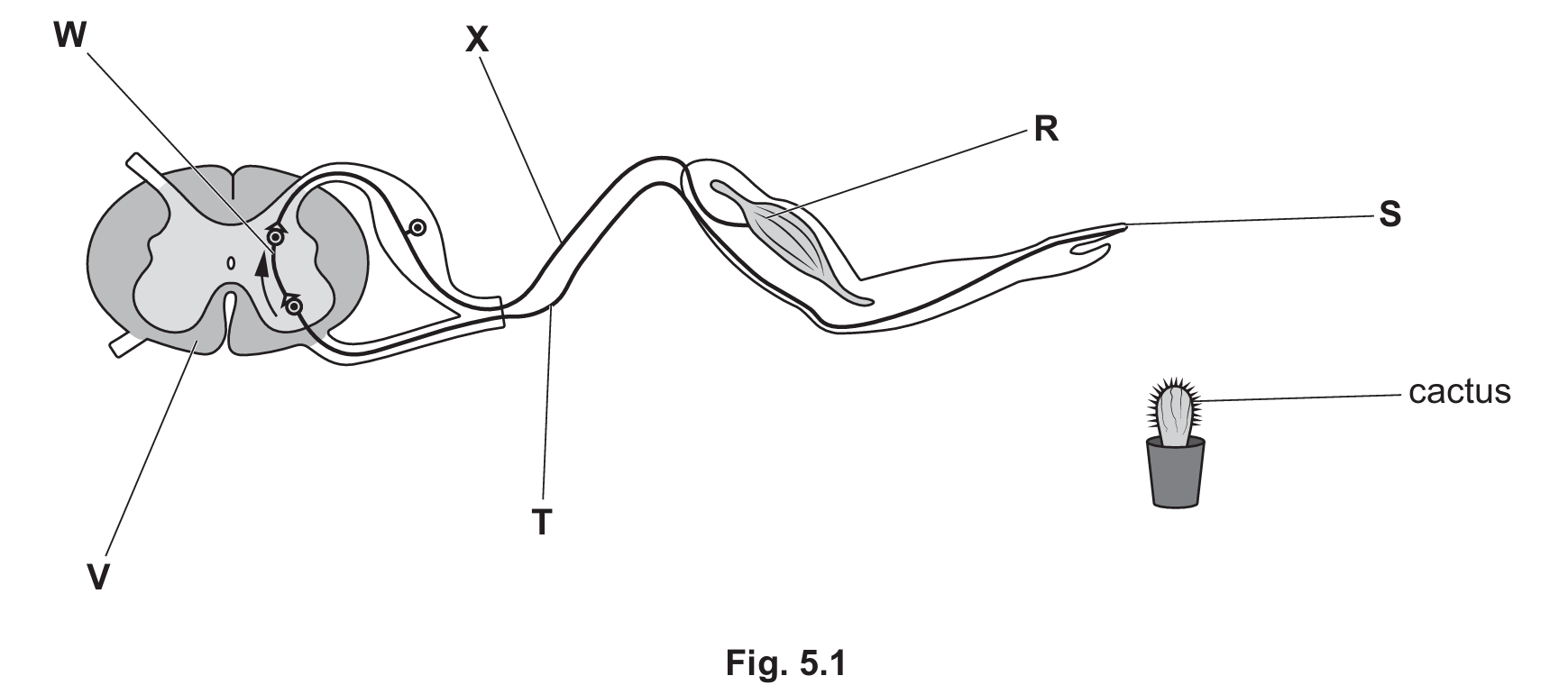
Answer: Any two from: S, T, X.
Explanation: The nervous system is divided into the Central Nervous System (CNS), which consists of the brain and spinal cord, and the Peripheral Nervous System (PNS), which consists of nerves outside of the brain and spinal cord.
- In Fig $5.1$, the large central structure is the spinal cord (CNS).
- S represents the sensory receptor/nerve endings in the skin.
- T represents the sensory neurone running from the skin to the spinal cord.
- X represents the motor neurone running from the spinal cord to the muscle.
These structures ($S, T, X$) lie outside the spinal cord and are therefore part of the PNS.
(b) (ii)
Answer:
1. Detected by S.
2. Passes along T.
3. Passed to W … passes out in X.
4. Causes R.
Explanation of the Reflex Arc Path:
- Stimulus detection (S): The painful stimulus (cactus) is detected by the receptor cells in the skin, labeled S.
- Sensory Neurone (T): The electrical impulse travels away from the receptor toward the Central Nervous System via the sensory neurone, labeled T.
- Relay Neurone (W): Inside the grey matter of the spinal cord, the impulse is transferred across a synapse to the relay neurone (interneurone), labeled W. Note that relay neurones connect sensory and motor neurones within the CNS.
- Motor Neurone (X): The impulse is then transferred to the motor neurone, labeled X, which carries the signal out of the spinal cord toward the effector.
- Response (R): The impulse reaches the effector muscle, labeled R, causing it to contract and pull the hand away.
(b) (iii)
Answer: Synapse.
Explanation: A synapse is the small gap or junction between two neurones (e.g., between the sensory neurone $T$ and the relay neurone $W$) where chemicals called neurotransmitters serve to transmit the electrical signal from one cell to the next.
▶️ Answer/Explanation
(a)(i)
Amino acids / proteins.
Explanation: Plants absorb nitrate ions ($NO_3^-$) from the soil/water. The nitrogen in these ions is an essential element required to synthesise amino acids, which are then linked together to form plant proteins. It is also used to make DNA and chlorophyll.
(a)(ii)
The effects of excess fertiliser (eutrophication) include:
- Algae/aquatic plants grow faster (Algal bloom).
- This growth blocks sunlight from reaching plants deeper in the water, causing them to die.
- Bacteria decompose the dead plant matter and reproduce rapidly.
- This decomposition process depletes the dissolved oxygen in the water (lack of oxygen).
- Consequently, aquatic animals (like fish) die due to suffocation, leading to a decrease in biodiversity.
(b)(i)
Comparing the populations in River A (clean) and River B (polluted/sewage):
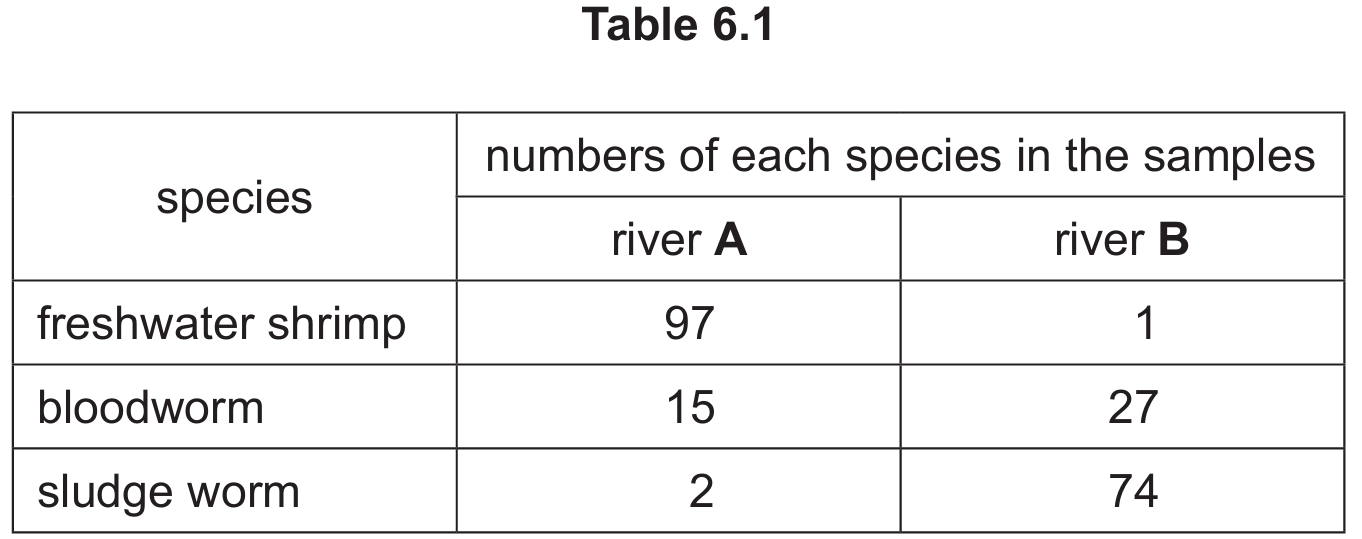
- There are more freshwater shrimps in river A ($97$) than in river B ($1$).
- There are more bloodworms in river B ($27$) than in river A ($15$).
- There are significantly more sludge worms in river B ($74$) than in river A ($2$).
- Overall, river A supports a higher number of organisms sensitive to pollution (shrimps), while river B supports organisms that thrive in low-oxygen/polluted conditions (sludge worms).
(b)(ii)
Freshwater shrimp.
Explanation: The population of freshwater shrimp dropped drastically (from 97 to 1) in the presence of sewage contamination, indicating they cannot survive in polluted waters.
(c)(i)
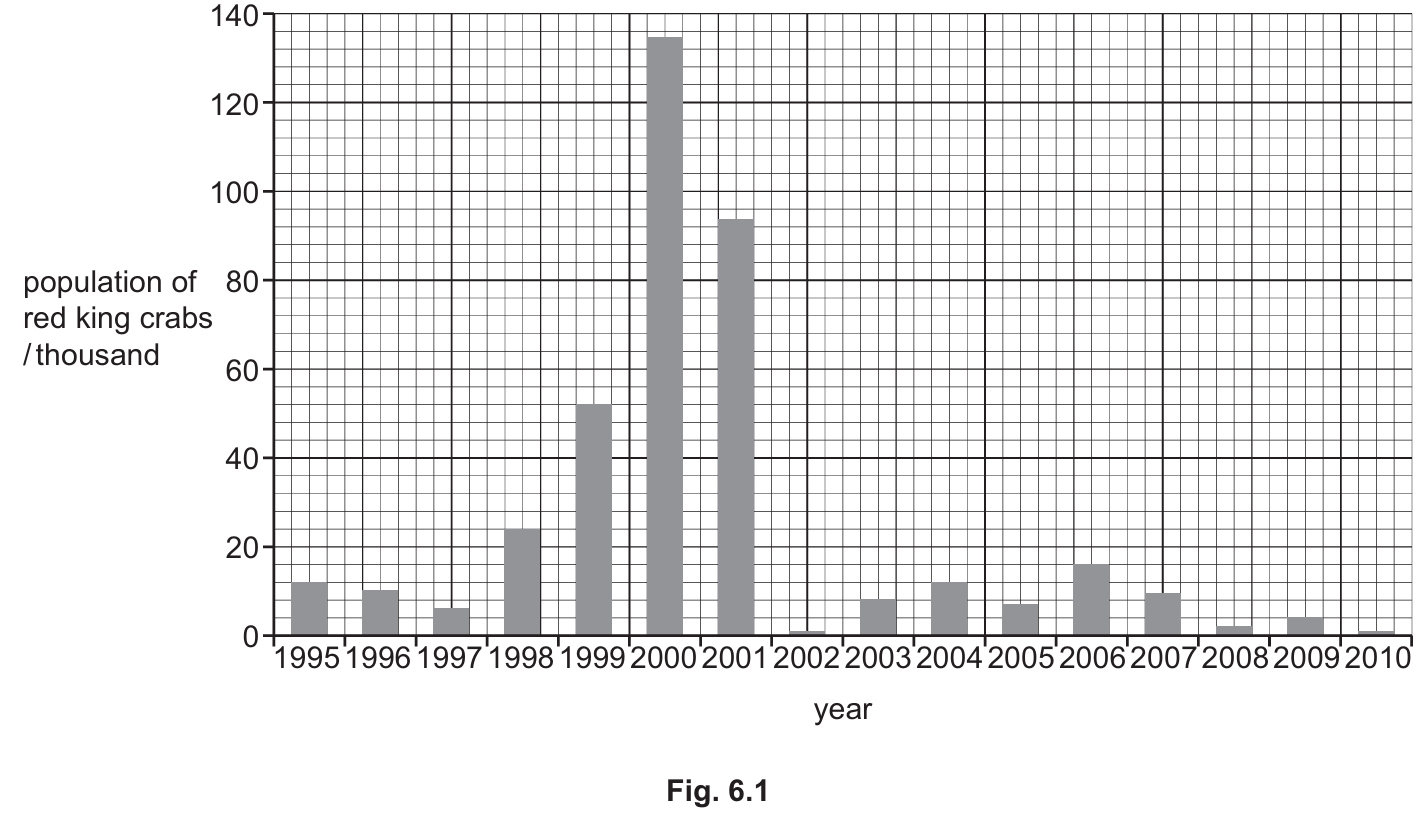
In 1998, the population size of red king crabs was 24,000 (or 24 thousand).
The largest population size of red king crabs was in the year 2000.
The population size in 1995 was the same as the population size in the year 2004.
(c)(ii)
333 %
Step-by-step Calculation:
1. Identify the population in 1995 from the graph: $12,000$.
2. Identify the population in 1999 from the graph: $52,000$. (Note: Each small grid square on the Y-axis represents $4$ units. The bar is $3$ squares above $40$).
3. [cite_start]Calculate the increase in population: $$52,000 – 12,000 = 40,000$$ 4. Calculate the percentage increase using the formula: $$\text{Percentage Increase} = \frac{\text{Change}}{\text{Original}} \times 100$$ $$\text{Percentage Increase} = \frac{40}{12} \times 100$$ $$\text{Percentage Increase} \approx 333.33…\%$$ 5. Round to the nearest whole number: 333%.


▶️ Answer/Explanation
(a) (i) Reasons bacteria are useful in biotechnology:
- They have a rapid reproduction rate. Bacteria reproduce asexually via binary fission very quickly (often every 20 minutes), allowing for the mass production of a product in a short time.
- They have the ability to make complex molecules.
- (Alternative point): They contain plasmids (circular DNA), which are easily modified and transferred from one cell to another.
(a) (ii) Ways genetic modification improves crop plants:
- Herbicide resistance: Crops can be modified to withstand weed-killers, allowing farmers to spray fields to kill weeds without harming the crop (e.g., Roundup Ready crops).
- Pest/Insect resistance: Crops can produce their own toxins (e.g., Bt toxin) that kill specific pests, reducing the need for chemical pesticides.
- Increased yield: Modification can lead to larger fruits, faster growth, or resistance to environmental stress like drought.
- Improved nutritional qualities: Crops can be fortified with vitamins (e.g., Golden Rice, which is enriched with Vitamin A precursor).
(b) (i) Conclusions from the graph:
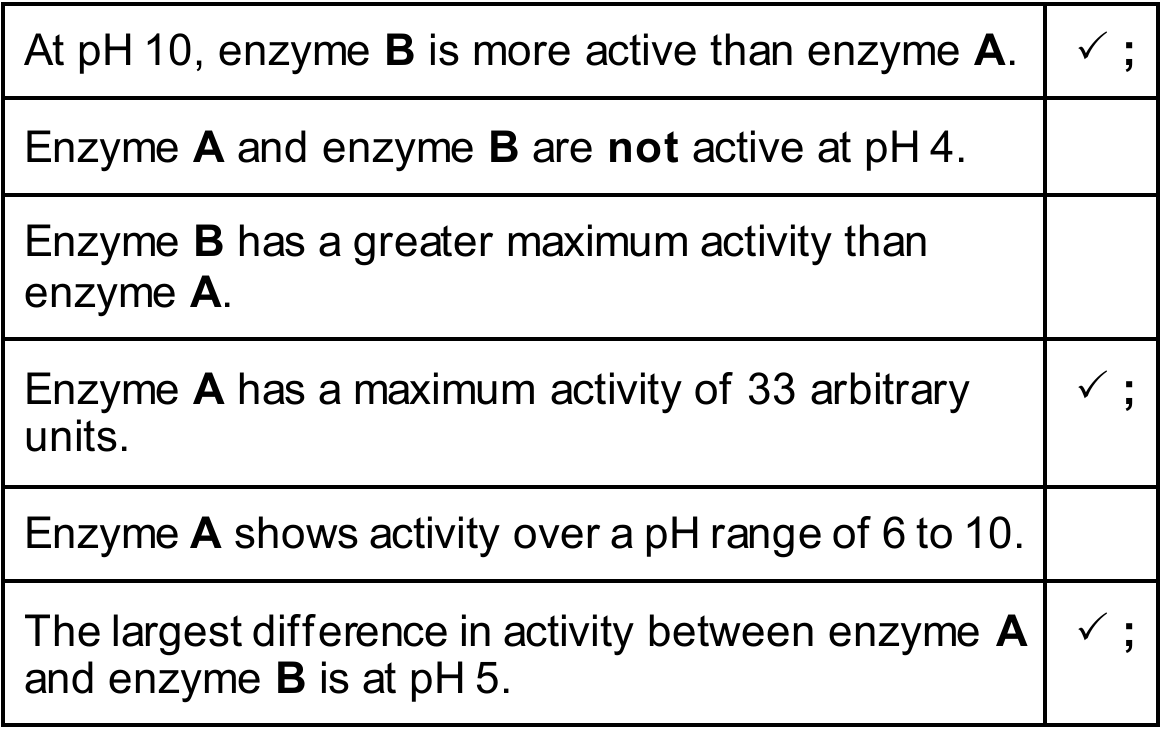
The correct statements based on Fig. 7.1 are:
- At \(\text{pH } 10\), enzyme B is more active than enzyme A. (\(\checkmark\))
Reasoning: Looking at the x-axis at \(10\), the line for Enzyme A is at \(0\), while the dashed line for Enzyme B is at approx \(12\) units. - Enzyme A has a maximum activity of \(33\) arbitrary units. (\(\checkmark\))
Reasoning: The peak of the solid line (Enzyme A) is at \(\text{pH } 5.5\). The y-axis value is \(3\) small squares above \(30\). Since \(5\) squares = \(5\) units, the value is \(33\). - The largest difference in activity between enzyme A and enzyme B is at \(\text{pH } 5\). (\(\checkmark\))
Reasoning: At \(\text{pH } 5\), Enzyme A is at \(30\) units and Enzyme B is at \(0\) units. The difference is \(30\). At any other pH, the gap between the lines is smaller than this.
Why the others are incorrect:
- “Enzyme A and enzyme B are not active at \(\text{pH } 4\)”: Incorrect. Enzyme A is active (value approx \(18\)).
- “Enzyme B has a greater maximum activity than enzyme A”: Incorrect. Peak A is \(33\), Peak B is \(30\).
- “Enzyme A shows activity over a pH range of \(6\) to \(10\)”: Incorrect. It loses activity before \(10\), and starts well before \(6\).
(b) (ii) Washing powder selection:
- Enzyme: B
- Reason: At \(\text{pH } 9\) (the pH of the washing powder), only Enzyme B is active. Enzyme A has denatured and has zero activity at this pH. Alternatively, Enzyme B’s optimum is closer to \(\text{pH } 9\).
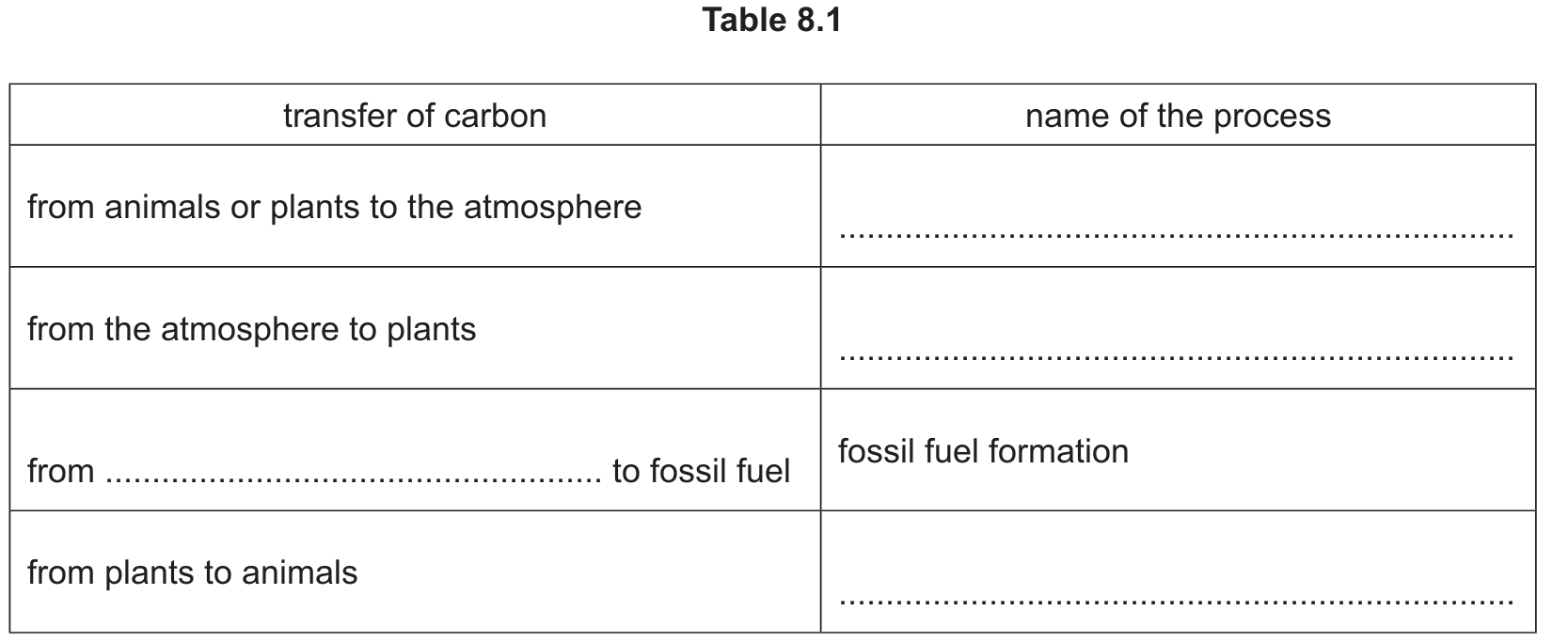
▶️ Answer/Explanation
(a)(i) Completed Table 8.1:
| from animals or plants to the atmosphere | respiration [cite: 928] |
| from the atmosphere to plants | photosynthesis [cite: 335, 928] |
| from (dead) animals / plants / organisms to fossil fuel | fossil fuel formation |
| from plants to animals | feeding [cite: 928] |
Explanation:
- Respiration: Living organisms break down nutrient molecules to release energy, releasing carbon dioxide into the atmosphere.
- Photosynthesis: Plants synthesise carbohydrates from raw materials using light energy, removing carbon dioxide from the atmosphere.
- Fossil Fuel Formation: Fossil fuels are formed from the fossilised remains of dead organisms over long periods.
- Feeding: Carbon is transferred from producers to consumers when animals eat plants or other animals.
(a)(ii)
Decomposition
Explanation: Microorganisms (decomposers) break down dead or waste organic material, releasing carbon dioxide back into the atmosphere through respiration.
(b) Completed Sentences:
Combustion of fossil fuels increases the concentration of carbon dioxide in the atmosphere.
This causes an enhanced greenhouse effect and leads to climate change / global warming.
Another gas that has a similar effect on the atmosphere to carbon dioxide is methane.
Explanation:
- Combustion: Burning fossil fuels releases carbon dioxide, contributing to air pollution and increasing atmospheric concentrations.
- Enhanced Greenhouse Effect: The accumulation of greenhouse gases like CO2 and methane traps heat in the atmosphere, leading to climate change.
- Methane: Methane is explicitly listed alongside carbon dioxide as a pollutant that causes the enhanced greenhouse effect and climate change.