
▶️ Answer/Explanation
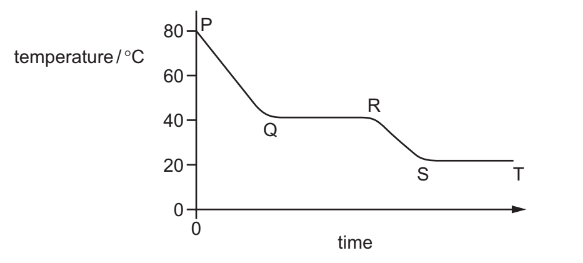
On a cooling curve, freezing is represented by the horizontal (flat) section where temperature remains constant as the liquid loses energy and converts to solid. The substance M starts as a liquid at 80 °C and cools; the flat plateau — where the temperature stays constant while the state change occurs — is the freezing point. This corresponds to the region Q to R, where thermal energy is released at constant temperature as particles become arranged into a fixed lattice. Sections P–Q and R–S show temperature falling, and S–T shows the solid continuing to cool.
✅ Answer: (B)
✅ Answer: (B)
▶️ Answer/Explanation
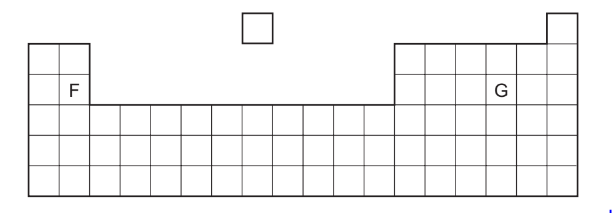
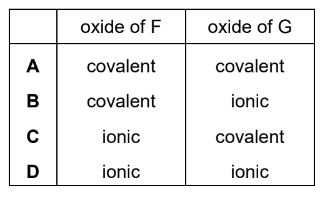
From the Periodic Table diagram, F is a metal (e.g. a Group I or II element) and G is a non-metal. The oxide of a metal (F) contains ionic bonding because the metal transfers electrons to oxygen, forming a giant ionic lattice. The oxide of a non-metal (G) contains covalent bonding as the atoms share electrons. The answer matching “ionic” for F’s oxide and “covalent” for G’s oxide is option C.
✅ Answer: (C)
✅ Answer: (C)
▶️ Answer/Explanation
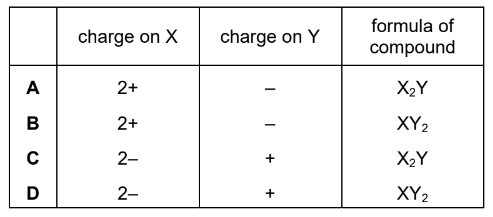
Element X loses 2 electrons, forming a 2+ ion (X²⁺). Element Y gains 1 electron, forming a 1– ion (Y⁻). To balance the charges in the compound, 2 Y⁻ ions are needed for every 1 X²⁺ ion (2× (−1) = −2 cancels +2). Therefore the formula of the compound is XY₂. This matches option B, which shows X²⁺, Y⁻, and formula XY₂.
✅ Answer: (B)
✅ Answer: (B)
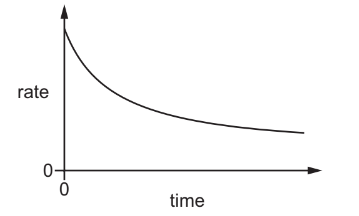
▶️ Answer/Explanation
Activation energy is a fixed property of a reaction and does not change with time, so statement 1 is incorrect. Although the reaction is exothermic and could slightly increase the temperature (increasing molecular speed), this does not account for the decreasing rate — so statement 2 is not the cause. Statement 3 is correct: as X and Y are consumed, their concentrations decrease, reducing the frequency of successful collisions and therefore the rate. The decrease in rate over time is solely explained by decreasing concentrations of reactants.
✅ Answer: (D)
✅ Answer: (D)
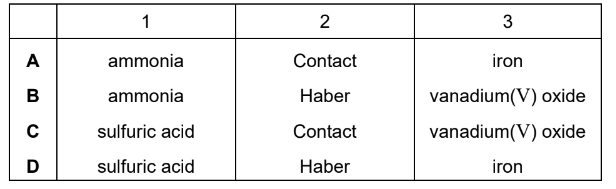
▶️ Answer/Explanation
Ammonium sulfate is made by reacting ammonia with sulfuric acid. The ammonia (gap 1) is produced by the Haber process (gap 2), which involves reacting nitrogen and hydrogen at 450 °C and 200 atm using an iron catalyst (gap 3). The Haber process equation is N₂(g) + 3H₂(g) ⇌ 2NH₃(g). This matches option C: ammonia / Haber / iron.
✅ Answer: (C)
✅ Answer: (C)
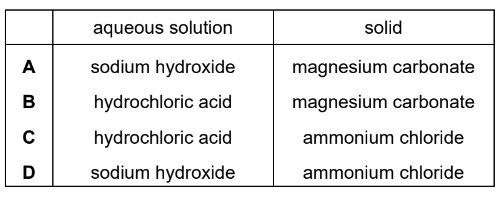
▶️ Answer/Explanation
The alkaline gas produced is ammonia (NH₃). Ammonia is released when an alkali (base) reacts with an ammonium salt — for example, aqueous sodium hydroxide reacting with solid ammonium chloride: NaOH(aq) + NH₄Cl(s) → NaCl(aq) + NH₃(g) + H₂O(l). The products match: alkaline gas (NH₃), salt (NaCl), and water. This corresponds to option D: aqueous sodium hydroxide and solid ammonium chloride.
✅ Answer: (D)
✅ Answer: (D)
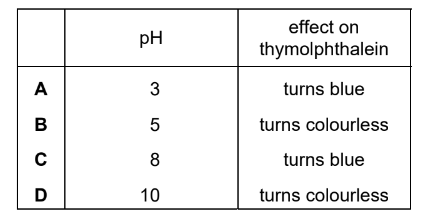
▶️ Answer/Explanation
Butanoic acid is a carboxylic acid that partially dissociates in aqueous solution, making it a weak acid (not a strong acid). Like all acids, it reacts with carbonates to produce a salt, water, and carbon dioxide. A weak acid that reacts with carbonates — this combination matches option B in the table. It is not completely dissociated (ruling it out as a strong acid), but it does still react chemically with metals, bases, and carbonates.
✅ Answer: (B)
✅ Answer: (B)
▶️ Answer/Explanation
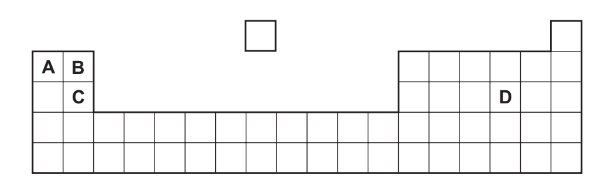
An element with 2 outer-shell electrons is in Group II of the Periodic Table. An element with 3 electron shells (occupied) is in Period 3. The element in Group II, Period 3 is magnesium (Mg), with electronic configuration 2,8,2 — two electrons in its outer (third) shell across three shells in total. This matches the description in the question and is option C.
✅ Answer: (C)
✅ Answer: (C)
▶️ Answer/Explanation
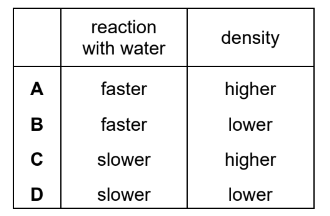
In Group II, going down the group, reactivity increases and density increases. Barium (Ba) is below calcium (Ca) in Group II, so barium is more reactive with water than calcium and has a higher density. The rate of reaction of barium with cold water is more vigorous than calcium’s. This matches option A, which states barium has a greater density and reacts more vigorously (higher reactivity) with water than calcium.
✅ Answer: (A)
✅ Answer: (A)
▶️ Answer/Explanation
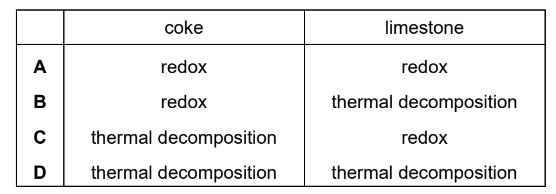
In the blast furnace, coke (carbon) undergoes combustion: C + O₂ → CO₂ — this is an oxidation/combustion reaction. Limestone (calcium carbonate, CaCO₃) undergoes thermal decomposition when heated: CaCO₃ → CaO + CO₂. Combustion is an oxidation reaction, and CaCO₃ breaking down on heating is thermal decomposition. This combination matches option B: coke — combustion; limestone — thermal decomposition.
✅ Answer: (B)
✅ Answer: (B)
▶️ Answer/Explanation
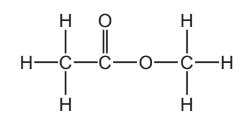
Esters are named from the alcohol part (first word, ending in -yl) and the acid part (second word, ending in -anoate). The structure shown has the formula CH₃COOCH₃: the acid part (CH₃COO–) comes from ethanoic acid (2 carbons), giving “ethanoate”; the alcohol part (–OCH₃) comes from methanol (1 carbon), giving “methyl”. Therefore, the compound is methyl ethanoate (CH₃COOCH₃), which is option C.
✅ Answer: (C)
✅ Answer: (C)
▶️ Answer/Explanation
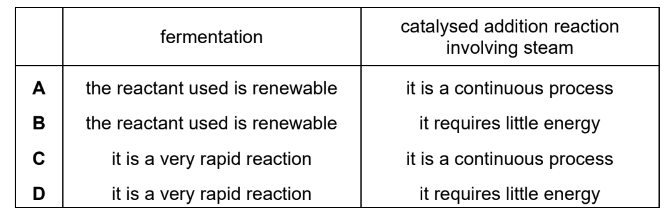
Fermentation uses glucose from renewable plant material (sugar cane, etc.) as a feedstock — making it sustainable and usable in countries without oil — but it is slow, produces dilute ethanol, and requires separation. Steam hydration (addition of steam to ethene) is a continuous process giving a high rate of production and pure ethanol, but uses a non-renewable feedstock (ethene from crude oil). Option A correctly states: fermentation uses a renewable resource (advantage of fermentation); steam hydration gives a faster/continuous production rate (advantage of steam hydration).
✅ Answer: (A)
✅ Answer: (A)
▶️ Answer/Explanation
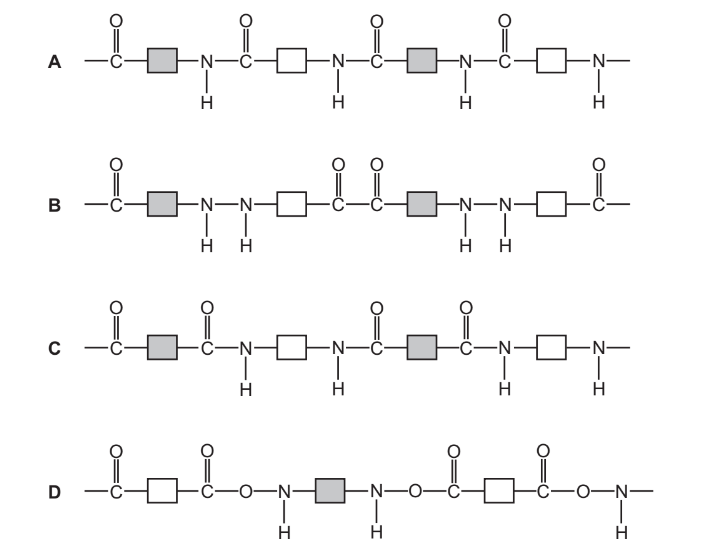
Nylon is a polyamide formed by condensation polymerisation of a dicarboxylic acid and a diamine, eliminating water at each step. The repeat unit of nylon contains amide linkages (–CO–NH–). The key structural feature to identify is the presence of both –C=O and –NH– groups alternating along the chain, which is the amide bond (–CONH–). Option C shows the correct polyamide chain structure with the –NH– and –C=O linkages characteristic of nylon.
✅ Answer: (C)
✅ Answer: (C)
▶️ Answer/Explanation
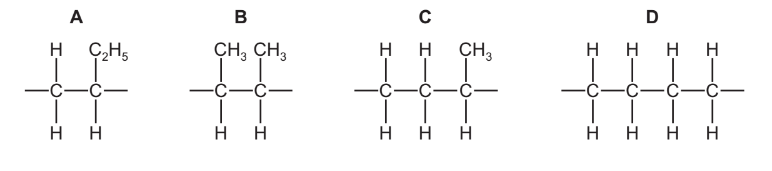
But-1-ene has the formula CH₂=CHCH₂CH₃. In addition polymerisation, the double bond opens and the monomer units link together. The repeat unit retains all 4 carbons of the monomer but with a single C–C bond replacing the double bond, adding –CH₂– connections to the chain. The pendant group is –CH₂CH₃ (ethyl group) on the second carbon. The correct repeat unit is –[CH₂–CH(CH₂CH₃)]–, which matches option A.
✅ Answer: (A)
✅ Answer: (A)
▶️ Answer/Explanation
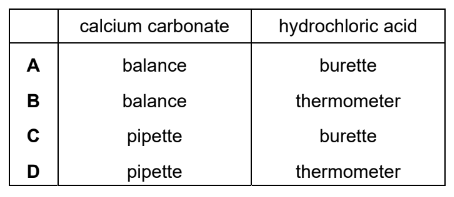
The mass of a solid (2.00 g of calcium carbonate) is measured using a balance, not a measuring cylinder. The volume of a liquid (50.0 cm³ of hydrochloric acid) is measured using a measuring cylinder, not a balance. A burette or pipette would be used only in titration contexts. The correct pairing is balance for the solid and measuring cylinder for the liquid, which corresponds to option A.
✅ Answer: (A)
✅ Answer: (A)
▶️ Answer/Explanation
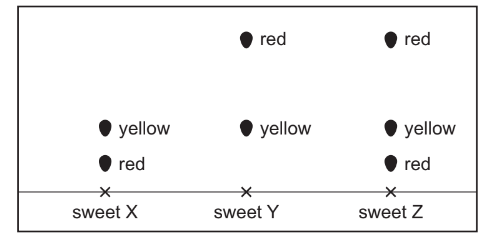
In a chromatogram, each distinct spot at a unique Rf value represents a different dye. The question specifies counting only the red dyes. Spots that travel to the same height (same Rf value) in different samples are the same dye. By examining the chromatogram from the three sweets, the red spots appear at two distinct heights/positions — meaning there are 2 different red dyes present across all three sweets combined, even though some sweets may share the same red dye.
✅ Answer: (B)
✅ Answer: (B)