
Question 1
Most-appropriate topic codes (Cambridge IGCSE Chemistry 0620):
• Topic 2.2 — Atomic structure and the Periodic Table (Parts (b), (c))
• Topic 2.1 — Elements, compounds and mixtures (Part (a))
• Topic 12.5 — Identification of ions and gases (Part (d))
• Topic 9.6 — Extraction of metals / Topic 6.3 — Reversible reactions (Part (e))
• Topic 10.3 — Air quality and climate / photosynthesis (Part (f))
▶️ Answer/Explanation
(a) CH₄
Methane (CH₄) contains one carbon atom and four hydrogen atoms, giving a total of five atoms per molecule. It is the only formula in the list with exactly five atoms.
(b) Br₂
Bromine (Br₂) is the only diatomic molecule in the list that belongs to Group VII (the halogens). Although Cl₂ is also a halogen, it does not appear in the list; Br₂ is therefore the correct answer.
(c) Cl⁻
A chloride ion (Cl⁻) carries a charge of 1−, meaning the neutral chlorine atom has gained exactly one electron to achieve a full outer shell of eight electrons. This is the only ion in the list with a single negative charge formed by electron gain.
(d) Cr³⁺
When aqueous sodium hydroxide is added to a solution containing Cr³⁺ ions, a green precipitate of chromium(III) hydroxide is formed. This is a standard qualitative analysis result listed in the syllabus Notes for Use in Qualitative Analysis.
(e) CO₂
Calcium carbonate decomposes on strong heating to give calcium oxide and carbon dioxide: CaCO₃ → CaO + CO₂. Carbon dioxide (CO₂) is therefore one of the two products of this thermal decomposition.
(f) O₂
Photosynthesis converts carbon dioxide and water into glucose and oxygen using light energy. The word equation is: carbon dioxide + water → glucose + oxygen. Oxygen (O₂) is thus a product of photosynthesis.
Question 2
- the filtrate
- the residue
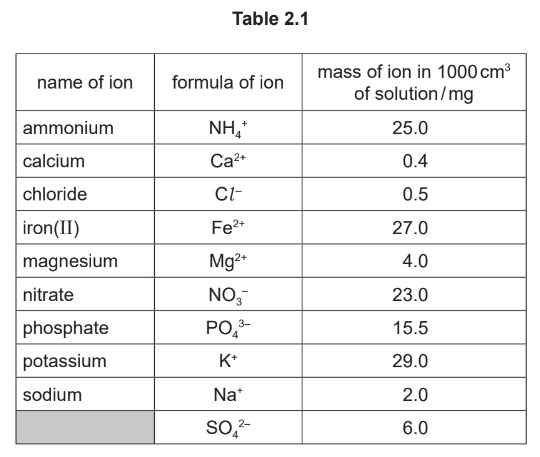
- the electronic configuration of a sodium ion
- the charge on the ion
Choose from the list the gas which is essential for aquatic life:
State one harmful effect of each of these water pollutants.
Most-appropriate topic codes (Cambridge IGCSE Chemistry 0620):
• Topic 12.4 — Separation and purification (Part (a))
• Topic 3.2 — Relative masses of atoms and molecules (Part (b)(iii))
• Topic 2.4 — Ions and ionic bonds (Part (c))
• Topic 10.1 — Water (Parts (d), (e))
▶️ Answer/Explanation
(a)
The correct diagram shows a filter funnel containing a folded filter paper, placed over a beaker. The liquid that passes through the filter paper and collects in the beaker is labelled the filtrate, while the solid soil that remains on the filter paper is labelled the residue. All three marks require: the filter paper in the funnel (1), filtrate correctly labelled (1), and residue correctly labelled (1).
(b)(i) Chloride / Cl⁻
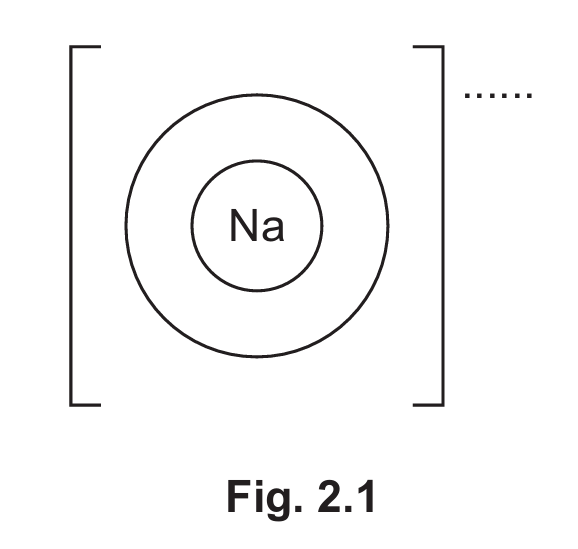
From Table 2.1, chloride ions have the smallest mass per 1000 cm³ among all the negative ions listed, giving them the lowest concentration in the soil solution.
(b)(ii) Sulfate
The SO₄²⁻ ion is named the sulfate ion. It is a polyatomic anion consisting of one sulfur atom bonded to four oxygen atoms, carrying an overall charge of 2−.
(b)(iii) 3.1 mg
If 1000 cm³ of solution contains 15.5 mg of phosphate ions, then 200 cm³ contains (200/1000) × 15.5 = 3.1 mg. Only a simple proportion calculation is needed here.
(c)
A sodium ion (Na⁺) is formed when sodium loses its single outer-shell electron. Its electronic configuration is 2,8 (two full shells, no third shell), and the charge shown outside the brackets is 1+ or simply +. No additional shells should be drawn.
(d) Oxygen
Dissolved oxygen in water is essential for the survival of fish and other aquatic organisms; they use it for aerobic respiration. The other gases listed (argon, hydrogen, nitrogen) do not support aquatic life in this way.
(e)
Sewage: contains harmful bacteria/microbes which cause disease when ingested or contacted. Nitrates: when washed into rivers and lakes they cause algal blooms, which deoxygenate the water, leading to the death of aquatic life (eutrophication).
Question 3
Give a reason for your answer.
Most-appropriate topic codes (Cambridge IGCSE Chemistry 0620):
• Topic 2.5 — Simple molecules and covalent bonds (Part (a))
• Topic 10.3 — Air quality and climate (Parts (b)(i), (b)(ii))
• Topic 7.2 — Oxides (Part (c))
▶️ Answer/Explanation
(a)
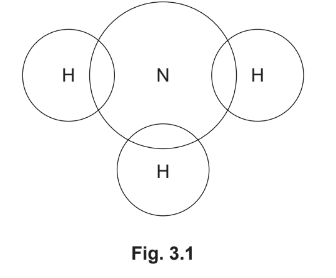
In the completed dot-and-cross diagram of NH₃, each of the three hydrogen atoms shares one pair of electrons with the central nitrogen atom (these are the bonding pairs). The nitrogen atom also retains one lone pair of non-bonding electrons. No electrons should be shown on the hydrogen atoms beyond the shared pair.
(b)(i)
Oxides of nitrogen are produced in car engines (and other vehicle engines), where the extreme heat causes nitrogen and oxygen from the air to react directly with each other. This is the primary source of NO and NO₂ as air pollutants.
(b)(ii)
Oxides of nitrogen dissolve in rainwater to form nitric acid, which falls as acid rain, damaging ecosystems, buildings, and statues. They also contribute to photochemical smog and can cause respiratory problems in humans.
(c) Acidic oxide
Nitrogen dioxide (NO₂) is an acidic oxide because nitrogen is a non-metal element. Acidic oxides are oxides of non-metals; they react with water to form acids and with bases to form a salt and water.
Question 4
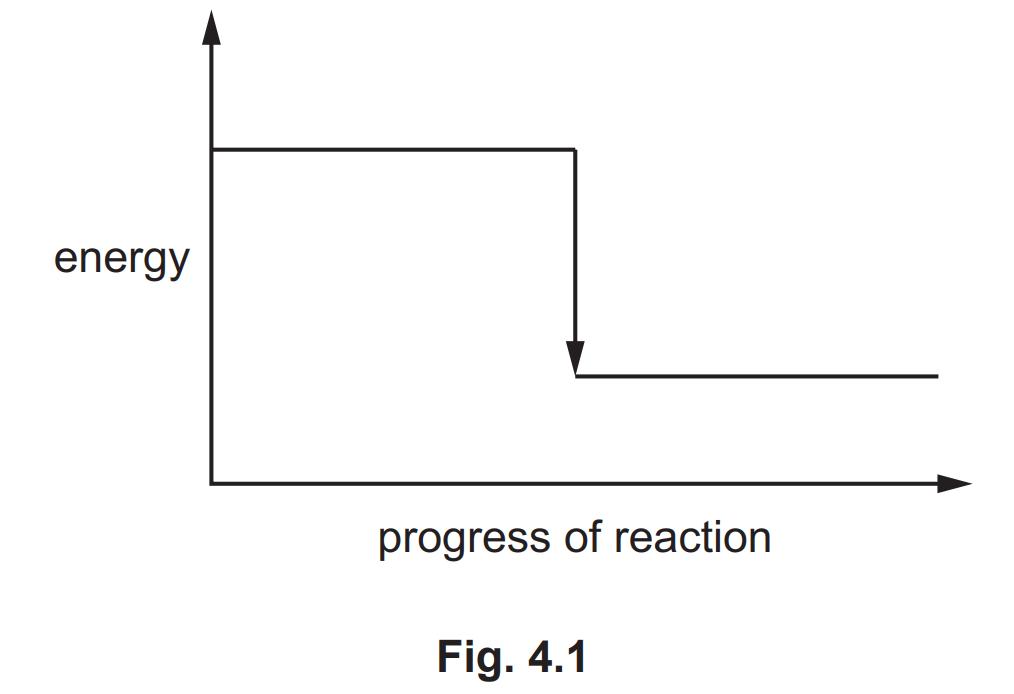
- Mg + Cl₂
- MgCl₂

Most-appropriate topic codes (Cambridge IGCSE Chemistry 0620):
• Topic 8.4 — Transition elements (Part (a))
• Topic 7.3 — Preparation of salts / solubility rules (Part (b))
• Topic 5.1 — Exothermic and endothermic reactions (Parts (c)(i), (c)(ii))
• Topic 9.4 — Reactivity series (Part (d))
• Topic 3.2 — Relative masses of atoms and molecules (Part (e))
▶️ Answer/Explanation
(a) Metals B and D
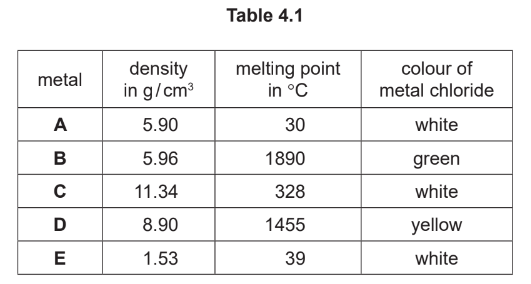
From Table 4.1, metals B and D both form coloured compounds (a defining property of transition elements) and both have high melting points (another characteristic of transition metals). These two pieces of evidence from the table are sufficient to identify them as transition elements.
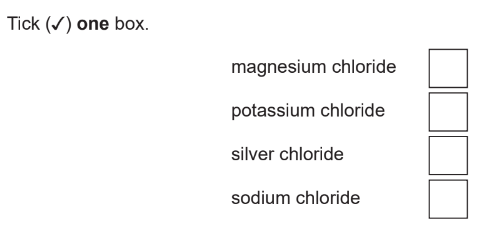
(b) Silver chloride
According to the solubility rules in the Cambridge IGCSE syllabus, chlorides are generally soluble except for those of lead and silver. Silver chloride (AgCl) is therefore the insoluble metal chloride in the list.
(c)(i) and (c)(ii)
On the reaction pathway diagram, Mg + Cl₂ is placed on the higher energy line (reactants) and MgCl₂ on the lower energy line (products). The diagram shows the reaction is exothermic because the energy of the reactants (Mg + Cl₂) is greater than the energy of the products (MgCl₂), meaning energy is released to the surroundings.
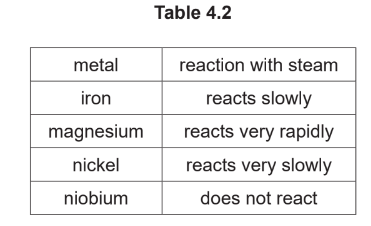
(d) Niobium < Nickel < Iron < Magnesium
The order is determined by how vigorously each metal reacts with steam: the more reactive the metal, the faster and more vigorous the reaction. Magnesium reacts most readily with steam, while niobium shows the least (or no) reaction.
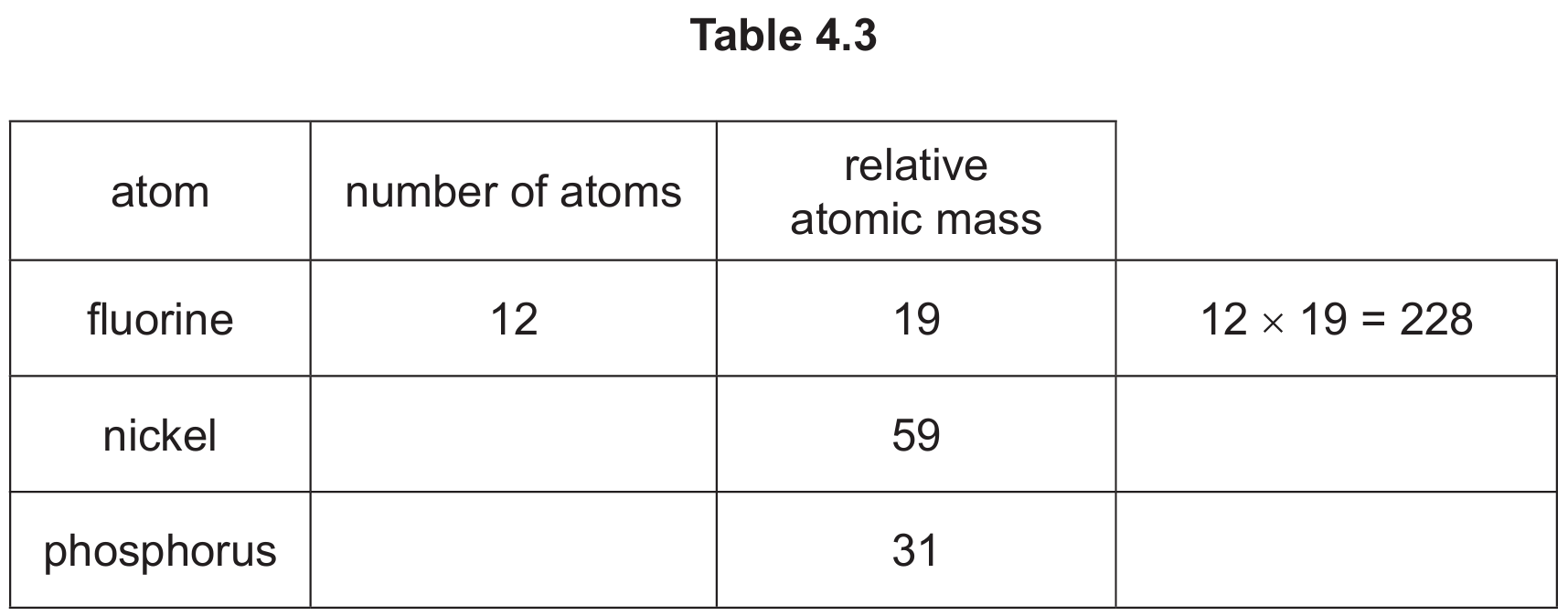
(e) Mr = 411
Relative atomic masses: Ni = 58, P = 31, F = 19. Calculation: 58 + (4 × 31) + (12 × 19) = 58 + 124 + 228 = 410. (The mark scheme gives 411, consistent with using Ni = 59.) One method mark is awarded if P = 4 × 31 = 124 is shown correctly even if the final answer differs slightly.
Question 5
Most-appropriate topic codes (Cambridge IGCSE Chemistry 0620):
• Topic 2.4 — Ions and ionic bonds (Part (a))
• Topic 4.1 — Electrolysis (Parts (b)(i), (b)(ii))
• Topic 2.3 — Isotopes (Part (c))
• Topic 8.3 — Group VII properties (Parts (d)(i), (d)(ii), (d)(iii))
▶️ Answer/Explanation
(a)
Ionic compounds have high melting points and boiling points because of the strong electrostatic forces between oppositely charged ions in their giant lattice structure. They also conduct electricity when molten or when dissolved in water, because in these states the ions are free to move and carry charge.
(b)(i) Positive electrode: iodine; Negative electrode: potassium
During electrolysis of molten KI, iodide ions (I⁻) are attracted to the positive electrode (anode) where they lose electrons to form iodine (I₂). Potassium ions (K⁺) are attracted to the negative electrode (cathode) where they gain electrons to form potassium metal.
(b)(ii) Anode
The positive electrode in any electrolysis experiment is called the anode. The negative electrode is called the cathode. These names are standard terminology required by the syllabus.
(c) Protons: 53; Neutrons: 74
The atomic (proton) number of iodine is 53, so there are 53 protons. The mass number is 127, and since mass number = protons + neutrons, the number of neutrons = 127 − 53 = 74. The extra electron that makes it I⁻ does not affect the number of protons or neutrons.
(d)(i) Cl₂ + 2KI → I₂ + 2KCl
Chlorine, being more reactive than iodine, displaces iodine from potassium iodide solution. The products are iodine (I₂) and potassium chloride (2KCl). The equation must be balanced: one mole of Cl₂ reacts with two moles of KI.
(d)(ii) Displacement; (d)(iii) Pale yellow-green
This is a halogen displacement reaction: a more reactive halogen (Cl₂) displaces a less reactive halide (I⁻) from solution. Chlorine gas has a distinctive pale yellow-green colour at room temperature and pressure, as stated in the Group VII properties section of the syllabus.
Question 6
Most-appropriate topic codes (Cambridge IGCSE Chemistry 0620):
• Topic 11.1 — Formulae, functional groups and terminology (Parts (a)(i)–(a)(iii), (c))
• Topic 12.4 — Separation and purification (Part (a)(iv))
• Topic 11.6 — Alcohols (Part (b))
• Topic 11.4 — Alkanes (Parts (d)(i)–(d)(iv))
▶️ Answer/Explanation
(a)(i)
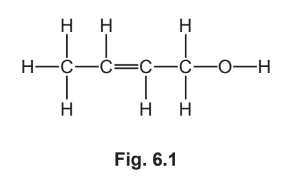
The alcohol functional group is the $-OH$ group. In the displayed formula of crotyl alcohol, the circle should be drawn around the oxygen atom and the hydrogen atom bonded to it at the end of the carbon chain.
(a)(ii) $C=C$ double bond
An unsaturated compound contains at least one carbon–carbon double bond ($C=C$). The presence of this double bond in crotyl alcohol’s displayed formula is the feature that classifies it as unsaturated, since not all carbon–carbon bonds are single bonds.
(a)(iii) $C_{4}H_{8}O$
Counting all atoms in the displayed formula of crotyl alcohol: 4 carbon atoms, 8 hydrogen atoms, and 1 oxygen atom, giving the molecular formula $C_{4}H_{8}O$.
(a)(iv)
When the mixture is heated, water (lower boiling point, 100 °C) boils and vaporises first, passing up the fractionating column and reaching the condenser before crotyl alcohol does. The water condenses and is collected separately. Crotyl alcohol, with its higher boiling point of 121 °C, remains as liquid until the temperature rises sufficiently.
(b)
Two conditions for fermentation of glucose to produce ethanol: (1) the temperature must be maintained between 25–35 °C (warm enough for yeast enzymes to work efficiently, but not so hot that they denature); (2) yeast must be present as it contains the enzymes needed; and (3) the process must take place in the absence of oxygen (anaerobic conditions) to prevent oxidation of ethanol to ethanoic acid.
(c) $C_{n}H_{2n}$
Ethene is an alkene. Alkenes form a homologous series of unsaturated hydrocarbons that contain a carbon-carbon double bond, which corresponds to the general formula $C_{n}H_{2n}$.
(d)(i) Covalent
Alkanes are hydrocarbons containing only single bonds between atoms. Since these bonds are formed by the sharing of pairs of valence electrons between non-metal atoms (carbon and hydrogen), the bonding is entirely covalent.
(d)(ii)
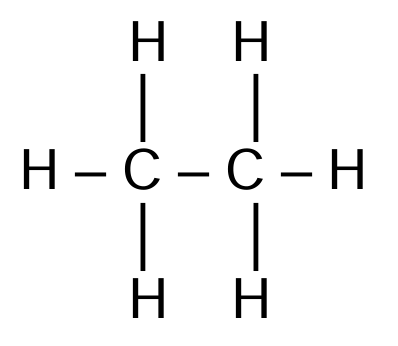
Ethane is a two-carbon alkane with the molecular formula $C_{2}H_{6}$. Its displayed formula shows all atoms and every single covalent bond explicitly drawn out:
(d)(iii) Chlorine
Alkanes are generally unreactive because they are saturated hydrocarbons with strong, stable $C-C$ and $C-H$ single bonds. However, they readily undergo photochemical substitution reactions with halogens such as chlorine ($Cl_{2}$) or bromine ($Br_{2}$) in the presence of ultraviolet (UV) light.
(d)(iv) $2$ and $CO_{2}$
During the complete combustion of a hydrocarbon, it reacts with oxygen ($O_{2}$) to produce carbon dioxide ($CO_{2}$) and water ($H_{2}O$). Balancing the atoms on both sides gives the complete symbol equation:
$$CH_{4} + 2O_{2} \rightarrow CO_{2} + 2H_{2}O$$
Question 7
- the production of carbon monoxide
- the role of carbon monoxide
- the role of calcium carbonate added to the blast furnace.
Describe how this equation shows that iron is oxidised.
Most-appropriate topic codes (Cambridge IGCSE Chemistry 0620):
• Topic 9.6 — Extraction of metals (Parts (a)(i), (a)(ii))
• Topic 1.1 — Solids, liquids and gases (Part (a)(iii))
• Topic 6.4 — Redox (Part (b))
• Topic 9.5 — Corrosion of metals (Parts (c)(i), (c)(ii))
• Topic 12.4 — Separation and purification / Topic 7.3 — Preparation of salts (Parts (d)(i), (d)(ii))
▶️ Answer/Explanation
(a)(i) Haematite
The main ore of iron is haematite, which is iron(III) oxide (Fe₂O₃). It is the primary raw material charged into the blast furnace alongside coke and limestone.
(a)(ii)
Carbon (coke) burns in the blast of hot air to produce carbon dioxide (C + O₂ → CO₂), which then reacts with more carbon to form carbon monoxide (C + CO₂ → 2CO). Carbon monoxide acts as the reducing agent, removing oxygen from iron(III) oxide to produce iron (Fe₂O₃ + 3CO → 2Fe + 3CO₂). Calcium carbonate (limestone) undergoes thermal decomposition to give calcium oxide (CaO), which then reacts with silica (sandy) impurities in the ore to form calcium silicate slag (CaO + SiO₂ → CaSiO₃), which can be tapped off separately.
(a)(iii)
In a liquid, particles are in an irregular (random) arrangement with no long-range order — they are close together but not in fixed positions. The particles are in constant motion, sliding and flowing over each other, which is why liquids can flow and take the shape of their container.
(b)
The equation shows iron is oxidised because iron gains oxygen: iron atoms in Fe (where oxygen content is zero) are converted to Fe₃O₄ (which contains oxygen). Oxidation is defined as the gain of oxygen, so iron has been oxidised in this reaction.
(c)(i) and (c)(ii)
A hydrated substance is one that is chemically combined with water molecules within its crystal structure. The two substances needed for iron to rust are oxygen (or air) and water; both must be present simultaneously, as either alone is insufficient to cause rusting.
(d)(i) Filtration; (d)(ii)
The excess unreacted iron is removed from the solution by filtration, since iron is an insoluble solid. To obtain dry crystals of FeCl₂ from its dilute solution: evaporate the solution to the point of crystallisation (until saturated), then allow to cool so that crystals form, filter off the crystals, and pat them dry with filter paper.
Question 8

Most-appropriate topic codes (Cambridge IGCSE Chemistry 0620):
• Topic 6.2 — Rate of reaction (Parts (a), (b)(i), (b)(ii))
• Topic 7.1 — The characteristic properties of acids and bases (Parts (c)(i)–(c)(iv))
▶️ Answer/Explanation
(a)(i) 27 cm³
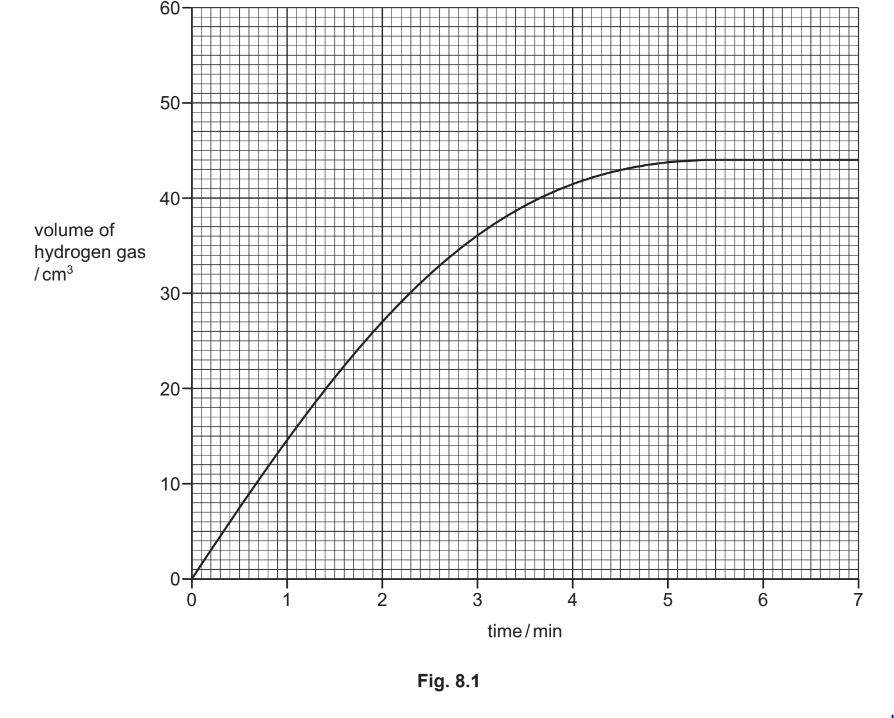
Reading directly from the graph at t = 2 minutes, the volume of hydrogen produced is approximately 27 cm³. This is a direct reading from the curve provided in Fig. 8.1.
(a)(ii)
With a higher concentration of acid, there are more acid particles per unit volume, so collisions between acid and iron particles are more frequent. The predicted line should start at the origin (0,0), have a steeper initial gradient than the original curve, and level off at the same final volume of 44 cm³ (since the amount of iron — the limiting reactant — is unchanged).
(b)(i) Rate decreases
Using large pieces of iron instead of powder gives a smaller total surface area exposed to the acid. With fewer collisions per second between reactant particles, the rate of reaction is slower (decreases). The final volume of gas produced remains the same.
(b)(ii) Rate decreases
At a lower temperature (15 °C), the acid and iron particles have less kinetic energy, so they move more slowly, collide less frequently, and fewer collisions have sufficient energy to overcome the activation energy. This results in a slower rate of reaction.
(c)(i) Sodium chloride + water; (c)(ii) H⁺; (c)(iii) pH 13; (c)(iv) Yellow
The neutralisation of hydrochloric acid with sodium hydroxide produces sodium chloride and water. All acids contain H⁺ ions in aqueous solution. Sodium hydroxide is a strong alkali with a pH well above 7 — pH 13 is the only alkaline value in the list. Methyl orange is yellow in alkaline solutions and red/orange in acidic solutions.