Question 1
Which statement about a solid, a liquid or a gas is correct?
A. A solid has a fixed shape and can be compressed.
B. A liquid takes the shape of the container it is in and can be compressed.
C. A solid has no fixed shape and cannot be compressed.
D. A gas takes the shape of the container it is in and can be compressed.
Most-appropriate topic codes (Cambridge IGCSE Chemistry 0620):
▶️ Answer/Explanation
✅ Answer: D
Question 2
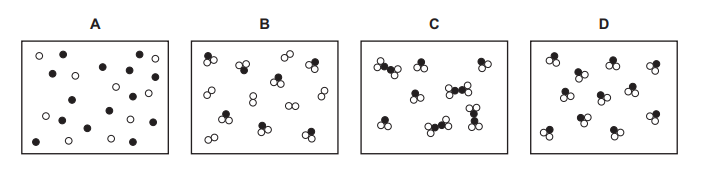
Which diagram represents a mixture of compounds?

Most-appropriate topic codes (Cambridge IGCSE Chemistry 0620):
▶️ Answer/Explanation
✅ Answer: (C)
Question 3
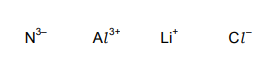
Four ions are listed.

Which pair of ions have the same electronic configuration?
A \(N^{3-}\) and \(Li^+\)
B \(Al^{3+}\) and \(N^{3-}\)
C \(Cl^-\) and \(Al^{3+}\)
D \(Li^+\) and \(Cl^-\)
Most-appropriate topic codes (Cambridge IGCSE Chemistry 0620):
• Topic 2.4: Ions and ionic bonds — Describe the formation of positive ions (cations) and negative ions (anions).
▶️ Answer/Explanation
✅ Answer: B
Question 4
Which statement about isotopes is correct?
A. Atoms with different numbers of electrons are isotopes of each other.
B. Atoms with the same mass numbers are isotopes of each other.
C. Isotopes of the same element have different numbers of neutrons.
D. Isotopes of the same element have different numbers of protons.
Most-appropriate topic codes (Cambridge IGCSE Chemistry 0620):
▶️ Answer/Explanation
✅ Answer: (C)
Question 5
Which statement about the ions formed by the elements in Group VII of the Periodic Table is correct?
A. All the ions have the same charge of 1–.
B. All the ions have the same number of electron shells.
C. Each ion is formed by losing one electron.
D. Each ion has seven electrons in its outer electron shell.
Most-appropriate topic codes (Cambridge IGCSE Chemistry 0620):
• Topic 8.1: Arrangement of elements — Describe the relationship between group number and the charge of the ions formed from elements in that group (Core)
• Topic 8.3: Group VII properties — Describe the Group VII halogens, chlorine, bromine and iodine, as diatomic non-metals (Core)
▶️ Answer/Explanation
✅ Answer: (A)
Question 6
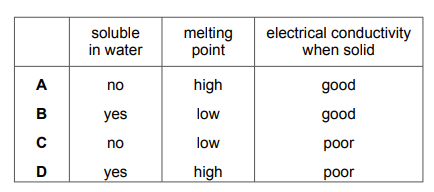
Which row describes the properties of potassium bromide?

Most-appropriate topic codes (Cambridge IGCSE Chemistry 0620):
▶️ Answer/Explanation
✅ Answer: (D)
Question 7
Which statement explains why graphite is used as a lubricant?
A. Each carbon atom in graphite forms three bonds.
B. The bonding in graphite is covalent.
C. The carbon atoms are arranged in hexagons.
D. There are weak forces of attraction between the layers of carbon atoms
Most-appropriate topic codes (Cambridge IGCSE Chemistry 0620):
▶️ Answer/Explanation
✅ Answer: (D)
Question 8
What is the balanced equation for the reaction between magnesium and dilute sulfuric acid?
A. Mg + H2SO4 → MgSO4 + H2
B. Mg + 2H2SO4 → Mg(SO4)2 + 2H2
C. 2Mg + H2SO4 → Mg2SO4 + H2
D. 2Mg + 3H2SO4 → Mg2(SO4)3 + 3H2
Most-appropriate topic codes (Cambridge IGCSE Chemistry 0620):
• Topic 9.4: Reactivity series — Describe the reactions of metals with dilute hydrochloric acid (Core)
▶️ Answer/Explanation
✅ Answer: (A)
Question 9
The relative atomic mass, Ar, of an element is the average mass of the isotopes of that element compared to another particle. Which particle is used for this comparison?
A. a proton
B. an atom of 12C
C. an atom of 40Ca
D. an atom of 1H
Most-appropriate topic codes (Cambridge IGCSE Chemistry 0620):
▶️ Answer/Explanation
✅ Answer: (B)
Question 10
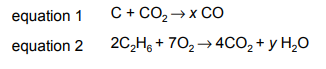
The equations for two reactions are shown.

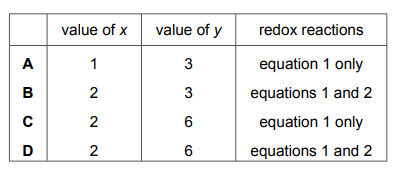
Which row shows the value of x, the value of y and the equations that are for redox reactions?

Most-appropriate topic codes (Cambridge IGCSE Chemistry 0620):
▶️ Answer/Explanation
✅ Answer: (D)
Question 11
Concentrated aqueous sodium chloride is electrolysed using graphite electrodes. What is the product formed at the cathode?
A. chlorine
B. hydrogen
C. oxygen
D. sodium
Most-appropriate topic codes (Cambridge IGCSE Chemistry 0620):
▶️ Answer/Explanation
✅ Answer: (B)
Question 12
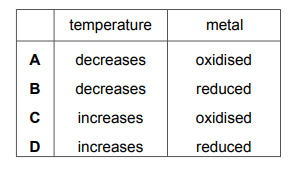
Which row describes the changes that occur when metals burn in oxygen?

Most-appropriate topic codes (Cambridge IGCSE Chemistry 0620):
▶️ Answer/Explanation
✅ Answer: (C)
Question 13
When calcium carbonate is heated strongly, carbon dioxide gas is produced. Which words describe the type of change that occurs?
A. endothermic and chemical
B. endothermic and physical
C. exothermic and chemical
D. exothermic and physical
Most-appropriate topic codes (Cambridge IGCSE Chemistry 0620):
• Topic 7.3 (Core): Describe the preparation, separation and purification of soluble salts by reaction of an acid with an excess insoluble carbonate.
• Topic 6.1 (Core): Identify physical and chemical changes, and describe the differences between them (a new substance, carbon dioxide, is formed).
▶️ Answer/Explanation
✅ Answer: (A)
Question 14
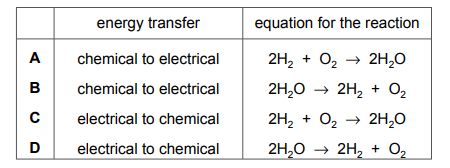
Which row about a hydrogen–oxygen fuel cell is correct?

Most-appropriate topic codes (Cambridge IGCSE Chemistry 0620):
▶️ Answer/Explanation
✅ Answer: A
Question 15
Which list contains only chemical changes?
A melting, evaporating, dissolving
B rusting, freezing, cracking
C neutralisation, polymerisation, combustion
D boiling, condensing, distillation
Most-appropriate topic codes (Cambridge IGCSE Chemistry 0620):
▶️ Answer/Explanation
✅ Answer: C
Question 16
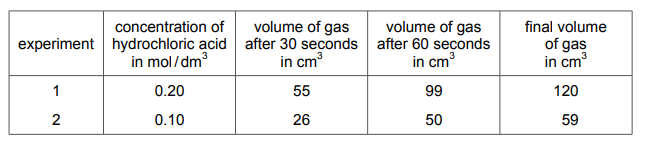
Excess calcium carbonate is added to \(50 cm^3\) of dilute hydrochloric acid of different concentrations in two separate experiments. The volume of gas produced in experiment 1 and in experiment 2 is measured every 30 seconds. The results are shown.

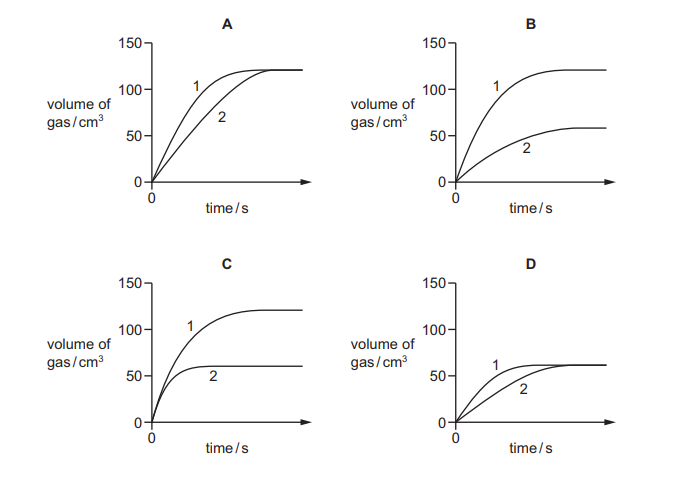
Which diagram represents the data collected? 
Most-appropriate topic codes (Cambridge IGCSE Chemistry 0620):
▶️ Answer/Explanation
Detailed Solution: Increasing the concentration of hydrochloric acid increases the number of acid particles per unit volume, leading to more frequent successful collisions with calcium carbonate and a faster initial rate of reaction (steeper slope). Both experiments use excess calcium carbonate and the same volume of acid, so the total volume of carbon dioxide gas produced will be the same at completion (equal plateau) because the amount of acid (limiting reagent) is the same. Graph B correctly shows a steeper initial gradient for experiment 2 (higher concentration) with both curves leveling off at the same final gas volume.
✅ Answer: (B)Question 17
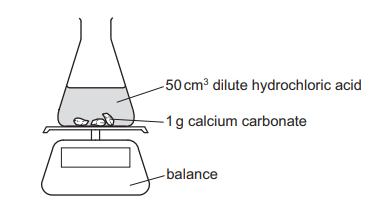
An experiment is set up as shown. The mass of the conical flask and its contents is measured at 30-second intervals.

Which statement about the reaction and changes to the reaction conditions is correct?
A. Adding \(10 cm^3\) of water to the \(50 cm^3\) of acid increases the rate of the reaction.
B. Increasing the size of the pieces of calcium carbonate increases the rate of the reaction.
C. Increasing the temperature increases the rate of the reaction.
D. The mass of the conical flask and its contents increases as carbon dioxide is formed.
Most-appropriate topic codes (Cambridge IGCSE Chemistry 0620):
▶️ Answer/Explanation
✅ Answer: (C)
Question 18
Which reaction is reversible?
A. reaction of aqueous sodium hydroxide with dilute hydrochloric acid
B. formation of anhydrous copper(II) sulfate from hydrated copper(II) sulfate
C. oxidation of methane to form carbon dioxide and water
D. combustion of sulfur to form sulfur dioxide
Most-appropriate topic codes (Cambridge IGCSE Chemistry 0620):
▶️ Answer/Explanation
✅ Answer: (B)
Question 19
Silver oxide reacts with magnesium to make silver and magnesium oxide.
![]()
Which substance is oxidised in this reaction?
A magnesium
B magnesium oxide
C silver
D silver oxide
Most-appropriate topic codes (Cambridge IGCSE Chemistry 0620):
▶️ Answer/Explanation
✅ Answer: (A) magnesium
Question 20
Compound X dissolves in water to form an aqueous solution. Methyl orange is added to aqueous compound X. The methyl orange turns red. What is compound X?
A. sodium carbonate
B. copper(II) oxide
C. potassium oxide
D. sulfur dioxide
Most-appropriate topic codes (Cambridge IGCSE Chemistry 0620):
▶️ Answer/Explanation
✅ Answer: (D)
Question 21
Dilute hydrochloric acid reacts with aqueous sodium hydroxide in a neutralisation reaction. Which two ions are involved in this neutralisation reaction?
![]()
Most-appropriate topic codes (Cambridge IGCSE Chemistry 0620):
▶️ Answer/Explanation
✅ Answer: (B)
Question 22
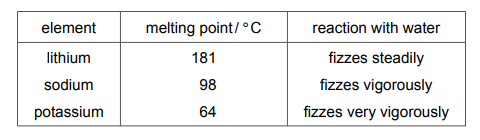
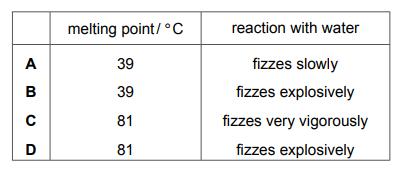
The table shows some properties of some of the elements in Group I of the Periodic Table.

Rubidium is also an element in Group I of the Periodic Table. Which row describes the properties of rubidium?

Most-appropriate topic codes (Cambridge IGCSE Chemistry 0620):
▶️ Answer/Explanation
✅ Answer: (B)
Question 23
Copper(II) sulfate crystals are blue. They are made by adding an excess of copper(II) oxide to sulfuric acid. The mixture is heated and stirred. The mixture is then filtered and the filtrate is allowed to evaporate, leaving blue crystals.
Why is filtration necessary?
A. to remove soluble impurities
B. to remove sulfuric acid
C. to remove the blue crystals
D. to remove unreacted copper(II) oxide
Most-appropriate topic codes (Cambridge IGCSE Chemistry 0620):
▶️ Answer/Explanation
✅ Answer: D
Question 24
Which barium salts are soluble in water?
1 barium carbonate
2 barium chloride
3 barium nitrate
4 barium sulfate
A 1 and 2
B 1 and 4
C 2 and 3
D 3 and 4
Most-appropriate topic codes (Cambridge IGCSE Chemistry 0620):
▶️ Answer/Explanation
✅ Answer: (C) 2 and 3
Question 25
Which statement about the properties of elements in Group I or in Group VII is correct?
A. Bromine displaces iodine from an aqueous solution of potassium iodide.
B. Chlorine, bromine and iodine are diatomic gases at room temperature.
C. Lithium, sodium and potassium are soft non-metals.
D. Lithium, sodium and potassium have an increasing number of electrons in their outer shells.
Most-appropriate topic codes (Cambridge IGCSE Chemistry 0620):
• Topic 8.3: Group VII properties — Describe and explain the displacement reactions of halogens with other halide ions.
▶️ Answer/Explanation
✅ Answer: (A)
Question 26
Rubidium and strontium are both in Period 5 of the Periodic Table. Rubidium is in Group I. Strontium is in Group II. Which statement about these elements is correct?
A. Each element has five electrons in its outer electron shell.
B. The atomic number of rubidium is greater than the atomic number of strontium.
C. Rubidium forms the \(Rb^+\) ion; strontium forms the \(Sr^{2+}\) ion.
D. Electrolysis of molten rubidium chloride and of molten strontium chloride produces hydrogen.
Most-appropriate topic codes (Cambridge IGCSE Chemistry 0620):
• Topic 2.4: Ions and ionic bonds — Describe the formation of positive ions, known as cations (Core)
• Topic 4.1: Electrolysis — Define electrolysis; Identify products formed at electrodes during electrolysis of molten compounds (Core)
• Topic 8.1: Arrangement of elements — Describe the relationship between group number and the charge of the ions formed from elements in that group (Core)
▶️ Answer/Explanation
✅ Answer: (C)
Question 27
A company needs a metal with a low density which resists corrosion and is a good electrical conductor. Which metal should it use?
A. aluminium
B. iron
C. magnesium
D. sodium
Most-appropriate topic codes (Cambridge IGCSE Chemistry 0620):
▶️ Answer/Explanation
✅ Answer: A
Question 28
Which statement about stainless steel is correct?
A All atoms in stainless steel are the same size.
B Stainless steel is a mixture of copper and zinc.
C Stainless steel is an iron compound.
D Stainless steel is stronger than pure iron.
Most-appropriate topic codes (Cambridge IGCSE Chemistry 0620):
▶️ Answer/Explanation
✅ Answer: (D)
Question 29
Which statements explain why a water tap made of steel is electroplated with copper?
1 It improves the conductivity of the tap.
2 It improves the tap’s resistance to corrosion.
3 It increases the density of the tap.
A 1 and 2
B 1 and 3
C 2 only
D 3 only
Most-appropriate topic codes (Cambridge IGCSE Chemistry 0620):
▶️ Answer/Explanation
✅ Answer: (C) 2 only
Question 30
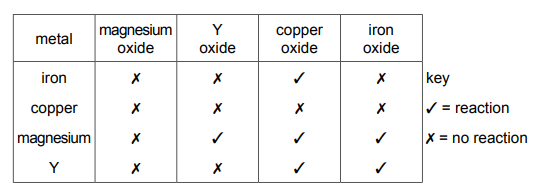
The table shows the results of separately heating four metals with oxides of different metals. The four metals are iron, copper, magnesium and Y. The results are shown.

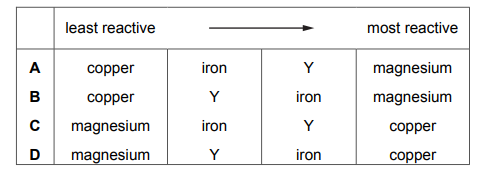
What is the order of reactivity of the metals, least reactive first?

Most-appropriate topic codes (Cambridge IGCSE Chemistry 0620):
▶️ Answer/Explanation
✅ Answer: (A)
Question 31
Which metal is most easily obtained from its ore?
A. aluminium
B. copper
C. calcium
D. iron
Most-appropriate topic codes (Cambridge IGCSE Chemistry 0620):
▶️ Answer/Explanation
✅ Answer: (B)
Question 32
Why is distilled water used in chemical experiments rather than tap water?
A. Distilled water contains fewer chemical impurities.
B. Distilled water has a better colour.
C. Distilled water has a higher boiling point.
D. Distilled water is a better solvent.
Most-appropriate topic codes (Cambridge IGCSE Chemistry 0620):
▶️ Answer/Explanation
✅ Answer: A
Question 33
Which type of compound is also the name of a homologous series?
A. carbonate
B. carboxylic acid
C. halide
D. hydroxide
Most-appropriate topic codes (Cambridge IGCSE Chemistry 0620):
▶️ Answer/Explanation
A homologous series is a family of organic compounds with the same functional group and similar chemical properties. Carboxylic acids (with the functional group -COOH) form a specific homologous series. In contrast, carbonates, halides, and hydroxides are classes of compounds (often ionic) but are not homologous series names.
✅ Answer: (B) carboxylic acid
Question 34
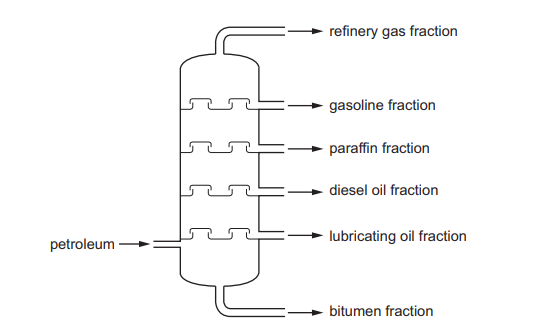
The fractional distillation of petroleum is shown.

Which fraction is the least volatile?
A bitumen
B diesel oil
C gasoline
D refinery gas
Most-appropriate topic codes (Cambridge IGCSE Chemistry 0620):
▶️ Answer/Explanation
✅ Answer: (A) bitumen
Question 35
Which formula represents an unsaturated hydrocarbon?
A \(C_3H_6\)
B \(C_3H_8\)
C \(C_4H_{10}\)
D \(C_5H_{12}\)
Most-appropriate topic codes (Cambridge IGCSE Chemistry 0620):
• Topic 11.5: Alkenes — State that the bonding in alkenes includes a double carbon-carbon covalent bond and that alkenes are unsaturated hydrocarbons.
▶️ Answer/Explanation
✅ Answer: (A) \(C_3H_6\)
Question 36
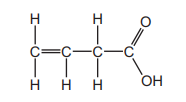
The structure of an organic compound is shown.

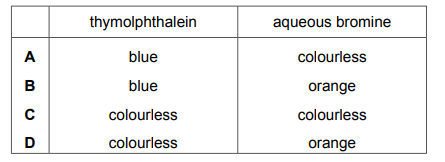
The compound is tested separately with thymolphthalein and with aqueous bromine. Which row describes the final colour observed for each test?

Most-appropriate topic codes (Cambridge IGCSE Chemistry 0620):
• Topic 11.5: Alkenes — Describe the test to distinguish between saturated and unsaturated hydrocarbons by their reaction with aqueous bromine (Core)
▶️ Answer/Explanation
✅ Answer: (C)
Question 37
Which statement describes methane?
A It is an alcohol.
B It is an unsaturated molecule.
C It contains carbon, hydrogen and oxygen atoms only.
D Its molecules contain four single covalent bonds.
Most-appropriate topic codes (Cambridge IGCSE Chemistry 0620):
▶️ Answer/Explanation
✅ Answer: D
Question 38
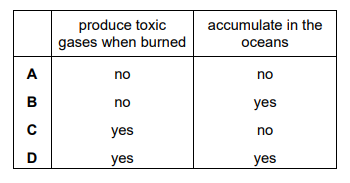
Which row explains why plastics such as poly(ethene) cause pollution?

Most-appropriate topic codes (Cambridge IGCSE Chemistry 0620):
▶️ Answer/Explanation
✅ Answer: D
Question 39
Two experiments are described.
experiment 1: A large mass of copper(II) sulfate is stirred into a beaker of water. After a few minutes, undissolved crystals are visible on the bottom of the beaker.
experiment 2: Sea water is distilled. Distilled water and solid impure salt are separated into two containers.
Which statement is correct?
A. In experiment 1, the undissolved crystals are the filtrate.
B. In experiment 1, the water is the solute.
C. In experiment 2, sea water boils at 100 °C.
D. In experiment 2, the impure salt is a residue.
Most-appropriate topic codes (Cambridge IGCSE Chemistry 0620):
• Topic 12.4: Separation and purification — Describe and explain methods of separation using simple distillation (Core).
▶️ Answer/Explanation
✅ Answer: D
Question 40
An aqueous sample of X is heated with aqueous sodium hydroxide and small pieces of aluminium. A gas is produced which turns damp red litmus paper blue. Aqueous sodium hydroxide is added to a second aqueous sample of X. A pale green precipitate is observed. What is X?
A. ammonium nitrate
B. chromium(II) chloride
C. iron(II) nitrate
D. iron(II) sulfate
Most-appropriate topic codes (Cambridge IGCSE Chemistry 0620):
• Topic 7.1: The characteristic properties of acids and bases — Reaction of ammonium salts with alkalis to produce ammonia.
▶️ Answer/Explanation
✅ Answer: (C) iron(II) nitrate