Home / 0620_m24_qp_22-hina

Question 1

Solid X is heated for 600 seconds. The graph shows the heating curve that is obtained.

Heating curve graph showing temperature vs time

What is the melting point of X?

A 20°C

B 170°C

C 240°C

D 270°C

Most-appropriate topic codes (Cambridge IGCSE Chemistry 0620):

Topic 1.1: Solids, liquids and gases — Describe changes of state in terms of melting, boiling, evaporating, freezing and condensing (Core); Explain changes of state in terms of kinetic particle theory, including the interpretation of heating and cooling curves (Supplement)
▶️ Answer/Explanation
On a heating curve, the temperature remains constant during a phase change. The flat, horizontal section of the graph represents melting (solid to liquid). This plateau starts at 170°C and ends at 240°C, indicating the substance absorbs heat to overcome intermolecular forces without rising in temperature. Therefore, the melting point of X is 170°C.
Answer: B (170°C)

Question 2

Which statements about diffusion are correct?
1 Aqueous ions cannot diffuse in water.
2 Diffusion is caused by the random movement of particles.
3 Particles spread out in all directions in diffusion.
4 Diffusion can only take place in solids and liquids.

A 1 and 2

B 1 and 4

C 2 and 3

D 3 and 4

Most-appropriate topic codes (Cambridge IGCSE Chemistry 0620):

Topic 1.2: Diffusion — Describe and explain diffusion in terms of kinetic particle theory (Core); Describe and explain the effect of relative molecular mass on the rate of diffusion of gases (Supplement)
▶️ Answer/Explanation
Statement 1 is false because aqueous ions (e.g., in solution) do diffuse in water, driven by random particle movement. Statement 4 is false because diffusion occurs in gases, liquids, and even solids (though very slowly in solids). Statement 2 is true: random motion of particles causes net movement from high to low concentration. Statement 3 is true: particles spread in all directions during diffusion until evenly distributed.
Answer: (C)

Question 3

Which statement about an atom of fluorine, \( _{9}^{19}\textrm{F} \), is correct?

A. It contains a total of 28 protons, neutrons and electrons.
B. It contains more protons than neutrons.
C. Its isotopes contain different numbers of protons.
D. Its nucleus contains 9 neutrons.

Most-appropriate topic codes (Cambridge IGCSE Chemistry 0620):

Topic 2.2: Atomic structure and the Periodic Table — State the relative charges and relative masses of subatomic particles; define proton number and mass number (Core).
Topic 2.3: Isotopes — Define isotopes as different atoms of the same element that have the same number of protons but different numbers of neutrons (Core).
▶️ Answer/Explanation
For fluorine-19, the proton number (atomic number) is 9, meaning 9 protons and 9 electrons. The mass number is 19, so neutrons = 19 – 9 = 10. Total protons, neutrons and electrons = 9 + 10 + 9 = 28. Option A is correct. Option B is false because neutrons (10) > protons (9). Isotopes have the same number of protons (option C is false). The nucleus contains 10 neutrons, not 9 (option D false).
Answer: (A)

Question 4

Two of the isotopes of calcium are represented as \( _{20}^{40}\textrm{Ca}\) and \( _{20}^{44}\textrm{Ca}\). Which statement explains why these isotopes of calcium have identical chemical properties?
A Both isotopes have the same number of neutrons.
B Both isotopes have an electronic configuration of 2,8,8,2.
C Both isotopes have a mass number of 20.
D Both isotopes have four fully occupied electron shells.

Most-appropriate topic codes (Cambridge IGCSE Chemistry 0620):

Topic 2.3: Isotopes — State that isotopes of the same element have the same chemical properties because they have the same number of electrons and therefore the same electronic configuration (Supplement)
Topic 2.2: Atomic structure and the Periodic Table — Determine the electronic configuration of elements and their ions with proton number 1 to 20 (Core)
▶️ Answer/Explanation
Isotopes have the same proton number (and hence same electron number and electronic configuration) but different neutron numbers. Chemical properties depend on electron arrangement, not mass number. Calcium (proton number 20) has the electronic configuration 2,8,8,2. Both isotopes share this same configuration, so they react identically.
Answer: (B)

Question 5

Which statement describes a property of potassium iodide?

A. It is insoluble in water.
B. It is a volatile substance.
C. It has a low melting point.
D. It conducts electricity when molten.

Most-appropriate topic codes (Cambridge IGCSE Chemistry 0620):

Topic 2.4: Ions and ionic bonds — Describe the properties of ionic compounds: high melting points and boiling points; good electrical conductivity when aqueous or molten and poor when solid (Core)
Topic 4.1: Electrolysis — Define electrolysis as the decomposition of an ionic compound, when molten or in aqueous solution, by the passage of an electric current (Core)
▶️ Answer/Explanation
Potassium iodide is an ionic compound. Ionic compounds have a giant lattice structure where ions are held by strong electrostatic forces, giving them high melting points (not low), and they are generally soluble in water (not insoluble). They do not conduct electricity when solid, but when molten, the ions are free to move and carry charge. Volatility is a property of molecular substances, not ionic compounds like KI.
Answer: (D)

Question 6

Methanal, \(CH_2O\), has a boiling point of –19 °C. At –20 °C, the liquid methanal is a non-conductor of electricity. In a sample of methanal, each atom of carbon, hydrogen and oxygen has noble gas electronic configuration. Each atom has achieved this electronic configuration in one of three ways:
• gaining electrons
• losing electrons
• sharing electrons.
Which statement describes the bonding between the carbon atom and the oxygen atom in methanal?
A. The carbon atom and the oxygen atom share four electrons.
B. The carbon atom and the oxygen atom share two electrons.
C. Carbon is a negative ion and oxygen is a positive ion. These two ions attract each other.
D. Carbon is a positive ion and oxygen is a negative ion. These two ions attract each other.

Most-appropriate topic codes (Cambridge IGCSE Chemistry 0620):

Topic 2.5: Simple molecules and covalent bonds — Describe the formation of covalent bonds in simple molecules, including H₂, Cl₂, H₂O, CH₄, NH₃ and HCl. Use dot-and-cross diagrams (Core); Describe the formation of covalent bonds in simple molecules, including CH₃OH, C₂H₄, O₂, CO₂ and N₂ (Supplement)
Topic 2.2: Atomic structure and the Periodic Table — Determine the electronic configuration of elements and their ions with proton number 1 to 20 (Core)
▶️ Answer/Explanation
Methanal (formaldehyde) is a covalent molecule; it does not conduct electricity as a liquid, which rules out ionic bonding (options C and D). The carbon atom forms a double covalent bond with the oxygen atom (one sigma bond and one pi bond). A double bond involves sharing four electrons (two pairs). The remaining two bonds from carbon are to hydrogen atoms (single bonds). Therefore, option A is correct and B is incorrect because two shared electrons would indicate a single bond, not the actual carbon–oxygen double bond present in methanal.
Answer: (A)

Question 7

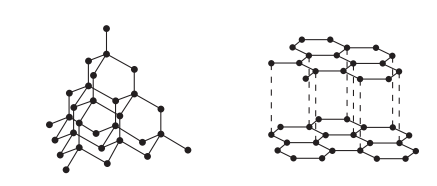
The structures of diamond and graphite are shown.

Structures of diamond and graphite

Which statement about diamond and graphite is correct?
A. Diamond and graphite contain strong covalent bonds between carbon atoms.
B. Diamond and graphite have delocalised electrons.
C. Diamond and graphite have layered structures.
D. Diamond and graphite have low melting points.

Most-appropriate topic codes (Cambridge IGCSE Chemistry 0620):

Topic 2.6: Giant covalent structures — Describe the giant covalent structures of graphite and diamond (Core); Relate the structures and bonding of graphite and diamond to their uses (Core)
▶️ Answer/Explanation
Both diamond and graphite are allotropes of carbon with giant covalent structures, meaning each carbon atom is joined to others by strong covalent bonds. Diamond has a rigid 3D network, while graphite has layered hexagons but still strong covalent bonds within layers. Delocalised electrons exist only in graphite (not diamond), layered structure applies only to graphite, and both have very high melting points due to strong covalent bonds.
Answer: A

Question 8

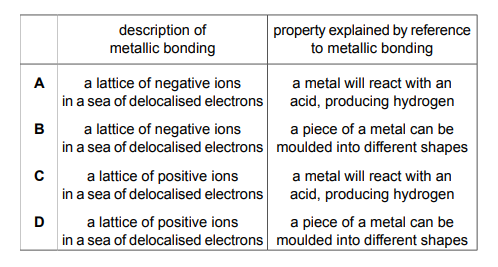
Which row contains a description of metallic bonding and a property that is explained by reference to metallic bonding?

Table showing descriptions of metallic bonding and properties.

Most-appropriate topic codes (Cambridge IGCSE Chemistry 0620):

Topic 2.7: Metallic bonding — Describe metallic bonding as the electrostatic attraction between the positive ions in a giant metallic lattice and a ‘sea’ of delocalised electrons (Supplement); Explain in terms of structure and bonding the properties of metals: good electrical conductivity, malleability and ductility (Supplement)
▶️ Answer/Explanation
Detailed Solution: Metallic bonding is correctly defined as the electrostatic attraction between positive metal ions and a sea of delocalised electrons. This structure allows electrons to move freely, which explains high electrical conductivity. Malleability is explained by the ability of metal layers to slide over each other without breaking the metallic bond. Reviewing the rows, only Row D provides both the accurate description of metallic bonding and the correct property (electrical conductivity) that directly results from it.
Answer: D

Question 9

What is the relative molecular mass, \(M_r\) , of sulfur dioxide?

A. 24
B. 32
C. 48
D. 64

Most-appropriate topic codes (Cambridge IGCSE Chemistry 0620):

Topic 3.2: Relative masses of atoms and molecules — Define relative molecular mass, \(M_r\) as the sum of the relative atomic masses (Core)
Topic 3.1: Formulae — State the formulae of the elements and compounds named in the subject content (Core)
▶️ Answer/Explanation
The molecular formula of sulfur dioxide is SO₂. From the Periodic Table, the relative atomic mass of sulfur (S) is 32 and oxygen (O) is 16. The relative molecular mass Mᵣ is calculated as 32 + (2 × 16) = 32 + 32 = 64.
Answer: (D) 64

Question 10

Magnetite is an ore of iron which contains the ions \(Fe^{2+}\), \(Fe^{3+}\) and \(O^{2–}\) only. What is the formula of magnetite?

A. \(Fe_2O\)
B. \(Fe_2O_3\)
C. \(Fe_3O_2\)
D. \(Fe_3O_4\)

Most-appropriate topic codes (Cambridge IGCSE Chemistry 0620):

Topic 2.4: Ions and ionic bonds — Describe the formation of positive ions (cations) and negative ions (anions); describe the formation of ionic bonds between metallic and non-metallic elements.
Topic 3.1: Formulae — Deduce the formula of an ionic compound from the relative numbers of the ions present or from the charges on the ions.
▶️ Answer/Explanation
To determine the formula, the total positive charge must balance the total negative charge. In magnetite, the Fe²⁺ and Fe³⁺ ions together balance the O²⁻ ions. The known formula Fe₃O₄ consists of one Fe²⁺ and two Fe³⁺ ions (total positive charge = +2 + 2×+3 = +8) and four O²⁻ ions (total negative charge = 4 × –2 = –8). Thus, the charges are perfectly balanced.

Answer: (D) Fe₃O₄

Question 11

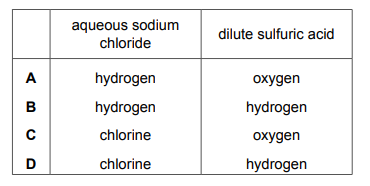
Concentrated aqueous sodium chloride and dilute sulfuric acid are both electrolysed using inert electrodes. Which row identifies the product at the cathode in each electrolysis?

Most-appropriate topic codes (Cambridge IGCSE Chemistry 0620):

Topic 4.1: Electrolysis — Identify products formed at electrodes during electrolysis of concentrated aqueous sodium chloride and dilute sulfuric acid using inert electrodes (Core); Predict products at electrodes for electrolysis of halide compounds in dilute or concentrated aqueous solution (Supplement)
▶️ Answer/Explanation
In the electrolysis of concentrated aqueous sodium chloride, the cathode product is hydrogen because H⁺ ions (from water) are discharged more easily than Na⁺ ions. In the electrolysis of dilute sulfuric acid, the cathode product is also hydrogen (H⁺ from the acid is discharged). Therefore, both electrolyses produce hydrogen at the cathode.
Answer: (B) – Hydrogen in both cases

Question 12

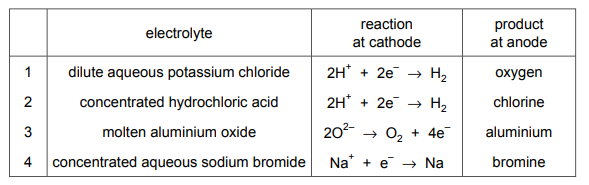
Electrolytes can be broken down by electrolysis. Which rows are correct for each electrolyte?

A 1 and 2

B 1 and 4

C 2 and 3

D 3 and 4

Most-appropriate topic codes (Cambridge IGCSE Chemistry 0620):

Topic 4.1: Electrolysis — Identify the products formed at the electrodes and describe the observations during the electrolysis of molten lead(II) bromide, concentrated aqueous sodium chloride, and dilute sulfuric acid (Core); Predict the identity of products for electrolysis of a binary compound in the molten state (Core); Construct ionic half-equations for reactions at the anode and cathode (Supplement).
▶️ Answer/Explanation
Detailed Solution: For molten lead(II) bromide (PbBr₂), the Pb²⁺ ions are reduced at the cathode to form grey molten lead, and the Br⁻ ions are oxidised at the anode to form red-brown bromine vapour. For concentrated aqueous sodium chloride (NaCl), water and Na⁺ are present; at the cathode, water is reduced (not Na⁺) to produce hydrogen gas and OH⁻, and at the anode, Cl⁻ is oxidised to produce pale green chlorine gas. Row 1 matches PbBr₂, Row 2 matches concentrated NaCl, Row 3 is wrong (Na is not produced at cathode in aqueous solution), Row 4 is wrong (oxygen is not produced at anode from concentrated NaCl). Thus rows 1 and 2 are correct.
Answer: (A) 1 and 2

Question 13

Which statement about hydrogen–oxygen fuel cells is correct?

A. Hydrogen is extracted from clean, dry air.
B. The only product is carbon dioxide.
C. The reaction is endothermic.
D. No toxic gases are produced.

Most-appropriate topic codes (Cambridge IGCSE Chemistry 0620):

Topic 4.2: Hydrogen-oxygen fuel cells — State that a hydrogen-oxygen fuel cell uses hydrogen and oxygen to produce electricity with water as the only chemical product (Core); Describe the advantages and disadvantages of using hydrogen-oxygen fuel cells in comparison with gasoline/petrol engines in vehicles (Supplement)
▶️ Answer/Explanation
In a hydrogen-oxygen fuel cell, hydrogen gas reacts with oxygen gas to produce electrical energy, with water (H₂O) being the only chemical product. This reaction is highly exothermic, not endothermic. The fuel cell produces no toxic gases such as carbon monoxide, oxides of nitrogen, or unburnt hydrocarbons, which are major pollutants from gasoline/petrol engines. Hydrogen is not extracted from air (air contains very little hydrogen); it is typically produced from natural gas or by electrolysis of water. Since only water is released, statement D is correct.
Answer: D

Question 14

Which statement defines the activation energy, \(E_a\) , for a reaction?

A. It is the minimum energy that colliding particles must have to react.
B. It is the minimum energy that endothermic reactions take in from their surroundings.
C. It is the maximum energy that exothermic reactions transfer to their surroundings.
D. It is the maximum energy released when the bonds in the products of a reaction form.

Most-appropriate topic codes (Cambridge IGCSE Chemistry 0620):

Topic 5.1: Exothermic and endothermic reactions — Define activation energy, \(E_{\mathrm{a}}\) as the minimum energy that colliding particles must have to react (Supplement)
▶️ Answer/Explanation
Activation energy (\(E_a\)) is the minimum amount of energy that colliding particles must possess before a chemical reaction can occur, as defined in collision theory. This energy is required to break existing bonds and initiate the reaction regardless of whether the overall reaction is exothermic or endothermic. Options B, C, and D describe enthalpy changes, not activation energy.
Answer: (A)

Question 15

The equation for the complete combustion of ethyne, H–C≡C–H, is shown.

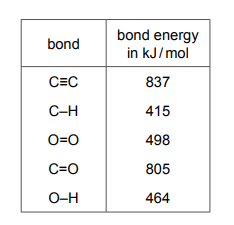
The bond energies are listed.

What is the enthalpy change of the reaction when 1mol of ethyne is completely burned?
A –2472 kJ / mol
B –1236 kJ / mol
C +1236 kJ / mol
D +2472 kJ / mol

Most-appropriate topic codes (Cambridge IGCSE Chemistry 0620):

Topic 5.1: Exothermic and endothermic reactions — Calculate the enthalpy change of a reaction using bond energies (Supplement)
▶️ Answer/Explanation
The enthalpy change = total bond energies broken (reactants) – total bond energies formed (products). Bonds broken: 2×C–H (2×410 = 820), 1×C≡C (1×830 = 830), 2.5×O=O (2.5×497 = 1242.5); total = 820+830+1242.5 = 2892.5 kJ. Bonds formed: 4×C=O (4×805 = 3220), 2×O–H (2×464 = 928); total = 3220+928 = 4148 kJ. ΔH = 2892.5 – 4148 = –1255.5 kJ ≈ –1236 kJ (using given approximate bond energies). Negative sign shows exothermic combustion.
Answer: (B) –1236 kJ/mol

Question 16

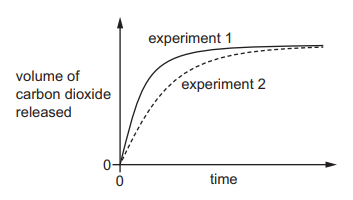
In experiment 1, small lumps of limestone are added to dilute ethanoic acid at 40°C. The volume of carbon dioxide released is measured at regular time intervals. A graph of the results is shown.

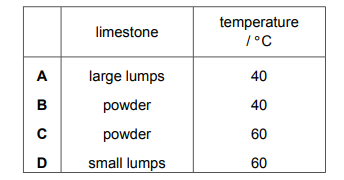
Which changes give the results shown in experiment 2?

Most-appropriate topic codes (Cambridge IGCSE Chemistry 0620):

Topic 6.2: Rate of reaction — Describe the effect on the rate of reaction of changing the concentration of solutions, surface area of solids, and temperature (Core); using collision theory (Supplement)
Topic 7.1: Characteristic properties of acids and bases — Reaction of acids with carbonates (Core)
▶️ Answer/Explanation
Experiment 2 shows the same final volume of CO₂ (same amount of limestone reacted) but a slower initial rate. This means the total reactant amounts are unchanged, but conditions make the reaction proceed more slowly. Decreasing temperature (from 40°C to a lower value) reduces the kinetic energy of particles, leading to fewer successful collisions per second and a lower initial rate without changing the final gas volume. Using larger lumps (same mass) reduces the surface area, which also slows the rate without altering the total CO₂ produced. Therefore, either lowering temperature or using larger lumps matches the graph in experiment 2.
Answer: (A) – Lower temperature or larger lumps
Question 17

In the Haber process, nitrogen and hydrogen are reacted to make ammonia.

\(N_2(g) + 3H_2(g) ⇌ 2NH_3(g)\)
The forward reaction is exothermic.
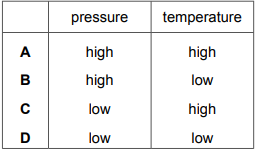
Which conditions produce the maximum yield of ammonia?

Table showing temperature and pressure options for the Haber process

Most-appropriate topic codes (Cambridge IGCSE Chemistry 0620):

Topic 6.3: Reversible reactions and equilibrium — Predict and explain, for a reversible reaction, how the position of equilibrium is affected by changing temperature and pressure; State the typical conditions in the Haber process (Supplement)
▶️ Answer/Explanation
To maximise the yield of ammonia, the conditions must favour the forward exothermic reaction. Lower temperatures favour exothermic reactions (Le Chatelier’s principle), and higher pressures favour the side with fewer gas molecules (here 4 molecules on the left, 2 on the right). Therefore, low temperature and high pressure (Option B) give the maximum yield, although in industry a compromise temperature is used for an acceptable rate.
Answer: (B)

Question 18

The Ostwald process is used to make nitric acid. The conditions used in this process are:
1 a catalyst containing a transition element
2 a pressure of 10 atm
3 a temperature of 800 °C.
Which of these conditions are also used in the Contact process?

A 1 and 2
B 1 only
C 2 and 3
D 3 only

Most-appropriate topic codes (Cambridge IGCSE Chemistry 0620):

Topic 6.3: Reversible reactions and equilibrium — State the symbol equation for the conversion of sulfur dioxide to sulfur trioxide in the Contact process, state the typical conditions for the conversion of sulfur dioxide to sulfur trioxide in the Contact process as 450 °C, 200 kPa / 2 atm and a vanadium(V) oxide catalyst (Core)
Topic 8.4: Transition elements — Often act as catalysts as elements and in compounds (Core)
▶️ Answer/Explanation
The Contact process uses a vanadium(V) oxide catalyst (a transition element compound), but operates at about 450 °C and 2 atm pressure — not 800 °C or 10 atm. Therefore, only condition 1 (a catalyst containing a transition element) is common to both the Ostwald and Contact processes. Pressure and temperature conditions differ significantly between the two processes.
Answer: (B) 1 only

Question 19

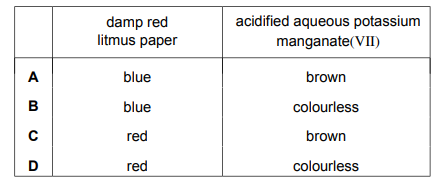
Hydrogen iodide is dissolved in water.

Which row describes the final colours seen when the solution is tested with damp red litmus paper and with acidified aqueous potassium manganate(VII)?

Most-appropriate topic codes (Cambridge IGCSE Chemistry 0620):

Topic 7.1: Characteristic properties of acids and bases — Aqueous solutions of acids contain H⁺ ions (Core)
Topic 12.5: Identification of ions and gases — Test for ammonia using damp red litmus paper; Test for reducing agents using acidified aqueous potassium manganate(VII) (Core)
▶️ Answer/Explanation
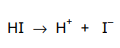
Hydrogen iodide (HI) is a strong acid that dissociates completely in water to give H⁺ and I⁻ ions. The acidic H⁺ turns damp red litmus paper red (it does not turn blue). The I⁻ ions are reducing agents; they decolorise purple acidified KMnO₄(aq) to colourless. Therefore, the correct row is the one showing red litmus and colourless manganate(VII).
Answer: C

Question 20

Which statements about aqueous ethanoic acid are correct?

1 It can be produced by oxidising ethanol with potassium iodide.
2 It reacts with magnesium to produce hydrogen gas.
3 It has an approximate pH value of 3.
4 It produces esters called methanoates.

A 1 and 3

B 1 and 4

C 2 and 3

D 2 and 4

Most-appropriate topic codes (Cambridge IGCSE Chemistry 0620):

Topic 7.1: The characteristic properties of acids and bases — Describe the characteristic properties of acids in terms of their reactions with metals (Core). State that ethanoic acid is a weak acid, as shown by the symbol equation (Supplement).
Topic 11.7: Carboxylic acids — Describe the formation of ethanoic acid by the oxidation of ethanol (Supplement). Describe the reaction of a carboxylic acid with an alcohol using an acid catalyst to form an ester (Supplement).
▶️ Answer/Explanation
Correct Answer: C (Statements 2 and 3)

Statement 1 is incorrect: ethanoic acid is produced by oxidizing ethanol with acidified potassium manganate(VII) (or by bacterial oxidation), not with potassium iodide.
Statement 2 is correct: as a weak acid, ethanoic acid reacts with reactive metals like magnesium to produce hydrogen gas.
Statement 3 is correct: ethanoic acid is a weak acid (partially dissociated), so a typical ~0.1 M solution has an approximate pH value of 3 (strong acids would have pH ~1).
Statement 4 is incorrect: esters formed from ethanoic acid are called ethanoates (e.g., ethyl ethanoate), not methanoates (which come from methanoic acid).

Question 21

Which element forms an acidic oxide?
A calcium
B lithium
C magnesium
D sulfur

Most-appropriate topic codes (Cambridge IGCSE Chemistry 0620):

Topic 7.2: Oxides — Classify oxides as acidic, including SO₂ and CO₂, or basic, including CuO and CaO, related to metallic and non-metallic character (Core).
▶️ Answer/Explanation
Metals (calcium, lithium, magnesium) form basic oxides; non-metals form acidic oxides. Sulfur is a non-metal and forms sulfur dioxide (SO₂) and sulfur trioxide (SO₃), which are acidic oxides. Therefore, the correct answer is D.
Answer: D

Question 22

Which statement describes the properties of hydrochloric acid?

A. Carbon dioxide is produced when limestone reacts with hydrochloric acid.
B. Hydrogen is produced when sodium hydroxide reacts with hydrochloric acid.
C. Methyl orange turns yellow in strong hydrochloric acid.
D. Red litmus paper turns blue when dipped into hydrochloric acid.

Most-appropriate topic codes (Cambridge IGCSE Chemistry 0620):

Topic 7.1: The characteristic properties of acids and bases — Describe the characteristic properties of acids in terms of their reactions with: (a) metals (b) bases (c) carbonates (Core); Describe acids in terms of their effect on litmus, thymolphthalein, methyl orange (Core).
▶️ Answer/Explanation
Hydrochloric acid reacts with carbonates (like limestone, CaCO₃) to produce carbon dioxide gas, water, and a salt (calcium chloride). Option B is incorrect because sodium hydroxide neutralises the acid to produce water and salt, not hydrogen. Option C is false as methyl orange turns red/red-orange in strong acids, not yellow. Option D is wrong because red litmus turns blue in bases, whereas hydrochloric acid is an acid and turns blue litmus red.
Answer: A

Question 23

Elements P and Q have the same number of electron shells. An atom of Q has more electrons in its outer electron shell than an atom of P. Which statements are correct?

1 P and Q are in the same group of the Periodic Table.
2 P and Q are in the same period of the Periodic Table.
3 P has a greater tendency to form positive ions than Q.
4 The oxide of Q is more basic than the oxide of P.

A 1 and 3

B 1 and 4

C 2 and 3

D 2 and 4

Most-appropriate topic codes (Cambridge IGCSE Chemistry 0620):

Topic 8.1: Arrangement of elements — Describe the Periodic Table as an arrangement of elements in periods and groups and in order of increasing proton number/atomic number; Describe the change from metallic to non-metallic character across a period.
Topic 8.1: Explain similarities in chemical properties in the same group in terms of electronic configuration; Explain how position in the Periodic Table can be used to predict properties.
Topic 2.2: Determine the electronic configuration of elements; number of outer shell electrons equals group number for Groups I to VII; number of occupied shells equals period number.
▶️ Answer/Explanation
Same number of electron shells means P and Q are in the same period (statement 2 correct, statement 1 incorrect). Q has more outer electrons than P, so Q is further to the right in the same period, thus P is more metallic and forms positive ions more easily (statement 3 correct). Oxides become less basic (more acidic) across a period, so Q’s oxide is less basic, not more basic (statement 4 incorrect).
Answer: C (2 and 3)

Question 24

Which substance reacts with dilute sulfuric acid to form a salt that can be removed from the resulting mixture by filtration?

A aqueous barium chloride
B aqueous sodium hydroxide
C copper
D copper(II) carbonate

Most-appropriate topic codes (Cambridge IGCSE Chemistry 0620):

Topic 7.3: Preparation of salts — Describe the preparation of soluble salts by reaction of an acid with an excess insoluble base or excess insoluble carbonate (Core); Describe the preparation of insoluble salts by precipitation (Supplement)
Topic 12.4: Separation and purification — Describe and explain methods of separation using filtration (Core)
▶️ Answer/Explanation
Copper(II) carbonate (D) is an insoluble base that reacts with dilute sulfuric acid to produce soluble copper(II) sulfate, water and carbon dioxide gas. Any unreacted solid copper(II) carbonate can be removed by filtration, leaving the salt in the filtrate. A and B are aqueous solutions and would not leave an insoluble residue to filter. Copper metal (C) does not react with dilute sulfuric acid because it is below hydrogen in the reactivity series.
Answer: D

Question 25

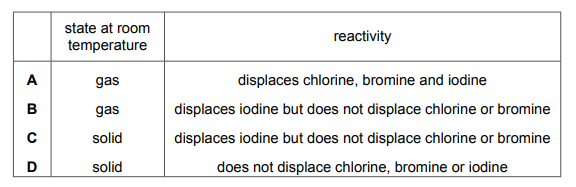
Astatine is below iodine in Group VII in the Periodic Table. Which row describes the properties of astatine?

Table comparing properties of chlorine, bromine, iodine, and astatine

Most-appropriate topic codes (Cambridge IGCSE Chemistry 0620):

Topic 8.3: Group VII properties — Describe the Group VII halogens, chlorine, bromine and iodine, as diatomic non-metals with general trends down the group, limited to: (a) increasing density (b) decreasing reactivity (Core); Predict the properties of other elements in Group VII, given information about the elements (Core)
▶️ Answer/Explanation
Down Group VII, the halogens increase in density (iodine is a grey-black solid, astatine is a darker solid) and decrease in reactivity (iodine displaces bromide and chloride less easily, astatine is even less reactive). As a diatomic non-metal, its state at r.t.p. is solid and its reactivity is lower than iodine, matching row D.
Answer: D

Question 26

Which property of copper explains why it is classified as a transition element?
A. Copper can be bent into different shapes.
B. Copper forms \(Cu^{2+}\) and \(Cu^+ \) ions.
C. Copper is a good conductor of electricity.
D. Copper has a low density.

Most-appropriate topic codes (Cambridge IGCSE Chemistry 0620):

Topic 8.4: Transition elements — Describe the transition elements as metals that form coloured compounds and often act as catalysts (Core); Describe transition elements as having ions with variable oxidation numbers, including iron(II) and iron(III) (Supplement).
▶️ Answer/Explanation
One of the key defining properties of transition elements (from the Supplement content of Topic 8.4) is their ability to form ions with variable oxidation states. The fact that copper can form both Cu⁺ and Cu²⁺ ions, with different charges, is the characteristic that classifies it as a transition element. The other options (malleability, conductivity, low density) are not unique to transition metals; they are also properties of main group metals like those in Group I or II.
Answer: (B)

Question 27

Brass is an alloy that is formed from copper and zinc. Which statements are correct?
1 Brass, copper and zinc all conduct electricity.
2 Brass is a compound of copper and zinc.
3 Brass is harder than zinc.
A 1, 2 and 3

B 1 and 2 only

C 1 and 3 only

D 2 and 3 only

Most-appropriate topic codes (Cambridge IGCSE Chemistry 0620):

Topic 9.3: Alloys and their properties — Describe an alloy as a mixture of a metal with other elements, including brass as a mixture of copper and zinc; state that alloys can be harder and stronger than the pure metals and are more useful.
Topic 9.1: Properties of metals — Compare the general physical properties of metals and non‑metals, including electrical conductivity.
▶️ Answer/Explanation
Brass is an alloy (a mixture) of copper and zinc, not a compound, so statement 2 is incorrect. Both pure metals and their alloys retain metallic bonding, so they conduct electricity – statement 1 is correct. Alloys are typically harder than their constituent pure metals because different-sized atoms distort the lattice and prevent layers from sliding, so statement 3 is correct. Hence, only statements 1 and 3 are correct.
Answer: (C) 1 and 3 only

Question 28

The equation for the reaction of metal M with aqueous zinc sulfate is shown.

Which statement explains why metal M reacts with aqueous zinc sulfate?
A Zinc is less reactive than M because M is able to accept electrons from zinc ions.
B Zinc is a more powerful reducing agent than M.
C Zinc is more reactive than M because it can lose electrons more easily than M.
D Zinc ions can remove electrons from M.

Most-appropriate topic codes (Cambridge IGCSE Chemistry 0620):

Topic 9.4: Reactivity series — Describe the relative reactivities of metals in terms of their tendency to form positive ions, by displacement reactions (Supplement)
Topic 6.4: Redox — Define oxidation as loss of electrons and reduction as gain of electrons; identify redox reactions (Supplement)
▶️ Answer/Explanation
In the displacement reaction M + ZnSO₄ → MSO₄ + Zn, metal M displaces zinc because M is more reactive than zinc. The reaction occurs because Zn²⁺ ions (zinc ions) act as an oxidising agent, removing electrons from M atoms (M → M²⁺ + 2e⁻), which are then gained by Zn²⁺ to form Zn. Option D correctly states that zinc ions remove electrons from M, driving the reaction. Options A, B, and C contradict the reactivity series direction or misrepresent electron transfer.
Answer: (D)

Question 29

In the blast furnace, the impurity silicon(IV) oxide is removed by the formation of slag. Which equation represents the formation of the substance which reacts with silicon(IV) oxide to form slag?
A \(C + O_2 → CO_2\)
B \(C + CO_2 → 2CO\)
C \(CaCO_3 → CaO + CO_2\)
D \(Fe_2O_3 + 3CO → 2Fe + 3CO_2\)

Most-appropriate topic codes (Cambridge IGCSE Chemistry 0620):

Topic 9.6: Extraction of metals — Describe the extraction of iron from hematite in the blast furnace, limited to: the thermal decomposition of calcium carbonate/limestone to produce calcium oxide; the formation of slag (Core). Also Supplement equations for extraction of iron.
▶️ Answer/Explanation
In the blast furnace, calcium carbonate (limestone) thermally decomposes to form calcium oxide (quicklime) and carbon dioxide. Calcium oxide then acts as the base that reacts with the acidic impurity silicon(IV) oxide (SiO₂) to form calcium silicate slag (CaSiO₃). Option C correctly shows the formation of calcium oxide, which is the substance that reacts with SiO₂. Options A and B produce carbon monoxide/reducing agents, not the slag-forming reactant; option D is the reduction of iron ore.
Answer: (C)

Question 30

Aluminium is extracted from bauxite by electrolysis. Which statement is correct?

A. Aluminium ions are oxidised to form aluminium.
B. The cathode has to be replaced regularly because it reacts with the oxygen which is formed.
C. Carbon dioxide is produced at the anode.
D. Cryolite is added to remove impurities.

Most-appropriate topic codes (Cambridge IGCSE Chemistry 0620):

Topic 9.6: Extraction of metals — Describe the extraction of aluminium from purified bauxite/aluminium oxide, including: the role of cryolite, why the carbon anodes need to be regularly replaced, the reactions at the electrodes, including ionic half-equations (Supplement)
▶️ Answer/Explanation
In the electrolysis of aluminium oxide, the anode (positive electrode) is made of carbon. The oxide ions (O²⁻) are discharged at the anode, lose electrons, and form oxygen gas. This oxygen immediately reacts with the hot carbon anode to produce carbon dioxide gas (C + O₂ → CO₂). Therefore, carbon dioxide is produced at the anode. Option A is incorrect because aluminium ions are reduced (gain electrons), not oxidised. Option B is incorrect because it is the carbon anode (not the cathode) that reacts with oxygen and needs replacement. Option D is incorrect because cryolite is added to lower the melting point of the aluminium oxide, not to remove impurities.
Answer: (C)

Question 31

Iron rusts but aluminium does not easily corrode. Which statement explains why aluminium does not easily corrode?
A. It is an alloy.
B. It is below iron in the reactivity series.
C. It is a transition element.
D. Its surface is protected by an oxide layer.

Most-appropriate topic codes (Cambridge IGCSE Chemistry 0620):

Topic 9.4: Reactivity series — Explain the apparent unreactivity of aluminium in terms of its oxide layer (Supplement)
▶️ Answer/Explanation
Aluminium is actually quite high in the reactivity series, but it does not corrode easily because a thin, adherent layer of aluminium oxide forms rapidly on its surface when exposed to air. This oxide layer is impermeable and prevents further reaction with oxygen or water, protecting the metal underneath. In contrast, rust (hydrated iron(III) oxide) is flaky and does not adhere well, allowing corrosion to continue.
Answer: (D) Its surface is protected by an oxide layer.

Question 32

Which chemicals can be used as a fertiliser to provide the three elements needed for improved plant growth?
A \((NH_2)_2CO\) and KCl
B \((NH_4)_2HPO_4\) and \(K_2SO_4\)
C \((NH_4)_2HPO_4\) and \((NH_2)_2CO\)
D \((NH_2)_2CO\) and \(K_2SO_4\)

Most-appropriate topic codes (Cambridge IGCSE Chemistry 0620):

Topic 10.2: Fertilisers — Describe the use of NPK fertilisers to provide the elements nitrogen, phosphorus and potassium for improved plant growth (Core)
▶️ Answer/Explanation
The three essential elements for improved plant growth in NPK fertilisers are nitrogen (N), phosphorus (P) and potassium (K). Option B provides N from \((NH_4)_2HPO_4\), P from the same compound, and K from \(K_2SO_4\). The other options lack at least one of these three elements (e.g., option A has N and K but no P; option C has N and P but no K; option D has N and K but no P).
Answer: (B)

Question 33

What is the colour change when water is added to anhydrous cobalt(II) chloride?
A blue to white
B blue to pink
C white to blue
D white to pink

Most-appropriate topic codes (Cambridge IGCSE Chemistry 0620):

Topic 10.1: Water — Describe chemical tests for the presence of water using anhydrous cobalt(II) chloride and anhydrous copper(II) sulfate (Core)
▶️ Answer/Explanation
Anhydrous cobalt(II) chloride is blue in its dry (anhydrous) form. When water is added, it forms the hydrated complex CoCl₂·6H₂O, which is pink. Therefore the colour change is from blue to pink. This is a standard test for water.
Answer: B (blue to pink)

Question 34

How do carbon dioxide and methane cause global warming?

A. They emit the thermal energy they have absorbed back to the Earth.
B. They absorb the radiation directly from the Sun.
C. They increase thermal energy loss to space.
D. They reduce reflection of thermal energy from the Earth’s surface.

Most-appropriate topic codes (Cambridge IGCSE Chemistry 0620):

Topic 10.3: Air quality and climate — Describe how the greenhouse gases carbon dioxide and methane cause global warming, limited to: (a) the absorption, reflection and emission of thermal energy (b) reducing thermal energy loss to space (Supplement)
▶️ Answer/Explanation
Carbon dioxide and methane (greenhouse gases) absorb infrared (thermal) radiation emitted from the Earth’s surface and then re-emit it in all directions, including back toward the Earth. This process traps thermal energy in the lower atmosphere, reducing energy loss to space and causing the planet to warm. Options B, C, and D are incorrect because these gases do not primarily absorb direct solar radiation (they are transparent to incoming short-wave radiation), nor do they increase energy loss or reduce reflection; they specifically slow the escape of thermal energy.
Answer: (A)

Question 35

Four statements about photosynthesis are listed.
1 Chlorophyll is required for photosynthesis.
2 The equation for photosynthesis is \(C_6H_{12}O_6 + 6O_2 \rightarrow 6CO_2 + 6H_2O\).
3 Photosynthesis requires energy from light.
4 Photosynthesis releases carbon dioxide, which can lead to climate change.
Which statements are correct?
A 1 and 3

B 1 and 4

C 2 and 3

D 2 and 4

Most-appropriate topic codes (Cambridge IGCSE Chemistry 0620):

Topic 6.2: Rate of reaction – Enzymes as biological catalysts (Core)
Topic 10.3: Air quality and climate – Carbon dioxide from complete combustion and its role in global warming (Core)
Topic 11.6: Alcohols – Fermentation of glucose (as an illustrative biological process)
▶️ Answer/Explanation
Statement 1 is correct – chlorophyll is the green pigment that absorbs light energy for photosynthesis. Statement 3 is also correct – light energy drives the reaction. Statement 2 is incorrect because the equation shown is for respiration, not photosynthesis (the correct photosynthesis equation is \(6CO_2 + 6H_2O \rightarrow C_6H_{12}O_6 + 6O_2\)). Statement 4 is incorrect – photosynthesis absorbs carbon dioxide, it does not release it. Therefore, statements 1 and 3 are correct.
Answer: (A) 1 and 3

Question 36

Which molecules are structural isomers?

Structural isomerism question diagram

A 1 and 2

B 1 and 3

C 2 and 4

D 3 and 4

Most-appropriate topic codes (Cambridge IGCSE Chemistry 0620):

Topic 11.1: Formulae, functional groups and terminology — Define structural isomers as compounds with the same molecular formula, but different structural formulae (Supplement)
▶️ Answer/Explanation
Structural isomers have the same molecular formula but different arrangements of atoms. Molecules 1 and 3 both have the formula C₄H₁₀ (butane), with 1 being butane and 3 being methylpropane. Molecule 2 is but-2-ene (C₄H₈) and 4 is methylpropene (C₄H₈), making them isomers of each other, but the question asks for the pair among all four that matches the definition.

Answer: (B) 1 and 3

Question 37

Which statements about the reaction of ethene with steam are correct?

1 The product has a higher molecular mass than ethane.
2 The product reacts with aqueous bromine.
3 The number of electrons shared between carbon atoms decreases.
4 The reaction produces an alcohol and hydrogen.

A 1 and 2

B 1 and 3

C 2 and 4

D 3 and 4

Most-appropriate topic codes (Cambridge IGCSE Chemistry 0620):

Topic 11.6: Alcohols — Describe the manufacture of ethanol by catalytic addition of steam to ethene at 300°C and 6000 kPa / 60 atm in the presence of an acid catalyst (Core).
Topic 11.5: Alkenes — Describe the properties of alkenes in terms of addition reactions with steam in the presence of an acid catalyst and draw the structural or displayed formulae of the products (Supplement).
▶️ Answer/Explanation
The reaction of ethene with steam is an addition reaction (hydration) producing ethanol. Ethanol (C₂H₅OH, Mᵣ = 46) has a higher molecular mass than ethane (C₂H₆, Mᵣ = 30), so statement 1 is correct. In this reaction, the C=C double bond in ethene becomes a C–C single bond in ethanol, decreasing the number of shared electrons (from 2 pairs to 1 pair between carbons), making statement 3 correct. Ethanol does not react with aqueous bromine (statement 2 is false), and the reaction produces only ethanol (no hydrogen, statement 4 is false).
Answer: B (1 and 3)

Question 38

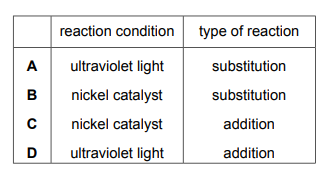
Methane and chlorine react to form chloromethane. Which row describes the necessary reaction condition and the type of reaction?

Table showing reaction conditions and types: A. Diffuse light, substitution; B. Diffuse light, addition; C. Ultraviolet light, substitution; D. Ultraviolet light, addition

Most-appropriate topic codes (Cambridge IGCSE Chemistry 0620):

Topic 11.4: Alkanes — Describe the substitution reaction of alkanes with chlorine as a photochemical reaction, with ultraviolet light providing the activation energy, and draw the structural formulae of the products (Supplement).
Topic 11.1: Formulae, functional groups and terminology — State that a saturated compound has molecules in which all carbon-carbon bonds are single bonds (Core).
▶️ Answer/Explanation
The reaction of methane (an alkane) with chlorine to form chloromethane is a free-radical substitution reaction. It requires ultraviolet (UV) light to break the chlorine-chlorine bond and provide activation energy. In substitution, one hydrogen atom in methane is replaced by a chlorine atom, unlike addition which occurs with unsaturated alkenes.
Answer: C (Ultraviolet light, substitution)
Question 39

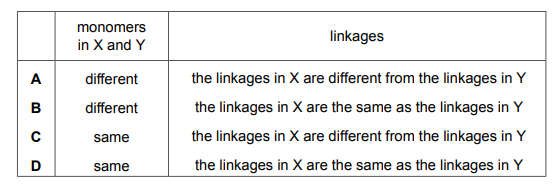
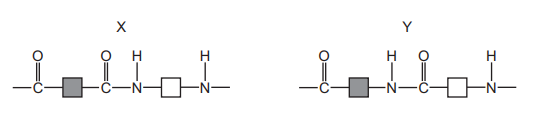
Parts of the structure of two different polymers, X and Y, are shown.

Polymer structures X and Y

Which row about the monomers and the linkages between the monomers in polymers X and Y is correct? Table of options for monomers and linkages

Most-appropriate topic codes (Cambridge IGCSE Chemistry 0620):

Topic 11.8: Polymers — Define polymers as large molecules built up from many smaller molecules called monomers; Describe the formation of poly(ethene) as an example of addition polymerisation; Describe the differences between addition and condensation polymerisation; Describe and draw the structure of nylon (a polyamide) and PET (a polyester).
▶️ Answer/Explanation
Polymer X shows a repeating amide linkage (-CO-NH-), characteristic of a condensation polymer (polyamide) formed from a dicarboxylic acid and a diamine. Polymer Y shows an ester linkage (-CO-O-), characteristic of a condensation polymer (polyester) formed from a dicarboxylic acid and a diol. Thus, the correct option identifies X monomers as dicarboxylic acid + diamine and Y monomers as dicarboxylic acid + diol.
Answer: (B)

Question 40

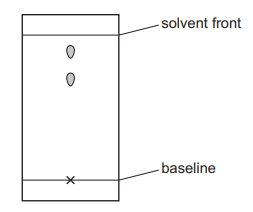
Substance Q is tested using paper chromatography. The resulting chromatogram is shown.

Which statement is correct?
A Q is a pure substance.
B The \(R_f\) value of the lower spot is 0.25.
C Q is a mixture of at least two different substances.
D Q is a compound of two elements.

Most-appropriate topic codes (Cambridge IGCSE Chemistry 0620):

Topic 12.3: Chromatography — Interpret simple chromatograms to identify unknown substances, pure and impure substances (Core)
▶️ Answer/Explanation
The chromatogram shows two separate spots (one lower, one higher), indicating that substance Q contains at least two different components. A pure substance would produce only one spot. The \(R_f\) of the lower spot is approximately (distance moved by spot)/(distance moved by solvent) = 1.5/6 = 0.25, but statement B is incomplete because it does not specify which spot; more importantly, statement C is definitively correct. There is no evidence from the chromatogram alone that Q is a compound of two elements (it could be a mixture of compounds).
Answer: (C)
Scroll to Top