
Question 1
A list of substances is shown.
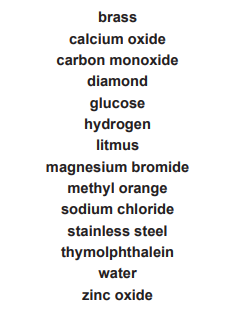 Answer the following questions about these substances. Each substance may be used once, more than once or not at all. State which substance:
(a) is formed by the thermal decomposition of calcium carbonate in the blast furnace.
(b) is a mixture of copper and zinc
(c) turns yellow when an alkali is added
(d) is a reactant in photosynthesis
(e) is a salt that contains a positive ion with a charge of 1+
(f) is a compound that reduces iron(III) oxide in the blast furnace.
Most-appropriate topic codes (Cambridge IGCSE Chemistry 0620):
• Topic 9.6 — Extraction of metals (Parts a & f)
• Topic 9.3 — Alloys and their properties (Part b)
• Topic 7.1 — The characteristic properties of acids and bases (Part c)
• Topic 10.3 — Air quality and climate / Photosynthesis (Part d)
• Topic 2.4 — Ions and ionic bonds (Part e)
▶️ Answer/Explanation
(a) calcium oxide
In the blast furnace, calcium carbonate undergoes thermal decomposition to form calcium oxide and carbon dioxide. The calcium oxide then reacts with silica to form slag.
(b) brass
Brass is a common alloy defined as a mixture of copper and zinc. It is harder than pure copper and is used for decorative purposes and fittings.
(c) methyl orange
Methyl orange is an indicator that turns yellow in alkaline (basic) conditions. In contrast, litmus turns blue in alkali, and thymolphthalein turns blue as well.
(d) water
Photosynthesis requires carbon dioxide and water as reactants to produce glucose and oxygen. Without water, the photosynthetic process cannot occur.
(e) sodium chloride
Sodium chloride (NaCl) contains the sodium ion (Na⁺) which carries a single positive charge. It is a neutral salt formed from the reaction of an acid and an alkali.
(f) carbon monoxide
Carbon monoxide acts as the primary reducing agent in the blast furnace. It removes oxygen from iron(III) oxide to produce molten iron, while itself being oxidized to carbon dioxide.
Question 2
Table 2.1 shows the masses of some of the ions in a \(1000 \text{ cm}^3\) sample of river water.
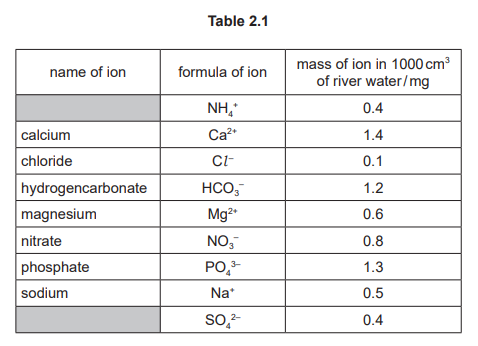
(i) Name the negative ion that has the highest concentration.
(ii) Name the compound that contains \( \text{NH}_4^+ \) and \( \text{SO}_4^{2-} \) ions only.
(iii) Calculate the mass of hydrogencarbonate ions in \(200 \text{ cm}^3\) of river water.
(i) Draw the displayed formula for ethanoic acid.
(ii) Ethanoic acid reacts with sodium hydroxide. Complete the word equation for this reaction.

Most-appropriate topic codes (Cambridge IGCSE Chemistry 0620):
• Topic 10.1 — Water (Parts (a), (d))
• Topic 12.5 — Identification of ions and gases (Part (b))
• Topic 10.2 — Fertilisers (Part (c))
• Topic 11.7 — Carboxylic acids (Part (e))
▶️ Answer/Explanation
(a)(i)
Answer: phosphate
From Table 2.1, the negative ions (anions) are chloride (0.31 mg), nitrate (0.27 mg), hydrogencarbonate (1.20 mg), sulfate (0.69 mg), and phosphate (4.87 mg). Phosphate has the highest mass (4.87 mg) per 1000 cm³, hence the highest concentration.
(a)(ii)
Answer: ammonium sulfate
The compound containing only NH₄⁺ and SO₄²⁻ ions is ammonium sulfate. The formula is (NH₄)₂SO₄, which requires two ammonium ions to balance the charge of one sulfate ion.
(a)(iii)
Answer: 0.24 (mg)
From the table, the mass of hydrogencarbonate ions in 1000 cm³ is 1.20 mg. For 200 cm³ (which is 1/5 of 1000 cm³), the mass is 1.20 mg × (200/1000) = 1.20 × 0.2 = 0.24 mg.
(b)
Answer: Flame test; yellow flame colour.
Sodium ions are identified by a flame test. A clean platinum wire loop is dipped into the sample and held in a blue Bunsen flame. Sodium ions produce a characteristic persistent yellow flame colour due to electron excitation and relaxation.
(c)
Answer: Improved plant growth / provides essential elements (nitrogen, phosphorus, potassium).
Fertilisers replace essential mineral ions (like nitrates, phosphates, and potassium) in the soil that are depleted by crops. They provide nitrogen for protein synthesis and phosphorus for DNA/ATP, leading to higher crop yields.
(d)
Answer: Sewage contains harmful microbes which cause disease. Phosphates lead to deoxygenation of water (eutrophication), damaging aquatic life.
Sewage introduces pathogenic bacteria and viruses. Phosphates cause algal blooms; when algae die, their decomposition by bacteria uses up dissolved oxygen, suffocating fish and other aquatic organisms.
(e)(i)
Answer: Displayed formula of ethanoic acid (C₂H₄O₂) showing all bonds.
The structure consists of a methyl group (-CH₃) bonded to a carboxyl group (-COOH). The carboxyl carbon has a double bond to one oxygen and a single bond to the -OH group.
(e)(ii)
Answer: sodium ethanoate + water
Ethanoic acid (CH₃COOH) neutralises sodium hydroxide (NaOH) in an acid-base reaction. The H⁺ from the acid combines with OH⁻ from the base to form H₂O. The remaining CH₃COO⁻ combines with Na⁺ to form sodium ethanoate.
(e)(iii)
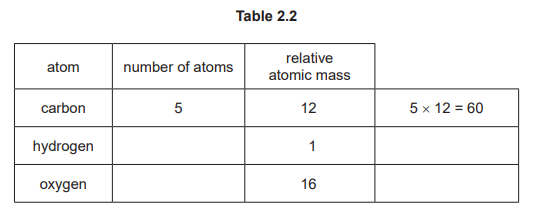
Answer: 102
Calculation: C₅ = 5 × 12 = 60; H₁₀ = 10 × 1 = 10; O₂ = 2 × 16 = 32. Total Mr = 60 + 10 + 32 = 102. (Award 1 mark for correct calculation of any one element’s contribution, e.g., 10 for H or 32 for O, if the total is incorrect).
Question 3
(i) Aqueous chlorine reacts with aqueous sodium bromide to produce aqueous bromine and aqueous sodium chloride. Complete the symbol equation for this reaction.

(ii) State why objects are electroplated.
Most-appropriate topic codes (Cambridge IGCSE Chemistry 0620):
• Topic 8.1 — Arrangement of elements (Part (a))
• Topic 8.3 — Group VII properties (Part (b))
• Topic 4.1 — Electrolysis (Part (c))
• Topic 4.1 — Electrolysis (Part (d))
▶️ Answer/Explanation
(a)(i)
It decreases / gets less metallic.
As you move left to right across a period, the elements change from metals (like sodium and magnesium) to non-metals (like sulfur and chlorine). This happens because the number of outer shell electrons increases, making it harder to lose electrons and form positive ions, thus decreasing metallic character.
(a)(ii)
Any two of the following: density increases, melting point decreases, reactivity increases.
Going down Group I, the atoms get larger because an extra electron shell is added. The single outer electron is held more weakly as it is further from the nucleus, making it easier to lose. This leads to higher reactivity. The larger atomic size also affects physical properties, causing lower melting points and higher densities.
(b)(i)
\(\mathrm{Cl_2(aq) + 2NaBr(aq) \rightarrow 2NaCl(aq) + Br_2(aq)}\)
This is a halogen displacement reaction. Chlorine is more reactive than bromine, so it displaces the bromide ions from the sodium bromide solution, forming sodium chloride and reddish-brown bromine. The equation must be balanced with a coefficient of 2 for NaBr and NaCl.
(b)(ii)
Iodine is less reactive than bromine. / Bromine is more reactive than iodine.
A more reactive halogen (like chlorine) will displace a less reactive halogen (like bromine or iodine) from its salt solution. Since iodine is the least reactive of the three halogens mentioned, it cannot displace bromine, so no reaction takes place.
(b)(iii)
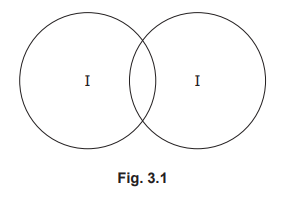
Bonding pair of electrons between iodine atoms (1), and 6 non-bonding electrons on each iodine atom (1).
Iodine (\(\mathrm{I_2}\)) is a diatomic molecule. Each iodine atom has 7 outer electrons. They share one pair of electrons to form a single covalent bond, giving each atom a stable octet configuration. Each atom also retains three lone pairs (6 non-bonding electrons).
(c)
Anode: bromine; Cathode: silver.
During electrolysis of molten silver bromide (\(\mathrm{AgBr}\)), the silver ions (\(\mathrm{Ag^+}\)) are attracted to the negative cathode, where they gain electrons to form solid silver. The bromide ions (\(\mathrm{Br^-}\)) are attracted to the positive anode, where they lose electrons to form reddish-brown bromine gas.
(d)(i)
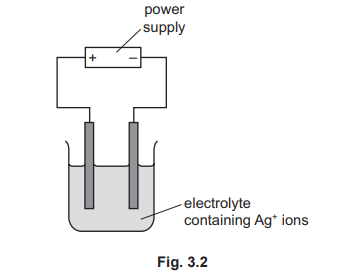
The object to be plated (the cathode) should be labelled ‘silver deposited’.
In electroplating, the object to be coated is made the cathode (negative electrode). Silver ions in the electrolyte are attracted to it and gain electrons to form a solid, shiny layer of silver on the object’s surface. The anode is made of pure silver, which dissolves to replace the ions in the solution.
(d)(ii)
To improve their appearance (e.g., making them shiny and attractive) and/or to improve resistance to corrosion (e.g., preventing the base metal from rusting or tarnishing).
Electroplating provides a thin, protective, and often decorative layer of a valuable metal (like silver, gold, or chromium) over a cheaper or more reactive metal. This prevents the underlying metal from reacting with air and moisture while giving it an appealing aesthetic finish.
Question 4
Alkenes are a homologous series of hydrocarbons which are made by cracking larger alkane molecules.
(a) (i) Write the general formula for alkenes.
(ii) Explain the need for cracking larger alkane molecules.
(iii) Describe two conditions needed for cracking.
(b) Alkenes are unsaturated compounds. State the meaning of the term unsaturated.
(c) Table 4.1 shows the boiling points of some alkenes.
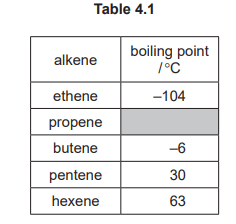
(i) Predict the boiling point of propene.
(ii) The melting point of butene is –185°C. Deduce the physical state of butene at –100°C. Give a reason for your answer.
(d) Fig. 4.1 shows a gas syringe that contains 60 cm³ of ethene gas.
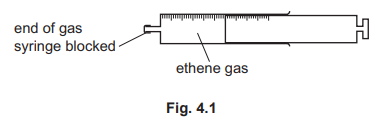
State how the volume of ethene in the gas syringe changes when the temperature is decreased and the pressure remains the same.
(e) Poly(ethene) is produced by the polymerisation of ethene. The reaction is exothermic.
(i) State the meaning of the term exothermic.
(ii) Fig. 4.2 shows the reaction pathway diagram for this reaction.
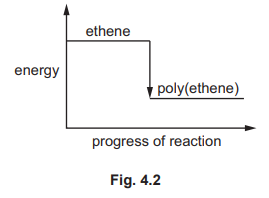
Explain how this reaction pathway diagram shows that the reaction is exothermic.
(f) Ethene reacts with steam to produce ethanol.
(i) Complete the symbol equation for this reaction.

(ii) Choose the word which describes the type of catalyst used in this reaction. Draw a circle around your chosen answer.

Most-appropriate topic codes (Cambridge IGCSE Chemistry 0620):
• Topic 11.5 — Alkenes (Parts a, b, c)
• Topic 1.1 — Solids, liquids and gases (Part d)
• Topic 5.1 — Exothermic and endothermic reactions (Part e)
• Topic 11.6 — Alcohols (Part f)
▶️ Answer/Explanation
(a)(i)
\( \mathrm{C}_n\mathrm{H}_{2n} \)
Alkenes are unsaturated hydrocarbons containing one carbon-carbon double bond. The general formula \( \mathrm{C}_n\mathrm{H}_{2n} \) reflects two fewer hydrogen atoms than alkanes (\( \mathrm{C}_n\mathrm{H}_{2n+2} \)) due to the presence of the double bond.
(a)(ii)
To produce more useful smaller molecules (e.g., petrol, alkenes) that are in higher demand, and to produce hydrogen for other industrial processes.
Cracking converts long-chain alkanes from crude oil fractions (excess supply) into shorter-chain alkenes and alkanes, which have greater economic value as fuels and chemical feedstocks.
(a)(iii)
High temperature (around 400–700°C) and a catalyst (e.g., zeolite, aluminium oxide, or silica).
The high temperature provides the activation energy to break strong carbon-carbon and carbon-hydrogen bonds, while the catalyst provides an alternative reaction pathway with lower activation energy, making the process economically feasible.
(b)
Unsaturated means that the molecule contains at least one carbon-carbon double bond (\( \mathrm{C}=\mathrm{C} \)), allowing it to undergo addition reactions.
Unlike saturated compounds (which contain only single bonds), unsaturated hydrocarbons can react with substances like bromine water by adding atoms across the double bond without displacing other atoms.
(c)(i)
Any value between –103°C and –7°C (e.g., –47°C).
Propene (\( \mathrm{C}_3\mathrm{H}_6 \)) lies between ethene (\( \mathrm{C}_2\mathrm{H}_4 \), b.p. –103°C) and butene (\( \mathrm{C}_4\mathrm{H}_8 \), b.p. –6°C) in the homologous series. Boiling points increase with increasing molecular mass due to stronger London dispersion forces.
(c)(ii)
Liquid. Because –100°C is higher than the melting point (–185°C) but lower than the boiling point (–6°C).
At a temperature between its melting point and boiling point, a substance exists as a liquid. Since –100°C is above the melting point (solid → liquid) and below the boiling point (liquid → gas), butene is liquid at this temperature.
(d)
The volume of ethene decreases.
According to the kinetic particle theory, when temperature decreases, the average kinetic energy of gas particles decreases. To maintain constant pressure, the particles must occupy a smaller volume (Charles’s Law: \( V \propto T \) at constant pressure).
(e)(i)
An exothermic reaction is one that transfers thermal energy to the surroundings, causing the temperature of the surroundings to increase.
In exothermic reactions, the total energy of the products is lower than that of the reactants. The energy difference is released to the environment, often as heat or light.
(e)(ii)
The energy level of the reactants (ethene) is higher than the energy level of the products (poly(ethene)).
On the reaction pathway diagram, the products (poly(ethene)) are shown at a lower vertical position (lower enthalpy) than the reactants (ethene). The downward arrow representing \( \Delta H \) is negative, confirming the release of thermal energy.
(f)(i)
\( \mathrm{C}_2\mathrm{H}_4 + \mathrm{H}_2\mathrm{O} \rightarrow \mathrm{C}_2\mathrm{H}_5\mathrm{OH} \)
This is an industrial addition reaction (hydration). Water (\( \mathrm{H}_2\mathrm{O} \)) adds across the double bond of ethene in the presence of an acid catalyst and high pressure, producing ethanol (\( \mathrm{C}_2\mathrm{H}_5\mathrm{OH} \)).
(f)(ii)
Circle around acid.
The catalytic hydration of ethene to ethanol uses a solid phosphoric(V) acid catalyst (or dilute sulfuric acid). Acids act as proton donors, stabilising the intermediate carbocation and facilitating the addition of water across the double bond.
Question 5
Samarium is a metal.
(a) Deduce the number of electrons and neutrons in the samarium atom shown.

(b) Samarium has properties that are similar to the properties of transition elements. Choose one statement about samarium that is correct.

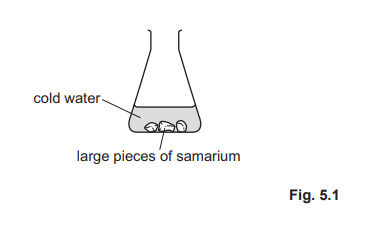
(c) Large pieces of samarium react with cold water to produce hydrogen gas.
(i) Complete Fig. 5.1 by drawing the apparatus to show how the volume of hydrogen gas is measured during this reaction.
(ii) The experiment is repeated using hot water instead of cold water. All other conditions stay the same. Describe how the rate of reaction changes when hot water is used.
(iii) The experiment is repeated using powdered samarium instead of large pieces of samarium. All other conditions stay the same. Describe how the rate of reaction changes when powdered samarium is used.
(d) Table 5.1 shows the observations when samarium and three other metals are heated in oxygen.
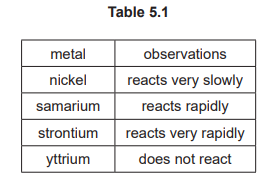
Put the four metals in order of their reactivity. Put the least reactive metal first.

(e) Samarium reacts with oxygen to produce samarium oxide, \(Sm_2O_3\). Complete the symbol equation for this reaction.

(f) Hydrated samarium chloride is an ionic compound.
(i) Define the term hydrated.
(ii) State two physical properties of an ionic compound.
Most-appropriate topic codes (Cambridge IGCSE Chemistry 0620):
• Topic 2.2 — Atomic structure and the Periodic Table (Part (a))
• Topic 8.4 — Transition elements (Part (b))
• Topic 6.2 — Rate of reaction (Parts (c)(ii)-(iii))
• Topic 12.1 — Experimental design (Part (c)(i))
• Topic 9.4 — Reactivity series (Part (d))
• Topic 3.1 — Formulae (Part (e))
• Topic 2.4 — Ions and ionic bonds (Part (f))
▶️ Answer/Explanation
(a)
Electrons: 62
Neutrons: 92
The atomic number (62) equals the number of protons and electrons in a neutral atom. The mass number (154) minus the atomic number (62) gives the number of neutrons (92).
(b)
Correct statement: Samarium has a high density. (4th box down)
Transition elements are known for their high densities, high melting points, and ability to form coloured compounds. Samarium shares this high-density characteristic.
(c)(i)
Gas syringe drawn connected to the reaction vessel, ensuring the apparatus is closed with no air gaps.
The gas syringe must be connected via a delivery tube to the sealed flask containing samarium and water, allowing the evolved hydrogen to push the plunger and be measured directly.
(c)(ii)
The rate increases / goes faster.
Increasing the water temperature gives the reactant particles more kinetic energy, leading to a higher frequency of successful collisions per unit time.
(c)(iii)
The rate increases / goes faster.
Powdered samarium has a larger total surface area in contact with water, providing more particles available for collision at the same time.
(d)
Yttrium < Nickel < Samarium < Strontium (least reactive first).
A metal that does not react is least reactive; a metal that burns brightly is most reactive. Based on the table: yttrium (no reaction) < nickel (slow reaction) < samarium (glows) < strontium (burns brightly).
(e)
\(4\mathrm{Sm} + 3\mathrm{O_2} \rightarrow 2\mathrm{Sm_2O_3}\)
To balance the equation, 4 samarium atoms require 3 oxygen molecules to produce 2 formula units of samarium oxide, conserving the number of each type of atom.
(f)(i)
A hydrated substance is chemically combined with water (water of crystallisation).
Water molecules are part of the crystalline structure of a hydrated salt, usually represented in the formula (e.g., CuSO₄·5H₂O).
(f)(ii)
Two properties: high melting point / high boiling point; conducts electricity when molten or in aqueous solution.
The strong electrostatic forces in the giant ionic lattice require high energy to overcome, leading to high melting points. Ions become mobile when the lattice is melted or dissolved.
Question 6
Sulfur is an element in Group VI of the Periodic Table.

This average mass is compared to 1/12th of the mass of an atom of ………………………… .
Most-appropriate topic codes (Cambridge IGCSE Chemistry 0620):
• Topic 2.2 — Atomic structure and the Periodic Table (Part a, b)
• Topic 1.1 — Solids, liquids and gases (Part c, d(i))
• Topic 3.2 — Relative masses of atoms and molecules (Part d(ii))
• Topic 10.3 — Air quality and climate (Part e(i-iv))
• Topic 7.1 — Characteristic properties of acids and bases (Part e(v))
• Topic 6.3 — Reversible reactions and equilibrium (Part e(vi))
▶️ Answer/Explanation
(a)
An element is a substance where all atoms have the same proton number (or atomic number). It is a pure substance that cannot be broken down into simpler substances by chemical means because it contains only one type of atom.
(b)
The relative atomic mass of sulfur is the average mass of the sulfur isotopes.
This average mass is compared to 1/12th of the mass of an atom of carbon-12 (or 12C).
(c)
Motion: The particles in solid sulfur only vibrate about their fixed positions.
Separation: The particles are very close together (or touching), with virtually no empty space between them.
(d)(i)
Difference 1: A solid has a definite (fixed) shape, whereas a liquid takes the shape of its container (has no definite shape).
Difference 2: A solid does not flow easily, whereas a liquid flows easily to spread out over a surface.
(d)(ii)
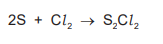
40.5 (g)
The ratio of sulfur to disulfur dichloride is constant. If 6.4 g of S produces 13.5 g of product, then 19.2 g is exactly 3 times larger (19.2 / 6.4 = 3). Therefore, the mass of product is also 3 times larger: 13.5 g × 3 = 40.5 g.
(e)(i)
21 (%)
Clean, dry air is approximately 78% nitrogen, 21% oxygen, and 1% other gases (noble gases and carbon dioxide).
(e)(ii)
Combustion of fossil fuels that contain sulfur compounds (e.g., coal or diesel) or from volcanic eruptions.
(e)(iii)
It causes acid rain (which leads to the acidification of lakes and damage to forests and buildings).
(e)(iv)
Using flue gas desulfurization (removing SO₂ from waste gases) or burning low-sulfur fuels.
(e)(v)
H⁺ (the hydrogen ion).
According to the Brønsted-Lowry theory, acids are proton donors, and in aqueous solution they increase the concentration of H⁺(aq) ions.
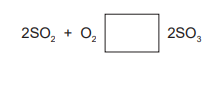
(e)(vi)
⇌
The complete equation is: 2SO₂(g) + O₂(g) ⇌ 2SO₃(g). The double-headed arrow indicates that the forward reaction (producing SO₃) and the reverse reaction (decomposing SO₃) are both occurring simultaneously in a closed system.
Question 7
Magnesium is an element in Group II of the Periodic Table.
(a) Deduce the electronic configuration of magnesium.
(b) Magnesium can be produced by reducing magnesium oxide with barium.
MgO + Ba → Mg + BaO
Explain how this equation shows that magnesium oxide is reduced.
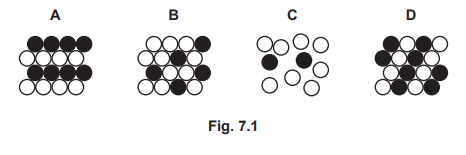
(c) Alloys of magnesium and aluminium are resistant to corrosion. Choose the diagram, A, B, C or D, in Fig. 7.1 that best shows the structure of an alloy.
(d) (i) Complete the word equation for the reaction of magnesium oxide with hydrochloric acid.

(ii) Magnesium oxide is insoluble in water. Choose from the list one other compound that is insoluble in water. Tick (✓) one box.

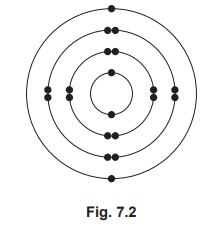
(e) Fig. 7.2 shows the electronic configuration of an element in Group II of the Periodic Table.
Deduce the period in the Periodic Table to which this element belongs.
Most-appropriate topic codes (Cambridge IGCSE Chemistry 0620):
• Topic 2.2 — Atomic structure and the Periodic Table (Parts a, e)
• Topic 6.4 — Redox (Part b)
• Topic 9.3 — Alloys and their properties (Part c)
• Topic 7.1 — Characteristic properties of acids and bases (Part d.i)
• Topic 7.3 — Preparation of salts / solubility rules (Part d.ii)
▶️ Answer/Explanation
(a)
2,8,2
Magnesium has proton number 12. Its electrons fill the first shell (2), second shell (8), and the remaining 2 electrons go into the third shell, giving the electronic configuration 2.8.2.
(b)
Magnesium oxide loses oxygen.
In the reaction MgO + Ba → Mg + BaO, magnesium oxide (MgO) loses an oxygen atom to become magnesium (Mg). The loss of oxygen from a substance is the definition of reduction (oxygen gain is oxidation, oxygen loss is reduction).
(c)
B
An alloy is a mixture of a metal with other elements (which may be metals or non-metals). The diagram showing randomly arranged different-sized atoms (distorted regular arrangement) represents an alloy, whereas pure metals have a regular, ordered lattice. Diagram B illustrates this mixed, irregular atomic packing.
(d)(i)
magnesium chloride water
The word equation is: magnesium oxide + hydrochloric acid → magnesium chloride + water. This is a neutralisation reaction between a base (metal oxide) and an acid, producing a salt (magnesium chloride) and water only.
(d)(ii)
First box from top ticked (magnesium carbonate)
Using the solubility rules: sodium sulfate and potassium chloride are soluble; magnesium sulfate is soluble. Magnesium carbonate is insoluble in water (most carbonates are insoluble except those of Group I and ammonium).
(e)
4 (four)
The electronic configuration shown has electrons in four shells (the largest shell number occupied is 4). The period number of an element equals the number of occupied electron shells. Therefore this element is in Period 4.