
Question 1
Iron ore contains iron(III) oxide, \(Fe_2O_3\). A blast furnace is used to extract iron from \(Fe_2O_3\).
Equations for some of the reactions in the blast furnace are shown.
equation 1 \(C + O_2 → CO_2\)
equation 2 \(CaCO_3 → CaO + CO_2\)
equation 3 \(CaO + SiO_2 → CaSiO_3\)
(a) Equation 1 shows the combustion of carbon in the blast furnace.
(i) Name the substance which provides the carbon for this reaction.
(ii) State the purpose of the combustion of carbon in the blast furnace.
(b) Iron(III) oxide, \(Fe_2O_3\), in iron ore is converted to iron when it reacts with carbon monoxide, CO, in the blast furnace.
(i) Calculate the percentage by mass of iron in iron(III) oxide, \(Fe_2O_3\).
(ii) State the name of the iron ore which consists mainly of iron(III) oxide.
(iii) Describe how carbon monoxide is formed in the blast furnace.
(iv) Write the symbol equation to show the reaction that occurs when iron(III) oxide is converted to iron in the blast furnace.
(v) Name the chemical process which happens to iron when iron(III) oxide is converted to iron in the blast furnace.
(c) State the type of reaction shown by equation 2.
(d) (i) Explain why the reaction in equation 3 can be described as an acid–base reaction.
(ii) State:
● the chemical name of \(SiO_2\)
● the common name given to \(CaSiO_3\) when it is formed in the blast furnace.
(e) Aluminium cannot be extracted from its ore using a blast furnace.
(i) State why aluminium is not extracted from its ore using a blast furnace.
(ii) Name the process used to extract aluminium from its ore.
(f) Both iron(III) oxide and aluminium oxide contain metal ions with a 3+ charge.
(i) Write the electronic configuration of an \(Al^{3+}\) ion
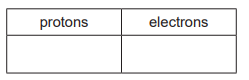
(ii) Deduce the number of protons and electrons in an \(Fe^{3+}\) ion.
Most-appropriate topic codes (Cambridge IGCSE Chemistry 0620):
• Topic 9.6 — Extraction of metals (Parts a, b, e)
• Topic 3.2 — Relative masses of atoms and molecules (Part b(i))
• Topic 6.4 — Redox (Part b(v))
• Topic 7.2 — Oxides (Part d(i))
• Topic 2.2 — Atomic structure and the Periodic Table (Part f)
▶️ Answer/Explanation
(a)(i) Coke (a form of carbon, obtained from coal).
(a)(ii) To provide heat (and also to produce carbon monoxide for the reduction of iron ore).
(b)(i) Step 1: Calculate \(M_r\) of \(Fe_2O_3\): \( (2 \times 56) + (3 \times 16) = 112 + 48 = 160\). Step 2: Percentage by mass of iron = \(\frac{112}{160} \times 100\% = 70.0\%\).
(b)(ii) Haematite (the main commercial ore of iron).
(b)(iii) Carbon monoxide is formed when carbon dioxide (from combustion) reacts with more hot coke: \(CO_2 + C \rightarrow 2CO\).
(b)(iv) \(Fe_2O_3 + 3CO \rightarrow 2Fe + 3CO_2\) (carbon monoxide reduces the iron(III) oxide to molten iron).
(b)(v) Reduction (the iron(III) oxide loses oxygen to form iron, so it is reduced).
(c) Thermal decomposition (calcium carbonate breaks down into calcium oxide and carbon dioxide when heated).
(d)(i) Calcium oxide (CaO) is a basic oxide (reacts with acids) and silicon dioxide (\(SiO_2\)) is an acidic oxide (reacts with bases); their reaction forms a salt (calcium silicate).
(d)(ii) Chemical name of \(SiO_2\): silicon(IV) oxide. Common name of \(CaSiO_3\): slag.
(e)(i) Aluminium is more reactive than carbon, so carbon cannot displace aluminium from its oxide in a blast furnace.
(e)(ii) Electrolysis (of molten aluminium oxide dissolved in cryolite).
(f)(i) Electronic configuration of \(Al^{3+}\): 2,8 (aluminium atom loses its 3 outer electrons, leaving the full second shell).
(f)(ii) In \(Fe^{3+}\): Number of protons = 26 (atomic number of iron). Number of electrons = 23 (26 protons minus the 3+ charge means 3 electrons lost).
Question 2
The elements in Group VII of the Periodic Table are known as the halogens. Halogens can form halide ions.
(a) Identify the halogen with the lowest density at r.t.p. (room temperature and pressure).
(b) State the appearance of bromine at r.t.p.
(c) Use the Periodic Table to:
● give the symbol of the halogen with the highest atomic number
● deduce the number of occupied electron shells in an atom of this element.
(d) Bromine molecules have covalent bonding.
(i) State what is meant by the term covalent bond.
(ii) Name one halide ion which bromine molecules can displace.
(iii) Explain why bromine can displace the halide ion in (d)(ii).
(e) Name a halide compound which can be used to detect the presence of water.
(f) Calcium chloride is an ionic compound. Complete the dot-and-cross diagram in Fig. 2.1 for the ions in calcium chloride. Give the charges on each of the ions.

(g) Aqueous lead(II) ions are added to aqueous chloride ions. A white precipitate of insoluble lead(II) chloride, \(PbCl_2\), is formed.
(i) Name a lead(II) compound which can be used in this reaction.
(ii) Write the ionic equation for this reaction. Include state symbols.
(iii) Name one other insoluble chloride.
Most-appropriate topic codes (Cambridge IGCSE Chemistry 0620):
• Topic 8.3 — Group VII properties (Parts a, b, c, d)
• Topic 2.5 — Simple molecules and covalent bonds (Part d(i))
• Topic 10.1 — Water (Part e)
• Topic 2.4 — Ions and ionic bonds (Part f)
• Topic 12.5 — Identification of ions and gases (Part g)
▶️ Answer/Explanation
(a) Fluorine (F₂) is the halogen with the lowest density at r.t.p. As we move down Group VII, both atomic mass and atomic size increase, leading to a steady increase in density from fluorine to astatine. Fluorine is a gas with very low density.
(b) Bromine appears as a red-brown liquid at room temperature and pressure. It is the only non-metal that is liquid at r.t.p., with a characteristic deep reddish-brown color and volatile nature.
(c) Tennessine (Ts) is the halogen with the highest atomic number (117). It has 7 occupied electron shells because it is in Period 7 of the Periodic Table, meaning its electrons fill shells 1 through 7. Ts is a synthetic superheavy element.
(d)(i) A covalent bond is formed when a pair of electrons is shared between two atoms. This sharing allows each atom to achieve a stable noble gas electronic configuration, usually a full outer shell of 8 electrons (octet rule).
(d)(ii) Bromine molecules can displace iodide ions (I⁻). In the displacement reaction, bromine (more reactive) oxidizes iodide to iodine while itself being reduced to bromide ions.
(d)(iii) Bromine can displace iodide because bromine is more reactive (higher in Group VII) than iodine. Reactivity decreases down Group VII, so a more reactive halogen will displace a less reactive halide from its compound.
(e) Anhydrous cobalt(II) chloride (CoCl₂) is a blue halide compound used to test for water. It turns pink in the presence of water, forming hydrated cobalt(II) chloride (CoCl₂·6H₂O).
(f) The dot-and-cross diagram for calcium chloride (CaCl₂) shows: a Ca²⁺ ion with its 4th shell empty (8 crosses in the 3rd shell for [Ar] configuration, but commonly drawn with no outer electrons after losing 2 e⁻). Each Cl⁻ ion has 8 outer electrons (7 original + 1 gained), shown as 7 dots and 1 cross (or vice versa) around each Cl with a full octet. The charges are ‘2+’ on calcium and ‘-‘ on each chloride ion.
(g)(i) Lead(II) nitrate [Pb(NO₃)₂] is a soluble lead(II) compound commonly used to provide Pb²⁺ ions in precipitation reactions because it mixes well with other aqueous solutions.
(g)(ii) Pb²⁺(aq) + 2Cl⁻(aq) → PbCl₂(s). The ionic equation shows only the reacting ions forming the solid precipitate, omitting spectator ions. State symbols indicate aqueous ions and solid product.
(g)(iii) Silver chloride (AgCl) is another insoluble chloride. Like PbCl₂, it forms a white precipitate when silver ions are added to chloride-containing solutions, and it is used in qualitative analysis to identify Cl⁻ ions.
Question 3
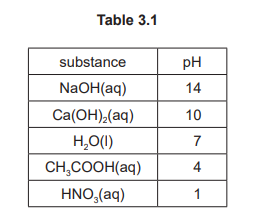
This question is about acids, bases and alkalis. Table 3.1 shows the pH values of some substances.
(a) Define the term base.
(b) State what is meant by the term alkali.
(c) Thymolphthalein is an indicator. State the colour of thymolphthalein in:
● NaOH(aq)
● CH₃COOH(aq)
(d) (i) Use the information in Table 3.1 to identify the substance with the highest concentration of H⁺(aq) ions. Explain your answer.
(ii) Name an indicator which can be used to identify the substance with the highest concentration of H⁺(aq) ions
(e) Complete the equation to show the dissociation of ethanoic acid, CH₃COOH, in aqueous solution.
(f) Write the ionic equation which represents a neutralisation reaction between any acid and any alkali.
(g) Dilute nitric acid, HNO₃(aq), reacts with aqueous calcium hydroxide, Ca(OH)₂(aq), as shown.
2HNO₃(aq) + Ca(OH)₂(aq) → Ca(NO₃)₂(aq) + 2H₂O(l)
20.0 cm³ of 0.0150 mol/dm³ Ca(OH)₂(aq) reacts with 25.0 cm³ of HNO₃(aq). Calculate the concentration of HNO₃(aq) in g/dm³. Use the following steps.
● Calculate the number of moles of Ca(OH)₂(aq) used.
● Determine the number of moles of HNO₃(aq) which react with the Ca(OH)₂(aq).
● Calculate the concentration of HNO₃(aq) in mol/dm³
● Calculate the concentration of HNO₃(aq) in g/dm³.
Most-appropriate topic codes (Cambridge IGCSE Chemistry 0620):
• Topic 7.1 — The characteristic properties of acids and bases (Parts (a), (b), (c), (d)(ii), (e), (f))
• Topic 7.1 — The characteristic properties of acids and bases / pH scale (Part (d)(i))
• Topic 3.3 — The mole and the Avogadro constant / Titration calculations (Part (g))
▶️ Answer/Explanation
(a) A base is a substance that accepts protons (H⁺ ions).
Alternatively, a base is a substance that neutralises an acid to form a salt and water. In terms of the Brønsted-Lowry theory, bases are proton acceptors, which explains their ability to react with and neutralise acids.
(b) An alkali is a soluble base that releases hydroxide ions (OH⁻) in aqueous solution.
This means that while all alkalis are bases, not all bases are alkalis because some bases are insoluble in water and do not produce OH⁻ ions in solution.
(c) NaOH(aq): blue / CH₃COOH(aq): colourless
Thymolphthalein is an indicator that turns blue in alkaline conditions (high pH) and remains colourless in acidic or neutral conditions. NaOH is a strong alkali, while ethanoic acid is a weak acid.
(d)(i) The substance is HNO₃ (nitric acid) because it has the lowest pH (pH = 1).
The concentration of H⁺ ions is inversely related to pH; a lower pH indicates a higher concentration of hydrogen ions. Among the substances listed, nitric acid is the strongest acid with the lowest pH value.
(d)(ii) Universal indicator (or a pH meter).
Universal indicator gives a distinct colour change over a wide pH range, allowing a precise estimation of pH, whereas many single indicators only change colour at a specific pH point.
(e) CH₃COOH(aq) ⇌ CH₃COO⁻(aq) + H⁺(aq).
Ethanoic acid is a weak acid, so it dissociates only partially, which is shown by the equilibrium arrow (⇌). The products are the ethanoate ion (CH₃COO⁻) and a hydrogen ion (H⁺).
(f) H⁺(aq) + OH⁻(aq) → H₂O(l).
This net ionic equation represents the fundamental chemical change that occurs in all neutralisation reactions: hydrogen ions from the acid combine with hydroxide ions from the alkali to form water molecules.
(g) Calculation of the concentration of HNO₃(aq) in g/dm³:
Step 1: Moles of Ca(OH)₂ = concentration × volume (in dm³) = 0.0150 mol/dm³ × (20.0/1000) dm³ = 3.00 × 10⁻⁴ mol.
Remember to always convert the volume from cm³ to dm³ by dividing by 1000 before multiplying by concentration.
Step 2: Moles of HNO₃ = 2 × moles of Ca(OH)₂ = 2 × (3.00 × 10⁻⁴) = 6.00 × 10⁻⁴ mol.
From the balanced chemical equation, 2 moles of HNO₃ react with 1 mole of Ca(OH)₂, hence the mole ratio is 2:1.
Step 3: Concentration of HNO₃ (mol/dm³) = moles / volume (in dm³) = (6.00 × 10⁻⁴ mol) / (25.0/1000 dm³) = 0.0240 mol/dm³.
Using the same volume conversion as above, dividing the number of moles by the volume in dm³ gives the molar concentration of the acid.
Step 4: Concentration of HNO₃ (g/dm³) = concentration (mol/dm³) × Mᵣ(HNO₃). Mᵣ(HNO₃) = 1 + 14 + (3×16) = 63 g/mol. So, 0.0240 mol/dm³ × 63 g/mol = 1.51 g/dm³ (rounded to 3 significant figures).
Converting molar concentration to mass concentration requires multiplying by the relative molecular mass of the solute (nitric acid).
Question 4
The equation for the reaction between methanoic acid and ethanol in the presence of a catalyst can be represented as shown.

X represents the ester formed.
(a) (i) In the equation, methanoic acid is represented by the formula HCOOH. Name this type of formula.
(ii) Write the empirical formula of methanoic acid.
(b) Name and draw the displayed formula of ester X.
(c) The reaction is reversible and reaches an equilibrium within a closed system.
(i) State what is meant by the term closed system.
(ii) State two characteristics of an equilibrium.
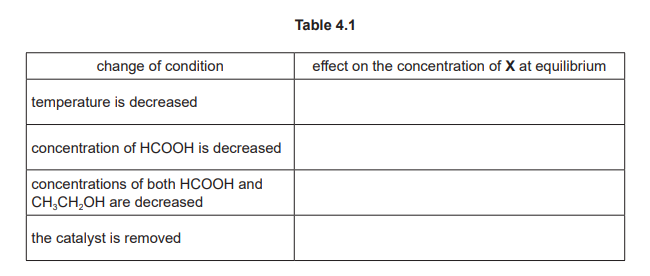
(iii) Complete Table 4.1 to show the effect, if any, on the concentration of X at equilibrium for each change of condition.
Most-appropriate topic codes (Cambridge IGCSE Chemistry 0620):
• Topic 11.1 — Formulae, functional groups and terminology (Part (a))
• Topic 11.7 — Carboxylic acids (ester formation) (Part (b))
• Topic 6.3 — Reversible reactions and equilibrium (Parts (c)(i), (c)(ii), (c)(iii))
▶️ Answer/Explanation
(a)(i) structural formula
Detailed solution: The formula HCOOH shows how the atoms are arranged in the molecule (the H attached to the C and the H in the carboxyl group -COOH). This is the definition of a structural formula, unlike a molecular formula (CH₂O₂) which only gives atom counts.
(a)(ii) CH₂O₂
Detailed solution: The molecular formula of methanoic acid is CH₂O₂. This is already in its simplest whole-number ratio (C:H:O = 1:2:2), so the empirical formula is the same as the molecular formula.
(b) Name: ethyl methanoate
Displayed formula:
H H H
| | |
H–C–C–O–C=O
| | |
H H H
(Alternatively, a more standard drawing: HCOO–CH₂CH₃ with all bonds shown explicitly).
Detailed solution: Methanoic acid (HCOOH) reacts with ethanol (CH₃CH₂OH) via esterification. The H from the carboxyl group of the acid and the OH from the alcohol are eliminated as water. The remaining parts join: the HCOO- group from the acid bonds to the -CH₂CH₃ group from the alcohol to form ethyl methanoate.
(c)(i) A closed system is one where nothing (matter or energy, though in IGCSE focus is on no matter) can enter or leave the reaction mixture.
Detailed solution: In a closed system, the reaction vessel is sealed so that no reactants or products are added or removed. This allows the forward and reverse reactions to eventually balance each other without external interference.
(c)(ii) Two characteristics of an equilibrium:
1. The rate of the forward reaction equals the rate of the reverse reaction.
2. The concentrations of reactants and products are constant (but not necessarily equal).
Detailed solution: At dynamic equilibrium, the reaction has not stopped; it continues in both directions at the same speed, so macroscopic properties like concentration and color no longer change over time.
(c)(iii) Completed Table 4.1:
- Adding more ethanol: increases
- Removing water: decreases
- Adding catalyst: no effect
- Increasing temperature (assuming forward reaction is exothermic): decreases
Detailed solution: Adding a reactant (ethanol) shifts equilibrium right (Le Châtelier) to increase X. Removing a product (water) also shifts right. A catalyst speeds up both directions equally, reaching equilibrium faster but not changing the position/concentration. The reaction is esterification, which is exothermic; increasing temperature favors the endothermic reverse reaction, decreasing X.
Question 5
Butane and but-1-ene are colourless gases at room temperature and pressure.
(a) Suggest why but-1-ene diffuses quicker than butane.
(b) Identify the products formed when butane undergoes complete combustion.
(c) One molecule of butane reacts with one molecule of chlorine in the presence of ultraviolet light. During the reaction, one hydrogen atom in butane is replaced by one chlorine atom.
(i) Name the type of reaction which needs ultraviolet light.
(ii) State the purpose of ultraviolet light during this reaction.
(iii) Name the type of reaction which takes place when one atom of chlorine replaces one atom of hydrogen.
(iv) Determine how many different structural isomers can form during this reaction.
(d) When but-1-ene reacts with steam, two possible products form.
(i) Identify the type of catalyst which is used in this reaction.
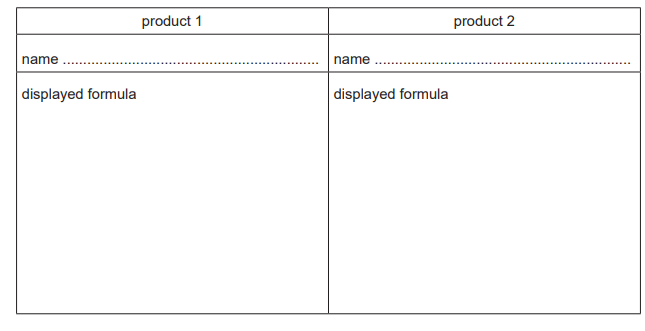
(ii) Name and draw the displayed formulae of the two possible products.
(e) But-1-ene undergoes polymerisation.
(i) State the type of polymerisation but-1-ene undergoes.
(ii) Draw part of the polymer molecule to show three repeat units.
Most-appropriate topic codes (Cambridge IGCSE Chemistry 0620):
• Topic 1.2 — Diffusion (Part (a))
• Topic 11.3 — Fuels / Combustion (Part (b))
• Topic 11.4 — Alkanes / Substitution / Photochemical reactions (Parts (c)(i)-(iv))
• Topic 11.5 — Alkenes / Addition reactions (Parts (d)(i)-(ii))
• Topic 11.8 — Polymers / Addition polymerisation (Parts (e)(i)-(ii))
▶️ Answer/Explanation
(a) But-1-ene diffuses quicker because it has a lower relative molecular mass (or is lighter) than butane.
Detailed solution: At the same temperature, the rate of diffusion of a gas is inversely proportional to the square root of its molar mass (Graham’s Law). But-1-ene (C₄H₈, Mᵣ = 56) has a slightly lower molecular mass than butane (C₄H₁₀, Mᵣ = 58). Lighter molecules move faster on average, leading to quicker diffusion.
(b) Carbon dioxide (CO₂) and water (H₂O).
Detailed solution: Complete combustion of any hydrocarbon (containing only C and H) in excess oxygen always produces only two products: carbon dioxide and water. The equation is: 2C₄H₁₀ + 13O₂ → 8CO₂ + 10H₂O.
(c)(i) Photochemical reaction.
Detailed solution: A photochemical reaction is one that requires light energy (in this case, ultraviolet light) to initiate or drive the reaction.
(c)(ii) To provide the activation energy (Eₐ) for the reaction (or to break the chlorine-chlorine bond).
Detailed solution: UV light provides the energy needed to break the Cl-Cl bond (bond energy ~242 kJ/mol). This splits the chlorine molecule into two highly reactive chlorine radicals (Cl•) via homolytic fission.
(c)(iii) Substitution reaction.
Detailed solution: A substitution reaction is defined as a reaction where an atom (or group of atoms) is replaced by another atom (or group of atoms). Here, a hydrogen atom is replaced by a chlorine atom.
(c)(iv) 2 (two) different structural isomers.
Detailed solution: Butane (CH₃-CH₂-CH₂-CH₃) has two non-equivalent types of hydrogen atoms: those attached to the end carbons (1° hydrogen, giving 1-chlorobutane) and those attached to the middle carbons (2° hydrogen, giving 2-chlorobutane). Chlorination at any of the four terminal carbons yields the same product (1-chlorobutane), and chlorination at the two middle carbons yields the same product (2-chlorobutane).
(d)(i) An acid catalyst.
Detailed solution: The industrial hydration of alkenes (ethene to ethanol, etc.) uses a catalyst of concentrated phosphoric acid (H₃PO₄) supported on silica. In the lab, dilute sulfuric acid can also be used.
(d)(ii) The two possible products are butan-1-ol and butan-2-ol.
Detailed solution: The addition of water (H-OH) to an unsymmetrical alkene like but-1-ene (CH₂=CH-CH₂-CH₃) follows Markovnikov’s rule. The hydrogen atom adds to the carbon with more hydrogens, forming butan-2-ol (major), while a small amount of butan-1-ol (minor) is also formed via anti-Markovnikov addition.
Displayed formulae:
- Butan-1-ol: H H H H
| | | |
H-C-C-C-C-O-H
| | | |
H H H H - Butan-2-ol: H H H H
| | | |
H-C-C-C-C-H
| | | |
H H O H
|
H
(e)(i) Addition polymerisation.
Detailed solution: But-1-ene is an alkene (contains a C=C double bond). Alkenes polymerise by opening their double bonds and joining together end-to-end without the loss of any small molecule, which is the defining feature of addition polymerisation.
(e)(ii) Part of the polymer (poly(but-1-ene)) showing three repeat units.
Detailed solution: The polymer chain consists of a backbone of carbon atoms (with single bonds) formed from the opened double bonds. The ethyl (C₂H₅) group remains as a pendant (side) group. The continuation bonds (represented by the ‘kinks’ or lines at the ends) indicate the chain continues in both directions.
Drawing:
H H H H H H
| | | | | |
-C – C – C – C – C – C –
| | | | | |
H C₂H₅ H C₂H₅ H C₂H₅
(repeating unit)