
Question 1
Most-appropriate topic codes (Cambridge IGCSE Chemistry 0620):
▶️ Answer/Explanation
Detailed solution:
Taking the shape of the container is a key distinguishing property shared by both liquids and gases. Liquids have a fixed volume but take the shape of their container, while gases take both the shape and the volume of their container. Solids, on the other hand, have a fixed shape and volume — they do not conform to the shape of a container because their particles are held in fixed positions in a rigid lattice. Since substance L takes the shape of the container, it must be either a liquid or a gas, making option A the correct answer.
Question 2
| M | N | O | |
|---|---|---|---|
| melting point / °C | −114 | 115 | −101 |
| boiling point / °C | 78 | 445 | −34 |
| M | N | O | |
|---|---|---|---|
| A | chlorine | ethanol | sulfur |
| B | ethanol | sulfur | chlorine |
| C | sulfur | chlorine | ethanol |
| D | sulfur | ethanol | chlorine |
Most-appropriate topic codes (Cambridge IGCSE Chemistry 0620):
• Topic 12.4: Separation and purification — Identify substances and assess their purity using melting point and boiling point information.
▶️ Answer/Explanation
Detailed solution:
Substance N has the highest melting point (115 °C) and boiling point (445 °C) of the three — this matches sulfur, which is a solid at room temperature with very high thermal stability. Substance O has both a melting point and boiling point below 0 °C (m.p. = −101 °C, b.p. = −34 °C), meaning it is a gas at room temperature — this matches chlorine (Cl₂). Substance M has a melting point of −114 °C but a boiling point of 78 °C, meaning it is a liquid at room temperature — this perfectly matches ethanol (CH₃CH₂OH). Therefore, M = ethanol, N = sulfur, O = chlorine, which is option B.
Question 3
Most-appropriate topic codes (Cambridge IGCSE Chemistry 0620):
• Topic 2.2: Atomic structure and the Periodic Table — State that Group VIII noble gases have a full outer electron shell.
▶️ Answer/Explanation
Detailed solution:
Chemical reactivity depends on the arrangement of electrons, specifically the outer electron shell. Noble gases have a completely filled outer electron shell (e.g., helium has 2, and the others have 8 outer electrons), which is an extremely stable configuration. Because they have no need to gain, lose, or share electrons to achieve stability, they do not form chemical bonds and are effectively unreactive. Options A, B, and D describe observable characteristics of noble gases but do not explain the underlying reason for their lack of reactivity — only option C addresses the cause.
Question 4
Most-appropriate topic codes (Cambridge IGCSE Chemistry 0620):
• Topic 2.4: Ions and ionic bonds — Describe the formation of negative ions, known as anions.
▶️ Answer/Explanation
Detailed solution:
Phosphorus has atomic number 15, so a neutral P atom has 15 electrons arranged as 2, 8, 5. The P3− ion has gained 3 extra electrons (since it carries a 3− charge), giving it a total of 15 + 3 = 18 electrons. These 18 electrons fill the shells as: 2 (first shell) + 8 (second shell) + 8 (third shell) = 2, 8, 8. This is the same electron configuration as argon (a noble gas), which explains why the P3− ion is stable. The correct answer is D.
Question 5
| atom or ion | charge | proton number | number of electrons | nucleon number |
|---|---|---|---|---|
| Q | +3 | 10 | 27 | |
| R | +2 | 12 | 24 | |
| S | +2 | 10 | 26 | |
| T | 16 | 16 |
Most-appropriate topic codes (Cambridge IGCSE Chemistry 0620):
▶️ Answer/Explanation
Detailed solution:
Isotopes are atoms of the same element (same proton number) but different nucleon numbers. For R: proton number = 12, charge = +2, so it has lost 2 electrons, confirming 10 electrons. For S: charge = +2, electrons = 10, so proton number = 10 + 2 = 12. Both R and S therefore have a proton number of 12 (magnesium), but different nucleon numbers (24 and 26 respectively), making them isotopes of magnesium. Q has a proton number of 10 + 3 = 13 (aluminium), and T has proton number 16 (sulfur) — neither matches the other. The answer is C.
Question 6
| metal atom | non-metal atom | |
|---|---|---|
| A | gains electrons to form a cation | gains electrons to form an anion |
| B | gains electrons to form a cation | loses electrons to form an anion |
| C | loses electrons to form a cation | gains electrons to form a cation |
| D | loses electrons to form a cation | gains electrons to form an anion |
Most-appropriate topic codes (Cambridge IGCSE Chemistry 0620):
▶️ Answer/Explanation
Detailed solution:
In ionic bonding, metals have few outer-shell electrons which they lose to form positively charged cations (e.g., Na → Na⁺). Non-metals have nearly full outer shells and gain electrons to form negatively charged anions (e.g., Cl + e⁻ → Cl⁻). A cation is a positive ion (formed by losing electrons) and an anion is a negative ion (formed by gaining electrons). Option D correctly states that the metal atom loses electrons to form a cation and the non-metal atom gains electrons to form an anion — this is the fundamental process of ionic bond formation.
Question 7
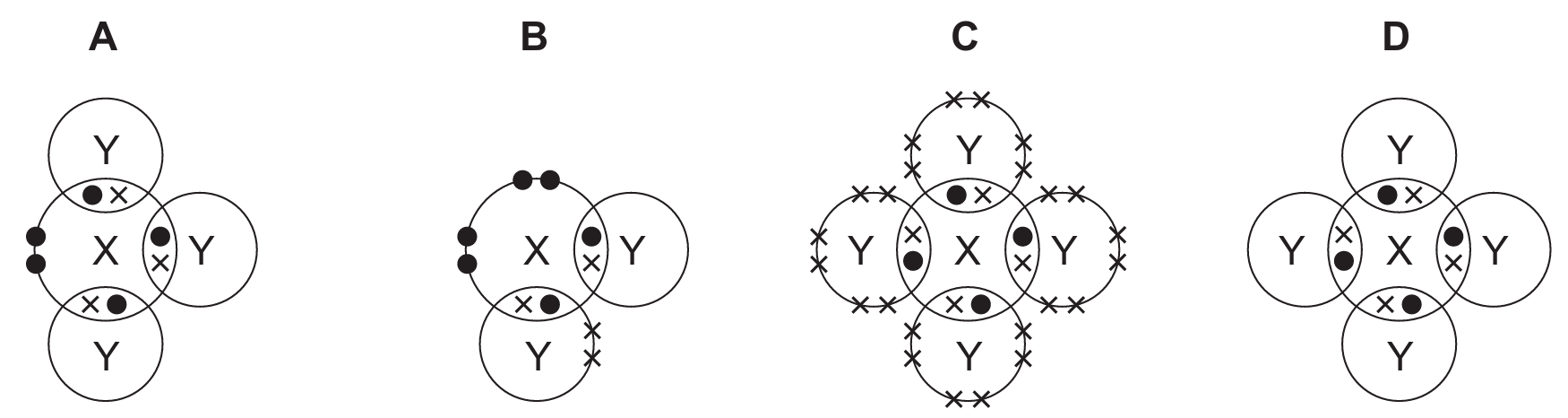
Most-appropriate topic codes (Cambridge IGCSE Chemistry 0620):
▶️ Answer/Explanation
Detailed solution:
Methane (CH₄) consists of one carbon atom (4 outer electrons) covalently bonded to four hydrogen atoms (1 outer electron each). In the dot-and-cross diagram, the central carbon atom shares one pair of electrons with each of the four hydrogen atoms, forming four single covalent C–H bonds. There are no lone pairs on the central carbon atom once all four bonds are formed, as all four of carbon’s outer electrons are used in bonding. The correct diagram (D) shows exactly this: one central X (carbon) surrounded symmetrically by four Y (hydrogen) atoms, each sharing one pair of electrons, with no lone pairs remaining on X.
Question 8
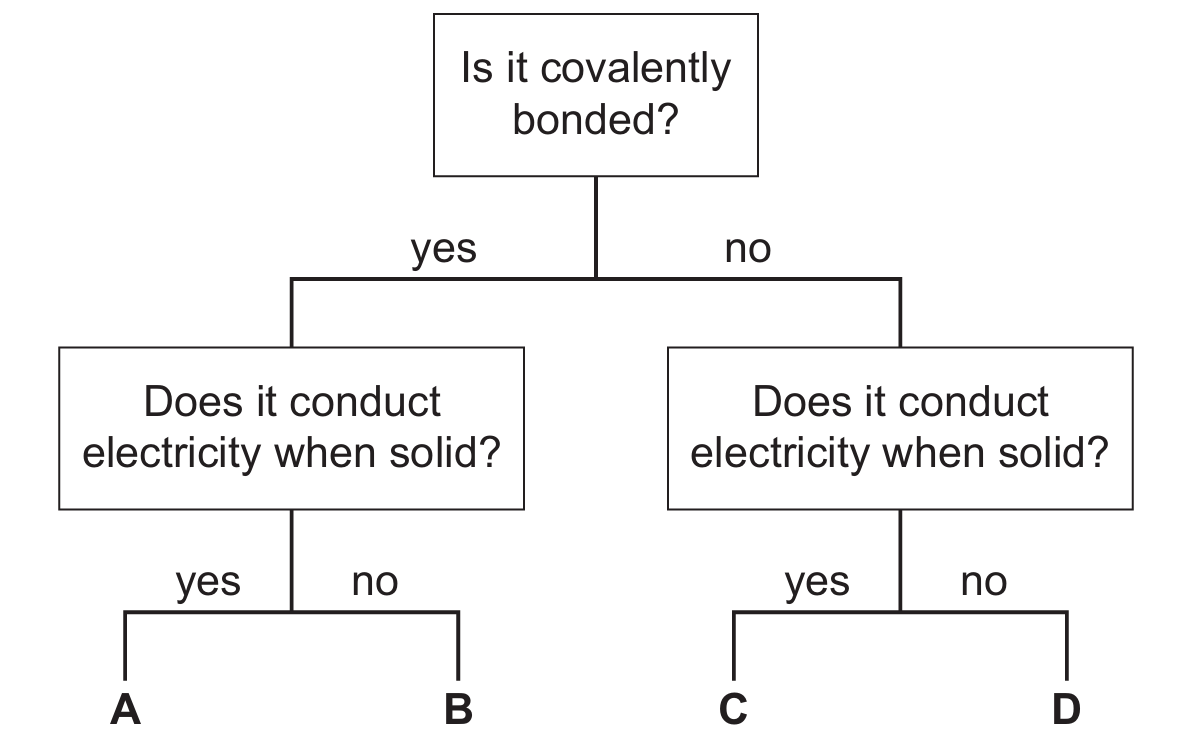
Most-appropriate topic codes (Cambridge IGCSE Chemistry 0620):
▶️ Answer/Explanation
Detailed solution:
Graphite is a giant covalent structure in which each carbon atom is bonded to three others via strong covalent bonds, forming layers of hexagonal rings. Each carbon contributes one electron to a delocalized “sea” of electrons that exists between the layers — these mobile electrons allow graphite to conduct electricity even in the solid state, making it unique among non-metals. Following the pathway: graphite is covalently bonded (Yes) and it does conduct electricity when solid (Yes), which leads to option A. This combination of properties is what makes graphite useful as an electrode material.
Question 9
| name | formula | |
|---|---|---|
| A | cobalt(II) chloride | CuCl₂ |
| B | ethane | C₂H₆ |
| C | helium | He₂ |
| D | iron(III) oxide | Fe₃O₂ |
Most-appropriate topic codes (Cambridge IGCSE Chemistry 0620):
• Topic 11.4: Alkanes — Know the formula of ethane (C₂H₆).
• Topic 8.5: Noble gases — Noble gases are monatomic (He, not He₂).
▶️ Answer/Explanation
Detailed solution:
Option A is wrong: CuCl₂ is copper(II) chloride, not cobalt(II) chloride (which should be CoCl₂). Option C is wrong: helium is a noble gas that exists as single atoms — its formula is He, not He₂ (noble gases are monatomic). Option D is wrong: iron(III) oxide has iron in the +3 state; balancing charges gives Fe₂O₃ (2 × (+3) = 3 × (−2) = 6), not Fe₃O₂. Option B is correct: ethane is the two-carbon alkane with formula C₂H₆, following the general alkane formula CₙH₂ₙ₊₂ with n = 2, giving C₂H₆. The correct answer is B.
Question 10
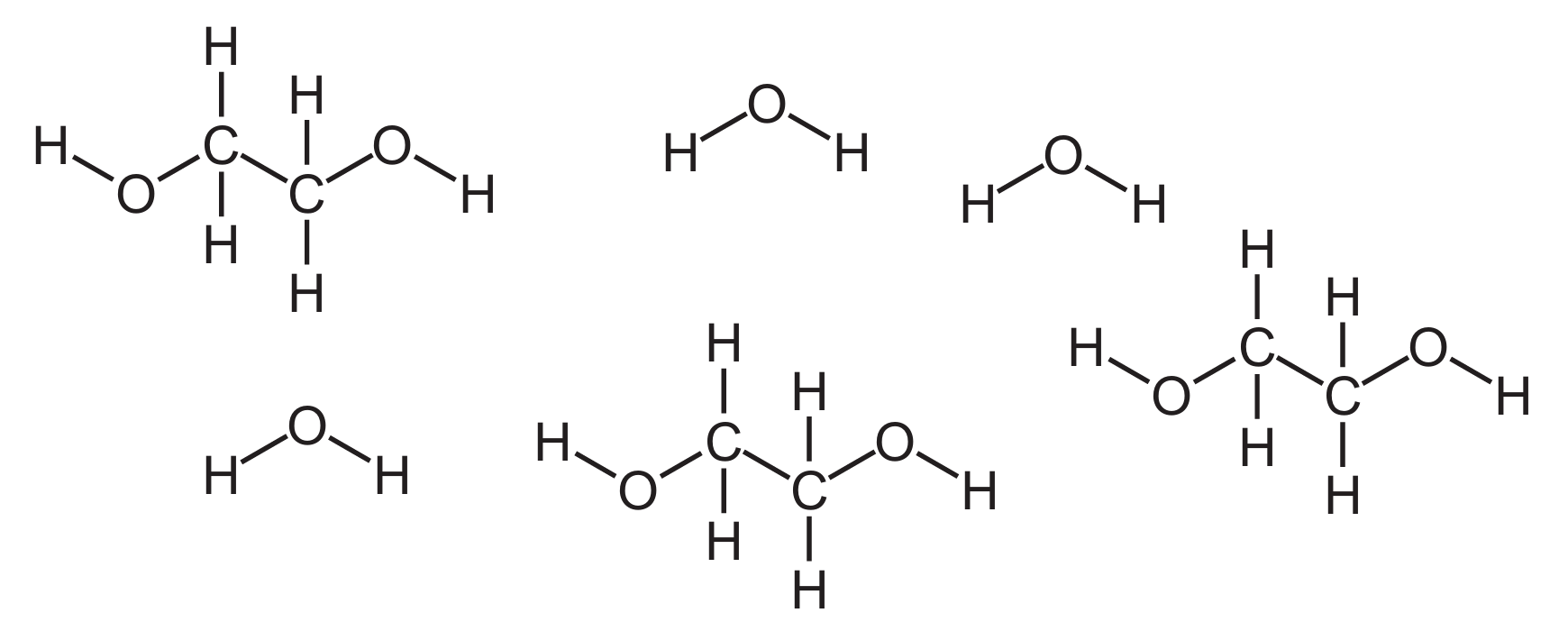
Most-appropriate topic codes (Cambridge IGCSE Chemistry 0620):
• Topic 3.1: Formulae — Deduce the formula of a simple compound from the relative numbers of atoms present in a diagrammatic representation.
▶️ Answer/Explanation
Detailed solution:
By counting all atoms in the displayed formula HO–CH₂–CH₂–OH: there are 2 carbon atoms (C₂), 4 hydrogen atoms on the two CH₂ groups plus 2 hydrogen atoms on the two OH groups = 6 hydrogen atoms (H₆), and 2 oxygen atoms from the two OH groups (O₂). This gives the molecular formula C₂H₆O₂. Options C and D are incorrect atom counts, and A is simply the empirical formula CHO (which doesn’t match the displayed structure). The correct molecular formula is C₂H₆O₂, option B.
Question 11
Most-appropriate topic codes (Cambridge IGCSE Chemistry 0620):
• Topic 3.3: The mole and the Avogadro constant — Use the relationship: amount of substance (mol) = mass (g) / molar mass (g/mol); Calculate stoichiometric reacting masses.
▶️ Answer/Explanation
Detailed solution:
First, calculate moles of Mg: moles = mass ÷ molar mass = 6.0 g ÷ 24 g/mol = 0.25 mol. From the balanced equation, 2 mol Mg produces 2 mol MgO, so the molar ratio is 1:1, meaning 0.25 mol Mg produces 0.25 mol MgO. The molar mass of MgO = 24 + 16 = 40 g/mol. Therefore, mass of MgO = 0.25 mol × 40 g/mol = 10 g. The correct answer is A.
Question 12
| product formed at the anode | product formed at the cathode | |
|---|---|---|
| A | oxygen | hydrogen |
| B | hydrogen | oxygen |
| C | sulfur dioxide | hydrogen |
| D | oxygen | sulfur dioxide |
Most-appropriate topic codes (Cambridge IGCSE Chemistry 0620):
▶️ Answer/Explanation
Detailed solution:
In the electrolysis of dilute sulfuric acid using inert electrodes, two types of ions are present in solution: H⁺ ions, SO₄²⁻ ions, and water molecules. At the cathode (negative electrode), H⁺ ions are reduced: 2H⁺ + 2e⁻ → H₂, producing hydrogen gas. At the anode (positive electrode), water molecules are preferentially oxidized over SO₄²⁻ ions: 2H₂O → O₂ + 4H⁺ + 4e⁻, producing oxygen gas. Sulfate ions remain in solution as they require more energy to discharge. Therefore oxygen forms at the anode and hydrogen at the cathode — option A.
Question 13
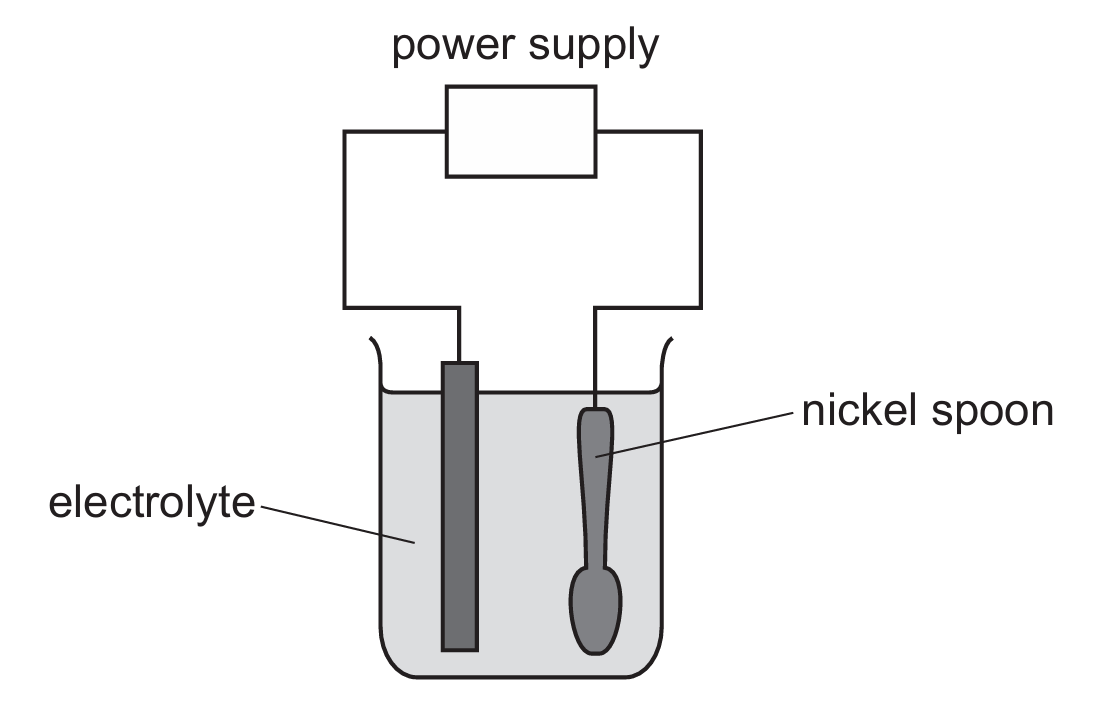
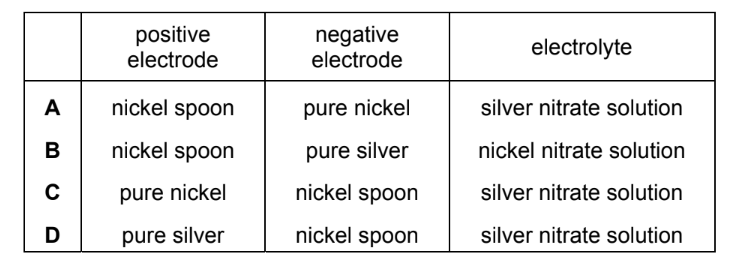
Most-appropriate topic codes (Cambridge IGCSE Chemistry 0620):
▶️ Answer/Explanation
Detailed solution:
For electroplating, three key rules apply: (1) The object to be plated (the nickel spoon) must always be the negative electrode (cathode), so that positive silver ions from solution are attracted to it and deposited as a silver coating. (2) The positive electrode (anode) must be made of the plating metal (pure silver), which dissolves to replenish Ag⁺ ions in solution. (3) The electrolyte must contain ions of the plating metal — silver nitrate solution provides Ag⁺ ions. Only option D correctly follows all three rules: anode = pure silver, cathode = nickel spoon, electrolyte = silver nitrate solution.
Question 14
Most-appropriate topic codes (Cambridge IGCSE Chemistry 0620):
• Topic 7.1: The characteristic properties of acids and bases — Describe the neutralisation reaction between an acid and an alkali: H⁺(aq) + OH⁻(aq) → H₂O(l).
▶️ Answer/Explanation
Detailed solution:
The reaction between sulfuric acid and sodium hydroxide is a classic neutralisation reaction: H₂SO₄ + 2NaOH → Na₂SO₄ + 2H₂O. The net ionic equation is H⁺(aq) + OH⁻(aq) → H₂O(l). Since the temperature of the solution increases, thermal energy is being released to the surroundings — this defines an exothermic reaction. It is not a redox reaction because no oxidation numbers change: Na stays +1, S stays +6, H stays +1, and O stays −2 throughout. Therefore the reaction is correctly described as exothermic and neutralisation — option C.
Question 15
Most-appropriate topic codes (Cambridge IGCSE Chemistry 0620):
• Topic 3.2: Relative masses of atoms and molecules — Conservation of mass applies to all chemical and physical changes.
▶️ Answer/Explanation
Detailed solution:
Option A is false: breaking and forming covalent bonds is characteristic of chemical changes only; physical changes (such as melting or dissolving) do not involve breaking chemical bonds. Option C is false: physical changes are often reversible, but many chemical changes (e.g. combustion) are not, so this cannot apply to both. Option D is false: temperature changes are not guaranteed in either type of change. Option B is true for both: the Law of Conservation of Mass states that the total mass of reactants always equals the total mass of products, and this holds for both physical and chemical changes alike.
Question 16
| final volume of gas produced / cm³ | time for reaction to finish / s | |
|---|---|---|
| A | 40 | 120 |
| B | 40 | 160 |
| C | 60 | 120 |
| D | 60 | 160 |
Most-appropriate topic codes (Cambridge IGCSE Chemistry 0620):
▶️ Answer/Explanation
Detailed solution:
Lowering the temperature decreases the rate of reaction because particles have less kinetic energy, so collisions are less frequent and fewer have sufficient energy to overcome the activation energy barrier. However, the amounts of reactants used are identical to the first experiment, so the same total amount of CO₂ will eventually be produced — the final volume remains 60 cm³. The reaction simply takes longer to complete at the lower temperature, giving a time greater than 120 seconds (here, 160 seconds). The final volume stays the same (60 cm³) but the time increases — option D.
Question 17
Most-appropriate topic codes (Cambridge IGCSE Chemistry 0620):
▶️ Answer/Explanation
Detailed solution:
Oxidation means gaining oxygen (or losing electrons / increasing oxidation number). In option A, iron goes from +2 (in FeO) to 0 (Fe) — this is reduction. In option B, iron goes from +3 (in Fe₂O₃) to 0 (Fe) — again reduction. In option C, iron goes from +3 (in Fe₂O₃) to +2 (in FeO) — partial reduction. In option D, iron starts as elemental Fe (oxidation number 0) and ends as FeO (oxidation number +2) — iron has gained oxygen and its oxidation number has increased, so iron is oxidised. The answer is D.
Question 18
| HOCl(aq) | NH₄OH(aq) | |
|---|---|---|
| A | H⁺ | H⁺ |
| B | H⁺ | OH⁻ |
| C | OH⁻ | H⁺ |
| D | OH⁻ | OH⁻ |
Most-appropriate topic codes (Cambridge IGCSE Chemistry 0620):
▶️ Answer/Explanation
Detailed solution:
By definition, an acid produces H⁺ ions in aqueous solution, and an alkali produces OH⁻ ions. HOCl (hypochlorous acid) is an acid, so it dissociates in water to release H⁺ ions. NH₄OH (ammonium hydroxide) is an alkali — it ionises in water to produce OH⁻ ions. Therefore the characteristic ion from the acid HOCl is H⁺, and the characteristic ion from the alkali NH₄OH is OH⁻, which corresponds directly to row B.
Question 19
Most-appropriate topic codes (Cambridge IGCSE Chemistry 0620):
• Topic 7.1: Characteristic properties of acids and bases — Describe alkalis in terms of their effect on thymolphthalein (turns blue in alkaline conditions).
▶️ Answer/Explanation
Detailed solution:
Thymolphthalein turns blue only in alkaline solutions (pH above approximately 9.3). Calcium oxide (CaO) is a basic oxide; it reacts with water to form calcium hydroxide: CaO + H₂O → Ca(OH)₂, which is a strong alkali — this solution turns thymolphthalein blue. Carbon dioxide (CO₂) dissolves in water to form carbonic acid (H₂CO₃), which is acidic, so thymolphthalein remains colourless. Sulfur dioxide (SO₂) dissolves in water to form sulfurous acid (H₂SO₃), also acidic — again no colour change. Therefore only calcium (element 1) satisfies the condition, making option B correct.
Question 20
Most-appropriate topic codes (Cambridge IGCSE Chemistry 0620):
• Topic 10.2: Fertilisers — State that ammonium salts and nitrates are used as fertilisers; Describe the use of NPK fertilisers to provide nitrogen for improved plant growth.
▶️ Answer/Explanation
Detailed solution:
The test described — warming with NaOH and observing a colourless gas that turns damp red litmus paper blue — is the standard test for ammonium ions (NH₄⁺). The reaction is: NH₄⁺ + OH⁻ → NH₃(g) + H₂O. Ammonia gas (NH₃) is the alkaline gas responsible for turning damp red litmus paper blue. Ammonium-containing fertilisers (such as ammonium nitrate or ammonium sulfate) are nitrogen-based compounds used to supply nitrogen to plants. Phosphorus, potassium, and sulfur do not produce ammonia gas under this test. Therefore nitrogen must be present — option A.
Question 21
Step 2 — Filter the mixture.
Step 3 — Heat the filtrate to the point of crystallisation.
Step 4 — Leave the filtrate to cool.
Most-appropriate topic codes (Cambridge IGCSE Chemistry 0620):
• Topic 12.4: Separation and purification — Describe and explain methods of separation using filtration.
▶️ Answer/Explanation
Detailed solution:
Excess magnesium carbonate is added in step 1 to ensure all the sulfuric acid reacts completely — this guarantees no acid remains in the final product. Since MgCO₃ is insoluble and is added in excess, some unreacted solid remains after the reaction. When the mixture is filtered in step 2, the insoluble excess magnesium carbonate is collected as the residue on the filter paper. The magnesium sulfate product is soluble and passes through the filter paper into the filtrate, along with water. Options B, C, and D are all soluble or liquid and would pass through the filter — only unreacted MgCO₃ forms the solid residue.
Question 22
Most-appropriate topic codes (Cambridge IGCSE Chemistry 0620):
▶️ Answer/Explanation
Detailed solution:
Across Period 3 from sodium (Na) to argon (Ar), there is a clear and consistent change in character from metals (Na, Mg, Al) through silicon (a metalloid/semi-metal) to non-metals (P, S, Cl) and finally to the noble gas argon. Option B is incorrect because melting points initially increase then decrease across the period (Si has the highest). Option C is wrong because sodium reacts most violently with water — reactivity with water decreases moving right across the period (most elements from Al onwards do not react with water at all). Option D is incorrect because electrical conductivity decreases across the period from metals to non-metals. The only consistently correct trend is A.
Question 23
Most-appropriate topic codes (Cambridge IGCSE Chemistry 0620):
▶️ Answer/Explanation
Detailed solution:
As you go down Group VII, density increases — bromine (below chlorine in the group) is therefore denser than chlorine, making option B correct. Option A is false: displacement reactions require a more reactive halogen to displace a less reactive one; since chlorine is more reactive than bromine, bromine cannot displace chlorine from potassium chloride solution. Option C is false: bromine is indeed diatomic (Br₂), but it is a non-metal, not a metal. Option D is false: at room temperature bromine is a red-brown liquid, not a green gas (chlorine is the pale yellow-green gas). Therefore only B is correct.
Question 24
Most-appropriate topic codes (Cambridge IGCSE Chemistry 0620):
• Topic 9.1: Properties of metals — Compare the general physical properties of metals including density.
▶️ Answer/Explanation
Detailed solution:
The question states element X is metallic and has a high density. Group I metals (Li, Na, K) are actually among the least dense metals — sodium and potassium are less dense than water. Halogens (Group VII) are non-metals. Group VIII (noble gases) are non-metals with very low densities as gases. The transition elements (e.g. iron, copper, nickel, gold, platinum), however, are well known for being hard, dense metals with high melting points — these properties are characteristic of the d-block metals. Element X must therefore be a transition element, making C the correct answer.
Question 25
Most-appropriate topic codes (Cambridge IGCSE Chemistry 0620):
▶️ Answer/Explanation
Detailed solution:
Option A is correct: aluminium’s low density (making cables lightweight) combined with its good electrical conductivity make it ideal for overhead power cables where minimising weight is critical. Option B is wrong: aluminium naturally forms a thin, protective oxide layer (Al₂O₃) on its surface that prevents further reaction — this is why aluminium is widely used for food packaging and can last indefinitely. Option C is wrong: copper wiring is insulated with plastic for electrical safety (to prevent electrocution and short circuits), not because copper corrodes easily — copper is actually very resistant to corrosion. Option D is wrong: it is aluminium, not copper, that is used in aircraft manufacture because of its low density; also copper is very malleable.
Question 26
Most-appropriate topic codes (Cambridge IGCSE Chemistry 0620):
▶️ Answer/Explanation
Detailed solution:
Rusting is an electrochemical oxidation process in which iron reacts with oxygen dissolved in water to form hydrated iron(III) oxide (rust), which has the approximate formula Fe₂O₃·nH₂O. Classic experiments (using boiled water with oil on top to exclude O₂, and dry air with a desiccant to exclude water) have confirmed that both water and oxygen must be present simultaneously for rusting to occur — neither alone is sufficient. Sunlight provides no chemical role in the rusting process itself. Painting the bridge acts as a barrier that excludes both water and oxygen from reaching the iron surface. The correct answer is B.
Question 27
Most-appropriate topic codes (Cambridge IGCSE Chemistry 0620):
▶️ Answer/Explanation
Detailed solution:
Brass is an alloy composed of copper (element 4) and zinc (element 2). This combination gives brass its characteristic gold-like yellow appearance, good malleability, low friction properties, and resistance to corrosion. The other alloy commonly confused with brass is bronze, which consists of copper and tin (elements 4 and 1). Stainless steel contains iron with chromium, nickel (element 3), and carbon — not copper or zinc. Knowing the specific compositions of named alloys is a syllabus requirement. The correct pair is copper and zinc — option D (2 and 4).
Question 28
2. It does not react with cold water but will react with dilute hydrochloric acid.
3. The metal can be obtained from its oxide by heating it strongly with carbon.
4. The metal oxide cannot be reduced using carbon.
Most-appropriate topic codes (Cambridge IGCSE Chemistry 0620):
▶️ Answer/Explanation
Detailed solution:
The reactivity series order includes: …zinc, iron, hydrogen, copper… Metal M sits between zinc and iron, so it is less reactive than zinc but more reactive than iron. Metals in this region of the series do not react with cold water (statement 1 is false — only metals above magnesium react with cold water), but do react with dilute acids to produce hydrogen (statement 2 is correct). Carbon appears above zinc in the reactivity series, meaning carbon can reduce the oxides of metals below it (zinc, iron, and M) — so statement 3 is correct and statement 4 is false. The correct statements are 2 and 3 — option C.
Question 29
Most-appropriate topic codes (Cambridge IGCSE Chemistry 0620):
• Topic 7.3: Preparation of salts — Define a hydrated substance; Define water of crystallisation (including CuSO₄·5H₂O).
▶️ Answer/Explanation
Detailed solution:
Anhydrous copper(II) sulfate (CuSO₄) is a white powder because it contains no water of crystallisation. When water is added, it reacts with the anhydrous salt to form the hydrated form, copper(II) sulfate pentahydrate (CuSO₄·5H₂O), which is characteristically blue: CuSO₄(white) + 5H₂O → CuSO₄·5H₂O(blue). This colour change from white to blue is the standard chemical test for the presence of water. The reverse reaction (heating the blue hydrated salt) removes the water of crystallisation and returns the white anhydrous form. Option D (white to blue) is correct.
Question 30
Most-appropriate topic codes (Cambridge IGCSE Chemistry 0620):
▶️ Answer/Explanation
Detailed solution:
Clean, dry air is approximately 78% nitrogen and 21% oxygen by volume — so options A and B have the percentages swapped and are therefore incorrect. Carbon dioxide makes up only about 0.04% of the atmosphere (not 4%), ruling out option D. Argon, the most abundant noble gas in air, accounts for roughly 0.93%, which is indeed less than 1%, making option C the only correct statement.
Question 31
| source | adverse effect | |
|---|---|---|
| A. | car engines | acid rain |
| B. | car engines | climate change |
| C. | decomposition of vegetation | acid rain |
| D. | decomposition of vegetation | climate change |
Most-appropriate topic codes (Cambridge IGCSE Chemistry 0620):
▶️ Answer/Explanation
Detailed solution:
Methane is produced naturally from the decomposition of vegetation in waterlogged conditions and from digestive processes in animals, not from car engines (those produce oxides of nitrogen). As a potent greenhouse gas, methane traps heat in the atmosphere, contributing to global warming and climate change — it does not cause acid rain (that is caused by sulfur dioxide and oxides of nitrogen). Option D correctly pairs both the source and the adverse effect.
Question 32
- Propene is a saturated hydrocarbon.
- Ethene is made by heating long-chain alkanes to a high temperature in the presence of a catalyst.
- Hexene reacts with aqueous bromine, changing its colour from colourless to orange.
- Ethene, propene and butene have the same general formula.
Most-appropriate topic codes (Cambridge IGCSE Chemistry 0620):
▶️ Answer/Explanation
Detailed solution:
Statement 1 is false — propene contains a C=C double bond, making it unsaturated, not saturated. Statement 2 is correct: ethene is produced by cracking larger alkane molecules using high temperature and a catalyst. Statement 3 is false: aqueous bromine is initially orange/brown and decolorises (turns colourless) when it reacts with alkenes — the colour change is from orange to colourless, not the reverse. Statement 4 is correct: ethene, propene, and butene all belong to the alkene homologous series sharing the general formula C$_n$H$_{2n}$. Therefore, only statements 2 and 4 are correct.
Question 33
| formula | name | |
|---|---|---|
| 1 | CH₃Cl | chloroethane |
| 2 | CH₃COOH | ethanoic acid |
| 3 | BrCH₂CH₂Br | 1,2-dibromoethane |
| 4 | (CH₃COO)₂Ca | calcium methanoate |
Most-appropriate topic codes (Cambridge IGCSE Chemistry 0620):
▶️ Answer/Explanation
Detailed solution:
Row 1: CH₃Cl has only one carbon atom, so it is chloromethane, not chloroethane — this is incorrect. Row 2: CH₃COOH is correctly named ethanoic acid — correct. Row 3: BrCH₂CH₂Br has two carbon atoms each bearing one bromine, making it 1,2-dibromoethane — correct. Row 4: The CH₃COO⁻ ion is the ethanoate ion (not methanoate), so (CH₃COO)₂Ca is calcium ethanoate, not calcium methanoate — this is incorrect. Therefore only rows 2 and 3 are correctly named.
Question 34
Most-appropriate topic codes (Cambridge IGCSE Chemistry 0620):
▶️ Answer/Explanation
Detailed solution:
Natural gas is a fossil fuel found underground, and it consists predominantly of methane (CH₄), typically around 70–90% by volume. Hydrogen, nitrogen, and oxygen are not significant components of natural gas. Methane is a simple hydrocarbon with one carbon atom and four hydrogen atoms, and it burns cleanly to produce carbon dioxide and water, making it a widely used fuel for heating and cooking.
Question 35
- X is more viscous than Z.
- Y has a higher boiling point than X.
| longest carbon chain | most volatile | |
|---|---|---|
| A. | Y | X |
| B. | Y | Z |
| C. | Z | X |
| D. | Z | Y |
Most-appropriate topic codes (Cambridge IGCSE Chemistry 0620):
▶️ Answer/Explanation
Detailed solution:
Longer carbon chains produce higher viscosity and higher boiling points. Since X is more viscous than Z, X has a longer carbon chain than Z. Since Y has a higher boiling point than X, Y has an even longer carbon chain than X. This gives the order Y > X > Z by chain length. Therefore Y has the longest carbon chain. Volatility decreases as chain length increases, so the shortest chains (Z) are the most volatile. Option B correctly identifies Y as having the longest chain and Z as the most volatile.
Question 36
| test | P | Q |
|---|---|---|
| a few drops of aqueous sodium hydroxide are added | green precipitate forms | red-brown precipitate forms |
| a few drops of dilute nitric acid and a few drops of barium nitrate are added | no change seen | white precipitate forms |
| a few drops of dilute nitric acid and a few drops of silver nitrate are added | white precipitate forms | no change seen |
| P | Q | |
|---|---|---|
| A. | iron(II) chloride | iron(III) sulfate |
| B. | iron(III) chloride | iron(III) sulfate |
| C. | iron(II) sulfate | iron(III) chloride |
| D. | iron(III) sulfate | iron(III) chloride |
Most-appropriate topic codes (Cambridge IGCSE Chemistry 0620):
▶️ Answer/Explanation
Detailed solution:
For solution P: the green precipitate with NaOH identifies Fe²⁺ ions, and the white precipitate with acidified silver nitrate identifies Cl⁻ ions — so P is iron(II) chloride, FeCl₂. For solution Q: the red-brown precipitate with NaOH identifies Fe³⁺ ions, and the white precipitate with acidified barium nitrate identifies SO₄²⁻ ions — so Q is iron(III) sulfate, Fe₂(SO₄)₃. Option A correctly identifies both salts.
Question 37
Most-appropriate topic codes (Cambridge IGCSE Chemistry 0620):
▶️ Answer/Explanation
Detailed solution:
We need a solid that dissolves in ethanoic acid with no gas produced and gives a colourless solution. Magnesium (C) would produce hydrogen gas, and sodium carbonate (D) would produce carbon dioxide gas — both ruled out by “no bubbles.” Copper(II) oxide (B) would give a blue solution of copper(II) ethanoate, not colourless — ruled out. Calcium hydroxide (A) reacts with ethanoic acid in a neutralisation reaction: Ca(OH)₂ + 2CH₃COOH → (CH₃COO)₂Ca + 2H₂O, producing calcium ethanoate (a soluble, colourless salt) and water, with no gas. This matches all observations perfectly.
Question 38
- glucose
- ethane
- ethene
- steam
Most-appropriate topic codes (Cambridge IGCSE Chemistry 0620):
▶️ Answer/Explanation
Detailed solution:
Ethanol is made by two industrial processes. The first is fermentation: glucose [1] is converted to ethanol and carbon dioxide by yeast. The second is catalytic hydration: ethene [3] reacts with steam [4] in the presence of an acid catalyst at high temperature and pressure to produce ethanol directly. Ethane [2] is not a raw material for either process. Therefore, the raw materials across both processes are glucose, ethene, and steam — option B.
Question 39
Most-appropriate topic codes (Cambridge IGCSE Chemistry 0620):
▶️ Answer/Explanation
Detailed solution:
Chlorine is identified using damp litmus paper, which it bleaches (turns white) due to the formation of chloric(I) acid when chlorine reacts with water. A glowing splint is used to test for oxygen (relights the splint). Limewater is used to test for carbon dioxide (turns milky). Acidified aqueous potassium manganate(VII) is used to test for sulfur dioxide (decolorises from purple to colourless). Therefore, damp litmus paper is the correct reagent for testing chlorine.
Question 40
Most-appropriate topic codes (Cambridge IGCSE Chemistry 0620):
▶️ Answer/Explanation
Detailed solution:
Paper chromatography works by separating soluble substances based on how strongly they are attracted to the stationary phase (paper) versus the mobile phase (solvent), so it cannot separate insoluble substances (ruling out B). It is a physical separation technique and cannot break chemical bonds to separate a compound into its elements (ruling out C). It separates rather than combines substances (ruling out D). A pure substance produces only a single spot on a chromatogram, while a mixture produces multiple spots — so chromatography can indeed be used to determine whether a substance is pure, making A correct.