Home / 0620_m25_qp_22

Question 1

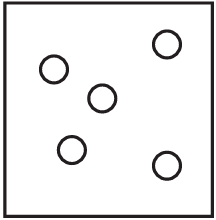
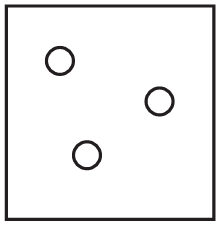
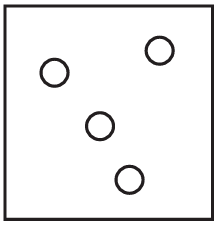
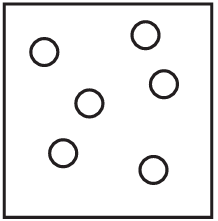
The diagrams show containers of gas at the same temperature. All containers have the same size.

Which container contains gas at the highest pressure?

A. Container A
B. Container B

C. Container C

D. Container D

Most-appropriate topic codes (Cambridge IGCSE Chemistry 0620):

• Topic 1.1: Solids, liquids and gases — Describe the effects of temperature and pressure on the volume of a gas (Core); Explain, in terms of kinetic particle theory, the effects of temperature and pressure on the volume of a gas (Supplement)
▶️ Answer/Explanation
At constant temperature and volume, the pressure of a gas is directly proportional to the number of gas particles present — this is a consequence of kinetic particle theory. More particles mean more frequent collisions with the container walls, producing a higher pressure. Container A contains the greatest number of particles compared to B, C, and D. Since all containers are the same size and at the same temperature, container A produces the highest number of wall collisions per unit time and therefore has the highest pressure.
Answer: A

Question 2

A cooling curve for a substance is shown.
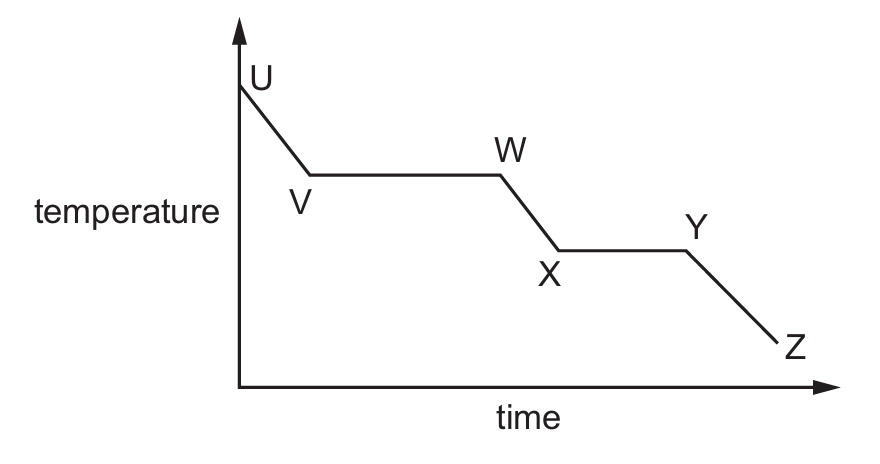
Cooling curve diagram

Which statement is correct?

A. Between U and V, the substance is condensing.
B. Between V and W, heat is being absorbed from the surroundings.
C. Between W and X, the particles are close together and randomly arranged.
D. Between Y and Z, the substance is changing from a liquid to a solid.

Most-appropriate topic codes (Cambridge IGCSE Chemistry 0620):

Topic 1.1: Solids, liquids and gases — Describe changes of state in terms of melting, boiling, evaporating, freezing and condensing (Core); Explain changes of state in terms of kinetic particle theory, including the interpretation of heating and cooling curves (Supplement)
▶️ Answer/Explanation
On a cooling curve, the sloping sections represent the substance cooling as a single phase, while the horizontal (flat) sections represent phase changes where thermal energy is released at constant temperature. Between W and X the temperature is constant, indicating the substance is undergoing condensation from gas to liquid; once fully liquid, the section between X and Y shows the liquid cooling. Therefore, between W and X the substance is in the liquid state, where particles are close together but move randomly (unlike the fixed positions in a solid). Options A and B are incorrect because U–V shows gas cooling and V–W is the gas-to-liquid phase change (heat released, not absorbed). Option D is incorrect because Y–Z shows the solid cooling after freezing is complete.
Answer: (C)

Question 3

Samples of four gases are released in a room at the same time.
The gases are carbon dioxide, CO₂, hydrogen chloride, HCl, hydrogen sulfide, H₂S, and nitrogen dioxide, NO₂.
Which gas diffuses fastest?

A. carbon dioxide
B. hydrogen chloride
C. hydrogen sulfide
D. nitrogen dioxide

Most-appropriate topic codes (Cambridge IGCSE Chemistry 0620):

Topic 1.2: Diffusion — Describe and explain diffusion in terms of kinetic particle theory (Core); Describe and explain the effect of relative molecular mass on the rate of diffusion of gases (Supplement)
▶️ Answer/Explanation
According to Graham’s Law of Diffusion, the rate of diffusion of a gas is inversely proportional to the square root of its molar mass — lighter gases diffuse faster. The molar masses are: CO₂ = 44 g/mol, HCl = 36.5 g/mol, H₂S = 34 g/mol, NO₂ = 46 g/mol. Hydrogen sulfide (H₂S) has the lowest molar mass of the four gases and therefore its particles move fastest on average at a given temperature, allowing it to diffuse the quickest across the room.
Answer: (C)

Question 4

Sulfur atoms can form the negative ion S²⁻.
Three other atoms or ions are listed:

  • argon, Ar
  • calcium, Ca
  • oxide, O²⁻

How many of these atoms or ions have the same electronic configuration as S²⁻?

A. 0
B. 1
C. 2
D. 3

Most-appropriate topic codes (Cambridge IGCSE Chemistry 0620):

Topic 2.2: Atomic structure and the Periodic Table — Determine the electronic configuration of elements and their ions with proton number 1 to 20 (Core)
Topic 2.3: Isotopes — State that isotopes of the same element have the same chemical properties because they have the same number of electrons (Supplement)
▶️ Answer/Explanation
Sulfur has atomic number 16, so S²⁻ has 16 + 2 = 18 electrons, giving the configuration 2,8,8. Argon (atomic number 18) also has 18 electrons and configuration 2,8,8 — it matches. Calcium (atomic number 20) is neutral with 20 electrons (2,8,8,2) — it does not match. Oxide O²⁻ has 8 + 2 = 10 electrons (2,8) — it does not match. Therefore, only argon has the same electronic configuration as S²⁻, giving the answer of 1.
Answer: (B)

Question 5

Element T has two isotopes, $^{12}_{6}\text{T}$ and $^{14}_{6}\text{T}$.
Which statement about these isotopes is correct?

A. They have different chemical properties because they have different numbers of neutrons.
B. They have the same chemical properties because they have the same number of outer shell electrons.
C. They have the same nucleon number because the sum of the number of protons and electrons is the same.
D. They have different positions in the Periodic Table because they have different numbers of neutrons.

Most-appropriate topic codes (Cambridge IGCSE Chemistry 0620):

Topic 2.3: Isotopes — Define isotopes as different atoms of the same element that have the same number of protons but different numbers of neutrons (Core); State that isotopes of the same element have the same chemical properties because they have the same number of electrons and therefore the same electronic configuration (Supplement)
▶️ Answer/Explanation
Isotopes are atoms of the same element that differ only in the number of neutrons. Both $^{12}_{6}\text{T}$ and $^{14}_{6}\text{T}$ have 6 protons and therefore 6 electrons, giving them identical electronic configurations and identical chemical properties. Option A is wrong because neutrons play no role in chemical reactions. Option C is wrong because nucleon number (mass number) equals protons + neutrons, which differs between the two isotopes (12 vs 14). Option D is wrong because position in the Periodic Table is determined by proton number, which is the same for both isotopes.
Answer: (B)

Question 6

Lithium is in Group I of the Periodic Table. Nitrogen is in Group V of the Periodic Table.
Lithium reacts with nitrogen to form the ionic compound lithium nitride, $\text{Li}_3\text{N}$.
What happens to the electrons when lithium atoms and nitrogen atoms form ions?
 lithiumnitrogen
A.each lithium atom loses one electron to form an $\text{Li}^{+}$ ioneach nitrogen atom gains three electrons to form an $\text{N}^{3-}$ ion
B.each lithium atom loses one electron to form an $\text{Li}^{+}$ ioneach nitrogen atom gains five electrons to form an $\text{N}^{5-}$ ion
C.each lithium atom gains one electron to form an $\text{Li}^{-}$ ioneach nitrogen atom loses three electrons to form an $\text{N}^{3+}$ ion
D.each lithium atom gains one electron to form an $\text{Li}^{-}$ ioneach nitrogen atom loses five electrons to form an $\text{N}^{5+}$ ion

Most-appropriate topic codes (Cambridge IGCSE Chemistry 0620):

Topic 2.4: Ions and ionic bonds — Describe the formation of positive ions (cations) and negative ions (anions); Describe the formation of ionic bonds between elements from Group I and Group VII (Core); Describe the formation of ionic bonds between ions of metallic and non-metallic elements (Supplement)
▶️ Answer/Explanation
When we look at the periodic table, we see that lithium is placed in Group I, meaning each atom has exactly one valence electron. To achieve a stable, full outer shell, it naturally loses this single electron, forming a positively charged $\text{Li}^{+}$ cation. On the other hand, nitrogen is found in Group V with five valence electrons, so it requires three additional electrons to complete its octet. By gaining these three electrons, each nitrogen atom becomes a negatively charged $\text{N}^{3-}$ anion. The ionic compound lithium nitride ($\text{Li}_3\text{N}$) forms when three lithium atoms each donate an electron to a single nitrogen atom, perfectly balancing the overall charges.
Answer: A.

Question 7

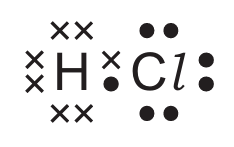
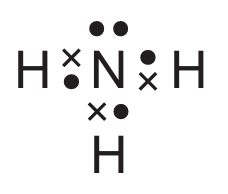
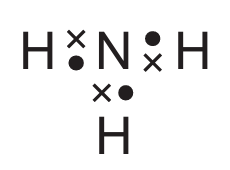
For which covalent compound does the dot-and-cross diagram correctly show the outer shell electrons?

A. Option A dot-and-cross diagram
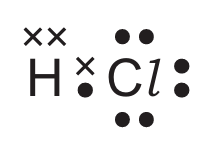
B. Option B dot-and-cross diagram
C. Option C dot-and-cross diagram
D. Option D dot-and-cross diagram

Most-appropriate topic codes (Cambridge IGCSE Chemistry 0620):

Topic 2.5: Simple molecules and covalent bonds — Describe the formation of covalent bonds in simple molecules including H₂, Cl₂, H₂O, CH₄, NH₃ and HCl using dot-and-cross diagrams (Core); Describe the formation of covalent bonds in simple molecules including CH₃OH, C₂H₄, O₂, CO₂ and N₂ (Supplement)
▶️ Answer/Explanation
Option C correctly shows the dot-and-cross diagram for ammonia (NH₃). Nitrogen has 5 valence electrons and forms three single covalent bonds with three hydrogen atoms (each contributing 1 electron), leaving one lone pair on nitrogen — giving a total of 8 electrons around nitrogen (one lone pair + three bonding pairs). This satisfies the octet rule for nitrogen and the duet rule for each hydrogen. The other diagrams in options A, B, and D contain incorrect numbers of electrons or bonds around the central atom, making them invalid representations of their respective compounds.
Answer: (C)

Question 8

Which row identifies the positive and the negative particles present in a giant metallic lattice?

 positive particlesnegative particles
A.anionscations
B.anionsdelocalised electrons
C.cationsanions
D.cationsdelocalised electrons

Most-appropriate topic codes (Cambridge IGCSE Chemistry 0620):

Topic 2.7: Metallic bonding — Describe metallic bonding as the electrostatic attraction between the positive ions in a giant metallic lattice and a ‘sea’ of delocalised electrons; Explain in terms of structure and bonding the properties of metals (Supplement)
▶️ Answer/Explanation
In a giant metallic lattice, metal atoms release their outermost electrons into a shared “sea,” leaving behind positively charged metal ions called cations. The released electrons are free to move throughout the entire structure and are called delocalised electrons — they carry a negative charge. The metallic bond is the strong electrostatic attraction between the positive cations and the surrounding sea of negative delocalised electrons. There are no anions present in a pure metallic structure, eliminating options A, B, and C.
Answer: (D)

Question 9

Which formula for the named compound is correct?

A. calcium oxide, CaO
B. cobalt(II) chloride, Co₂Cl
C. sulfur dioxide, S₂O₂
D. anhydrous copper(II) sulfate, Cu(SO₄)₂

Most-appropriate topic codes (Cambridge IGCSE Chemistry 0620):

Topic 3.1: Formulae — State the formulae of the elements and compounds named in the subject content; Deduce the formula of a simple compound from the relative numbers of atoms present (Core); Deduce the formula of an ionic compound from the charges on the ions (Supplement)
▶️ Answer/Explanation
Calcium forms Ca²⁺ ions and oxygen forms O²⁻ ions; the charges balance in a 1:1 ratio, giving the correct formula CaO. Option B is wrong — cobalt(II) is Co²⁺ and chloride is Cl⁻, so the correct formula is CoCl₂ (not Co₂Cl). Option C is wrong — sulfur dioxide is correctly written as SO₂, not S₂O₂. Option D is wrong — copper(II) is Cu²⁺ and sulfate is SO₄²⁻; the charges already balance in a 1:1 ratio, giving CuSO₄, not Cu(SO₄)₂.
Answer: (A)

Question 10

The equation for the reaction of magnesium with dilute sulfuric acid is shown.

$$\text{Mg} + \text{H}_2\text{SO}_4 \rightarrow \text{MgSO}_4 + \text{H}_2$$

[$M_r$: $\text{MgSO}_4 = 120$]

Which mass of magnesium sulfate is formed when 12 g of magnesium completely reacts with dilute sulfuric acid?

A. 5 g
B. 10 g
C. 60 g
D. 120 g

Most-appropriate topic codes (Cambridge IGCSE Chemistry 0620):

Topic 3.2: Relative masses of atoms and molecules — Calculate reacting masses in simple proportions (Core)
Topic 3.3: The mole and the Avogadro constant — Calculate stoichiometric reacting masses (Supplement)
▶️ Answer/Explanation
To determine the mass of magnesium sulfate produced, we first calculate the number of moles of magnesium used in the reaction. Given the molar mass of magnesium is 24 g/mol, a 12 g sample corresponds to exactly 0.5 moles. According to the balanced chemical equation, magnesium reacts with sulfuric acid to form magnesium sulfate in a 1:1 molar ratio, meaning 0.5 moles of magnesium will yield 0.5 moles of $\text{MgSO}_4$. The relative formula mass ($M_r$) of $\text{MgSO}_4$ is given as 120. Multiplying the moles of product by its molar mass ($0.5 \times 120$) gives a final theoretical yield of 60 g. This precisely matches the expected stoichiometric proportions.
Answer: (C)

Question 11

An organic compound, Q, contains carbon, hydrogen and oxygen only.
Q contains 40.0% carbon and 6.7% hydrogen by mass.
What is the empirical formula of Q?

A. CHO
B. CH₂O
C. C₂HO₂
D. C₃H₆O₃

Most-appropriate topic codes (Cambridge IGCSE Chemistry 0620):

Topic 3.3: The mole and the Avogadro constant — Calculate empirical formulae and molecular formulae, given appropriate data (Supplement)
▶️ Answer/Explanation
Assuming 100 g of Q: C = 40.0 g, H = 6.7 g, O = 100 − 40.0 − 6.7 = 53.3 g. Converting to moles: C = 40.0 ÷ 12 ≈ 3.33 mol; H = 6.7 ÷ 1 = 6.7 mol; O = 53.3 ÷ 16 ≈ 3.33 mol. Dividing each by the smallest (3.33): C = 1, H ≈ 2, O = 1. The simplest whole-number ratio is C:H:O = 1:2:1, giving the empirical formula CH₂O.
Answer: (B)

Question 12

The value of the Avogadro constant is $6.02 \times 10^{23}$.
What is the total number of atoms in 2.00 mol of ammonia gas?

A. $1.20 \times 10^{24}$
B. $2.41 \times 10^{24}$
C. $4.82 \times 10^{24}$
D. $2.89 \times 10^{25}$

Most-appropriate topic codes (Cambridge IGCSE Chemistry 0620):

Topic 3.3: The mole and the Avogadro constant — State that one mole contains $6.02 \times 10^{23}$ particles; Use the relationship: amount of substance = mass ÷ molar mass; Calculate number of particles using the Avogadro constant (Supplement)
▶️ Answer/Explanation
Detailed solution:
First, find the number of NH₃ molecules in 2.00 mol: $2.00 \times 6.02 \times 10^{23} = 1.204 \times 10^{24}$ molecules. Each ammonia molecule (NH₃) contains 4 atoms (1 nitrogen + 3 hydrogen). Multiplying: $1.204 \times 10^{24} \times 4 = 4.816 \times 10^{24} \approx 4.82 \times 10^{24}$ atoms.
Answer: (C)

Question 13

Three aqueous solutions, L, M and N, are electrolysed using inert electrodes.

L is concentrated hydrochloric acid.
M is concentrated aqueous sodium chloride.
N is dilute aqueous sodium chloride.

Which solutions produce a pale yellow-green gas at the anode?

A. L and M
B. L only
C. M and N
D. N only

Most-appropriate topic codes (Cambridge IGCSE Chemistry 0620):

Topic 4.1: Electrolysis — Identify the products formed at the electrodes and describe the observations during the electrolysis of concentrated aqueous sodium chloride (Core); Predict the identity of products at each electrode for the electrolysis of a halide compound in dilute or concentrated aqueous solution (Supplement)
▶️ Answer/Explanation
Let’s break this down step by step. The pale yellow-green gas mentioned is chlorine ($\text{Cl}_2$). When we electrolyze concentrated solutions like L (concentrated HCl) and M (concentrated NaCl), the high concentration of chloride ($\text{Cl}^-$) ions means they are preferentially discharged at the anode over hydroxide ($\text{OH}^-$) ions. This reaction produces chlorine gas: $2\text{Cl}^- \rightarrow \text{Cl}_2 + 2\text{e}^-$. On the other hand, in a dilute solution like N (dilute NaCl), the $\text{Cl}^-$ concentration is simply too low. As a result, the $\text{OH}^-$ ions are preferentially discharged instead, producing oxygen gas: $4\text{OH}^- \rightarrow 2\text{H}_2\text{O} + \text{O}_2 + 4\text{e}^-$. Therefore, only solutions L and M will produce the pale yellow-green chlorine gas.
Answer: (A)

Question 14

Dilute sulfuric acid is electrolysed using inert electrodes.
What are the ionic half-equations for the reactions that take place at each electrode?
 positive electrodenegative electrode
A.$2H^+ + 2e^- \rightarrow H_2$$4OH^- \rightarrow 2H_2O + O_2 + 4e^-$
B.$2H^+ + 2e^- \rightarrow H_2$$4OH^- + 4H^+ \rightarrow 4H_2O$
C.$4OH^- \rightarrow 2H_2O + O_2 + 4e^-$$2H^+ + 2e^- \rightarrow H_2$
D.$4OH^- + 4H^+ \rightarrow 4H_2O$$2H^+ + 2e^- \rightarrow H_2$

Most-appropriate topic codes (Cambridge IGCSE Chemistry 0620):

Topic 4.1: Electrolysis — Identify the products formed at the electrodes during the electrolysis of dilute sulfuric acid (Core); Construct ionic half-equations for reactions at the anode (oxidation) and at the cathode (reduction) (Supplement)
▶️ Answer/Explanation
At the positive electrode (anode), oxidation occurs: hydroxide ions are discharged, giving $4OH^- \rightarrow 2H_2O + O_2 + 4e^-$, producing oxygen gas. At the negative electrode (cathode), reduction occurs: hydrogen ions gain electrons, giving $2H^+ + 2e^- \rightarrow H_2$, producing hydrogen gas. Option C correctly assigns these half-equations to the correct electrodes. Options A and B have the equations reversed or are not valid half-equations.
Answer: (C)

Question 15

Which statements about hydrogen–oxygen fuel cells are correct?

1. They convert chemical energy into electrical energy.
2. Hydrogen is reduced in the fuel cells.
3. They do not produce any atmospheric pollutants.

A. 1, 2 and 3
B. 1 and 2 only
C. 1 and 3 only
D. 2 and 3 only

Most-appropriate topic codes (Cambridge IGCSE Chemistry 0620):

Topic 4.2: Hydrogen–oxygen fuel cells — State that a hydrogen–oxygen fuel cell uses hydrogen and oxygen to produce electricity with water as the only chemical product (Core); Describe the advantages and disadvantages of using hydrogen–oxygen fuel cells in comparison with gasoline/petrol engines (Supplement)
▶️ Answer/Explanation
Detailed solution:
Statement 1 is correct — fuel cells convert the chemical energy stored in hydrogen directly into electrical energy. Statement 2 is incorrect — hydrogen is oxidised at the anode (loses electrons to form H⁺ or reacts with OH⁻), not reduced; it is oxygen that is reduced at the cathode. Statement 3 is correct — the only product of a hydrogen–oxygen fuel cell is water (H₂O), so no harmful atmospheric pollutants are produced. Therefore statements 1 and 3 are correct, giving option C.

Answer: (C)

Question 16

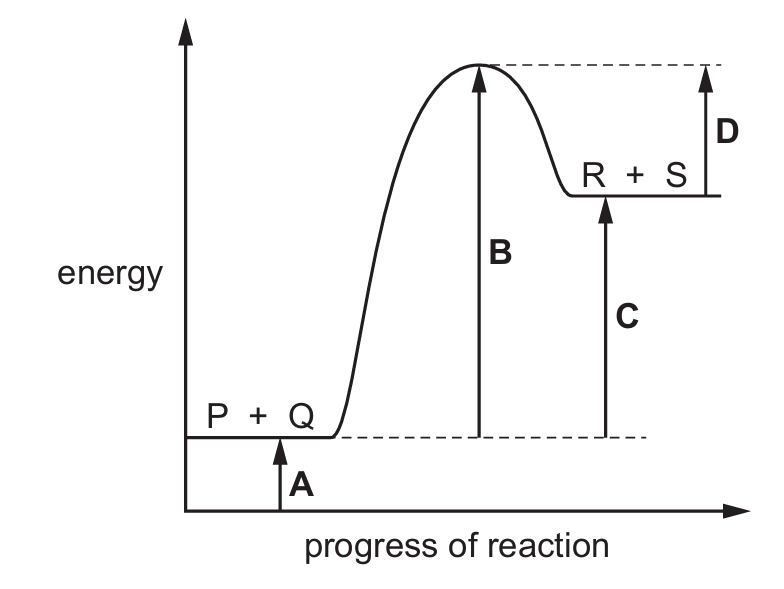
The reaction pathway diagram for the reaction between P and Q to form R and S is shown.
Which letter represents the enthalpy change for the reaction?
Reaction pathway diagram

Most-appropriate topic codes (Cambridge IGCSE Chemistry 0620):

Topic 5.1: Exothermic and endothermic reactions — Interpret reaction pathway diagrams showing exothermic and endothermic reactions (Core); Draw and label reaction pathway diagrams including enthalpy change ΔH and activation energy Ea (Supplement)
▶️ Answer/Explanation
On a reaction pathway diagram, the enthalpy change (ΔH) is defined as the difference in energy between the products and the reactants — it is the vertical distance between the energy level of P + Q (reactants) and R + S (products). The activation energy is the energy difference from the reactants up to the peak (transition state). The letter C represents the vertical gap between reactant and product energy levels, which is the enthalpy change of the reaction. Other letters label the activation energy or the total energy of the transition state.
Answer: (C)

Question 17

The equation for the complete combustion of methane is shown.

$$\text{CH}_4(g) + 2\text{O}_2(g) \rightarrow \text{CO}_2(g) + 2\text{H}_2\text{O}(g)$$

The table shows some bond energies.

bondbond energy in kJ/mol
C–H410
C=O805
O=O496
O–H460

What is the enthalpy change for this reaction?

(A) $-1458\text{ kJ/mol}$
(B) $-818\text{ kJ/mol}$
(C) $-359\text{ kJ/mol}$
(D) $+102\text{ kJ/mol}$

Most-appropriate topic codes (Cambridge IGCSE Chemistry 0620):

Topic 5.1: Exothermic and endothermic reactions — State that bond breaking is endothermic and bond making is exothermic; Calculate the enthalpy change of a reaction using bond energies (Supplement)
▶️ Answer/Explanation
To calculate the enthalpy change for the complete combustion of methane, we first determine the energy required to break the bonds in the reactants. Breaking four $\text{C–H}$ bonds and two $\text{O=O}$ double bonds absorbs $(4 \times 410) + (2 \times 496) = 2632\text{ kJ/mol}$. Next, we calculate the energy released upon forming the products, which involves creating two $\text{C=O}$ double bonds and four $\text{O–H}$ bonds, releasing $(2 \times 805) + (4 \times 460) = 3450\text{ kJ/mol}$. The overall enthalpy change, $\Delta H$, is the energy absorbed minus the energy released: $2632 – 3450 = -818\text{ kJ/mol}$. This negative value indicates the reaction is exothermic.
Answer: (B)

Question 18

Which change is a physical change?

(A) cracking an alkane
(B) evaporating ethanol
(C) fermenting glucose
(D) neutralising an acid

Most-appropriate topic codes (Cambridge IGCSE Chemistry 0620):

Topic 6.1: Physical and chemical changes — Identify physical and chemical changes, and describe the differences between them (Core)
▶️ Answer/Explanation
A physical change alters the form or state of a substance without changing its chemical composition or producing new substances. Evaporating ethanol (B) is simply a liquid-to-gas phase change — the ethanol molecules remain unchanged (C₂H₅OH). By contrast, cracking (A) breaks C–C bonds to form different hydrocarbons, fermentation (C) converts glucose into ethanol and CO₂, and neutralisation (D) forms salt and water — all of these involve new chemical substances being produced, making them chemical changes.
Answer: (B)

Question 19

Which statements explain why increasing the temperature in a reaction involving gases increases the rate of reaction?
1. It increases the collision frequency between the gas particles.
2. It lowers the activation energy.
3. It increases the kinetic energy of the gas particles.
4. It increases the number of gas particles per unit volume.
A. 1 and 3
B. 1 and 4
C. 2 and 3
D. 2 and 4

Most-appropriate topic codes (Cambridge IGCSE Chemistry 0620):

Topic 6.2: Rate of reaction — Describe the effect on the rate of reaction of changing temperature (Core); Describe and explain the effect on the rate of reaction of changing temperature using collision theory (Supplement)
▶️ Answer/Explanation
Increasing temperature raises the rate of reaction through two related effects explained by collision theory. First, particles move faster so they collide more frequently (statement 1 — correct). Second, particles have greater kinetic energy, meaning a larger proportion of collisions have energy equal to or greater than the activation energy, producing more successful collisions (statement 3 — correct). Statement 2 is wrong — temperature does not lower the activation energy; a catalyst does that. Statement 4 is wrong — temperature does not change the number of particles per unit volume (concentration stays constant in a closed system).
Answer: (A)

Question 20

The equation for the reaction between ammonia and oxygen is shown.

$$4\text{NH}_3(g) + 5\text{O}_2(g) \rightleftharpoons 4\text{NO}(g) + 6\text{H}_2\text{O}(g) \quad \Delta H = -909\,\text{kJ/mol}$$

Which two changes to the reaction conditions will both move the position of equilibrium to the right?

 change 1change 2
A.increasing the temperaturedecreasing the pressure
B.increasing the temperatureincreasing the pressure
C.decreasing the temperatureincreasing the pressure
D.decreasing the temperaturedecreasing the pressure

Most-appropriate topic codes (Cambridge IGCSE Chemistry 0620):

Topic 6.3: Reversible reactions and equilibrium — Predict and explain, for a reversible reaction, how the position of equilibrium is affected by changing temperature, pressure and concentration (Supplement)
▶️ Answer/Explanation
According to Le Chatelier’s Principle, a decrease in temperature favors the exothermic forward reaction ($\Delta H = -909\,\text{kJ/mol}$), shifting the equilibrium to the right. Additionally, there are 9 moles of gas on the reactant side and 10 moles on the product side. Decreasing the pressure favors the side with a greater number of gas molecules, further shifting the equilibrium to the right. Thus, both changes favor the forward reaction.
Answer: (D)

Question 21

Mercury(II) oxide, HgO, decomposes when heated. The equation is shown.

$$2\text{HgO} \rightarrow 2\text{Hg} + \text{O}_2$$

Why is this a reduction reaction?

A. The products weigh less than the reactants.
B. There are fewer reactants than products.
C. There is a gain of oxygen.
D. There is a loss of oxygen.

Most-appropriate topic codes (Cambridge IGCSE Chemistry 0620):

Topic 6.4: Redox — Define oxidation as gain of oxygen and reduction as loss of oxygen; Identify oxidation and reduction in redox reactions (Core)
▶️ Answer/Explanation
Reduction, in terms of oxygen, is defined as the loss of oxygen from a substance. In this reaction, mercury(II) oxide (HgO) loses oxygen to form elemental mercury (Hg), so Hg is reduced. Option C describes oxidation (gain of oxygen), not reduction. Option A is incorrect because by conservation of mass the total mass of products equals the total mass of reactants. Option B is irrelevant to the definition of reduction. Therefore D is the correct reason.
Answer: (D)

Question 22

Some information about two dilute acids is shown.

dilute acidacid concentration in mol/dm³pH
nitric acid0.11.0
propanoic acid0.42.6

Three statements about the acids are listed.

1. Nitric acid has a lower pH because it dissociates more than propanoic acid.
2. Propanoic acid has a lower concentration of hydrogen ions than nitric acid.
3. Propanoic acid has a higher pH because it has a higher concentration.

Which statements are correct?

A. 1 and 2
B. 1 and 3
C. 2 only
D. 3 only

Most-appropriate topic codes (Cambridge IGCSE Chemistry 0620):

Topic 7.1: The characteristic properties of acids and bases — Define a strong acid as an acid that is completely dissociated in aqueous solution and a weak acid as an acid that is partially dissociated; State that hydrochloric acid is a strong acid and ethanoic acid is a weak acid (Supplement)
▶️ Answer/Explanation
Statement 1 is correct: nitric acid is a strong acid that fully dissociates, producing a high [H⁺] and a low pH of 1.0, whereas propanoic acid is a weak acid that only partially dissociates. Statement 2 is correct: despite propanoic acid having a higher overall concentration (0.4 mol/dm³ vs 0.1 mol/dm³), its partial dissociation means its actual [H⁺] is much lower than that of fully dissociated nitric acid, giving it a higher pH of 2.6. Statement 3 is incorrect: the higher pH of propanoic acid is due to its weak-acid nature (incomplete dissociation), not its higher concentration — concentration alone does not determine pH when comparing strong and weak acids.
Answer: (A)

Question 23

Element E is a metal in Group I of the Periodic Table and element G is a non-metal in Group VII. Both of these elements form oxides.

Which statement about their oxides is correct?

A. Both oxides are acidic.
B. Both oxides are basic.
C. The oxide of E is acidic and the oxide of G is basic.
D. The oxide of G is acidic and the oxide of E is basic.

Most-appropriate topic codes (Cambridge IGCSE Chemistry 0620):

Topic 7.2: Oxides — Classify oxides as acidic or basic, related to metallic and non-metallic character (Core)
▶️ Answer/Explanation
Metal oxides are generally basic — Group I metals form ionic oxides that dissolve in water to produce alkaline solutions (e.g. $\text{Na}_2\text{O} + \text{H}_2\text{O} \rightarrow 2\text{NaOH}$), so the oxide of E (Group I metal) is basic. Non-metal oxides are generally acidic — Group VII halogens form covalent oxides that react with water to produce acidic solutions (e.g. $\text{Cl}_2\text{O} + \text{H}_2\text{O} \rightarrow 2\text{HClO}$), so the oxide of G (Group VII non-metal) is acidic. Therefore option D correctly describes both oxides.
Answer: (D)

Question 24

Lead(II) sulfate is an insoluble salt.
Which method is suitable for obtaining pure solid lead(II) sulfate?

A. Mix aqueous lead(II) nitrate and aqueous potassium sulfate, heat to evaporate all of the water, collect the solid and then wash and dry it.
B. Mix aqueous lead(II) nitrate and aqueous potassium sulfate, filter, collect the filtrate, crystallise, then wash and dry the crystals.
C. Mix aqueous lead(II) nitrate and dilute sulfuric acid, filter, then wash and dry the residue.
D. Titrate aqueous lead(II) hydroxide with dilute sulfuric acid, crystallise, then wash and dry the crystals.

Most-appropriate topic codes (Cambridge IGCSE Chemistry 0620):

Topic 7.3: Preparation of salts — Describe the preparation of insoluble salts by precipitation (Supplement); Describe general solubility rules for salts (Core)
▶️ Answer/Explanation
Insoluble salts are prepared by precipitation: mixing two soluble solutions that contain the required ions, then filtering to collect the insoluble precipitate. In option C, $\text{Pb(NO}_3)_2\text{(aq)} + \text{H}_2\text{SO}_4\text{(aq)} \rightarrow \text{PbSO}_4\text{(s)} + 2\text{HNO}_3\text{(aq)}$; the insoluble $\text{PbSO}_4$ precipitates immediately, is collected by filtration as the residue, washed with distilled water to remove soluble impurities ($\text{HNO}_3$), and dried to give pure $\text{PbSO}_4$. Option B collects the filtrate (wrong — filtrate contains soluble $\text{KNO}_3$, not $\text{PbSO}_4$). Option A would leave mixed salts after evaporation. Option D incorrectly uses titration (for soluble salts) and $\text{Pb(OH)}_2$ is itself insoluble.
Answer: (C)

Question 25

The elements oxygen and sulfur are in the same group of the Periodic Table.
Which statement about oxygen and sulfur is not correct?

A. They are non-metals.
B. They have giant covalent structures.
C. They have six electrons in the outer electron shells of their atoms.
D. They react together to form an acidic oxide.

Most-appropriate topic codes (Cambridge IGCSE Chemistry 0620):

Topic 2.6: Giant covalent structures — Describe the giant covalent structures of graphite and diamond (Core)
Topic 8.1: Arrangement of elements — Describe the change from metallic to non-metallic character across a period; Explain similarities in chemical properties of elements in the same group (Core)
▶️ Answer/Explanation
Both oxygen and sulfur exist as simple molecular structures, not giant covalent structures. Oxygen exists as diatomic $O_2$ molecules, and sulfur most commonly exists as $S_8$ ring molecules at room temperature — both are simple molecular and held together only by weak intermolecular forces. Giant covalent structures (like diamond or $SiO_2$) have atoms bonded throughout in an extended network. Therefore statement B (“they have giant covalent structures”) is the one that is not correct. All other statements — both are non-metals (A), both have 6 outer electrons as Group VI elements (C), and $SO_2$/$SO_3$ are acidic oxides (D) — are correct.
Answer: (B)

Question 26

Tennessine, Ts, is at the bottom of Group VII of the Periodic Table.
What are the predicted properties of tennessine at room temperature?

A. a black solid, more dense than iodine
B. a black solid, more reactive than iodine
C. a colourless gas, less dense than chlorine
D. a colourless gas, less reactive than chlorine

Most-appropriate topic codes (Cambridge IGCSE Chemistry 0620):

Topic 8.3: Group VII properties — Describe the Group VII halogens with general trends down the group including increasing density and decreasing reactivity; Predict the properties of other elements in Group VII (Core)
▶️ Answer/Explanation
Going down Group VII (halogens), density increases (Cl₂ is a gas, Br₂ is a liquid, I₂ is a grey-black solid) and reactivity decreases. Tennessine is below iodine, so it is predicted to be a solid (denser than iodine), darker in colour (following the trend from pale yellow-green → red-brown → grey-black, so tennessine would be even darker, i.e. black), and less reactive than iodine. Option B is incorrect because reactivity decreases down Group VII. Options C and D are incorrect because tennessine would be a solid, not a gas, at room temperature.
Answer: (A)

Question 27

An example of sacrificial protection is the fitting of zinc blocks to the outside of a ship’s steel hull.
Which statement explains why zinc is used to protect the iron in the steel from rusting?

A. Zinc is more reactive than iron so it loses electrons more easily.
B. Zinc is less reactive than iron so it loses electrons more easily.
C. Zinc is more reactive than iron so it gains electrons more easily.
D. Zinc is less reactive than iron so it gains electrons more easily.

Most-appropriate topic codes (Cambridge IGCSE Chemistry 0620):

Topic 9.5: Describe the use of zinc in galvanising as an example of a barrier method and sacrificial protection; Explain sacrificial protection in terms of the reactivity series and in terms of electron loss
▶️ Answer/Explanation
Zinc sits above iron in the reactivity series, making it more reactive than iron. Because of this higher reactivity, zinc loses electrons more readily than iron when both are in contact with an electrolyte (such as sea water). This means zinc acts as the anode in an electrochemical cell and is preferentially oxidised (corroded) rather than the iron in the steel hull. As long as zinc remains, the iron is cathodically protected and cannot rust — this is the principle of sacrificial protection.
Answer: (A)

Question 28

Which statement about alloys is correct?

A. Alloys are harder than pure metals because they contain strong intermolecular forces.
B. Brass is an alloy containing mainly copper and tin.
C. The different-sized atoms in an alloy mean that the layers cannot easily slide over each other.
D. There are no alloys containing carbon because carbon is a non-metal.

Most-appropriate topic codes (Cambridge IGCSE Chemistry 0620):

Topic 9.3: State that alloys can be harder and stronger than the pure metals and are more useful; Describe an alloy as a mixture of a metal with other elements
Topic 9.3: Explain in terms of structure how alloys can be harder and stronger than the pure metals because the different sized atoms in alloys mean the layers can no longer slide over each other
▶️ Answer/Explanation
In a pure metal, all atoms are the same size and arranged in regular layers that can slide past one another easily, making the metal soft and malleable. When a second element is added to form an alloy, the different-sized atoms disrupt the regular arrangement, preventing the layers from sliding — this is why alloys are harder. Option A is wrong because the hardening is structural, not due to intermolecular forces. Option B is wrong because brass is copper and zinc, not tin (copper-tin makes bronze). Option D is wrong because steel is an important alloy containing iron and carbon.
Answer: (C)

Question 29

Separate pieces of aluminium foil and copper foil are heated in air. The copper foil reacts to give a black solid. The aluminium foil does not react.

Which statement explains these observations?

A. Aluminium has an unreactive layer, but copper does not.
B. Aluminium is below copper in the reactivity series.
C. Copper reacts with moisture in the air, but aluminium does not.
D. Copper reacts with nitrogen in the air, but aluminium does not.

Most-appropriate topic codes (Cambridge IGCSE Chemistry 0620):

Topic 9.4: Explain the apparent unreactivity of aluminium in terms of its oxide layer
▶️ Answer/Explanation
Although aluminium is actually higher than copper in the reactivity series, it appears unreactive because its surface is already coated with a thin, tough, adherent layer of aluminium oxide ($\text{Al}_2\text{O}_3$) that forms spontaneously in air. This oxide layer acts as a barrier, preventing further reaction with oxygen or other reagents. Copper, which is much lower in the reactivity series, does not form such a protective oxide layer, so it can react with oxygen in air when heated to form the black copper(II) oxide. Option B is therefore incorrect as it states the opposite of the true reactivity order.
Answer: (A)

Question 30

Which row gives the symbol equation for the formation of carbon monoxide and for the reduction of iron(III) oxide in a blast furnace?

 equation for the formation of carbon monoxideequation for the reduction of iron(III) oxide
A.2C + O₂ → 2COFeO + CO → Fe + CO₂
B.CO₂ + C → 2COFeO + CO → Fe + CO₂
C.C + O₂ → CO₂Fe₂O₃ + 3CO → 2Fe + 3CO₂
D.CO₂ + C → 2COFe₂O₃ + 3CO → 2Fe + 3CO₂

Most-appropriate topic codes (Cambridge IGCSE Chemistry 0620):

Topic 9.6: State the symbol equations for the extraction of iron from hematite: C + CO₂ → 2CO and Fe₂O₃ + 3CO → 2Fe + 3CO₂
▶️ Answer/Explanation
In the blast furnace, carbon (coke) first burns with limited oxygen to produce carbon dioxide (C + O₂ → CO₂). This CO₂ then reacts with more coke in the hotter lower zone to form carbon monoxide: CO₂ + C → 2CO. This is the correct equation for CO formation (not 2C + O₂ → 2CO, which would give CO only if oxygen were severely limited). The iron ore (haematite, Fe₂O₃) is then reduced by carbon monoxide in the reaction Fe₂O₃ + 3CO → 2Fe + 3CO₂, since the ore is iron(III) oxide, not FeO. Only option D gives both correct equations.
Answer: D

Question 31

A sample of river water contains a high concentration of nitrates from fertilisers.

Which statements about the river water are correct?

  1. It has a boiling point of 100 °C.
  2. Its melting point is below 0 °C.
  3. It turns anhydrous cobalt(II) chloride from pink to blue.
  4. It turns anhydrous copper(II) sulfate from white to blue.

A. 1 and 3
B. 1 and 4
C. 2 and 3
D. 2 and 4

Most-appropriate topic codes (Cambridge IGCSE Chemistry 0620):

Topic 10.1: Describe chemical tests for the presence of water using anhydrous cobalt(II) chloride and anhydrous copper(II) sulfate; Describe how to test for the purity of water using melting point and boiling point
▶️ Answer/Explanation
Dissolved solutes (like nitrates) lower the freezing point of water below 0 °C (statement 2 ✓) and raise the boiling point slightly above 100 °C — so statement 1 is incorrect. Anhydrous cobalt(II) chloride is blue and turns pink on contact with water, so statement 3 (pink to blue) is backwards and incorrect. Anhydrous copper(II) sulfate is white and turns blue on contact with water (statement 4 ✓). Both test reagents detect the presence of water, not its purity — the river water contains water, so statement 4 is correct. Therefore, only statements 2 and 4 are correct.
Answer: (D)

Question 32

Which statements about the treatment of domestic water supplies are correct?

  1. The water undergoes sedimentation to remove dissolved solids.
  2. The water is filtered to remove insoluble solids.
  3. The water is treated with carbon to improve the taste.
  4. The water is chlorinated to decrease the pH.

A. 1 and 2
B. 1 and 4
C. 2 and 3
D. 3 and 4

Most-appropriate topic codes (Cambridge IGCSE Chemistry 0620):

Topic 10.1: Describe the treatment of the domestic water supply in terms of: sedimentation and filtration to remove solids; use of carbon to remove tastes and odours; chlorination to kill microbes
▶️ Answer/Explanation
Statement 1 is wrong: sedimentation and filtration remove suspended (insoluble) solids, not dissolved solids. Statement 2 is correct: filtration does remove insoluble solids. Statement 3 is correct: activated carbon (charcoal) is used to adsorb chemicals that cause unpleasant tastes and odours. Statement 4 is incorrect: chlorination is used to kill microbes/bacteria, not to decrease the pH. Therefore, statements 2 and 3 are both correct.
Answer: (C)

Question 33

An experiment to find the percentage of oxygen in 150 cm³ of polluted air is shown.
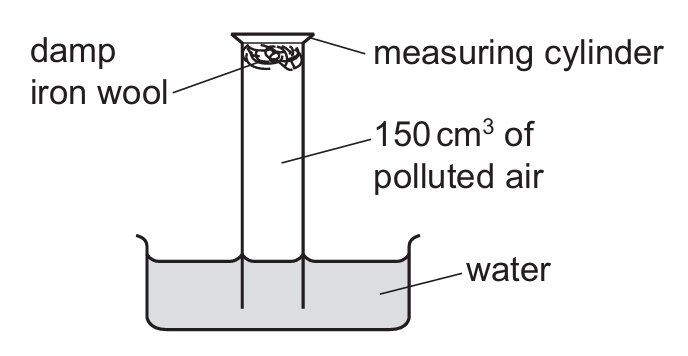
The apparatus is left for one week.

After this time, the volume of gas in the measuring cylinder is 122 cm³.

What is the percentage of oxygen, to the nearest whole number, in the polluted air?

A. 19%
B. 21%
C. 28%
D. 81%

Most-appropriate topic codes (Cambridge IGCSE Chemistry 0620):

Topic 10.3: State the composition of clean, dry air as approximately 78% nitrogen and 21% oxygen
Topic 12.1: Suggest advantages and disadvantages of experimental methods and apparatus
▶️ Answer/Explanation
The damp iron wool rusts by reacting with the oxygen in the air sample, causing the water level inside the measuring cylinder to rise as oxygen is consumed. The volume of oxygen used = 150 − 122 = 28 cm³. The percentage of oxygen = (28 ÷ 150) × 100 = 18.67%, which rounds to 19% to the nearest whole number. This is slightly below the normal atmospheric level of 21%, which is consistent with “polluted air” that may contain a higher proportion of other gases. Option C (28%) is a common error from confusing the volume of oxygen removed with the percentage.
Answer: (A)

Question 34

Nitrogen monoxide, NO, and carbon monoxide, CO, are both removed from the exhaust gases of a car by a catalytic converter.

Which statement describes how nitrogen monoxide and carbon monoxide are removed by a catalytic converter?

A. Nitrogen monoxide and carbon monoxide are both reduced.
B. Nitrogen monoxide and carbon monoxide are both oxidised.
C. Nitrogen monoxide is oxidised and carbon monoxide is reduced.
D. Nitrogen monoxide is reduced and carbon monoxide is oxidised.

Most-appropriate topic codes (Cambridge IGCSE Chemistry 0620):

Topic 10.3: Explain how oxides of nitrogen form in car engines and describe their removal by catalytic converters, e.g. 2CO + 2NO → 2CO₂ + N₂
Topic 6.4: Define oxidation in terms of loss of electrons / increase in oxidation number; define reduction in terms of gain of electrons / decrease in oxidation number
▶️ Answer/Explanation
In the catalytic converter the reaction is: 2CO + 2NO → 2CO₂ + N₂. Tracking oxidation numbers: in NO, nitrogen has oxidation number +2; in N₂ it is 0 — a decrease, so nitrogen monoxide is reduced. Carbon in CO has oxidation number +2; in CO₂ it is +4 — an increase, so carbon monoxide is oxidised. This is a redox reaction where NO acts as the oxidising agent and CO acts as the reducing agent.
Answer: (D)

Question 35

Propan-1-ol is oxidised by acidified aqueous potassium manganate(VII) in a similar way to ethanol.

Which compound is produced by the oxidation of propan-1-ol with acidified aqueous potassium manganate(VII)?

A. $\mathrm{CH_3CH_2OH}$
B. $\mathrm{CH_3CH_2CH_2OH}$
C. $\mathrm{CH_3COOH}$
D. $\mathrm{CH_3CH_2COOH}$

Most-appropriate topic code (Cambridge IGCSE Chemistry 0620):

• Topic 11.6 — Alcohols: Describe the oxidation of ethanol to ethanoic acid using acidified aqueous potassium manganate(VII). (Extended Supplement)

▶️ Answer/Explanation
Just as ethanol ($\mathrm{CH_3CH_2OH}$) is oxidised to ethanoic acid ($\mathrm{CH_3COOH}$), propan-1-ol ($\mathrm{CH_3CH_2CH_2OH}$) is oxidised to propanoic acid ($\mathrm{CH_3CH_2COOH}$). The primary alcohol group (–OH) at the end of the 3-carbon chain is converted into a carboxylic acid group (–COOH) while the carbon skeleton remains unchanged.
Answer: (D)

Question 36

The structural formula of methyl propane is CH₃CH(CH₃)CH₃.

The equation represents the reaction of methyl propane with chlorine.

C₄H₁₀ + Cl₂ → C₄H₉Cl + HCl

How many structural isomers with the molecular formula C₄H₉Cl can be formed from this reaction?

A. 1
B. 2
C. 3
D. 4

Most-appropriate topic codes (Cambridge IGCSE Chemistry 0620):

Topic 11.1: Define structural isomers as compounds with the same molecular formula, but different structural formulae
Topic 11.4: Describe the substitution reaction of alkanes with chlorine as a photochemical reaction; draw structural or displayed formulae of the products, limited to monosubstitution
▶️ Answer/Explanation
Methyl propane (2-methylpropane) has the structure (CH₃)₃CH. It contains two distinct types of hydrogen atoms: one hydrogen on the central (tertiary) carbon, and nine hydrogens on the three equivalent methyl groups. Monosubstitution of the central H gives 2-chloro-2-methylpropane: (CH₃)₃CCl. Monosubstitution of any one of the nine equivalent methyl H atoms gives 1-chloro-2-methylpropane: ClCH₂CH(CH₃)CH₃. Since all nine methyl H atoms are equivalent, they all yield the same product. Therefore exactly 2 structural isomers with formula C₄H₉Cl can be formed.
Answer: (B)

Question 37

Which statements describe disadvantages of manufacturing ethanol by fermentation?

  1. The process uses a renewable resource.
  2. The process produces impure ethanol.
  3. The process requires a high temperature.
  4. The process is slow.

A. 1 and 3
B. 1 and 4
C. 2 and 3
D. 2 and 4

Most-appropriate topic codes (Cambridge IGCSE Chemistry 0620):

Topic 11.6: Describe the advantages and disadvantages of the manufacture of ethanol by fermentation and by catalytic addition of steam to ethene
▶️ Answer/Explanation
Statement 1 is an advantage of fermentation (using renewable sugars/glucose from crops), not a disadvantage. Statement 3 is incorrect because fermentation occurs at a low temperature of 25–35 °C, not a high temperature — low temperature operation is actually an advantage. Statement 2 is a true disadvantage: fermentation produces a dilute (approximately 15%) aqueous ethanol mixture that requires energy-intensive distillation to purify. Statement 4 is also a true disadvantage: the batch fermentation process is slow (taking days), compared to the continuous, rapid catalytic hydration of ethene. Therefore statements 2 and 4 are both disadvantages.
Answer: (D)

Question 38

Nylon is made in a polymerisation reaction.

Which row describes the type of polymerisation and identifies the other product of the reaction?

 type of polymerisationother product
A.additionwater
B.additionnone
C.condensationwater
D.condensationnone

Most-appropriate topic codes (Cambridge IGCSE Chemistry 0620):

Topic 11.8: Describe the differences between addition and condensation polymerisation; Describe and draw the structure of nylon, a polyamide; Deduce the structure of a condensation polymer from given monomers (polyamides from a dicarboxylic acid and a diamine)
▶️ Answer/Explanation
Nylon is a polyamide made by condensation polymerisation between a dicarboxylic acid and a diamine. In condensation polymerisation, monomers join together with the elimination of a small molecule — in this case, water (H₂O) is released each time an amide (peptide) bond forms between –COOH and –NH₂ groups. This contrasts with addition polymerisation (e.g. poly(ethene) from ethene), where monomers simply join together with no other product. Therefore the type is condensation and the byproduct is water.
Answer: (C)

Question 39

Which ion forms a green precipitate with aqueous sodium hydroxide that dissolves in an excess of aqueous sodium hydroxide?

A. Ca²⁺
B. Cr³⁺
C. Cu²⁺
D. Fe²⁺

Most-appropriate topic codes (Cambridge IGCSE Chemistry 0620):

Topic 12.5: Describe tests using aqueous sodium hydroxide and aqueous ammonia to identify the aqueous cations: aluminium Al³⁺, chromium(III) Cr³⁺, copper(II) Cu²⁺, iron(II) Fe²⁺, and zinc Zn²⁺
▶️ Answer/Explanation
Cr³⁺ forms a green precipitate of Cr(OH)₃ when sodium hydroxide is added, and this precipitate dissolves in excess NaOH to give a dark green solution (Cr³⁺ is amphoteric). Ca²⁺ forms a white precipitate that is insoluble in excess NaOH. Cu²⁺ forms a light blue precipitate insoluble in excess NaOH (though it dissolves in excess aqueous ammonia to give a dark blue solution). Fe²⁺ also forms a green precipitate which is insoluble in excess NaOH and gradually turns brown on standing as Fe²⁺ oxidises to Fe³⁺ at the surface. The key distinguishing feature here is solubility in excess NaOH — only Cr³⁺ gives a green precipitate that dissolves in excess sodium hydroxide.
Answer: (B)

Question 40

A mixture of soluble substances can be separated by paper chromatography. Each substance can be identified using its Rf value.

Which formula shows how the Rf value is calculated?

A. Rf = distance travelled by substance ÷ distance travelled by solvent
B. Rf = distance travelled by solvent ÷ distance travelled by substance
C. Rf = distance travelled by solvent − distance travelled by substance
D. Rf = distance travelled by solvent × distance travelled by substance

Most-appropriate topic codes (Cambridge IGCSE Chemistry 0620):

Topic 12.3: State and use the equation for Rf: Rf = distance travelled by substance ÷ distance travelled by solvent
▶️ Answer/Explanation
The Rf (retardation factor) value is defined as the ratio of the distance moved by the substance to the distance moved by the solvent front, both measured from the starting baseline. Because a substance always moves the same distance or less than the solvent, Rf values are always between 0 and 1. A value of 1 would mean the substance travels with the solvent front, while a value of 0 means it does not move at all. Option A gives the correct formula. Option B is inverted and would give values greater than 1, which is physically impossible. Options C and D are dimensionally incorrect for an identification ratio.
Answer: (A)
Scroll to Top