
Question 1
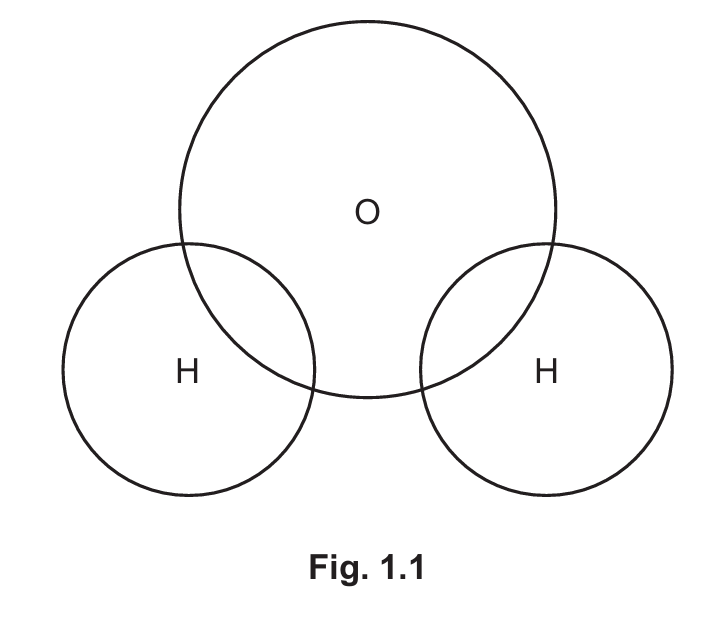
Most-appropriate topic codes (Cambridge IGCSE Chemistry 0620):
• Topic 4.1 — Electrolysis (Part (a)(i))
• Topic 2.2 — Atomic structure and the Periodic Table (Parts (a)(ii), (a)(iv))
• Topic 7.2 — Oxides (Part (a)(iii))
• Topic 10.3 — Air quality and climate (Part (a)(v))
• Topic 4.2 — Hydrogen-oxygen fuel cells (Part (a)(vi))
• Topic 2.5 — Simple molecules and covalent bonds (Part (b))
▶️ Answer/Explanation
(a)(i)
For the correct answer:
\(\mathbf{C}\)
Carbon in the form of graphite is used as an inert electrode because it conducts electricity (due to delocalised electrons between its layers) and is chemically unreactive, meaning it does not participate in the electrolytic reaction itself.
(a)(ii)
For the correct answer:
\(\mathbf{O^{2-}}\)
The oxide ion \(\mathrm{O^{2-}}\) is formed when an oxygen atom (electronic configuration \(2,6\)) gains two electrons to achieve a full outer shell (electronic configuration \(2,8\)), which is the stable electronic structure of neon.
(a)(iii)
For the correct answer:
\(\mathbf{CuO}\)
Copper(II) oxide is classified as a basic oxide. Basic oxides are typically metallic oxides that react with acids to form a salt and water. For example, CuO reacts with warm dilute sulfuric acid to give blue copper(II) sulfate solution.
(a)(iv)
For the correct answer:
\(\mathbf{Na^+}\)
In a flame test, sodium ions (\(\mathrm{Na^+}\)) produce a characteristic intense yellow flame colour. This distinct emission spectrum arises when excited electrons fall back to lower energy levels, releasing energy as visible light.
(a)(v)
For the correct answer:
\(\mathbf{CO}\)
Carbon monoxide is a toxic gas produced by the incomplete combustion of methane (and other carbon-containing fuels). Incomplete combustion occurs when the oxygen supply is limited: \(2\mathrm{CH_4} + 3\mathrm{O_2} \rightarrow 2\mathrm{CO} + 4\mathrm{H_2O}\). CO is toxic because it binds irreversibly to haemoglobin in red blood cells, reducing the blood’s oxygen-carrying capacity.
(a)(vi)
For the correct answer:
\(\mathbf{H_2}\)
Hydrogen gas is the reactant used at the negative electrode (anode) of a hydrogen-oxygen fuel cell. Here it is oxidised, releasing electrons to the external circuit: \(2\mathrm{H_2} + 4\mathrm{OH^-} \rightarrow 4\mathrm{H_2O} + 4\mathrm{e^-}\) (in an alkaline fuel cell). The only chemical product is water.
(b)
For the correct answer (2 marks):
• A pair of electrons (one dot, one cross) shown between each hydrogen atom and the oxygen atom, with no other electrons on the hydrogen atoms.
• Four non-bonding electrons (two lone pairs, correctly shown as dots or crosses) on the oxygen atom.
Oxygen has six outer-shell electrons. Two of these are shared (one with each hydrogen atom) to form two single covalent bonds. The remaining four electrons exist as two lone pairs. Each hydrogen atom achieves the stable helium configuration (\(2\)) by sharing one electron.
Question 2


Most-appropriate topic codes (Cambridge IGCSE Chemistry 0620):
• Topic 9.4 — Reactivity series (Part (a))
• Topic 8.4 — Transition elements / 8.2 — Group I properties (Part (b))
• Topic 9.3 — Alloys and their properties (Part (c))
• Topic 2.2 — Atomic structure and the Periodic Table (Part (d))
▶️ Answer/Explanation
(a)
For the correct answer (2 marks):
calcium > cobalt > tin > platinum
If 2 marks are not scored: 1 mark for 1 pair reversed (consecutive) OR the full reverse order: platinum > tin > cobalt > calcium.
The reactivity series ranks metals by their tendency to form positive ions. Calcium, an alkali earth metal, reacts most vigorously here. Platinum is a noble metal and shows no reaction with oxygen, placing it least reactive.
(b)
For any two of:
• cobalt has a high melting point / boiling point / lithium has a low melting point / boiling point
• cobalt has a high density / lithium has a low density
• cobalt is strong/hard / lithium is weak/soft
Transition metals typically have high melting points and densities due to strong metallic bonding involving delocalised d-electrons. Group I metals like lithium have relatively weak metallic bonding because only one s-electron per atom is delocalised.
(c)(i)
mixture of a metal with another element / mixture of a metal with another metal
An alloy is a homogeneous mixture where atoms of different sizes disrupt the regular lattice, often enhancing properties like strength and hardness.
(c)(ii)
copper and zinc
Brass is an alloy primarily of copper and zinc (\(60-70\%\) Cu, \(30-40\%\) Zn). It is harder than pure copper and is used for musical instruments and fittings.
(c)(iii)
cutlery
Stainless steel (an alloy of iron with chromium, nickel, and carbon) is used for cutlery because of its hardness and resistance to rusting. Chromium forms a protective oxide layer.
(d)(i)
protons: \(27\)
neutrons: \(33\) (mass number \(60\) minus proton number \(27\))
electrons: \(24\) (atom had \(27\) electrons; \(3+\) charge means \(3\) electrons lost)
The nuclear symbol \(^{60}_{27}\mathrm{Co}^{3+}\) indicates the mass number is 60 and atomic number (protons) is 27. The ionic charge \(3+\) shows the number of protons exceeds electrons by three.
(d)(ii)
0 / zero
Neutrons are subatomic particles found in the nucleus with a relative mass of 1 and relative charge of 0. They contribute to nuclear stability but not to the atom’s chemical properties.
Question 3

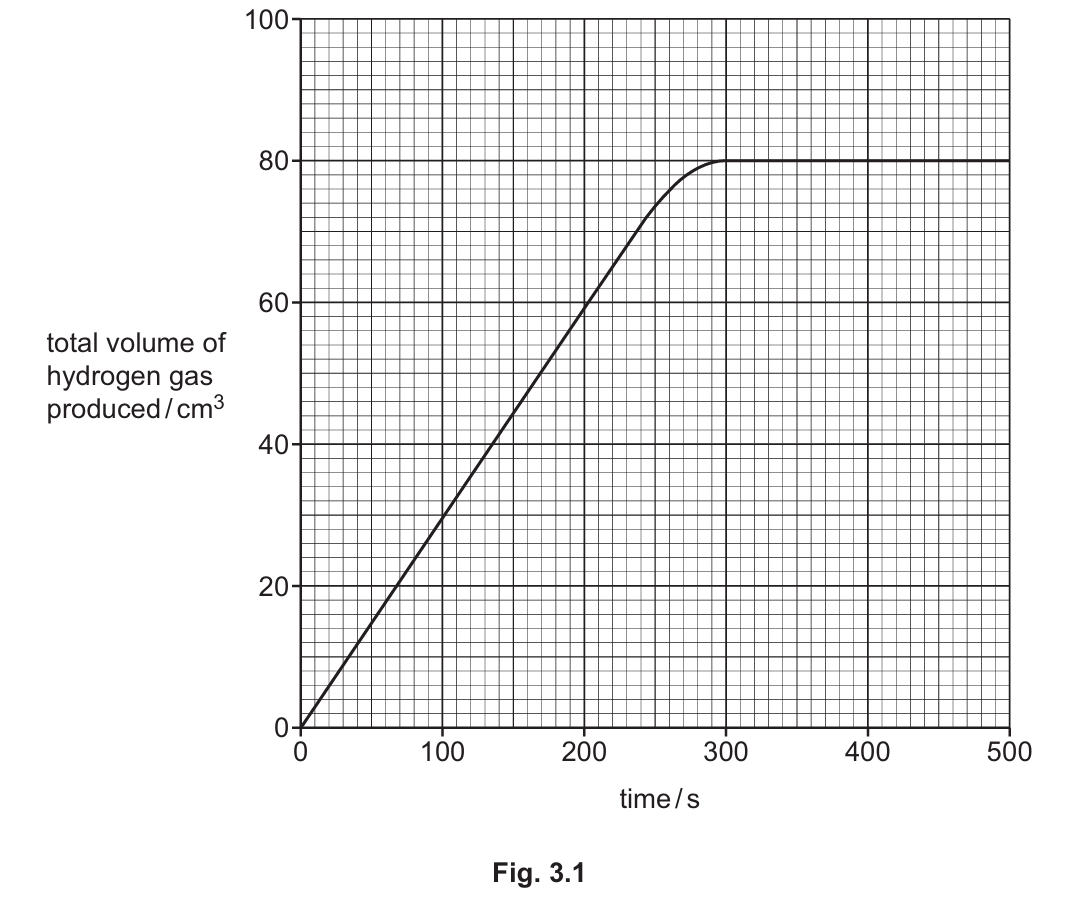
- carries out the experiment at \(25^\circ\mathrm{C}\) using \(2.00 \, \mathrm{g}\) of magnesium ribbon and \(25 \, \mathrm{cm}^3\) of dilute sulfuric acid
- measures the total volume of gas produced at regular time intervals
- plots a graph of the results.
Most-appropriate topic codes (Cambridge IGCSE Chemistry 0620):
• Topic 7.1 — Characteristic properties of acids and bases (Part (a))
• Topic 12.1 — Experimental design (Part (b)(i))
• Topic 6.2 — Rate of reaction (Parts (b)(ii)–(vi))
• Topic 12.5 — Identification of ions and gases (Part (c))
▶️ Answer/Explanation
(a)
For the correct answer:
magnesium sulfate
The reaction is: magnesium + sulfuric acid → magnesium sulfate + hydrogen. The salt magnesium sulfate (\(\mathrm{MgSO_4}\)) is named from the metal (magnesium) and the acid (sulfuric acid → sulfate).
(b)(i)
For the correct diagram (3 marks):
• conical flask (1)
• gas syringe / syringe (1)
• connection from conical flask to gas syringe which will not allow any gas to escape (1)
The apparatus must be sealed to prevent gas loss. Magnesium ribbon is placed in the conical flask with dilute sulfuric acid. A delivery tube connects the flask to a gas syringe. As hydrogen gas is evolved, it pushes the syringe plunger, allowing the volume of gas to be measured directly at various time intervals.
(b)(ii)
\(30 \, (\mathrm{cm}^3)\)
Reading directly from the graph at \(t = 100 \, \mathrm{s}\), the interpolated volume on the y-axis corresponds to \(30 \, \mathrm{cm}^3\).
(b)(iii)
(one) reactant has been (completely) used up
The reaction stops because the limiting reactant — either all the magnesium ribbon has dissolved, or all the sulfuric acid molecules have been consumed — is no longer available to react. The graph plateauing at \(300 \, \mathrm{s}\) confirms no further gas production.
(b)(iv)
For the correct line (3 marks):
• steeper initial gradient starting at \((0,0)\) (1)
• levels off before \(300 \, \mathrm{s}\) (1)
• line levels off at \(80 \, \mathrm{cm}^3\) (1)
At a higher temperature, reactant particles possess greater kinetic energy. This results in a higher frequency of collisions and a greater proportion of collisions with energy exceeding the activation energy (\(E \geq E_\mathrm{a}\)). Consequently, the initial rate is faster (steeper curve slope). However, the same masses of reactants produce the same final volume of hydrogen; the reaction simply finishes sooner.
(b)(v)
decreasing the concentration: (rate) decreases / gets slower / slows down
Lower concentration means fewer acid particles per unit volume of solution. According to collision theory, this reduces the frequency of effective collisions between reactant particles per unit time, slowing the reaction rate.
(b)(vi)
catalyst: (rate) increases / gets faster / speeds up
A catalyst provides an alternative reaction pathway having a lower activation energy (\(E_\mathrm{a}\)). More colliding particles now possess the minimum energy required to react, increasing the frequency of successful collisions and thus the reaction rate. The catalyst itself remains chemically unchanged at the end.
(c)
test: lighted splint
observations: pops / explosion
Hydrogen gas is collected, e.g., in an inverted test tube. A burning splint applied to the mouth of the tube ignites the hydrogen, which reacts explosively with oxygen in the air to form water (\(2\mathrm{H_2} + \mathrm{O_2} \rightarrow 2\mathrm{H_2O}\)), producing a characteristic squeaky pop sound.
Question 4

Most-appropriate topic codes (Cambridge IGCSE Chemistry 0620):
• Topic 11.1 — Formulae, functional groups and terminology (Parts (a)(i)–(iii), (b)(iii))
• Topic 11.5 — Alkenes (Part (a)(iv))
• Topic 11.4 — Alkanes (Parts (b)(i)–(ii))
• Topic 11.3 — Fuels (Parts (c), (d))
▶️ Answer/Explanation
(a)(i)
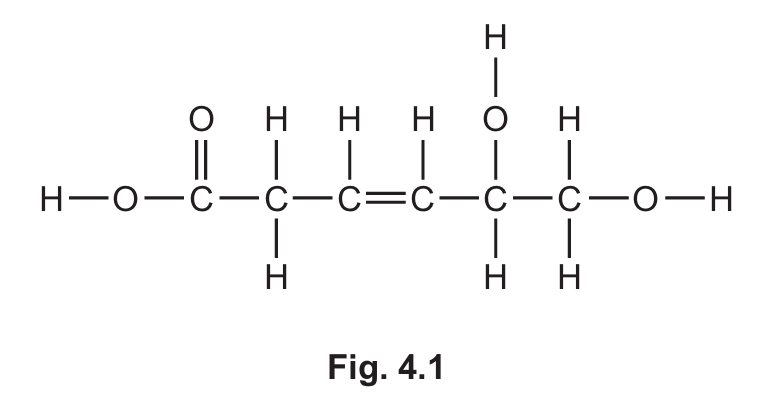
Circle around the \(-\mathrm{COOH}\) group.
The carboxylic acid functional group comprises a carbonyl group (\(\mathrm{C=O}\)) bonded to a hydroxyl group (\(-\mathrm{OH}\)). It is written as \(-\mathrm{COOH}\) and determines the characteristic reactions of carboxylic acids.
(a)(ii)
\(\mathrm{C_6H_{10}O_4}\)
From the displayed formula of compound B, count each atom type: 6 carbon atoms, 10 hydrogen atoms, and 4 oxygen atoms. This gives the molecular formula \(\mathrm{C_6H_{10}O_4}\).
(a)(iii)
has a \(\mathrm{C=C}\) bond / has a carbon–carbon double bond
Unsaturated compounds contain one or more carbon-carbon multiple bonds (double or triple bonds). The presence of a \(\mathrm{C=C}\) double bond in compound B means it is an unsaturated molecule, capable of undergoing addition reactions.
(a)(iv)
test: aqueous bromine
observations: turns colourless / decolorises
When orange/brown bromine water is added to an unsaturated compound, the bromine adds across the carbon-carbon double bond in an electrophilic addition reaction. The product is colourless (a dibromo-compound), so the bromine water is decolorised.
(b)(i)
covalent
In alkanes, carbon and hydrogen atoms are joined by covalent bonds — the electrostatic attraction between shared pairs of electrons and the nuclei of the bonded atoms. All C–C and C–H bonds in alkanes are single covalent bonds.
(b)(ii)
Displayed formula of chloroethane: \(\mathrm{CH_3CH_2Cl}\)
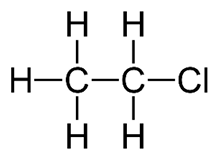
Ethane (\(\mathrm{C_2H_6}\)) reacts with chlorine in a substitution reaction: \(\mathrm{C_2H_6 + Cl_2 \rightarrow C_2H_5Cl + HCl}\). One hydrogen atom is substituted by a chlorine atom. Ultraviolet light provides the activation energy for this photochemical reaction.
(b)(iii)
compounds made up of carbon and hydrogen (atoms) only
A hydrocarbon is an organic compound containing exclusively carbon and hydrogen. Alkanes, alkenes, and alkynes are all examples of hydrocarbons.
(c)
fractional distillation
Petroleum (crude oil) is a complex mixture of hydrocarbons. It is separated in a fractionating column where the mixture is heated, and components boil off at different temperatures based on their molecular size. Larger molecules condense lower down; smaller, more volatile molecules rise higher.
(d)
gasoline/petrol: fuel for cars (1)
jet fuel name: kerosene / paraffin (1)
bitumen: (making) roads (1)
Gasoline (petrol) is used as fuel in internal combustion engines of cars. Kerosene (paraffin) is the fraction used as jet fuel in aircraft turbines. Bitumen is the thick, viscous residue used for surfacing roads and roofing.
Question 5
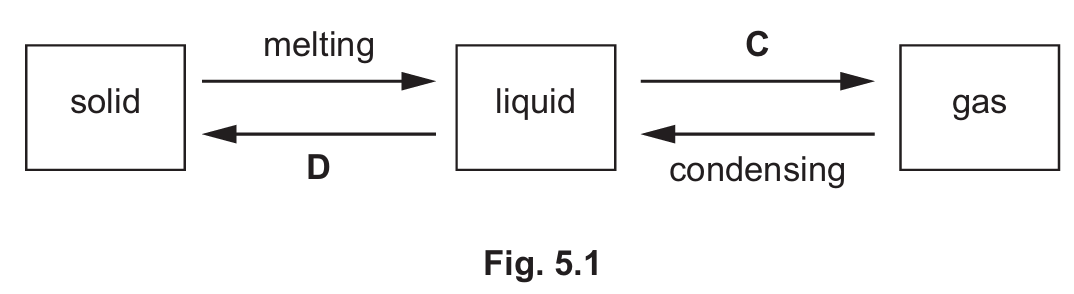
Most-appropriate topic codes (Cambridge IGCSE Chemistry 0620):
• Topic 1.1 — Solids, liquids and gases (Parts (a), (b))
• Topic 3.1 — Formulae (Part (c))
• Topic 9.6 — Extraction of metals (Part (d))
• Topic 6.3 — Reversible reactions and equilibrium (Part (e))
• Topic 9.5 — Corrosion of metals (Part (f))
▶️ Answer/Explanation
(a)
C: evaporation / boiling (1)
D: freezing (1)
C describes the change from liquid to gas. Evaporation occurs at the surface at temperatures below the boiling point; boiling occurs throughout the liquid at a specific temperature. D is freezing, the change from liquid to solid at the melting/freezing point.
(b)
arrangement: irregular / no (particular) arrangement (1)
motion: sliding over each other / random (1)
In the liquid state, particles are still close together (maintaining a definite volume) but are not fixed in a regular lattice. They possess enough kinetic energy to move randomly and slide past one another, allowing the liquid to flow and take the shape of the container’s bottom.
(c)
\(3\mathrm{Fe} + 2\mathrm{O}_2 \rightarrow \mathrm{Fe}_3\mathrm{O}_4\) (2 marks; 1 mark for correct Fe coefficient 3, 1 mark for correct O₂ coefficient 2).
Balancing the equation: On the right, \(\mathrm{Fe}_3\mathrm{O}_4\) has 3 Fe and 4 O atoms. Therefore, \(3\mathrm{Fe}\) and \(2\mathrm{O}_2\) are required on the left, giving \(3 + (2 \times 2) = 4\) oxygen atoms.
(d)(i)
hematite
The primary ore of iron is hematite, which is mainly iron(III) oxide (\(\mathrm{Fe_2O_3}\)). It is reduced in the blast furnace to produce metallic iron.
(d)(ii)
(provide) heat / (produce) carbon dioxide
Coke (carbon) is burned in a blast of hot air: \(\mathrm{C} + \mathrm{O}_2 \rightarrow \mathrm{CO}_2\). This reaction is highly exothermic, generating temperatures around \(1500^\circ\mathrm{C}\) in the furnace. The carbon dioxide produced subsequently reacts with more coke to form carbon monoxide (\(\mathrm{CO_2 + C \rightarrow 2CO}\)), the principal reducing agent that converts iron oxide to iron.
(d)(iii)
calcium oxide
Limestone (\(\mathrm{CaCO_3}\)) thermally decomposes: \(\mathrm{CaCO_3 \rightarrow CaO + CO_2}\). Calcium oxide (\(\mathrm{CaO}\), quicklime) is a basic oxide that then reacts with acidic silica impurities (\(\mathrm{SiO_2}\)) to form molten slag (\(\mathrm{CaSiO_3}\)).
(e)
reversible reaction
The symbol \(\rightleftharpoons\) indicates the reaction is reversible — it proceeds in both the forward (\(\mathrm{N_2 + 3H_2 \rightarrow 2NH_3}\)) and reverse (\(2\mathrm{NH_3} \rightarrow \mathrm{N_2 + 3H_2}\)) directions simultaneously. In a closed system, it can reach dynamic equilibrium where the rates of the forward and reverse reactions are equal.
(f)
painting / greasing / oiling / coating with plastic
These are barrier methods that physically prevent both oxygen (from air) and water (moisture) from reaching the iron surface, thereby inhibiting the electrochemical process of rusting. For rust to occur, both \(\mathrm{O_2}\) and \(\mathrm{H_2O}\) must be present.
Question 6
Most-appropriate topic codes (Cambridge IGCSE Chemistry 0620):
• Topic 7.1 — Characteristic properties of acids and bases (Parts (a), (b))
• Topic 12.5 — Identification of ions and gases (Parts (c), (e))
• Topic 7.3 — Preparation of salts (Part (d))
▶️ Answer/Explanation
(a)
calcium chloride (1)
water (1)
carbon dioxide (1)
The word equation: hydrochloric acid + calcium carbonate → calcium chloride + water + carbon dioxide. The symbol equation: \(2\mathrm{HCl} + \mathrm{CaCO_3} \rightarrow \mathrm{CaCl_2} + \mathrm{H_2O} + \mathrm{CO_2}\). Effervescence is observed as CO₂ gas is released.
(b)
red
Methyl orange is a pH indicator. In acidic solutions (pH below approximately \(3.1\)), it turns red. Hydrochloric acid, being a strong acid, fully dissociates in water, giving a high concentration of \(\mathrm{H}^+\) ions and a low pH.
(c)(i)
(hydrochloric acid contains a) halide / chloride / \(\mathrm{Cl}^-\)
Hydrochloric acid itself contains chloride ions. Using it to acidify the test solution would introduce \(\mathrm{Cl}^-\) ions, which would react with silver nitrate to form a white precipitate of AgCl, giving a false positive test for chloride ions regardless of the halide present in the sample.
(c)(ii)
nitric acid
Dilute nitric acid (\(\mathrm{HNO_3}\)) is the standard acid used in halide testing. It provides the necessary acidic medium without introducing any halide ions that would interfere with the test, as the nitrate ion (\(\mathrm{NO_3^-}\)) does not form a precipitate with silver ions.
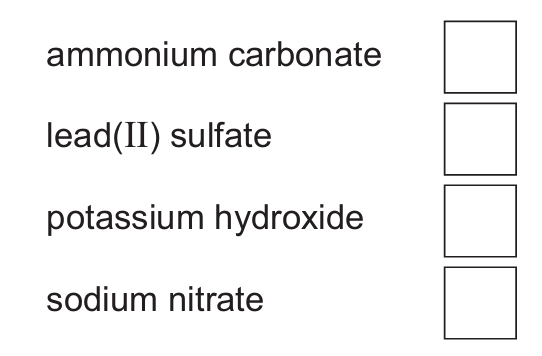
(d)
Second box down ticked (lead sulfate)
According to solubility rules: all sodium, potassium, and ammonium salts are soluble (ruling out barium chloride, sodium carbonate, and potassium hydroxide). Most sulfates are soluble, but lead sulfate (\(\mathrm{PbSO_4}\)) is an exception, along with barium sulfate and calcium sulfate, and is insoluble in water.
(e)
\(\mathrm{CO_3^{2-}}\)
The carbonate ion consists of one carbon atom covalently bonded to three oxygen atoms, carrying an overall charge of \(2-\). Carbonates generally react with dilute acids to produce a salt, water, and carbon dioxide gas.
Question 7
(ii) can be produced by the incomplete combustion of carbon-containing fuels
(iii) is a gas formed from the decomposition of vegetation.
Most-appropriate topic codes (Cambridge IGCSE Chemistry 0620):
• Topic 10.1 — Water (Part (a)(i))
• Topic 10.3 — Air quality and climate (Parts (a)(ii)–(iii), (c))
• Topic 3.2 — Relative masses of atoms and molecules (Part (b))
• Topic 2.5 — Simple molecules and covalent bonds (Part (d))
▶️ Answer/Explanation
(a)(i)
sewage
Untreated sewage contains pathogenic microorganisms (harmful microbes) such as bacteria, viruses, and protozoa that can cause waterborne diseases like cholera, typhoid, and dysentery if ingested.
(a)(ii)
particulates
Particulates (soot, fine carbon particles, \(\mathrm{PM_{2.5}}\) and \(\mathrm{PM_{10}}\)) are produced by the incomplete combustion of carbon-containing fuels. They can penetrate deep into the lungs, causing respiratory problems and an increased risk of cancer.
(a)(iii)
methane
Methane (\(\mathrm{CH_4}\)) is produced by the anaerobic decomposition of organic matter, including vegetation. It is also generated by waste gases from digestion in animals (enteric fermentation) and from landfills. Methane is a potent greenhouse gas.
(b)
\(1.4 \, (\mathrm{mg})\)
Calculation: \(\displaystyle \frac{3.5}{250} \times 100 = \frac{3.5 \times 100}{250} = \frac{350}{250} = 1.4 \, \mathrm{mg}\). This is a simple proportion calculation; the mass of particulates is directly proportional to the volume of the water sample.
(c)
low sulfur fuels / flue gas desulfurisation
Using low-sulfur fuels (e.g., natural gas instead of coal) reduces the amount of sulfur available to form \(\mathrm{SO_2}\) during combustion. Flue gas desulfurisation involves passing exhaust gases through a scrubber containing calcium oxide (lime), which reacts with \(\mathrm{SO_2}\): \(\mathrm{CaO + SO_2 \rightarrow CaSO_3}\).
(d)
low melting point / low boiling point (1)
poor electrical conductivity / poor thermal conductivity (1)
Simple molecular compounds consist of small, discrete molecules held together by weak intermolecular forces (van der Waals forces), requiring little energy to overcome, hence low melting and boiling points. They do not contain mobile charged particles (ions or delocalised electrons), so they do not conduct electricity in any state.
Question 8
Most-appropriate topic codes (Cambridge IGCSE Chemistry 0620):
• Topic 4.1 — Electrolysis (Part (a))
• Topic 11.7 — Carboxylic acids (Part (b))
• Topic 7.1 — Characteristic properties of acids and bases (Part (c))
• Topic 3.2 — Relative masses of atoms and molecules (Part (d))
• Topic 11.6 — Alcohols (Part (e))
▶️ Answer/Explanation
(a)(i)
positive electrode: chlorine / \(\mathrm{Cl_2}\) (1)
negative electrode: potassium / \(\mathrm{K}\) (1)
Molten potassium chloride (\(\mathrm{KCl}\)) contains \(\mathrm{K^+}\) and \(\mathrm{Cl^-}\) ions. During electrolysis, \(\mathrm{Cl^-}\) ions are attracted to the positive electrode (anode), where they lose electrons (oxidation): \(2\mathrm{Cl^-} \rightarrow \mathrm{Cl_2} + 2\mathrm{e^-}\). \(\mathrm{K^+}\) ions migrate to the negative electrode (cathode), where they gain electrons (reduction): \(\mathrm{K^+} + \mathrm{e^-} \rightarrow \mathrm{K}\).
(a)(ii)
cathode
The cathode is defined as the negative electrode in an electrolytic cell. It attracts cations (positive ions) from the electrolyte, where they undergo reduction by gaining electrons.
(b)
potassium ethanoate
The reaction of a reactive metal with a carboxylic acid produces a salt and hydrogen gas: \(2\mathrm{K} + 2\mathrm{CH_3COOH} \rightarrow 2\mathrm{CH_3COOK} + \mathrm{H_2}\). The salt is named from the metal (potassium) and the acid (ethanoic acid → ethanoate).
(c)
pH 5 circled
Universal indicator turns yellow in weakly acidic solutions (pH approximately \(4-6\)). Ethanoic acid is a weak acid, meaning it only partially dissociates in water (\(\mathrm{CH_3COOH \rightleftharpoons H^+ + CH_3COO^-}\)), giving a moderate \(\mathrm{H^+}\) concentration, around pH 5. pH 1 is strongly acidic, pH 7 is neutral, and pH 13 is strongly alkaline.
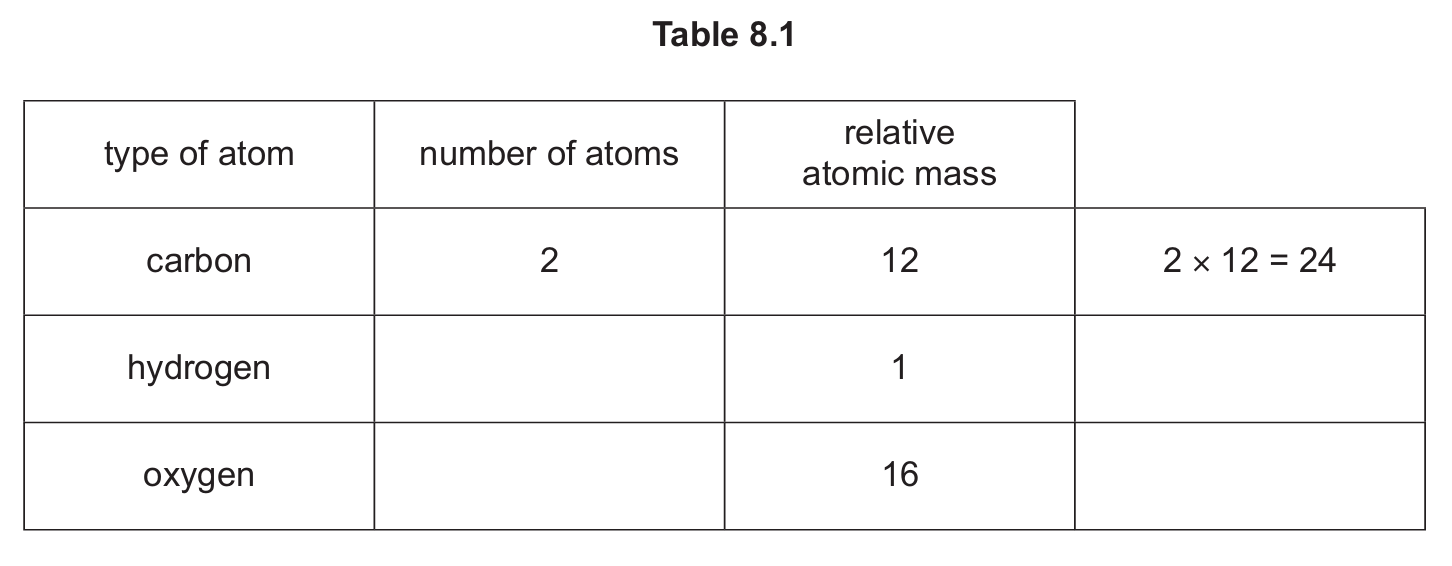
(d)
hydrogen: number of atoms = 4; calculation = \(4 \times 1 = 4\)
oxygen: number of atoms = 2; calculation = \(2 \times 16 = 32\)
relative molecular mass = \(60\)
Ethanoic acid, \(\mathrm{CH_3COOH}\), can also be written \(\mathrm{C_2H_4O_2}\). Adding the contributions: \((2 \times 12) + (4 \times 1) + (2 \times 16) = 24 + 4 + 32 = 60\). The relative molecular mass is calculated as specified in the table format. (1 mark for correct H and O entries; 2 marks total for correct final answer \(60\).)
(e)(i)
high temperature / \(300\,^\circ\mathrm{C}\) (1)
acid catalyst (1)
The industrial catalytic hydration of ethene: \(\mathrm{C_2H_4 + H_2O \rightarrow C_2H_5OH}\). Conditions: \(300\,^\circ\mathrm{C}\), \(60\,\mathrm{atm}\) pressure, and a phosphoric acid (\(\mathrm{H_3PO_4}\)) catalyst. This is a continuous process with high atom economy, contrasting with the batch fermentation method.
(e)(ii)
solvent / fuel
Ethanol is widely used as a solvent in perfumes, cosmetics, medicines, and varnishes. It is also used as a biofuel (often blended with petrol, e.g., E10) and in alcoholic beverages. Methylated spirits contains ethanol with additives to make it undrinkable.