
▶️ Answer/Explanation
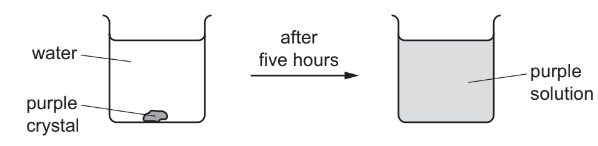
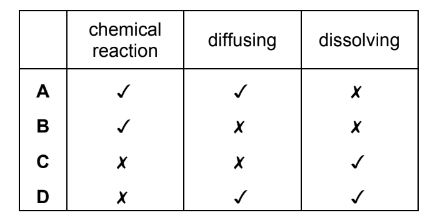
When a purple crystal (such as potassium manganate(VII)) is dropped into water, two processes occur simultaneously: first, the crystal dissolves in the water as the water molecules interact with and break apart the ionic lattice, releasing coloured ions into solution — this is dissolution. Second, once the ions are free in solution, they spread out from the region of high concentration (near the crystal) to regions of lower concentration throughout the water — this is diffusion, explained by kinetic particle theory as the random movement of particles. Both dissolution and diffusion are therefore taking place, and no chemical reaction occurs since the process is entirely physical. This combination of dissolving followed by diffusion of the coloured ions accounts for the spreading purple colour observed in the diagram.
✅ Answer: D
✅ Answer: D
▶️ Answer/Explanation
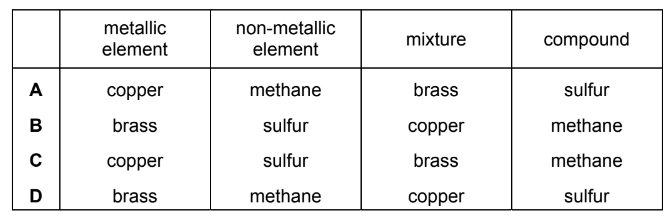
An element consists of only one type of atom (identified by its proton number), and it cannot be broken down into simpler substances by chemical means. A compound contains two or more different elements chemically bonded together in fixed proportions, and its properties differ from those of its constituent elements; it can only be separated by chemical reactions. A mixture, by contrast, contains two or more substances that are not chemically combined — the components retain their individual properties and can be separated by physical means such as filtration, distillation or chromatography. Row C correctly reflects all three of these definitions without contradiction, making it the only fully accurate row in the table.
✅ Answer: C
✅ Answer: C
▶️ Answer/Explanation
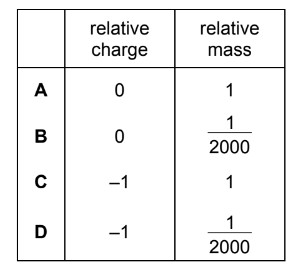
An electron carries a relative charge of –1, equal in magnitude but opposite in sign to that of a proton (+1), which is why atoms are electrically neutral when the number of protons equals the number of electrons. The relative mass of an electron is approximately 1/1840 of that of a proton or neutron, which is so negligibly small that it is considered to be effectively zero (or 1/2000) for most calculations at this level. Protons and neutrons each have a relative mass of 1 and are located in the nucleus, while electrons occupy shells surrounding the nucleus and contribute virtually nothing to the overall mass of the atom. Therefore, the correct answer assigns a relative charge of –1 and a relative mass of 0 (or negligible) to the electron.
✅ Answer: D
✅ Answer: D
▶️ Answer/Explanation
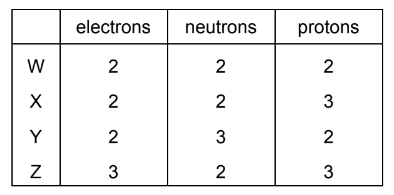
Isotopes are defined as atoms of the same element that have the same number of protons (same atomic number) but different numbers of neutrons (different mass numbers); the number of protons determines which element an atom belongs to. To identify isotopes, you must look for two particles with identical proton numbers but differing neutron counts — any difference in proton number means the particles belong to entirely different elements and cannot be isotopes. From the diagram, particles W and Y have the same number of protons but different numbers of neutrons, satisfying the definition of isotopes exactly, while the other pairs either differ in proton number or have identical nucleon compositions. Therefore, W and Y are isotopes of the same element.
✅ Answer: B
✅ Answer: B
▶️ Answer/Explanation
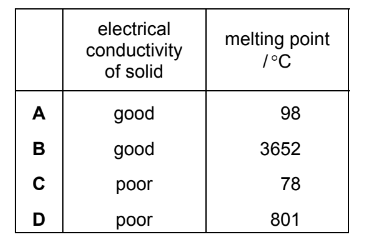
Ionic compounds are held together by strong electrostatic forces of attraction between oppositely charged ions arranged in a giant ionic lattice, which requires a large amount of energy to overcome — this gives them characteristically high melting points. When solid, the ions are fixed in their lattice positions and cannot move freely, so ionic compounds do not conduct electricity in the solid state; however, when melted or dissolved in water, the ions become free to move and carry charge, making them good electrical conductors in the molten or aqueous state. Any row suggesting low melting points or conductivity in the solid state would be incorrect. Row D correctly combines a high melting point with poor electrical conductivity when solid and good conductivity when molten or in solution.
✅ Answer: D
✅ Answer: D
▶️ Answer/Explanation
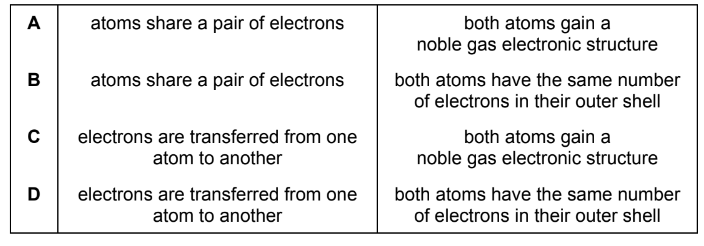
Methane (CH4) is formed when one carbon atom shares electrons with four hydrogen atoms through single covalent bonds. Carbon has 4 electrons in its outer shell and needs 4 more to achieve a full outer shell of 8 (noble gas configuration), while each hydrogen atom has 1 electron and needs 1 more to achieve a full outer shell of 2; by sharing one pair of electrons in each of the four C–H bonds, both carbon and all four hydrogen atoms simultaneously achieve stable noble gas electronic configurations. Each single covalent bond therefore consists of exactly one shared pair of electrons — giving carbon 4 bonds and each hydrogen 1 bond. Row A correctly identifies that 4 single covalent bonds are formed, each consisting of one shared pair of electrons, with the carbon atom achieving a full outer shell of 8 electrons.
✅ Answer: A
✅ Answer: A
▶️ Answer/Explanation
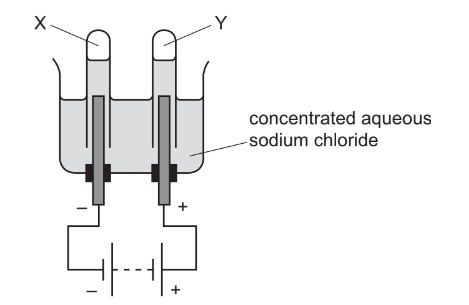
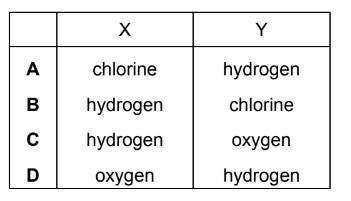
During the electrolysis of concentrated aqueous sodium chloride, the solution contains Na+, Cl–, H+ and OH– ions. At the cathode (negative electrode), hydrogen gas is preferentially discharged as H+ ions are attracted to the negative electrode and gain electrons (2H+ + 2e– → H2); sodium ions are not discharged because sodium is too reactive. At the anode (positive electrode), chloride ions are preferentially discharged in concentrated solution to produce chlorine gas (2Cl– → Cl2 + 2e–), rather than OH– ions which would be preferentially discharged in dilute solution. Therefore, gas X produced at the anode is chlorine and gas Y produced at the cathode is hydrogen.
✅ Answer: B
✅ Answer: B
▶️ Answer/Explanation
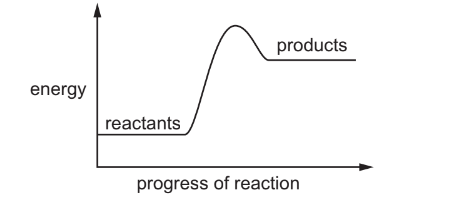
In a reaction pathway diagram, the relative energy levels of the reactants and products determine whether the reaction is exothermic or endothermic. When the products are at a higher energy level than the reactants, the reaction requires a net input of thermal energy from the surroundings — this is the definition of an endothermic reaction, and the enthalpy change ΔH is positive. Options C and D describe exothermic behaviour (energy released to surroundings, temperature of surroundings increases), which would only apply if the products were at a lower energy level than the reactants. Option A is unrelated to the reaction pathway diagram, as reaction rate is not shown or implied by energy level diagrams. Since the diagram shows products higher in energy than reactants, the reaction is endothermic, making option B correct.
✅ Answer: B
✅ Answer: B
▶️ Answer/Explanation
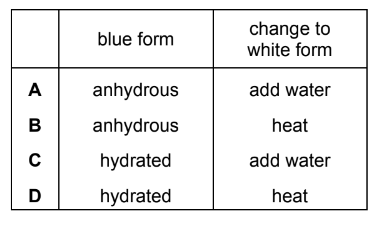
Hydrated copper(II) sulfate (CuSO4•5H2O) is the blue form, as the water of crystallisation chemically combined within its crystal lattice gives it the characteristic blue colour. When hydrated copper(II) sulfate is heated, the water of crystallisation is driven off, converting it to anhydrous copper(II) sulfate (CuSO4), which is white — this is the forward reaction in the reversible equation shown. The reverse reaction (white → blue) is brought about simply by adding water to the anhydrous form, which rehydrates the crystals and restores the blue colour. Therefore, the blue form is hydrated copper(II) sulfate and the change to the white anhydrous form is brought about by heating.
✅ Answer: D
✅ Answer: D
▶️ Answer/Explanation
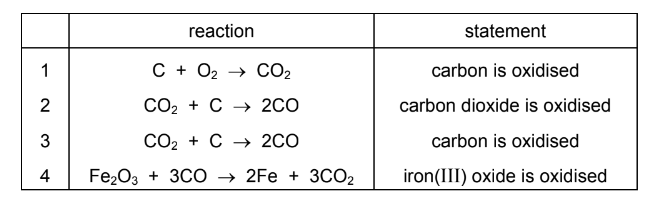
In redox reactions, oxidation and reduction always occur simultaneously — a substance that loses oxygen or electrons is oxidised (and acts as a reducing agent), while a substance that gains oxygen or electrons is reduced (and acts as an oxidising agent). To evaluate each statement, the changes in oxygen content or oxidation numbers of each species in the equations must be carefully tracked: a species gaining oxygen is being oxidised, and a species losing oxygen is being reduced. Statements 1 and 3 correctly identify which species is oxidised and which is reduced in their respective equations, correctly applying the definitions of oxidation (gain of oxygen/loss of electrons) and reduction (loss of oxygen/gain of electrons). Statements 2 and 4 incorrectly assign the roles of oxidation and reduction, either by misidentifying the oxidising or reducing agent or by reversing the direction of electron/oxygen transfer.
✅ Answer: B
✅ Answer: B
▶️ Answer/Explanation
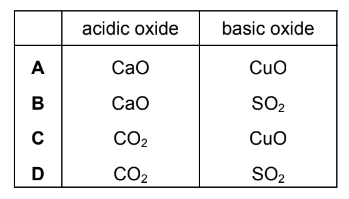
Acidic oxides are formed from non-metals and dissolve in water to produce acidic solutions or react with bases to form a salt and water — examples include SO2, SO3, CO2 and NO2. Basic oxides are formed from metals and react with acids to form a salt and water — examples include CuO, CaO, MgO and Fe2O3. Any row containing a metallic oxide in the acidic column or a non-metallic oxide in the basic column would be incorrect. Row C correctly pairs a non-metal oxide (acidic) with a metal oxide (basic), satisfying both definitions simultaneously without confusion with amphoteric oxides such as Al2O3 or ZnO, which can react with both acids and bases.
✅ Answer: C
✅ Answer: C
▶️ Answer/Explanation
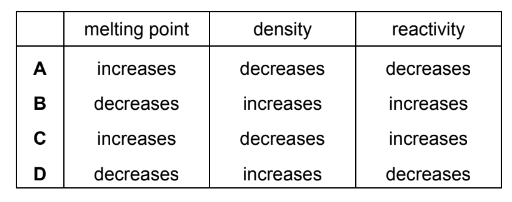
As Group I is descended from lithium to caesium, three key trends are observed. The melting point decreases because the metallic bonds become weaker as the atomic radius increases and the delocalised electrons are further from the nucleus. The density increases because each successive element has a significantly heavier nucleus even though the atomic size also grows, resulting in a net increase in mass per unit volume. The reactivity increases because the outer electron is further from the nucleus and more shielded by inner electron shells, making it increasingly easy to lose that electron and form a positive ion. This gives a combination of decreasing melting point, increasing density, and increasing reactivity.
✅ Answer: (B)
✅ Answer: (B)
▶️ Answer/Explanation
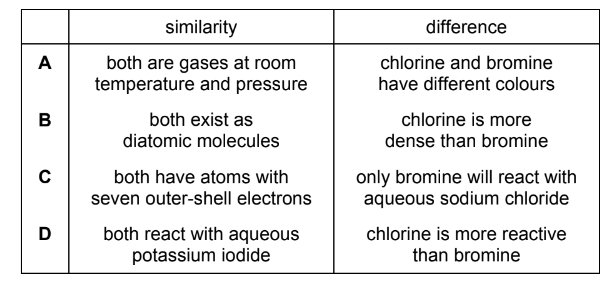
Chlorine and bromine are both members of Group VII (halogens) and share the similarity of existing as diatomic molecules (Cl₂ and Br₂), meaning both are composed of pairs of atoms bonded covalently. However, they differ in their physical state at room temperature and pressure (r.t.p.): chlorine is a pale yellow-green gas while bromine is a red-brown liquid, reflecting the increase in intermolecular forces down the group as the molecules become larger and have more electrons. Additionally, chlorine is more reactive than bromine, as the ability to gain an electron decreases down the group due to the increased atomic radius and greater electron shielding. Row D correctly identifies that both are diatomic (similarity) while differing in their states at r.t.p.
✅ Answer: (D)
✅ Answer: (D)
▶️ Answer/Explanation
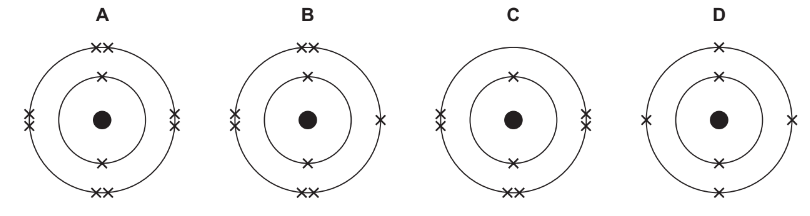
Noble gases belong to Group VIII of the Periodic Table and are characterised by having a completely full outer electron shell, which makes them exceptionally stable and chemically unreactive. For a noble gas to be identified from an electronic structure diagram, its outermost shell must be completely filled — the first shell holds a maximum of 2 electrons, and subsequent shells hold a maximum of 8 electrons. Diagram A shows the electronic configuration 2, 8, 8, which corresponds to argon (proton number 18), a noble gas with a full outer shell of 8 electrons. The other diagrams show configurations with incomplete outer shells, meaning those atoms would need to gain, lose, or share electrons to become stable, which is characteristic of non-noble gas elements.
✅ Answer: (A)
✅ Answer: (A)
▶️ Answer/Explanation
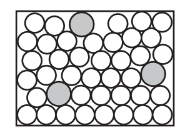
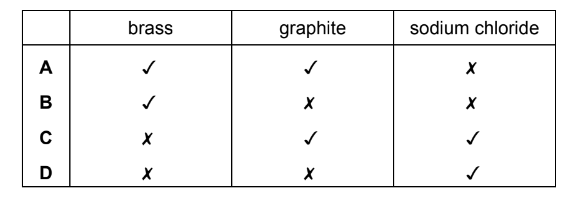
The diagram shows a giant lattice structure where particles are arranged in a regular, repeating three-dimensional pattern — this is characteristic of giant structures, which include ionic lattices, giant covalent structures, and metallic lattices. Diamond is a giant covalent structure where each carbon atom is covalently bonded to four others in a tetrahedral arrangement forming an extensive lattice, and silicon(IV) oxide (SiO₂) similarly forms a giant covalent lattice structure with a comparable appearance. Simple molecular solids such as iodine do not form giant lattices — they consist of discrete molecules held together by weak intermolecular forces — and sodium chloride, while also a giant lattice, is ionic rather than covalent. Row B correctly identifies diamond and silicon(IV) oxide as the two solids represented by this type of giant covalent lattice diagram.
✅ Answer: (B)
✅ Answer: (B)
▶️ Answer/Explanation
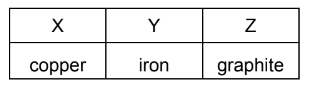
Solid P must satisfy two conditions simultaneously: it reacts with dilute acids and it conducts electricity in the solid state. Metals fulfil both criteria — they react with dilute acids (provided they are above hydrogen in the reactivity series) and they conduct electricity in the solid state due to the presence of delocalised electrons in their giant metallic lattice. Student Y correctly identifies P as a metal, which is the only category of solid that satisfies both properties. Student X suggesting an ionic compound is incorrect because ionic compounds do not conduct electricity in the solid state (ions are fixed in the lattice) and generally do not react with dilute acids in the same way. Student Z suggesting graphite is incorrect because although graphite does conduct electricity, it does not react with dilute acids. Therefore, only Student Y is correct.
✅ Answer: (C)
✅ Answer: (C)
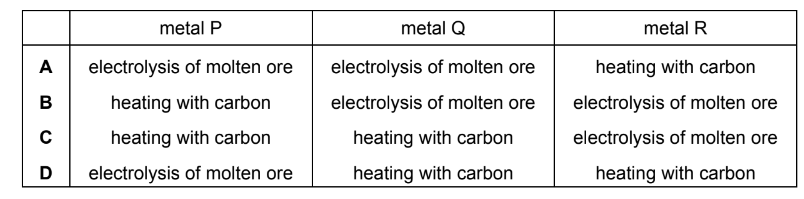
▶️ Answer/Explanation
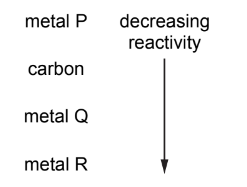
The method used to extract a metal from its ore is directly linked to its position in the reactivity series. Highly reactive metals such as aluminium (above carbon in the reactivity series) cannot be reduced by carbon or carbon monoxide, so they must be extracted by the more energy-intensive process of electrolysis of their molten ores. Metals of moderate reactivity such as iron (below carbon but above hydrogen) can be extracted by reduction with carbon or carbon monoxide in a blast furnace. Metals of low reactivity such as copper (below hydrogen in the reactivity series) can be extracted by reduction with carbon, or in some cases found native; copper is also increasingly obtained by electrolytic refining. Row D correctly matches aluminium with electrolysis, iron with reduction by carbon/carbon monoxide, and copper with reduction or electrolysis, consistent with their positions in the reactivity series.
✅ Answer: (D)
✅ Answer: (D)
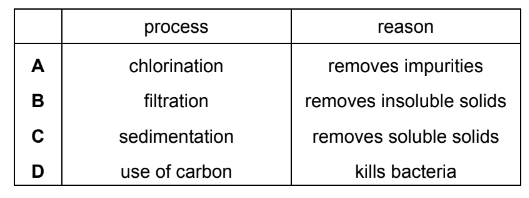
▶️ Answer/Explanation
Domestic water treatment involves several distinct processes, each with a specific purpose. Sedimentation and filtration are used to remove suspended solid particles from the water, making it clear. Activated carbon (charcoal) is used to remove unpleasant tastes and odours from the water by adsorbing the organic compounds responsible for them — it does not kill microbes or remove solids effectively. Chlorination involves adding small amounts of chlorine to the water specifically to kill harmful microbes and bacteria, making the water safe to drink. Row B correctly pairs chlorination with the reason of killing microbes, which is the sole purpose of this treatment step and matches precisely with the syllabus requirement.
✅ Answer: (B)
✅ Answer: (B)
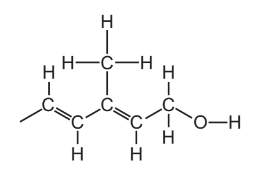
▶️ Answer/Explanation
Examining each statement against the displayed structure of the vitamin A fragment: Statement 1 is incorrect because the structure clearly contains carbon–carbon double bonds (C=C), which means it is unsaturated, not saturated — a saturated compound would have only single C–C bonds throughout. Statement 2 is correct because the structure shows two C=C double bonds, which are the defining functional group of alkenes, making this part of the molecule contain two alkene groups. Statement 3 is incorrect because a carboxylic acid requires the –COOH functional group (a carbonyl and hydroxyl on the same carbon), which is not present in this portion of the vitamin A structure. Therefore, only statement 2 is correct.
✅ Answer: (D)
✅ Answer: (D)
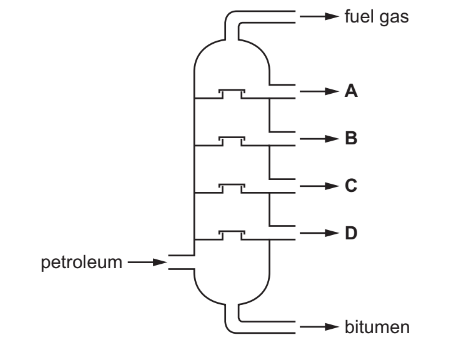
▶️ Answer/Explanation
In the fractional distillation of petroleum, the fractionating column operates on the principle that hydrocarbons with longer carbon chains have stronger intermolecular forces, higher boiling points, and therefore condense at higher temperatures lower down the column. As a result, fractions collected at the bottom of the column contain hydrocarbons with the longest chain lengths and highest boiling points, such as bitumen and fuel oil, while fractions collected at the top have the shortest chains, lowest boiling points, and highest volatility, such as refinery gases. Fraction D, being collected at the bottom of the fractionating column shown in the diagram, therefore contains the hydrocarbons with the longest carbon chain lengths.
✅ Answer: (D)
✅ Answer: (D)
▶️ Answer/Explanation
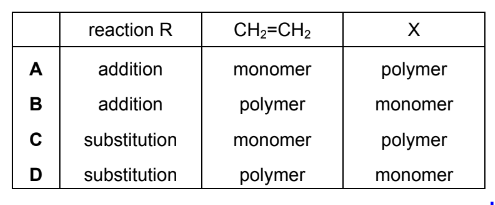
Reaction R involves 2000 small molecules of ethene (CH₂=CH₂) joining together to form a single large molecule X with no other products — this is the definition of addition polymerisation, where the C=C double bonds open up and the molecules link together in a chain. CH₂=CH₂ is ethene, which is the starting small molecule used to build the polymer, making it the monomer. Since only one product (X) is formed and no other substance is released, this confirms it is addition polymerisation rather than condensation polymerisation. The product X is poly(ethene), which is a large molecule made of many repeating ethene units joined together, making it a polymer. Row A correctly identifies reaction R as addition polymerisation, CH₂=CH₂ as the monomer, and X as the polymer.
✅ Answer: (A)
✅ Answer: (A)
▶️ Answer/Explanation
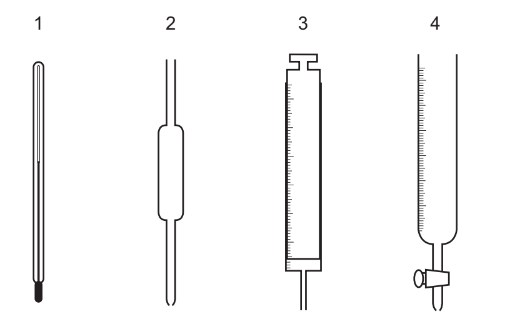
A titration requires two key pieces of volumetric glassware that allow precise measurement of liquid volumes. A burette (piece 2) is essential as it allows the controlled, measured addition of one solution (the titrant) drop by drop into the other solution, with readings taken before and after to determine the exact volume added. A volumetric pipette (piece 4) is used to deliver a precise, fixed volume of the other solution into the conical flask before the titration begins, ensuring accuracy and reproducibility. A measuring cylinder (piece 1) is not precise enough for titration work, and a beaker (piece 3) cannot deliver or measure accurate volumes of solution. Together, the burette and volumetric pipette are the two essential pieces of equipment for performing an accurate acid-base titration.
✅ Answer: (D)
✅ Answer: (D)
▶️ Answer/Explanation
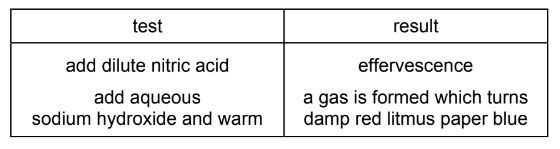
The two test results must be used together to identify X. The first test shows that adding dilute acid to X produces a gas that turns limewater milky, which is the confirmatory test for carbon dioxide — this means X contains the carbonate ion (CO₃²⁻), eliminating options B (aluminium nitrate) and D (ammonium nitrate) which contain no carbonate. The second test shows that adding aqueous sodium hydroxide to X and warming produces a gas that turns damp red litmus paper blue, which is the confirmatory test for ammonia — this means X contains the ammonium ion (NH₄⁺), eliminating option A (aluminium carbonate). Ammonium carbonate ((NH₄)₂CO₃) contains both the ammonium ion and the carbonate ion, satisfying both test results perfectly, and it is indeed a white solid.
✅ Answer: (C)
✅ Answer: (C)