
Question 1
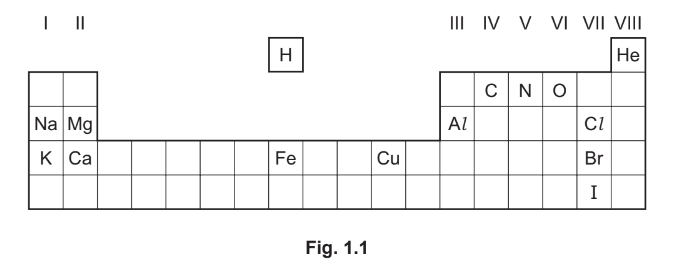
Most-appropriate topic codes (Cambridge IGCSE Chemistry 0620):
• Topic 10.3 — Air quality and climate (Part (a))
• Topic 2.2 — Atomic structure and the Periodic Table (Parts (b), (c))
• Topic 2.4 — Ions and ionic bonds (Part (d))
• Topic 12.5 — Identification of ions and gases (Part (e))
• Topic 9.2 — Uses of metals (Part (f))
▶️ Answer/Explanation
(a) N (Nitrogen)
Clean, dry air is composed of approximately 78% nitrogen by volume. Nitrogen gas (N₂) is therefore the most abundant element in the atmosphere and the correct answer here from the Periodic Table extract.
(b) He (Helium)
Helium is a noble gas in Group VIII (Group 0). Its outer — and only — electron shell contains 2 electrons, which is the maximum for the first shell, making it complete. All noble gases have full outer electron shells, but helium is the only one likely shown in a partial Periodic Table at this level.
(c) I (Iodine)
Iodine has atomic number 53 and electronic configuration 2, 8, 18, 18, 7 — five occupied electron shells in total. This places it in Period 5 of the Periodic Table. No other element in a typical partial table extract for IGCSE level would have five occupied shells.
(d) O (Oxygen)
Oxygen is in Group VI of the Periodic Table. It gains 2 electrons to achieve a stable noble-gas configuration, forming the oxide ion O²⁻ with a charge of 2–. This is consistent with the rule that Group VI elements form ions with a 2– charge.
(e) Fe (Iron)
When aqueous sodium hydroxide is added to a solution containing Fe²⁺ ions, a green precipitate of iron(II) hydroxide is formed. This is a standard qualitative test result from the syllabus Notes for Use in Qualitative Analysis. Iron is the only transition metal in the partial table that gives a green precipitate with NaOH(aq).
(f) Al (Aluminium)
Aluminium is used in food containers specifically because it resists corrosion — a thin, tough layer of aluminium oxide forms on its surface and prevents further oxidation. This use is explicitly stated in Topic 9.2 of the syllabus.
Question 2
Most-appropriate topic codes (Cambridge IGCSE Chemistry 0620):
• Topic 8.3 — Group VII properties (Parts (a)(i)–(a)(iii), (b)(i), (b)(ii), (d))
• Topic 2.2 — Atomic structure and the Periodic Table (Part (c))
• Topic 12.5 — Identification of ions and gases (Part (d))
▶️ Answer/Explanation
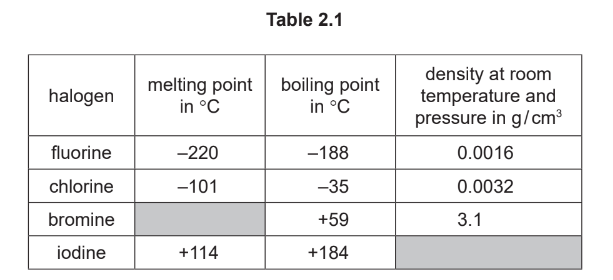
(a)(i) Between −100 °C and +58 °C
The melting points of the halogens increase going down the group (fluorine lowest, iodine highest). Bromine’s melting point must fall between the melting points of chlorine (below it) and iodine (above it) in the group, so any value in the range −100 °C to +58 °C is acceptable.
(a)(ii) Between 3.20 and 10.0 g/dm³ (or appropriate unit)
Density increases down Group VII. Iodine is below bromine in the group, so its density must be greater than bromine’s. Any value between the density of bromine and a reasonable upper limit (10.0) is accepted, reflecting the trend of increasing density down the group.
(a)(iii) Gas; because −10 °C is above chlorine’s boiling point
Chlorine has a boiling point of approximately −34 °C. Since −10 °C is higher than this boiling point, chlorine exists as a gas at −10 °C. A substance is a gas at any temperature above its boiling point.
(b)(i) Displacement
This is a halogen displacement reaction. Chlorine, being more reactive than iodine, displaces iodine from the potassium iodide solution. A more reactive element displacing a less reactive one from its compound is the definition of a displacement reaction.
(b)(ii)
Iodine is less reactive than chlorine. For a halogen to displace another from its salt, it must be more reactive than the halide ion present. Since iodine is less reactive than chlorine, it cannot displace chloride ions from potassium chloride solution — it lacks the reactivity needed to do so.
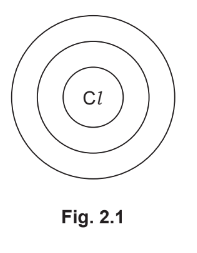
(c) Electronic configuration 2, 8, 7
Chlorine has atomic number 17, so it has 17 electrons arranged as 2 in the first shell, 8 in the second shell, and 7 in the third (outer) shell. The diagram should show three concentric circles with 2, 8, and 7 electrons respectively.
(d) Test: hold damp litmus paper in the gas; Observation: the paper is bleached (turns white)
Chlorine is a powerful bleaching agent. When moist litmus paper is exposed to chlorine gas, the paper is first turned red (due to acidity) and then bleached white as the chlorine reacts with water to form hypochlorous acid, which destroys the dye.
Question 3
Most-appropriate topic codes (Cambridge IGCSE Chemistry 0620):
• Topic 10.1 — Water (Parts (a), (b)(i), (b)(ii), (c)(i)–(c)(iii), (d)(i), (d)(ii))
• Topic 9.4 — Reactivity series (Part (e))
• Topic 3.1 — Formulae (Part (e))
▶️ Answer/Explanation
(a) Oxygen
Dissolved oxygen in water is essential for the aerobic respiration of fish, invertebrates, and other aquatic organisms. Without sufficient dissolved oxygen, aquatic life suffocates and dies. The other gases listed — argon, hydrogen, and nitrogen — do not support life in this way.
(b)(i) Sewage / harmful microbes
Sewage is another major category of harmful substance found in polluted natural water sources. It contains harmful bacteria and other microbes that can cause serious diseases such as cholera and typhoid when ingested by humans or animals.
(b)(ii)
Nitrates act as nutrients that cause excessive algal growth (algal blooms) on the water surface. This blocks sunlight, killing underwater plants, and when the algae die and decompose, bacteria consume large amounts of dissolved oxygen, deoxygenating the water and causing the death of aquatic animals.
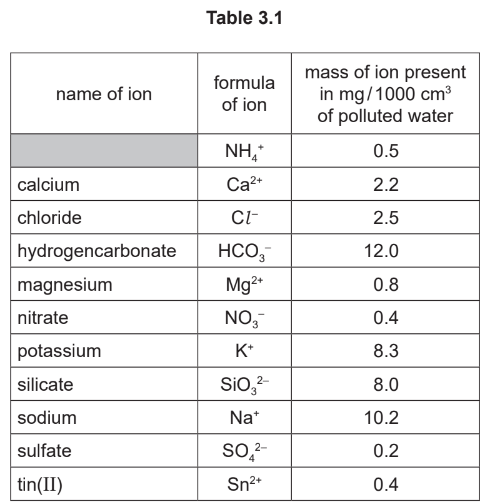
(c)(i) Hydrogencarbonate; (c)(ii) Ammonium; (c)(iii) 0.44 mg
From Table 3.1, the hydrogencarbonate ion has the greatest mass per 1000 cm³ among the negative ions, giving it the highest concentration. The NH₄⁺ ion is named the ammonium ion. For calcium ions: if 1000 cm³ contains 2.2 mg, then 200 cm³ contains (200/1000) × 2.2 = 0.44 mg.
(d)(i) and (d)(ii)
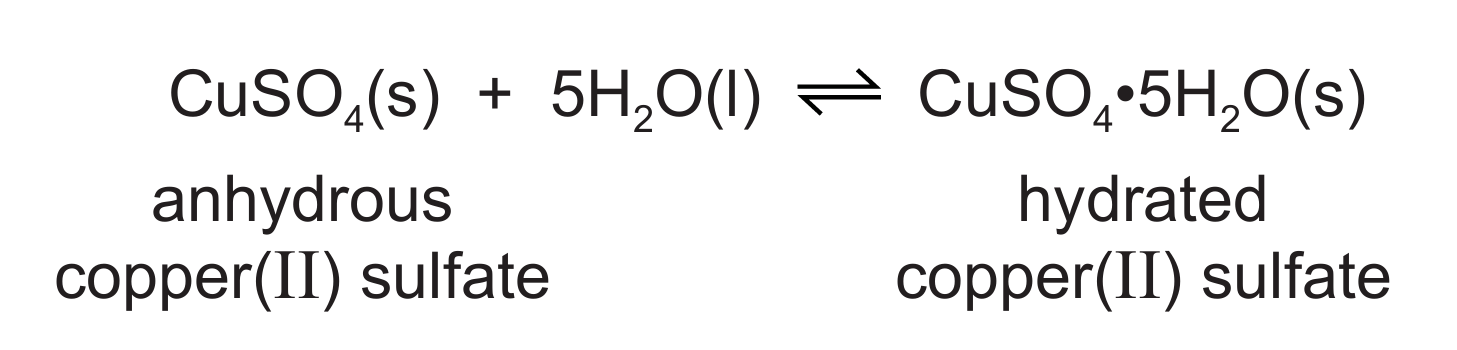
A hydrated substance is one that is chemically combined with water molecules within its crystal structure. To convert hydrated copper(II) sulfate (blue crystals, CuSO₄·5H₂O) to the anhydrous form (white powder, CuSO₄), the crystals are heated strongly to drive off the combined water molecules.
(e) 2Na + 2H₂O → 2NaOH + H₂
The balanced equation requires 2 water molecules and produces 1 molecule of hydrogen gas (H₂). Sodium reacts vigorously with cold water, producing sodium hydroxide and hydrogen gas. The coefficient 2 in front of H₂O and the product H₂ are the two marks available.
Question 4

Most-appropriate topic codes (Cambridge IGCSE Chemistry 0620):
• Topic 2.3 — Isotopes (Part (a))
• Topic 2.2 — Atomic structure (Part (b))
• Topic 5.1 — Exothermic and endothermic reactions (Parts (c)(i)–(c)(iii))
• Topic 4.1 — Electrolysis (Parts (d)(i), (d)(ii))
• Topic 7.1 — Characteristic properties of acids and bases (Parts (e), (f))
▶️ Answer/Explanation
(a)
Isotopes are atoms of the same element (therefore having the same number of protons / same proton number) but with different numbers of neutrons (and therefore different mass numbers). Since they have the same number of protons, they have the same electronic configuration and identical chemical properties.
(b) Protons: 16; Neutrons: 20; Electrons: 18
The atomic number of sulfur is 16, giving 16 protons. Mass number = protons + neutrons, so neutrons = 36 − 16 = 20. The ion S²⁻ has gained 2 extra electrons compared to a neutral atom, so the number of electrons = 16 + 2 = 18.
(c)(i), (c)(ii), (c)(iii)
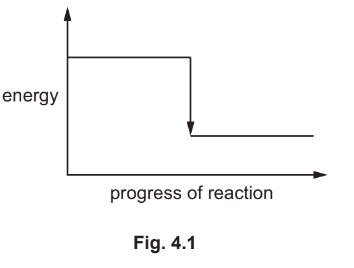
On the reaction pathway diagram, S + O₂ is placed on the higher energy line (left) and SO₂ on the lower energy line (right). The reaction is exothermic because the energy of the reactants (S + O₂) is greater than the energy of the product (SO₂) — the products sit lower on the energy axis. An exothermic reaction transfers thermal energy to the surroundings.
(d)(i) and (d)(ii)
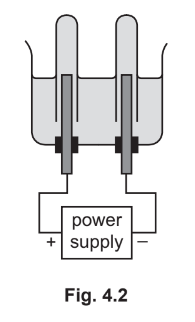
In the electrolysis of dilute H₂SO₄, the right-hand electrode connected to the negative terminal of the battery is the cathode; the liquid between the electrodes is the electrolyte. At the positive electrode (anode), oxygen gas is produced — observed as bubbles forming. At the negative electrode (cathode), hydrogen gas is produced — also observed as bubbles, and at twice the volume of oxygen.
(e) dilute sulfuric acid + sodium carbonate → sodium sulfate + carbon dioxide + water
Acids react with carbonates to produce a salt, carbon dioxide, and water. Here, sulfuric acid reacts with sodium carbonate to give sodium sulfate (the salt), carbon dioxide gas (which causes effervescence), and water. All three products are required for full marks.
(f) Colourless
Thymolphthalein indicator is colourless in acidic and neutral solutions and turns blue in alkaline solutions. Since dilute sulfuric acid is acidic (pH below 7), the indicator remains colourless when added to it.
Question 5
State two differences in the physical properties of iron compared to potassium.
State two uses of carbon in the extraction process.

Most-appropriate topic codes (Cambridge IGCSE Chemistry 0620):
• Topic 8.4 — Transition elements / Topic 8.2 — Group I properties (Part (a))
• Topic 9.6 — Extraction of metals (Part (b))
• Topic 9.3 — Alloys and their properties (Parts (c)(i), (c)(ii))
• Topic 9.4 — Reactivity series (Part (d))
▶️ Answer/Explanation
(a)
Iron has a much higher melting point than potassium (iron melts at ~1538 °C; potassium melts at ~63 °C), reflecting the stronger metallic bonding in transition metals. Iron also has a much higher density than potassium — potassium is so light it floats on water, while iron is a dense, heavy metal. Iron is also harder and stronger than potassium.
(b)
Carbon (coke) is used in the blast furnace firstly to provide heat — it burns in the hot air blast to generate the very high temperatures needed for the process (C + O₂ → CO₂). Secondly, carbon acts as a reducing agent indirectly: the CO₂ produced reacts with more carbon to form carbon monoxide (C + CO₂ → 2CO), which then reduces iron(III) oxide to iron.
(c)(i) and (c)(ii)
An alloy is a mixture of a metal with one or more other elements (metallic or non-metallic). Alloys are more useful than pure metals because they are generally harder and stronger — the differently-sized atoms in the mixture disrupt the regular lattice, making it harder for layers to slide over each other, so the alloy resists deformation better.
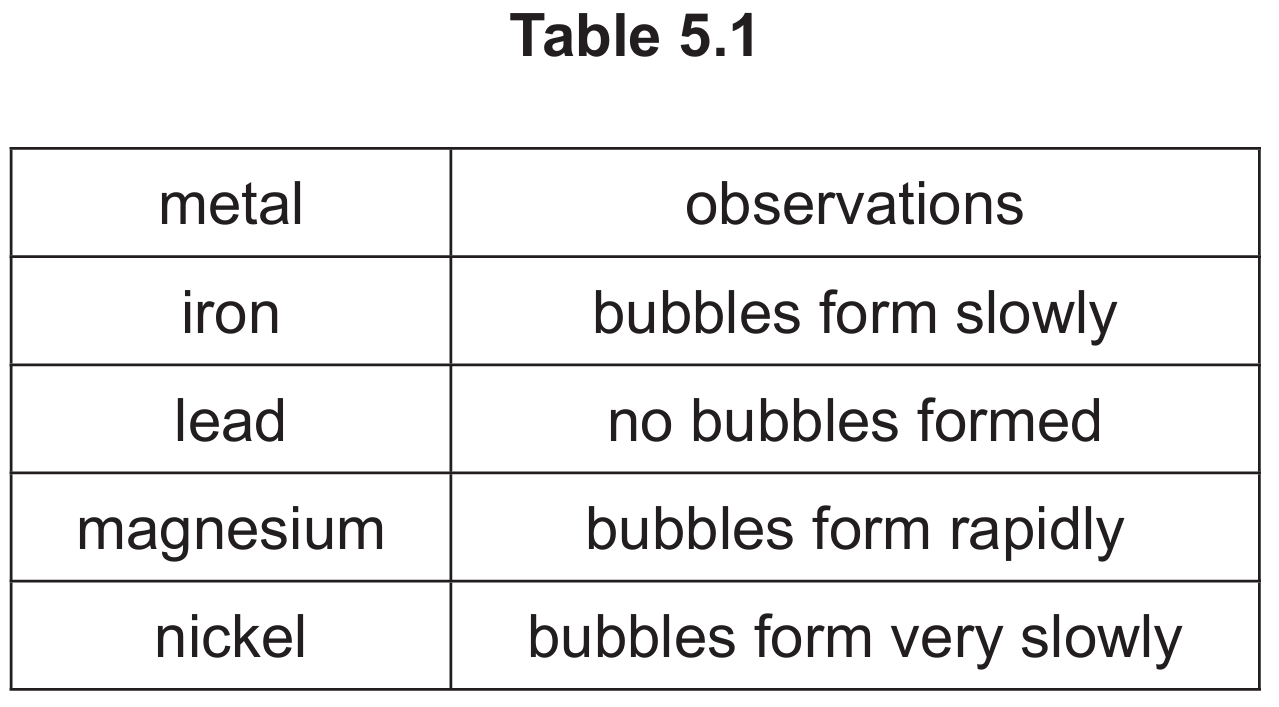
(d) Lead < Nickel < Iron < Magnesium
Reactivity is judged from the observations: the more vigorous and rapid the reaction with dilute HCl, the more reactive the metal. Magnesium reacts most vigorously, followed by iron, then nickel, with lead reacting least (or very slowly). This order is consistent with the standard reactivity series in the syllabus.
Question 6
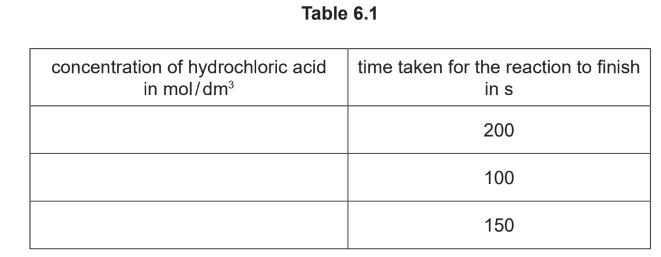
- 1.0 mol/dm³
- 1.5 mol/dm³
- 2.0 mol/dm³.
Most-appropriate topic codes (Cambridge IGCSE Chemistry 0620):
• Topic 6.2 — Rate of reaction (Parts (a)(i)–(a)(iii))
• Topic 12.4 — Separation and purification (Part (b))
• Topic 7.3 — Preparation of salts / solubility rules (Part (c))
▶️ Answer/Explanation
(a)(i) 1.0, 2.0, 1.5 mol/dm³
Higher concentration means more acid particles per unit volume, leading to more frequent collisions and a faster reaction, so the time taken is shorter. The shortest time corresponds to the highest concentration (2.0 mol/dm³), the longest to the lowest (1.0 mol/dm³), and 1.5 mol/dm³ falls in between.
(a)(ii) Time taken increases (reaction is slower)
A catalyst increases the rate of reaction by providing an alternative reaction pathway with a lower activation energy. Removing the catalyst means the activation energy is higher, fewer collisions are successful, and the reaction proceeds more slowly — so it takes longer for the zinc to finish reacting.
(a)(iii) Time taken decreases (reaction is faster)
Increasing the surface area of the zinc exposes more zinc atoms to the acid particles. This increases the frequency of successful collisions between reactant particles, raising the rate of reaction and therefore reducing the time needed for all the zinc to react.
(b) Filtration
Unreacted zinc is an insoluble solid in the reaction mixture, while zinc chloride is dissolved in solution. Filtration is the correct method to separate an insoluble solid (residue) from a liquid (filtrate); the zinc is retained on the filter paper while the zinc chloride solution passes through.
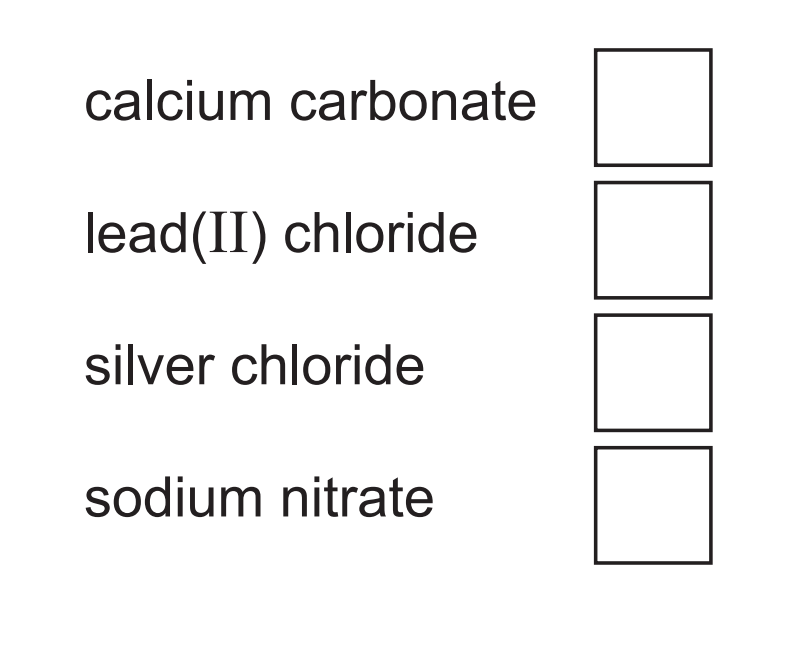
(c) Sodium nitrate (4th box)
According to the solubility rules in the syllabus, all nitrates are soluble, and all sodium salts are soluble. Sodium nitrate is therefore soluble. The other options in the list (such as barium sulfate, silver chloride, and calcium carbonate) are insoluble according to the standard solubility rules.
Question 7

Complete the word equation for one other method of manufacturing ethanol: ………………… + ………………… → ethanol.
Most-appropriate topic codes (Cambridge IGCSE Chemistry 0620):
• Topic 11.7 — Carboxylic acids (Parts (a)(i)–(a)(iii), (b), (c))
• Topic 11.1 — Formulae, functional groups and terminology (Part (b))
• Topic 3.2 — Relative masses of atoms and molecules (Part (d))
• Topic 11.6 — Alcohols (Part (e))
▶️ Answer/Explanation
(a)(i)
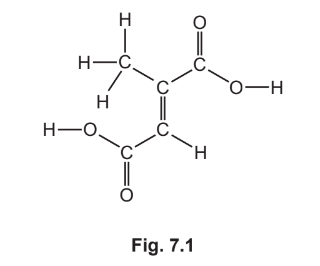
The carboxylic acid functional group is –COOH (a carbonyl group C=O bonded to a hydroxyl group –OH on the same carbon). In the displayed formula of mesaconic acid, the circle should be drawn around one of the –COOH groups at either end of the carbon chain.
(a)(ii) C₅H₆O₄
Counting all atoms in the displayed formula of mesaconic acid: 5 carbon atoms, 6 hydrogen atoms, and 4 oxygen atoms (two –COOH groups each contribute 2 oxygen atoms). The molecular formula is therefore C₅H₆O₄.
(a)(iii) From orange/brown to colourless
Mesaconic acid contains a C=C double bond, making it an unsaturated compound. When it is added in excess to aqueous bromine (orange/brown), the bromine undergoes an addition reaction across the double bond, decolourising the solution completely to give a colourless product.
(b)
A homologous series is a family of compounds with similar chemical properties because they share the same functional group, and they have the same general formula. Successive members differ from each other by one –CH₂– unit, and the series shows a gradual trend in physical properties such as boiling point.
(c) ethanoic acid + magnesium → magnesium ethanoate + hydrogen
Carboxylic acids react with metals (above hydrogen in the reactivity series) to produce a salt and hydrogen gas. Magnesium reacts with ethanoic acid to give magnesium ethanoate (the salt) and hydrogen gas, which is released as bubbles.
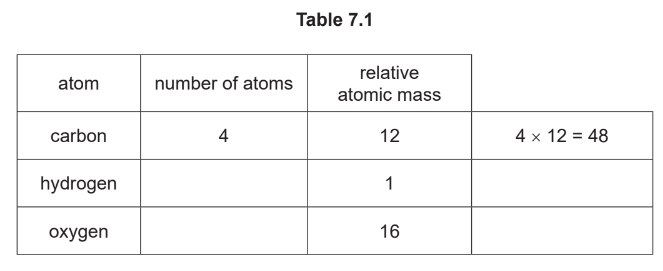
(d) Mr = 88; (e) ethene + steam → ethanol
For C₄H₈O₂: Mr = (4 × 12) + (8 × 1) + (2 × 16) = 48 + 8 + 32 = 88. The alternative industrial method for manufacturing ethanol is the catalytic addition of steam to ethene at 300 °C, 60 atm pressure, using an acid catalyst.
Question 8
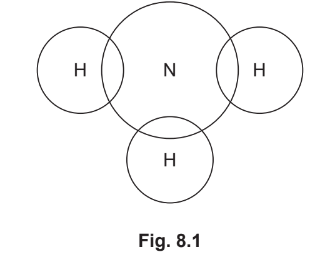
Ammonia gas turns damp red litmus paper blue.
A long glass tube is set up as shown in Fig. 8.2.
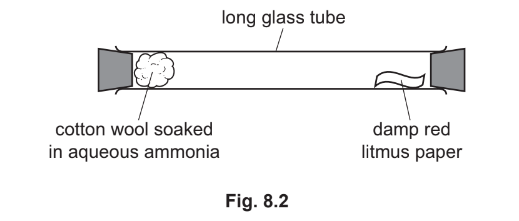
After a short time it turns blue.
Explain these results in terms of the kinetic particle theory.
Most-appropriate topic codes (Cambridge IGCSE Chemistry 0620):
• Topic 9.1 — Properties of metals (Part (a) — contrast with non-metals)
• Topic 10.3 — Air quality and climate (Parts (b)(i), (b)(ii))
• Topic 2.5 — Simple molecules and covalent bonds (Parts (c)(i), (c)(ii))
• Topic 7.1 — Characteristic properties of acids and bases (Part (c)(iii))
• Topic 1.2 — Diffusion (Part (c)(iv))
▶️ Answer/Explanation
(a)
Two other physical properties typical of non-metals (any two): poor thermal conductors (low thermal conductivity); low melting points and boiling points; not malleable (brittle — they crack or crumble under stress rather than bending); not ductile (cannot be drawn into wires). These contrast sharply with the properties of metals such as potassium or iron.
(b)(i) Car engines; (b)(ii) Photochemical smog / respiratory problems
Oxides of nitrogen (NO and NO₂) are formed when nitrogen and oxygen in air react at the extremely high temperatures inside car engines. Besides contributing to acid rain, they also react with sunlight and other pollutants to form photochemical smog, and they can cause or worsen respiratory conditions such as asthma when inhaled.
(c)(i)
A covalent bond is formed when a pair of electrons is shared between two atoms. Each atom in the bond contributes one electron to the shared pair (in a normal covalent bond), and both atoms are held together by the electrostatic attraction between the positive nuclei and the shared negative electron pair.
(c)(ii)
In the dot-and-cross diagram of NH₃, three bonding pairs of electrons (shown as one dot and one cross each) are drawn between the nitrogen atom and each of the three hydrogen atoms. A lone pair of two non-bonding electrons is shown on the nitrogen atom. No electrons are shown on the hydrogen atoms outside the shared bonding pairs.
(c)(iii) pH 10
A pH greater than 7 indicates an alkaline solution. Of the values listed, only pH 10 is above 7. pH 7 is neutral, and pH 1 and pH 5 are both acidic. Aqueous ammonia releases OH⁻ ions into solution, making it alkaline.
(c)(iv)
Ammonia evaporates from the aqueous solution and the resulting gas molecules are in constant random motion (kinetic particle theory). The molecules diffuse along the tube from the region of higher ammonia concentration towards the region of lower concentration. It takes time for the molecules to travel the length of the tube, which is why the litmus paper does not turn blue immediately — once the ammonia molecules reach and contact the litmus paper, their alkaline nature turns it blue.