
Question 1
B. \(\mathrm{H}^{+} + \mathrm{OH}^{-} \rightarrow \mathrm{H_2O}\)
C. ethane + chlorine \(\rightarrow\) chloroethane + hydrogen chloride
D. \(\mathrm{C_{12}H_{26}} \rightarrow \mathrm{C_8H_{18}} + \mathrm{C_4H_8}\)
E. ethene + steam \(\rightarrow\) ethanol
F. chlorine + aqueous potassium iodide \(\rightarrow\) iodine + aqueous potassium chloride
G. \(\mathrm{C_6H_{12}O_6} \rightarrow 2\mathrm{C_2H_5OH} + 2\mathrm{CO_2}\)
H. ethanoic acid + ethanol \(\rightarrow\) ethyl ethanoate + water
I. calcium carbonate \(\rightarrow\) calcium oxide + carbon dioxide
J. \(6\mathrm{CO_2} + 6\mathrm{H_2O} \rightarrow \mathrm{C_6H_{12}O_6} + 6\mathrm{O_2}\)
Give the letter, A to J, for the equation that represents:
Most-appropriate topic codes (Cambridge IGCSE Chemistry 0620):
• Topic $7.1$ — The characteristic properties of acids and bases (Part $\mathrm{(a)}$)
• Topic $7.3$ — Preparation of salts (Part $\mathrm{(b)}$)
• Topic $11.7$ — Carboxylic acids (Part $\mathrm{(c)}$)
• Topic $10.3$ — Air quality and climate (Part $\mathrm{(d)}$)
• Topic $11.6$ — Alcohols (Part $\mathrm{(e)}$)
• Topic $11.5$ — Alkenes (Part $\mathrm{(f)}$)
▶️ Answer/Explanation
(a) B
Neutralisation is the reaction between an acid and an alkali (or base) to form water. Equation B, \(\mathrm{H^{+}(aq) + OH^{-}(aq) \rightarrow H_2O(l)}\), shows a hydrogen ion reacting with a hydroxide ion to produce water — this is the standard ionic equation for neutralisation. No salt is shown here because the spectator ions are omitted.
(b) A
A precipitation reaction occurs when two aqueous solutions are mixed and an insoluble product (precipitate) forms. Equation A, \(\mathrm{Fe^{3+}(aq) + 3OH^{-}(aq) \rightarrow Fe(OH)_3(s)}\), shows iron(III) hydroxide forming as an insoluble solid precipitate. This matches the test for identifying \(\mathrm{Fe^{3+}}\) ions using aqueous sodium hydroxide.
(c) H
An ester is formed when a carboxylic acid reacts with an alcohol in the presence of an acid catalyst. Equation H shows ethanoic acid (\(\mathrm{CH_3COOH}\)) reacting with ethanol (\(\mathrm{C_2H_5OH}\)) to produce ethyl ethanoate (\(\mathrm{CH_3COOC_2H_5}\)) and water — this esterification reaction is the defining reaction for ester formation.
(d) J
Photosynthesis is the process by which green plants convert carbon dioxide and water into glucose and oxygen using light energy and chlorophyll. The symbol equation is \(6\mathrm{CO_2} + 6\mathrm{H_2O} \rightarrow \mathrm{C_6H_{12}O_6} + 6\mathrm{O_2}\), which exactly matches equation J.
(e) G
Fermentation is the anaerobic (absence of oxygen) breakdown of glucose by yeast at 25–35 °C to produce ethanol and carbon dioxide. Equation G, \(\mathrm{C_6H_{12}O_6 \rightarrow 2C_2H_5OH + 2CO_2}\), is the balanced equation for this process and is the basis for the industrial production of ethanol by fermentation.
(f) D
Cracking is the decomposition of large alkane molecules into smaller, more useful hydrocarbons using high temperature and a catalyst. Equation D, \(\mathrm{C_{12}H_{26} \rightarrow C_8H_{18} + C_4H_8}\), shows a long-chain alkane splitting into a shorter alkane (octane) and an alkene (butene), which is characteristic of catalytic cracking.
Question 2
Give the symbol of the element that:
(i) State the meaning of the term isotopes.
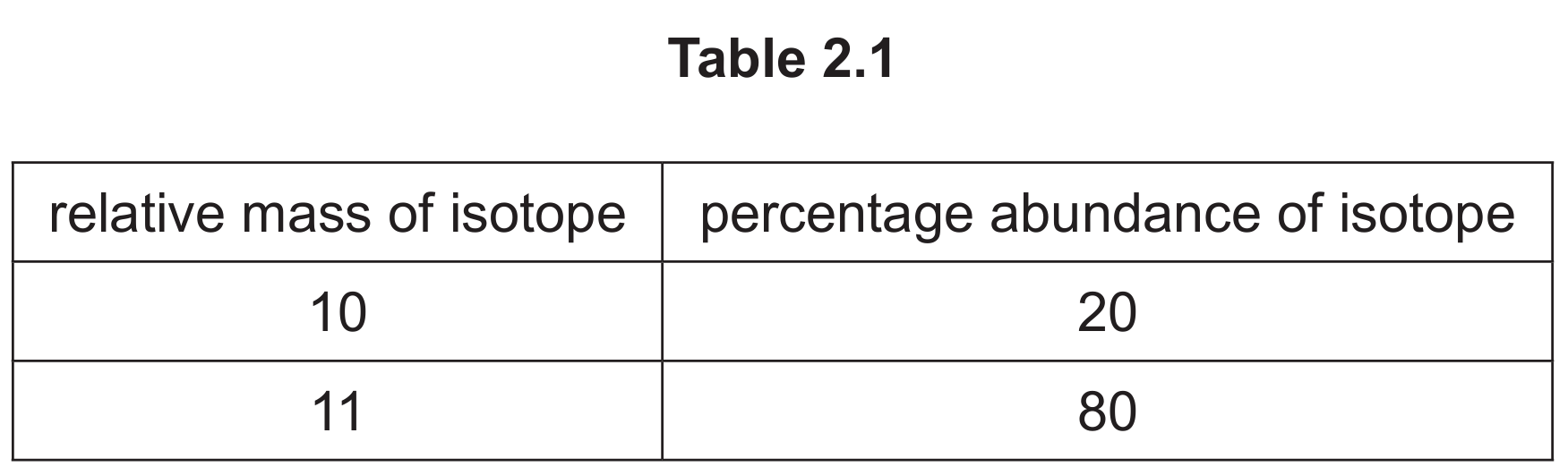
Calculate the relative atomic mass of boron to one decimal place.
Most-appropriate topic codes (Cambridge IGCSE Chemistry 0620):
• Topic $10.3$ — Air quality and climate (Part $\mathrm{(a)(i)}$)
• Topic $2.2$ — Atomic structure and the Periodic Table (Parts $\mathrm{(a)(ii)}$, $\mathrm{(a)(iii)}$)
• Topic $2.6$ — Giant covalent structures (Part $\mathrm{(a)(iv)}$)
• Topic $8.2$ — Group I properties (Part $\mathrm{(a)(v)}$)
• Topic $8.5$ — Noble gases (Part $\mathrm{(a)(vi)}$)
• Topic $2.3$ — Isotopes (Parts $\mathrm{(b)(i)}$, $\mathrm{(b)(ii)}$)
• Topic $3.2$ — Relative masses of atoms and molecules (Part $\mathrm{(b)(ii)}$)
▶️ Answer/Explanation
(a)(i) N
Clean, dry air is approximately 78% nitrogen (\(\mathrm{N_2}\)), 21% oxygen (\(\mathrm{O_2}\)), with the remainder being noble gases and carbon dioxide. Nitrogen, symbol N, is the Period 2 element that makes up the dominant fraction of the atmosphere and exists as diatomic molecules \(\mathrm{N_2}\) held together by a triple covalent bond.
(a)(ii) B
Boron is in Group III of the Periodic Table, so its electronic configuration is \(2, 3\) — it has 3 electrons in its outer (second) shell. All other Period 2 elements have a different number of outer-shell electrons: Li has 1, Be has 2, C has 4, and so on.
(a)(iii) F
The proton number (atomic number) equals the number of protons in the nucleus. Fluorine has atomic number 9, meaning its atoms each contain exactly 9 protons. Its electronic configuration is \(2, 7\), placing it in Group VII as a highly reactive halogen.
(a)(iv) C
Carbon is the only Period 2 element that exists in the giant covalent allotropic forms of graphite and diamond. In graphite, each carbon atom forms three covalent bonds in hexagonal layers, with delocalised electrons between the layers that allow it to conduct electricity and act as a lubricant.
(a)(v) Li
Lithium is the only Period 2 element that belongs to Group I, the alkali metals. It is a relatively soft metal with a low density and a single outer-shell electron (\(2, 1\)) that it readily loses to form the \(\mathrm{Li^+}\) ion, making it highly reactive.
(a)(vi) Ne
Neon is a Group VIII noble gas with a full outer electron shell (\(2, 8\)). Because it does not form compounds or ions under normal conditions, it retains an oxidation number of zero in all circumstances — unlike, for example, oxygen or fluorine which have non-zero oxidation numbers in compounds.
(b)(i)
Isotopes are different atoms of the same element that have the same number of protons (same atomic number) but different numbers of neutrons (and therefore different mass numbers). They have identical chemical properties because their electronic configurations are the same, but they differ in physical properties such as mass.
(b)(ii)
The relative atomic mass is calculated as the weighted mean of the masses of all isotopes: \[ A_r = \frac{(10 \times 20) + (11 \times 80)}{100} = \frac{200 + 880}{100} = \frac{1080}{100} = \mathbf{10.8} \] The relative atomic mass of boron is 10.8.
Question 3


Complete the dot-and-cross diagram in Fig. 3.3 to show the electronic configuration in a molecule of carbon dioxide. Show outer shell electrons only.

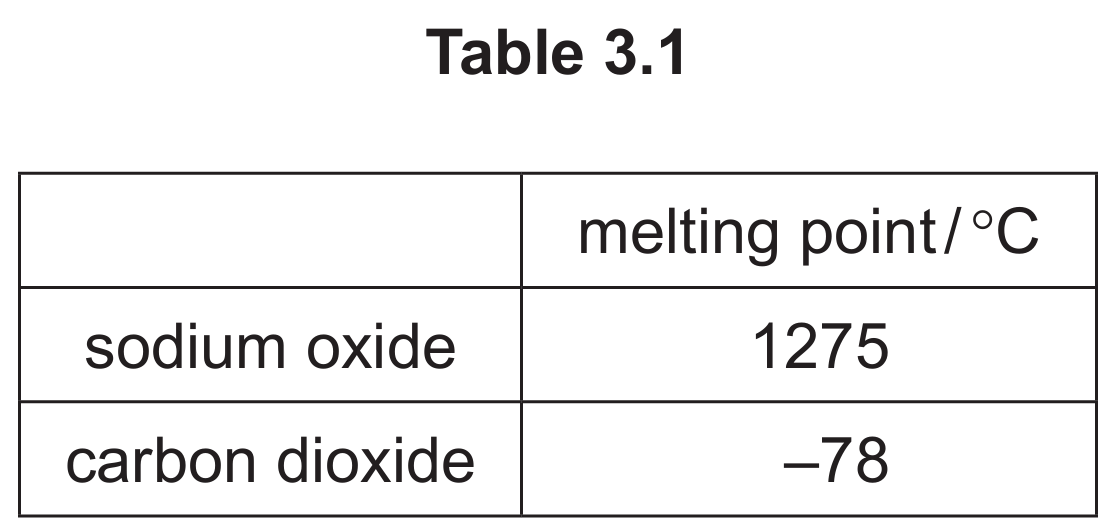
(i) Explain, in terms of bonding, why sodium oxide has a high melting point.
(ii) Carbon dioxide has a low melting point. State the general term for the weak forces that cause carbon dioxide to have a low melting point.
Most-appropriate topic codes (Cambridge IGCSE Chemistry 0620):
• Topic $2.4$ — Ions and ionic bonds (Parts $\mathrm{(a)(i)}$, $\mathrm{(a)(ii)}$, $\mathrm{(c)(i)}$)
• Topic $2.5$ — Simple molecules and covalent bonds (Parts $\mathrm{(b)}$, $\mathrm{(c)(ii)}$)
▶️ Answer/Explanation
(a)(i)
Sodium (electronic configuration \(2, 8, 1\)) loses its one outer-shell electron to become \(\mathrm{Na^+}\) with configuration \(2, 8\) (shown with crosses only). Oxygen (configuration \(2, 6\)) gains two electrons to become \(\mathrm{O^{2-}}\) with configuration \(2, 8\) (shown with 6 dots and 2 crosses in the outer shell). The charges \(+\) on \(\mathrm{Na^+}\) and \(2-\) on \(\mathrm{O^{2-}}\) must both be shown on the diagram.
(a)(ii)
Each oxide ion carries a \(2-\) charge, while each sodium ion carries a \(1+\) charge. Two sodium ions are therefore needed to balance one oxide ion, giving the formula: \[ \mathrm{Na_2O} \]
(b)
Carbon has 4 outer-shell electrons and forms two double bonds with the two oxygen atoms. Each double bond consists of 2 dots and 2 crosses between the carbon and each oxygen. Each oxygen atom also has 2 lone pairs (shown as dots or crosses) in its outer shell, completing the octets of all three atoms: \[ \mathrm{O{=}C{=}O} \]
(c)(i)
Sodium oxide consists of \(\mathrm{Na^+}\) and \(\mathrm{O^{2-}}\) ions arranged in a giant ionic lattice. There is a strong electrostatic attraction between the oppositely charged ions throughout the entire lattice structure. A large amount of energy is required to overcome these strong forces, resulting in a high melting point of 1275 °C.
(c)(ii)
Carbon dioxide consists of simple \(\mathrm{CO_2}\) molecules. The weak forces holding the molecules together are called intermolecular forces. Because these forces are much weaker than ionic or covalent bonds, very little energy is needed to separate the molecules, giving carbon dioxide its very low melting point of −78 °C.
Question 4
(a) State the meaning of the term catalyst.

(i) State why the mass of the conical flask and its contents decreases as time increases.
(ii) The rate of reaction is highest at the start of the reaction. The rate decreases and eventually becomes zero. Explain why the rate of reaction is highest at the start of the reaction.
(iii) Explain why the rate of reaction eventually becomes zero.
(c) The experiment is repeated at an increased temperature. All other conditions stay the same. Explain in terms of collision theory why the rate of reaction is higher at an increased temperature.
Calculate the mass of \(\mathrm{O_2}\) that forms. Use the following steps.
- Calculate the number of moles of \(\mathrm{H_2O_2}\) used.
- Determine the number of moles of \(\mathrm{O_2}\) produced.
- Calculate the mass of \(\mathrm{O_2}\) produced.
(e) State the effect on the mass of oxygen produced if the mass of powdered manganese(IV) oxide catalyst is increased.
(f) Oxygen can also be produced by the decomposition of mercury(II) oxide, \(\mathrm{HgO}\). The only products of this decomposition are mercury and oxygen.
Write a symbol equation for this decomposition.
Most-appropriate topic codes (Cambridge IGCSE Chemistry 0620):
• Topic $6.2$ — Rate of reaction (Parts $\mathrm{(a)}$, $\mathrm{(b)(i)}$, $\mathrm{(b)(ii)}$, $\mathrm{(b)(iii)}$, $\mathrm{(c)}$, $\mathrm{(e)}$)
• Topic $3.3$ — The mole and the Avogadro constant (Part $\mathrm{(d)}$)
• Topic $3.1$ — Formulae (Part $\mathrm{(f)}$)
▶️ Answer/Explanation
(a)
A catalyst is a substance that increases the rate of a chemical reaction without being used up or permanently changed at the end of the reaction. It works by providing an alternative reaction pathway with a lower activation energy \(E_a\), allowing more collisions to result in a successful reaction at a given temperature.
(b)(i)
As the reaction proceeds, oxygen gas is produced and escapes from the open conical flask into the surrounding atmosphere. Since oxygen has mass, its loss from the flask causes the total measured mass of the flask and its contents to decrease over time.
(b)(ii)
At the start of the reaction, the concentration of \(\mathrm{H_2O_2}\) is at its highest, meaning hydrogen peroxide particles are closest together. This results in the highest frequency of collisions between reactant particles, and therefore the highest rate of reaction.
(b)(iii)
The rate eventually becomes zero because all the hydrogen peroxide has been completely used up (decomposed). With no reactant particles remaining, no further collisions between reactant particles can occur, so the reaction stops entirely.
(c)
At a higher temperature, the particles have greater kinetic energy and therefore move faster. This leads to a higher frequency of collisions between \(\mathrm{H_2O_2}\) particles and the \(\mathrm{MnO_2}\) surface. More importantly, a greater proportion of the colliding particles now possess energy equal to or greater than the activation energy \(E_a\), so a higher fraction of collisions are successful and the rate of reaction increases.
(d)
Step 1 — Moles of \(\mathrm{H_2O_2}\): \[ n(\mathrm{H_2O_2}) = \frac{50.0}{1000} \times 0.200 = 0.0100\ \mathrm{mol} \] Step 2 — From the equation, \(2\ \mathrm{mol}\) of \(\mathrm{H_2O_2}\) produces \(1\ \mathrm{mol}\) of \(\mathrm{O_2}\), so: \[ n(\mathrm{O_2}) = \frac{0.0100}{2} = 0.00500\ \mathrm{mol} \] Step 3 — Mass of \(\mathrm{O_2}\) \((M_r = 32)\): \[ m(\mathrm{O_2}) = 0.00500 \times 32 = 0.160\ \mathrm{g} \]
(e)
There is no effect on the mass of oxygen produced. A catalyst increases the rate of reaction but does not change the amount of product formed — the yield of \(\mathrm{O_2}\) depends only on the amount of \(\mathrm{H_2O_2}\) present, not on the quantity of catalyst used.
(f)
Mercury(II) oxide decomposes on heating to give mercury and oxygen. The balanced symbol equation is: \[ 2\mathrm{HgO} \rightarrow 2\mathrm{Hg} + \mathrm{O_2} \] Two formula units of \(\mathrm{HgO}\) are needed to balance the equation, producing one molecule of \(\mathrm{O_2}\) and two atoms of mercury.
Question 5
(a) The electrolysis of concentrated aqueous potassium bromide using graphite electrodes forms:
- hydrogen at the cathode
- bromine at the anode.
The electrolyte becomes aqueous potassium hydroxide.
(i) State what is meant by the term electrolysis.
(ii) State why graphite is suitable for use as an electrode.
(iii) Write an ionic half-equation for the formation of hydrogen at the cathode.
(iv) Name the type of particle responsible for the transfer of charge in the conducting wires.
(v) Name the type of particle responsible for the transfer of charge in aqueous potassium bromide.
(vi) State the names of the products formed when electricity is passed through dilute aqueous potassium bromide using graphite electrodes.
(i) Name the aluminium compound in purified bauxite.
(ii) State two reasons why cryolite is used in this electrolysis.
(iii) The anode is made from carbon. Explain why the carbon anode has to be replaced regularly.
(i) Write the symbol equation for the overall reaction in a hydrogen–oxygen fuel cell.
(ii) State one advantage of using hydrogen–oxygen fuel cells instead of petrol in vehicle engines.
Most-appropriate topic codes (Cambridge IGCSE Chemistry 0620):
• Topic $4.1$ — Electrolysis (Parts $\mathrm{(a)(i)}$, $\mathrm{(a)(ii)}$, $\mathrm{(a)(iii)}$, $\mathrm{(a)(iv)}$, $\mathrm{(a)(v)}$, $\mathrm{(a)(vi)}$)
• Topic $9.6$ — Extraction of metals (Parts $\mathrm{(b)(i)}$, $\mathrm{(b)(ii)}$, $\mathrm{(b)(iii)}$)
• Topic $4.2$ — Hydrogen–oxygen fuel cells (Parts $\mathrm{(c)(i)}$, $\mathrm{(c)(ii)}$)
▶️ Answer/Explanation
(a)(i)
Electrolysis is the decomposition of an ionic compound — when molten or dissolved in aqueous solution — by the passage of an electric current through it. The current causes positive ions (cations) to move to the cathode and negative ions (anions) to move to the anode, where they are discharged to form products.
(a)(ii)
Graphite is suitable as an electrode because it conducts electricity (due to its delocalised electrons between the carbon layers) and it is chemically inert, meaning it does not react with the electrolyte or the products formed during electrolysis under normal conditions.
(a)(iii)
At the cathode, \(\mathrm{H^+}\) ions from the water gain electrons (reduction) to form hydrogen gas. The ionic half-equation is: \[ 2\mathrm{H^+}(\mathrm{aq}) + 2\mathrm{e^-} \rightarrow \mathrm{H_2}(\mathrm{g}) \] The \(\mathrm{H^+}\) ions are preferentially discharged over \(\mathrm{K^+}\) ions because hydrogen is lower than potassium in the reactivity series.
(a)(iv)
In the conducting wires, charge is carried by electrons. Electrons flow from the negative terminal of the power supply to the cathode, and from the anode back to the positive terminal of the power supply.
(a)(v)
In the aqueous potassium bromide electrolyte, charge is carried by ions. The \(\mathrm{K^+}\) and \(\mathrm{H^+}\) ions move towards the cathode, while the \(\mathrm{Br^-}\) and \(\mathrm{OH^-}\) ions move towards the anode.
(a)(vi)
In dilute aqueous potassium bromide, the \(\mathrm{OH^-}\) ions from water are present in a higher relative concentration than the \(\mathrm{Br^-}\) ions, so they are preferentially discharged at the anode. Therefore:
at the anode: oxygen
at the cathode: hydrogen
(b)(i)
The aluminium compound present in purified bauxite is aluminium oxide, \(\mathrm{Al_2O_3}\). The purification step (Bayer process) removes impurities such as iron(III) oxide from the raw bauxite ore before electrolysis takes place.
(b)(ii)
Cryolite (\(\mathrm{Na_3AlF_6}\)) is used for two reasons:
1. It acts as a solvent for aluminium oxide, allowing the \(\mathrm{Al_2O_3}\) to dissolve and provide freely moving ions for electrolysis.
2. It lowers the operating temperature of the electrolysis from over 2000 °C (the melting point of pure \(\mathrm{Al_2O_3}\)) to around 850–1000 °C, greatly reducing energy costs.
(b)(iii)
At the anode, oxygen gas is produced as \(\mathrm{O^{2-}}\) ions are oxidised. This oxygen reacts with the hot carbon anode to form carbon dioxide: \[ \mathrm{C(s)} + \mathrm{O_2(g)} \rightarrow \mathrm{CO_2(g)} \] The anode is gradually burned away and must therefore be replaced regularly to maintain the electrolysis cell.
(c)(i)
In a hydrogen–oxygen fuel cell, hydrogen and oxygen react to produce water as the only chemical product. The balanced symbol equation for the overall reaction is: \[ 2\mathrm{H_2(g)} + \mathrm{O_2(g)} \rightarrow 2\mathrm{H_2O(l)} \]
(c)(ii)
One advantage of hydrogen–oxygen fuel cells over petrol engines is that the only chemical product is water, so no carbon dioxide or other polluting gases are emitted during operation. This makes fuel cells significantly cleaner and more environmentally friendly than combustion engines that burn fossil fuels.
Question 6
Sulfur is converted into sulfuric acid, \(\mathrm{H_2SO_4}\), by the Contact process.
The process involves four stages.
- Stage-1: Molten sulfur is converted into sulfur dioxide.
- Stage-2: Sulfur dioxide reacts with oxygen to form sulfur trioxide.
- Stage-3: Sulfur trioxide combines with concentrated sulfuric acid to form oleum, \(\mathrm{H_2S_2O_7}\).
- Stage-4: Oleum reacts to form concentrated sulfuric acid.
Balance the equation for the reaction occurring when iron pyrites reacts with oxygen in the air.
(ii) Name \(\mathrm{Fe_2O_3}\). Include the oxidation number of iron.
The reaction is carried out at a temperature of \(450\ ^\circ\mathrm{C}\) and a pressure of \(2\ \mathrm{atm}\).
(i) explain why a temperature greater than \(450\ ^\circ\mathrm{C}\) is not used.
(ii) explain why a pressure greater than \(2\ \mathrm{atm}\) is not used.
(c) When sulfuric acid reacts with ammonia the salt produced is ammonium sulfate. Write the symbol equation for this reaction.
(i) Name a solution that can be added to aqueous ammonium sulfate to produce a precipitate of lead(II) sulfate.
(ii) Write an ionic equation for this precipitation reaction. Include state symbols.
(iii) The precipitate of lead(II) sulfate forms in an aqueous solution.
Describe how pure lead(II) sulfate can be obtained from the mixture.
Most-appropriate topic codes (Cambridge IGCSE Chemistry 0620):
• Topic $3.1$ — Formulae (Part $\mathrm{(a)(i)}$)
• Topic $6.4$ — Redox (Part $\mathrm{(a)(ii)}$)
• Topic $6.3$ — Reversible reactions and equilibrium (Part $\mathrm{(b)(i)}$)
• Topic $7.1$ — The characteristic properties of acids and bases (Part $\mathrm{(c)}$)
• Topic $7.3$ — Preparation of salts (Parts $\mathrm{(d)(i)}$, $\mathrm{(d)(ii)}$)
• Topic $12.4$ — Separation and purification (Part $\mathrm{(d)(iii)}$)
▶️ Answer/Explanation
(a)(i)
To balance the equation, count atoms on each side. With 4 formula units of \(\mathrm{FeS_2}\) giving 2 units of \(\mathrm{Fe_2O_3}\) and 8 units of \(\mathrm{SO_2}\), the oxygen balance requires 11 molecules of \(\mathrm{O_2}\): \[ 4\mathrm{FeS_2} + 11\mathrm{O_2} \rightarrow 2\mathrm{Fe_2O_3} + 8\mathrm{SO_2} \] Checking: Fe: \(4=4\); S: \(8=8\); O: \(22=6+16=22\). The equation is balanced.
(a)(ii)
In \(\mathrm{Fe_2O_3}\), the overall charge is zero and oxygen has an oxidation number of \(-2\). Therefore the oxidation number of iron is: \[ 2x + 3(-2) = 0 \implies x = +3 \] The compound is named iron(III) oxide.
(b)(i)
The forward reaction \(2\mathrm{SO_2} + \mathrm{O_2} \rightleftharpoons 2\mathrm{SO_3}\) is exothermic. Increasing the temperature above \(450\ ^\circ\mathrm{C}\) shifts the equilibrium position to the left (towards reactants) by Le Chatelier’s principle, reducing the yield of \(\mathrm{SO_3}\). Although a higher temperature would increase the reaction rate, the \(450\ ^\circ\mathrm{C}\) compromise gives an acceptable yield of approximately 99.5% with the vanadium(V) oxide catalyst.
(b)(ii)
In the reaction \(2\mathrm{SO_2(g)} + \mathrm{O_2(g)} \rightleftharpoons 2\mathrm{SO_3(g)}\), there are 3 moles of gas on the left and 2 moles on the right. Increasing the pressure shifts the equilibrium to the right, favouring \(\mathrm{SO_3}\) production. However, the yield at \(2\ \mathrm{atm}\) is already very high (close to 99.5%), so using a higher pressure provides negligible additional benefit to the yield while posing greater safety risks and engineering challenges.
(c)
Ammonia (\(\mathrm{NH_3}\)) acts as a base and reacts with sulfuric acid in a neutralisation reaction. Two moles of ammonia are required to neutralise one mole of sulfuric acid: \[ 2\mathrm{NH_3} + \mathrm{H_2SO_4} \rightarrow (\mathrm{NH_4})_2\mathrm{SO_4} \] The product, ammonium sulfate \(\mathrm{(NH_4)_2SO_4}\), is widely used as a nitrogen-rich fertiliser.
(d)(i)
To produce a precipitate of lead(II) sulfate from aqueous ammonium sulfate, a soluble source of \(\mathrm{Pb^{2+}}\) ions is needed. Aqueous lead(II) nitrate, \(\mathrm{Pb(NO_3)_2(aq)}\), is the most suitable choice since lead(II) nitrate is soluble and its nitrate ions are spectator ions that do not interfere with the precipitation.
(d)(ii)
When \(\mathrm{Pb^{2+}}\) ions and \(\mathrm{SO_4^{2-}}\) ions meet in solution, insoluble lead(II) sulfate precipitates immediately. The ionic equation with state symbols is: \[ \mathrm{Pb^{2+}(aq)} + \mathrm{SO_4^{2-}(aq)} \rightarrow \mathrm{PbSO_4(s)} \] The nitrate and ammonium ions are spectator ions and are omitted from the ionic equation.
(d)(iii)
Pure lead(II) sulfate is obtained from the mixture by the following steps:
1. Filter the mixture to collect the lead(II) sulfate precipitate as the residue on the filter paper.
2. Wash the residue thoroughly with distilled (or deionised) water to remove any soluble impurities such as ammonium nitrate remaining on the surface of the solid.
3. Dry the washed residue, for example by leaving it in a warm oven or a desiccator, to obtain pure, dry lead(II) sulfate.
Question 7
(i) State the meaning of the term photochemical.
(ii) An organic compound with the formula \(\mathrm{C_4H_9Cl}\) is formed when one molecule of butane reacts with one molecule of chlorine.
Draw the displayed formulae of two possible structural isomers with the formula \(\mathrm{C_4H_9Cl}\) formed in this reaction.

(i) Deduce the molecular formula of compound A.
(ii) There are three functional groups in compound A.
Name the homologous series of compounds that contain the following functional groups:
\(-\mathrm{C{=}C-\)
\(-\mathrm{OH\)
\(-\mathrm{COOH\)
(iii) State what is observed when compound A is added to:
- aqueous bromine
- aqueous sodium carbonate
(iv) Compound A can be used as a single monomer to produce two different polymers.
Draw one repeat unit of the addition polymer formed from compound A.
(v) Compound A can be converted into a dicarboxylic acid.
Name the type of condensation polymer formed from a dicarboxylic acid and a diol.
Most-appropriate topic codes (Cambridge IGCSE Chemistry 0620):
• Topic $11.4$ — Alkanes (Parts $\mathrm{(a)(i)}$, $\mathrm{(a)(ii)}$)
• Topic $11.2$ — Naming organic compounds (Part $\mathrm{(a)(ii)}$)
• Topic $11.1$ — Formulae, functional groups and terminology (Parts $\mathrm{(b)(i)}$, $\mathrm{(b)(ii)}$)
• Topic $11.5$ — Alkenes (Parts $\mathrm{(b)(ii)}$, $\mathrm{(b)(iii)}$)
• Topic $11.6$ — Alcohols (Part $\mathrm{(b)(ii)}$)
• Topic $11.7$ — Carboxylic acids (Parts $\mathrm{(b)(ii)}$, $\mathrm{(b)(iii)}$)
• Topic $11.8$ — Polymers (Parts $\mathrm{(b)(iv)}$, $\mathrm{(b)(v)}$)
▶️ Answer/Explanation
(a)(i)
A photochemical reaction is one that requires ultraviolet (UV) light to proceed. In the reaction between butane and chlorine, UV light provides the activation energy needed to break the \(\mathrm{Cl-Cl}\) bond homolytically, initiating a free-radical substitution chain reaction. Without UV light, the reaction does not occur at room temperature.
(a)(ii)
In butane (\(\mathrm{CH_3CH_2CH_2CH_3}\)), chlorine can replace a hydrogen atom on either carbon-1 or carbon-2, giving two distinct structural isomers:
• 1-chlorobutane: \(\mathrm{CH_2Cl-CH_2-CH_2-CH_3}\) — chlorine attached to a terminal (C-1) carbon atom.
• 2-chlorobutane: \(\mathrm{CH_3-CHCl-CH_2-CH_3}\) — chlorine attached to the second (C-2) carbon atom.
Both displayed formulae must show all atoms and all bonds explicitly.
(b)(i)
From Fig. 7.1, compound A contains 4 carbon atoms, 6 hydrogen atoms, and 3 oxygen atoms (one \(-\mathrm{C{=}C}-\) group, one \(-\mathrm{OH}\) group, and one \(-\mathrm{COOH}\) group). Counting all atoms in the displayed structure gives the molecular formula: \[ \mathrm{C_4H_6O_3} \]
(b)(ii)
Each functional group defines a different homologous series:
• \(-\mathrm{C{=}C}-\) → alkenes (characterised by a carbon–carbon double bond)
• \(-\mathrm{OH}\) → alcohols (characterised by the hydroxyl group)
• \(-\mathrm{COOH}\) → carboxylic acids (characterised by the carboxyl group)
(b)(iii)
When compound A is added to aqueous bromine: the bromine water turns colourless (decolourises). This is because the \(\mathrm{C{=}C}\) double bond undergoes an addition reaction with bromine, breaking the double bond and producing a dibromo compound, which is colourless.
When compound A is added to aqueous sodium carbonate: bubbles / effervescence are observed as carbon dioxide gas is produced. The \(-\mathrm{COOH}\) group reacts with the carbonate: \[ 2\mathrm{RCOOH} + \mathrm{Na_2CO_3} \rightarrow 2\mathrm{RCOONa} + \mathrm{H_2O} + \mathrm{CO_2} \]
(b)(iv)
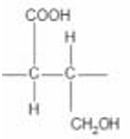
In addition polymerisation, the \(\mathrm{C{=}C}\) double bond of compound A opens up and the molecules join together. The two carbon atoms previously joined by the double bond are now connected by a single bond and carry the remaining substituents. The repeat unit shows these two carbon atoms joined by a single bond within square brackets with continuing bonds, with the \(-\mathrm{OH}\) and \(-\mathrm{COOH}\) groups retained on the chain as side groups: \[ \left[{-\mathrm{CH_2}-\mathrm{CH}-}\right]_n \] with \(-\mathrm{OH}\) and \(-\mathrm{COOH}\) groups attached to the backbone carbons as shown in Fig. 7.1.
(b)(v)
When a dicarboxylic acid (\(-\mathrm{COOH}\) at both ends) reacts with a diol (\(-\mathrm{OH}\) at both ends) in condensation polymerisation, an ester linkage (\(-\mathrm{COO}-\)) is formed at each junction and water is released as a small molecule by-product. The type of condensation polymer formed is called a polyester.