Home / 0620_s24_qp_21-hina

Question 1

A gas is heated. The pressure is kept constant. Which statement describes the behaviour of the particles in the gas?

A. The particles move faster and become closer together.
B. The particles move faster and become further apart.
C. The particles move more slowly and become closer together.
D. The particles move more slowly and become further apart.

Most-appropriate topic codes (Cambridge IGCSE Chemistry 0620):

Topic 1.1: Solids, liquids and gases — Describe the effects of temperature and pressure on the volume of a gas (Core); Explain, in terms of kinetic particle theory, the effects of temperature and pressure on the volume of a gas (Supplement)
▶️ Answer/Explanation
When a gas is heated at constant pressure, the average kinetic energy of its particles increases, causing them to move faster. To keep the pressure constant, the gas must expand (volume increases) so that the particles become further apart, maintaining the same frequency of collisions with the container walls.
Answer: (B)

Question 2

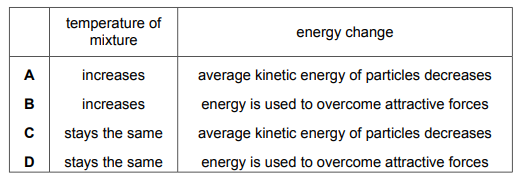
A mixture of ice and water is left to stand and the ice melts. Which row describes what happens as the ice is melting?

Table comparing temperature and energy change during melting

Most-appropriate topic codes (Cambridge IGCSE Chemistry 0620):

Topic 1.1: Solids, liquids and gases — Describe changes of state in terms of melting (Core); Explain changes of state in terms of kinetic particle theory, including the interpretation of heating and cooling curves (Supplement)
▶️ Answer/Explanation
During a change of state (melting), the temperature remains constant because the thermal energy absorbed is used to overcome intermolecular forces, not to increase kinetic energy. For an ice-water mixture at 0°C, the temperature stays constant during melting, and energy is absorbed from the surroundings.

Answer: D (Temperature: constant; Thermal energy change: absorbed)
Question 3

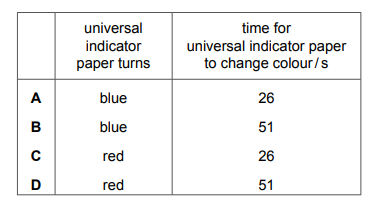
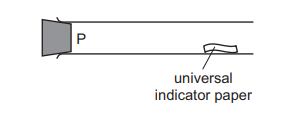
Hydrogen chloride gas [\(M_r\): HCl, 36.5] is released at P in the apparatus shown. The universal indicator paper turns red after 38 s.

Apparatus diagram with gas release point P and universal indicator paper

The experiment is repeated using sulfur dioxide gas [\(M_r: SO_2, 64\)]. What is the result for sulfur dioxide gas?

Multiple choice options showing different times for the universal indicator paper to turn red: A. 28 s, B. 38 s, C. 48 s, D. 68 s

Most-appropriate topic codes (Cambridge IGCSE Chemistry 0620):

Topic 1.2: Diffusion — Describe and explain the effect of relative molecular mass on the rate of diffusion of gases (Supplement)
Topic 3.2: Relative masses of atoms and molecules — Define relative molecular mass, \(M_{r}\) as the sum of the relative atomic masses.
▶️ Answer/Explanation
The rate of diffusion is inversely proportional to the square root of the molar mass (Graham’s Law). Sulfur dioxide (Mr 64) has a higher molar mass than hydrogen chloride (Mr 36.5), so it diffuses more slowly. The time taken is therefore longer than 38 s. Calculating the ratio: √(64/36.5) ≈ √1.75 ≈ 1.32, giving 38 s × 1.32 ≈ 50 s, so 48 s is the closest correct option (C).
Answer: C

Question 4

Four statements about atoms are listed.
1 The centre of an atom is positively charged.
2 Protons and electrons are located in the nucleus.
3 Protons and electrons have the same mass.
4 Most of the mass of an atom is in the nucleus.
Which statements are correct?
A 1 and 2

B 1 and 4

C 2 and 3

D 3 and 4

Most-appropriate topic codes (Cambridge IGCSE Chemistry 0620):

Topic 2.2: Atomic structure and the Periodic Table — Describe the structure of the atom as a central nucleus containing neutrons and protons surrounded by electrons in shells; State the relative charges and relative masses of a proton, a neutron and an electron (Core)
▶️ Answer/Explanation
Statement 1 is correct because the nucleus contains protons (positively charged) and neutrons. Statement 2 is false because electrons are located in shells outside the nucleus, not inside it. Statement 3 is false because a proton has a relative mass of 1 while an electron has a negligible relative mass (about 1/1840). Statement 4 is true because the dense nucleus contains protons and neutrons, accounting for almost all the atom’s mass. Hence, statements 1 and 4 are correct.
Answer: (B) 1 and 4

Question 5

The electronic configurations of two elements are given.
element L: 2,8,8,1
element M: 2,8,4
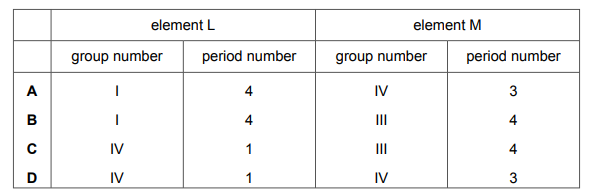
Which row identifies the group number and the period number for element L and element M?

Table showing group and period numbers for elements L and M

Most-appropriate topic codes (Cambridge IGCSE Chemistry 0620):

Topic 2.2: Atomic structure and the Periodic Table — Determine the electronic configuration of elements and their ions with proton number 1 to 20 (Core); State that the number of outer shell electrons is equal to the group number in Groups I to VII and the number of occupied electron shells is equal to the period number (Core)
▶️ Answer/Explanation
For element L (2,8,8,1), the highest shell number (4) indicates Period 4, and 1 outer electron indicates Group I. For element M (2,8,4), the highest shell number (3) indicates Period 3, and 4 outer electrons indicate Group IV. Therefore, the correct row shows L: Group I, Period 4 and M: Group IV, Period 3.
Answer: (A)

Question 6

Which statement explains why isotopes of the same element have the same chemical properties?

A. They have different numbers of protons in their nucleus.
B. They have different numbers of neutrons in their nucleus.
C. They have the same electronic configuration.
D. They have the same number of electrons as protons.

Most-appropriate topic codes (Cambridge IGCSE Chemistry 0620):

Topic 2.3: Isotopes — State that isotopes of the same element have the same chemical properties because they have the same number of electrons and therefore the same electronic configuration (Supplement)
▶️ Answer/Explanation
Isotopes have the same number of protons and electrons but differ in neutron count. Chemical properties are determined by the electronic configuration (the arrangement of electrons in shells). Since isotopes share identical electronic configurations, they undergo the same chemical reactions. Option C is correct; A and B are false (proton number is the same, neutron variation doesn’t affect chemistry directly), and D is true for neutral atoms but does not explain the similarity in chemical properties across isotopes.
Answer: (C)

Question 7

Which statements about potassium chloride are correct?
1 It conducts electricity when solid because its ions are free to move.
2 It has a high melting point because it has strong intermolecular forces.
3 Its structure is a giant lattice of alternating positive and negative ions.
4 It is soluble in water.
A 1 and 2

B 1 and 4

C 2 and 3

D 3 and 4

Most-appropriate topic codes (Cambridge IGCSE Chemistry 0620):

Topic 2.4: Ions and ionic bonds — Describe the giant lattice structure of ionic compounds as a regular arrangement of alternating positive and negative ions (Supplement); Describe the properties of ionic compounds: high melting points and boiling points, good electrical conductivity when aqueous or molten and poor when solid (Core)
▶️ Answer/Explanation
Statement 1 is false because in solid potassium chloride, ions are fixed in the lattice and cannot move, so it does not conduct electricity. Statement 2 is false because the high melting point is due to strong electrostatic forces between ions (ionic bonds), not intermolecular forces. Statement 3 is true: it has a giant ionic lattice of alternating K⁺ and Cl⁻ ions. Statement 4 is true: many ionic compounds, including KCl, are soluble in water. Thus only statements 3 and 4 are correct.
Answer: D (3 and 4)

Question 8

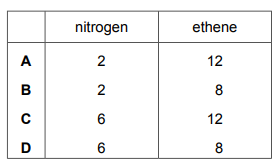
How many electrons are shared in one molecule of nitrogen and in one molecule of ethene?

Most-appropriate topic codes (Cambridge IGCSE Chemistry 0620):

Topic 2.5: Simple molecules and covalent bonds — Describe the formation of covalent bonds in simple molecules, including N₂ and C₂H₄, using dot-and-cross diagrams (Core/Supplement)
Topic 11.5: Alkenes — State that the bonding in alkenes includes a double carbon-carbon covalent bond (Core)
▶️ Answer/Explanation
Answer: C

Nitrogen (N₂) has a triple covalent bond, where three pairs of electrons (6 electrons total) are shared between the two nitrogen atoms. Ethene (C₂H₄) has a carbon-carbon double bond (one sigma and one pi bond), so two pairs of electrons (4 electrons total) are shared between the two carbon atoms. Therefore, the numbers of shared electrons are 6 in nitrogen and 4 in ethene.
Correct option: (C) 6 and 4

Question 9

What is the total number of electrons in one molecule of ammonia, \(NH_3\)?
A 6

B 8

C 10

D 11

Most-appropriate topic codes (Cambridge IGCSE Chemistry 0620):

Topic 2.2: Atomic structure and the Periodic Table — Determine the electronic configuration of elements and their ions with proton number 1 to 20.
Topic 2.5: Simple molecules and covalent bonds — Describe the formation of covalent bonds in simple molecules, including \(NH_3\).
▶️ Answer/Explanation
Nitrogen has atomic number 7, so it contributes 7 electrons. Each hydrogen atom has atomic number 1, contributing 1 electron each. Total electrons = 7 + (3 × 1) = 10 electrons. This matches option C. The ammonia molecule is neutral, so the number of electrons equals the total number of protons.
Answer: (C) 10

Question 10

When heated, copper(II) oxide, CuO, reacts with ammonia, \(NH_3\).
\(3CuO + 2NH_3 → 3Cu + N_2 + 3H_2O\)
8.5 g of ammonia reacts with an excess of copper(II) oxide to produce 26.4 g of copper. What is the percentage yield of copper in this reaction?
A 27.5%

B 32.2%

C 55.0%

D 82.5%

Most-appropriate topic codes (Cambridge IGCSE Chemistry 0620):

Topic 3.2 & 3.3: Relative masses of atoms and molecules; The mole and the Avogadro constant — Calculate reacting masses, percentage yield and percentage purity (Supplement)
▶️ Answer/Explanation
First, calculate the theoretical yield of copper. Moles of NH₃ = 8.5 g / 17 g/mol = 0.5 mol. From the equation, 2 mol NH₃ produces 3 mol Cu, so 0.5 mol NH₃ produces 0.75 mol Cu. Theoretical mass of Cu = 0.75 mol × 63.5 g/mol = 47.625 g. Percentage yield = (actual mass / theoretical mass) × 100% = (26.4 / 47.625) × 100% ≈ 55.4%, which rounds to 55.0%. Option C is correct as it matches the calculated yield based on the stoichiometry of the reaction.
Answer: C

Question 11

What is the empirical formula of ethanoic acid?

A. CHO
B. \(CH_2O\)
C. \(C_2H_2O\)
D. \(C_2H_4O_2\)

Most-appropriate topic codes (Cambridge IGCSE Chemistry 0620):

Topic 3.1: Formulae — Define the empirical formula of a compound as the simplest whole number ratio of the different atoms or ions in a compound (Supplement).
Topic 3.3: The mole and the Avogadro constant — Calculate empirical formulae and molecular formulae, given appropriate data (Supplement).
▶️ Answer/Explanation
Ethanoic acid has the molecular formula C₂H₄O₂. The empirical formula represents the simplest whole-number ratio of atoms, which is obtained by dividing all subscripts by their greatest common divisor (2). This gives CH₂O.

Answer: (B) \(CH_2O\)

Question 12

Magnesium chloride, \(MgCl_2\), contains magnesium ions and chloride ions. How many chloride ions are present in two moles of magnesium chloride?

A \(6.02 \times 10^{23}\)
B \(1.204 \times 10^{24}\)
C \(2.408 \times 10^{24}\)
D \(3.612 \times 10^{24}\)

Most-appropriate topic codes (Cambridge IGCSE Chemistry 0620):

Topic 3.3: The mole and the Avogadro constant — Use the relationship amount of substance (mol) = mass (g) to calculate: (e) number of particles, using the value of the Avogadro constant (Supplement).
Topic 3.1: Formulae — Deduce the formula of an ionic compound from the relative numbers of ions present.
▶️ Answer/Explanation
One mole of \(MgCl_2\) contains 2 moles of chloride ions because the formula shows 2 chloride ions per formula unit. Two moles of \(MgCl_2\) therefore contain \(2 \times 2 = 4\) moles of chloride ions. Using the Avogadro constant (\(6.02 \times 10^{23}\) particles per mole), the number of chloride ions is \(4 \times (6.02 \times 10^{23}) = 2.408 \times 10^{24}\).
Answer: (C)

Question 13

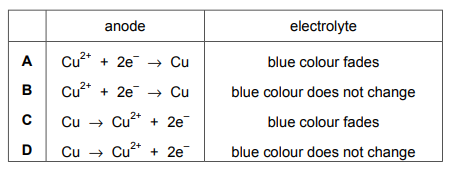
A metal object is electroplated with copper. One electrode is the metal object and the other electrode is copper. The electrolyte is aqueous copper(II) sulfate. Which row shows the ionic half-equation for the reaction at the anode and the observation of the electrolyte?

Table showing options A, B, C, D for half-equation at anode and electrolyte observation

Most-appropriate topic codes (Cambridge IGCSE Chemistry 0620):

Topic 4.1: Electrolysis — Describe how metals are electroplated; Construct ionic half-equations for reactions at the anode (to show oxidation) and at the cathode (to show reduction) (Supplement).
▶️ Answer/Explanation
During copper electroplating, the object to be plated is the cathode, and the pure copper electrode is the anode. At the anode, copper atoms lose electrons and dissolve into the electrolyte as Cu²⁺ ions (oxidation: Cu → Cu²⁺ + 2e⁻), which keeps the blue colour of the copper(II) sulfate solution constant. Option D correctly shows this half-equation and the observation that the electrolyte remains blue (unchanged concentration).
Answer: D

Question 14

Which statement about electrolysis is correct?
A Chemical energy is converted to electrical energy.
B Electrons flow through the electrolyte.
C Ionic compounds are broken down.
D Metals are formed at the positive electrode.

Most-appropriate topic codes (Cambridge IGCSE Chemistry 0620):

Topic 4.1: Electrolysis — Define electrolysis as the decomposition of an ionic compound, when molten or in aqueous solution, by the passage of an electric current (Core)
▶️ Answer/Explanation
Electrolysis uses electrical energy to decompose an ionic compound into its elements, so it is electrical → chemical, not the reverse (A is wrong). Electrons flow through the external circuit, not through the electrolyte; ions carry charge in the electrolyte (B is wrong). Metals (cations) are attracted to the negative electrode (cathode) and formed there, not at the positive electrode (anode) (D is wrong). The correct statement is that ionic compounds are broken down into simpler substances during electrolysis. ✅ Answer: (C)

Question 15

The reaction between hydrogen and oxygen releases 486 kJ / mol of energy.
\(2H_2(g) + O_2(g) → 2H_2O(g)\)
The bond energy of H–H is 436 kJ / mol and that of H–O is 464 kJ / mol. What is the bond energy of O=O?
A 430 kJ / mol
B 458 kJ / mol
C 498 kJ / mol
D 984 kJ / mol

Most-appropriate topic codes (Cambridge IGCSE Chemistry 0620):

Topic 5.1: Exothermic and endothermic reactions — Calculate the enthalpy change of a reaction using bond energies (Supplement)
▶️ Answer/Explanation
Energy released = Bonds broken – Bonds formed. Bonds broken: 2×H–H + 1×O=O = 2×436 + O=O = 872 + O=O. Bonds formed: 4×H–O = 4×464 = 1856. Enthalpy change = –486 kJ/mol (exothermic) = (872 + O=O) – 1856. Solving: –486 = O=O – 984 → O=O = 984 – 486 = 498 kJ/mol. ✅ Answer: (C) 498 kJ/mol

Question 16

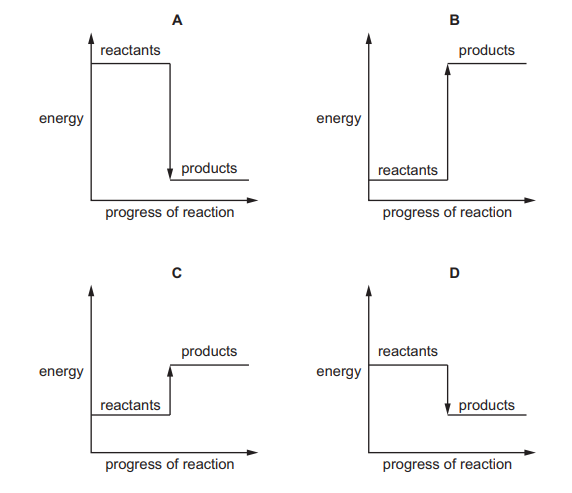
Which reaction pathway diagram shows the reaction that will give out the most energy? The scale on the y-axis is the same in each diagram.

Reaction pathway diagrams showing exothermic reactions with different activation energies and enthalpy changes

Most-appropriate topic codes (Cambridge IGCSE Chemistry 0620):

Topic 5.1: Exothermic and endothermic reactions — Interpret reaction pathway diagrams showing exothermic and endothermic reactions (Core); Draw and label reaction pathway diagrams including enthalpy change, ΔH (Supplement)
Topic 6.2: Rate of reaction — Describe and explain the effect of catalysts and activation energy using collision theory (Supplement)
▶️ Answer/Explanation
In exothermic reactions, the products have lower energy than the reactants, and the energy released is represented by the downward vertical drop from reactants to products on the y-axis. With the same y-axis scale across all diagrams, the reaction that gives out the most energy is the one with the largest vertical drop between the reactant energy level and the product energy level. Diagram A shows the reactants at the highest level and products at the lowest level compared to B, C, and D, meaning it has the most negative ΔH (enthalpy change) and therefore releases the greatest amount of thermal energy to the surroundings.
Answer: (A)

Question 17

When calcium carbonate is heated strongly, a gas is given off. Which word describes this change?
A chemical
B exothermic
C physical
D reduction

Most-appropriate topic codes (Cambridge IGCSE Chemistry 0620):

Topic 6.1: Physical and chemical changes — Identify physical and chemical changes, and describe the differences between them (Core).
Topic 7.3: Preparation of salts — Describe the preparation, separation and purification of soluble salts by reaction of an acid with an excess insoluble carbonate (Core).
Topic 6.4: Redox — Define oxidation as gain of oxygen and reduction as loss of oxygen (Core).
▶️ Answer/Explanation
Heating calcium carbonate (thermal decomposition) produces a new substance (calcium oxide) and a gas (carbon dioxide), making it a chemical change, not a physical one. The reaction is endothermic (absorbs heat), not exothermic, and calcium carbonate is broken down into simpler substances (not a reduction in terms of electron or oxygen loss). Therefore, only option A correctly classifies this as a chemical change.
Answer: (A)

Question 18

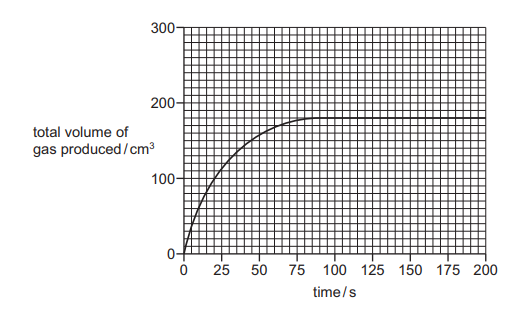
Powdered magnesium carbonate is added to excess dilute hydrochloric acid. The total volume of gas produced is measured over time. A graph of the results is shown.

The experiment is repeated but the concentration of the hydrochloric acid is doubled. All other conditions are kept the same. Which statements about the second experiment are correct?
1 The final volume of gas is 360 cm³.
2 The reaction finishes before 90 seconds.
3 The activation energy of the reaction is lower.

A 1 and 2

B 1 and 3

C 2 and 3

D 2 only

Most-appropriate topic codes (Cambridge IGCSE Chemistry 0620):

Topic 6.2: Rate of reaction — Describe the effect of changing concentration of solutions on rate of reaction (Core); Describe and explain using collision theory (Supplement)
Topic 3.2/3.3: Stoichiometry — Reacting masses and mole concept (the final gas volume depends on the limiting reagent, which is the solid here as acid is in excess)
▶️ Answer/Explanation
Doubling the acid concentration increases the rate of reaction (more frequent successful collisions), so the same amount of magnesium carbonate will be used up faster – the reaction finishes before 90 seconds (statement 2 correct). However, the amount of magnesium carbonate is unchanged and it is the limiting reagent (acid is in excess), so the final volume of CO₂ remains the same (180 cm³ from the graph), not 360 cm³ (statement 1 wrong). Activation energy is a fixed property of the reaction and is not changed by concentration (only by a catalyst), so statement 3 is wrong.
Answer: D (2 only)

Question 19

Which statements explain why increasing the temperature changes the rate of a chemical reaction?

1 It increases the activation energy.
2 It increases the frequency of collisions between the reacting particles.
3 It increases the kinetic energy of the reacting particles.
4 It increases the number of particles per unit volume.

A 1 and 2

B 1 and 4

C 2 and 3

D 3 and 4

Most-appropriate topic codes (Cambridge IGCSE Chemistry 0620):

Topic 6.2: Rate of reaction — Describe and explain the effect on the rate of reaction of changing the temperature using collision theory (Supplement)
▶️ Answer/Explanation
Increasing temperature does NOT change the activation energy (statement 1 is incorrect); it remains constant for a given reaction. Temperature increases the kinetic energy of particles (statement 3 is correct), causing them to move faster, which increases the frequency of collisions (statement 2 is correct). The number of particles per unit volume (concentration) is unchanged by temperature (statement 4 is incorrect). Therefore, statements 2 and 3 correctly explain the increased reaction rate.
Answer: C (2 and 3)

Question 20

Hydrogen is made by reacting carbon with steam. The equation for the reaction is shown.
\(C(s) + H_2O(g) ⇌ H_2(g) + CO(g)\)
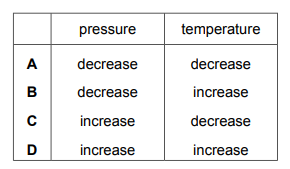
The forward reaction is endothermic. Which row describes changes in the pressure and the temperature that will both shift the position of equilibrium to the right?

Table showing pressure and temperature changes: Row A: Increase pressure, Increase temperature; Row B: Decrease pressure, Increase temperature; Row C: Increase pressure, Decrease temperature; Row D: Decrease pressure, Decrease temperature

Most-appropriate topic codes (Cambridge IGCSE Chemistry 0620):

Topic 6.3: Reversible reactions and equilibrium — Predict and explain, for a reversible reaction, how the position of equilibrium is affected by changing temperature and changing pressure (Supplement).
Topic 6.3: Reversible reactions and equilibrium — Predict and explain, for a reversible reaction, how the position of equilibrium is affected by changing temperature (Core/Supplement).
▶️ Answer/Explanation
For the endothermic forward reaction, increasing temperature shifts equilibrium to the right. On the left side, 1 mole of gas (steam) produces 2 moles of gas on the right (H₂ and CO). Decreasing pressure favors the side with more gas molecules, shifting equilibrium to the right. Row B shows decreasing pressure and increasing temperature, both shifting equilibrium to the right.
Answer: B

Question 21

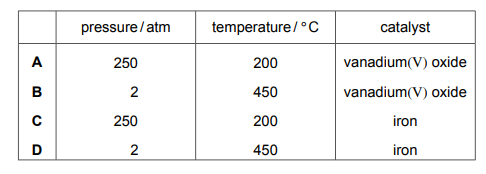
Which row shows the conditions used for the conversion of sulfur dioxide to sulfur trioxide in the Contact process?

Table with rows A, B, C, D showing temperature (450°C or 200°C) and pressure (200 kPa or 2 atm, 20000 kPa, 200 kPa)

Most-appropriate topic codes (Cambridge IGCSE Chemistry 0620):

Topic 10.3: Air quality and climate – State the source of sulfur dioxide from combustion of fossil fuels; strategies to reduce acid rain.
Topic 6.3: Reversible reactions and equilibrium – State the typical conditions for the conversion of sulfur dioxide to sulfur trioxide in the Contact process as 450°C, 200 kPa / 2 atm and a vanadium(V) oxide catalyst.
▶️ Answer/Explanation
According to the IGCSE Chemistry 0620 syllabus (Topic 6.3, Supplement), the typical conditions for the conversion of SO₂ to SO₃ in the Contact process are 450°C and 200 kPa (which is equivalent to approximately 2 atm). A vanadium(V) oxide catalyst is used, but the question focuses on temperature and pressure. Row B correctly shows 450°C and 200 kPa.
Answer: B

Question 22

The equation for the reaction of magnesium with carbon dioxide is shown.
\(2Mg + CO_2 → 2MgO + C\)
Which statement about this reaction is correct?
A. Magnesium is oxidised and carbon dioxide is reduced.
B. Magnesium is reduced and carbon dioxide is oxidised.
C. Magnesium and carbon dioxide are both oxidised.
D. Magnesium and carbon dioxide are neither oxidised nor reduced.

Most-appropriate topic codes (Cambridge IGCSE Chemistry 0620):

Topic 6.4: Redox — Define oxidation as gain of oxygen and reduction as loss of oxygen (Core); Identify redox reactions as reactions involving gain and loss of oxygen.
▶️ Answer/Explanation
In the reaction \(2Mg + CO_2 \rightarrow 2MgO + C\), magnesium (Mg) gains oxygen to become magnesium oxide (MgO), so it is oxidised. Carbon dioxide (\(CO_2\)) loses oxygen to become carbon (C), so it is reduced. Oxidation and reduction occur simultaneously, making this a redox reaction.
Answer: (A)

Question 23

Chlorine displaces bromine from aqueous potassium bromide. The ionic equation for the reaction is shown.
\(Cl_2 + 2Br^– → 2Cl^– + Br_2\)
Which statement about this reaction is correct?
A Bromide ions act as an oxidising agent.
B Bromide ions are oxidised as electrons are lost.
C Chlorine acts as a reducing agent.
D Chlorine is reduced as electrons are lost.

Most-appropriate topic codes (Cambridge IGCSE Chemistry 0620):

Topic 6.4: Redox — Define oxidation in terms of loss of electrons and reduction in terms of gain of electrons; Identify redox reactions as reactions involving gain and loss of electrons; Identify oxidising agents and reducing agents in redox reactions.
▶️ Answer/Explanation
In the reaction, each Br⁻ loses one electron to become Br₂ (oxidation), while Cl₂ gains electrons to become 2Cl⁻ (reduction). Thus Br⁻ is oxidised (electrons lost), making B correct. A is wrong because Br⁻ is a reducing agent, not an oxidising agent. C is wrong because Cl₂ is reduced, so it acts as an oxidising agent. D is wrong because reduction is gain (not loss) of electrons.
Answer: (B)

Question 24

Which gas is produced when ammonium chloride is warmed with aqueous sodium hydroxide?

A. ammonia
B. chlorine
C. hydrogen
D. nitrogen

Most-appropriate topic codes (Cambridge IGCSE Chemistry 0620):

Topic 12.5: Identification of ions and gases — Tests to identify the anion nitrate, NO3, by reduction with aluminium foil and aqueous sodium hydroxide and then testing for ammonia gas (Core); Tests to identify the gas ammonia, NH3, using damp red litmus paper (Core).
▶️ Answer/Explanation
Answer: A
Warming ammonium chloride (an ammonium salt) with aqueous sodium hydroxide (an alkali) produces ammonia gas. This is a standard test for the ammonium ion (NH₄⁺). The ammonia gas can be identified by its pungent smell and by turning damp red litmus paper blue.

Question 25

Which equation represents a solution of ethanoic acid in water?
A \(HCOOH(aq) ⇌ HCOO^–(aq) + H^+ (aq)\)
B \(HCOOH(aq) → HCOO^–(aq) + H^+ (aq)\)
C \(CH_3COOH(aq) ⇌ CH_3COO^– (aq) + H^+ (aq)\)
D \(CH_3COOH(aq) → CH_3COO^–(aq) + H^+ (aq)\)

Most-appropriate topic codes (Cambridge IGCSE Chemistry 0620):

Topic 7.1: The characteristic properties of acids and bases — Define a weak acid as an acid that is partially dissociated in aqueous solution; State that ethanoic acid is a weak acid, as shown by the symbol equation CH₃COOH(aq) ⇌ H⁺(aq) + CH₃COO⁻(aq)
▶️ Answer/Explanation
Ethanoic acid (CH₃COOH) is a weak acid, meaning it only partially dissociates in water, establishing an equilibrium between the undissociated acid and its ions. Therefore, the correct equation must use the equilibrium arrow (⇌) and the correct formula for ethanoic acid. Options A and B use methanoic acid (HCOOH), not ethanoic acid. Option D uses a forward arrow (→), which incorrectly implies complete dissociation. Only option C correctly shows ethanoic acid with the equilibrium sign.
Answer: (C)

Question 26

Four statements about the reactions of oxides with dilute hydrochloric acid and with aqueous sodium hydroxide are listed.
1 Aluminium oxide reacts with both dilute hydrochloric acid and aqueous sodium hydroxide.
2 Calcium oxide reacts with both dilute hydrochloric acid and aqueous sodium hydroxide.
3 Copper(II) oxide reacts with dilute hydrochloric acid but not with aqueous sodium hydroxide.
4 Sulfur dioxide does not react with either dilute hydrochloric acid or aqueous sodium hydroxide.
Which statements are correct?
A 1 and 2

B 1 and 3

C 2 and 4

D 3 and 4

Most-appropriate topic codes (Cambridge IGCSE Chemistry 0620):

Topic 7.2: Oxides — Classify oxides as acidic (e.g. SO₂, CO₂) or basic (e.g. CuO, CaO); Describe amphoteric oxides as oxides that react with acids and with bases (Al₂O₃, ZnO).
▶️ Answer/Explanation
Aluminium oxide is amphoteric (reacts with acid and base), so statement 1 is correct. Calcium oxide is basic (reacts with acid only, not with NaOH), so statement 2 is incorrect. Copper(II) oxide is basic (reacts with HCl but not with NaOH), so statement 3 is correct. Sulfur dioxide is acidic (reacts with NaOH to form sulfite, but not with HCl), so statement 4 is incorrect. Thus only statements 1 and 3 are correct.
Answer: B (1 and 3)

Question 27

Which statement about elements in Period 3 of the Periodic Table is correct?

A. Aluminium is a non-metal in Group III.
B. Argon is in Group VIII and has eight electrons in its outer electron shell.
C. Magnesium is in Group II and has three electrons in its outer electron shell.
D. Sulfur is a metal in Group VI.

Most-appropriate topic codes (Cambridge IGCSE Chemistry 0620):

Topic 8.1: Arrangement of elements — Describe the relationship between group number and the number of outer shell electrons (Core); Explain how the position of an element in the Periodic Table can be used to predict its properties (Core).
Topic 2.2: Atomic structure and the Periodic Table — State that the number of outer shell electrons is equal to the group number in Groups I to VII (Core).
▶️ Answer/Explanation
Correct Answer: B
Argon (Ar) is in Group VIII (also known as Group 0 or Group 18), and all noble gases have a full outer electron shell. For argon, which has an atomic number of 18, its electronic configuration is 2,8,8, meaning it has eight electrons in its outermost shell.
A is incorrect: Aluminium is a metal (not a non-metal) and is in Group III.
C is incorrect: Magnesium is in Group II, which means it has two (not three) electrons in its outer shell.
D is incorrect: Sulfur is a non-metal (not a metal) and is in Group VI.

Question 28

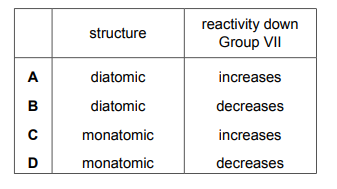
Which row describes the structure of Group VII elements and the trend in their reactivity down the group?

Table showing options A, B, C, D for structure (diatomic/single atoms) and reactivity trend (increases/decreases)

Most-appropriate topic codes (Cambridge IGCSE Chemistry 0620):

Topic 8.3 (Core): Group VII properties — Describe the Group VII halogens, chlorine, bromine and iodine, as diatomic non-metals with general trends down the group, limited to: (b) decreasing reactivity.
▶️ Answer/Explanation
Detailed Solution: Group VII elements (halogens) exist as diatomic molecules (e.g., Cl₂, Br₂, I₂), not single atoms. Down the group, the atomic radius increases, making it harder for the nucleus to attract an additional electron, so reactivity decreases. Option B correctly states diatomic structure with decreasing reactivity. Options A and D have incorrect reactivity trends (increasing or no change), and Option C incorrectly describes them as single atoms.
Answer: (B)

Question 29

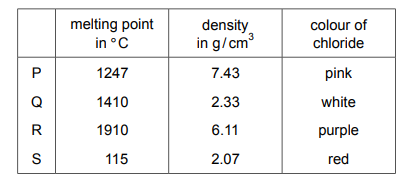
Some information about four elements, P, Q, R and S, is shown.

Table of properties for elements P, Q, R, S

Which elements are transition elements?
A P and R
B P and S
C Q and R
D R and S

Most-appropriate topic codes (Cambridge IGCSE Chemistry 0620):

Topic 8.4: Transition elements — Describe the transition elements as metals that have high densities, high melting points, form coloured compounds, and often act as catalysts (Core)
▶️ Answer/Explanation
Transition elements are metals with high melting points, high densities, coloured compounds, and catalytic activity. From the table, P has a high melting point and forms a blue compound (coloured), while R has a high melting point, acts as a catalyst, and forms a green compound (coloured) — both match the properties of transition elements. Q has a low melting point (typical of Group I or non-transition metals) and S has a very low melting point (likely a non-metal).
Answer: A (P and R)

Question 30

Propanoic acid is a carboxylic acid. It has similar chemical properties to ethanoic acid. Which statements are correct?

1 Aqueous propanoic acid is a weaker acid than dilute hydrochloric acid.
2 Propanoic acid partially ionises in aqueous solution.
3 Propanoic acid reacts with ethanol to form propyl ethanoate.

A 1, 2 and 3
B 1 and 2 only
C 1 and 3 only
D 2 and 3 only

Most-appropriate topic codes (Cambridge IGCSE Chemistry 0620):

Topic 7.1: The characteristic properties of acids and bases — Define a strong acid as an acid that is completely dissociated and a weak acid as an acid that is partially dissociated (Supplement).
Topic 11.7: Carboxylic acids — Describe the reaction of a carboxylic acid with an alcohol using an acid catalyst to form an ester (Supplement).
▶️ Answer/Explanation
Propanoic acid, like ethanoic acid, is a weak carboxylic acid. It is weaker than strong acids like hydrochloric acid (Statement 1 is correct) and only partially ionises in water to release H⁺ ions (Statement 2 is correct). However, propanoic acid reacts with ethanol to form ethyl propanoate (not propyl ethanoate) via esterification. Statement 3 is incorrect because the alcohol contributes the alkyl group to the ester’s name: ethanol + propanoic acid → ethyl propanoate.
Answer: (B) 1 and 2 only

Question 31

Iron rusts in the presence of oxygen and water. Which statements about the rusting of iron are correct?

1 Anhydrous iron(II) oxide is produced when iron rusts.
2 Iron rusts more quickly when attached to a piece of zinc.
3 Coating the iron with plastic prevents the iron from rusting.
4 Iron loses electrons when it rusts.

A 1 and 2

B 1 and 4

C 2 and 3

D 3 and 4

Most-appropriate topic codes (Cambridge IGCSE Chemistry 0620):

Topic 9.5: Corrosion of metals — State the conditions required for the rusting of iron and steel to form hydrated iron(III) oxide; Describe how barrier methods prevent rusting by excluding oxygen or water; Describe the use of zinc in galvanising as an example of a barrier method and sacrificial protection; Explain sacrificial protection in terms of the reactivity series and in terms of electron loss.
▶️ Answer/Explanation
Rust is hydrated iron(III) oxide (Fe₂O₃·xH₂O), not anhydrous iron(II) oxide, so statement 1 is incorrect. Zinc is more reactive than iron; when attached, zinc corrodes sacrificially (loses electrons instead of iron), so iron rusts more slowly, not more quickly — statement 2 is incorrect. Coating with plastic acts as a barrier method, excluding oxygen and water to prevent rusting, so statement 3 is correct. Rusting involves iron losing electrons (oxidation: Fe → Fe²⁺ + 2e⁻), so statement 4 is correct.
Answer: D (statements 3 and 4)

Question 32

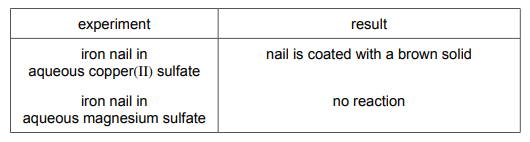
An iron nail is added to aqueous copper(II) sulfate and a different iron nail is added to aqueous magnesium sulfate. The results are shown.

Which statement is correct?
A Copper atoms are oxidised more easily than magnesium atoms.
B Copper atoms are reduced more easily than iron ions.
C Iron atoms are oxidised more easily than copper atoms.
D Iron atoms are reduced more easily than copper ions.

Most-appropriate topic codes (Cambridge IGCSE Chemistry 0620):

Topic 9.4: Reactivity series — Describe the relative reactivities of metals in terms of their tendency to form positive ions, by displacement reactions, if any, with the aqueous ions of magnesium, zinc, iron, copper and silver (Supplement)
Topic 6.4: Redox — Define oxidation as loss of electrons and reduction as gain of electrons; identify redox reactions by changes in oxidation number (Supplement)
▶️ Answer/Explanation
Iron displaces copper from copper(II) sulfate (brown copper deposits) because iron is more reactive than copper; iron atoms lose electrons (oxidation: Fe → Fe²⁺ + 2e⁻) more easily than copper atoms. No reaction occurs with magnesium sulfate because magnesium is more reactive than iron, so iron cannot displace magnesium. Thus iron atoms are oxidised more easily than copper atoms.
Answer: (C)

Question 33

Which pollutant leads to the deoxygenation of water in ponds and lakes?

A. fertilisers containing nitrates and phosphates
B. toxic metal compounds
C. combustion products of fossil fuels
D. acid rain

Most-appropriate topic codes (Cambridge IGCSE Chemistry 0620):

Topic 10.1: Water — State that some of these substances are potentially harmful, including: nitrates and phosphates lead to deoxygenation of water and damage to aquatic life (Core)
▶️ Answer/Explanation
✅ Answer: (A)

The syllabus (Topic 10.1) explicitly states that nitrates and phosphates from fertilisers and detergents are potentially harmful substances in water. They lead to deoxygenation (eutrophication) by causing algal blooms; the subsequent decay of dead algae by bacteria depletes the dissolved oxygen, damaging aquatic life. Toxic metal compounds (B) are harmful but do not primarily cause deoxygenation. Combustion products (C) and acid rain (D) cause air pollution and soil/water acidification, not specifically deoxygenation of freshwater bodies.

Question 34

Which statement identifies a sample of water as pure?

A. It melts at room temperature.
B. It turns anhydrous copper(II) sulfate blue.
C. It turns hydrated cobalt(II) chloride from blue to pink.
D. It boils at 100 °C.

Most-appropriate topic codes (Cambridge IGCSE Chemistry 0620):

Topic 10.1: Water — Describe how to test for the purity of water using melting point and boiling point
Topic 12.4: Separation and purification — Identify substances and assess their purity using melting point and boiling point information
▶️ Answer/Explanation
A pure substance has a sharp, fixed melting point and a sharp, fixed boiling point at standard pressure. For pure water, the boiling point is exactly 100 °C (at 1 atm). Options B and C are chemical tests for the presence of water, not for purity. Option A is incorrect because pure water melts at 0 °C, not at room temperature. Therefore, boiling at exactly 100 °C is a reliable indicator of purity.
Answer: (D)

Question 35

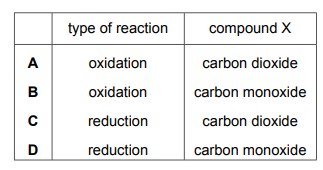
Oxides of nitrogen are produced by car engines. In a catalytic converter oxides of nitrogen are removed by reacting them with compound X. Which row describes the type of reaction oxides of nitrogen undergo and identifies compound X?

Table with rows for A, B, C, D showing reaction type (reduction, oxidation, reduction, oxidation) and compound X (carbon monoxide, carbon monoxide, nitrogen, nitrogen)

Most-appropriate topic codes (Cambridge IGCSE Chemistry 0620):

Topic 10.3: Air quality and climate — State the source of oxides of nitrogen from car engines; State the adverse effect of oxides of nitrogen; strategies to reduce effects including catalytic converters (Core)
Topic 10.3 Supplement: Explain how oxides of nitrogen form in car engines and describe their removal by catalytic converters, e.g. 2CO + 2NO → 2CO₂ + N₂ (Supplement)
▶️ Answer/Explanation
In a catalytic converter, harmful nitrogen oxides (NOₓ) are reduced to harmless nitrogen gas (N₂) by reacting with carbon monoxide (CO). The NOₓ gains electrons and is reduced, while CO is oxidised to CO₂. Therefore, the oxides of nitrogen undergo reduction and compound X is carbon monoxide.
Answer: A

Question 36

What is a disadvantage of producing ethanol using the catalytic addition of steam to ethene?
A the energy cost is low
B the process is continuous
C the process uses a non-renewable raw material
D the ethanol is pure

Most-appropriate topic codes (Cambridge IGCSE Chemistry 0620):

Topic 11.6: Alcohols — Describe the manufacture of ethanol by catalytic addition of steam to ethene (Core); Describe the advantages and disadvantages of the manufacture of ethanol by catalytic addition of steam to ethene (Supplement)
▶️ Answer/Explanation
The catalytic addition of steam to ethene (hydration) uses ethene, which is derived from crude oil or natural gas—non-renewable fossil fuels. This is a key environmental and sustainability disadvantage compared to the fermentation route (which uses renewable biomass). Options A and B are advantages (energy cost can be high, but the process is continuous and fast), while D is not necessarily a disadvantage because the ethanol produced needs distillation.
Answer: (C)

Question 37

Which statement about the polymer PET is correct?

A. It can be broken down into its monomers and re-polymerised.
B. It is an addition polymer.
C. It is a polyamide.
D. It is made from amino acid monomers.

Most-appropriate topic codes (Cambridge IGCSE Chemistry 0620):

Topic 11.8 (Supplement): Polymers — State that PET can be converted back into monomers and re-polymerised. Describe and draw the structure of PET, a polyester.
▶️ Answer/Explanation
PET (polyethylene terephthalate) is a polyester that can be depolymerised back into its monomers (terephthalic acid and ethylene glycol) and then re-polymerised, which is a key process in plastic recycling. It is not an addition polymer (it is a condensation polymer), not a polyamide (nylon is a polyamide), and it is made from dicarboxylic acid and diol monomers, not amino acids.
Answer: (A)

Question 38

The formulae of five compounds are listed.
1 \(C_4H_{10}\)
2 \(C_2H_5OH\)
3 \(C_4H_9OH\)
4 \(C_4H_9COOH\)
5 \(C_5H_{11}OH\)

Which compounds are in the same homologous series?
A 1, 3 and 4
B 2, 3 and 5
C 3 and 4 only
D 3 and 5 only

Most-appropriate topic codes (Cambridge IGCSE Chemistry 0620):

Topic 11.1: Formulae, functional groups and terminology — Write and interpret general formulae of compounds in the same homologous series, limited to alkanes, alkenes, alcohols, carboxylic acids (Core); State that a homologous series is a family of similar compounds with similar chemical properties due to the same functional group (Core)
▶️ Answer/Explanation
Compounds 2 (C₂H₅OH), 3 (C₄H₉OH) and 5 (C₅H₁₁OH) are all alcohols, containing the –OH functional group, and fit the general formula CₙH₂ₙ₊₁OH. Compound 1 is an alkane, compound 4 is a carboxylic acid, so they belong to different homologous series. Hence the correct answer is B.
Answer: B

Question 39

Propane reacts with chlorine. Which statements about this reaction are correct?
1 Ultraviolet light is used to provide the activation energy.
2 Propane undergoes an addition reaction.
3 One of the products is \(CH_3CH_2Cl\) .
4 One of the products is HCl .
A 1 and 2

B 1 and 4

C 2 and 3

D 3 and 4

Most-appropriate topic codes (Cambridge IGCSE Chemistry 0620):

Topic 11.4: Alkanes — Describe the substitution reaction of alkanes with chlorine as a photochemical reaction, with ultraviolet light providing the activation energy, Eₐ, and draw the structural or displayed formulae of the products, limited to monosubstitution
▶️ Answer/Explanation
Propane (an alkane) reacts with chlorine in a photochemical substitution reaction, not addition (so statement 2 is false). Ultraviolet light provides the activation energy (statement 1 correct). A hydrogen atom is replaced by a chlorine atom, producing HCl (statement 4 correct) and chloropropane. CH₃CH₂Cl is chloroethane, not a product from propane. Therefore only statements 1 and 4 are correct.
Answer: (B) 1 and 4

Question 40

Which statement about chromatography is correct?
A. It is not possible for two different substances to have the same \(R_f\) value.
B. It is only possible to use chromatography on substances which have a colour.
C. It is possible to use chromatography on colourless substances using a locating agent.
D. The \( R_f \) value of a substance = \( \frac{\text{the distance travelled by the solvent}}{\text{the distance travelled by the substance}} \)

Most-appropriate topic codes (Cambridge IGCSE Chemistry 0620):

Topic 12.3: Chromatography — Describe how paper chromatography is used to separate mixtures of soluble coloured substances (Core); Describe how paper chromatography is used to separate mixtures of soluble colourless substances, using a suitable solvent and a locating agent (Supplement); State and use the equation for \(R_f\) (Supplement)
▶️ Answer/Explanation
Different substances can have the same \(R_f\) value under identical conditions, so statement A is incorrect. Chromatography works for colourless substances when a locating agent (such as ninhydrin or iodine vapour) is used to visualise the spots, making statement B false and C correct. Statement D is incorrect because the correct formula is \(R_f = \frac{\text{distance travelled by substance}}{\text{distance travelled by solvent}}\).
Answer: (C)
Scroll to Top