
▶️ Answer/Explanation
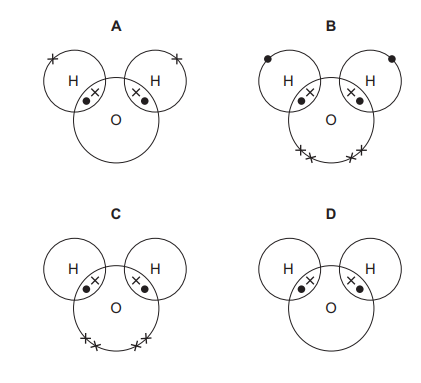
A water molecule (H₂O) has one oxygen atom bonded to two hydrogen atoms. Oxygen has 6 outer electrons and needs 2 more to complete its octet, while each hydrogen has 1 electron and shares it with oxygen. Diagram C correctly shows the oxygen atom with 8 outer electrons (2 lone pairs and 4 shared in two single covalent bonds), and each hydrogen atom achieves a duplet with the shared pair. Options A, B, and D do not satisfy the octet rule for oxygen or show incorrect electron sharing and arrangement.
✅ Answer: (C)
✅ Answer: (C)
▶️ Answer/Explanation
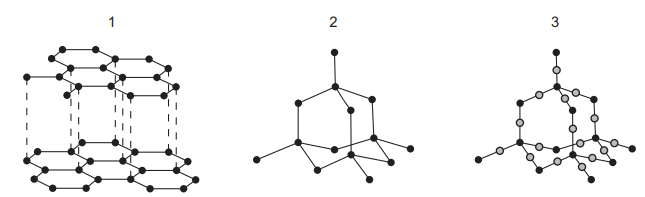
Structure 1 shows simple molecular (covalent) molecules with weak intermolecular forces — these are soft, low melting point. Structures 2 and 3 show giant covalent network (diamond-like) and giant ionic lattice respectively; both have strong bonds throughout the structure, making them hard and with very high melting points.
✅ Answer: D (2 and 3 only)
✅ Answer: D (2 and 3 only)
▶️ Answer/Explanation
Detailed Solution:
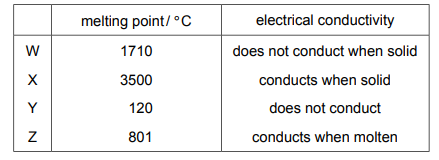
Substance W has a very high melting point (conducts electricity) — this matches graphite, a giant covalent structure with delocalised electrons.
Substance X has a very high melting point (does not conduct) — this matches silicon(IV) oxide, a giant covalent structure with no free charge carriers.
Substance Y has a high melting point (conducts when molten) — this matches sodium chloride, an ionic compound.
Substance Z has a low melting point (does not conduct) — this matches poly(ethene), a simple molecular polymer.
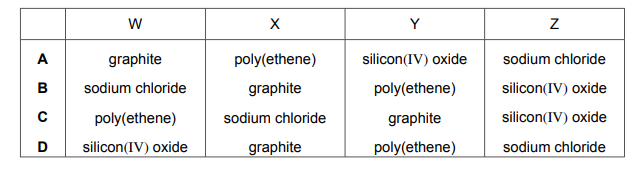
This sequence (W=graphite, X=SiO₂, Y=NaCl, Z=polyethene) corresponds to option D.
✅ Answer: D
Substance W has a very high melting point (conducts electricity) — this matches graphite, a giant covalent structure with delocalised electrons.
Substance X has a very high melting point (does not conduct) — this matches silicon(IV) oxide, a giant covalent structure with no free charge carriers.
Substance Y has a high melting point (conducts when molten) — this matches sodium chloride, an ionic compound.
Substance Z has a low melting point (does not conduct) — this matches poly(ethene), a simple molecular polymer.
This sequence (W=graphite, X=SiO₂, Y=NaCl, Z=polyethene) corresponds to option D.
✅ Answer: D
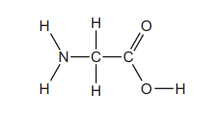
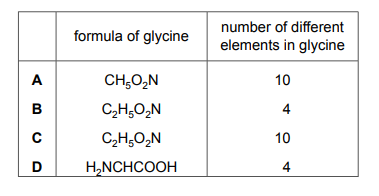
▶️ Answer/Explanation
Glycine is the simplest amino acid, containing both a basic amino group (–NH₂) and an acidic carboxyl group (–COOH). In aqueous solution, the carboxyl group donates a proton to the amino group, forming a zwitterion with –NH₃⁺ and –COO⁻. This zwitterion is overall neutral. Among the rows, the correct combination is: functional groups = amine and carboxylic acid; formula = C₂H₅NO₂; nature of aqueous solution = neutral (since the positive and negative charges balance).
✅ Answer: B
✅ Answer: B

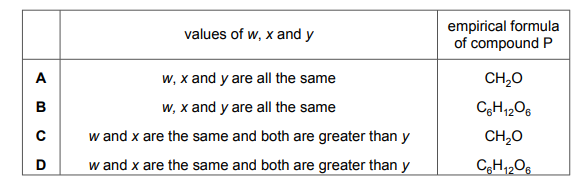
▶️ Answer/Explanation
The balanced symbol equation for photosynthesis is 6CO₂ + 6H₂O → C₆H₁₂O₆ + 6O₂. Therefore w = 6, x = 6, and y = 6, making compound P (oxygen) O₂. The empirical formula of O₂ is O because it simplifies to the smallest whole‑number ratio of atoms. Only row A has w=6, x=6, y=6 and empirical formula O.
✅ Answer: (A)
✅ Answer: (A)
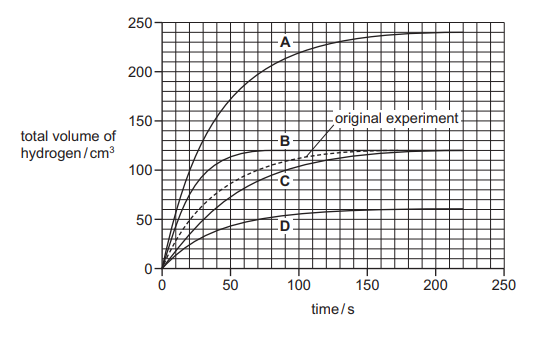
▶️ Answer/Explanation
Answer: D
In the second experiment, the sulfuric acid is diluted from 10 cm³ to 10 cm³ total volume (5 cm³ acid + 5 cm³ water), halving the concentration. The rate of reaction decreases because there are fewer H⁺ ions per unit volume, reducing collision frequency. However, the amount (moles) of acid is half, so the total volume of hydrogen gas produced is also halved. Line D shows both a slower initial rate (less steep slope) and a lower final gas volume compared to the original experiment.
In the second experiment, the sulfuric acid is diluted from 10 cm³ to 10 cm³ total volume (5 cm³ acid + 5 cm³ water), halving the concentration. The rate of reaction decreases because there are fewer H⁺ ions per unit volume, reducing collision frequency. However, the amount (moles) of acid is half, so the total volume of hydrogen gas produced is also halved. Line D shows both a slower initial rate (less steep slope) and a lower final gas volume compared to the original experiment.
▶️ Answer/Explanation
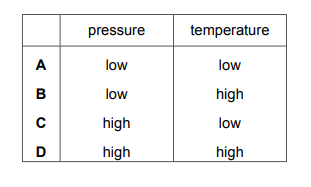
Since ΔH is negative, the forward reaction (ethene + steam → ethanol) is exothermic. For an exothermic reversible reaction, a lower temperature favours the forward reaction (increases yield). The reaction also involves a decrease in the number of gas moles (2 moles of gas → 1 mole of gas), so higher pressure favours the forward reaction. Therefore, the greatest yield is achieved at low temperature and high pressure, which corresponds to option C.
✅ Answer: (C)
✅ Answer: (C)
▶️ Answer/Explanation
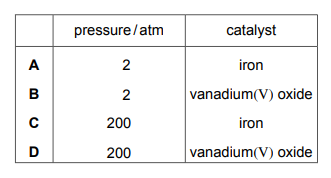
According to the Cambridge IGCSE Chemistry syllabus (Section 6.3), the Contact process converts sulfur dioxide to sulfur trioxide using a vanadium(V) oxide catalyst (V₂O₅) at a typical pressure of about 200 kPa (approximately 2 atm) and a temperature of 450°C. Examining the table, Row B correctly lists a pressure of 200 kPa and vanadium(V) oxide as the catalyst, matching these exact specifications. The other rows either use an incorrect catalyst (such as iron, which is for the Haber process) or an incorrect pressure.
✅ Answer: B
✅ Answer: B
▶️ Answer/Explanation
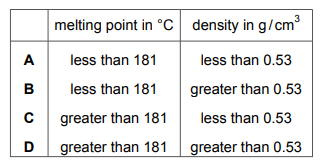
Down Group I (from lithium to potassium), the melting point decreases due to weaker metallic bonding from larger ions, while density increases because the increase in atomic mass outweighs the increase in atomic volume. Potassium is below lithium, so it has a lower melting point (63 °C) and a higher density (0.86 g/cm³). Therefore, the correct row shows melting point lower than 181 °C and density higher than 0.53 g/cm³.
✅ Answer: (B)
✅ Answer: (B)
▶️ Answer/Explanation
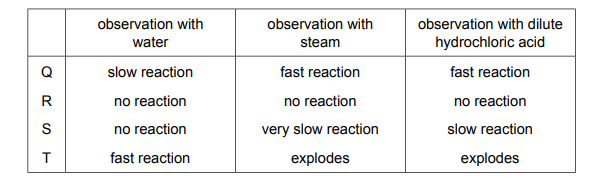
From the table: R reacts with nothing → least reactive (statement 1 correct). T reacts with water vigorously (like K, Na, Ca) → could be potassium (statement 2 correct). S reacts with steam but not cold water, while Q reacts with dilute acid but not steam/water → S is more reactive than Q and R? No: S (reacts steam) is less reactive than Q (reacts acid) because metals that react with acid are above H₂, but comparing S and Q: Q reacts with acid (more reactive than S which only reacts with steam). So statement 3 is false. Steam is hotter than water → faster reaction (statement 4 correct). Correct statements: 1, 2, 4 → answer A.
✅ Answer: (A) 1, 2 and 4
✅ Answer: (A) 1, 2 and 4
▶️ Answer/Explanation
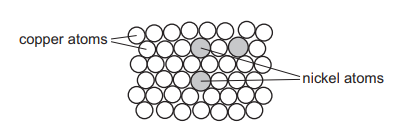
The diagram shows a mixture of two different types of atoms (copper and nickel) arranged randomly in a metallic lattice. This is characteristic of an alloy, not a pure metal, compound, or isotope. Cupronickel is an alloy of copper and nickel, widely used for coins because of its hardness and corrosion resistance.
✅ Answer: (A) an alloy
✅ Answer: (A) an alloy
▶️ Answer/Explanation
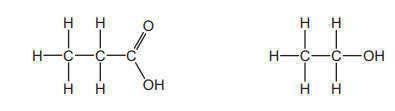
The left structure shows propanoic acid (3 carbons), and the right structure shows ethanol (2 carbons). In esterification, the alcohol provides the first part of the name (‘ethyl’) and the carboxylic acid provides the second part (‘propanoate’), forming ethyl propanoate. The reaction involves removing water (H₂O) to join the two molecules via an ester link.
✅ Answer: (A) ethyl propanoate
✅ Answer: (A) ethyl propanoate
▶️ Answer/Explanation
Detailed Solution:
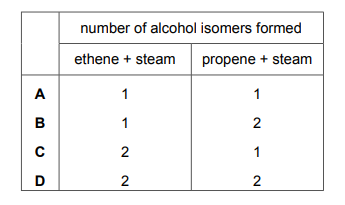
Ethene (C₂H₄) is a symmetrical alkene. When it reacts with steam (hydration), water adds across the double bond. Because both carbon atoms in the double bond are identical, the addition can only produce one alcohol: ethanol (CH₃CH₂OH).
Propene (C₃H₆) is an unsymmetrical alkene. The double bond is between carbon 1 and carbon 2. Following Markovnikov’s rule, the hydrogen from water (H-OH) can attach to the less substituted carbon (carbon 1), giving propan-2-ol (major product). However, the addition can also occur the other way, producing propan-1-ol. These two products, propan-1-ol and propan-2-ol, have the same molecular formula (C₃H₈O) but different structural arrangements of atoms, making them structural isomers.
Therefore, ethene forms 1 alcohol isomer and propene forms 2 alcohol isomers.
✅ Answer: Option B (Ethene: 1, Propene: 2)
Ethene (C₂H₄) is a symmetrical alkene. When it reacts with steam (hydration), water adds across the double bond. Because both carbon atoms in the double bond are identical, the addition can only produce one alcohol: ethanol (CH₃CH₂OH).
Propene (C₃H₆) is an unsymmetrical alkene. The double bond is between carbon 1 and carbon 2. Following Markovnikov’s rule, the hydrogen from water (H-OH) can attach to the less substituted carbon (carbon 1), giving propan-2-ol (major product). However, the addition can also occur the other way, producing propan-1-ol. These two products, propan-1-ol and propan-2-ol, have the same molecular formula (C₃H₈O) but different structural arrangements of atoms, making them structural isomers.
Therefore, ethene forms 1 alcohol isomer and propene forms 2 alcohol isomers.
✅ Answer: Option B (Ethene: 1, Propene: 2)
▶️ Answer/Explanation
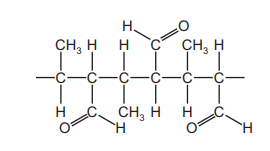
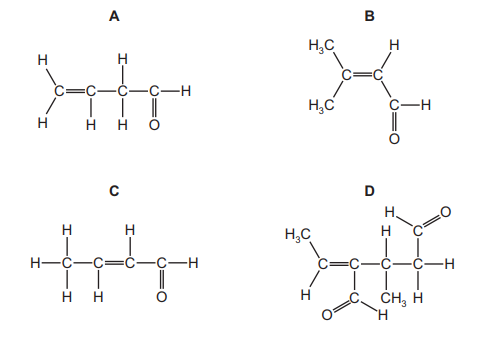
The polymer shown has a carbon backbone with a methyl (CH₃) group and an ethyl (CH₂CH₃) group branching alternately from every other carbon. This repeating pattern indicates it is an addition polymer formed from an alkene monomer. To find the monomer, identify the two-carbon unit with the substituents that repeat; breaking the double bond between these two carbons gives the monomer. The repeating unit is –CH(CH₃)–CH(CH₂CH₃)–, so the monomer must be the corresponding alkene with a methyl and an ethyl group on the double-bonded carbons. Option C correctly shows CH₂=C(CH₃)(CH₂CH₃) (2-methylbut-1-ene or a similar isomer), which polymerizes to give the shown structure. Option A has only one substituent, B has a chlorine atom, and D has a longer chain that does not match the repeating pattern.
✅ Answer: (C)
✅ Answer: (C)