
Question 1
Name the process that is used to:
(a) convert sulfur dioxide into sulfur trioxide in the manufacture of sulfuric acid
(b) obtain water from aqueous sodium chloride
(c) extract aluminium from purified bauxite
(d) separate petroleum into useful substances
(e) produce ethanol from aqueous glucose
(f) manufacture alkenes and hydrogen from large alkane molecules
(g) separate a mixture of soluble coloured substances.
Most-appropriate topic codes (Cambridge IGCSE Chemistry 0620):
• Topic 6.3 — Reversible reactions and equilibrium / Contact process (Part a)
• Topic 12.4 — Separation and purification (Part b, d, g)
• Topic 9.6 — Extraction of metals (Part c)
• Topic 11.6 — Alcohols (Part e)
• Topic 11.5 — Alkenes (Part f)
▶️ Answer/Explanation
(a) Contact process
The Contact process is the industrial method for manufacturing sulfuric acid, where sulfur dioxide is catalytically oxidized to sulfur trioxide using vanadium(V) oxide as a catalyst at high temperature.
(b) Distillation
Distillation (specifically simple distillation) separates a liquid from a solution by boiling the liquid and condensing its vapors, leaving the solid solute behind, thus obtaining pure water from aqueous sodium chloride.
(c) Electrolysis
Aluminium is extracted from its purified ore (bauxite, Al₂O₃) by electrolysis. The aluminium oxide is dissolved in molten cryolite to lower the melting point, and an electric current decomposes it into aluminium metal and oxygen.
(d) Fractional distillation
Crude petroleum is separated into useful fractions (like petrol, kerosene, diesel) by fractional distillation, which relies on the different boiling points of the hydrocarbon molecules in the mixture.
(e) Fermentation
Ethanol is produced industrially by fermentation, where yeast enzymes convert aqueous glucose into ethanol and carbon dioxide in the absence of oxygen at temperatures between 25-35°C.
(f) Cracking
Cracking is the process that breaks down large, less useful alkane molecules into smaller, more useful alkenes (like ethene) and hydrogen by passing them over a hot catalyst or using high temperature.
(g) Chromatography
Paper chromatography separates mixtures of soluble colored substances based on how differently they travel through a stationary phase (paper) with a mobile phase (solvent), due to their varying solubilities and attractions.
Question 2
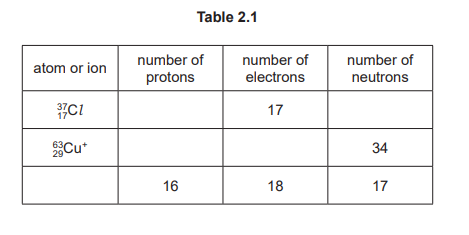
Complete Table 2.1.
Most-appropriate topic codes (Cambridge IGCSE Chemistry 0620):
• Topic 2.2 — Atomic structure and the Periodic Table
• Topic 2.3 — Isotopes
▶️ Answer/Explanation
Complete Table 2.1:
| atom or ion | number of protons | number of electrons | number of neutrons |
|---|---|---|---|
| \( \frac{37}{17} \, \text{Cl} \) | 17 | 17 | 20 |
| \( \frac{63}{29} \, \text{Cu}^+ \) | 29 | 28 | 34 |
| \( \frac{33}{16} \, \text{S}^{2-} \) | 16 | 18 | 17 |
Detailed Solutions:
- For \( \frac{37}{17} \, \text{Cl} \): The lower number (17) is the proton number, so protons = 17. In a neutral atom, electrons = protons = 17. Neutrons = mass number – protons = 37 – 17 = 20.
- For \( \frac{63}{29} \, \text{Cu}^+ \): The lower number (29) is the proton number, so protons = 29. The ion has a 1+ charge, meaning it has lost one electron, so electrons = 29 – 1 = 28. Neutrons = 63 – 29 = 34.
- For the last row (protons=16, electrons=18, neutrons=17): Protons=16 identifies the element as sulfur (S). Mass number = protons + neutrons = 16 + 17 = 33. Electrons (18) are 2 more than protons (16), so the charge is 2-. Thus, the ion is \( \frac{33}{16} \, \text{S}^{2-} \).
Question 3
This question is about the elements sodium and fluorine and the compound sodium fluoride.
(a) Sodium reacts with fluorine to form sodium fluoride. Write a symbol equation for this reaction.
(b) Some properties of sodium, fluorine and sodium fluoride are shown in Table 3.1.
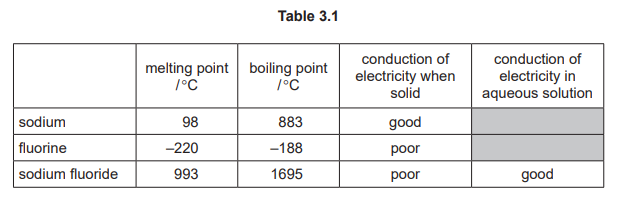
(i) Explain why sodium conducts electricity when it is a solid.
(ii) Complete the dot-and-cross diagram in Fig. 3.1 of a molecule of fluorine. Show outer shell electrons only. 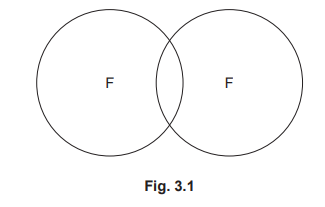
(iii) Deduce the physical state of fluorine at –200°C. Use the data in Table 3.1 to explain your answer.
(iv) Explain in terms of structure and bonding why sodium fluoride has a much higher melting point than fluorine.
(c) Dilute aqueous sodium fluoride undergoes electrolysis. Hydrogen is produced at the cathode.
(i) State what is meant by the term electrolysis.
(ii) Write an ionic half-equation for the production of hydrogen at the cathode.
Most-appropriate topic codes (Cambridge IGCSE Chemistry 0620):
• Topic 2.7 — Metallic bonding (Part (b)(i))
• Topic 2.5 — Simple molecules and covalent bonds (Part (b)(ii))
• Topic 1.1 — Solids, liquids and gases / Interpreting data (Part (b)(iii))
• Topic 2.4 & 2.5 — Ionic vs. molecular bonding/melting points (Part (b)(iv))
• Topic 4.1 — Electrolysis (Parts (c)(i), (c)(ii))
• Topic 9.1 — Properties of metals (Part (a))
▶️ Answer/Explanation
(a) \(2\mathrm{Na} + \mathrm{F}_2 \rightarrow 2\mathrm{NaF}\)
Sodium (Group I) forms a +1 ion, and fluorine (Group VII) forms a -1 ion, so the formula is NaF. The equation is balanced with 2 Na atoms and 2 F atoms on both sides.
(b)(i) Sodium conducts electricity when solid because it has a giant metallic lattice structure where the outer-shell electrons are delocalised and free to move throughout the metal, carrying charge.
(b)(ii) The completed dot-and-cross diagram for \(\mathrm{F}_2\) shows:
– One shared pair of electrons (single covalent bond) between the two F atoms, represented by one dot and one cross in the overlapping region.
– Six non-bonding electrons (three lone pairs) around each fluorine atom to complete the octet (represented as three pairs of dots on one atom and three pairs of crosses on the other).
(b)(iii) Fluorine is a liquid at –200°C.
Explanation: The melting point of fluorine is –220°C and the boiling point is –188°C. Since –200°C is above the melting point but below the boiling point, fluorine exists as a liquid at this temperature.
(b)(iv) Sodium fluoride (NaF) is an ionic compound with strong electrostatic forces (ionic bonds) between Na\(^+\) and F\(^-\) ions in a giant lattice, requiring much energy to overcome. Fluorine (F\(_2\)) is a simple molecular substance with weak intermolecular forces between molecules, which are easily overcome, resulting in a low melting point.
(c)(i) Electrolysis is the decomposition of an ionic compound (electrolyte) when molten or in aqueous solution by the passage of an electric current, causing chemical changes at the electrodes.
(c)(ii) The ionic half-equation for the production of hydrogen at the cathode is:
\(2\mathrm{H}^+(\mathrm{aq}) + 2\mathrm{e}^- \rightarrow \mathrm{H}_2(\mathrm{g})\)
In aqueous solution, water provides H\(^+\) ions, which are reduced (gain electrons) at the cathode to form hydrogen gas.
Question 4
Hydrogen iodide thermally decomposes into iodine and hydrogen. The reaction is reversible.

Fig. 4.1 shows a gas syringe containing a mixture of hydrogen iodide, iodine and hydrogen gases. The gas syringe is sealed and the mixture is heated to 300°C. The mixture of gases reaches equilibrium and is purple. 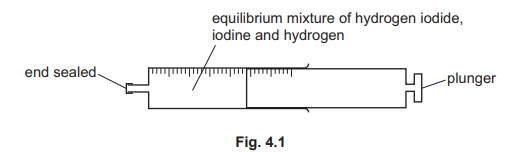
(a) State what is meant by the term equilibrium.
(b) The pressure of the mixture is increased. All other conditions stay the same. The position of equilibrium does not change. The colour of the gaseous mixture turns darker purple. The temperature remains constant. 
(i) Explain why the position of equilibrium does not change.
(ii) Suggest why the colour of the mixture of gases turns darker purple.
(c) The temperature of the mixture of gases is decreased. All other conditions stay the same. The mixture of gases turns lighter purple. State what can be deduced about the forward reaction from this information.
(d) Deduce the oxidation number of iodine, I, in:
HI ……………
\(I_2\)………
(e) Methanol is manufactured by reacting carbon monoxide with hydrogen.
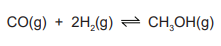
The rate of formation of methanol increases when a catalyst is used.
(i) Choose from the list the element that is most likely to be used as the catalyst. Draw a circle around your chosen answer.
calcium carbon copper sodium sulfur
(ii) State the effect on the position of equilibrium when a catalyst is used.
(iii) State the effect that a catalyst has on the activation energy, \(E_a\), of a reaction.
Most-appropriate topic codes (Cambridge IGCSE Chemistry 0620):
• Topic 6.3 — Reversible reactions and equilibrium (Parts (a), (b)(i), (c))
• Topic 6.2 — Rate of reaction / Collision theory (Part (b)(ii))
• Topic 6.4 — Redox (Part (d))
• Topic 6.2 — Catalysts (Parts (e)(i), (e)(ii), (e)(iii))
▶️ Answer/Explanation
(a) Equilibrium is reached in a reversible reaction when the rate of the forward reaction equals the rate of the reverse reaction, and the concentrations of reactants and products remain constant (though not necessarily equal).
(b)(i) The position of equilibrium does not change because the reaction has the same number of gas moles on both sides (2 moles of HI on the left, 1 mole of H₂ + 1 mole of I₂ = 2 moles of gas on the right). Changing pressure therefore has no effect on the equilibrium position.
(b)(ii) The colour turns darker purple because increasing the pressure reduces the volume, bringing iodine molecules (purple) closer together, increasing their concentration and making the colour appear more intense, even though the equilibrium position hasn’t shifted.
(c) Decreasing the temperature makes the mixture turn lighter purple (less iodine), so the equilibrium shifts to the left, favouring the reverse reaction. Since cooling favours the exothermic direction, the forward reaction must be endothermic.
(d) In HI, hydrogen has oxidation number +1, so iodine must be −1 to balance. In elemental I₂, the oxidation number is zero (by definition for any uncombined element).
(e)(i) Copper is circled (transition metals and their compounds are often catalysts; copper is used industrially in methanol synthesis).
(e)(ii) A catalyst has no effect on the position of equilibrium — it speeds up both forward and reverse reactions equally.
(e)(iii) A catalyst lowers the activation energy (Eₐ) of a reaction, providing an alternative reaction pathway with a lower energy barrier.
Question 5
(a) Lead(II) bromide, \(PbBr_2\), is an insoluble salt and is made by precipitation.
(i) Name two aqueous solutions that produce a precipitate of lead(II) bromide when they are mixed.
(ii) Describe how to produce a pure sample of lead(II) bromide from the mixture of aqueous solutions in (a)(i).
(iii) Write an ionic equation for the precipitation reaction which produces lead(II) bromide. Include state symbols.
(b) When iron(II) sulfate crystals are heated strongly, sulfur dioxide gas is given off. Describe a test for sulfur dioxide gas.
(c) Complete the equation for the thermal decomposition of hydrated cobalt(II) nitrate.

(d) Hydrated cobalt(II) sulfate, CoSO4•xH2O, produces water when it is heated. 
A student does an experiment to determine the value of x in \(CoSO4•xH_2O\).
step 1 The student weighs a sample of hydrated cobalt(II) sulfate.
step 2 The student heats the sample of hydrated cobalt(II) sulfate.
step 3 The student weighs the remaining solid after heating.
(i) Describe what else the student should do to ensure that all the water has been given off. No other substances are required.
(ii) In an experiment, 1.405g of \(CoSO_4•xH_2O\) is heated until all the water is given off. The mass of \(CoSO_4\) that remains is 0.775g. [Mr: \(CoSO_4\), 155; \(H_2O\), 18] Determine the value of x using the following steps.
- Calculate the number of moles of \(CoSO_4\) that remains.
- Calculate the mass of \(H_2O\) given off.
- Calculate the number of moles of \(H_2O\) given off.
- Determine the value of x
Most-appropriate topic codes (Cambridge IGCSE Chemistry 0620):
• Topic 7.3 — Preparation of salts (Parts (a)(i), (a)(ii), (a)(iii))
• Topic 12.5 — Identification of ions and gases (Part (b))
• Topic 7.3 — Preparation of salts / Hydrated substances (Parts (c), (d))
• Topic 3.3 — The mole and the Avogadro constant (Part (d)(ii))
▶️ Answer/Explanation
(a)(i) Two aqueous solutions that produce a precipitate of lead(II) bromide when mixed are lead(II) nitrate and potassium bromide (or sodium bromide/ammonium bromide).
This is a precipitation reaction where the lead(II) ions from one solution combine with the bromide ions from the other to form the insoluble salt PbBr₂.
(a)(ii) To produce a pure sample of lead(II) bromide from the mixture, first filter the mixture to collect the precipitate. Then wash the residue with distilled water to remove soluble impurities, and finally dry it between filter papers.
Filtration separates the insoluble solid from the liquid. Washing ensures no contaminating ions remain, and drying removes residual water to yield a pure solid product.
(a)(iii) The ionic equation for the precipitation reaction is:
\(Pb^{2+}(aq) + 2Br^–(aq) \rightarrow PbBr_2(s)\)
This equation shows only the reacting ions, omitting spectator ions. The state symbols confirm that the lead(II) and bromide ions are in aqueous solution and the lead(II) bromide formed is a solid precipitate.
(b) Test for sulfur dioxide gas: Bubble the gas through acidified aqueous potassium manganate(VII). The purple solution turns colourless.
Potassium manganate(VII) is a strong oxidising agent. Sulfur dioxide (SO₂) is a reducing agent and reduces the purple manganate(VII) ions (MnO₄⁻) to colourless manganese(II) ions (Mn²⁺).
(c) The completed equation is:
\(2Co(NO_3)_2•6H_2O \rightarrow 2CoO + 4NO_2 + 8H_2O + O_2\)
However, from the image, the expected blanks are 2CoO and 4NO₂ and 8H₂O.
Cobalt(II) nitrate hexahydrate decomposes upon heating. It loses water molecules and then the anhydrous cobalt(II) nitrate breaks down to form cobalt(II) oxide (CoO), nitrogen dioxide (NO₂), oxygen (O₂), and water vapour.
(d)(i) To ensure all water has been given off, the student should heat the sample again and reweigh it, repeating this process until the mass remains constant after successive heating steps.
Heating to constant mass guarantees that all water of crystallisation has been driven off, as no further mass loss indicates that no more water remains in the sample.
(d)(ii) Calculation of x:
Step 1: Moles of CoSO₄ remaining
Moles = mass / Mᵣ = 0.775 g / 155 g/mol = 0.005 mol.
Step 2: Mass of H₂O given off
Mass of H₂O = initial mass – final mass = 1.405 g – 0.775 g = 0.63 g.
Step 3: Moles of H₂O given off
Moles H₂O = mass / Mᵣ = 0.63 g / 18 g/mol = 0.035 mol.
Step 4: Determine the value of x
x = moles of H₂O / moles of CoSO₄ = 0.035 / 0.005 = 7.
Therefore, the formula is CoSO₄•7H₂O.
Question 6
This question is about metals.
(a) Fig. 6.1 shows a blast furnace used to extract iron from its ore.
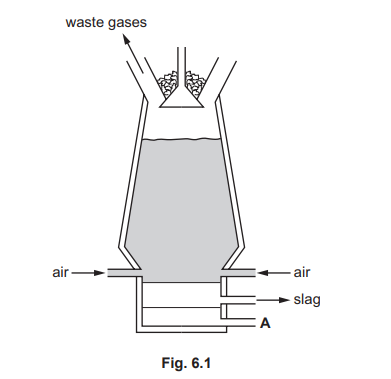
(i) Coke and iron ore are added at the top of the blast furnace. Name one other substance that is added at the top of the blast furnace.
(ii) Name the substance that leaves the blast furnace at A.
(iii) Slag is produced from an impurity in iron ore. Name the impurity in iron ore that is converted into slag.
(iv) Name two substances that react together to produce the high temperature in the blast furnace.
(v) Name two waste gases that leave the blast furnace.
(b) Zinc is produced from zinc oxide in a furnace. The zinc is produced as a gas. It then forms molten zinc.
(i) Suggest why the zinc produced inside the furnace is a gas.
(ii) State the name of the physical change that occurs when gaseous zinc is converted into molten zinc.
(c) Zinc is used to coat iron to prevent rusting.
(i) Name the process used to coat iron with zinc as a method of rust prevention.
(ii) When the zinc coating is scratched, the iron underneath does not rust. Explain why the iron underneath the zinc does not rust.
(d) Zinc oxide neutralises both acids and bases.
(i) State the general name given to oxides that neutralise both acids and bases.
(ii) When zinc oxide neutralises aqueous sodium hydroxide, sodium zincate is formed. The formula of the zincate ion is \(ZnO_2^{2–}\). Deduce the formula of sodium zincate.
(iii) Name the zinc compound that forms when zinc oxide neutralises dilute sulfuric acid.
Most-appropriate topic codes (Cambridge IGCSE Chemistry 0620):
• Topic 9.6 — Extraction of metals (Part (a), Blast furnace)
• Topic 9.4 — Reactivity series (Part (b), extraction of zinc)
• Topic 9.5 — Corrosion of metals / galvanising / sacrificial protection (Part (c))
• Topic 7.2 — Oxides (amphoteric oxides) (Part (d)(i))
• Topic 7.3 — Preparation of salts (Part (d)(ii), (d)(iii))
▶️ Answer/Explanation
(a)(i) Limestone (calcium carbonate).
Limestone is added to remove the acidic impurity (silicon dioxide) from the iron ore by forming slag.
(a)(ii) Molten iron.
At the bottom of the blast furnace, the reduced iron is collected as a liquid because of the very high temperature.
(a)(iii) Silicon(IV) oxide (silica / SiO₂).
This acidic impurity reacts with calcium oxide (from limestone) to form calcium silicate slag.
(a)(iv) Coke (carbon) and oxygen (from hot air).
Coke burns in the hot air blast to produce carbon dioxide and a large amount of heat, raising the temperature.
(a)(v) Any two: nitrogen, carbon dioxide, argon (or carbon monoxide).
Nitrogen and argon come from the air blast; carbon dioxide is a product of combustion and reduction reactions.
(b)(i) The temperature inside the furnace is above the boiling point of zinc.
Zinc has a relatively low boiling point (907°C), so it vaporises at the furnace temperature.
(b)(ii) Condensation (condensing).
The change from gaseous zinc to liquid (molten) zinc is the physical process of condensation.
(c)(i) Galvanising.
This is the process of coating iron or steel with a layer of zinc to protect against rusting.
(c)(ii) Zinc is more reactive than iron, so it acts as a sacrificial protector. Zinc loses electrons (is oxidised) in preference to iron, so the iron remains as metal and does not rust.
(d)(i) Amphoteric.
An amphoteric oxide can react with both acids (acting as a base) and bases (acting as an acid).
(d)(ii) Na₂ZnO₂.
The zincate ion has a 2– charge, so two sodium ions (Na⁺) are needed to balance the charge, giving sodium zincate.
(d)(iii) Zinc sulfate.
ZnO + H₂SO₄ → ZnSO₄ + H₂O, a neutralisation reaction producing a salt (zinc sulfate) and water.
Question 7
Many organic compounds contain carbon and hydrogen only.
(a) (i) Organic compound A has the following composition by mass.
C, 82.76%; H, 17.24%
Calculate the empirical formula of compound A.
(ii) Compound B has the empirical formula \(CH_2\) and a relative molecular mass of 70. Determine the molecular formula of compound B.
(b) Fig. 7.1 shows a section of polymer Q
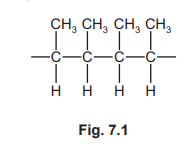
- Draw the displayed formula of the monomer that forms polymer Q.
- Name the monomer used to form polymer Q
(c) Propene, \(C_3H_6\), can be produced by heating \(C_{11}H_{24}\). The products of the reaction are propene, hydrogen and one other product in a 1:1:1 mole ratio. Complete the symbol equation for this reaction 
(d) Carboxylic acids and esters contain carbon, hydrogen and oxygen only. An ester X and a carboxylic acid Y both contain 3 carbon atoms. X and Y have the same molecular formula.
(i) State the name given to compounds with the same molecular formula but different structural formulae.
(ii) Esters are made by the reaction between carboxylic acids and alcohols. Ester X is methyl ethanoate. Name the carboxylic acid and the alcohol used to make methyl ethanoate.
carboxylic acid ……………..
alcohol ………………….
(iii) Draw the displayed formula of carboxylic acid Y. Name the carboxylic acid.
Most-appropriate topic codes (Cambridge IGCSE Chemistry 0620):
• Topic 3.3 — The mole and the Avogadro constant (Part (a))
• Topic 11.5 — Alkenes & addition polymerisation (Part (b))
• Topic 11.3 — Fuels & cracking (Part (c))
• Topic 11.1 — Formulae, functional groups and terminology / Structural isomers (Part (d)(i))
• Topic 11.6 — Alcohols & 11.7 — Carboxylic acids (Parts (d)(ii), (d)(iii))
▶️ Answer/Explanation
(a)(i) M1: Divide the percentage by the atomic mass: C = 82.76 / 12 = 6.90; H = 17.24 / 1 = 17.24.
M2: Divide by the smaller number (6.90): C = 1; H = 17.24 / 6.90 = 2.5.
M3: Multiply to get whole numbers (×2): C = 2, H = 5. Hence the empirical formula is C₂H₅.
(a)(ii) The empirical formula mass of CH₂ is 12 + (2×1) = 14. The molecular mass is 70. The multiplier (n) = 70 / 14 = 5. Therefore the molecular formula is (CH₂)₅ = C₅H₁₀.
(b) The polymer structure shows a carbon chain with a methyl side group, indicating it is poly(propene) made from propene monomers. The monomer must have a double bond.
Monomer displayed formula: 
Monomer name: propene.
(c) C₁₁H₂₄ → C₃H₆ + H₂ + another product. Balancing carbons: 11 – 3 = 8 carbons in the other product. Balancing hydrogens: Left = 24, Right = 6 (propene) + 2 (hydrogen) = 8, so remaining product needs 16 H. The other product is C₈H₁₆ (an alkene). The balanced equation is:
C₁₁H₂₄ → C₃H₆ + H₂ + C₈H₁₆.
(d)(i) Compounds with the same molecular formula but different structural formulae are called structural isomers.
(d)(ii) Methyl ethanoate is formed from the condensation reaction of ethanoic acid (carboxylic acid) and methanol (alcohol).
(d)(iii) Both X and Y have the same molecular formula (C₃H₆O₂). Since Y is a carboxylic acid with 3 carbons, it is propanoic acid (C₂H₅COOH).
Displayed formula of propanoic acid: 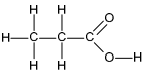
Name of carboxylic acid Y: propanoic acid.