
Question 1
Name the process used to:
(a) produce ammonia from nitrogen
(b) produce lead from molten lead(II) bromide
(c) separate an insoluble solid from a mixture of an insoluble solid and a solution
(d) produce ethanol from ethene
(e) identify the components of a mixture of soluble coloured substances
(f) separate a mixture of several liquids with different boiling points
(g) determine the volume of an acid required to neutralise a given volume of an alkali.
Most-appropriate topic codes (Cambridge IGCSE Chemistry 0620):
• Topic 6.3 — Reversible reactions and equilibrium (Haber process) (a)
• Topic 4.1 — Electrolysis (b)
• Topic 12.4 — Separation and purification (c, f)
• Topic 11.6 — Alcohols (Manufacture of ethanol) (d)
• Topic 12.3 — Chromatography (e)
• Topic 12.2 — Acid-base titrations (g)
▶️ Answer/Explanation
(a) Haber process
Detailed solution: The Haber process is the industrial method for fixing atmospheric nitrogen. It reacts nitrogen (from air) with hydrogen (from methane) under high pressure and temperature with an iron catalyst to produce ammonia.
(b) electrolysis
Detailed solution: Electrolysis uses electrical energy to decompose molten ionic compounds. For molten lead(II) bromide, passing a current causes lead ions (Pb²⁺) to migrate to the cathode and gain electrons, forming liquid lead metal.
(c) filtration
Detailed solution: Filtration separates a solid from a liquid using a porous barrier (filter paper). The insoluble solid remains as the residue, while the solution passes through as the filtrate.
(d) catalytic addition
Detailed solution: Ethanol is manufactured industrially by the catalytic addition of steam to ethene. This requires a phosphoric acid catalyst at high temperature (300°C) and high pressure (60-70 atm).
(e) chromatography
Detailed solution: Paper chromatography separates soluble coloured substances based on their differing solubilities in a solvent. As the solvent moves up the paper, each component travels a different distance, producing a distinct spot.
(f) fractional distillation
Detailed solution: Fractional distillation separates liquids with different boiling points. The mixture is heated, and vapours rise up a fractionating column; components condense at different heights based on their boiling points.
(g) titration
Detailed solution: Titration is a quantitative technique where a solution of known concentration (in a burette) is added to a known volume of another solution until neutralisation occurs, indicated by a colour change of an indicator.
Question 2
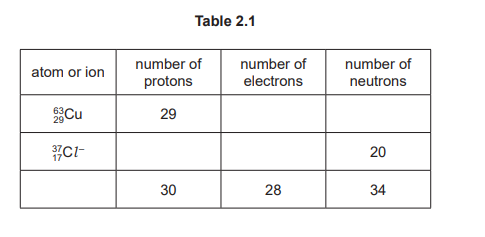
Complete Table 2.1.
Most-appropriate topic codes (Cambridge IGCSE Chemistry 0620):
• Topic 2.2 — Atomic structure and the Periodic Table (Proton number, electron configuration, group and period numbers)
• Topic 8.1 — Arrangement of elements (Relationship between electronic configuration and position in the Periodic Table)
▶️ Answer/Explanation
Completed Table 2.1:
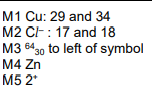
Detailed solution:
Fluorine: Proton number (atomic number) is 9, giving the electron configuration 2,7. It has 7 outer-shell electrons, placing it in Group VII. It has two occupied electron shells, so it is in Period 2.
Sodium: Proton number (atomic number) is 11, giving the electron configuration 2,8,1. It has 1 outer-shell electron, placing it in Group I. It has three occupied electron shells (2,8,1), so it is in Period 3.
Question 3
This question is about elements and compounds.
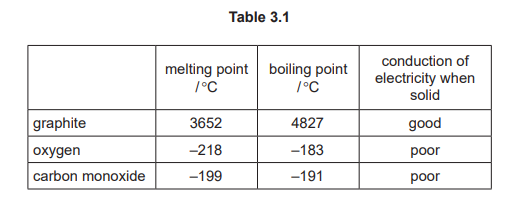
(a) Some properties of graphite, oxygen and carbon monoxide are shown in Table 3.1
(i) Explain why graphite conducts electricity when solid.
(ii) Complete the dot-and-cross diagram in Fig. 3.1 of a molecule of oxygen. Show outer shell electrons only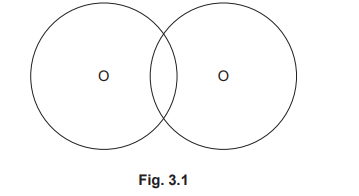
(iii) Deduce the physical state of carbon monoxide at –195°C. Use the data in Table 3.1 to explain your answer.
(iv) Explain in terms of structure and bonding why graphite has a much higher melting point than carbon monoxide.
(b) Potassium reacts with chlorine to form potassium chloride. Write a symbol equation for this reaction.
(c) A dilute aqueous solution of potassium chloride undergoes electrolysis. Oxygen is produced at the anode.
(i) State what is meant by the term electrolysis.
(ii) Write an ionic half-equation for the production of oxygen at the anode.
Most-appropriate topic codes (Cambridge IGCSE Chemistry 0620):
• Topic 2.6 — Giant covalent structures (Parts (a)(i), (a)(iv))
• Topic 2.5 — Simple molecules and covalent bonds (Part (a)(ii))
• Topic 1.1 — Solids, liquids and gases (Part (a)(iii))
• Topic 2.2 — Atomic structure and the Periodic Table / Topic 8.2 — Group I properties (Part (b))
• Topic 4.1 — Electrolysis (Parts (c)(i), (c)(ii))
▶️ Answer/Explanation
(a)(i) Graphite conducts electricity when solid because it has delocalised (mobile) electrons.
In graphite, each carbon atom is bonded to three others, leaving one electron per atom free to move along the parallel layers, carrying charge.
(a)(ii) The completed dot-and-cross diagram for an oxygen molecule (\(\mathrm{O_2}\)) must show a double covalent bond and two lone pairs on each oxygen atom.
Each oxygen atom contributes 6 outer electrons. The diagram should show two shared pairs (4 electrons: 2 dots and 2 crosses in the overlapping region) representing the double bond, plus four non-bonding electrons (two lone pairs) arranged around each atom to complete the octet.
(a)(iii) Carbon monoxide is a liquid at –195°C.
The data shows that CO has a melting point of –199°C and a boiling point of –191°C. Since –195°C is higher than –199°C but lower than –191°C, the substance exists as a liquid.
(a)(iv) Graphite has a much higher melting point than carbon monoxide because graphite has a giant covalent structure.
Melting graphite requires breaking many strong covalent bonds between carbon atoms, whereas melting solid carbon monoxide only requires overcoming weak intermolecular forces between simple \(\mathrm{CO}\) molecules, which requires much less energy.
(b) The balanced symbol equation is: \(2\mathrm{K} + \mathrm{Cl}_2 \rightarrow 2\mathrm{KCl}\).
Potassium (Group I) loses one electron each to form \(\mathrm{K}^+\) ions, while a chlorine molecule gains two electrons to form two \(\mathrm{Cl}^-\) ions, resulting in the ionic compound potassium chloride.
(c)(i) Electrolysis is the decomposition (breakdown) of an ionic compound when molten or in aqueous solution by the passage of an electric current.
The electric current provides the energy to force the compound to decompose into its elements, with positive ions moving to the cathode and negative ions moving to the anode.
(c)(ii) The ionic half-equation for the production of oxygen at the anode is: \(4\mathrm{OH}^- \rightarrow 2\mathrm{H_2O} + \mathrm{O}_2 + 4e^-\).
In the electrolysis of dilute potassium chloride, water molecules ionise to give \(\mathrm{OH}^-\) ions, which are preferentially discharged at the anode. These hydroxide ions lose electrons (oxidation) to form oxygen gas and water.
Question 4
Dinitrogen tetroxide, \(N_2O_4\), decomposes into nitrogen dioxide, \(NO_2\). The reaction is reversible
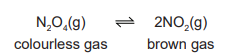
Fig. 4.1 shows a gas syringe containing a mixture of dinitrogen tetroxide and nitrogen dioxide. The gas syringe is sealed. The mixture reaches equilibrium and the colour of the mixture of gases is a pale brown. 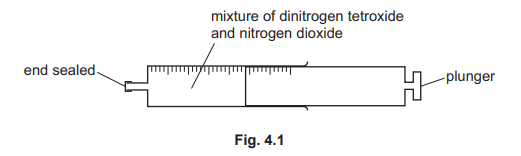
(a) Describe a reversible reaction at equilibrium in terms of:
- the rate of the forward reaction and the rate of the reverse reaction
- the concentration of reactants and products.
(b) The pressure of the mixture is increased. All other conditions stay the same. The mixture immediately turns darker brown before the position of equilibrium changes. Explain in terms of particles why the mixture immediately turns darker brown.
(c) The temperature of the mixture is increased. All other conditions stay the same. The mixture turns darker brown. State what can be deduced about the forward reaction from this information.
(d) Sulfur is converted into sulfuric acid, \(H_2SO_4\), by a series of reactions. Sulfur dioxide, \(SO_2\), and oxygen, \(O_2\), react to form sulfur trioxide, \(SO_3\). The reversible reaction reaches equilibrium. 
(i) Complete Table 4.1 using only the words, increases, decreases or no change. 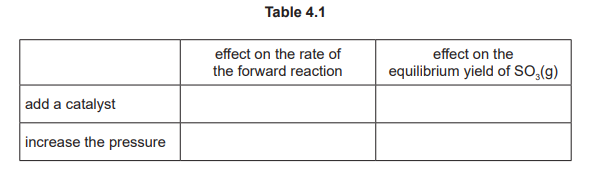
(ii) Deduce the oxidation number of sulfur in:
S ………………
\(SO_3\) ……………..
Most-appropriate topic codes (Cambridge IGCSE Chemistry 0620):
• Topic 6.3 — Reversible reactions and equilibrium (Parts (a), (b), (c), (d)(i))
• Topic 6.4 — Redox (Part (d)(ii))
• Topic 8.3 — Group VII properties (context of gas colours)
▶️ Answer/Explanation
(a) At equilibrium, the rate of the forward reaction equals the rate of the reverse reaction. Also, the concentrations of reactants and products remain constant (no longer changing) because the system is dynamic but macroscopic properties are steady.
(b) Increasing the pressure instantly compresses the gas mixture, increasing the number of \(NO_2\) molecules per unit volume. Since \(NO_2\) is dark brown and \(N_2O_4\) is colourless, the higher concentration of \(NO_2\) makes the mixture appear darker brown before the equilibrium shifts.
(c) The mixture turns darker brown when temperature increases, meaning more \(NO_2\) (brown gas) is formed. This indicates the forward reaction (decomposition of \(N_2O_4\) to \(NO_2\)) is endothermic, because increasing temperature favours the endothermic direction.
(d)(i) For the reaction \(2SO_2 + O_2 \rightleftharpoons 2SO_3\):
Adding \(SO_2\) increases rate of forward reaction. Increasing pressure shifts equilibrium to the side with fewer gas moles (right), so yield of \(SO_3\) increases. Adding a catalyst speeds up both forward and reverse rates equally (no change to equilibrium yield).
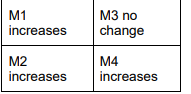
(d)(ii) Oxidation number of sulfur in elemental S is zero (by definition, uncombined elements have oxidation number 0). In \(SO_3\), oxygen is -2 each, total -6, so sulfur must be +6 to balance.
Question 5
(a) Barium sulfate, \(BaSO_4\), is an insoluble salt and is made by precipitation.
(i) Name two aqueous solutions that produce a precipitate of barium sulfate when they are mixed.
(ii) Describe how to produce a pure sample of barium sulfate from the mixture of aqueous solutions in (a)(i).
(iii) Write an ionic equation for the precipitation reaction which produces barium sulfate. Include state symbols.
(b) Soluble salts are made from dilute acids. Name the dilute acid and one other substance that react together to make copper(II) sulfate.
(c) Nitrates decompose when they are heated. When hydrated copper(II) nitrate is heated, oxygen gas is produced.
(i) Describe a test for oxygen.
(ii) Complete the equation for the decomposition of hydrated copper(II) nitrate.

(d) Hydrated zinc sulfate gives off water when it is heated.

A student does an experiment to determine the value of x in \(ZnSO_4•xH_2O\).
step 1 The student weighs a sample of hydrated zinc sulfate.
step 2 The student heats the sample of hydrated zinc sulfate.
step 3 The student weighs the solid after heating.
step 4 The student repeats step 2 and step 3 until the mass of solid after heating is constant.
(i) State why the student does step 4.
(ii) In an experiment, 0.574g of \(ZnSO_4•xH_2O\) is heated until the mass is constant. The mass of \(ZnSO_4\) that remains is 0.322g.
[\(M_r: ZnSO_4\), 161; H2O, 18]
Determine the value of x using the following steps.
- Calculate the number of moles of \(ZnSO_4\) remaining
- Calculate the mass of \(H_2O\) given off.
- Calculate the number of moles of \(H_2O\) given off.
- Determine the value of x.
Most-appropriate topic codes (Cambridge IGCSE Chemistry 0620):
• Topic 7.3 — Preparation of salts (Parts (a)(i), (a)(ii), (b))
• Topic 12.2 — Acid-base titrations / Ionic equations (Part (a)(iii))
• Topic 12.5 — Identification of ions and gases (Part (c)(i))
• Topic 6.3 — Reversible reactions and equilibrium / Thermal decomposition (Part (c)(ii))
• Topic 3.3 — The mole and the Avogadro constant / Water of crystallisation (Part (d)(ii))
▶️ Answer/Explanation
(a)(i) Barium chloride (or barium nitrate) and sodium sulfate (or potassium/sulfuric acid).
(Detailed solution): An insoluble salt like BaSO₄ is made by mixing a soluble barium salt (providing Ba²⁺ ions) with a soluble sulfate salt (providing SO₄²⁻ ions). The Ba²⁺ and SO₄²⁻ ions then combine to form the solid precipitate.
(a)(ii) Filter the mixture, wash the residue with distilled water, and dry it between filter papers or in a warm place.
(Detailed solution): Filtration separates the solid precipitate from the liquid. Washing removes soluble impurities from the solid’s surface, and drying removes the washing liquid, leaving a pure solid sample.
(a)(iii) Ba²⁺(aq) + SO₄²⁻(aq) → BaSO₄(s)
(Detailed solution): This equation shows only the reacting ions (Ba²⁺ and SO₄²⁻) and the insoluble product (BaSO₄), ignoring spectator ions. The state symbols indicate aqueous solutions and a solid precipitate.
(b) dilute acid: sulfuric acid; other substance: copper(II) oxide (or copper(II) carbonate or copper(II) hydroxide).
(Detailed solution): Copper(II) sulfate is made by reacting an insoluble base (like CuO) with sulfuric acid. The acid provides the SO₄²⁻ ions, and the base provides the Cu²⁺ ions for the salt.
(c)(i) test: Insert a glowing splint into the gas; observations: The splint relights.
(Detailed solution): Oxygen supports combustion strongly. A glowing splint provides enough heat to ignite in pure oxygen, bursting back into flame, which is a definitive positive test.
(c)(ii) Complete equation: 2Cu(NO₃)₂ → 2CuO + 4NO₂ + O₂
(Detailed solution): Balancing the equation requires 2 moles of copper(II) nitrate to decompose into 2 moles of copper(II) oxide, 4 moles of nitrogen dioxide, and 1 mole of oxygen, conserving all atoms.
(d)(i) To ensure that all the water of crystallisation has been given off (so the remaining solid is pure anhydrous ZnSO₄).
(Detailed solution): Repeating heating until constant mass confirms the reaction is complete. If the mass no longer changes upon further heating, no more water is being lost, meaning the sample is fully dehydrated.
(d)(ii)
Moles of ZnSO₄: 0.322 / 161 = 0.00200 mol
Mass of H₂O given off: 0.574 – 0.322 = 0.252 g
Moles of H₂O given off: 0.252 / 18 = 0.0140 mol
Value of x: 0.0140 / 0.00200 = 7
(Detailed solution): x represents the mole ratio of H₂O to ZnSO₄ in the crystal. After finding moles of each, the ratio (moles H₂O / moles ZnSO₄) calculates to 7, so the formula is ZnSO₄·7H₂O.
Question 6
This question is about iron.
(a) Fig. 6.1 shows a blast furnace used to extract iron from its ore.
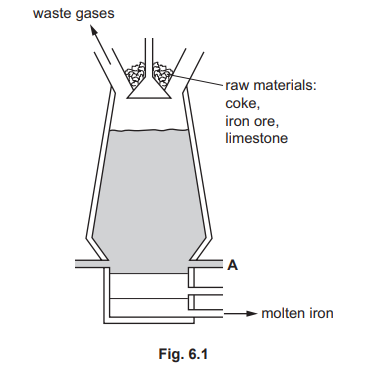
(i) Name the main ore of iron used in the blast furnace.
(ii) Name the substance that enters the blast furnace at A.
(iii) Name the reducing agent in the extraction of iron in the blast furnace.
(iv) Explain why limestone is added to the blast furnace. Give details of the chemical reactions that are involved.
(b) The list shows the properties of some elements.
- act as catalysts
- have low densities
- have low melting points
- form acidic or basic oxides
- form coloured compounds
- form positive or negative ions
Iron is a transition metal. Sodium is a Group I metal. State which property from the list:
(i) is true for sodium but not iron
(ii) is true for iron but not sodium
(iii) is true for both sodium and iron
(iv) is not true for sodium and not true for iron.
(c) Steel consists mainly of iron. Iron rusts when it reacts with water and oxygen. Fig. 6.2 shows magnesium blocks attached to the bottom of a steel boat. The magnesium does not completely cover the steel. The magnesium blocks provide sacrificial protection for the steel. 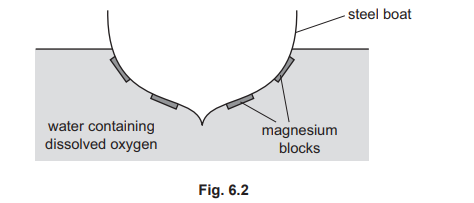
(i) Explain, in terms of electrons, why magnesium is used for sacrificial protection.
(ii) Name a metal that cannot provide sacrificial protection for steel.
Most-appropriate topic codes (Cambridge IGCSE Chemistry 0620):
• Topic 9.6 — Extraction of metals (Parts (a)(i)-(a)(iv))
• Topic 8.2 & 8.4 — Group I properties vs transition elements (Parts (b)(i)-(b)(iv))
• Topic 9.5 — Corrosion of metals / Sacrificial protection (Parts (c)(i)-(c)(ii))
▶️ Answer/Explanation
(a)(i) Hematite
Hematite is the main iron ore and contains iron(III) oxide (Fe₂O₃). Other ores exist, but hematite is the most commonly used in the blast furnace.
(a)(ii) Air (or oxygen)
Hot air is blown into the blast furnace at the bottom (A) to provide oxygen for the combustion of carbon (coke).
(a)(iii) Carbon monoxide
Carbon monoxide (CO) is the main reducing agent; it reduces iron(III) oxide to iron while being oxidised to carbon dioxide.
(a)(iv) Limestone decomposes to calcium oxide and carbon dioxide. Calcium oxide then reacts with silicon(IV) oxide (an acidic impurity in the ore) to form calcium silicate (slag). This removes impurities and prevents them from contaminating the iron.
(b)(i) Have low densities / have low melting points
Sodium, being a Group I metal, has a low density and a very low melting point compared to the transition metal iron.
(b)(ii) Act as catalysts / form coloured compounds
Transition metals like iron often act as catalysts and form coloured compounds; sodium does not show these properties.
(b)(iii) Form basic oxides / form positive ions
Both sodium oxide and iron(II/III) oxides are basic, and both elements form positive ions (cations) in compounds.
(b)(iv) Form acidic oxides / form negative ions
Neither sodium nor iron form acidic oxides (they form basic oxides) and neither forms stable negative ions in normal chemistry.
(c)(i) Magnesium loses electrons more readily than iron because magnesium is more reactive (higher in the reactivity series). Magnesium atoms oxidise preferentially, supplying electrons to prevent iron atoms from losing electrons and rusting.
(c)(ii) Copper (or silver or gold)
Any metal less reactive than iron cannot provide sacrificial protection; it would not lose electrons in preference to iron and would not act as a sacrificial anode.
Question 7
Many organic compounds contain carbon and hydrogen only.
(a) (i) An organic compound A has the following composition by mass.
C, 83.33%; H, 16.67%
Calculate the empirical formula of compound A.
(ii) Compound B has the empirical formula \(C_2H_5\) and a relative molecular mass of 58. Determine the molecular formula of compound B.
(b) Fig. 7.1 shows a section of a polymer formed from an alkene.
(i) Identify the functional group in alkenes that reacts when alkenes form polymers.
(ii) A section of a polymer is shown in Fig. 7.1.
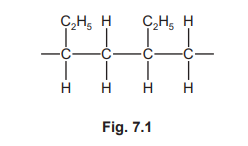 Draw the displayed formula of the monomer that forms this polymer.
- Name the monomer used to form this polymer.
(c) Alkenes are produced by cracking alkanes. When \(C_{12}H_{26}\) is cracked, the products are ethene and an alkane which form in a 2:1 mole ratio. Write a symbol equation for this reaction.
\(C_{12}H_{26} → …………………… + ……………………………………………\)
(d) (i) State the general formula for alcohols.
(ii) Draw the displayed formula of one alcohol with the molecular formula \(C_3H_8O\). Name the alcohol you have drawn.
Most-appropriate topic codes (Cambridge IGCSE Chemistry 0620):
• Topic 3.3 — The mole and the Avogadro constant / Stoichiometry (Part (a))
• Topic 11.5 — Alkenes / Polymerisation (Part (b))
• Topic 11.5 — Alkenes / Cracking (Part (c))
• Topic 11.6 — Alcohols / Formulae (Part (d))
▶️ Answer/Explanation
(a)(i) Empirical formula of compound A:
Moles of C = 83.33 / 12 = 6.94; Moles of H = 16.67 / 1 = 16.67.
Ratio C : H = 6.94 : 16.67 = 1 : 2.4 = 5 : 12.
Therefore, the empirical formula is C₅H₁₂.
(a)(ii) Molecular formula of compound B:
Mr of empirical unit C₂H₅ = (2 × 12) + 5 = 29.
n = Molecular mass / Empirical mass = 58 / 29 = 2.
Molecular formula = 2 × (C₂H₅) = C₄H₁₀.
(b)(i) Functional group in alkenes:
The functional group responsible for polymerisation is the carbon-carbon double bond (C=C).
(b)(ii) Monomer from the polymer section:
The polymer section shows a repeating unit of two carbons singly bonded, indicating the monomer is ethene.
Displayed formula: H₂C=CH₂. Name of monomer: ethene.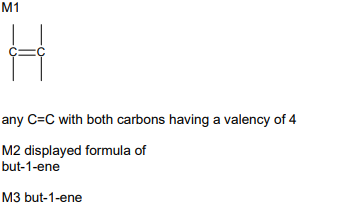
(c) Cracking equation:
C₁₂H₂₆ → 2C₂H₄ + C₈H₁₈.
This balances the equation: 12 C and 26 H on both sides, with ethene (C₂H₄) and octane (C₈H₁₈) in a 2:1 mole ratio.
(d)(i) General formula for alcohols:
The general formula is CₙH₂ₙ₊₁OH or CₙH₂ₙ₊₂O.
(d)(ii) Alcohol with formula C₃H₈O:
One possible alcohol is propan-1-ol.
Displayed formula: CH₃-CH₂-CH₂-OH.
Name: propan-1-ol (alternatively propan-2-ol with the -OH on the middle carbon is also correct).