Home / 0620_s25_qp_11

Question 1

Which process happens when water vapour changes to rain?
A. boiling
B. condensing
C. evaporating
D. freezing

Most-appropriate topic codes (Cambridge IGCSE Chemistry 0620):

TOPIC 1.1: Solids, liquids and gases (Describe changes of state in terms of melting, boiling, evaporating, freezing and condensing)
▶️ Answer/Explanation
Correct Option: B

Detailed solution:

When water vapour changes to rain, it is changing from a gas to a liquid. This process is called condensing. The water vapour molecules lose energy and come closer together to form liquid water droplets. Boiling and evaporating are liquid to gas changes, while freezing is liquid to solid. So condensing is the correct answer.

Question 2

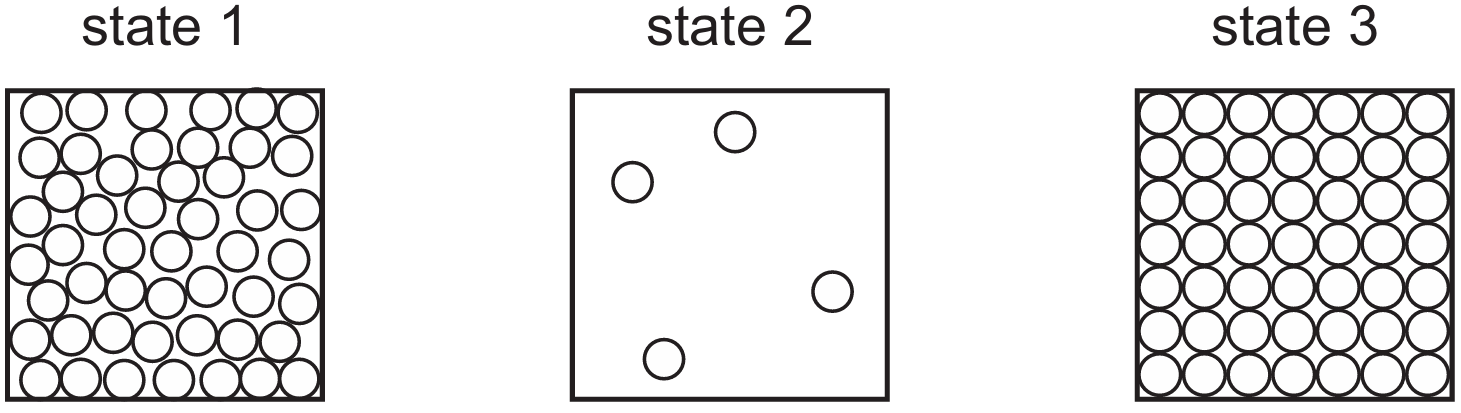
The diagrams show the arrangement of particles in three different states of matter.
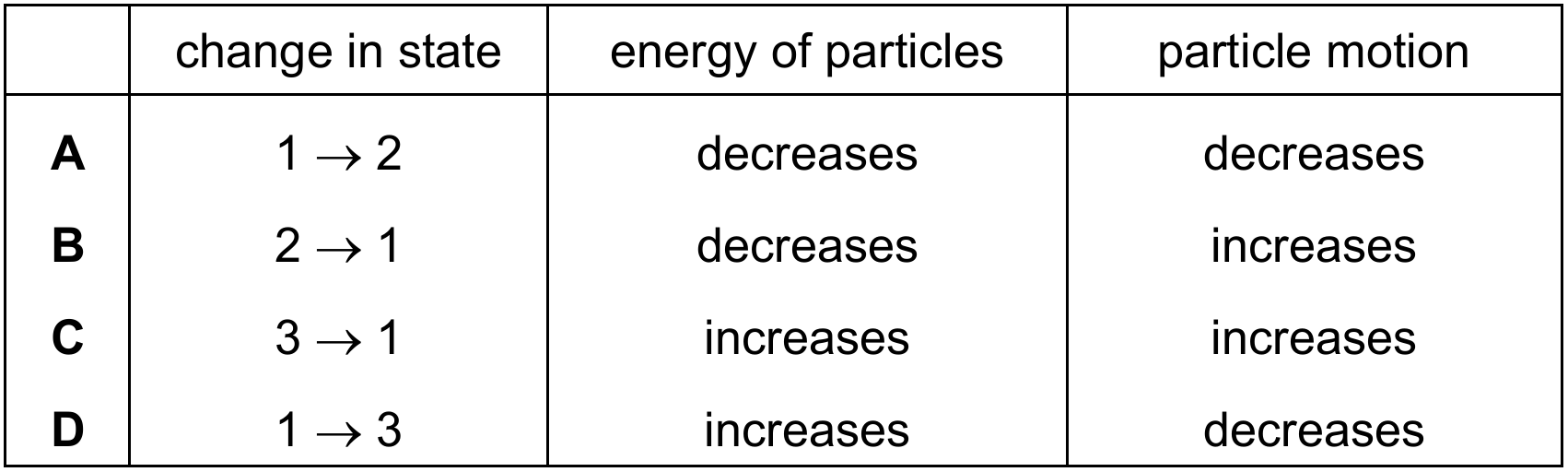
Which row describes the change in energy of the particles and in particle motion for the given change in state?

Most-appropriate topic codes (Cambridge IGCSE Chemistry 0620):

TOPIC 1.1: Solids, liquids and gases (Describe changes of state in terms of kinetic particle theory, including the interpretation of heating and cooling curves)
▶️ Answer/Explanation
Correct Option: C

Detailed solution:

The diagrams show three states: 1 = gas (particles far apart, random motion), 2 = liquid (particles close, random arrangement), 3 = solid (particles close, regular arrangement). When a solid (3) changes to a gas (1), this is sublimation. During this change, the particles gain energy and their motion increases significantly. Therefore, for change 3→1, energy increases and particle motion increases, which matches row C.
Question 3

An atom of element Q contains 19 electrons, 19 protons and 20 neutrons.
What is Q?
A. calcium
B. potassium
C. strontium
D. yttrium

Most-appropriate topic codes (Cambridge IGCSE Chemistry 0620):

TOPIC 2.2: Atomic structure and the Periodic Table (Define proton number/atomic number as the number of protons in the nucleus of an atom)
▶️ Answer/Explanation
Correct Option: B

Detailed solution:

The number of protons determines the identity of an element, and this number is called the atomic number. Since the atom has 19 protons, its atomic number is 19. Looking at the Periodic Table, the element with atomic number 19 is potassium (K). Calcium has 20 protons, strontium has 38 protons, and yttrium has 39 protons. So Q is definitely potassium.

Question 4

Which part of an atom has a relative mass of 1 and a relative charge of 0?
A. electron
B. neutron
C. nucleus
D. proton

Most-appropriate topic codes (Cambridge IGCSE Chemistry 0620):

TOPIC 2.2: Atomic structure and the Periodic Table (State the relative charges and relative masses of a proton, a neutron and an electron)
▶️ Answer/Explanation
Correct Option: B

Detailed solution:

A neutron is a subatomic particle located in the nucleus of an atom. It has a relative mass of approximately 1 (the same as a proton), but it carries no electrical charge, meaning its relative charge is 0. An electron has a relative mass of about 1/1840 and a charge of -1. A proton has a relative mass of 1 and a relative charge of +1. The nucleus contains both protons and neutrons, so it has a positive charge and a mass greater than 1. Only the neutron fits both criteria.

Question 5

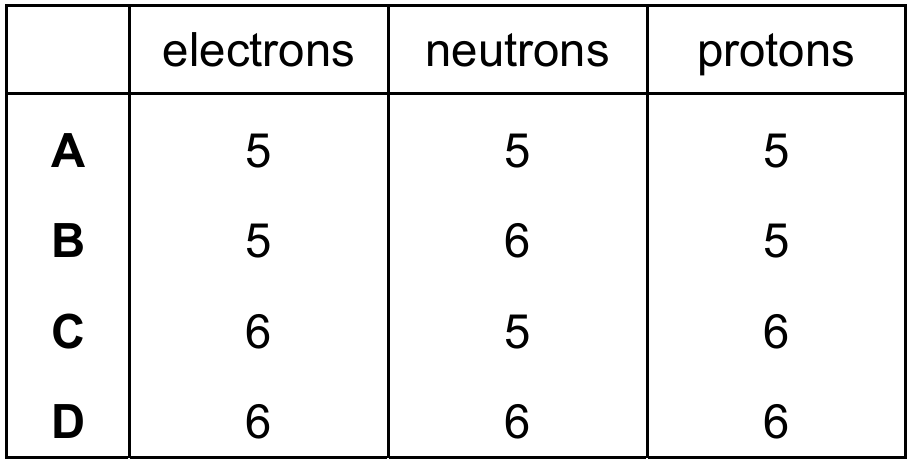
Which row identifies the number of electrons, neutrons and protons in a particle which is an isotope of $^{11}_{5}\mathrm{B}$ ?

Most-appropriate topic codes (Cambridge IGCSE Chemistry 0620):

TOPIC 2.3: Isotopes (Define isotopes as different atoms of the same element that have the same number of protons but different numbers of neutrons; Interpret and use symbols for atoms)
▶️ Answer/Explanation
Correct Option: A

Detailed solution:

$^{11}_{5}\mathrm{B}$ has atomic number 5, so any isotope of boron must have 5 protons. In a neutral atom, electrons equal protons, so 5 electrons. $^{11}_{5}\mathrm{B}$ itself has 11 – 5 = 6 neutrons. The question asks for a particle which is an isotope of $^{11}_{5}\mathrm{B}$. An isotope has the same number of protons (5) but a different number of neutrons. Option A (5 electrons, 5 neutrons, 5 protons) represents boron-10 ($^{10}_{5}\mathrm{B}$), which is indeed a different isotope of boron. Option B represents $^{11}_{5}\mathrm{B}$ itself, while options C and D have the wrong number of protons.
Question 6

Which statements about potassium iodide are correct?
  1. It is formed from potassium anions and iodide cations.
  2. It is a good electrical conductor when molten or in aqueous solution.
  3. Potassium atoms share electrons with iodine atoms.
A. 1 and 3
B. 1 only
C. 2 and 3
D. 2 only

Most-appropriate topic codes (Cambridge IGCSE Chemistry 0620):

TOPIC 2.4: Ions and ionic bonds (Describe the formation of positive ions, known as cations, and negative ions, known as anions; Describe the properties of ionic compounds: good electrical conductivity when aqueous or molten and poor when solid)
▶️ Answer/Explanation
Correct Option: D

Detailed solution:

Potassium iodide (KI) is an ionic compound. Statement 1 is incorrect: potassium forms positive ions (cations, K⁺), while iodide forms negative ions (anions, I⁻). Statement 2 is correct: like other ionic compounds, potassium iodide conducts electricity when molten or dissolved in water because the ions become free to move. Statement 3 is incorrect: potassium and iodine form an ionic bond by transferring electrons, not sharing them. Therefore, only statement 2 is correct.

Question 7

Which substances contain one or more shared pairs of electrons?
  1. argon
  2. methane
  3. iron(III) oxide
  4. chlorine
A. 1 and 3
B. 1 and 4
C. 2 and 3
D. 2 and 4

Most-appropriate topic codes (Cambridge IGCSE Chemistry 0620):

TOPIC 2.5: Simple molecules and covalent bonds (State that a covalent bond is formed when a pair of electrons is shared between two atoms leading to noble gas electronic configurations)
▶️ Answer/Explanation
Correct Option: D

Detailed solution:

Shared pairs of electrons are found in covalent bonds. Argon is a noble gas that exists as single atoms with no chemical bonds, so it has no shared pairs. Iron(III) oxide is an ionic compound where electrons are transferred from iron to oxygen. Methane (CH₄) has four C–H covalent bonds, each containing a shared pair of electrons. Chlorine exists as Cl₂ molecules with one shared pair of electrons between the two chlorine atoms. So only methane and chlorine contain shared pairs of electrons.

Question 8

Which substance has a giant covalent structure at room temperature and pressure?
A. ammonia
B. carbon dioxide
C. diamond
D. water

Most-appropriate topic codes (Cambridge IGCSE Chemistry 0620):

TOPIC 2.6: Giant covalent structures (Describe the giant covalent structures of graphite and diamond)
▶️ Answer/Explanation
Correct Option: C

Detailed solution:

Diamond is an allotrope of carbon where each carbon atom is covalently bonded to four other carbon atoms, forming a continuous three-dimensional giant lattice structure. This makes it extremely hard with a very high melting point. Ammonia (NH₃), carbon dioxide (CO₂), and water (H₂O) are all simple molecular compounds made of small molecules held together by weak intermolecular forces, not giant covalent structures.

Question 9

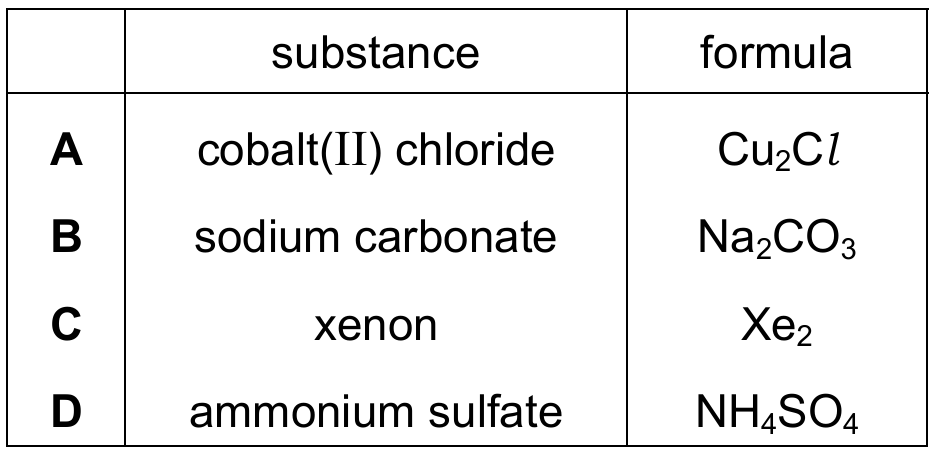
Which row shows the correct formula for the named substance?

Most-appropriate topic codes (Cambridge IGCSE Chemistry 0620):

TOPIC 3.1: Formulae (State the formulae of the elements and compounds named in the subject content; Deduce the formula of a simple compound from the relative numbers of atoms present)
▶️ Answer/Explanation
Correct Option: B

Detailed solution:

Sodium carbonate has the correct formula Na₂CO₃ because sodium ions are Na⁺ and carbonate ions are CO₃²⁻, so two sodium ions are needed to balance the charge. Option A is wrong: cobalt(II) chloride should be CoCl₂, not Cu₂Cl (copper is a different element altogether). Xenon is a monatomic noble gas, so its formula is simply Xe, not Xe₂. Ammonium sulfate contains NH₄⁺ and SO₄²⁻ ions, so the correct formula is (NH₄)₂SO₄, not NH₄SO₄.
Question 10

The equation shows the thermal decomposition of magnesium carbonate.
\[\mathrm{MgCO_3\rightarrow MgO + CO_2}\]
[M: $\mathrm{MgCO_3}$ ,84]
Which mass of magnesium oxide is formed when 21.0 g of magnesium carbonate is completely decomposed?
A. 1.9g
B. 4.0g
C. 10.0g
D. 40.0g

Most-appropriate topic codes (Cambridge IGCSE Chemistry 0620):

TOPIC 3.2: Relative masses of atoms and molecules (Calculate reacting masses in simple proportions. Calculations will not involve the mole concept)
▶️ Answer/Explanation
Correct Option: C

Detailed solution:

The relative formula mass of MgCO₃ is given as 84. The relative formula mass of MgO is 24 (Mg) + 16 (O) = 40. According to the equation, 84 g of MgCO₃ produces 40 g of MgO. To find the mass produced from 21.0 g, we use the ratio: (40 ÷ 84) × 21.0 = (40 × 21.0) ÷ 84 = 840 ÷ 84 = 10.0 g. So 10.0 g of magnesium oxide is formed.

Question 11

Concentrated aqueous sodium chloride is electrolysed using inert electrodes.
What is the main product formed at the positive electrode (anode)?
A. chlorine
B. hydrogen
C. oxygen
D. sodium

Most-appropriate topic codes (Cambridge IGCSE Chemistry 0620):

TOPIC 4.1: Electrolysis (Identify the products formed at the electrodes and describe the observations made during the electrolysis of concentrated aqueous sodium chloride)
▶️ Answer/Explanation
Correct Option: A

Detailed solution:

When concentrated aqueous sodium chloride (brine) is electrolysed, the ions present are Na⁺, Cl⁻, H⁺, and OH⁻. At the positive electrode (anode), oxidation occurs and negative ions are attracted. In a concentrated solution, chloride ions (Cl⁻) are discharged in preference to hydroxide ions (OH⁻). So chlorine gas (Cl₂) is produced as the main product at the anode. Hydrogen forms at the cathode, and sodium is not produced in aqueous solution.

Question 12

A hydrogen-oxygen fuel cell uses $630\mathrm{dm}^3$ of oxygen.
The oxygen for the reaction is extracted from clean, dry air.
What is the minimum volume of clean, dry air needed to provide this volume of oxygen?
A. 788 dm³
B. 808 dm³
C. 3000 dm³
D. 3316 dm³

Most-appropriate topic codes (Cambridge IGCSE Chemistry 0620):

TOPIC 10.3: Air quality and climate (State the composition of clean, dry air as approximately 78% nitrogen, 21% oxygen and the remainder as a mixture of noble gases and carbon dioxide)
▶️ Answer/Explanation
Correct Option: C

Detailed solution:

Air contains about 21% oxygen by volume. This means 21 cm³ of oxygen is present in every 100 cm³ of air. To get 630 dm³ of oxygen, we set up the proportion: 21% of total air = 630 dm³. So total air volume = (630 ÷ 21) × 100 = 30 × 100 = 3000 dm³. Therefore, a minimum of 3000 dm³ of clean, dry air is needed to supply 630 dm³ of oxygen.

Question 13

Three statements about energy changes in chemical reactions are listed.
  1. In an endothermic reaction, the temperature of the surroundings increases.
  2. In an exothermic reaction, thermal energy is taken in from the surroundings.
  3. In the reaction pathway diagram for an exothermic reaction, the energy level of the products is lower than the energy level of the reactants.
Which statements are correct?
A. 1 and 2
B. 1 only
C. 2 and 3
D. 3 only

Most-appropriate topic codes (Cambridge IGCSE Chemistry 0620):

TOPIC 5.1: Exothermic and endothermic reactions (State that an exothermic reaction transfers thermal energy to the surroundings leading to an increase in the temperature of the surroundings; State that an endothermic reaction takes in thermal energy from the surroundings leading to a decrease in the temperature of the surroundings; Interpret reaction pathway diagrams showing exothermic and endothermic reactions)
▶️ Answer/Explanation
Correct Option: D

Detailed solution:

Statement 1 is wrong because endothermic reactions take in energy from the surroundings, making the surroundings cooler. Statement 2 is wrong because exothermic reactions transfer energy out to the surroundings; it is endothermic reactions that take in energy. Statement 3 is correct: in an exothermic reaction, the products end up with less energy than the reactants started with, so on the energy level diagram, the products are drawn lower down than the reactants. Only statement 3 is correct.

Question 14

When a small piece of a Group I metal is placed into a large beaker of cold water, a reaction occurs.
Four statements about this reaction are listed.
  1. The metal melts.
  2. Hydrogen is produced.
  3. Steam is produced.
  4. The pH of the solution increases.
Which statements about this reaction describe a physical change?
A. 1 and 3
B. 1 and 4
C. 2 and 3
D. 2 and 4

Most-appropriate topic codes (Cambridge IGCSE Chemistry 0620):

TOPIC 6.1: Physical and chemical changes (Identify physical and chemical changes, and describe the differences between them)
▶️ Answer/Explanation
Correct Option: A

Detailed solution:

A physical change is one where no new substance is formed. The metal melting (statement 1) is simply a change of state from solid to liquid caused by the heat of the reaction – the metal itself does not change into a new substance. Steam being produced (statement 3) is water evaporating due to the heat released, again just a change of state. Hydrogen being produced (statement 2) and the pH increasing due to alkali formation (statement 4) both involve the creation of new chemical substances, so these are chemical changes.

Question 15

The equation for the decomposition of hydrogen peroxide is shown.
\[2H_{2}O_{2}\rightarrow 2H_{2}O + O_{2}\]
The reaction is exothermic.
When a small amount of a catalyst is added, the oxygen is produced more quickly.
Which statement about the catalyst is correct?
A. The catalyst makes the reaction more exothermic.
B. The mass of catalyst is the same before and after the reaction.
C. The catalyst increases the final volume of oxygen produced.
D. All of the catalyst is used up in the reaction.

Most-appropriate topic codes (Cambridge IGCSE Chemistry 0620):

TOPIC 6.2: Rate of reaction (State that a catalyst increases the rate of a reaction and is unchanged at the end of a reaction)
▶️ Answer/Explanation
Correct Option: B

Detailed solution:

A catalyst works by providing an alternative reaction pathway with a lower activation energy, which speeds up the rate of reaction. Crucially, the catalyst itself is not consumed during the reaction – it remains chemically unchanged. Therefore, its mass is exactly the same before and after the reaction. A catalyst does not change the overall enthalpy change (so it does not make the reaction more exothermic), does not affect the final yield of products, and is definitely not used up.

Question 16

The equation for the reaction between copper(II) oxide and carbon is shown.
\[2\mathrm{CuO} + \mathrm{C}\rightarrow 2\mathrm{Cu} + \mathrm{CO}_2\]
Which statement about this reaction is correct?
A. CuO is reduced.
B. CO₂ is oxidised.
C. Cu is oxidised.
D. C is reduced.

Most-appropriate topic codes (Cambridge IGCSE Chemistry 0620):

TOPIC 6.4: Redox (Define oxidation as gain of oxygen and reduction as loss of oxygen; Identify redox reactions as reactions involving gain and loss of oxygen; Identify oxidation and reduction in redox reactions)
▶️ Answer/Explanation
Correct Option: A

Detailed solution:

In this reaction, copper(II) oxide (CuO) loses its oxygen to become copper (Cu). Loss of oxygen is the definition of reduction, so CuO is reduced. Carbon (C) gains oxygen to become carbon dioxide (CO₂) – gain of oxygen is oxidation, so carbon is oxidised. CO₂ is a product and is not being oxidised further. Copper is a product of reduction, not being oxidised. So the only correct statement is that CuO is reduced.

Question 17

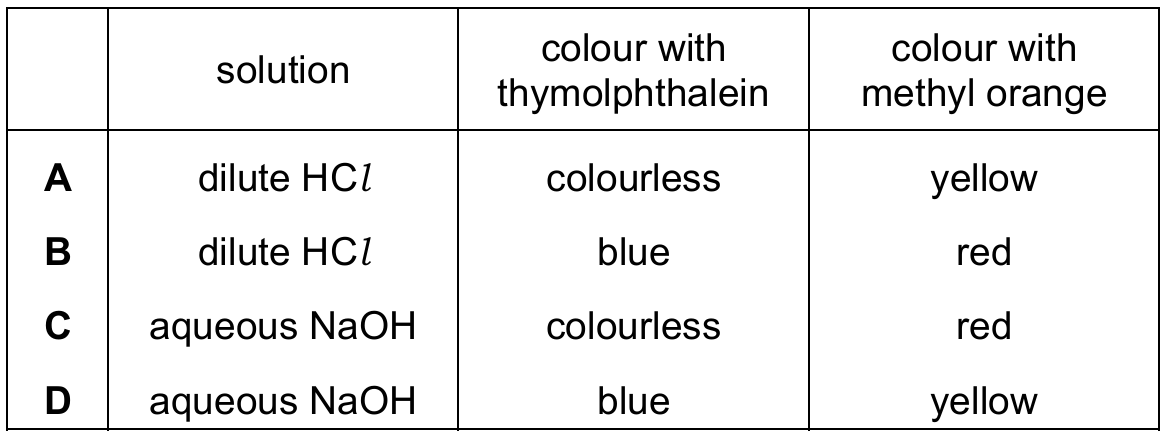
Which row gives the colours observed when thymolphthalein and methyl orange are added separately to the named solution?

Most-appropriate topic codes (Cambridge IGCSE Chemistry 0620):

TOPIC 7.1: The characteristic properties of acids and bases (Describe acids in terms of their effect on thymolphthalein and methyl orange; Describe alkalis in terms of their effect on thymolphthalein and methyl orange)
▶️ Answer/Explanation
Correct Option: D

Detailed solution:

Thymolphthalein is an indicator that is colourless in acids and turns blue in alkaline solutions. Methyl orange turns red in acidic solutions and yellow in alkaline solutions. Aqueous sodium hydroxide (NaOH) is an alkali. Therefore, in NaOH, thymolphthalein will appear blue and methyl orange will appear yellow. This perfectly matches row D.
Question 18

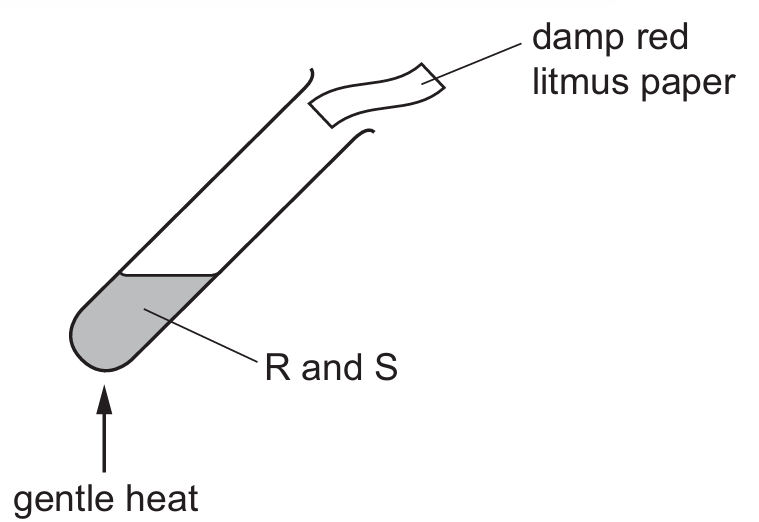
A mixture of two substances, R and S, is heated gently.
The damp red litmus paper turns blue.
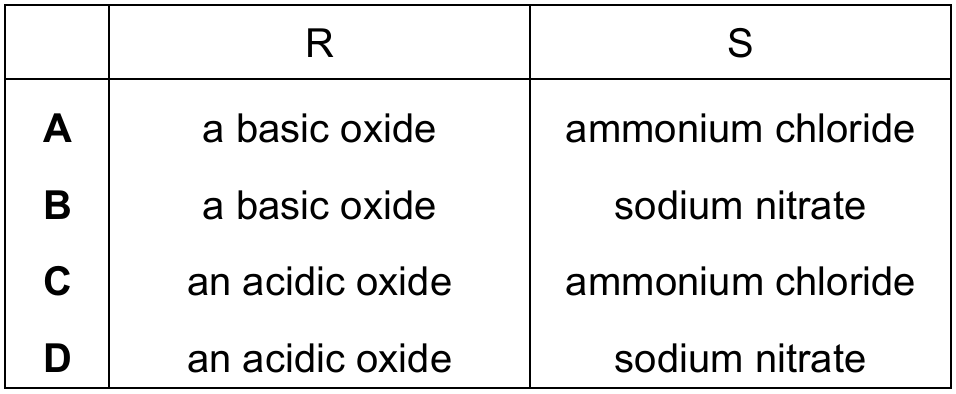
What are R and S?

Most-appropriate topic codes (Cambridge IGCSE Chemistry 0620):

TOPIC 7.1: The characteristic properties of acids and bases (Describe the characteristic properties of bases in terms of their reactions with ammonium salts)
▶️ Answer/Explanation
Correct Option: A

Detailed solution:

Damp red litmus paper turning blue indicates the presence of an alkaline gas, which is ammonia (NH₃). Ammonia is produced when a base reacts with an ammonium salt upon heating. Therefore, one substance must be a base (a basic oxide) and the other must be an ammonium salt (ammonium chloride, NH₄Cl). The basic oxide reacts with ammonium chloride to release ammonia gas, which then turns the red litmus paper blue.
Question 19

Which reactants are used to make the salt copper(II) sulfate?
A. dilute acid + alkali
B. dilute acid + metal carbonate
C. dilute acid + metal
D. dilute acid + non-metal oxide

Most-appropriate topic codes (Cambridge IGCSE Chemistry 0620):

TOPIC 7.3: Preparation of salts (Describe the preparation, separation and purification of soluble salts by reaction of an acid with excess metal, excess insoluble base, excess insoluble carbonate)
▶️ Answer/Explanation
Correct Option: B

Detailed solution:

Copper(II) sulfate is a soluble salt that can be prepared by reacting dilute sulfuric acid with an excess of copper(II) oxide (a base) or copper(II) carbonate (a metal carbonate). Copper metal is not reactive enough to directly displace hydrogen from dilute acids. Copper(II) hydroxide (alkali) could be used but is less common. The reaction between an acid and a metal carbonate is a standard method that produces the salt, water, and carbon dioxide gas.

Question 20

Which statement about the Periodic Table is correct?
A. The elements are arranged in order of increasing relative atomic mass.
B. The reactivity of the elements in Group I and in Group VII increases as the groups are descended.
C. Elements in the same period have similar chemical properties.
D. Elements in Group II form ions with a 2+ charge.

Most-appropriate topic codes (Cambridge IGCSE Chemistry 0620):

TOPIC 8.1: Arrangement of elements (Describe the Periodic Table as an arrangement of elements in periods and groups and in order of increasing proton number/atomic number; Describe the relationship between group number and the charge of the ions formed from elements in that group; Explain similarities in the chemical properties of elements in the same group of the Periodic Table)
▶️ Answer/Explanation
Correct Option: D

Detailed solution:

Elements in Group II have two electrons in their outermost shell. They lose these two electrons to achieve a stable noble gas configuration, forming ions with a 2+ charge (e.g., Mg²⁺, Ca²⁺). Option A is wrong because elements are arranged by increasing atomic number, not atomic mass. Option B is wrong because in Group VII, reactivity decreases down the group. Option C is wrong because elements in the same group (vertical column), not period (horizontal row), have similar chemical properties.

Question 21

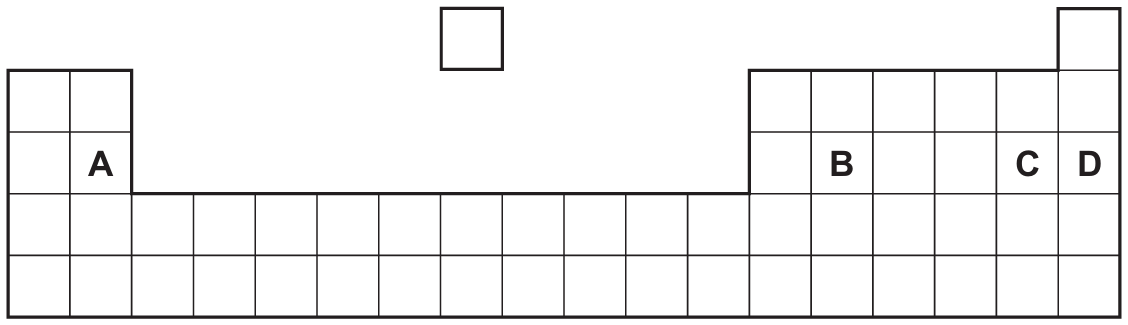
Part of the Periodic Table is shown.
Which element shows the most metallic character?

Most-appropriate topic codes (Cambridge IGCSE Chemistry 0620):

TOPIC 8.1: Arrangement of elements (Describe the change from metallic to non-metallic character across a period; Explain how the position of an element in the Periodic Table can be used to predict its properties)
▶️ Answer/Explanation
Correct Option: A (Sodium/Na on the left)

Detailed solution:

Metallic character decreases as you move from left to right across a period and increases as you move down a group. In the section of the Periodic Table shown, the element located furthest to the left and lowest down will have the most pronounced metallic properties. Based on the diagram, sodium (Na) in Group I, Period 3 is the element that best fits this description among the highlighted elements.
Question 22

E is an element from Group I of the Periodic Table. Two properties of E are listed.
  • It has a higher melting point than caesium.
  • It has a lower density than sodium.
What is the identity of E?
A. lithium
B. potassium
C. rubidium
D. francium

Most-appropriate topic codes (Cambridge IGCSE Chemistry 0620):

TOPIC 8.2: Group I properties (Describe the Group I alkali metals, lithium, sodium and potassium, as relatively soft metals with general trends down the group, limited to decreasing melting point and increasing density; Predict the properties of other elements in Group I, given information about the elements)
▶️ Answer/Explanation
Correct Option: A

Detailed solution:

In Group I, as you go down the group, melting points decrease and densities generally increase. Caesium is near the bottom, so it has a relatively low melting point. For E to have a higher melting point than caesium, it must be above it in the group. Sodium has a certain density; for E to have a lower density than sodium, it must be above sodium. The only Group I element above both sodium and caesium is lithium (Li).

Question 23

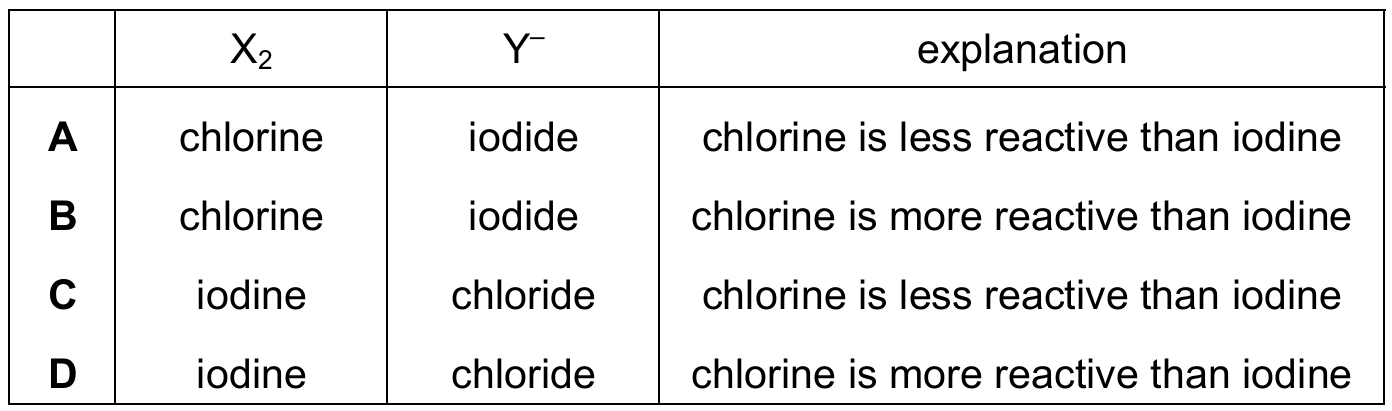
An equation for the displacement reaction between aqueous halogen, $X_{2}$ , and aqueous halides, $Y^{-}$ , is shown.
\[ X_{2}(aq) + 2Y^{-}(aq) \rightarrow 2X^{-}(aq) + Y_{2}(aq) \]
Which row identifies $X_{2}$ and $Y^{-}$ and explains why the reaction takes place?

Most-appropriate topic codes (Cambridge IGCSE Chemistry 0620):

TOPIC 8.3: Group VII properties (Describe and explain the displacement reactions of halogens with other halide ions)
▶️ Answer/Explanation
Correct Option: B

Detailed solution:

In Group VII, a more reactive halogen can displace a less reactive halogen from its halide compound. Chlorine is higher up the group and therefore more reactive than iodine. So chlorine (X₂) will displace iodide ions (Y⁻) from solution, forming chloride ions and iodine. The reaction takes place precisely because chlorine is more reactive than iodine, making row B the correct choice.
Question 24

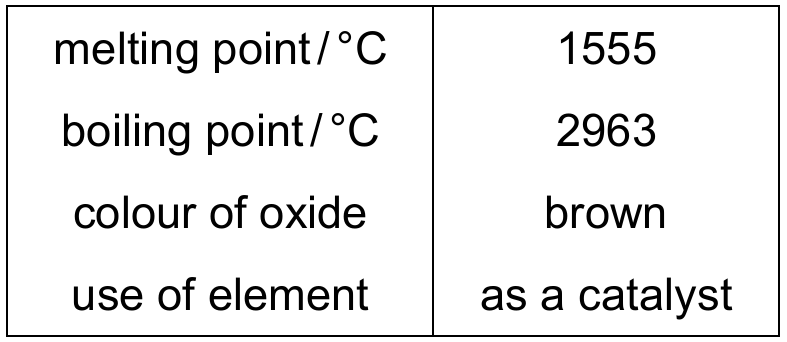
Some information about an element is shown.
What is the position of this element in the Periodic Table?
A. Group I
B. Group VII
C. Group VIII
D. transition elements

Most-appropriate topic codes (Cambridge IGCSE Chemistry 0620):

TOPIC 8.4: Transition elements (Describe the transition elements as metals that have high densities, have high melting points, form coloured compounds, and often act as catalysts as elements and in compounds)
▶️ Answer/Explanation
Correct Option: D

Detailed solution:

The properties listed—a very high melting point (1555°C), a very high boiling point, formation of a coloured oxide (brown), and use as a catalyst—are all characteristic features of transition elements. Group I metals have low melting points and are not used as catalysts in their elemental form. Group VII elements are non-metals. Group VIII elements are noble gases, which are unreactive and do not form oxides. The description fits perfectly with transition metals like iron.
Question 25

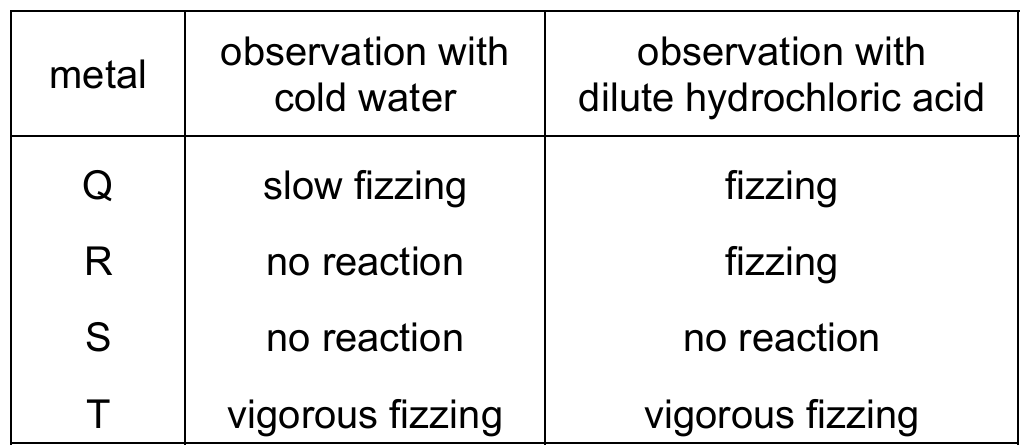
The table shows the observations when four metals, Q, R, S and T, are added separately to cold water and to dilute hydrochloric acid.
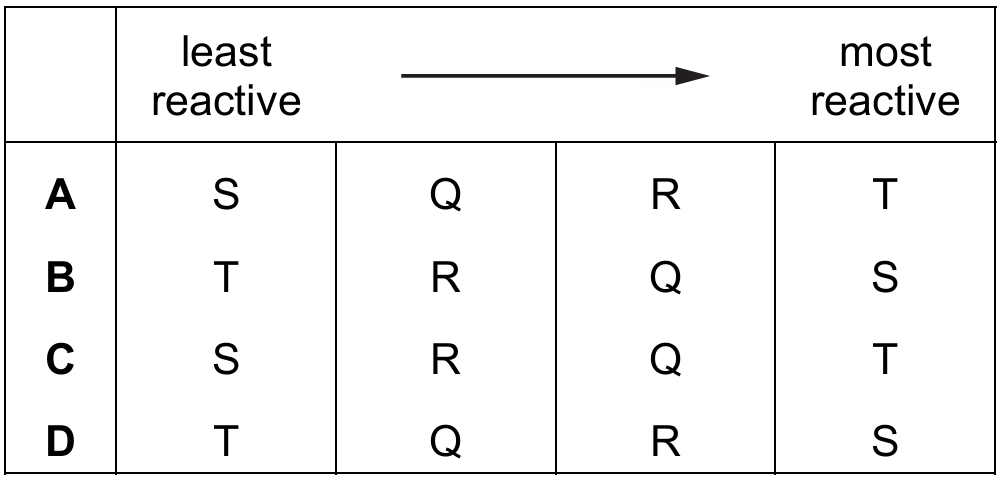
Which row gives the order of reactivity of the metals?

Most-appropriate topic codes (Cambridge IGCSE Chemistry 0620):

TOPIC 9.4: Reactivity series (Deduce an order of reactivity from a given set of experimental results)
▶️ Answer/Explanation
Correct Option: C

Detailed solution:

Metal S shows no reaction with either cold water or acid, so it is the least reactive. Metal T reacts vigorously with both, so it is the most reactive. Metal Q reacts slowly with water and acid, while metal R shows no reaction with water but does fizz with acid. A metal that can react with water is more reactive than one that cannot, so Q is more reactive than R. The correct order from least to most reactive is therefore S, R, Q, T.
Question 26

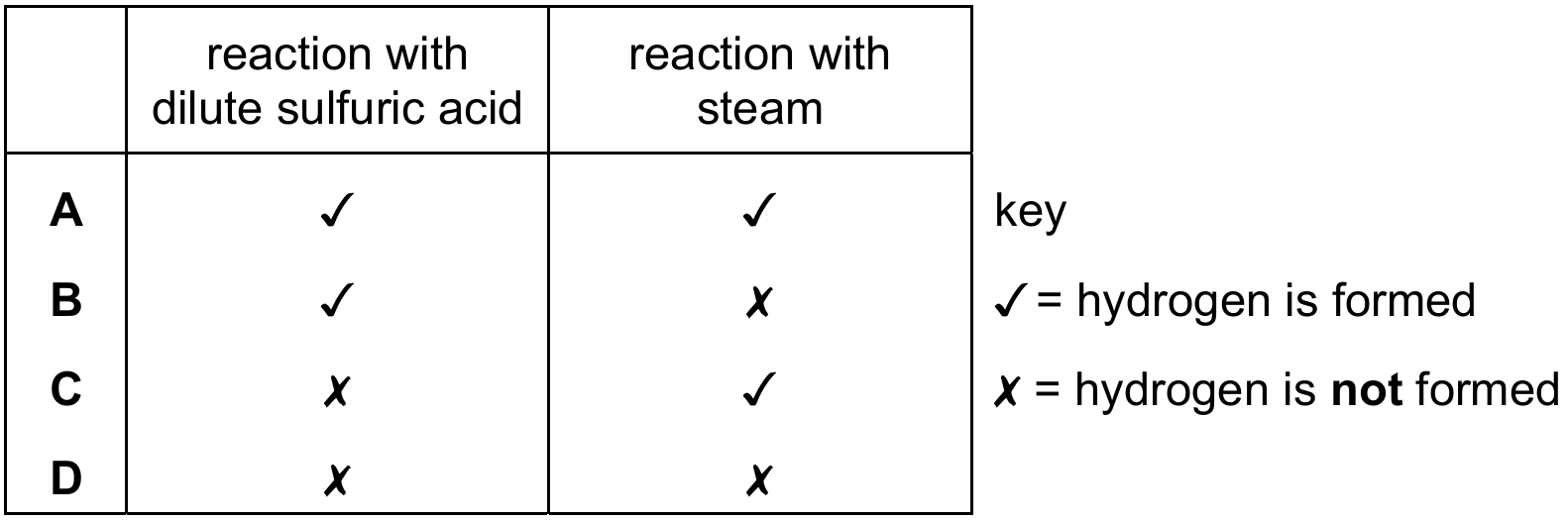
Magnesium is reacted separately with dilute sulfuric acid and with steam.
Which row correctly identifies if hydrogen is formed as a product in each reaction?

Most-appropriate topic codes (Cambridge IGCSE Chemistry 0620):

TOPIC 9.4: Reactivity series (Describe the reactions of magnesium with steam and magnesium with dilute hydrochloric acid and explain these reactions in terms of the position of the metals in the reactivity series)
▶️ Answer/Explanation
Correct Option: A

Detailed solution:

Magnesium is a reactive metal. With dilute sulfuric acid, it reacts to form magnesium sulfate and hydrogen gas. The equation is: Mg + H₂SO₄ → MgSO₄ + H₂. When magnesium reacts with steam, it forms magnesium oxide and also releases hydrogen gas: Mg + H₂O → MgO + H₂. So hydrogen is formed as a product in both reactions.
Question 27

Which statements about aluminium are correct?
  1. It is more reactive than calcium.
  2. The main ore of aluminium is bauxite.
  3. It can be extracted from its oxide using carbon.
  4. Brass is an alloy of aluminium and copper.
A. 1 and 2
B. 1 and 3
C. 2 only
D. 3 and 4

Most-appropriate topic codes (Cambridge IGCSE Chemistry 0620):

TOPIC 9.6: Extraction of metals (State that the main ore of aluminium is bauxite and that aluminium is extracted by electrolysis; Describe the ease in obtaining metals from their ores, related to the position of the metal in the reactivity series)
▶️ Answer/Explanation
Correct Option: C

Detailed solution:

Statement 1 is false: in the reactivity series, calcium is above aluminium, meaning calcium is more reactive. Statement 2 is true: bauxite (Al₂O₃) is indeed the main ore from which aluminium is extracted. Statement 3 is false: aluminium is too reactive to be extracted by reduction with carbon; it must be extracted by electrolysis. Statement 4 is false: brass is an alloy of copper and zinc, not aluminium. Therefore, only statement 2 is correct.

Question 28

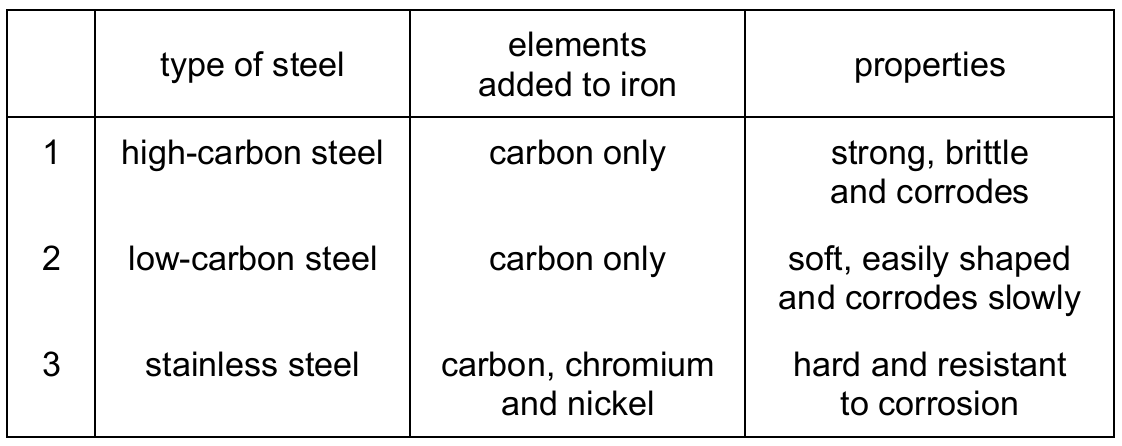
Steel is a mixture of iron and one or more other elements.
The table gives some information about three common types of steel.
Which rows identify a type of steel that is suitable to make cutlery?
A. 1 and 2
B. 1 only
C. 2 and 3
D. 3 only

Most-appropriate topic codes (Cambridge IGCSE Chemistry 0620):

TOPIC 9.3: Alloys and their properties (Describe the uses of alloys in terms of their physical properties, including stainless steel in cutlery because of its hardness and resistance to rusting)
▶️ Answer/Explanation
Correct Option: D

Detailed solution:

Cutlery needs to be hard, strong, and resistant to corrosion (rusting) since it comes into contact with water and food. Stainless steel (type 3) is an alloy containing chromium and nickel, which makes it hard and highly resistant to rust. High-carbon steel (type 1) is brittle and corrodes, while low-carbon steel (type 2) is too soft and still corrodes. Therefore, only stainless steel is suitable for cutlery.
Question 29

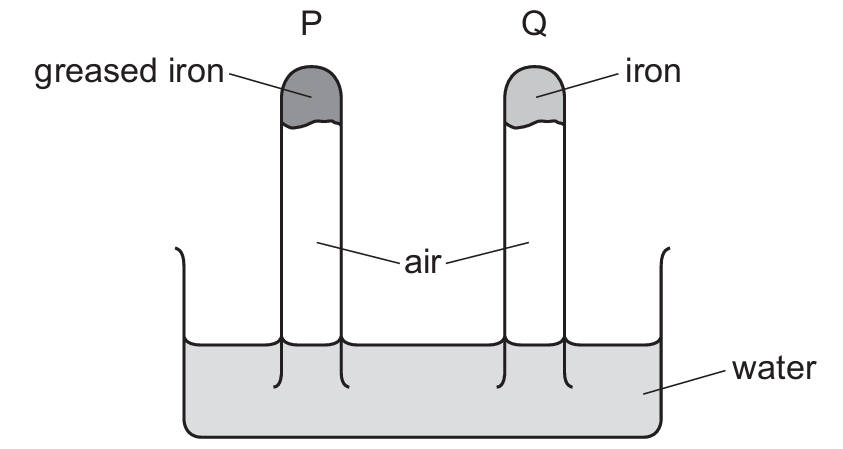
The diagram shows an experiment to investigate the corrosion of iron.
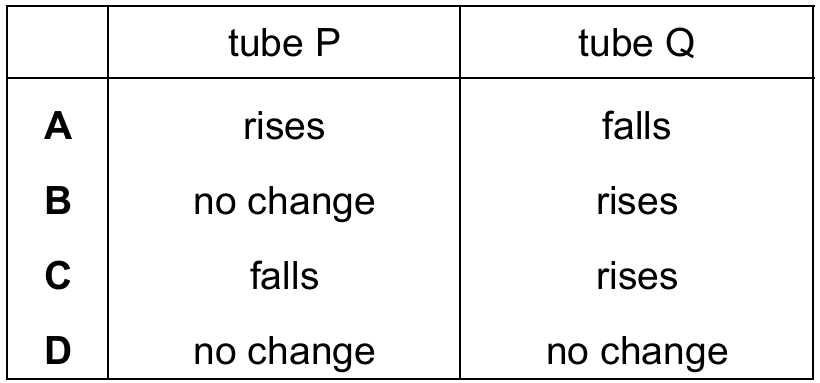
What happens to the water level in tubes P and Q?

Most-appropriate topic codes (Cambridge IGCSE Chemistry 0620):

TOPIC 9.5: Corrosion of metals (State the conditions required for the rusting of iron and steel to form hydrated iron(III) oxide)
▶️ Answer/Explanation
Correct Option: B

Detailed solution:

Rusting of iron requires both water and oxygen. In tube P, a drying agent (anhydrous calcium chloride) absorbs all moisture, so there is no water present. Without water, rusting cannot occur, and no oxygen is consumed, so the water level remains unchanged. In tube Q, water is present along with air, so rusting takes place. Rusting consumes oxygen from the air, reducing the pressure inside the tube, and as a result, water from the beaker rises up the tube.
Question 30

Fertilisers are used to provide the three elements needed for improved plant growth. Which two compounds would provide all three of these elements?
A. ammonium nitrate and calcium phosphate
B. ammonium nitrate and potassium sulfate
C. potassium nitrate and calcium phosphate
D. potassium phosphate and potassium sulfate

Most-appropriate topic codes (Cambridge IGCSE Chemistry 0620):

TOPIC 10.2: Fertilisers (Describe the use of NPK fertilisers to provide the elements nitrogen, phosphorus and potassium for improved plant growth)
▶️ Answer/Explanation
Correct Option: C

Detailed solution:

Plants need three primary elements: nitrogen (N), phosphorus (P), and potassium (K). We need two compounds that between them contain all three. Potassium nitrate (KNO₃) provides nitrogen and potassium. Calcium phosphate (Ca₃(PO₄)₂) provides phosphorus. Together, they supply all three essential elements: N, P, and K. The other combinations either miss one element or do not provide all three between the two compounds.

Question 31

Which substances can be used to detect the presence of water?
  1. anhydrous cobalt(II) chloride
  2. anhydrous copper(II) sulfate
  3. litmus
  4. methyl orange
A. 1 and 2
B. 1 and 3
C. 2 and 4
D. 3 and 4

Most-appropriate topic codes (Cambridge IGCSE Chemistry 0620):

TOPIC 10.1: Water (Describe chemical tests for the presence of water using anhydrous cobalt(II) chloride and anhydrous copper(II) sulfate)
▶️ Answer/Explanation
Correct Option: A

Detailed solution:

Anhydrous cobalt(II) chloride is blue and turns pink when it comes into contact with water. Anhydrous copper(II) sulfate is white and turns blue when hydrated by water. Both are classic chemical tests used to detect the presence of water. Litmus and methyl orange are acid-base indicators; they change colour based on pH, not specifically due to water. So substances 1 and 2 are correct.

Question 32

What is produced by the incomplete combustion of methane?
A. carbon monoxide
B. hydrogen
C. lead compounds
D. sulfur dioxide

Most-appropriate topic codes (Cambridge IGCSE Chemistry 0620):

TOPIC 10.3: Air quality and climate (State the source of carbon monoxide and particulates from the incomplete combustion of carbon-containing fuels)
▶️ Answer/Explanation
Correct Option: A

Detailed solution:

When methane (CH₄) burns in a plentiful supply of oxygen, it undergoes complete combustion to produce carbon dioxide and water. However, when the oxygen supply is limited, incomplete combustion occurs, producing carbon monoxide (CO) and/or carbon (soot). Carbon monoxide is a toxic, colourless, odorless gas. Hydrogen is not produced, and sulfur dioxide would require sulfur in the fuel, which methane does not contain.

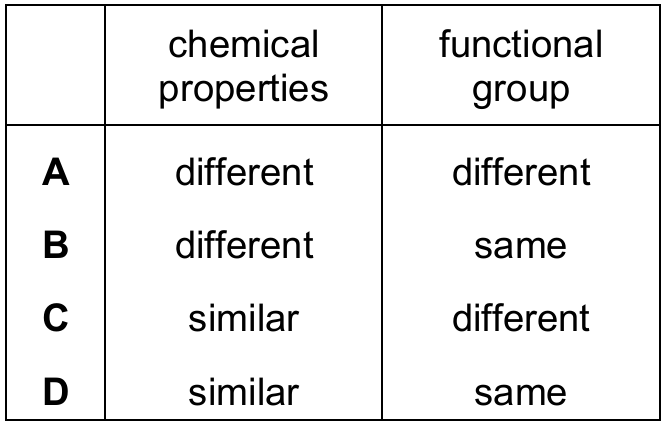
Question 33

Which row identifies compounds in the same homologous series?

Most-appropriate topic codes (Cambridge IGCSE Chemistry 0620):

TOPIC 11.1: Formulae, functional groups and terminology (State that a homologous series is a family of similar compounds with similar chemical properties due to the presence of the same functional group)
▶️ Answer/Explanation
Correct Option: D

Detailed solution:

A homologous series is a group of organic compounds that share the same functional group and, because of this, exhibit very similar chemical properties. For example, all alkanes are unreactive except in combustion and substitution, all alkenes undergo addition reactions, etc. Therefore, compounds belonging to the same homologous series will always have similar chemical properties and the same functional group.
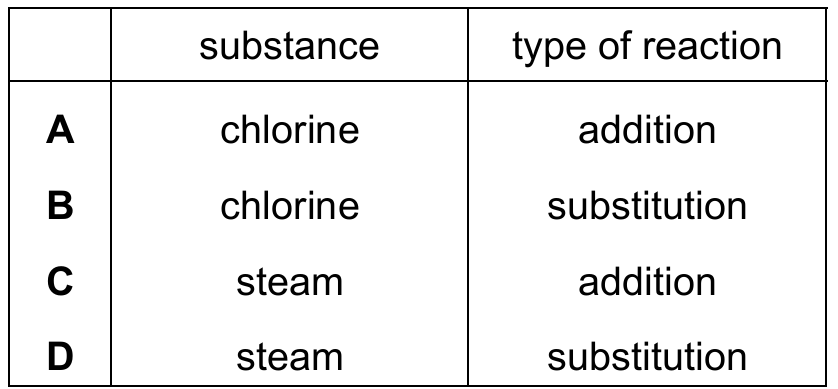
Question 34

The molecular formula of compound Z is $\mathrm{C_4H_{10}}$ . Which row identifies the substance that reacts with Z and describes the type of reaction that occurs?

Most-appropriate topic codes (Cambridge IGCSE Chemistry 0620):

TOPIC 11.4: Alkanes (Describe the properties of alkanes as being generally unreactive, except in terms of combustion and substitution by chlorine)
▶️ Answer/Explanation
Correct Option: B

Detailed solution:

Compound Z has the molecular formula C₄H₁₀, which fits the general formula for alkanes (CₙH₂ₙ₊₂). This means Z is butane, an alkane. Alkanes are saturated hydrocarbons that generally only undergo combustion and substitution reactions. They do not react with steam. With chlorine, in the presence of ultraviolet (UV) light, alkanes undergo a substitution reaction where a hydrogen atom is replaced by a chlorine atom.
Question 35

Which list shows the fractions obtained from the fractional distillation of petroleum, in order of increasing boiling point?
A. bitumen → diesel oil → fuel oil → lubricating oil
B. diesel oil → gasoline → naphtha → kerosene
C. gasoline → naphtha → kerosene → diesel oil
D. kerosene → lubricating oil → naphtha → refinery gas

Most-appropriate topic codes (Cambridge IGCSE Chemistry 0620):

TOPIC 11.3: Fuels (Describe how the properties of fractions obtained from petroleum change from the bottom to the top of the fractionating column, limited to decreasing chain length, higher volatility, lower boiling points, lower viscosity)
▶️ Answer/Explanation
Correct Option: C

Detailed solution:

In the fractionating column, the smallest molecules with the lowest boiling points are collected at the top. The order of fractions from lowest boiling point to highest is: refinery gas (lowest), then gasoline, naphtha, kerosene, diesel oil, fuel oil, lubricating oil, and bitumen (highest). Option C correctly lists gasoline → naphtha → kerosene → diesel oil, which is in order of increasing boiling point.

Question 36

Three statements about cracking of larger alkane molecules are listed.
  1. Cracking produces petrol for cars.
  2. Cracking only produces short-chain alkenes.
  3. Cracking produces alkenes used to make polymers.
Which statements are correct?
A. 1, 2 and 3
B. 1 and 2 only
C. 1 and 3 only
D. 2 and 3 only

Most-appropriate topic codes (Cambridge IGCSE Chemistry 0620):

TOPIC 11.5: Alkenes (Describe the manufacture of alkenes and hydrogen by the cracking of larger alkane molecules using a high temperature and a catalyst; Describe the reasons for the cracking of larger alkane molecules)
▶️ Answer/Explanation
Correct Option: C

Detailed solution:

Cracking is the process of breaking down large alkane molecules into smaller, more useful hydrocarbons. Statement 1 is correct because cracking produces shorter-chain alkanes that are used in petrol. Statement 2 is incorrect because cracking produces both short-chain alkanes and alkenes, not just alkenes. Statement 3 is correct because the alkenes produced (like ethene and propene) are used as monomers to manufacture polymers such as poly(ethene).

Question 37

Some words used to describe organic compounds are listed.
  1. hydrocarbon
  2. monomer
  3. saturated
  4. unreactive
Which words describe ethene?
A. 1 and 2
B. 1 and 3
C. 2 and 4
D. 3 and 4

Most-appropriate topic codes (Cambridge IGCSE Chemistry 0620):

TOPIC 11.5: Alkenes (State that the bonding in alkenes includes a double carbon-carbon covalent bond and that alkenes are unsaturated hydrocarbons)
▶️ Answer/Explanation
Correct Option: A

Detailed solution:

Ethene (C₂H₄) is a hydrocarbon because it is composed only of carbon and hydrogen atoms. It is a monomer because it can be polymerised to form poly(ethene). However, ethene contains a carbon-carbon double bond (C=C), which makes it an unsaturated compound, not saturated. The double bond also makes ethene fairly reactive, as it readily undergoes addition reactions. So ethene is described as a hydrocarbon and a monomer.

Question 38

A student measures $25.00\,\mathrm{cm}^3$ of dilute hydrochloric acid accurately. Which piece of apparatus is most suitable?
A. beaker
B. measuring cylinder
C. burette
D. dropping pipette

Most-appropriate topic codes (Cambridge IGCSE Chemistry 0620):

TOPIC 12.1: Experimental design (Name appropriate apparatus for the measurement of time, temperature, mass and volume, including burettes, volumetric pipettes, measuring cylinders)
▶️ Answer/Explanation
Correct Option: C

Detailed solution:

To measure a volume as precise as $25.00\,\mathrm{cm}^3$ (i.e., to two decimal places), a high-precision apparatus is needed. A burette is graduated in $0.1\,\mathrm{cm}^3$ intervals, allowing the user to read volumes to the nearest $0.05\,\mathrm{cm}^3$, making it suitable for such accurate measurements. A beaker gives only approximate volumes, a measuring cylinder is less precise (typically to the nearest $0.5\,\mathrm{cm}^3$), and a dropping pipette is not calibrated for specific volumes.

Question 39

Excess solid magnesium oxide is added to dilute nitric acid.
Which separation technique is used to remove the excess solid magnesium oxide after the reaction finishes?
A. chromatography
B. crystallisation
C. distillation
D. filtration

Most-appropriate topic codes (Cambridge IGCSE Chemistry 0620):

TOPIC 12.4: Separation and purification (Describe and explain methods of separation and purification using filtration)
▶️ Answer/Explanation
Correct Option: D

Detailed solution:

When excess solid magnesium oxide is added to dilute nitric acid, the acid reacts to form soluble magnesium nitrate and water, but the unreacted magnesium oxide remains as an insoluble solid. To remove this excess solid from the liquid, we use filtration. The mixture is poured through filter paper in a funnel; the solid remains on the filter paper (as residue) and the clear solution (filtrate) passes through.

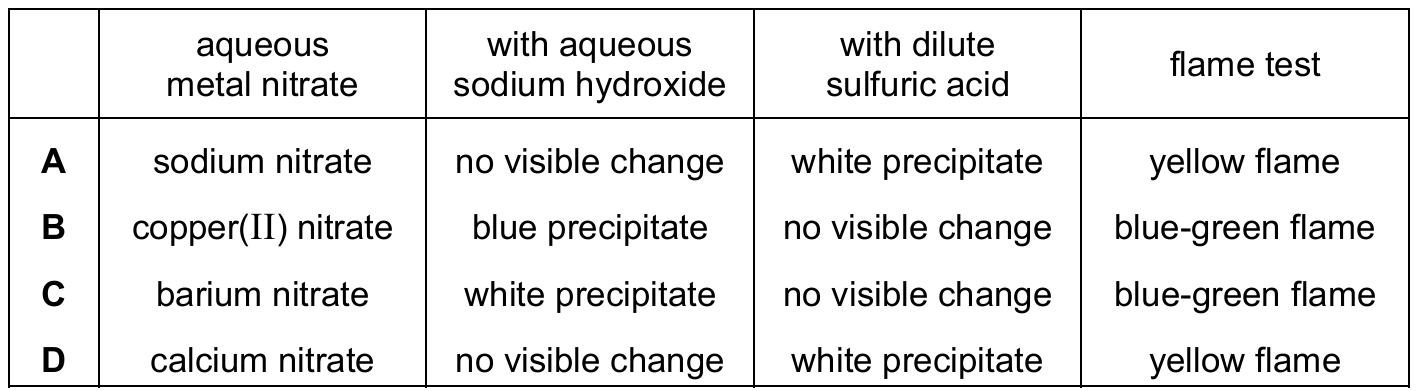
Question 40

Four different aqueous metal nitrates are tested separately with aqueous sodium hydroxide, with dilute sulfuric acid and with a flame test.
Which row shows the correct set of results for the named aqueous metal nitrate?

Most-appropriate topic codes (Cambridge IGCSE Chemistry 0620):

TOPIC 12.5: Identification of ions and gases (Describe tests using aqueous sodium hydroxide to identify aqueous cations; Describe tests to identify sulfate ions; Describe the use of a flame test to identify cations)
▶️ Answer/Explanation
Correct Option: B

Detailed solution:

Copper(II) ions (Cu²⁺) react with aqueous sodium hydroxide to form a light blue precipitate of copper(II) hydroxide, which is insoluble in excess. Copper(II) sulfate is soluble, so with dilute sulfuric acid there is no visible change (no precipitate). In a flame test, copper(II) ions produce a characteristic blue-green flame. Sodium nitrate would not form a precipitate with sulfuric acid; barium nitrate gives a white precipitate with sulfuric acid and a light green flame; calcium nitrate gives a white precipitate with sodium hydroxide and an orange-red flame.

Scroll to Top