Home / 0620_s25_qp_13

Question 1

Liquid iron is cooled to form solid iron. Which statement about the particles in iron is correct?
A. The particles move further apart.
B. The particles move faster.
C. The position of the particles becomes fixed.
D. The attractions between the particles become weaker.

Most-appropriate topic codes (Cambridge IGCSE Chemistry 0620):

TOPIC 1.1: Solids, liquids and gases (Describe the structures of solids, liquids and gases in terms of particle separation, arrangement and motion)
▶️ Answer/Explanation
Correct Option: C

Detailed solution:

When a liquid freezes into a solid, the particles lose kinetic energy and the attractive forces between them pull them into a regular, fixed arrangement. They can no longer move past each other freely—they can only vibrate in fixed positions. So, their positions become fixed. The particles actually move closer together (not further apart), move slower (not faster), and the attractions become stronger (not weaker).

Question 2

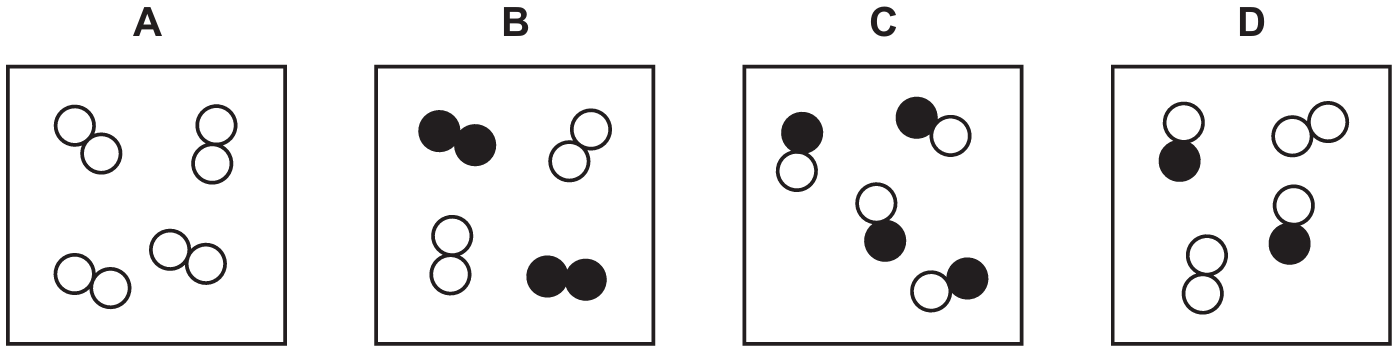
Which diagram shows a mixture of an element and a compound?

Most-appropriate topic codes (Cambridge IGCSE Chemistry 0620):

TOPIC 2.1: Elements, compounds and mixtures (Describe the differences between elements, compounds and mixtures)
▶️ Answer/Explanation
Correct Option: D

Detailed solution:

A mixture of an element and a compound must show particles of a single element (like diatomic molecules or single atoms of one type) mixed with particles of a compound (two or more different atoms chemically bonded). In option D, you see one type of atom (element) alongside molecules made of two different atoms bonded together (compound), and they are not chemically combined with each other, which fits the description of a mixture perfectly.
Question 3

Which statement about elements and their atoms is correct?
A. Aluminium is in the second period of the Periodic Table and has two occupied electron shells.
B. Helium is in Group VIII of the Periodic Table and has eight outer shell electrons.
C. Lithium is in Group I of the Periodic Table and has one occupied electron shell.
D. Sulfur is in the third period of the Periodic Table and has six outer shell electrons.

Most-appropriate topic codes (Cambridge IGCSE Chemistry 0620):

TOPIC 2.2: Atomic structure and the Periodic Table (State that the number of outer shell electrons is equal to the group number in Groups I to VII; the number of occupied electron shells is equal to the period number)
▶️ Answer/Explanation
Correct Option: D

Detailed solution:

Sulfur has the atomic number 16, so its electronic configuration is 2,8,6. This means it has three occupied electron shells, placing it in the third period, and it has six electrons in its outer shell, which matches its group (Group VI). Aluminium is in period 3, not period 2. Helium is in Group VIII but has only 2 outer electrons (its first shell is full). Lithium has two occupied shells (2,1), not one.

Question 4

An atom of the element erium is represented by ${}^{167}_{68}\text{Er}$.
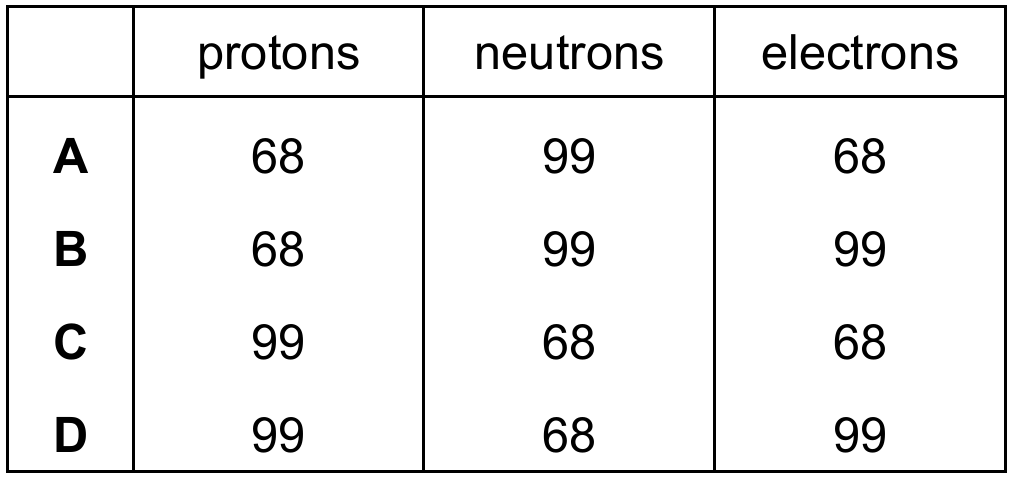
Which row shows the number of protons, neutrons and electrons in this atom?

Most-appropriate topic codes (Cambridge IGCSE Chemistry 0620):

TOPIC 2.2: Atomic structure and the Periodic Table (Define proton number/atomic number and mass number/nucleon number)
▶️ Answer/Explanation
Correct Option: A

Detailed solution:

In the notation ${}^{167}_{68}\text{Er}$, the bottom number (68) is the atomic number, which tells us the number of protons. A neutral atom has the same number of electrons as protons, so electrons are also 68. The top number (167) is the mass number, which is protons + neutrons. So, neutrons = mass number − atomic number = 167 − 68 = 99. This matches row A perfectly.
Question 5

Rubidium is in Group I of the Periodic Table and bromine is in Group VII of the Periodic Table.
Rubidium reacts with bromine to form an ionic compound.
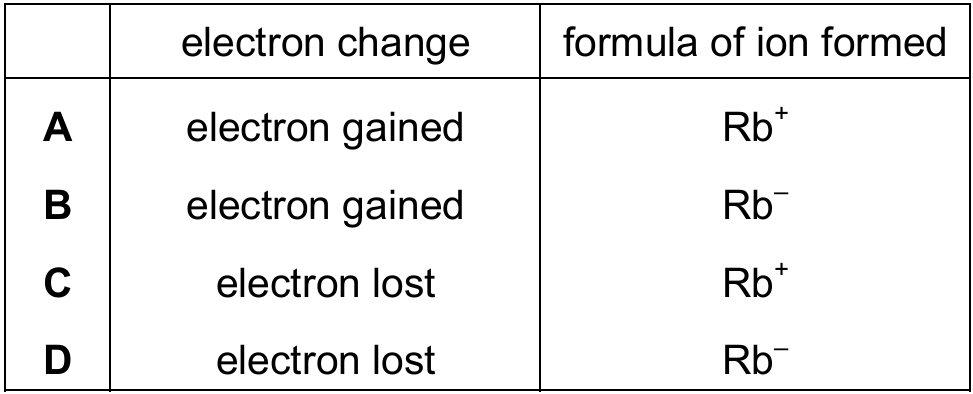
Which row shows the electron change taking place for rubidium and the correct formula of the rubidium ion formed?

Most-appropriate topic codes (Cambridge IGCSE Chemistry 0620):

TOPIC 2.4: Ions and ionic bonds (Describe the formation of ionic bonds between elements from Group I and Group VII)
▶️ Answer/Explanation
Correct Option: C

Detailed solution:

Rubidium (Rb) is in Group I, so it has one electron in its outer shell. To achieve a stable noble gas configuration, it loses that one electron easily. Losing an electron forms a positive ion with a 1+ charge, written as $\text{Rb}^+$. So, the electron change is “electron lost” and the formula is $\text{Rb}^+$, as shown in row C.
Question 6

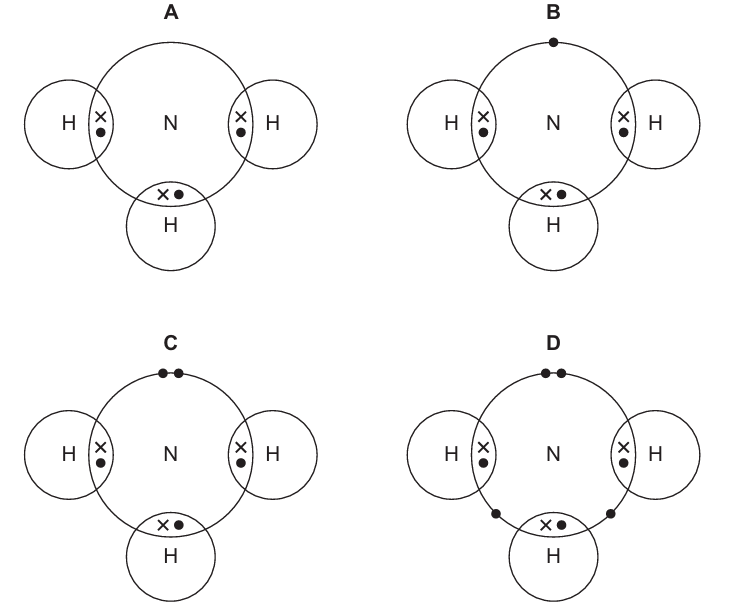
Which dot-and-cross diagram represents the electronic configuration for the outer shell electrons in ammonia, $\text{NH}_3$?

Most-appropriate topic codes (Cambridge IGCSE Chemistry 0620):

TOPIC 2.5: Simple molecules and covalent bonds (Describe the formation of covalent bonds in simple molecules, including $\text{NH}_3$)
▶️ Answer/Explanation
Correct Option: C

Detailed solution:

Nitrogen has five outer electrons, and each hydrogen has one. In ammonia ($\text{NH}_3$), nitrogen shares three of its electrons with three hydrogen atoms to form three single covalent bonds. This leaves one lone pair (two electrons) on the nitrogen. So we look for a diagram where the central nitrogen atom has three bonding pairs (each a shared pair with H) and one lone pair. That configuration is shown in option C.
Question 7

Which statements about graphite are correct?
  1. Each carbon atom is covalently bonded to four other carbon atoms.
  2. Graphite is an electrical conductor because it contains ions that are free to move.
  3. Graphite is used as a lubricant because it has layers that slide over each other.
A. 1 and 2
B. 1 only
C. 2 and 3
D. 3 only

Most-appropriate topic codes (Cambridge IGCSE Chemistry 0620):

TOPIC 2.6: Giant covalent structures (Describe the giant covalent structures of graphite and diamond; Relate the structures and bonding of graphite and diamond to their uses)
▶️ Answer/Explanation
Correct Option: D

Detailed solution:

In graphite, each carbon atom is bonded to only three others (not four), forming hexagonal layers. Statement 1 is wrong. Graphite conducts electricity because it has delocalised electrons between the layers, not because it contains free ions. So statement 2 is also wrong. However, the layers are held together by weak forces and can easily slide over each other, making graphite a great lubricant. Only statement 3 is correct.

Question 8

Which equation represents the reaction of magnesium with dilute hydrochloric acid?
A. $\text{Mg(s)} + 2\text{HCl(aq)} \rightarrow \text{MgCl}_2\text{(aq)} + \text{H}_2\text{(g)}$
B. $\text{Mg(s)} + 2\text{HCl(l)} \rightarrow \text{MgCl}_2\text{(s)} + \text{H}_2\text{(g)}$
C. $2\text{Mg(s)} + 2\text{HCl(aq)} \rightarrow 2\text{MgCl(aq)} + \text{H}_2\text{(g)}$
D. $2\text{Mg(s)} + 2\text{HCl(l)} \rightarrow 2\text{MgCl(s)} + \text{H}_2\text{(g)}$

Most-appropriate topic codes (Cambridge IGCSE Chemistry 0620):

TOPIC 3.1: Formulae (Construct word equations and symbol equations to show how reactants form products, including state symbols)
▶️ Answer/Explanation
Correct Option: A

Detailed solution:

Magnesium reacts with hydrochloric acid to form magnesium chloride (which is soluble, so it’s aqueous) and hydrogen gas. The correct formula for magnesium chloride is $\text{MgCl}_2$ because Mg has a 2+ charge and Cl has a 1– charge. Hydrochloric acid is an aqueous solution, so its state symbol is (aq), not (l). Option A shows the correct balanced equation with the right state symbols: $\text{Mg(s)} + 2\text{HCl(aq)} \rightarrow \text{MgCl}_2\text{(aq)} + \text{H}_2\text{(g)}$.

Question 9

The relative formula mass, $M_r$ of calcium carbonate, $\text{CaCO}_3$, is 100.
What is the mass of carbon present in $100\text{g}$ of calcium carbonate?
A. $12\text{g}$
B. $36\text{g}$
C. $40\text{g}$
D. $60\text{g}$

Most-appropriate topic codes (Cambridge IGCSE Chemistry 0620):

TOPIC 3.2: Relative masses of atoms and molecules (Calculate reacting masses in simple proportions)
▶️ Answer/Explanation
Correct Option: A

Detailed solution:

The formula $\text{CaCO}_3$ contains one carbon atom. The relative atomic mass of carbon is 12. Since the $M_r$ of $\text{CaCO}_3$ is 100, carbon makes up $\frac{12}{100}$ of the total mass. So, in $100\text{g}$ of calcium carbonate, the mass of carbon is $\frac{12}{100} \times 100 = 12\text{g}$. Simple proportion gives us 12g.

Question 10

What is the definition of relative atomic mass?
A. It is the average mass of the isotopes of an element compared to $\frac{1}{12}$th of the mass of an atom of ${}^{12}\text{C}$
B. It is the total mass of the isotopes of an element compared to $\frac{1}{12}$th of the mass of an atom of ${}^{12}\text{C}$
C. It is the average mass of an element compared to $\frac{1}{12}$th of the mass of an atom of ${}^{12}\text{C}$
D. It is the total mass of an element compared to $\frac{1}{12}$th of the mass of an atom of ${}^{12}\text{C}$

Most-appropriate topic codes (Cambridge IGCSE Chemistry 0620):

TOPIC 3.2: Relative masses of atoms and molecules (Describe relative atomic mass)
▶️ Answer/Explanation
Correct Option: A

Detailed solution:

Relative atomic mass is the *average* mass of the isotopes of an element, taking into account their relative abundances, compared to $\frac{1}{12}$th the mass of a carbon-12 atom. It must mention “isotopes” and “average”, which option A does. The other options incorrectly say “total mass” or “average mass of an element” without specifying isotopes.

Question 11

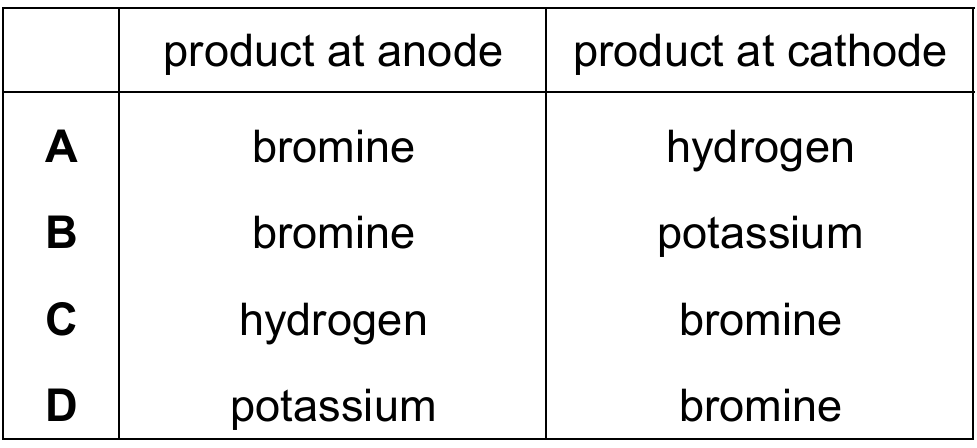
Which row describes the electrolysis of molten potassium bromide?

Most-appropriate topic codes (Cambridge IGCSE Chemistry 0620):

TOPIC 4.1: Electrolysis (Identify the products formed at the electrodes during the electrolysis of molten lead(II) bromide; State that metals or hydrogen are formed at the cathode and that non-metals are formed at the anode; Predict the identity of the products at each electrode for the electrolysis of a binary compound in the molten state)
▶️ Answer/Explanation
Correct Option: B

Detailed solution:

Molten potassium bromide ($\text{KBr}$) contains potassium ions ($\text{K}^+$) and bromide ions ($\text{Br}^-$). During electrolysis, the positive potassium ions move to the negative cathode and gain electrons to form potassium metal. The negative bromide ions move to the positive anode and lose electrons to form bromine gas. So, bromine at the anode and potassium at the cathode is correct.

Question 12

What is produced in a hydrogen-oxygen fuel cell?
A. hydrogen and oxygen
B. hydrogen only
C. carbon dioxide
D. water

Most-appropriate topic codes (Cambridge IGCSE Chemistry 0620):

TOPIC 4.2: Hydrogen-oxygen fuel cells (State that a hydrogen-oxygen fuel cell uses hydrogen and oxygen to produce electricity with water as the only chemical product)
▶️ Answer/Explanation
Correct Option: D

Detailed solution:

A hydrogen-oxygen fuel cell works by reacting hydrogen and oxygen together electrochemically to produce electricity. The great thing about it is that the only chemical product is water ($\text{H}_2\text{O}$). There are no carbon emissions like carbon dioxide, and the original hydrogen and oxygen are reactants, not products.

Question 13

When ammonium nitrate is added to water, the temperature of the mixture decreases. The ammonium nitrate can be recovered by evaporating the water. Which statement explains these observations?
A. The ammonium nitrate dissolves in the water, and the process is endothermic.
B. The ammonium nitrate reacts with the water, and the process is endothermic.
C. The ammonium nitrate dissolves in the water, and the process is exothermic.
D. The ammonium nitrate reacts with the water, and the process is exothermic.

Most-appropriate topic codes (Cambridge IGCSE Chemistry 0620):

TOPIC 5.1: Exothermic and endothermic reactions (State that an endothermic reaction takes in thermal energy from the surroundings leading to a decrease in the temperature of the surroundings)
▶️ Answer/Explanation
Correct Option: A

Detailed solution:

A temperature decrease means heat is absorbed from the surroundings, so the process is endothermic. Since the ammonium nitrate is simply recovered by evaporating water, it has dissolved, not undergone a chemical reaction. If it had reacted, you wouldn’t get the original substance back by just removing water. So, it’s a dissolving process that is endothermic.

Question 14

Magnesium is reacted with dilute hydrochloric acid. The table shows the total volume of hydrogen produced every 15 seconds.
During which time period is the rate of reaction the fastest?
A. 0–30 seconds
B. 30–60 seconds
C. 60–90 seconds
D. 90–120 seconds

Most-appropriate topic codes (Cambridge IGCSE Chemistry 0620):

TOPIC 6.2: Rate of reaction (Interpret data, including graphs, from rate of reaction experiments)
▶️ Answer/Explanation
Correct Option: A

Detailed solution:

The fastest rate means the largest volume of hydrogen is produced per second. Let’s check the volume changes: 0–30s: 32 cm³ produced (average ~1.07 cm³/s). 30–60s: 59 − 32 = 27 cm³. 60–90s: 68 − 59 = 9 cm³. 90–120s: 74 − 68 = 6 cm³. The largest change is in the first 30 seconds (32 cm³), so the rate is fastest in the 0–30 second period.
Question 15

Which substance forms a blue solution when it is added to water?
A. cobalt(II) chloride
B. copper(II) sulfate
C. thymolphthalein
D. universal indicator

Most-appropriate topic codes (Cambridge IGCSE Chemistry 0620):

TOPIC 8.4: Transition elements (Describe the transition elements as metals that form coloured compounds)
▶️ Answer/Explanation
Correct Option: B

Detailed solution:

Copper(II) sulfate ($\text{CuSO}_4$) contains the transition metal copper, and its compounds are characteristically blue in solution. Cobalt(II) chloride can be blue when anhydrous but forms a pink solution in water. Thymolphthalein and universal indicator are acid-base indicators and don’t give a simple blue solution with just water.

Question 16

Steam reacts with carbon to produce carbon monoxide and hydrogen.
\[\text{C(s) + H}_2\text{O(g) → CO(g) + H}_2\text{(g)}\]
Which substance is reduced in the reaction?
A. C
B. CO
C. H₂
D. H₂O

Most-appropriate topic codes (Cambridge IGCSE Chemistry 0620):

TOPIC 6.4: Redox (Define reduction as loss of oxygen; Identify oxidation and reduction in redox reactions)
▶️ Answer/Explanation
Correct Option: D

Detailed solution:

Reduction can be defined as the loss of oxygen. Here, water ($\text{H}_2\text{O}$) loses its oxygen to carbon, turning into hydrogen ($\text{H}_2$). So, water is reduced. Carbon gains oxygen (becomes CO), so it is oxidised. We look for the substance that loses oxygen, which is $\text{H}_2\text{O}$.

Question 17

Three compounds are listed.
  1. aluminium nitrate
  2. ammonium chloride
  3. ammonium nitrate
All three compounds are heated with aqueous sodium hydroxide.
Which compounds produce ammonia?
A. 1 and 3
B. 1 only
C. 2 and 3
D. 2 only

Most-appropriate topic codes (Cambridge IGCSE Chemistry 0620):

TOPIC 7.1: The characteristic properties of acids and bases (Describe the characteristic properties of bases in terms of their reactions with ammonium salts)
▶️ Answer/Explanation
Correct Option: C

Detailed solution:

When a base like sodium hydroxide is heated with an ammonium salt, ammonia gas is produced. Both ammonium chloride and ammonium nitrate contain the ammonium ion ($\text{NH}_4^+$), so they release ammonia. Aluminium nitrate does not contain ammonium ions, so it won’t produce ammonia in this reaction. That means compounds 2 and 3 produce ammonia.

Question 18

A solution containing hydroxide ions, $\text{OH}^-\text{(aq)}$, is added to a solution containing hydrogen ions, $\text{H}^+\text{(aq)}$. An equation representing the reaction is shown.
\[\text{H}^+\text{(aq) + OH}^-\text{(aq) → H}_2\text{O(l)}\]
Which statement about the reaction is correct?
A. The hydrogen ions represent an alkali.
B. The reaction is a neutralisation reaction.
C. The reaction is a reduction.
D. As the $\text{OH}^-$ ions are added, the pH of the reaction mixture falls.

Most-appropriate topic codes (Cambridge IGCSE Chemistry 0620):

TOPIC 7.1: The characteristic properties of acids and bases (Describe the neutralisation reaction between an acid and an alkali to produce water)
▶️ Answer/Explanation
Correct Option: B

Detailed solution:

This equation shows hydrogen ions (from an acid) reacting with hydroxide ions (from an alkali) to form water. That’s the classic definition of a neutralisation reaction. Hydrogen ions represent an acid, not an alkali. Adding OH⁻ ions neutralises the acid, causing the pH to rise, not fall. It’s not a reduction because no electrons are transferred in this specific neutralisation.

Question 19

Which compound is an acidic oxide?
A. barium oxide
B. carbon dioxide
C. copper(II) oxide
D. magnesium oxide

Most-appropriate topic codes (Cambridge IGCSE Chemistry 0620):

TOPIC 7.2: Oxides (Classify oxides as acidic, including $\text{SO}_2$ and $\text{CO}_2$, or basic, including CuO and CaO, related to metallic and non-metallic character)
▶️ Answer/Explanation
Correct Option: B

Detailed solution:

Acidic oxides are usually oxides of non-metals. Carbon dioxide ($\text{CO}_2$) is a non-metal oxide and dissolves in water to form carbonic acid, so it’s acidic. Barium oxide, copper(II) oxide, and magnesium oxide are all metal oxides, and metal oxides are typically basic, reacting with acids rather than bases.

Question 20

Which statement describes a hydrated salt?
A. It is an aqueous solution of a salt.
B. It is a solid salt that is chemically combined with water.
C. It is a solid salt that contains no water.
D. It is a salt that has been broken down by water.

Most-appropriate topic codes (Cambridge IGCSE Chemistry 0620):

TOPIC 7.3: Preparation of salts (Define a hydrated substance as a substance that is chemically combined with water)
▶️ Answer/Explanation
Correct Option: B

Detailed solution:

A hydrated salt is a solid that contains water of crystallisation—water molecules that are chemically bound within its crystal structure. This is different from being dissolved in water (an aqueous solution) or being just a dry powder. Anhydrous salts contain no water. So, a hydrated salt is a solid chemically combined with water.

Question 21

In the Periodic Table, how does the metallic character of the elements vary from left to right across a period?
A. It decreases.
B. It increases.
C. It increases then decreases.
D. It stays the same.

Most-appropriate topic codes (Cambridge IGCSE Chemistry 0620):

TOPIC 8.1: Arrangement of elements (Describe the change from metallic to non-metallic character across a period)
▶️ Answer/Explanation
Correct Option: A

Detailed solution:

As you move from left to right across a period, elements change from metallic to non-metallic. This means metallic character decreases. On the left, you have reactive metals; on the right, you find non-metals. For example, in period 3, sodium (metal) is on the left, chlorine (non-metal) is on the right.

Question 22

Lithium, sodium and potassium are elements in Group I of the Periodic Table.
Which statements about these elements are correct?
  1. They react with water to produce hydrogen.
  2. The melting point increases down the group.
  3. The density decreases down the group.
  4. The reactivity increases down the group.
A. 1 and 2
B. 1 and 4
C. 2 and 3
D. 3 and 4

Most-appropriate topic codes (Cambridge IGCSE Chemistry 0620):

TOPIC 8.2: Group I properties (Describe the Group I alkali metals, lithium, sodium and potassium, as relatively soft metals with general trends down the group, limited to: decreasing melting point, increasing density, increasing reactivity)
▶️ Answer/Explanation
Correct Option: B

Detailed solution:

All Group I metals react with water to produce hydrogen gas and a metal hydroxide (statement 1 is correct). Down the group, the melting point actually decreases (not increases), and the density generally increases (not decreases). So statements 2 and 3 are wrong. Reactivity does increase down Group I (statement 4 is correct). That leaves 1 and 4 as the correct pair.

Question 23

X, Y and Z are each one of the elements chlorine, bromine and iodine.
When aqueous X is mixed with aqueous ions of Y, there is no reaction.
When aqueous Y is mixed with aqueous ions of Z, there is no reaction.
Which statement is correct?
A. X is more reactive than Y.
B. X is a pale yellow-green gas at room temperature and pressure.
C. Y is a red-brown liquid at room temperature and pressure.
D. Z is less reactive than Y.

Most-appropriate topic codes (Cambridge IGCSE Chemistry 0620):

TOPIC 8.3: Group VII properties (Describe and explain the displacement reactions of halogens with other halide ions; State the appearance of the halogens at r.t.p.)
▶️ Answer/Explanation
Correct Option: C

Detailed solution:

No reaction means the halogen added is less reactive than the halide it’s mixed with. X with Y ions → no reaction, so X is less reactive than Y. Y with Z ions → no reaction, so Y is less reactive than Z. Reactivity order (least to most) is X < Y < Z. So X is iodine (least reactive), Y is bromine, and Z is chlorine. Bromine (Y) is indeed a red-brown liquid at room temperature and pressure, making C correct.

Question 24

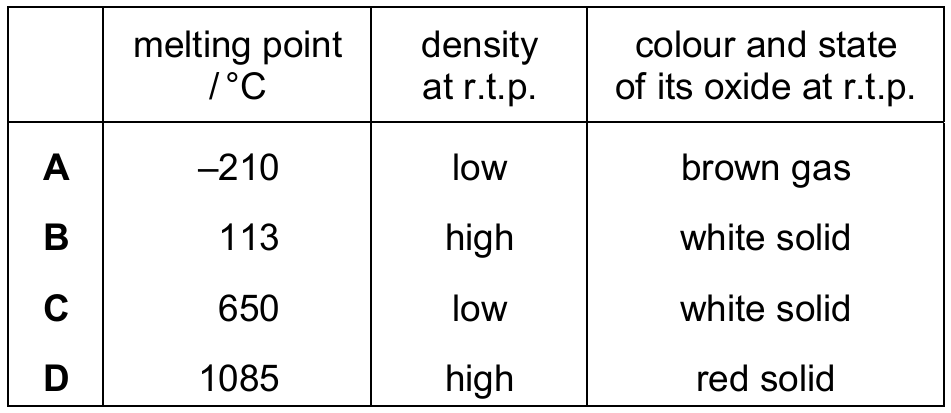
Which row describes the properties of a transition element?

Most-appropriate topic codes (Cambridge IGCSE Chemistry 0620):

TOPIC 8.4: Transition elements (Describe the transition elements as metals that have high densities, have high melting points, form coloured compounds)
▶️ Answer/Explanation
Correct Option: D

Detailed solution:

Transition elements are typical metals with high melting points and high densities. They also form coloured compounds. A high melting point like 1085°C and a high density fit perfectly. The oxide being a red solid indicates it is coloured, another characteristic property of transition elements. Options A, B, and C have either very low melting points, low densities, or white (colourless) compounds.
Question 25

Which statements about the elements in Group VIII are correct?
  1. They all have eight electrons in their outer electron shell.
  2. They all react with sodium to form ionic compounds.
  3. They are all monatomic gases.
A. 1 and 2
B. 1 only
C. 2 and 3
D. 3 only

Most-appropriate topic codes (Cambridge IGCSE Chemistry 0620):

TOPIC 8.5: Noble gases (Describe the Group VIII noble gases as unreactive, monatomic gases and explain this in terms of electronic configuration)
▶️ Answer/Explanation
Correct Option: D

Detailed solution:

Noble gases are monatomic gases, so statement 3 is correct. However, helium only has 2 outer electrons, not 8—so statement 1 is incorrect. Their full outer shells make them very unreactive; they do not easily react with sodium to form ionic compounds, so statement 2 is incorrect. Only statement 3 is correct.

Question 26

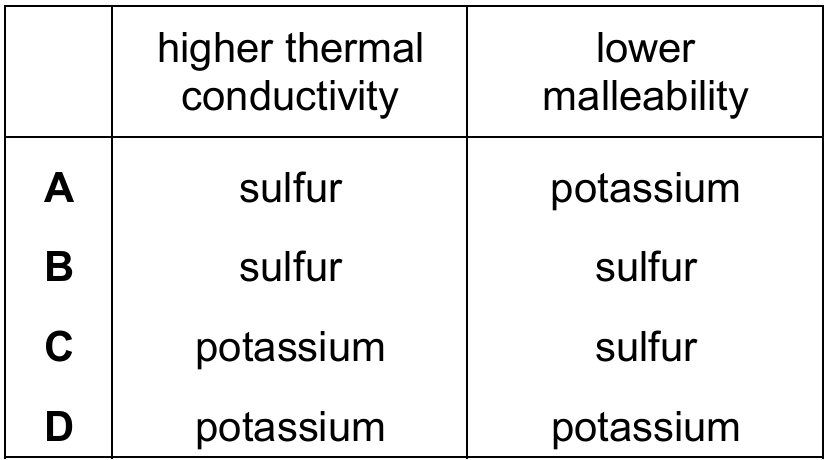
Sulfur and potassium are two elements in the Periodic Table.
Which row identifies the element with the higher thermal conductivity and the element with the lower malleability?

Most-appropriate topic codes (Cambridge IGCSE Chemistry 0620):

TOPIC 9.1: Properties of metals (Compare the general physical properties of metals and non-metals, including thermal conductivity and malleability)
▶️ Answer/Explanation
Correct Option: C

Detailed solution:

Potassium is a metal, so it has high thermal conductivity and is malleable. Sulfur is a non-metal, so it has poor thermal conductivity and is brittle (low malleability). So, potassium has the higher thermal conductivity, and sulfur has the lower malleability. That matches row C perfectly.
Question 27

Three statements about aluminium and copper are listed.
  1. The density of aluminium is less than that of copper.
  2. The electrical conductivity of copper is higher than that of aluminium.
  3. Aluminium is more reactive than copper.
Which statements explain why aluminium is used instead of copper to make overhead power cables?
A. 1 and 2
B. 1 and 3
C. 1 only
D. 2 and 3

Most-appropriate topic codes (Cambridge IGCSE Chemistry 0620):

TOPIC 9.2: Uses of metals (Describe the uses of metals in terms of their physical properties, including aluminium in the manufacture of overhead electrical cables because of its low density and good electrical conductivity)
▶️ Answer/Explanation
Correct Option: C

Detailed solution:

For overhead cables, low density is the key advantage of aluminium—it makes the cables lighter, so they can be strung over longer distances without sagging. Although copper has higher conductivity, aluminium’s lower density is the main reason it is preferred for this specific use. Reactivity doesn’t matter much here because aluminium is protected by its oxide layer. So, only statement 1 explains the choice.

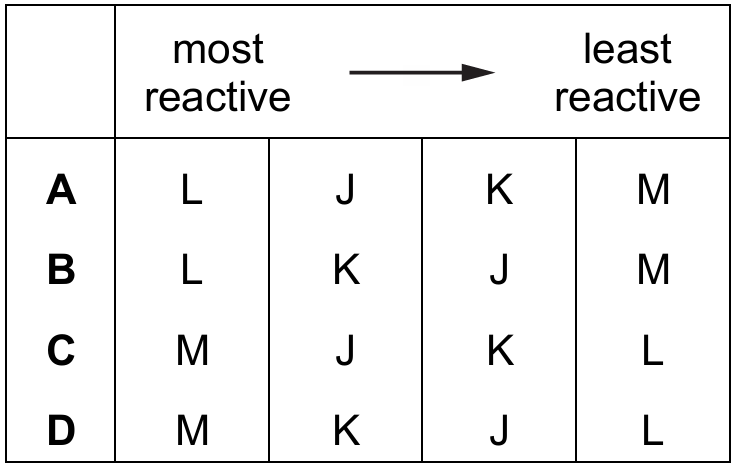
Question 28

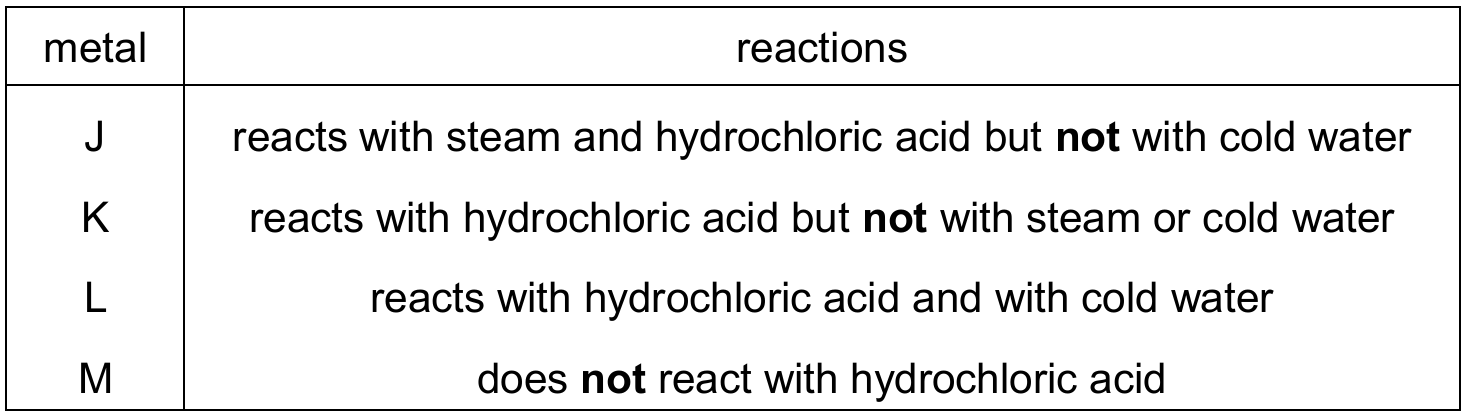
The table gives some information about the reactions of four metals, J, K, L and M.
What is the order of reactivity of metals J, K, L and M?

Most-appropriate topic codes (Cambridge IGCSE Chemistry 0620):

TOPIC 9.4: Reactivity series (Deduce an order of reactivity from a given set of experimental results)
▶️ Answer/Explanation
Correct Option: A

Detailed solution:

L is definitely the most reactive because it reacts with cold water (a very vigorous reaction for metals). J reacts with steam but not cold water, putting it next. K only reacts with acid, so it’s less reactive than J. M doesn’t react with acid at all, making it the least reactive. So, the order from most to least reactive is L → J → K → M, which matches option A.

Question 29

What is the chemical name for rust?
A. anhydrous iron(II) oxide
B. anhydrous iron(III) oxide
C. hydrated iron(II) oxide
D. hydrated iron(III) oxide

Most-appropriate topic codes (Cambridge IGCSE Chemistry 0620):

TOPIC 9.5: Corrosion of metals (State the conditions required for the rusting of iron and steel to form hydrated iron(III) oxide)
▶️ Answer/Explanation
Correct Option: D

Detailed solution:

Rust is specifically hydrated iron(III) oxide. It requires both oxygen and water to form, so it includes water molecules in its structure (hydrated). The iron is in the +3 oxidation state (iron(III)), not iron(II). The terms “anhydrous” (without water) or “iron(II)” are therefore incorrect for rust.

Question 30

Water from natural sources can contain many dissolved substances.
Which substances are often harmful to aquatic life?
  1. dissolved oxygen
  2. nitrates
  3. phosphates
A. 1, 2 and 3
B. 1 and 2 only
C. 1 and 3 only
D. 2 and 3 only

Most-appropriate topic codes (Cambridge IGCSE Chemistry 0620):

TOPIC 10.1: Water (State that some of these substances are potentially harmful, including: nitrates and phosphates lead to deoxygenation of water and damage to aquatic life)
▶️ Answer/Explanation
Correct Option: D

Detailed solution:

Dissolved oxygen is actually beneficial—aquatic life needs it to survive. Nitrates and phosphates, however, are harmful. They come from fertilisers and detergents, and they cause excessive plant growth. When these plants die and decompose, the process uses up oxygen, leading to deoxygenation and damage to aquatic ecosystems. So only 2 and 3 are harmful.

Question 31

Which gas is over 30% of clean, dry air?
A. argon
B. carbon dioxide
C. nitrogen
D. oxygen

Most-appropriate topic codes (Cambridge IGCSE Chemistry 0620):

TOPIC 10.3: Air quality and climate (State the composition of clean, dry air as approximately 78% nitrogen, 21% oxygen, and the remainder as a mixture of noble gases and carbon dioxide)
▶️ Answer/Explanation
Correct Option: C

Detailed solution:

Clean, dry air is approximately 78% nitrogen. That’s well over 30%. Oxygen makes up about 21%, which is less than 30%. Argon is about 0.9%, and carbon dioxide is only about 0.04%. So nitrogen is the only gas listed that exceeds 30%.

Question 32

Farmers use fertilisers to replace elements in the soil that have been removed by the crops they grow.
Which elements in the soil are replaced by adding fertilisers?
A. Ca, P, O
B. K, O, S
C. N, O, S
D. N, K, P

Most-appropriate topic codes (Cambridge IGCSE Chemistry 0620):

TOPIC 10.2: Fertilisers (Describe the use of NPK fertilisers to provide the elements nitrogen, phosphorus and potassium for improved plant growth)
▶️ Answer/Explanation
Correct Option: D

Detailed solution:

Fertilisers are labelled as NPK, which stands for the three essential elements they supply: Nitrogen (N), Phosphorus (P), and Potassium (K). Plants need these in relatively large amounts, and they are often depleted from soil by crops. So, the elements replaced are N, P, and K.

Question 33

The equation for the reaction between carbon dioxide and water in the presence of chlorophyll and sunlight is shown.
\[\text{carbon dioxide + water} \xrightarrow[\text{chlorophyll}]{\text{sunlight}} \text{glucose + oxygen}\]
Which process does this equation represent?
A. combustion
B. decomposition
C. displacement
D. photosynthesis

Most-appropriate topic codes (Cambridge IGCSE Chemistry 0620):

TOPIC 10.3: Air quality and climate (Describe photosynthesis as the reaction between carbon dioxide and water to produce glucose and oxygen in the presence of chlorophyll and using energy from light)
▶️ Answer/Explanation
Correct Option: D

Detailed solution:

The reaction shown is the photosynthesis equation: carbon dioxide and water react, using sunlight energy and chlorophyll, to form glucose and oxygen. This is how plants make their food. Combustion uses oxygen to burn a fuel, decomposition breaks things down, and displacement involves replacing an element in a compound.

Question 34

Which statement about members of a homologous series is correct?
A. They are elements with the same chemical properties.
B. They are compounds with the same functional group.
C. They are atoms with the same number of outer shell electrons.
D. They are molecules with the same boiling point.

Most-appropriate topic codes (Cambridge IGCSE Chemistry 0620):

TOPIC 11.1: Formulae, functional groups and terminology (State that a homologous series is a family of similar compounds with similar chemical properties due to the presence of the same functional group)
▶️ Answer/Explanation
Correct Option: B

Detailed solution:

Members of a homologous series are organic compounds that have the same functional group and similar chemical properties, but they are not elements or atoms. Their physical properties, like boiling point, show a trend but are not the same. The key characteristic is the presence of the same functional group.

Question 35

The molecular formulae of four organic compounds, W, X, Y and Z, are shown.
Which statement about compounds W, X, Y and Z is correct?
A. W and Z could both be alcohols.
B. Y is the only compound that could be a carboxylic acid.
C. W is a hydrocarbon.
D. X is ethene.

Most-appropriate topic codes (Cambridge IGCSE Chemistry 0620):

TOPIC 11.1: Formulae, functional groups and terminology (Write and interpret general formulae of compounds in the same homologous series); TOPIC 11.2: Naming organic compounds
▶️ Answer/Explanation
Correct Option: B

Detailed solution:

The general formula for a carboxylic acid is $\text{C}_n\text{H}_{2n+1}\text{COOH}$, which works out to $\text{C}_n\text{H}_{2n}\text{O}_2$. Y has the formula $\text{C}_4\text{H}_8\text{O}_2$, which fits this pattern (with $n=4$). W has oxygen but doesn’t fit the alcohol general formula $\text{C}_n\text{H}_{2n+1}\text{OH}$; it’s not an alcohol. W contains oxygen, so it’s not a hydrocarbon. X could be propene, not ethene (ethene is $\text{C}_2\text{H}_4$). So only Y can be a carboxylic acid.
Question 36

Fractional distillation is used to separate petroleum into useful fractions. Which statement about the properties of the fractions of petroleum is correct?
A. The refinery gas fraction has a lower volatility than the gasoline fraction.
B. The molecules in the gasoline fraction have a longer chain length than the molecules in the naphtha fraction.
C. The naphtha fraction has a higher boiling point than the kerosene fraction.
D. The fuel oil fraction has a higher viscosity than the diesel oil fraction.

Most-appropriate topic codes (Cambridge IGCSE Chemistry 0620):

TOPIC 11.3: Fuels (Describe how the properties of fractions obtained from petroleum change from the bottom to the top of the fractionating column; higher volatility, lower boiling points, lower viscosity)
▶️ Answer/Explanation
Correct Option: D

Detailed solution:

As you go down the fractionating column, the fractions get heavier, with longer chain molecules, higher boiling points, lower volatility, and higher viscosity. Fuel oil is collected lower down than diesel oil, so it has a higher viscosity. Refinery gas is at the top, so it’s more volatile than gasoline. Gasoline is higher than naphtha, so its molecules are shorter. Naphtha is higher than kerosene, so it has a lower boiling point.

Question 37

Which statements about the alkanes are correct?
  1. They are generally unreactive except in terms of combustion and substitution by chlorine.
  2. They have the general formula $\text{C}_n\text{H}_{2n+2}$.
  3. They contain double carbon-carbon covalent bonds.
  4. They decolourise aqueous bromine.
A. 1, 2 and 3
B. 1 and 2 only
C. 1, 3 and 4
D. 2 and 4

Most-appropriate topic codes (Cambridge IGCSE Chemistry 0620):

TOPIC 11.1: Formulae, functional groups and terminology (alkan general formula); TOPIC 11.4: Alkanes (Describe the properties of alkanes as being generally unreactive, except in terms of combustion and substitution by chlorine)
▶️ Answer/Explanation
Correct Option: B

Detailed solution:

Alkanes are saturated hydrocarbons with only single bonds, so statement 3 is false. Because they have no double bonds, they do not decolourise bromine water (statement 4 false). They have the general formula $\text{C}_n\text{H}_{2n+2}$ (statement 2 true) and are generally unreactive except for combustion and substitution reactions (statement 1 true). So, 1 and 2 are correct.

Question 38

Which products can be formed by the cracking of one molecule of hexane, $\text{C}_6\text{H}_{14}$?
A. $\text{C}_4\text{H}_{10}$ and $\text{C}_2\text{H}_4$ only
B. $\text{C}_{12}\text{H}_{26}$ and $\text{H}_2$ only
C. $\text{C}_3\text{H}_7$ only
D. $\text{C}_2\text{H}_6$ and $\text{C}_4\text{H}_{10}$ only

Most-appropriate topic codes (Cambridge IGCSE Chemistry 0620):

TOPIC 11.5: Alkenes (Describe the manufacture of alkenes and hydrogen by the cracking of larger alkane molecules using a high temperature and a catalyst)
▶️ Answer/Explanation
Correct Option: A

Detailed solution:

Cracking breaks a large alkane into a smaller alkane and an alkene. Hexane ($\text{C}_6\text{H}_{14}$) has 6 carbons. Option A gives butane ($\text{C}_4\text{H}_{10}$, 4C alkane) and ethene ($\text{C}_2\text{H}_4$, 2C alkene), total 6C — perfect. Option B has more carbons than the original molecule, which is impossible. Option C shows a fragment, not stable molecules. Option D gives two alkanes, but cracking must produce at least one alkene. So only A works.

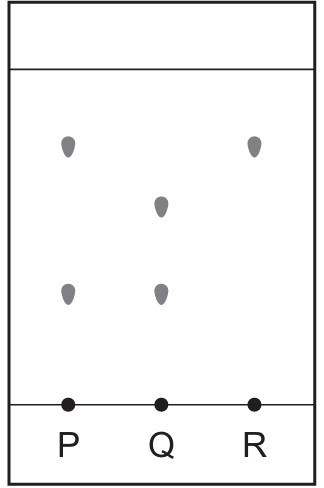
Question 39

Three coloured inks, P, Q and R, are tested using paper chromatography.
The chromatogram is shown.
Which statement is correct?
A. P is a pure substance.
B. P and Q have a colour that could be the same in both inks.
C. The top line of the chromatogram is called the baseline.
D. All the colours in R are also in Q.

Most-appropriate topic codes (Cambridge IGCSE Chemistry 0620):

TOPIC 12.3: Chromatography (Interpret simple chromatograms to identify pure and impure substances; unknown substances by comparison with known substances)
▶️ Answer/Explanation
Correct Option: B

Detailed solution:

From the chromatogram, P shows more than one spot, so it’s a mixture, not pure. A spot from P lines up at the same height as a spot from Q, meaning they share a colour that travels the same distance in the solvent. The top line is the solvent front, not the baseline. R has some spots not present in Q, so D is false. Therefore, B is the correct statement.
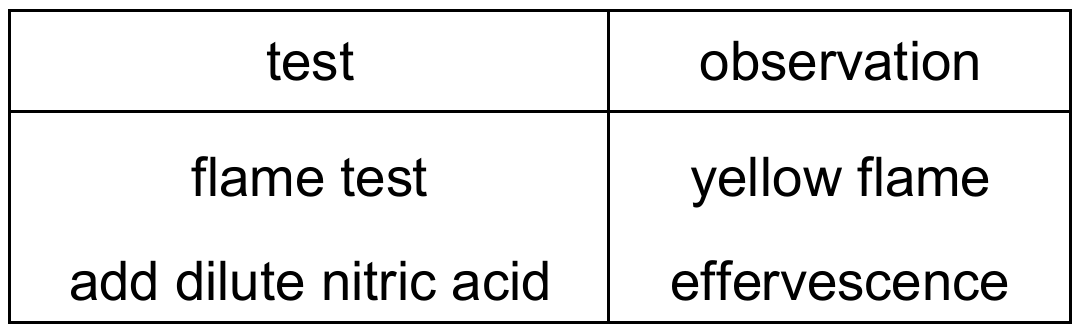
Question 40

The table shows the results of two separate tests on a sample of aqueous T.
What is the identity of T?
A. sodium chloride
B. calcium chloride
C. sodium carbonate
D. calcium carbonate

Most-appropriate topic codes (Cambridge IGCSE Chemistry 0620):

TOPIC 12.5: Identification of ions and gases (Describe the use of a flame test to identify cations; Describe tests to identify the anions: carbonate by reaction with dilute acid)
▶️ Answer/Explanation
Correct Option: C

Detailed solution:

A yellow flame test indicates the presence of sodium ions ($\text{Na}^+$). Effervescence (fizzing) when dilute nitric acid is added means a carbonate is present, as carbon dioxide gas is produced. So the compound must contain both sodium and carbonate ions — that’s sodium carbonate ($\text{Na}_2\text{CO}_3$). Chlorides wouldn’t fizz with acid, and calcium gives a different flame colour.

Scroll to Top