Question 1
A gas is placed in a sealed container with a fixed volume.
The gas is heated.
Which statements are correct?
1. The gas molecules move around faster.
2. The gas particles collide with the walls of the container more frequently.
3. The pressure in the container decreases.
(A) 1 and 2
(B) 1 only
(C) 2 and 3
(D) 2 only
Most-appropriate topic codes (Cambridge IGCSE Chemistry 0620):
▶️ Answer/Explanation
✅ Answer: (A)
Question 2
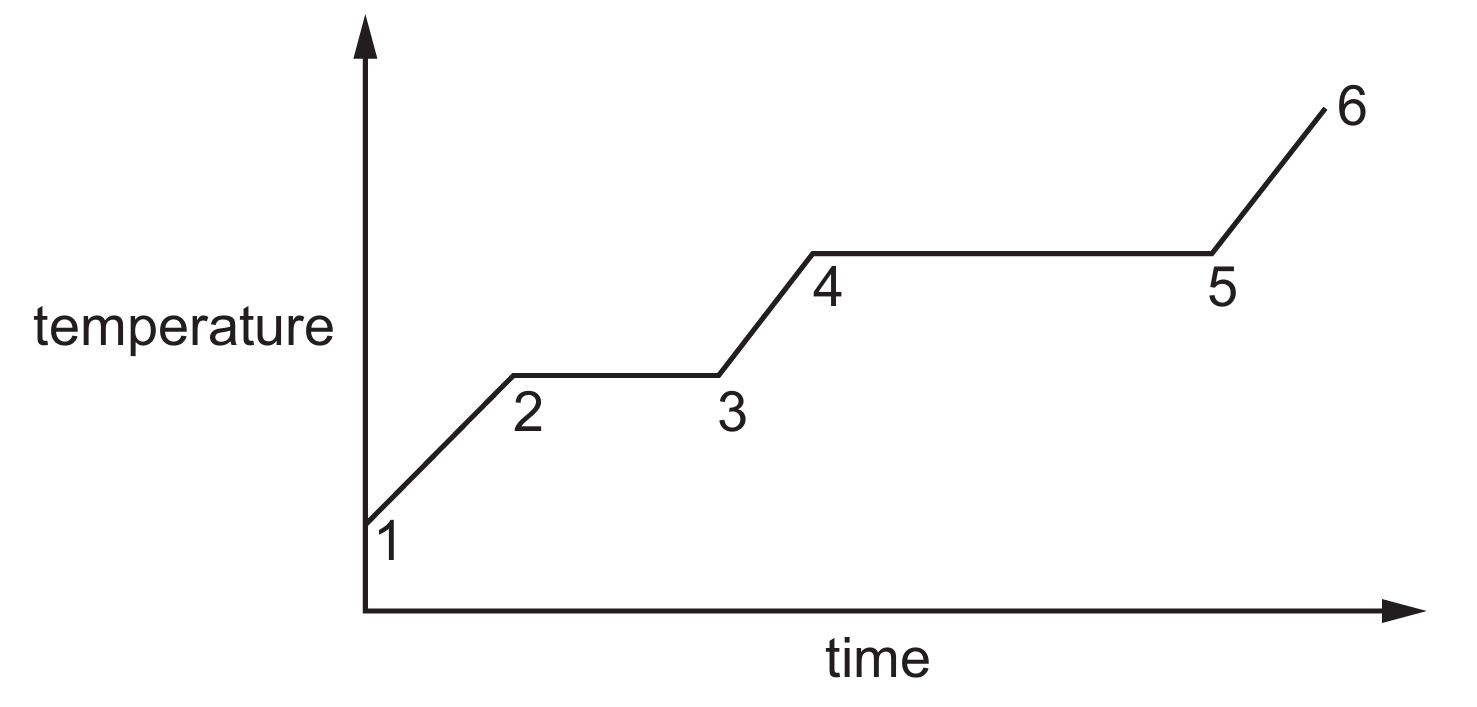
A sample of ethanol is heated at a constant rate. The heating curve for this sample is shown.

Which statement about the heating curve is correct?
(A) Ethanol changes its physical state between 3 and 4.
(B) Ethanol condenses between 2 and 3.
(C) Energy is absorbed between 3 and 4 but not absorbed between 4 and 5.
(D) More energy is absorbed between 4 and 5 than between 2 and 3.
Most-appropriate topic codes (Cambridge IGCSE Chemistry 0620):
▶️ Answer/Explanation
✅ Answer: (D)
Question 3
Which atom has an equal number of protons, neutrons and electrons?
(A) 40Ar
(B) 1H
(C) 23Na
(D) 14N
Most-appropriate topic codes (Cambridge IGCSE Chemistry 0620):
▶️ Answer/Explanation
✅ Answer: (D)
Question 4
The only naturally occurring isotopes in a sample of europium are 151Eu and 153Eu. This sample of europium has a relative atomic mass, Ar, of 152. What is the percentage of 151Eu present in this sample to three significant figures?
(A) 0.987%
(B) 50.0%
(C) 76.0%
(D) 98.7%
Most-appropriate topic codes (Cambridge IGCSE Chemistry 0620):
▶️ Answer/Explanation
✅ Answer: (B)
Question 5
Which statement about potassium chloride is correct?
(A) It has a high melting point because it is a giant structure with strong covalent bonds.
(B) It conducts electricity when solid because of its oppositely charged ions.
(C) It conducts electricity when molten because its ions can move.
(D) It is insoluble in water because of its strong bonding.
Most-appropriate topic codes (Cambridge IGCSE Chemistry 0620):
▶️ Answer/Explanation
✅ Answer: (C)
Question 6
Which dot-and-cross diagram shows the outer shell electron arrangement in a molecule of nitrogen?

Most-appropriate topic codes (Cambridge IGCSE Chemistry 0620):
▶️ Answer/Explanation
✅ Answer: (B)
Question 7
Which statement about silicon(IV) oxide is correct?
(A) It contains silicon ions and oxide ions arranged in a giant lattice.
(B) It is used in electrical circuits because it can conduct electricity.
(C) Its bonds each contain one shared pair of electrons.
(D) Its atoms are arranged in the same way as the atoms in graphite.
Most-appropriate topic codes (Cambridge IGCSE Chemistry 0620):
▶️ Answer/Explanation
✅ Answer: (C)
Question 8
Three organic molecules are described.
• The molecular formula of propanoic acid is CH₃CH₂COOH
• The molecular formula of lactic acid is CH₃CH(OH)COOH
• A glucose molecule consists of 6 carbon atoms, 6 oxygen atoms and 12 hydrogen atoms only.
Which molecules have the same empirical formula?
(A) propanoic acid, lactic acid and glucose
(B) propanoic acid and lactic acid only
(C) propanoic acid and glucose only
(D) lactic acid and glucose only
Most-appropriate topic codes (Cambridge IGCSE Chemistry 0620):
▶️ Answer/Explanation
✅ Answer: (D)
Question 9
Calcium carbonate reacts with dilute hydrochloric acid. The equation for the reaction is shown.
CaCO₃ + 2HCl → CaCl₂ + H₂O + CO₂
1.00 g of calcium carbonate is added to 50.0 cm³ of 0.0500 mol/dm³ hydrochloric acid. Which volume of carbon dioxide is made in this reaction?
(A) 30 cm³
(B) 60 cm³
(C) 120 cm³
(D) 240 cm³
Most-appropriate topic codes (Cambridge IGCSE Chemistry 0620):
▶️ Answer/Explanation
✅ Answer: (A)
Question 10
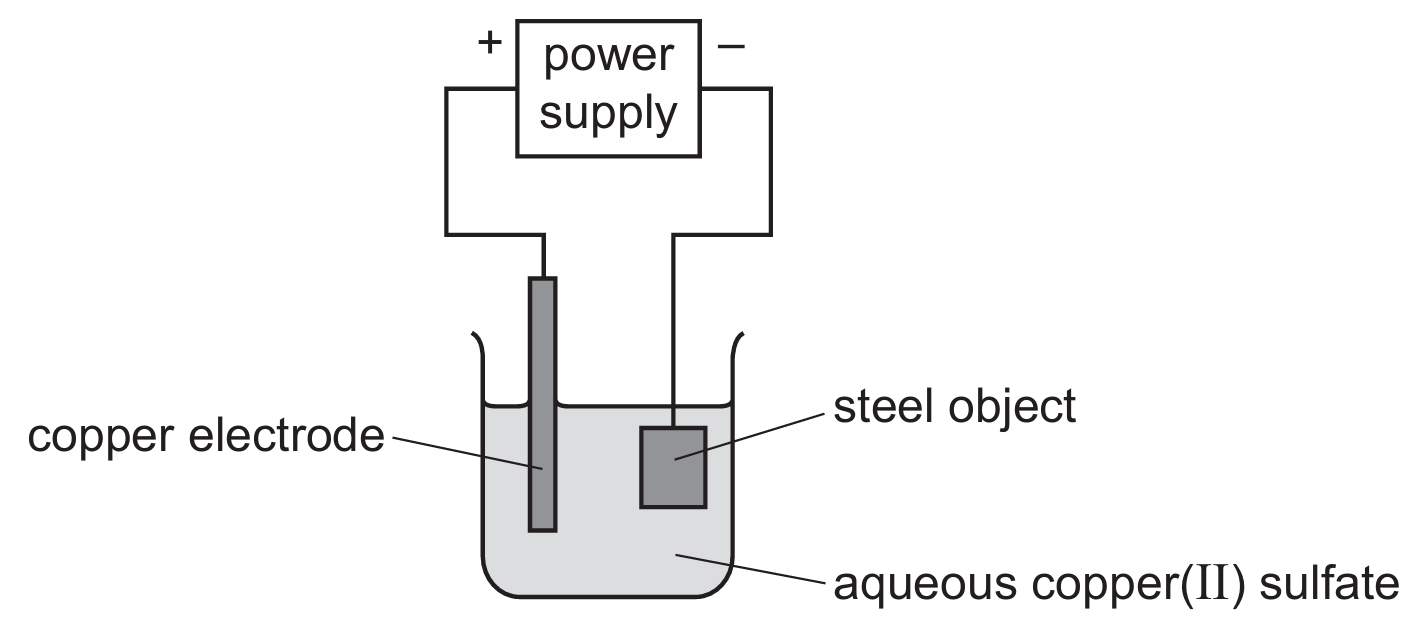
The diagram shows the electroplating of a steel object.

A student makes three statements.
1. The steel object turns a reddish-brown colour.
2. The aqueous copper(II) sulfate changes to a paler blue colour.
3. The copper electrode becomes thinner.
Which statements are correct?
(A) 1, 2 and 3
(B) 1 and 2 only
(C) 1 and 3 only
(D) 2 and 3 only
Most-appropriate topic codes (Cambridge IGCSE Chemistry 0620):
▶️ Answer/Explanation
✅ Answer: (C)
Question 11
Concentrated aqueous sodium chloride is electrolysed using inert electrodes.
Which equation shows the correct ionic half-equation for the reaction at the anode?
(A) Cl⁻ + e⁻ → Cl
(B) 2Cl⁻ → Cl₂ + 2e⁻
(C) H⁺ → H + e⁻
(D) 2H⁺ + 2e⁻ → H₂
Most-appropriate topic codes (Cambridge IGCSE Chemistry 0620):
▶️ Answer/Explanation
✅ Answer: (B)
Question 12
Which equation represents the overall reaction in a hydrogen-oxygen fuel cell?
(A) 2H₂ + O₂ → 2H₂O
(B) 2H₂O → 2H₂ + O₂
(C) H₂ + O₂ → H₂O₂
(D) H₂O₂ → H₂ + O₂
Most-appropriate topic codes (Cambridge IGCSE Chemistry 0620):
▶️ Answer/Explanation
✅ Answer: (A)
Question 13
Water is added to anhydrous copper(II) sulfate in a test-tube. The mixture becomes hot. Which type of reaction and reaction pathway diagram apply to this reaction?

Most-appropriate topic codes (Cambridge IGCSE Chemistry 0620):
▶️ Answer/Explanation
✅ Answer: (C)
Question 14
The equation represents the reaction between ethanoic acid and ethanol.
CH₃COOH + CH₃CH₂OH ⇌ CH₃COOCH₂CH₃ + H₂O
Which type of reaction does this show?
(A) addition
(B) neutralisation
(C) reduction
(D) reversible
Most-appropriate topic codes (Cambridge IGCSE Chemistry 0620):
▶️ Answer/Explanation
✅ Answer: (D)
Question 15
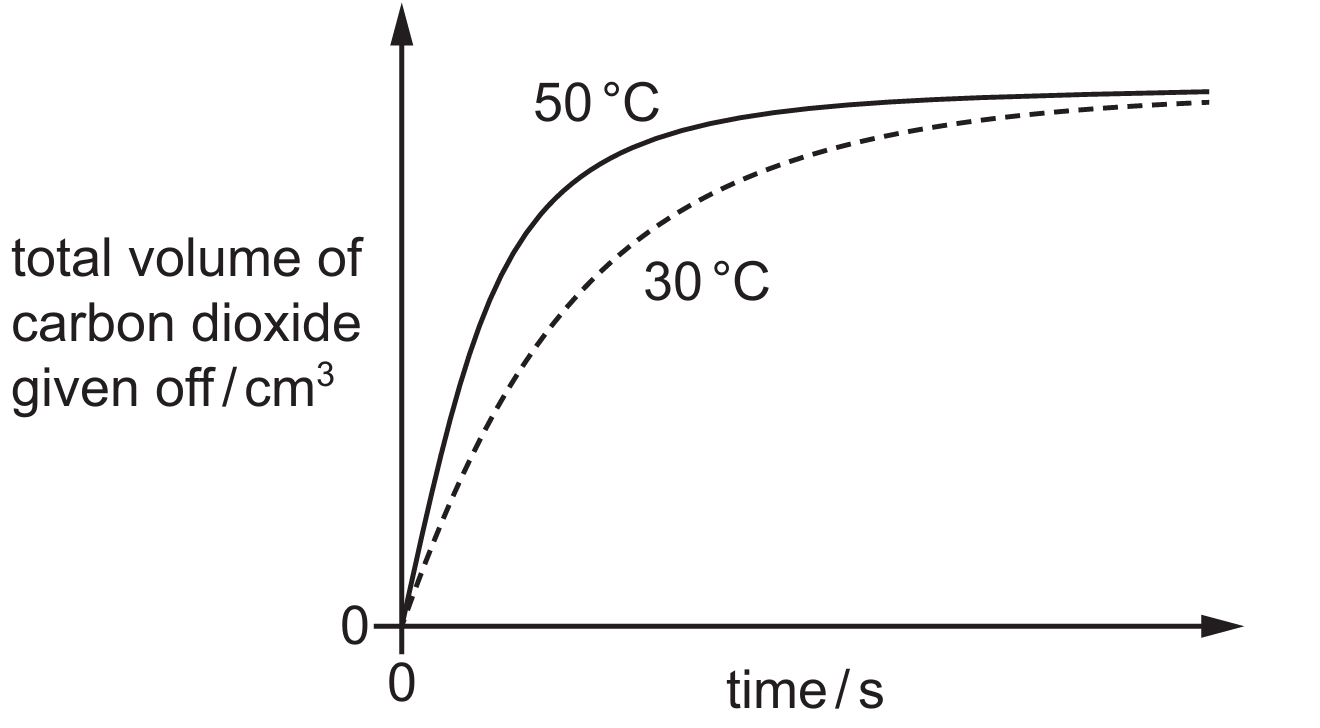
The graph shows the results of adding excess calcium carbonate to hydrochloric acid at 50 °C and at 30 °C. Only the temperature is changed.

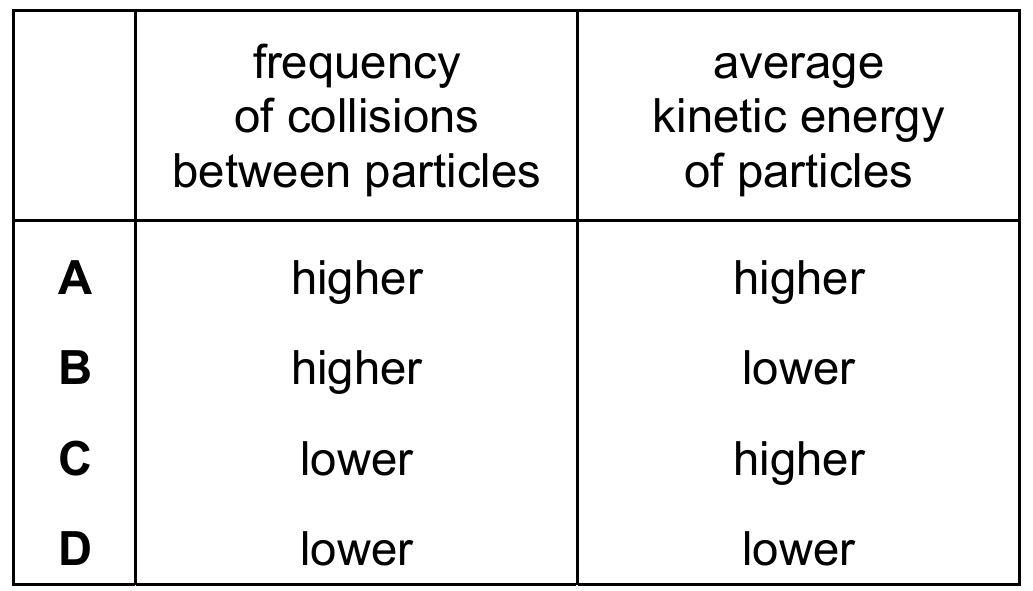
Which row describes the reacting particles at 30 °C compared to those at 50 °C?

Most-appropriate topic codes (Cambridge IGCSE Chemistry 0620):
▶️ Answer/Explanation
✅ Answer: (D)
Question 16
Industrially, ammonia is made by the Haber process. The equation is shown.
N₂(g) + 3H₂(g) ⇌ 2NH₃(g) ΔH = −92 kJ/mol
The conditions used are 450 °C and 200 atm. Which statements about the conditions are correct?
1. Temperatures below 450 °C give a lower rate of reaction.
2. Temperatures below 450 °C give a lower yield of ammonia.
3. Pressures above 200 atm give a lower yield of ammonia.
4. Pressures above 200 atm are too expensive to maintain.
(A) 1 and 2
(B) 1 and 4
(C) 2 and 3
(D) 3 and 4
Most-appropriate topic codes (Cambridge IGCSE Chemistry 0620):
▶️ Answer/Explanation
✅ Answer: (B)
Question 17
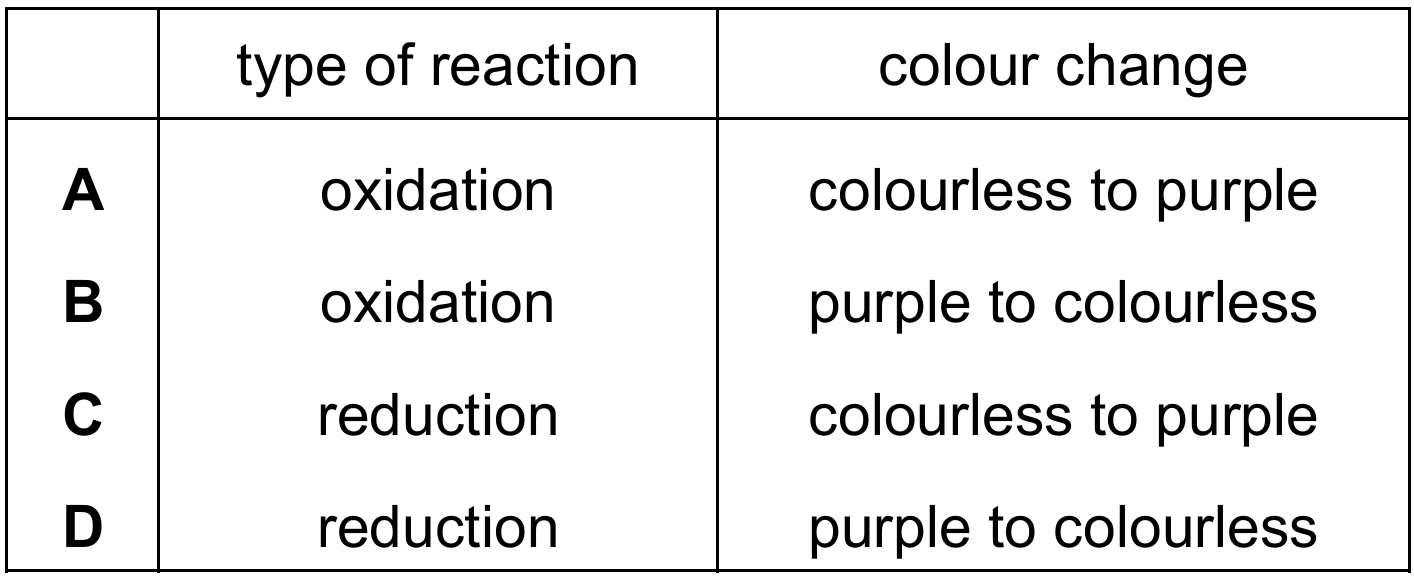
Ethanol is warmed with acidified aqueous potassium manganate(VII). Which row describes the type of reaction of the ethanol and the colour change observed in the reaction mixture?

Most-appropriate topic codes (Cambridge IGCSE Chemistry 0620):
▶️ Answer/Explanation
✅ Answer: (B)
Question 18
Two experiments involving acids R or S are done.
• 0.10 mol of acid R completely dissolves in 500 cm³ of water. 0.0048 mol of acid R is dissociated in the solution.
• 0.10 mol of acid S completely dissolves in 500 cm³ of water. 0.0179 mol of acid S is dissociated in the solution.
Which statement about acids R and S is correct?
(A) Acid R is a strong acid, and acid S is a weak acid.
(B) Acid R is a weak acid, and acid S is a strong acid.
(C) Acid R and acid S are both strong acids.
(D) Acid R and acid S are both weak acids.
Most-appropriate topic codes (Cambridge IGCSE Chemistry 0620):
▶️ Answer/Explanation
✅ Answer: (D)
Question 19
Lead(II) sulfate is an insoluble salt. Which process is not used to prepare a pure sample of this salt?
(A) crystallisation
(B) drying
(C) filtration
(D) precipitation
Most-appropriate topic codes (Cambridge IGCSE Chemistry 0620):
▶️ Answer/Explanation
✅ Answer: (A)
Question 20
The formulae of two hydrated salts are shown.
CuSO₄ • xH₂O
CoCl₂ • yH₂O
What are the values of x and y?

Most-appropriate topic codes (Cambridge IGCSE Chemistry 0620):
▶️ Answer/Explanation
✅ Answer: (B)
Question 21
The properties of the elements change from left to right across the Periodic Table. Which statement describes how the properties change across Period 3?
(A) Elements change from gases to solids.
(B) Elements change from non-conductors to electrical conductors.
(C) Elements change from metal to non-metal.
(D) Elements have a decreasing number of electron shells.
Most-appropriate topic codes (Cambridge IGCSE Chemistry 0620):
▶️ Answer/Explanation
✅ Answer: (C)
Question 22
Which property decreases down Group VII of the Periodic Table, from chlorine to iodine?
(A) atomic number
(B) density
(C) reactivity
(D) melting point
Most-appropriate topic codes (Cambridge IGCSE Chemistry 0620):
▶️ Answer/Explanation
✅ Answer: (C)
Question 23
Some properties of elements are listed.
1. They have good electrical conductivity.
2. They have high melting points.
3. They are malleable.
4. They have ions with variable oxidation numbers.
Which properties are correct for both iron and lithium?
(A) 1 and 3
(B) 1 and 4
(C) 2 and 3
(D) 2 and 4
Most-appropriate topic codes (Cambridge IGCSE Chemistry 0620):
▶️ Answer/Explanation
✅ Answer: (A)
Question 24
Two statements about noble gases are listed.
1. Noble gases are reactive, monatomic gases.
2. Noble gases all have a full outer shell of electrons.
Which statements about noble gases are correct?
(A) Both statements are correct, and statement 2 explains statement 1.
(B) Both statements are correct but statement 2 does not explain statement 1.
(C) Statement 1 is correct but statement 2 is not correct.
(D) Statement 2 is correct but statement 1 is not correct.
Most-appropriate topic codes (Cambridge IGCSE Chemistry 0620):
▶️ Answer/Explanation
✅ Answer: (D)
Question 25
Which statement about the properties and uses of copper is correct?
(A) It is used in electrical wiring, and it is ductile.
(B) It is mixed with tin to make the alloy brass.
(C) It is used in overhead electrical cables because it has a low density.
(D) It is used in takeaway food containers because of its resistance to corrosion.
Most-appropriate topic codes (Cambridge IGCSE Chemistry 0620):
▶️ Answer/Explanation
✅ Answer: (A)
Question 26
Three statements about solid Z are listed.
• It reacts with dilute hydrochloric acid to produce hydrogen.
• It reacts very slowly with cold water and quickly with steam.
• It is a good thermal conductor.
What is solid Z?
(A) gold
(B) magnesium
(C) potassium
(D) silver
Most-appropriate topic codes (Cambridge IGCSE Chemistry 0620):
▶️ Answer/Explanation
✅ Answer: (B)
Question 27
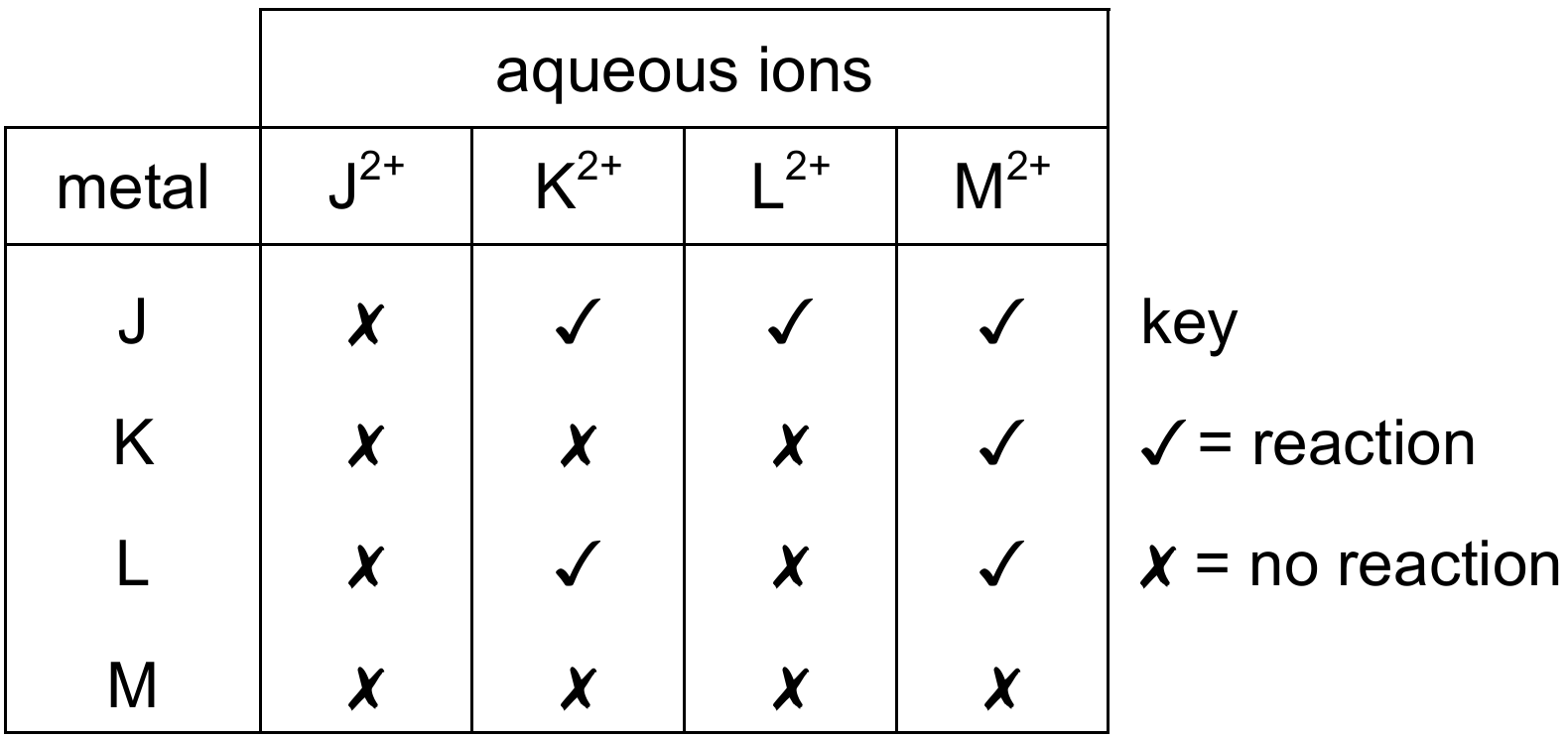
Four metals J, K, L and M are added separately to aqueous solutions of their ions.
The results are shown.

Which statement about the metals is correct?
(A) J has a greater tendency to form positive ions than K.
(B) L has a greater tendency to form positive ions than J.
(C) K has a greater tendency to form positive ions than L.
(D) M has a greater tendency to form positive ions than K.
Most-appropriate topic codes (Cambridge IGCSE Chemistry 0620):
▶️ Answer/Explanation
✅ Answer: (A)
Question 28
Which process is used in the extraction of iron from hematite?
(A) electrolysis
(B) precipitation
(C) reduction
(D) fractional distillation
Most-appropriate topic codes (Cambridge IGCSE Chemistry 0620):
▶️ Answer/Explanation
✅ Answer: (C)
Question 29
Galvanising prevents iron from rusting. Which statements about galvanising are correct?
1. Galvanising involves coating the iron with silver.
2. Galvanising prevents oxygen and water from coming into contact with the iron.
3. Galvanising works because the metal coating loses electrons more readily than iron.
(A) 1, 2 and 3
(B) 1 and 3 only
(C) 2 and 3 only
(D) 2 only
Most-appropriate topic codes (Cambridge IGCSE Chemistry 0620):
▶️ Answer/Explanation
✅ Answer: (C)
Question 30
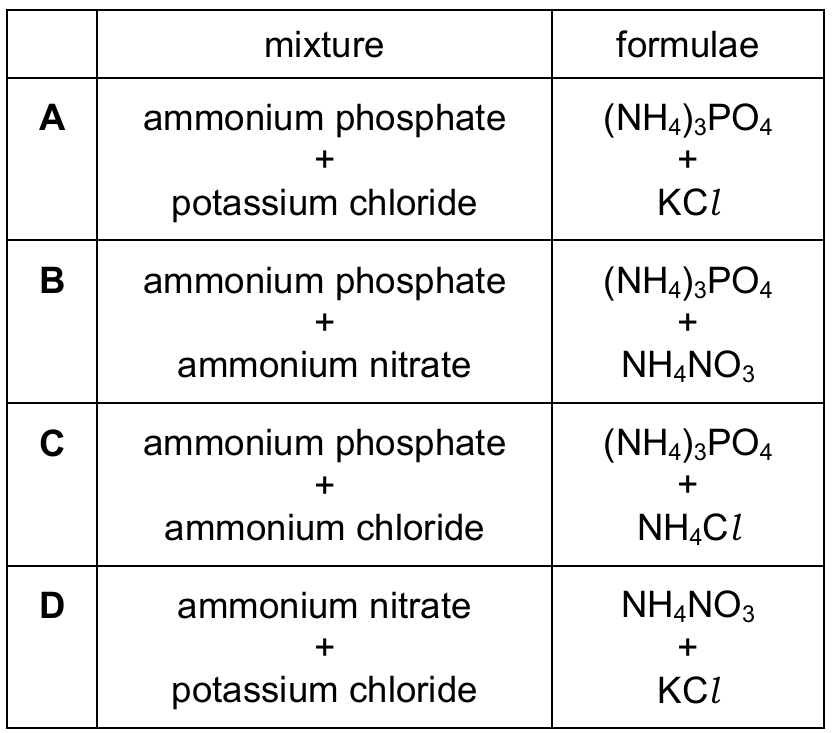
Nitrogen, phosphorus and potassium are essential elements for improved plant growth. Which mixture provides all three essential elements?

Most-appropriate topic codes (Cambridge IGCSE Chemistry 0620):
▶️ Answer/Explanation
✅ Answer: (A)
Question 31
Which statements help explain why an increasing amount of carbon dioxide or methane in the atmosphere causes global warming?
1. Carbon dioxide absorbs thermal energy from the Earth.
2. Methane does not absorb thermal energy from the Sun.
3. Carbon dioxide does not reflect thermal energy from the Sun to the Earth.
4. Methane reflects thermal energy from the Earth back to the Earth.
(A) 1 and 3
(B) 1 and 4
(C) 2 and 3
(D) 2 and 4
Most-appropriate topic codes (Cambridge IGCSE Chemistry 0620):
▶️ Answer/Explanation
✅ Answer: (B)
Question 32
The exhaust gases from cars contain oxides of nitrogen. How are these oxides of nitrogen formed?
(A) Nitrogen and oxygen from the air react together at the high temperatures in the engine.
(B) Nitrogen and oxygen from the petrol react together in the car exhaust.
(C) Nitrogen from the petrol reacts with oxygen at the high temperatures in the engine.
(D) Nitrogen reacts with oxygen from the air in the catalytic converter.
Most-appropriate topic codes (Cambridge IGCSE Chemistry 0620):
▶️ Answer/Explanation
✅ Answer: (A)
Question 33
The structural formula of methyl ethanoate is CH₃COOCH₃. Which compounds are structural isomers of methyl ethanoate?
1. HCOOCHCH₃
2. CHCHCOOH
3. HOCHCHCHOH
(A) 1, 2 and 3
(B) 1 and 2 only
(C) 2 and 3 only
(D) 3 only
Most-appropriate topic codes (Cambridge IGCSE Chemistry 0620):
▶️ Answer/Explanation
✅ Answer: (B)
Question 34
What is the total number of covalent bonds in one molecule of propane?
(A) 8
(B) 9
(C) 10
(D) 11
Most-appropriate topic codes (Cambridge IGCSE Chemistry 0620):
▶️ Answer/Explanation
✅ Answer: (C)
Question 35
Industrially, ethanol is produced by fermentation or by the reaction of ethene with steam. Which row is correct?

Most-appropriate topic codes (Cambridge IGCSE Chemistry 0620):
▶️ Answer/Explanation
✅ Answer: (C)
Question 36
Some properties of an organic compound, J, are listed.
- It is a liquid at room temperature.
- It is soluble in water.
- A solution of J reacts with calcium carbonate to form carbon dioxide.
- A solution of J has a pH of 3.
In which homologous series does J belong?
(A) alkane
(B) alkene
(C) alcohol
(D) carboxylic acid
Most-appropriate topic codes (Cambridge IGCSE Chemistry 0620):
▶️ Answer/Explanation
✅ Answer: (D)
Question 37
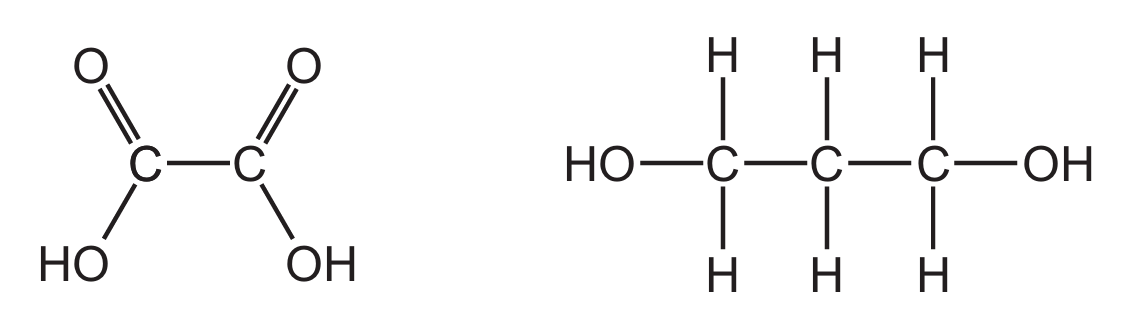
The structures of two monomers that are used to make a condensation polymer are shown.

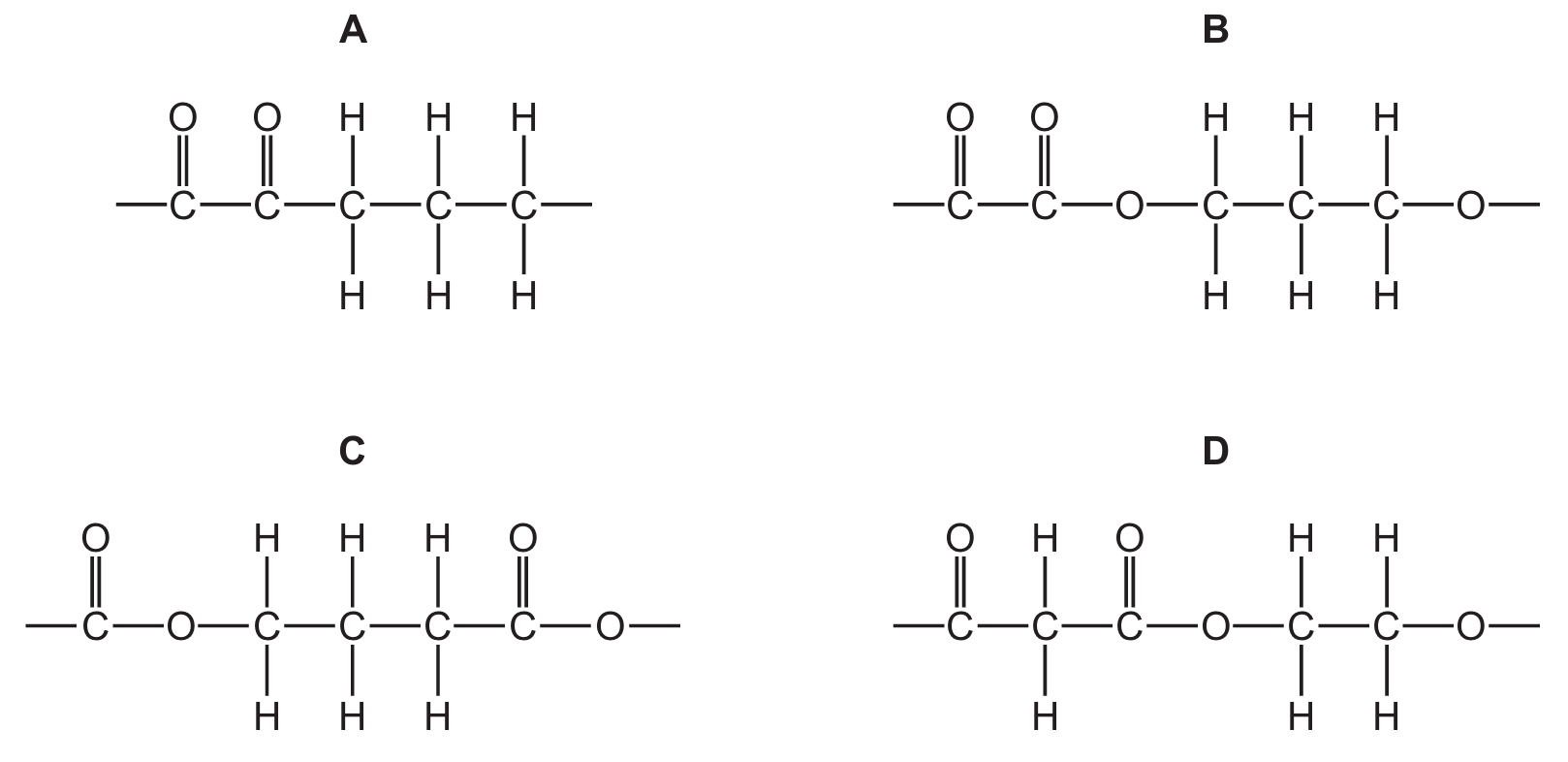
Which structure represents one repeat unit of the condensation polymer formed?

Most-appropriate topic codes (Cambridge IGCSE Chemistry 0620):
▶️ Answer/Explanation
✅ Answer: (B)
Question 38
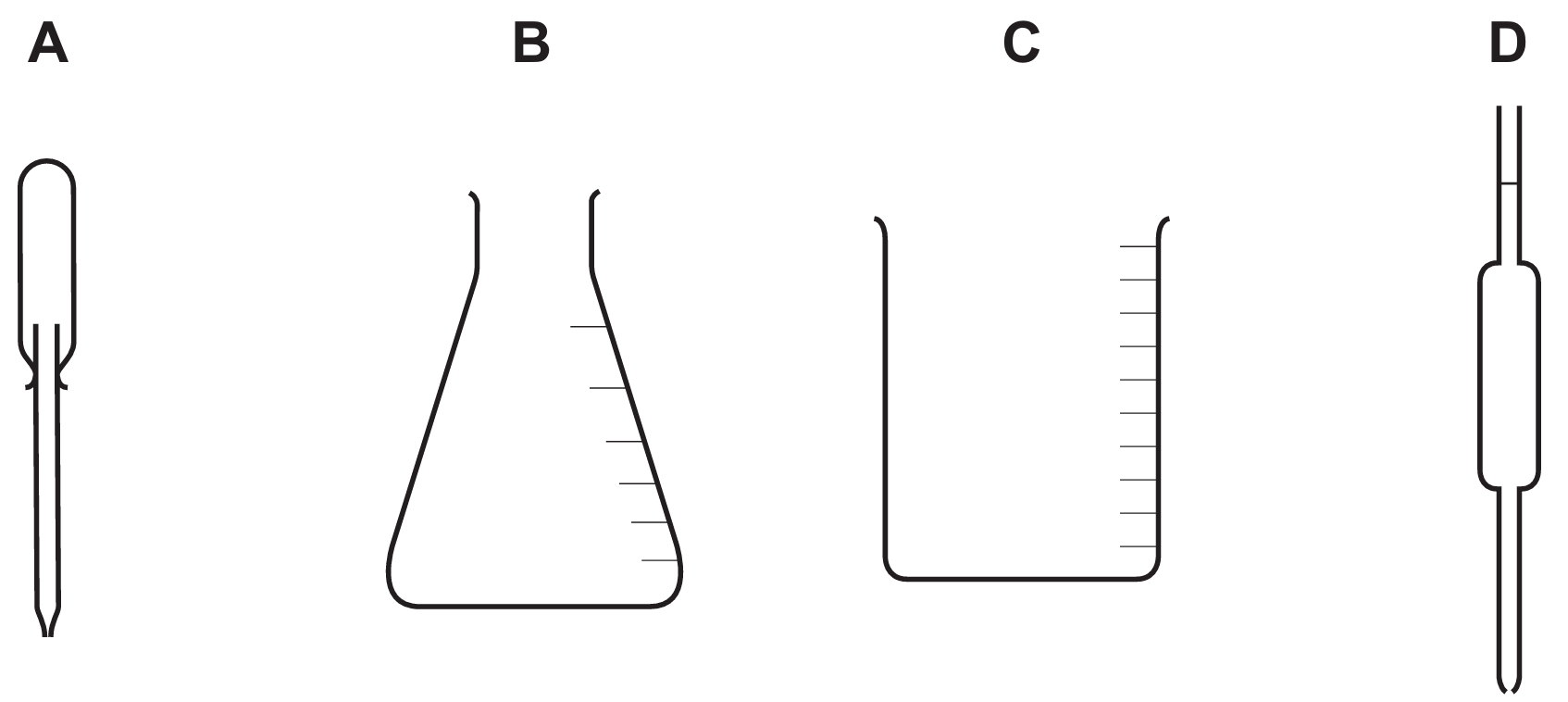
Which item of apparatus is used to measure 25.0cm³ of aqueous sodium hydroxide?

Most-appropriate topic codes (Cambridge IGCSE Chemistry 0620):
▶️ Answer/Explanation
✅ Answer: (D)
Question 39
Which method is used to obtain copper(II) sulfate crystals from an aqueous solution of copper(II) sulfate?
(A) chromatography
(B) condensation
(C) evaporation
(D) filtration
Most-appropriate topic codes (Cambridge IGCSE Chemistry 0620):
▶️ Answer/Explanation
✅ Answer: (C)
Question 40
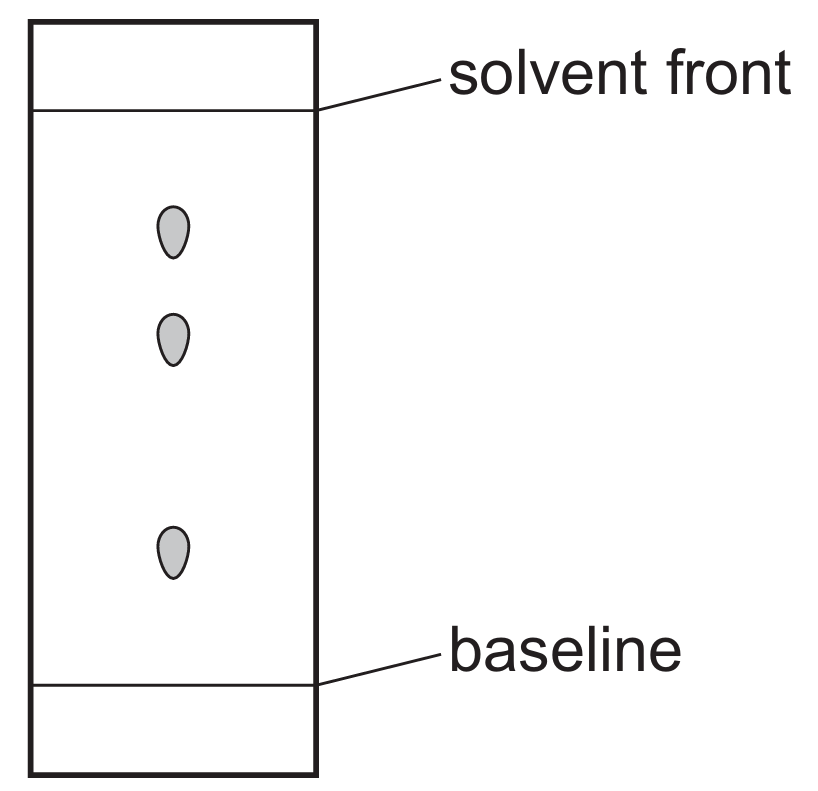
A mixture of four different colourless amino acids is analysed by paper chromatography.
The final chromatogram is shown.

Why does the chromatogram only show three spots?
(A) A locating agent is not used.
(B) One of the amino acids is insoluble in the solvent.
(C) The solvent front is too near the top of the paper.
(D) Two of the amino acids have the same Rf value.
Most-appropriate topic codes (Cambridge IGCSE Chemistry 0620):
▶️ Answer/Explanation
✅ Answer: (D)