Question 1
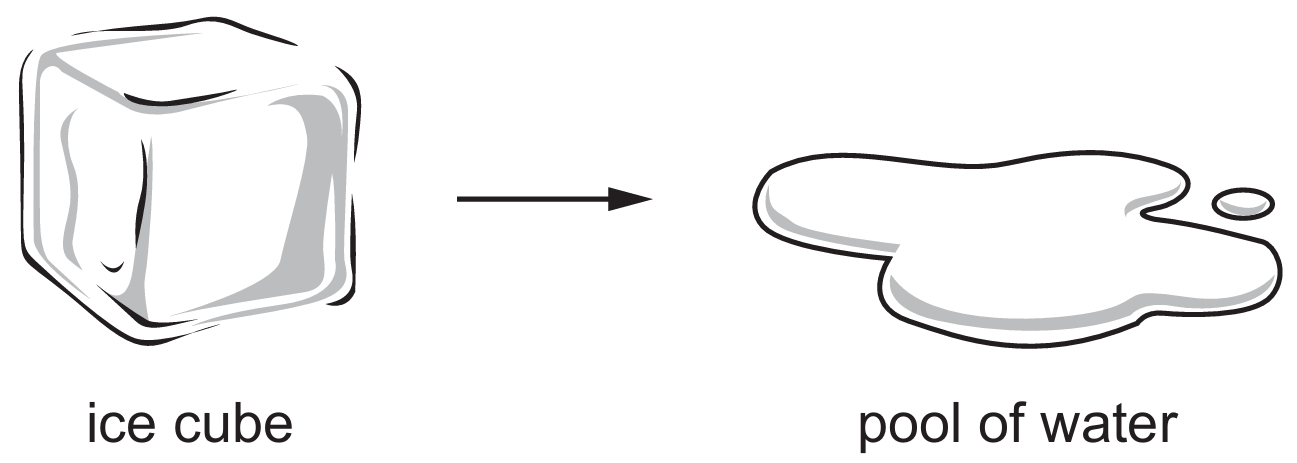
An ice cube melts.

What happens to the molecules of water in the ice cube?
(A) They evaporate.
(B) They dissolve.
(C) They gain energy.
(D) They lose energy.
Most-appropriate topic codes (Cambridge IGCSE Chemistry 0620):
▶️ Answer/Explanation
✅ Answer: (C)
Question 2
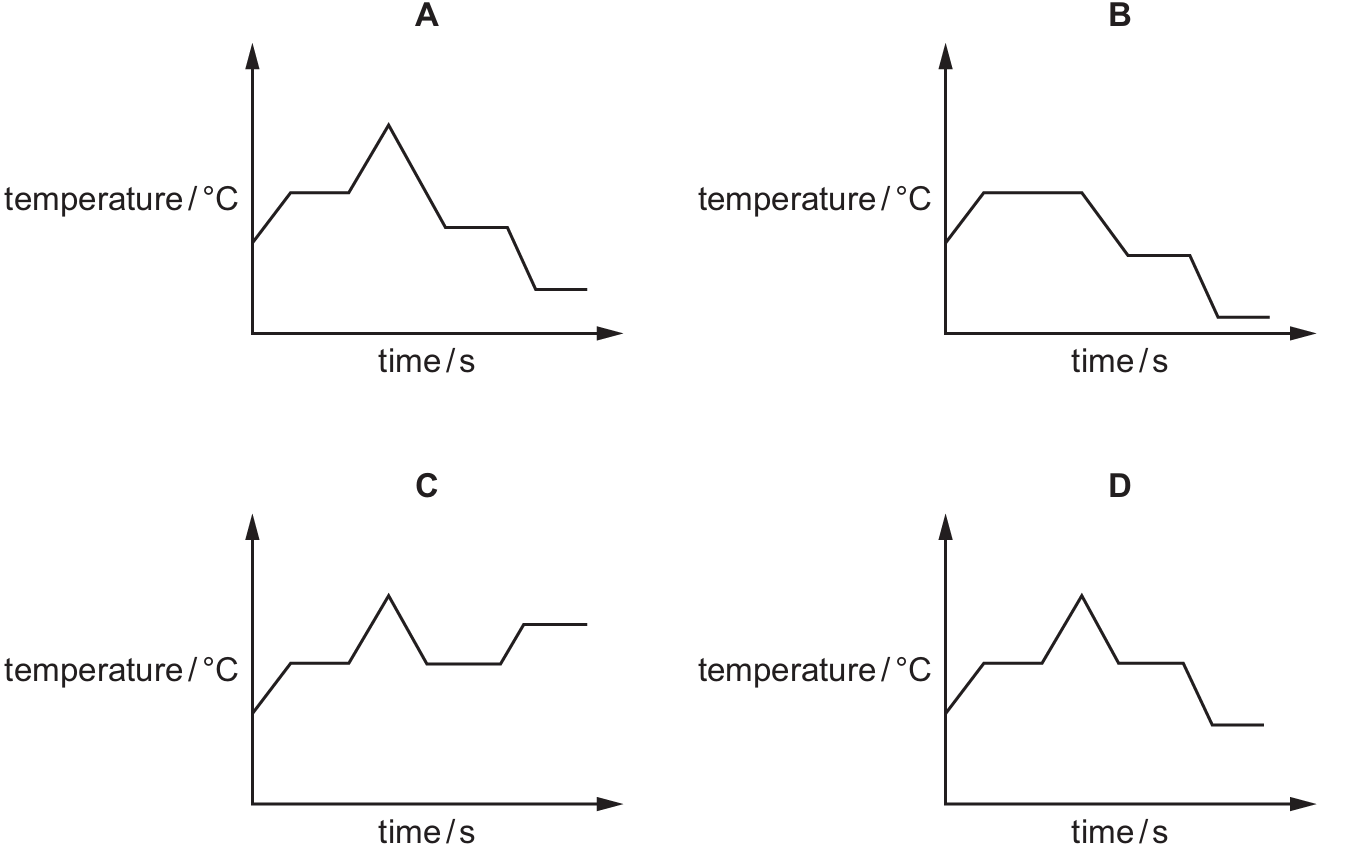
A sample of a liquid, X, is heated to a temperature above its boiling point.
X is then cooled, so that it condenses and then freezes.
Which graph describes the change in temperature of X over time?

Most-appropriate topic codes (Cambridge IGCSE Chemistry 0620):
▶️ Answer/Explanation
✅ Answer: (D)
Question 3
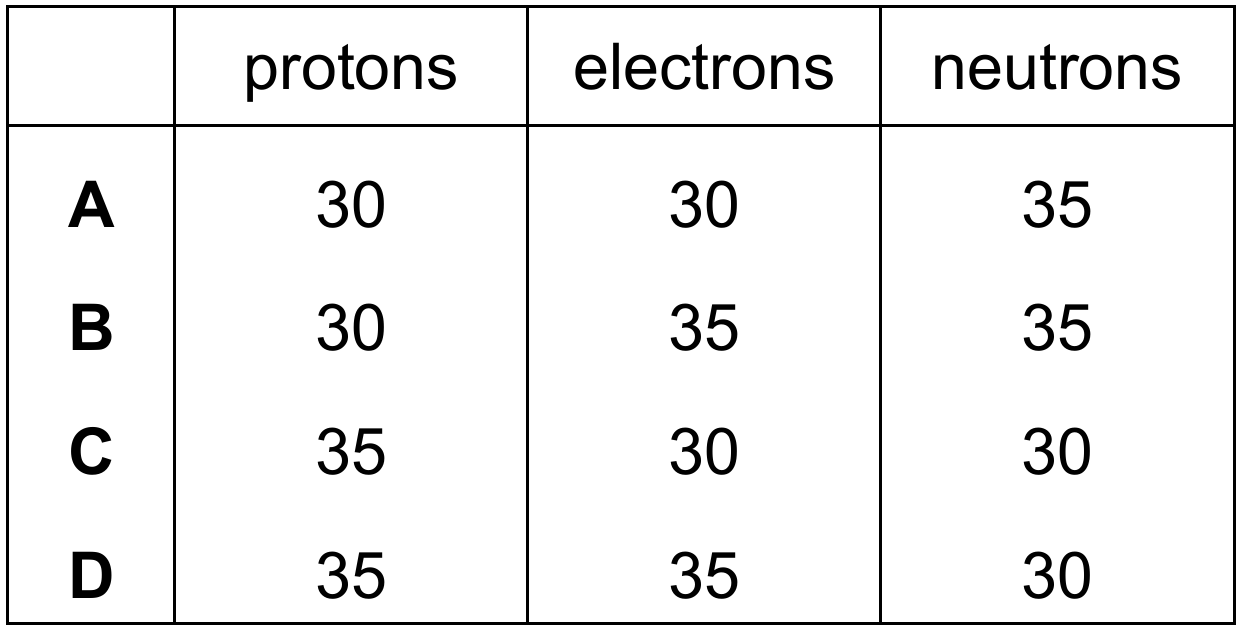
Which row gives the number of protons, electrons and neutrons in an atom of zinc?

Most-appropriate topic codes (Cambridge IGCSE Chemistry 0620):
▶️ Answer/Explanation
✅ Answer: (A)
Question 4
Which particles have the electronic configuration 2,8,8?
- an argon atom, Ar
- an aluminium ion, Al3+
- a sodium ion, Na+
- a chloride ion, Cl−
(A) 1 and 3
(B) 1 and 4
(C) 2 and 3
(D) 2 and 4
Most-appropriate topic codes (Cambridge IGCSE Chemistry 0620):
▶️ Answer/Explanation
✅ Answer: (B)
Question 5
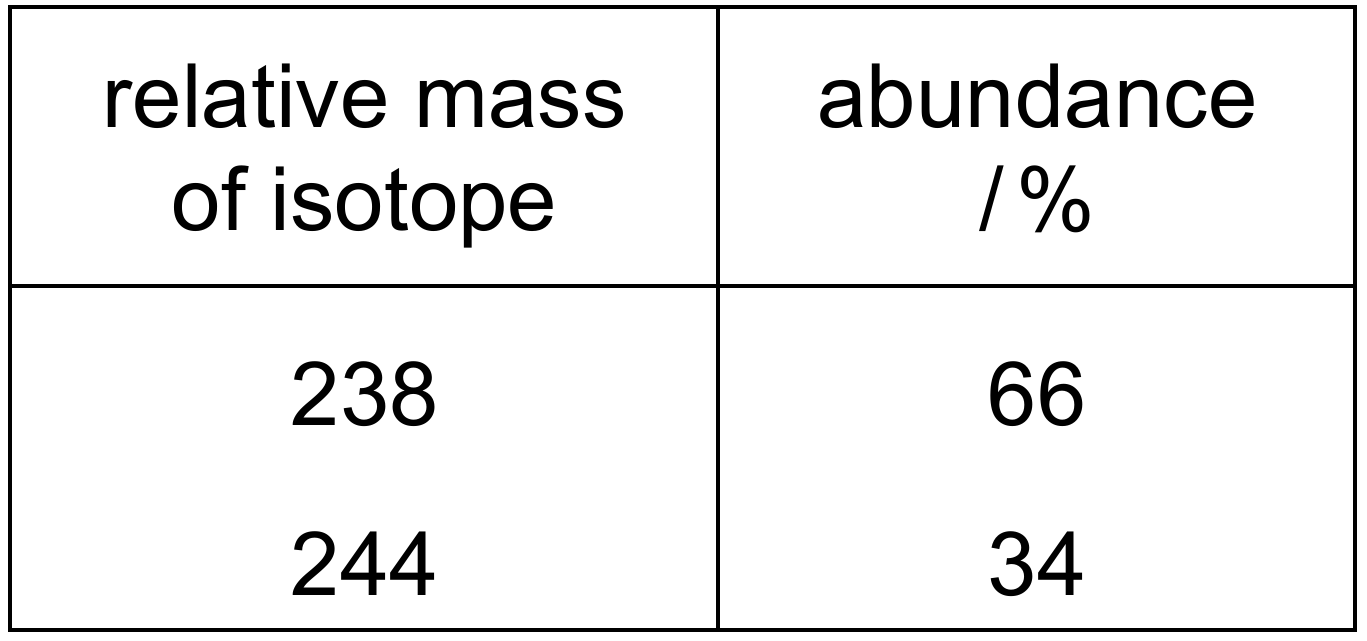
A sample of element Q has two isotopes.
Their relative masses and abundances are shown.

What is the relative atomic mass of this sample of Q to three significant figures?
(A) 240
(B) 241
(C) 242
(D) 243
Most-appropriate topic codes (Cambridge IGCSE Chemistry 0620):
▶️ Answer/Explanation
✅ Answer: (A)
Question 6
Which statement about silicon(IV) oxide, SiO2, is correct?
(A) It conducts electricity because it contains delocalised electrons.
(B) It has a giant covalent structure with each silicon atom bonded to four oxygen atoms.
(C) It is a simple covalent molecule.
(D) Its structure is similar to that of graphite.
Most-appropriate topic codes (Cambridge IGCSE Chemistry 0620):
▶️ Answer/Explanation
✅ Answer: (B)
Question 7
When 65g of zinc reacts with 32g of sulfur, 97g of zinc sulfide is produced.
When 65g of zinc reacts with 40g of sulfur, the mass of zinc sulfide produced is still 97g.
Which statement explains this observation?
(A) Some of the zinc sulfide evaporates.
(B) The reaction rate is slow.
(C) The reaction stops before it is complete.
(D) Zinc is the limiting reactant.
Most-appropriate topic codes (Cambridge IGCSE Chemistry 0620):
▶️ Answer/Explanation
✅ Answer: (D)
Question 8
Aluminium reacts with iron(III) oxide to form aluminium oxide and iron.
Which chemical equation for the reaction between aluminium and iron(III) oxide is correct?
(A) Al + FeO → AlO + Fe
(B) 2Al + Fe2O → Al2O + 2Fe
(C) Al + Fe2O3 → Al2O3 + Fe
(D) 2Al + Fe2O3 → Al2O3 + 2Fe
Most-appropriate topic codes (Cambridge IGCSE Chemistry 0620):
▶️ Answer/Explanation
✅ Answer: (D)
Question 9
The concentration of a solution of aqueous sodium hydroxide is 0.50 mol/dm³.
Which mass of sodium hydroxide is used to make 500cm³ of this solution?
(A) 10g
(B) 20g
(C) 40g
(D) 160g
Most-appropriate topic codes (Cambridge IGCSE Chemistry 0620):
▶️ Answer/Explanation
✅ Answer: (A)
Question 10
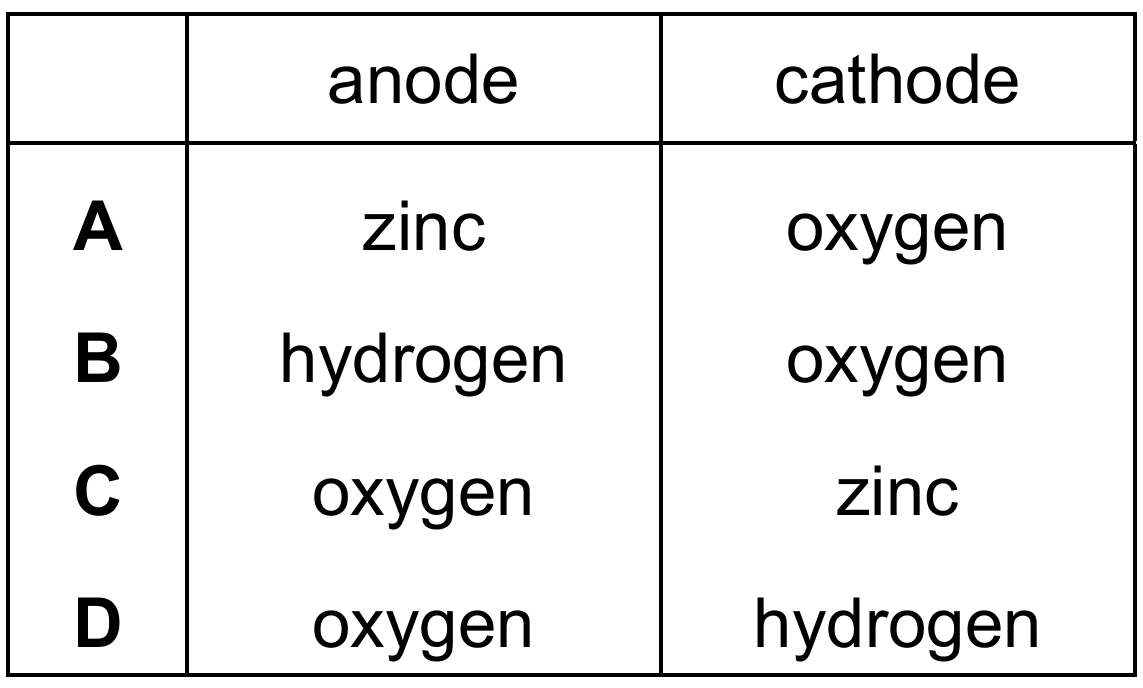
Molten zinc oxide is electrolysed using inert electrodes.
Which row identifies the product at each electrode?

Most-appropriate topic codes (Cambridge IGCSE Chemistry 0620):
▶️ Answer/Explanation
✅ Answer: (C)
Question 11
Dilute aqueous sodium chloride is electrolysed using platinum electrodes. What is the half-equation for the reaction at the cathode?
(A) 2H+ + 2e− → H2
(B) Na+ + e− → Na
(C) 2Cl− → Cl2 + 2e−
(D) 4OH− → 2H2O + O2 + 4e−
Most-appropriate topic codes (Cambridge IGCSE Chemistry 0620):
▶️ Answer/Explanation
✅ Answer: (A)
Question 12
Hydrogen-oxygen fuel cells can be used to power vehicles.
Which statement about hydrogen-oxygen fuel cells is correct?
(A) The equation for the overall reaction is H2 + O2 → H2O2
(B) The only chemical products are water and carbon dioxide.
(C) Chemical energy in the fuel is converted into electrical energy.
(D) The hydrogen used in hydrogen-oxygen fuel cells is a fossil fuel.
Most-appropriate topic codes (Cambridge IGCSE Chemistry 0620):
▶️ Answer/Explanation
✅ Answer: (C)
Question 13
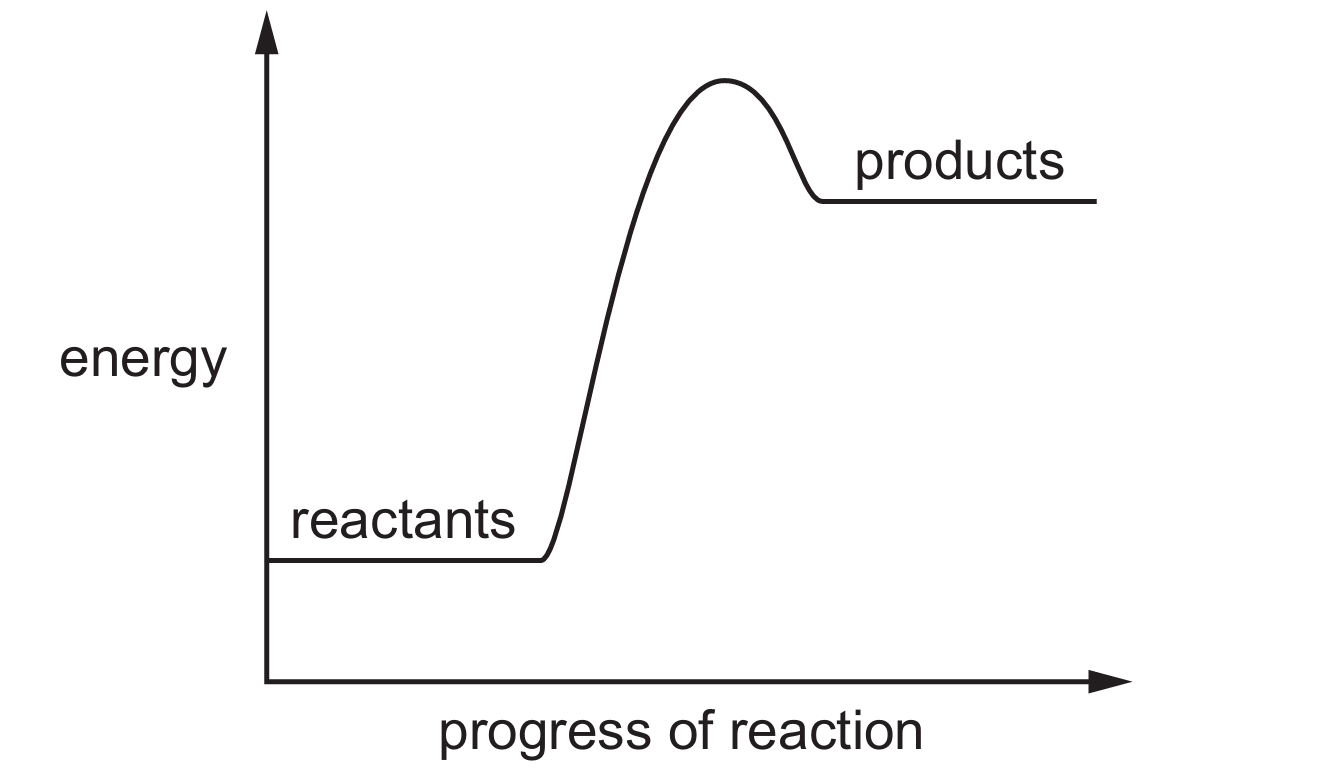
A reaction pathway diagram is shown.

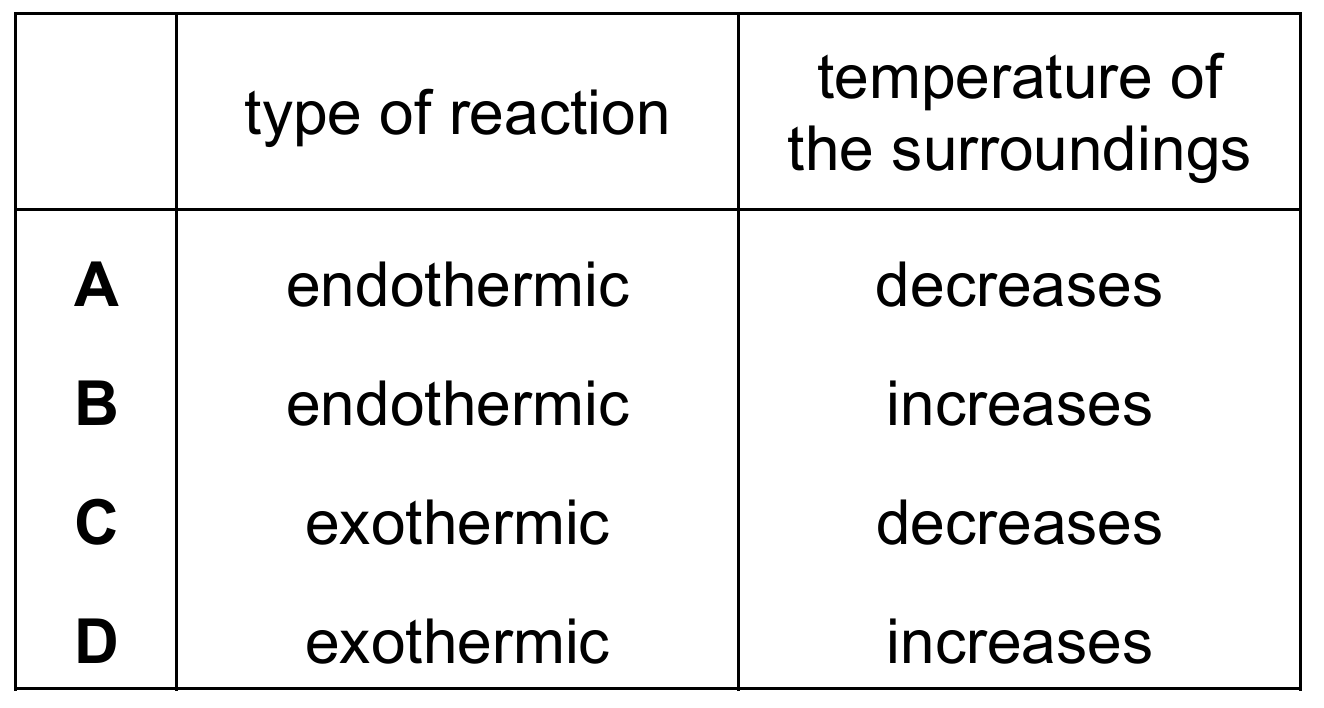
Which row identifies the type of reaction and how the temperature of the surroundings changes during the reaction?

Most-appropriate topic codes (Cambridge IGCSE Chemistry 0620):
▶️ Answer/Explanation
✅ Answer: (A)
Question 14
The average bond energy for the C-H bond is 413 kJ/mol. What is the enthalpy change when 1.0 mol of methane molecules is formed from carbon and hydrogen atoms?
(A) −1652 kJ
(B) −413 kJ
(C) +413 kJ
(D) +1652 kJ
Most-appropriate topic codes (Cambridge IGCSE Chemistry 0620):
▶️ Answer/Explanation
✅ Answer: (A)
Question 15
Which statement describes the effect of adding a catalyst to a chemical reaction?
(A) The activation energy, Ea, of the reaction is increased.
(B) The enthalpy change, ΔH, of the reaction stays unchanged.
(C) The frequency of collisions between the particles is decreased.
(D) The kinetic energy of the particles is increased.
Most-appropriate topic codes (Cambridge IGCSE Chemistry 0620):
▶️ Answer/Explanation
✅ Answer: (B)
Question 16
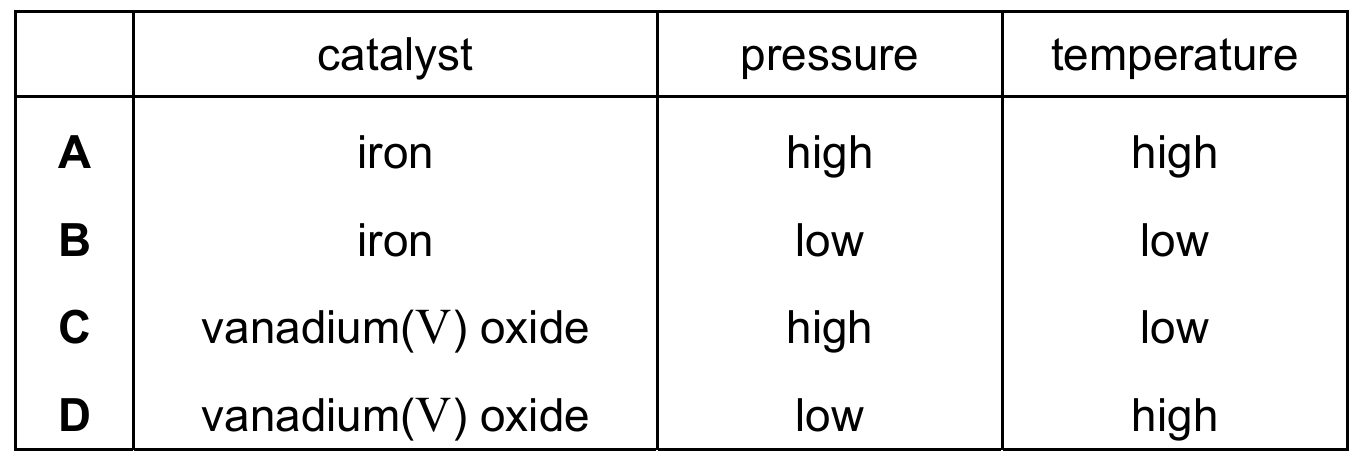
Which row describes the conditions used in the manufacture of sulfuric acid by the Contact process?

Most-appropriate topic codes (Cambridge IGCSE Chemistry 0620):
▶️ Answer/Explanation
✅ Answer: (D)
Question 17
Which equations show the underlined species acting as a reducing agent?
- Fe2O3 + 3CO → 2Fe + 3CO2
- Fe + CuSO4 → FeSO4 + Cu
- 5Fe2+ + MnO4− + 8H+ → 5Fe3+ + Mn2+ + 4H2O
- Fe(OH)2 + H2SO4 → FeSO4 + 2H2O
(A) 1 and 2
(B) 1 and 4
(C) 2 and 3
(D) 3 and 4
Most-appropriate topic codes (Cambridge IGCSE Chemistry 0620):
▶️ Answer/Explanation
✅ Answer: (C)
Question 18
A farmer incorrectly adds two substances to the soil at the same time.
They react together to form a gas which turns damp red litmus paper blue.
What are the two substances?
(A) a basic oxide and a potassium salt
(B) a basic oxide and an ammonium salt
(C) an acidic oxide and a potassium salt
(D) an acidic oxide and an ammonium salt
Most-appropriate topic codes (Cambridge IGCSE Chemistry 0620):
▶️ Answer/Explanation
✅ Answer: (B)
Question 19
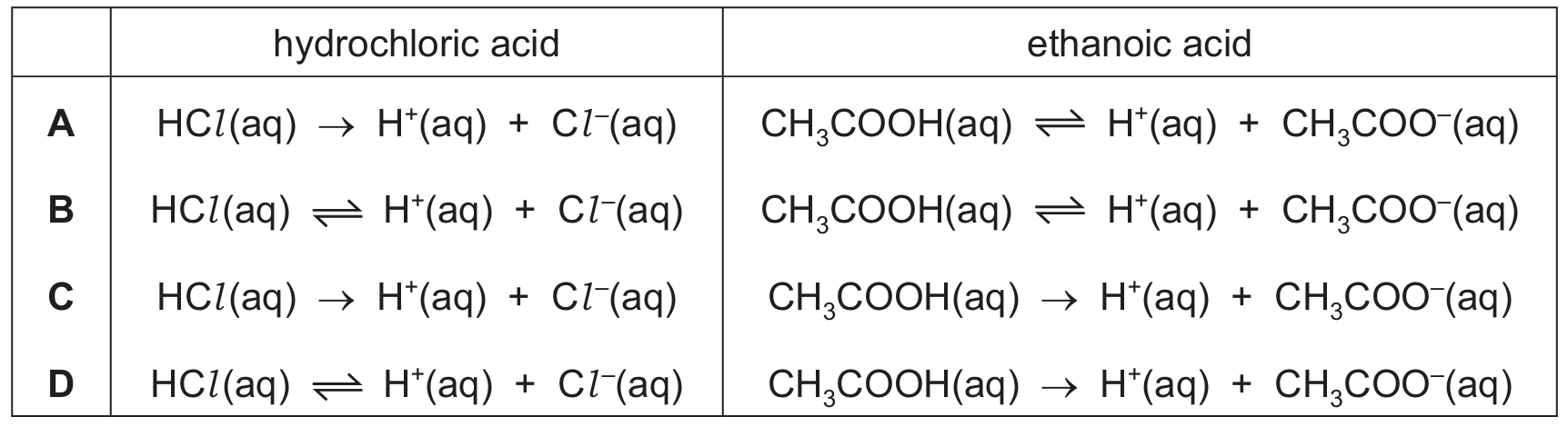
Which row shows the equations for the dissociation of hydrochloric acid and of ethanoic acid in aqueous solution?

Most-appropriate topic codes (Cambridge IGCSE Chemistry 0620):
▶️ Answer/Explanation
✅ Answer: (A)
Question 20
Which three oxides are all acidic?
(A) CaO, NO2, SO2
(B) CaO, CO2, Na2O
(C) CO2, NO2, SO2
(D) CO2, Na2O, SO2
Most-appropriate topic codes (Cambridge IGCSE Chemistry 0620):
▶️ Answer/Explanation
✅ Answer: (C)
Question 21
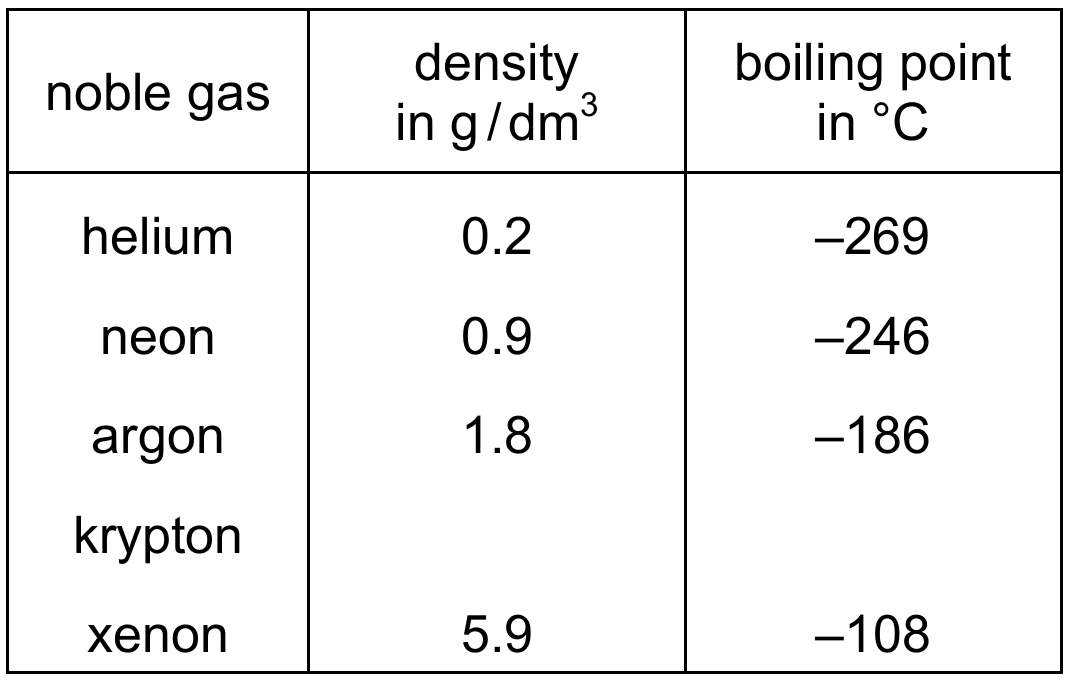
The table shows some properties of noble gases.

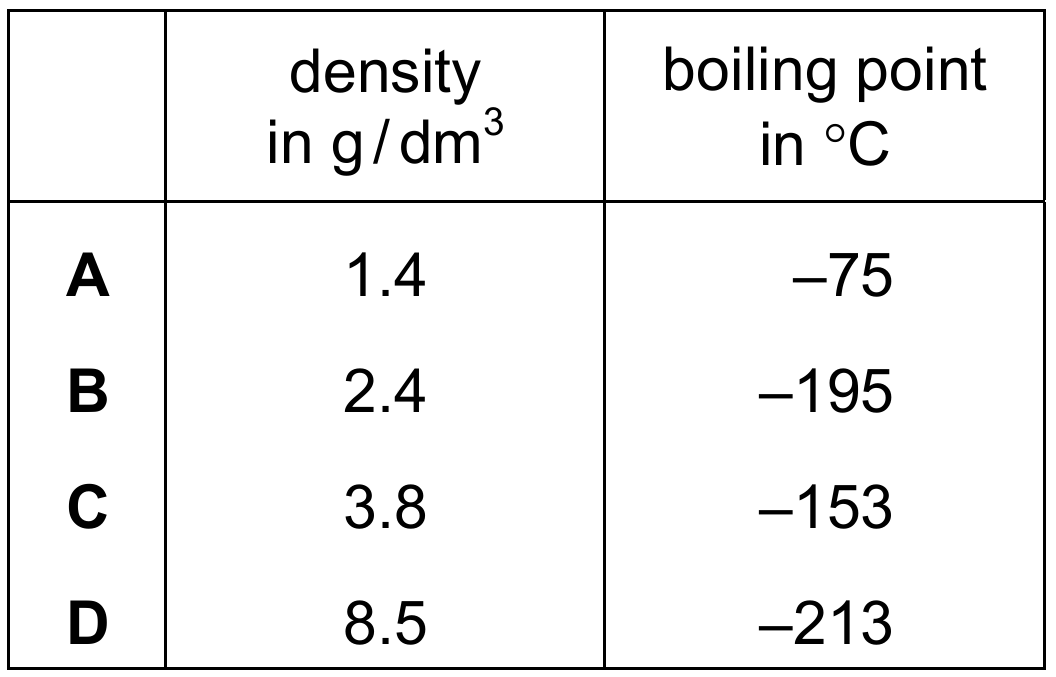
Which row predicts the density and the boiling point of krypton?

Most-appropriate topic codes (Cambridge IGCSE Chemistry 0620):
▶️ Answer/Explanation
✅ Answer: (C)
Question 22
Sodium is a Group I metal.
What is a physical property of sodium?
(A) non-conductor of electricity
(B) high melting point
(C) high density
(D) malleable
Most-appropriate topic codes (Cambridge IGCSE Chemistry 0620):
▶️ Answer/Explanation
✅ Answer: (D)
Question 23
Tennessee (atomic number 117) is a manufactured element that is below astatine in Group VII of the Periodic Table.
What is the expected state of tennessine at room temperature and pressure?
(A) a diatomic gas
(B) a liquid
(C) a monatomic gas
(D) a solid
Most-appropriate topic codes (Cambridge IGCSE Chemistry 0620):
▶️ Answer/Explanation
✅ Answer: (D)
Question 24
When chlorine is bubbled into aqueous sodium bromide, a displacement reaction occurs.
Which description of this reaction is correct?
(A) Chloride displaces bromide.
(B) Chlorine displaces bromine.
(C) Chloride displaces bromine.
(D) Chlorine displaces bromide.
Most-appropriate topic codes (Cambridge IGCSE Chemistry 0620):
▶️ Answer/Explanation
✅ Answer: (B)
Question 25
Brass is an alloy of copper.
Which statement about brass or copper is correct?
(A) Brass does not conduct electricity because it is a compound.
(B) Copper conducts electricity because its atoms are free to move.
(C) Brass is harder than copper because its layers of atoms cannot easily slide over each other.
(D) Copper is stronger than brass because it is a pure metal.
Most-appropriate topic codes (Cambridge IGCSE Chemistry 0620):
▶️ Answer/Explanation
✅ Answer: (C)
Question 26
The ionic equations for some reactions between metals and aqueous metal ions are shown.
Cu + 2Ag+ → 2Ag + Cu2+
Mg + Zn2+ → Mg2+ + Zn
Zn + Cu2+ → Cu + Zn2+
Sn + Cu2+ → Sn2+ + Cu
Which further information can be used to place copper, magnesium, silver, tin and zinc in order of their reactivity?
(A) Zinc reacts with Sn2+ ions.
(B) Copper does not react with Sn2+ ions.
(C) Magnesium reacts with Cu2+ ions.
(D) Magnesium reacts with Ag+ ions.
Most-appropriate topic codes (Cambridge IGCSE Chemistry 0620):
▶️ Answer/Explanation
✅ Answer: (A)
Question 27
Zinc is used to galvanise iron to prevent it from rusting.
Which statements are correct?
- Galvanising is an example of a barrier method.
- If the zinc is scratched, the iron will rust very quickly.
- Galvanising is an example of sacrificial protection.
- Zinc is more reactive than iron and so accepts electrons more readily.
(A) 1, 2 and 4
(B) 1 and 3
(C) 2, 3 and 4
(D) 2 and 3 only
Most-appropriate topic codes (Cambridge IGCSE Chemistry 0620):
▶️ Answer/Explanation
✅ Answer: (B)
Question 28
Which equation represents a reaction that occurs in a blast furnace during the extraction of iron from hematite?
(A) Ca + CO2 → CaO + CO
(B) Fe2O3 + 3Ca → 2Fe + 3CaO
(C) Ca(OH)2 → CaO + H2O
(D) Fe2O3 + 3CO → 2Fe + 3CO2
Most-appropriate topic codes (Cambridge IGCSE Chemistry 0620):
▶️ Answer/Explanation
✅ Answer: (D)
Question 29
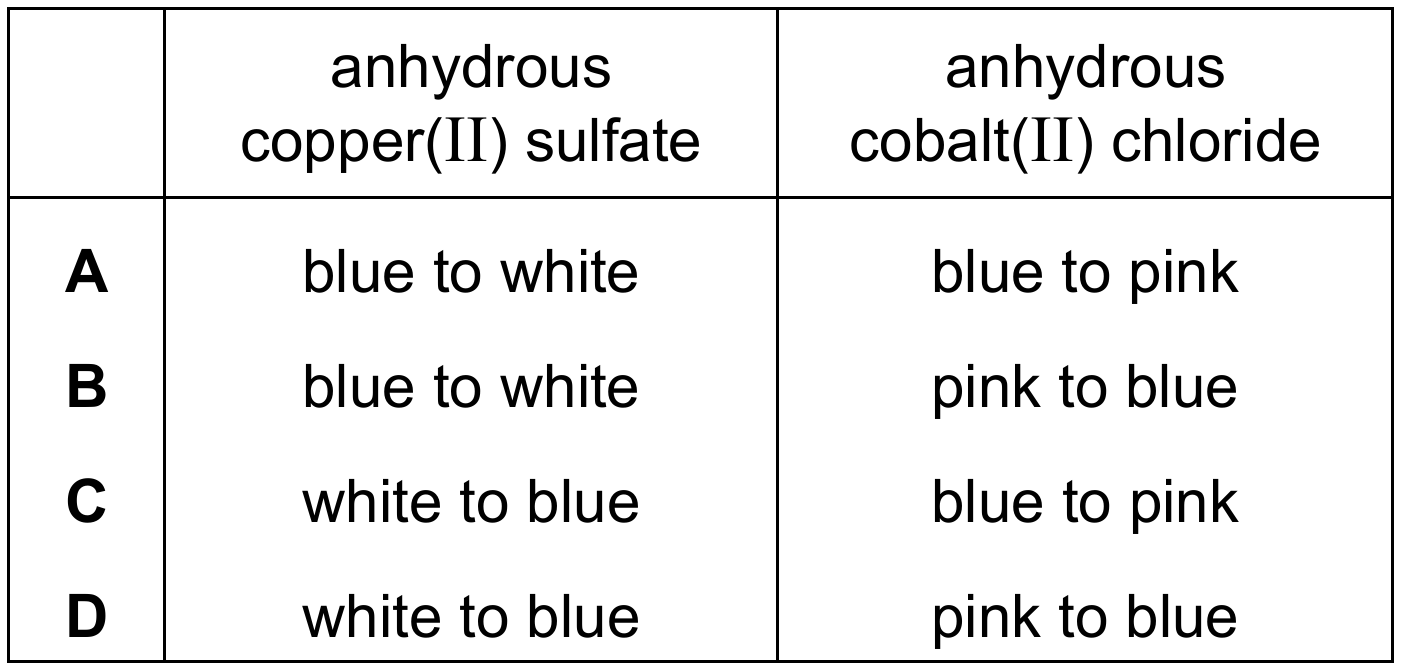
Water is added separately to anhydrous copper(II) sulfate and to anhydrous cobalt(II) chloride. Which row shows the colour changes?

Most-appropriate topic codes (Cambridge IGCSE Chemistry 0620):
▶️ Answer/Explanation
✅ Answer: (C)
Question 30
Gases which cause acid rain form in car engines. These gases can be removed using a catalytic converter.
Which equation represents the removal of one of these gases using a catalytic converter?
(A) CO2 + C → 2CO
(B) 2CO + 2NO → 2CO2 + N2
(C) N2 + 2O2 → 2NO2
(D) 2NO + O2 → 2NO2
Most-appropriate topic codes (Cambridge IGCSE Chemistry 0620):
▶️ Answer/Explanation
✅ Answer: (B)
Question 31
Which statements about carbon dioxide are correct?
- Carbon dioxide absorbs thermal energy from the Earth.
- Carbon dioxide increases the thermal energy loss to space.
- The level of carbon dioxide in the atmosphere has increased due to the burning of fossil fuels.
- Carbon dioxide is the only gas that causes global warming.
(A) 1 and 2
(B) 1 and 3
(C) 2 and 3
(D) 2 and 4
Most-appropriate topic codes (Cambridge IGCSE Chemistry 0620):
▶️ Answer/Explanation
✅ Answer: (B)
Question 32
What is the structural formula of butan-2-ol?
(A) CH3CH2CH2OH
(B) CH3CH(OH)CH3
(C) CH3CH2CH2CH2OH
(D) CH3CH2CH(OH)CH3
Most-appropriate topic codes (Cambridge IGCSE Chemistry 0620):
▶️ Answer/Explanation
✅ Answer: (D)
Question 33
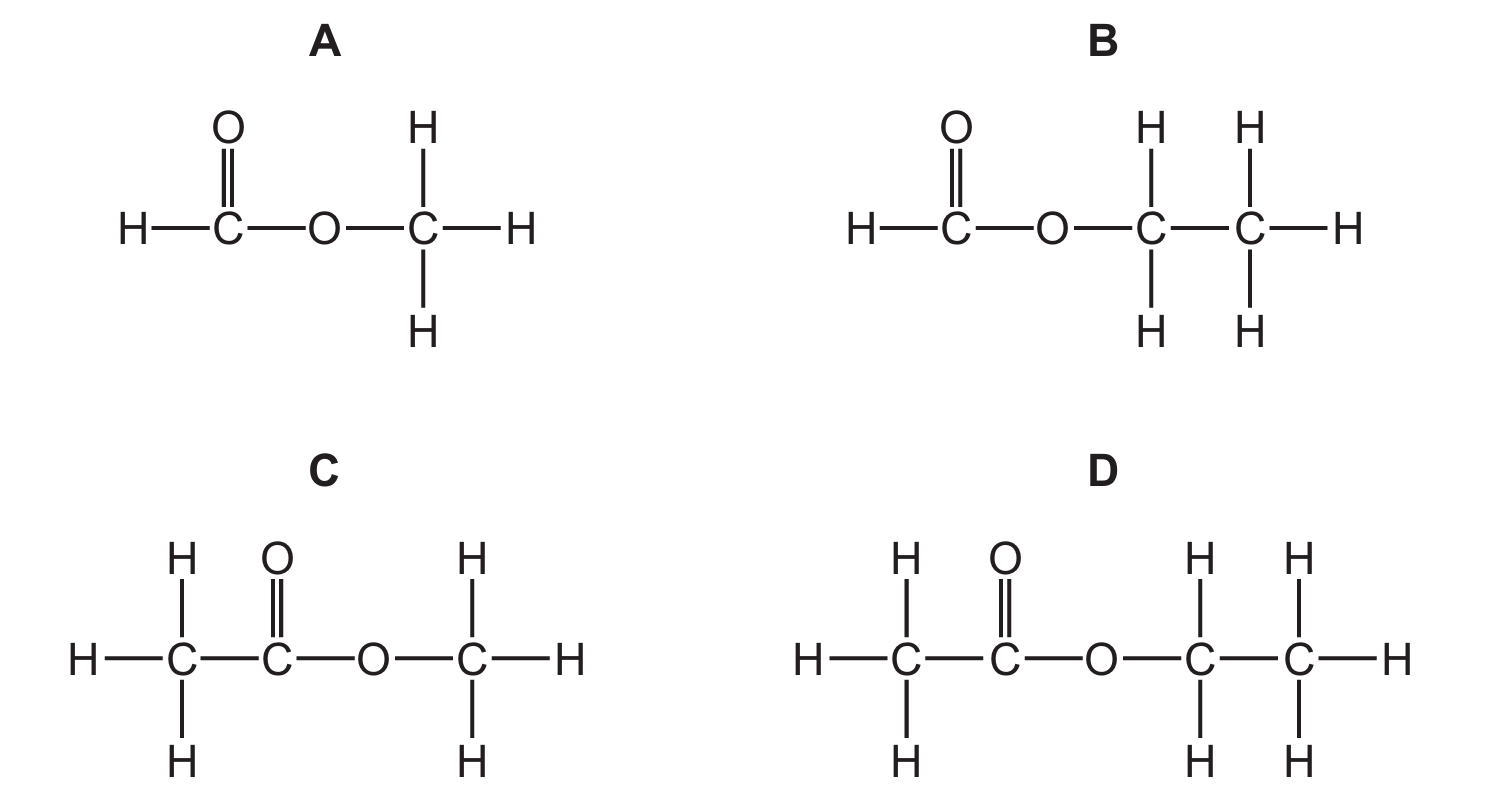
Methanol reacts with ethanoic acid to form an ester.
What is the displayed formula for this ester?

Most-appropriate topic codes (Cambridge IGCSE Chemistry 0620):
▶️ Answer/Explanation
✅ Answer: (C)
Question 34
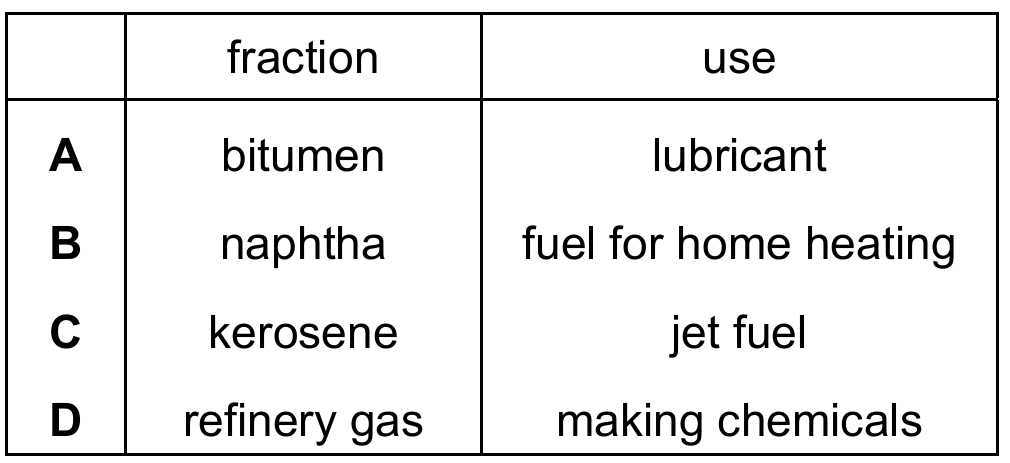
Petroleum can be separated into useful fractions by fractional distillation.
Which row shows a correct use of the named fraction?

Most-appropriate topic codes (Cambridge IGCSE Chemistry 0620):
▶️ Answer/Explanation
✅ Answer: (C)
Question 35
Ethane reacts with chlorine in the presence of ultraviolet light.
Which products are formed?
(A) ClCH₂CH₂Cl and H₂
(B) 2CHCl and H₂
(C) C₂H₅Cl and HCl
(D) CH=CH₂ and 2HCl
Most-appropriate topic codes (Cambridge IGCSE Chemistry 0620):
• TOPIC 11.4: Alkanes (Describe the substitution reaction of alkanes with chlorine as a photochemical reaction, with ultraviolet light providing the activation energy, $E_{\mathrm{a}}$, and draw the structural or displayed formulae of the products, limited to monosubstitution)
▶️ Answer/Explanation
✅ Answer: (C)
Question 36
Ethanol can be made by the fermentation of aqueous glucose and by the catalytic addition of steam to ethene.
What are two advantages of making ethanol by the catalytic addition of steam to ethene rather than by the fermentation of aqueous glucose?
(A) faster reaction and renewable raw materials
(B) purer product and faster reaction
(C) renewable raw materials and continuous process
(D) uses more energy and forms a purer product
Most-appropriate topic codes (Cambridge IGCSE Chemistry 0620):
• TOPIC 11.6: Alcohols (Describe the advantages and disadvantages of the manufacture of ethanol by fermentation and catalytic addition of steam to ethene)
▶️ Answer/Explanation
✅ Answer: (B)
Question 37
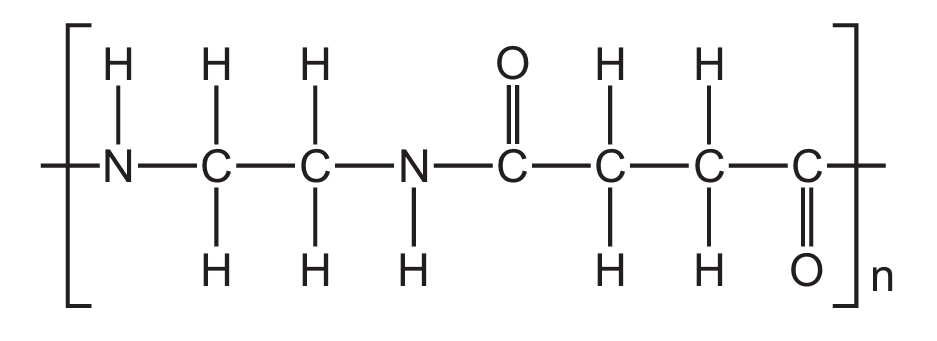
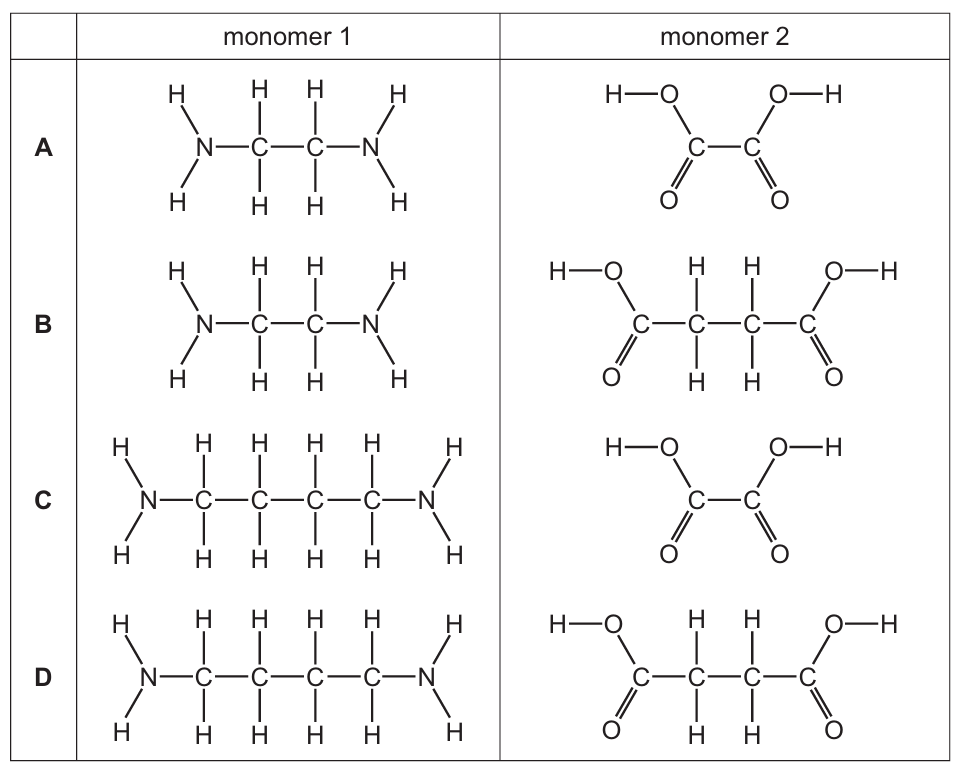
The structure of a polymer repeat unit is shown.

Which pair of monomers is used to make this polymer?

Most-appropriate topic codes (Cambridge IGCSE Chemistry 0620):
• TOPIC 11.8: Polymers (Deduce the structure or repeat unit of a condensation polymer from given monomers and vice versa, limited to: polyamides from a dicarboxylic acid and a diamine)
▶️ Answer/Explanation
✅ Answer: (B)
Question 38
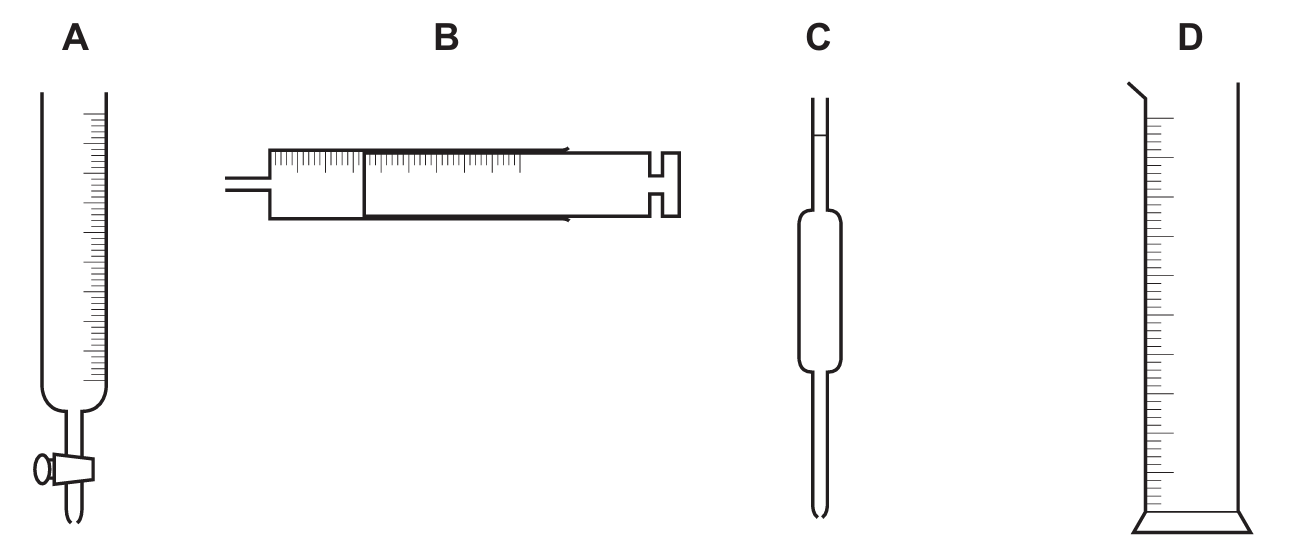
Which item of apparatus is used to measure exactly $26.3cm^3$ of a liquid?

Most-appropriate topic codes (Cambridge IGCSE Chemistry 0620):
• TOPIC 12.1: Experimental design (Name appropriate apparatus for the measurement of time, temperature, mass and volume, including: burettes, volumetric pipettes, measuring cylinders)
▶️ Answer/Explanation
✅ Answer: (A)
Question 39
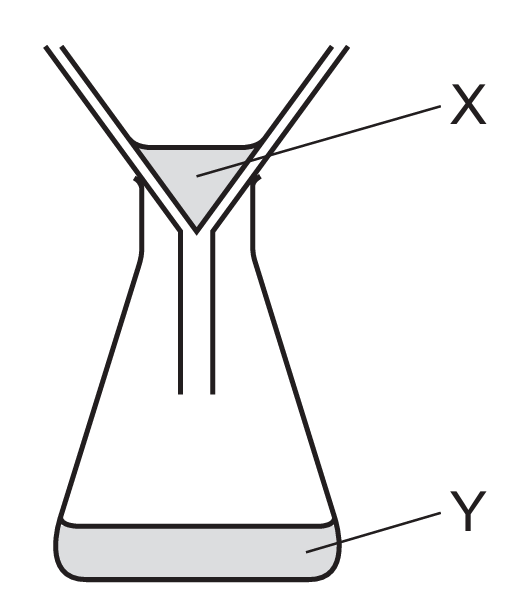
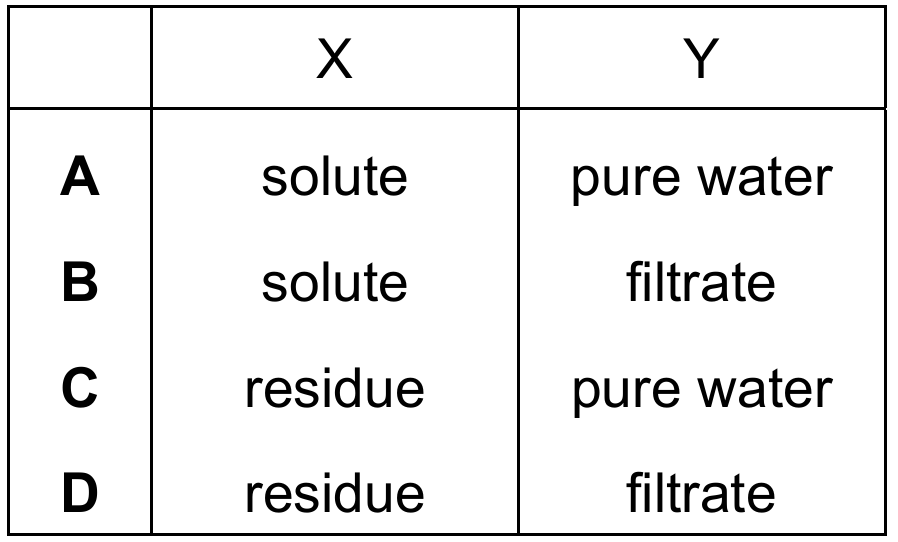
A mixture containing an aqueous salt and an insoluble salt is filtered.

Which row describes X and Y?

Most-appropriate topic codes (Cambridge IGCSE Chemistry 0620):
• TOPIC 12.1: Experimental design (Describe a: residue as a substance that remains after evaporation, distillation, filtration or any similar process; filtrate as a liquid or solution that has passed through a filter)
▶️ Answer/Explanation
✅ Answer: (D)
Question 40
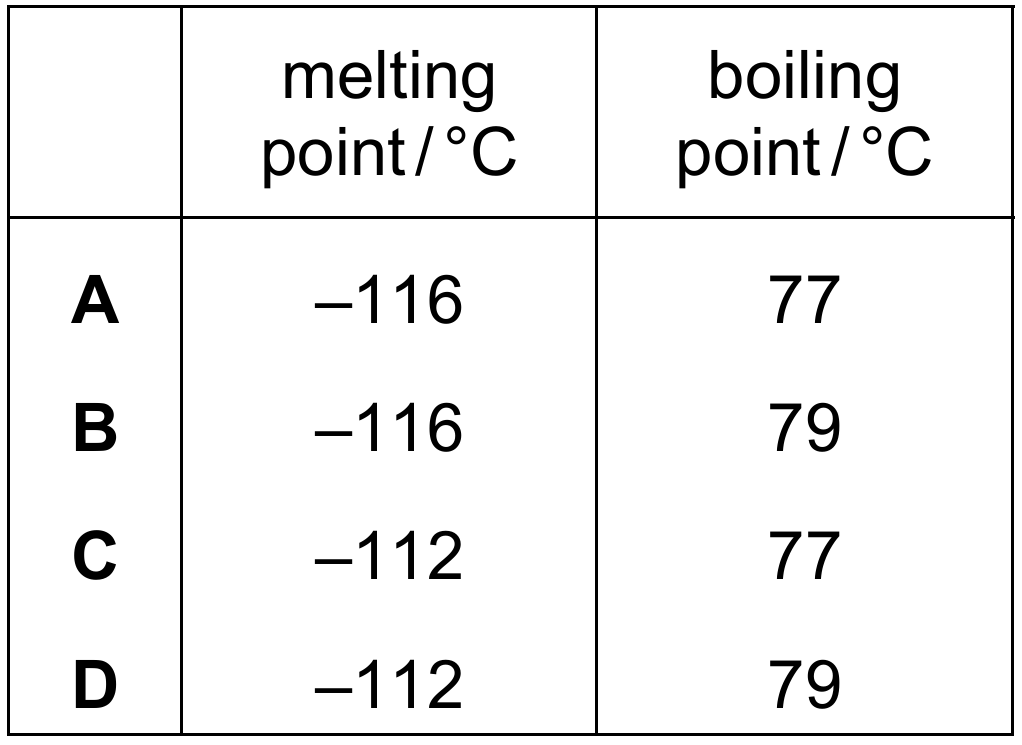
Pure ethanol has a melting point of $-114^{\circ}C$ and a boiling point of $78^{\circ}C$. What are the melting and boiling points of a sample of ethanol with glucose dissolved in it?

Most-appropriate topic codes (Cambridge IGCSE Chemistry 0620):
• TOPIC 12.4: Separation and purification (Identify substances and assess their purity using melting point and boiling point information)
▶️ Answer/Explanation
✅ Answer: (B)