
Question 1
A list of substances is shown.
aluminium
bromine
calcium
carbon dioxide
iron
magnesium
magnesium oxide
neon
oxygen
potassium
sulfur dioxide
Answer the following questions about these substances. Each substance may be used once, more than once or not at all.
State which substance is:
(a) an element which forms an ion with a $2-$ charge
(b) an ionic compound
(c) used as a catalyst
(d) approximately $21\%$ of clean, dry air
(e) a gas needed for photosynthesis
(f) the most reactive metal in the list
(g) a gas that is tested for using acidified aqueous potassium manganate(VII)
(h) a noble gas
(i) in Group VII.
Most-appropriate topic codes (Cambridge IGCSE Chemistry 0620):
• Topic 2.2 — Atomic structure and the Periodic Table (Parts (a), (h), (i))
• Topic 2.4 — Ions and ionic bonds (Part (b))
• Topic 6.2 — Rate of reaction / 8.4 Transition elements (Part (c))
• Topic 10.3 — Air quality and climate (Parts (d), (e))
• Topic 9.4 — Reactivity series (Part (f))
• Topic 12.5 — Identification of ions and gases (Part (g))
▶️ Answer/Explanation
(a) oxygen
Oxygen ($\mathrm{O}$) is in Group VI. It has 6 valence electrons and needs to gain 2 electrons to achieve a full octet. By gaining $2\mathrm{e}^-$, it forms the oxide anion $\mathrm{O}^{2-}$, which carries a $2-$ charge.
(b) magnesium oxide
Magnesium oxide ($\mathrm{MgO}$) consists of a metal (magnesium) and a non-metal (oxygen). There is a complete transfer of 2 electrons from $\mathrm{Mg}$ to $\mathrm{O}$, forming $\mathrm{Mg}^{2+}$ and $\mathrm{O}^{2-}$. The strong electrostatic attraction between these oppositely charged ions constitutes an ionic bond, making $\mathrm{MgO}$ an ionic compound.
(c) iron
Iron is a transition metal. Finely divided iron acts as a heterogeneous catalyst in the Haber process: $\mathrm{N}_2(\mathrm{g}) + 3\mathrm{H}_2(\mathrm{g}) \rightleftharpoons 2\mathrm{NH}_3(\mathrm{g})$.
(d) oxygen
By volume, clean, dry air consists of approximately $78\%$ nitrogen, $21\%$ oxygen, and $1\%$ argon, carbon dioxide and other noble gases.
(e) carbon dioxide
Photosynthesis uses light energy to convert carbon dioxide and water into glucose and oxygen: $6\mathrm{CO}_2 + 6\mathrm{H}_2\mathrm{O} \xrightarrow{\text{light}} \mathrm{C}_6\mathrm{H}_{12}\mathrm{O}_6 + 6\mathrm{O}_2$. $\mathrm{CO}_2$ is the essential gas.
(f) potassium
Potassium ($\mathrm{K}$) is an alkali metal in Group I. Reactivity in Group I increases down the group (Li $\lt$ Na $\lt$ K). Potassium is below lithium and sodium in the list and is therefore the most reactive metal present.
(g) sulfur dioxide
Sulfur dioxide ($\mathrm{SO}_2$) is a reducing agent. It reduces purple acidified potassium manganate(VII) ($\mathrm{MnO}_4^-$) to colourless $\mathrm{Mn}^{2+}$ ions. This colour change from purple to colourless is a specific test for $\mathrm{SO}_2$.
(h) neon
Neon is in Group VIII (Group 0). It is an inert monatomic gas because its atoms possess a full outer electron shell (2,8), making it extremely unreactive.
(i) bromine
Bromine ($\mathrm{Br}$) is a halogen. The halogens (fluorine, chlorine, bromine, iodine, astatine) are located in Group VII of the Periodic Table and are diatomic non-metals.
Question 2
This question is about sea water and the substances found in sea water.
(a) Table 2.1 shows the masses of some of the compounds formed when $500\,\mathrm{cm}^3$ of sea water is evaporated.
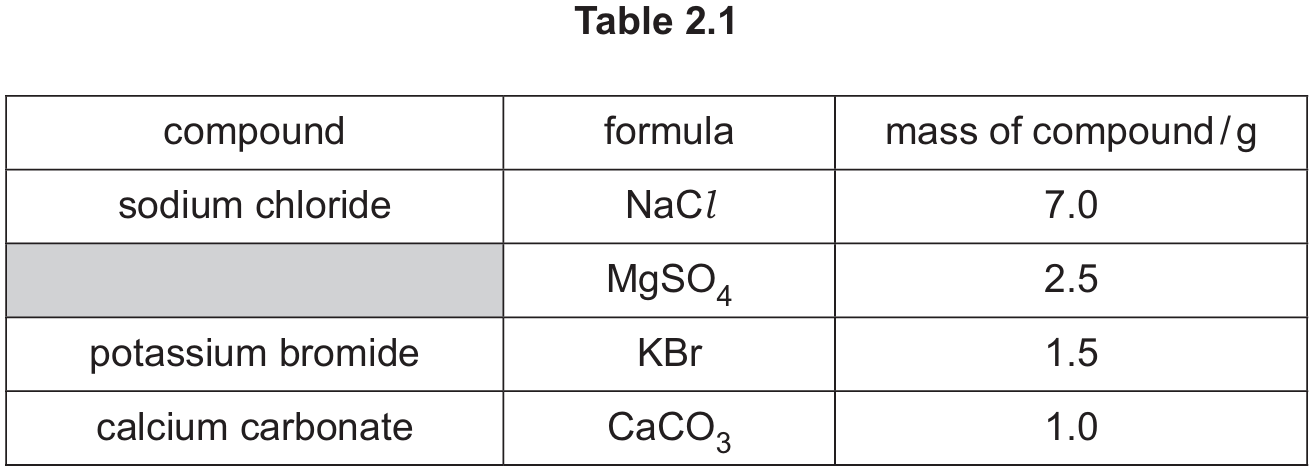
Answer these questions using the information from Table 2.1.
(i) State the chemical name of $\mathrm{MgSO_4}$.
(ii) The total mass of compounds formed from $500\,\mathrm{cm}^3$ of sea water is $12.0\,\mathrm{g}$.
Calculate the total mass of compounds formed from $750\,\mathrm{cm}^3$ of sea water.
(iii) State which compound in Table 2.1 reacts with an acid to produce carbon dioxide.
(b) Potassium bromide is found in sea water and contains bromide ions.
Describe a test for bromide ions.
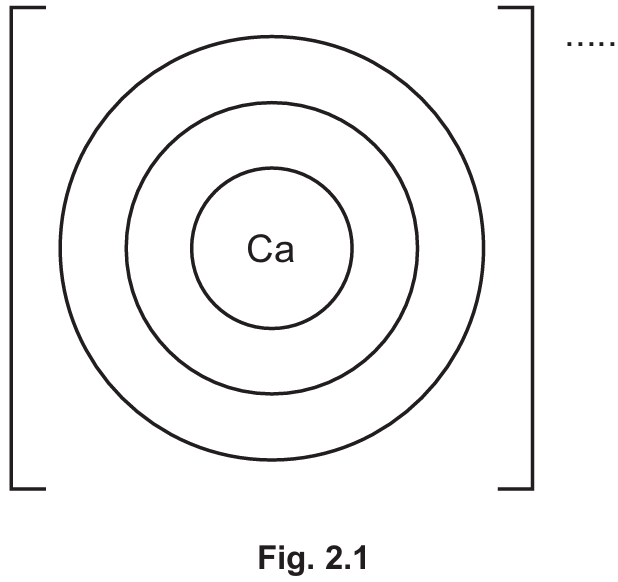
(c) Calcium ions are in sea water.
Complete Fig. 2.1 to show:
- the electronic configuration of a calcium ion
- the charge on the ion.
(d) Sodium chloride is a solid at room temperature.
Describe the arrangement and motion of the particles in a solid.
(e) Sea water contains dissolved nitrate ions.
State one source of nitrate ions.
Most-appropriate topic codes (Cambridge IGCSE Chemistry 0620):
• Topic 3.1 — Formulae (Part (a)(i))
• Topic 3.2 — Relative masses of atoms and molecules (Part (a)(ii))
• Topic 7.1 — The characteristic properties of acids and bases (Part (a)(iii))
• Topic 12.5 — Identification of ions and gases (Part (b))
• Topic 2.2 — Atomic structure and the Periodic Table (Part (c))
• Topic 1.1 — Solids, liquids and gases (Part (d))
• Topic 10.1 — Water / 10.2 Fertilisers (Part (e))
▶️ Answer/Explanation
(a)(i) magnesium sulfate
(a)(ii) $18$ or $18.0$ (g)
Explanation: The mass of dissolved compounds is directly proportional to the volume of sea water. For $500\,\mathrm{cm}^3$, the mass is $12.0\,\mathrm{g}$. So for $1\,\mathrm{cm}^3$, the mass is $\frac{12.0}{500} = 0.024\,\mathrm{g}$. For $750\,\mathrm{cm}^3$, the total mass is $0.024 \times 750 = 18.0\,\mathrm{g}$.
(a)(iii) calcium carbonate / $\mathrm{CaCO_3}$
Explanation: Carbonates react with dilute acids to produce a salt, water, and carbon dioxide gas. For example, $\mathrm{CaCO}_3(\mathrm{s}) + 2\mathrm{HCl}(\mathrm{aq}) \to \mathrm{CaCl}_2(\mathrm{aq}) + \mathrm{H}_2\mathrm{O}(\mathrm{l}) + \mathrm{CO}_2(\mathrm{g})$.
(b)
test: (add nitric acid / acidify and add aqueous) silver nitrate
observations: cream precipitate
Explanation: The test for halide ions involves first adding dilute nitric acid to react with any carbonate ions that might interfere. Aqueous silver nitrate is then added. Silver ions react with bromide ions to form a cream precipitate of silver bromide: $\mathrm{Ag}^+(\mathrm{aq}) + \mathrm{Br}^-(\mathrm{aq}) \to \mathrm{AgBr}(\mathrm{s})$.
(c)
electronic configuration: $2,8,8$ (with no other shells added)
charge: $2+$ or $+2$ written outside the brackets
Explanation: A neutral calcium atom ($\mathrm{Ca}$) has the electron configuration $2,8,8,2$. To achieve a stable noble gas configuration, a calcium atom loses its two outermost electrons. The resulting calcium ion ($\mathrm{Ca}^{2+}$) has the electron configuration $2,8,8$ and carries a double positive charge.
(d)
arrangement: regular / in rows
motion: vibrate
Explanation: In the solid state, particles are closely packed together in a fixed and orderly arrangement. They possess kinetic energy that allows them to vibrate about their fixed lattice positions, but they cannot move freely or change places.
(e) fertilisers
Explanation: Nitrate ions are a key component of nitrogen-based fertilisers. These fertilisers are used in agriculture to promote plant growth, and excess nitrates are often washed (leached) from the soil into rivers and eventually the sea.
Question 3
This question is about phosphorus and its compounds.
(a) (i) Phosphorus is in Group V of the Periodic Table. Explain why phosphorus is placed in this group. [1]
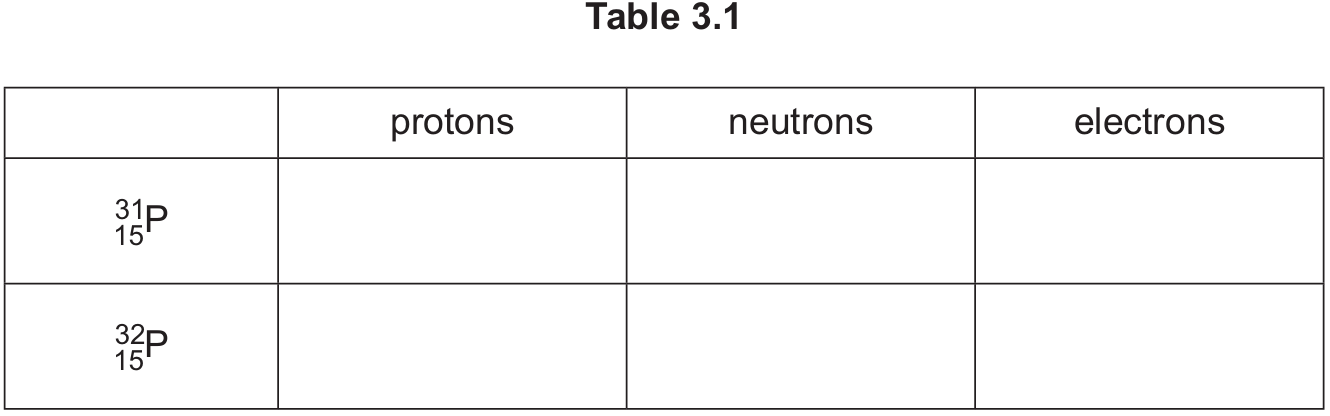
(a) (ii) Two isotopes of phosphorus are shown in Fig. 3.1.
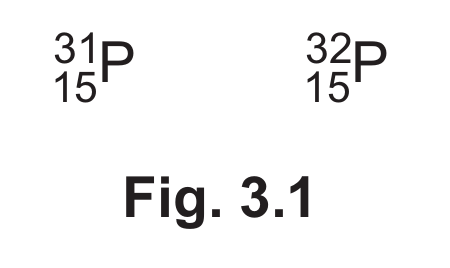
Complete Table 3.1 to show the number of protons, neutrons and electrons in one atom of these isotopes.
(iii) Phosphorus burns in oxygen to produce phosphorus(V) oxide.
Complete the symbol equation for this reaction.
$$\dots \mathrm{P} + \dots \mathrm{O}_2 \rightarrow \mathrm{P}_4\mathrm{O}_{10}$$
(iv) State whether phosphorus(V) oxide is an acidic oxide or a basic oxide.
Give a reason for your answer.
(b) (i) Phosphorus is one element in NPK fertilisers.
Draw a circle around one other element that is also in NPK fertilisers.
krypton nickel platinum potassium
(b) (ii) State why farmers use fertilisers on fields where crops are grown.
(c) A compound of phosphorus has the formula $\mathrm{Ca_3(PO_4)_2}$.
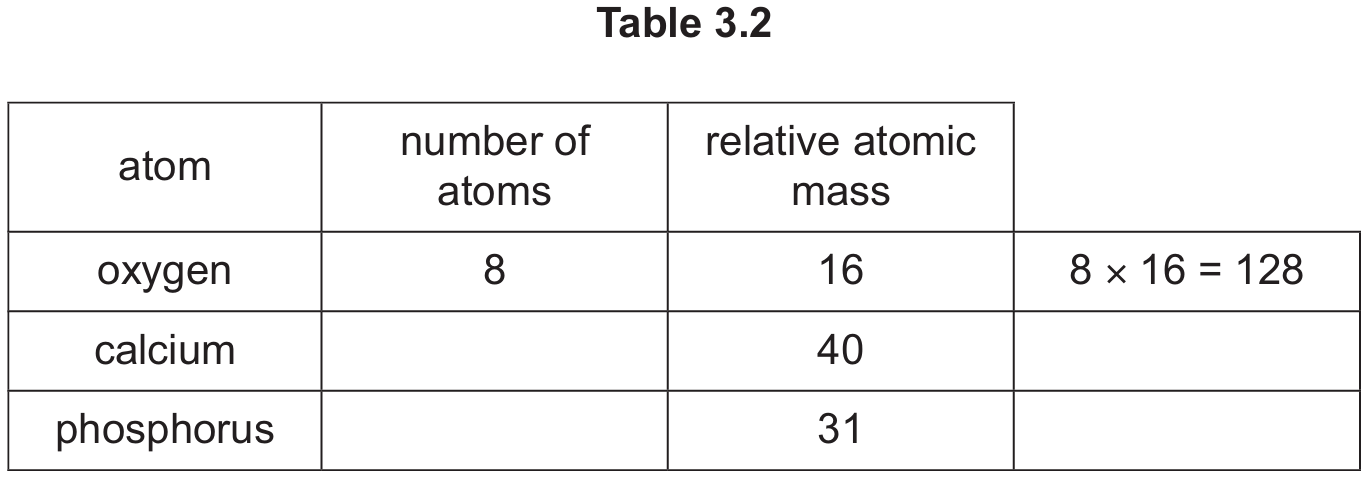
Complete Table 3.2 to calculate the relative formula mass of $\mathrm{Ca_3(PO_4)_2}$.
Most-appropriate topic codes (Cambridge IGCSE Chemistry 0620):
• Topic 8.1 — Arrangement of elements (Part (a)(i))
• Topic 2.3 — Isotopes (Part (a)(ii))
• Topic 3.1 — Formulae (Part (a)(iii))
• Topic 7.2 — Oxides (Part (a)(iv))
• Topic 10.2 — Fertilisers (Parts (b)(i), (b)(ii))
• Topic 3.2 — Relative masses of atoms and molecules (Part (c))
▶️ Answer/Explanation
(a)(i) Has 5 electrons in its outer shell.
Explanation: The group number for elements in Groups I to VII is determined by the number of valence electrons. A phosphorus atom has the configuration $2,8,5$, so it has 5 electrons in its outermost shell, placing it in Group V.
(a)(ii)

Explanation: The atomic number (bottom number) is 15, which defines the element and equals the number of protons. In a neutral atom, electrons = protons = 15. Neutrons = mass number (top) – atomic number: for $\frac{31}{15}\mathrm{P}$: $31-15 = 16$ neutrons; for $\frac{32}{15}\mathrm{P}$: $32-15 = 17$ neutrons.
(a)(iii) $4\mathrm{P} + 5\mathrm{O}_2 \rightarrow \mathrm{P}_4\mathrm{O}_{10}$
Explanation: The product side shows 4 phosphorus atoms and 10 oxygen atoms. To balance, 4 P atoms are needed on the left. To get 10 oxygen atoms, $5\,\mathrm{O}_2$ molecules are required, as each $\mathrm{O}_2$ molecule contains 2 atoms of oxygen.
(a)(iv) acidic because phosphorus is a non-metal.
Explanation: Metal oxides are basic (e.g., $\mathrm{CaO}$), while non-metal oxides are acidic. Phosphorus(V) oxide reacts with water to form phosphoric acid: $\mathrm{P}_4\mathrm{O}_{10} + 6\mathrm{H}_2\mathrm{O} \to 4\mathrm{H}_3\mathrm{PO}_4$.
(b)(i) potassium
Explanation: NPK fertilisers supply the three primary macronutrients for plants: Nitrogen (N), Phosphorus (P), and Potassium (K).
(b)(ii) to increase crop growth / to replace elements taken from the soil by previous crops.
(c)
Table 3.2: calcium atoms = $3$, so $3 \times 40 = 120$; phosphorus atoms = $2$, so $2 \times 31 = 62$; oxygen atoms = $8$, so $8 \times 16 = 128$.
relative formula mass = $120 + 62 + 128 = 310$
Question 4
This question is about organic chemistry.
(a) (i) State the meaning of the term hydrocarbon.
(a) (ii) Petroleum is a mixture of hydrocarbons.
Outline how petroleum is separated into its useful components.
Include in your answer:
- the name of the separation technique
- the property of the hydrocarbons which allows them to be separated
- a description of how this technique separates the petroleum into its useful components.
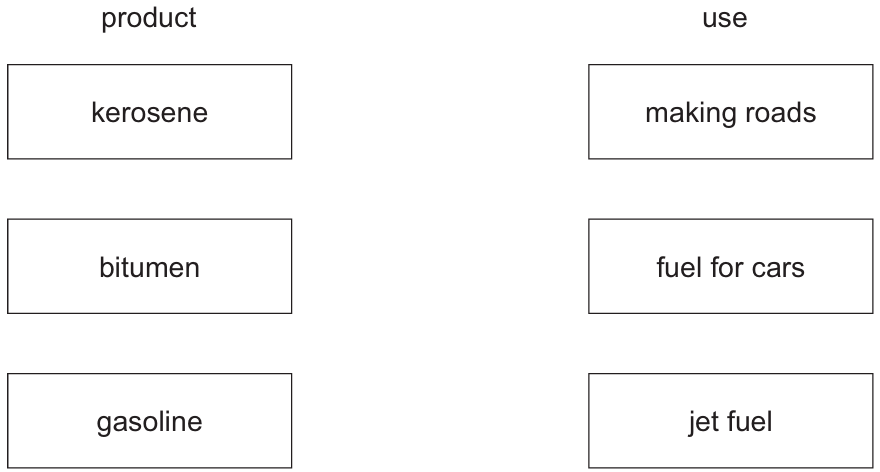
(iii) Some of the products obtained from petroleum are shown.
Draw a line from each product to its use.
(b) Ethanol is an organic molecule.
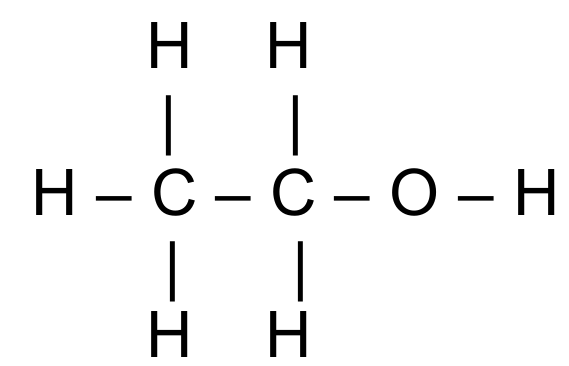
(i) Draw the displayed formula of a molecule of ethanol.
(ii) Ethanol is manufactured by the reaction of steam with ethene.
State two conditions for this process.
(c) Fig. 4.1 shows the displayed formula of tetramethylsilane.
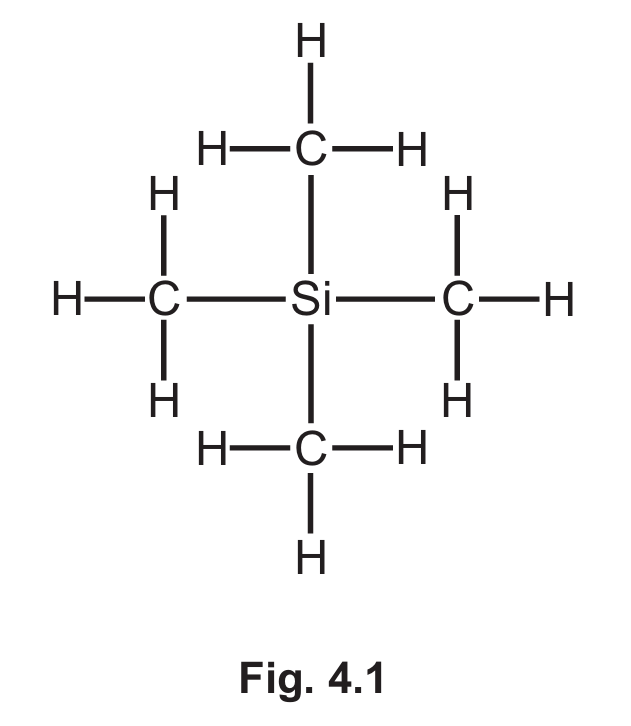
(i) Deduce the molecular formula of tetramethylsilane.
(ii) Name the two elements in tetramethylsilane that are in the same group in the Periodic Table.
Most-appropriate topic codes (Cambridge IGCSE Chemistry 0620):
• Topic 11.1 — Formulae, functional groups and terminology (Part (a)(i))
• Topic 11.3 — Fuels (Parts (a)(ii), (a)(iii))
• Topic 11.2 — Naming organic compounds / 11.6 Alcohols (Parts (b)(i), (b)(ii))
• Topic 11.1 — Formulae, functional groups and terminology (Parts (c)(i), (c)(ii))
▶️ Answer/Explanation
(a)(i) compounds made up of carbon and hydrogen (atoms) only
(a)(ii)
separation technique: fractional distillation
property: have different boiling points
how it works:
- petroleum is heated / vapourised / evaporated
- fractionating column has a temperature gradient / column is hot at bottom and cold at top
- fractions condense (when they get to their boiling points)
- fractions are piped off as liquids
(a)(iii) kerosene – jet fuel; bitumen – making roads; gasoline – fuel for cars
(b)(i)
(b)(ii) high temperature / $300\,(^{\circ}\mathrm{C})$; high pressure / $6000\,\mathrm{kPa}$ / $60\,\mathrm{atm}$; acid catalyst.
(c)(i) $\mathrm{SiC_4H_{12}}$
(c)(ii) silicon and carbon
Explanation: Silicon and carbon are both in Group IV of the Periodic Table. Elements in the same group have the same number of electrons in their outer shell (4 valence electrons).
Question 5
This question is about zinc salts.
(a) Excess solid zinc oxide is added to dilute sulfuric acid to produce a salt.
(i) Complete the word equation for this reaction.

(ii) Name the method used to remove excess solid zinc oxide from the reaction mixture.
(iii) Describe how crystals of the pure salt are made from an aqueous solution of the salt formed.
(b) Fig. 5.1 shows the apparatus for the electrolysis of molten zinc chloride using inert electrodes.
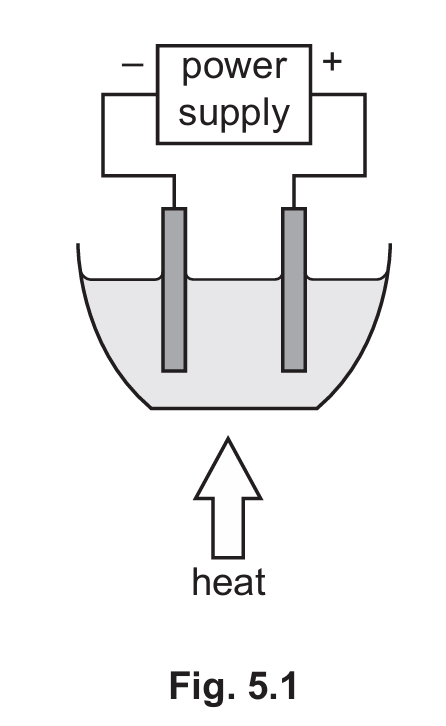
(i) Label Fig. 5.1 to show the:
- cathode
- electrolyte
(ii) Name a suitable material for the inert electrodes.
(iii) Name the products formed at the positive and negative electrodes.
(c) Zinc chloride has ionic bonds. State the meaning of the term ionic bond.
Most-appropriate topic codes (Cambridge IGCSE Chemistry 0620):
• Topic 7.3 — Preparation of salts (Parts (a)(i), (a)(ii), (a)(iii))
• Topic 4.1 — Electrolysis (Parts (b)(i), (b)(ii), (b)(iii))
• Topic 2.4 — Ions and ionic bonds (Part (c))
▶️ Answer/Explanation
(a)(i) zinc sulfate + water
Explanation: Zinc oxide is a metallic base. The reaction between an acid and a base is a neutralisation reaction. Zinc sulfate ($\mathrm{ZnSO_4}$), the salt, and water ($\mathrm{H_2O}$) are produced.
(a)(ii) filtration
Explanation: Excess solid zinc oxide is insoluble. Filtration is the separation technique used to separate an insoluble solid from a liquid. The reaction mixture is poured through a filter funnel lined with filter paper; the solid (residue) is trapped, and the aqueous salt solution (filtrate) passes through.
(a)(iii)
- evaporate to point of crystallisation OR evaporate until saturated solution is formed OR heat until crystals just appear
- filter off crystals / pick out crystals
- dry with filter paper
(b)(i) left hand electrode labelled cathode; electrolyte labelled (in the middle area of the molten zinc chloride).
(b)(ii) graphite / carbon / platinum
(b)(iii) positive electrode: chlorine; negative electrode: zinc.
Explanation: Molten zinc chloride contains mobile $\mathrm{Zn}^{2+}$ and $\mathrm{Cl}^-$ ions. At the negative electrode (cathode), $\mathrm{Zn}^{2+}$ ions gain electrons (reduction) to form molten zinc metal: $\mathrm{Zn}^{2+} + 2\mathrm{e}^- \to \mathrm{Zn}(\mathrm{l})$. At the positive electrode (anode), $\mathrm{Cl}^-$ ions lose electrons (oxidation) to form chlorine gas: $2\mathrm{Cl}^- \to \mathrm{Cl}_2(\mathrm{g}) + 2\mathrm{e}^-$.
(c) electrostatic attraction between oppositely charged ions / between positive and negative ions.
Explanation: An ionic bond is a strong electrostatic force of attraction that binds cations (positively charged ions) and anions (negatively charged ions) together in a giant ionic lattice.
Question 6
This question is about metals.
(a) (i) A student investigates the reaction of four different metals, A, B, C and D, with dilute hydrochloric acid.
All other conditions are the same in each test-tube.
The results of the experiment are shown in Fig. 6.1.
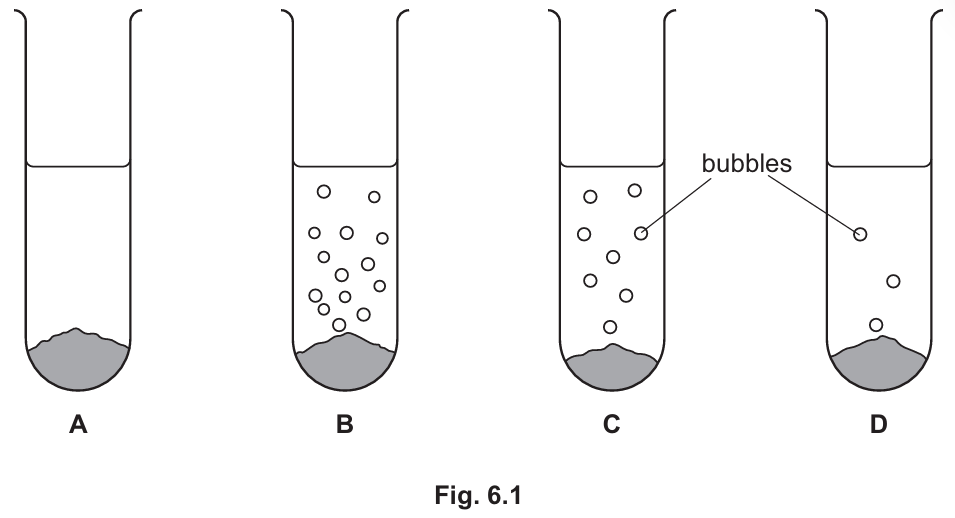
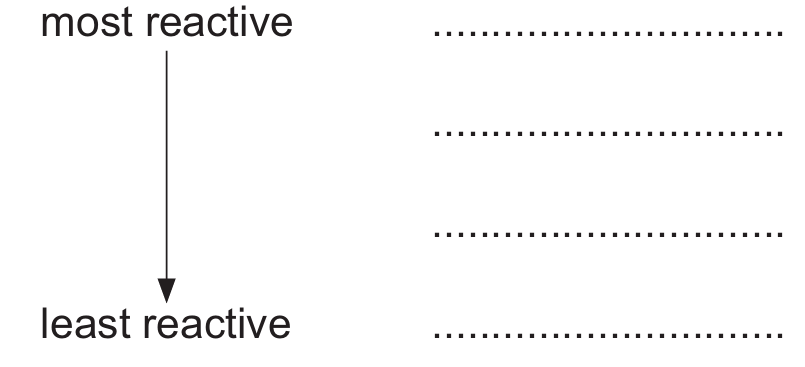
Put the metals, A, B, C and D, in order of their reactivity.
(ii) The student wants to decrease the rate of the reaction in the experiment.
State two ways to decrease the rate of this reaction.
(b) In another experiment, a student adds potassium carbonate to dilute hydrochloric acid.
State the colour seen in the flame test for potassium ions.
(c) Brass is a mixture of two metals.
(i) State the name given to a mixture of metals such as brass.
(ii) Name the two metals in brass.
(iii) Magnalium is a mixture of magnesium and aluminium.
Suggest one property of magnalium that makes it more useful than pure magnesium metal.
Most-appropriate topic codes (Cambridge IGCSE Chemistry 0620):
• Topic 9.4 — Reactivity series (Parts (a)(i), (a)(ii))
• Topic 12.5 — Identification of ions and gases (Part (b))
• Topic 9.3 — Alloys and their properties (Parts (c)(i), (c)(ii), (c)(iii))
▶️ Answer/Explanation
(a)(i) least reactive – D A C B – most reactive
(a)(ii) 1 mark each for any two of:
- decrease temperature
- decrease concentration (of acid)
- decrease (surface) area of metal / larger pieces of metal
(b) lilac
Explanation: In a flame test, potassium ions ($\mathrm{K}^+$) emit a characteristic lilac colour when heated in a non-luminous Bunsen flame.
(c)(i) alloy
(c)(ii) copper and zinc
(c)(iii) harder / stronger
Explanation: Magnalium is an alloy. Alloys contain atoms of different sizes which disrupt the regular layers of the metal lattice. This prevents the layers from sliding easily over each other, making the alloy harder and stronger than the pure metal, magnesium.
Question 7
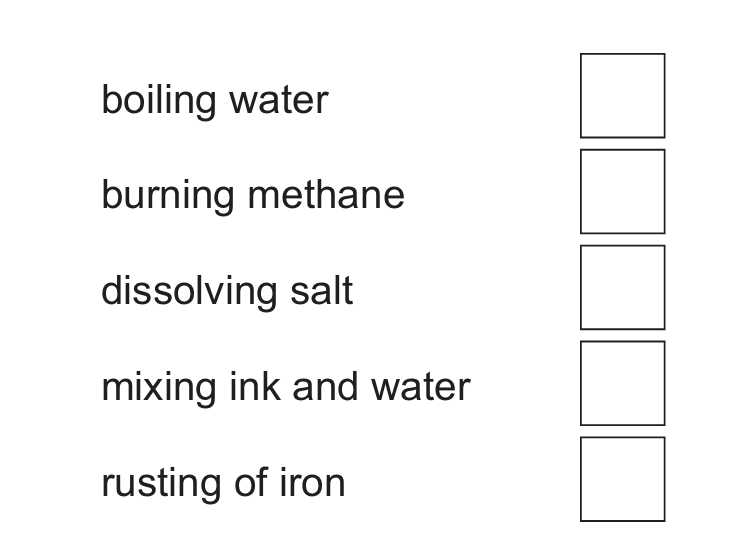
(a) Select two processes that show a chemical change.
Tick (✓) two boxes.
(b) The reaction of hydrogen with nitrogen is a reversible reaction.
Write the symbol that shows a reversible reaction.
(c) Table 7.1 shows the results of four experiments.
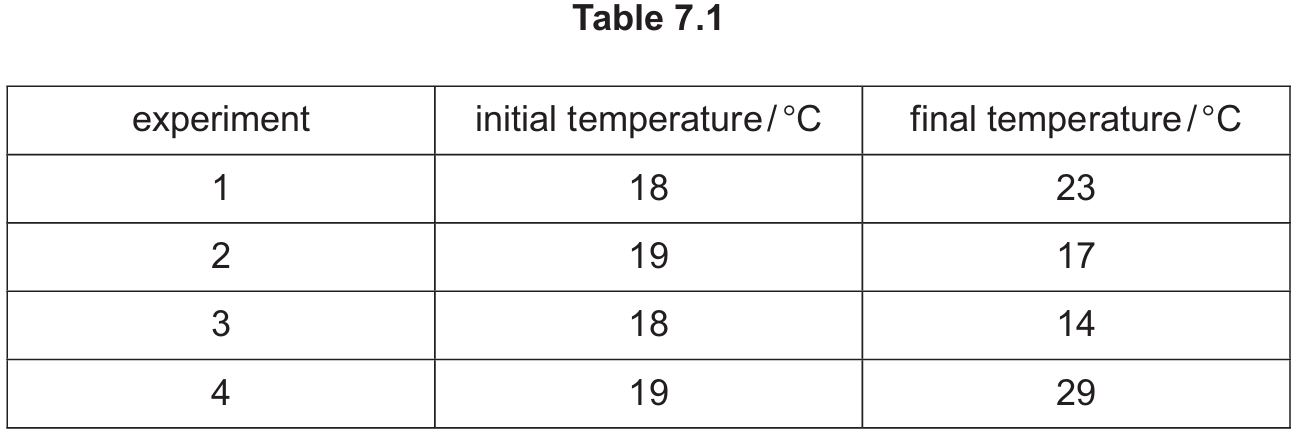
(i) State which experiment shows the greatest temperature change.
(ii) State which experiment is the most endothermic.
(iii) In experiment 4, magnesium was added to dilute hydrochloric acid.
Complete the symbol equation.
$$\mathrm{Mg} + \dots \mathrm{HCl} \rightarrow \mathrm{MgCl}_2 + \dots \dots \dots \dots \dots \dots \dots \dots \dots \dots$$
(iv) Fig. 7.1 shows an incomplete reaction pathway diagram for an endothermic reaction.
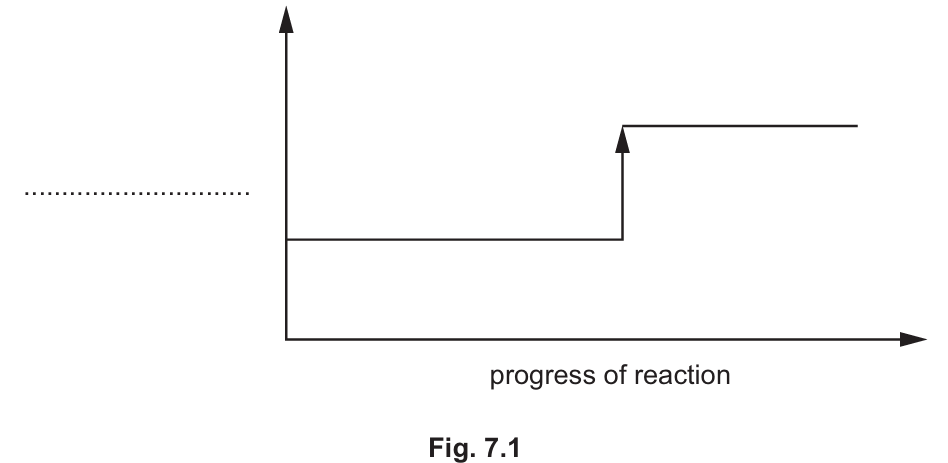
Complete Fig. 7.1 by labelling:
- the vertical axis
- the reactants
- the products.
Most-appropriate topic codes (Cambridge IGCSE Chemistry 0620):
• Topic 6.1 — Physical and chemical changes (Part (a))
• Topic 6.3 — Reversible reactions and equilibrium (Part (b))
• Topic 5.1 — Exothermic and endothermic reactions (Parts (c)(i), (c)(ii), (c)(iv))
• Topic 3.1 — Formulae (Part (c)(iii))
▶️ Answer/Explanation
(a) burning methane (second box down ticked) and rusting of iron (fifth box down ticked).
Explanation: A chemical change results in the formation of new chemical substances with different properties. Burning methane produces carbon dioxide and water ($\mathrm{CH}_4 + 2\mathrm{O}_2 \to \mathrm{CO}_2 + 2\mathrm{H}_2\mathrm{O}$). Rusting iron produces hydrated iron(III) oxide ($\mathrm{Fe}_2\mathrm{O}_3 \cdot x\mathrm{H}_2\mathrm{O}$). Boiling water, dissolving salt, and mixing ink are reversible physical changes where no new substance is formed.
(b) $\rightleftharpoons$
(c)(i) (experiment) 4
Explanation: The magnitude of temperature change is calculated as $|T_\text{final} – T_\text{initial}|$.
Exp 1: $|23-18| = 5\,^{\circ}\mathrm{C}$; Exp 2: $|17-19| = 2\,^{\circ}\mathrm{C}$; Exp 3: $|14-18| = 4\,^{\circ}\mathrm{C}$; Exp 4: $|29-19| = 10\,^{\circ}\mathrm{C}$. Experiment 4 shows the largest change at $10\,^{\circ}\mathrm{C}$.
(c)(ii) (experiment) 3
Explanation: An endothermic reaction absorbs thermal energy from the surroundings, resulting in a decrease in temperature. Experiment 3 is the only one showing a temperature decrease of the highest magnitude ($4\,^{\circ}\mathrm{C}$ drop), making it the most endothermic.
(c)(iii) $\mathrm{Mg} + 2\mathrm{HCl} \rightarrow \mathrm{MgCl}_2 + \mathrm{H}_2$
Explanation: Magnesium reacts with hydrochloric acid in a single displacement reaction. Magnesium displaces hydrogen. Two molecules of $\mathrm{HCl}$ are required to provide 2 chloride ions to form the neutral salt, $\mathrm{MgCl}_2$, and release one molecule of hydrogen gas.
(c)(iv) energy (on the y-axis); reactants on left hand line and products on right hand line on the graph.
Explanation: For an endothermic reaction, energy is absorbed, so the energy of the products is higher than the energy of the reactants. The vertical axis is therefore labelled ‘energy’ (or enthalpy). Reactants are at the lower energy level on the left, and products at the higher energy level on the right.
Question 8
This question is about water and air.
(a) Water needs to be treated to make it safe to drink.
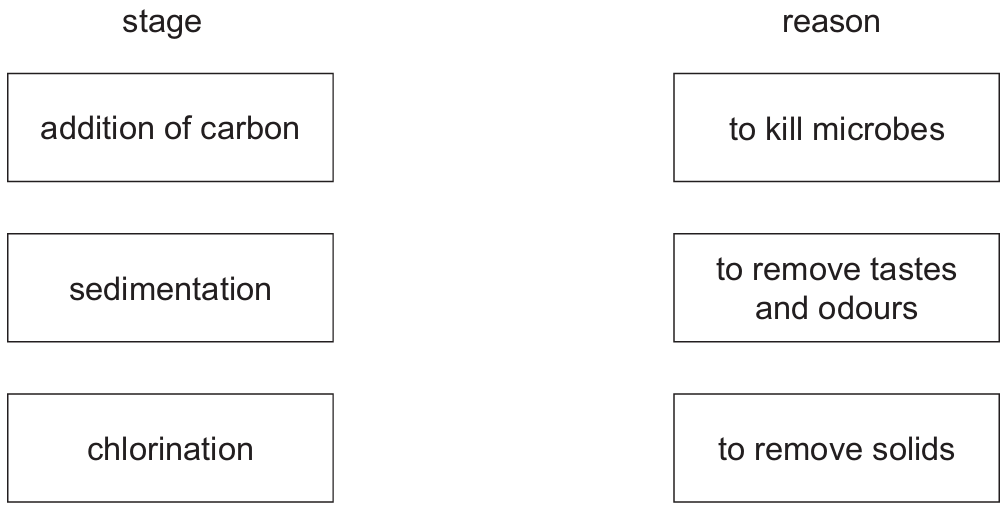
Draw a line from each stage in the treatment of domestic water to the reason why it is carried out.
(b) Describe how to test whether a sample of water is pure using melting point.
(c) Air may contain sulfur dioxide and particulates.
(i) State one harmful effect of each of these air pollutants.
(ii) Describe how flue gas desulfurisation reduces emissions of sulfur dioxide gas.
Most-appropriate topic codes (Cambridge IGCSE Chemistry 0620):
• Topic 10.1 — Water (Parts (a), (b))
• Topic 10.3 — Air quality and climate (Parts (c)(i), (c)(ii))
▶️ Answer/Explanation
(a) addition of carbon – to remove tastes / odours; sedimentation – to remove solids; chlorination – to kill microbes.
(b) heat to melting point of the sample and measure mp OR heat to $0\,^{\circ}\mathrm{C}$ and observe if it’s melting. pure water melts at $0\,^{\circ}\mathrm{C}$ / has a sharp melting point / if not $0\,^{\circ}\mathrm{C}$ then it must be impure. OR impure water melts at a lower mp than $0\,^{\circ}\mathrm{C}$ / melts over a range of temperatures OR compare the melting point of the water sample to the mp of pure water.
(c)(i) sulfur dioxide: acid rain; particulates: respiratory problems / cancer.
(c)(ii) calcium oxide (is used); neutralisation (reaction takes place).
Explanation: Flue gas desulfurisation involves reacting acidic sulfur dioxide gas ($\mathrm{SO_2}$) with a basic oxide, most commonly calcium oxide ($\mathrm{CaO}$). This is an acid-base neutralisation reaction: $\mathrm{CaO}(\mathrm{s}) + \mathrm{SO}_2(\mathrm{g}) \to \mathrm{CaSO}_3(\mathrm{s})$. The solid calcium sulfite is then removed, preventing $\mathrm{SO_2}$ from escaping into the atmosphere.