
Question 1
A list of substances is shown.
calcium
calcium oxide
carbon
carbon dioxide
chlorine
copper
gold
iodine
neon
nitrogen
oxygen
potassium
sulfur dioxide
Answer the following questions about these substances. Each substance may be used once, more than once or not at all.
State which substance is:
Most-appropriate topic codes (Cambridge IGCSE Chemistry 0620):
• Topic 2.2 — Atomic structure and the Periodic Table (Parts (a), (i))
• Topic 8.4 — Transition elements (Part (b))
• Topic 12.5 — Identification of ions and gases (Part (c))
• Topic 10.3 — Air quality and climate (Part (d))
• Topic 9.2 — Uses of metals (Parts (e), (f))
• Topic 2.1 — Elements, compounds and mixtures (Parts (g), (h))
▶️ Answer/Explanation
(a)
For the correct answer:
nitrogen
Nitrogen is in Group V of the Periodic Table, meaning it has 5 electrons in its outer shell. To achieve a full outer shell (8 electrons, like the noble gas neon), it gains 3 electrons. This gain of 3 electrons forms the nitride ion, $\mathrm{N}^{3-}$, which carries a 3- charge. The other elements in the list either form positive ions (metals), do not form ions (noble gases), or form anions with different charges (e.g., chlorine forms $\mathrm{Cl}^{-}$, oxygen forms $\mathrm{O}^{2-}$).
(b)
For the correct answer:
copper or gold
Transition elements are located in the central block of the Periodic Table (between Groups II and III). They are characteristically metals with high densities, high melting points, and they form coloured compounds. Both copper (Cu) and gold (Au) fit this description perfectly. Copper forms blue compounds, while gold is known for its distinctive yellow colour and very low reactivity.
(c)
For the correct answer:
carbon dioxide
The standard chemical test for carbon dioxide ($\mathrm{CO}_2$) is to bubble the gas through limewater, which is a solution of calcium hydroxide, $\mathrm{Ca(OH)_2}$. If carbon dioxide is present, it reacts to form a white precipitate of calcium carbonate ($\mathrm{CaCO_3}$), making the limewater turn milky or cloudy. This is a specific and confirmatory test.
(d)
For the correct answer:
nitrogen
Clean, dry air is a mixture of gases. By volume, its approximate composition is $78\%$ nitrogen ($\mathrm{N_2}$), $21\%$ oxygen ($\mathrm{O_2}$), and about $1\%$ other gases, which include argon, carbon dioxide, and traces of noble gases. Nitrogen is therefore the most abundant gas in the atmosphere.
(e)
For the correct answer:
copper
Copper is the standard metal for electrical wiring. This is primarily due to two of its physical properties: its excellent electrical conductivity, which allows electricity to flow with minimal energy loss, and its high ductility, which allows it to be drawn into thin, flexible wires without breaking.
(f)
For the correct answer:
gold
The reactivity series orders metals by their tendency to react. Gold is famously unreactive and is found native (as a pure element) in the Earth’s crust. It is positioned very low in the reactivity series, below copper and silver, meaning it resists corrosion and does not react with dilute acids. Therefore, from the list, it is the least reactive metal.
(g)
For the correct answer:
iodine
A diatomic molecule consists of two atoms bonded together. In the list, chlorine, iodine, nitrogen, and oxygen are diatomic ($\mathrm{Cl_2, I_2, N_2, O_2}$). At room temperature and pressure (r.t.p.), chlorine is a gas, nitrogen is a gas, and oxygen is a gas. Iodine ($\mathrm{I_2}$) is the only one that exists as a grey-black solid with a slight metallic lustre.
(h)
For the correct answer:
calcium oxide
In the extraction of iron in a blast furnace, limestone ($\mathrm{CaCO_3}$) is added. It thermally decomposes to form calcium oxide ($\mathrm{CaO}$) and carbon dioxide. The calcium oxide is a basic oxide that reacts with acidic sandy impurities, mainly silicon dioxide ($\mathrm{SiO_2}$), to form calcium silicate ($\mathrm{CaSiO_3}$). This molten waste product is called slag, which can be tapped off and used for road building.
(i)
For the correct answer:
carbon
The relative atomic mass ($A_r$) of an element is the weighted average mass of its isotopes compared to $\frac{1}{12}$th the mass of a carbon-12 atom. By definition, the $A_r$ of carbon is exactly $12.0$. This is a fundamental standard in chemistry.
Question 2
This question is about sea water and the substances found in sea water.
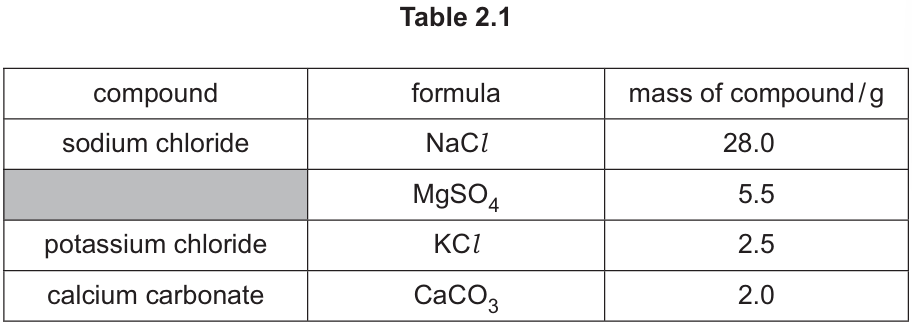
Answer these questions using the information from Table 2.1.
(i) State the chemical name of $\mathrm{MgSO_4}$
(ii) The total mass of compounds formed from $2000\mathrm{cm}^3$ of sea water is $38.0\mathrm{g}$. Calculate the total mass of compounds present in $800\mathrm{cm}^3$ of sea water.
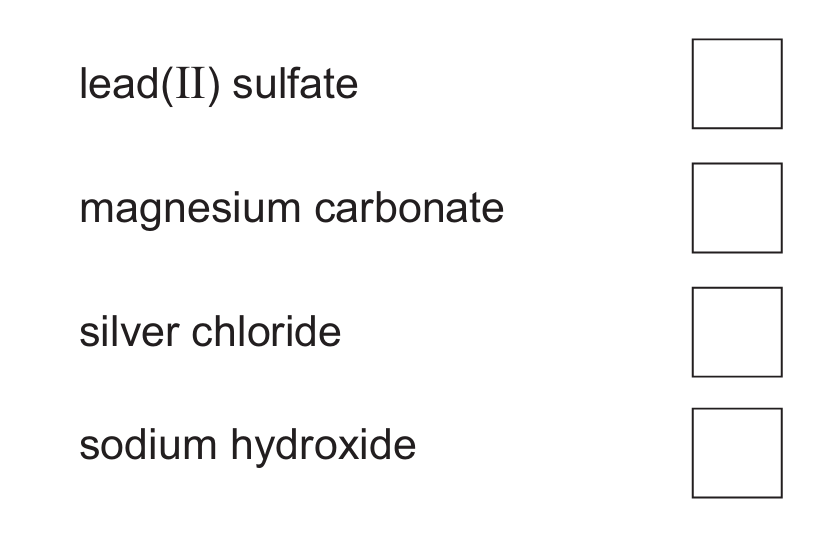
(iii) Potassium chloride is soluble in water. Choose one other compound that is soluble in water.
Tick ($\checkmark$) one box.
(b) Potassium iodide is also found in sea water and contains iodide ions.
Describe a test for iodide ions.
(c) Potassium chloride contains potassium ions.
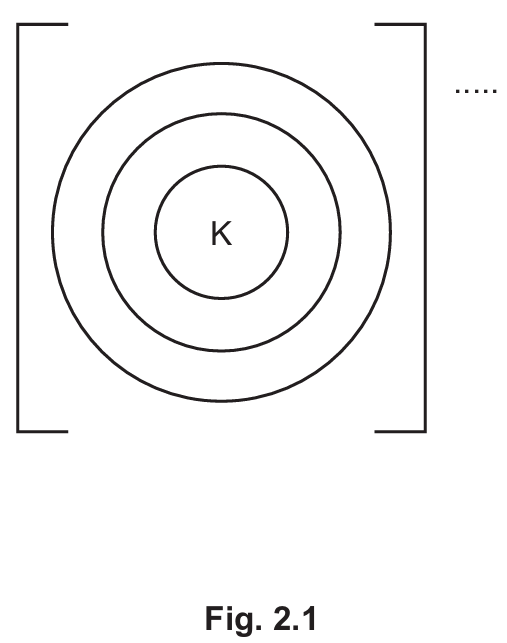
Complete Fig. 2.1 to show:
- the electronic configuration of a potassium ion
- the charge on the ion.
(d) Sodium chloride is a solid at room temperature.
Describe the separation and motion of the particles in a solid.
(e) Sea water contains dissolved phosphate ions.
State one source of phosphate ions.
(f) Water is a simple molecular compound.
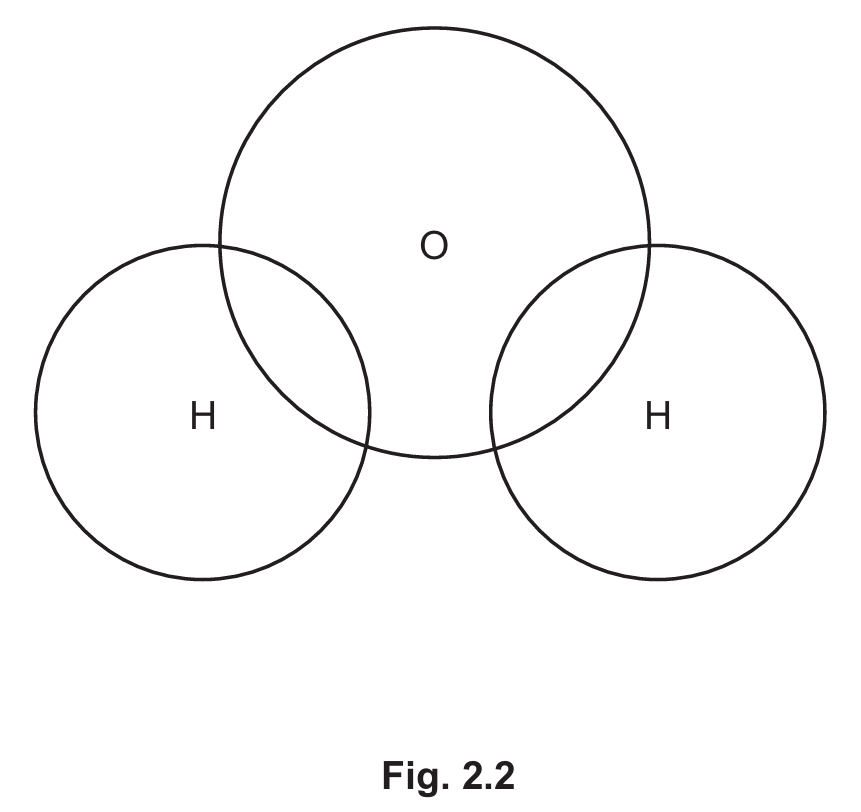
Complete the dot-and-cross diagram in Fig. 2.2 for a molecule of water.
Show outer electrons only.
Most-appropriate topic codes (Cambridge IGCSE Chemistry 0620):
• Topic 2.4 — Ions and ionic bonds (Parts (a)(i), (c), (d))
• Topic 3.2 — Relative masses of atoms and molecules (Part (a)(ii))
• Topic 7.3 — Preparation of salts (Part (a)(iii))
• Topic 12.5 — Identification of ions and gases (Part (b))
• Topic 10.1 — Water (Part (e))
• Topic 2.5 — Simple molecules and covalent bonds (Part (f))
▶️ Answer/Explanation
(a)(i)
For the correct answer:
magnesium sulfate
The compound $\mathrm{MgSO_4}$ is an ionic compound composed of magnesium ions ($\mathrm{Mg}^{2+}$) and sulfate ions ($\mathrm{SO_4}^{2-}$). Following standard nomenclature rules, the metal name (magnesium) is stated first, followed by the name of the non-metal or polyatomic ion (sulfate).
(a)(ii)
For the correct answer:
$15.2\mathrm{g}$
This is a simple ratio calculation. The mass of dissolved solids is directly proportional to the volume of the water sample. First, find the mass in $1\mathrm{cm}^3$: $38.0\mathrm{g} / 2000 = 0.019\mathrm{g}$. Then multiply by $800$: $0.019\mathrm{g} \times 800 = 15.2\mathrm{g}$. Alternatively, use a fraction: $(800 / 2000) \times 38.0\mathrm{g} = 0.4 \times 38.0\mathrm{g} = 15.2\mathrm{g}$.
(a)(iii)
For the correct answer:
sodium chloride (or magnesium sulfate, depending on the options listed in the question; the mark scheme specifies sodium hydroxide as a soluble option, but among the compounds in Table 2.1, sodium chloride is definitively soluble).
Solubility rules state that all sodium, potassium, and ammonium salts are soluble. All nitrates are soluble. Most chlorides are soluble (except lead and silver). Most sulfates are soluble (except barium, calcium, and lead). Most carbonates are insoluble (except sodium, potassium, and ammonium). Therefore, sodium chloride ($\mathrm{NaCl}$) and magnesium sulfate ($\mathrm{MgSO_4}$) are soluble, while calcium carbonate ($\mathrm{CaCO_3}$) is insoluble.
(b)
For the correct answer:
test: add dilute nitric acid and then add aqueous silver nitrate.
observations: a (pale) yellow precipitate is formed.
To test for halide ions (chloride, bromide, iodide), the solution must first be acidified with dilute nitric acid to remove any carbonate ions that might also form a precipitate. Adding aqueous silver nitrate then precipitates the halide ion as a silver halide. Silver iodide ($\mathrm{AgI}$) is characteristically a pale yellow solid.
(c)
For the correct answer:
electronic configuration: 2,8,8 with no other shells added. charge: $1+$ / + written outside brackets.
A potassium atom has the electronic configuration 2,8,8,1. To achieve a stable noble gas configuration (like argon), it loses its single outer shell electron. This forms a potassium ion ($\mathrm{K}^+$) with 18 electrons arranged in three shells (2,8,8) and a single positive charge due to having 19 protons but only 18 electrons.
(d)
For the correct answer:
separation: (very) close / touching.
motion: vibrate (about fixed positions).
In a solid, the particles (ions in the case of sodium chloride) are held together by strong electrostatic forces of attraction in a regular, fixed lattice structure. They do not have enough energy to overcome these forces to move around, but they possess kinetic energy that causes them to vibrate constantly about their fixed points in the lattice.
(e)
For the correct answer:
fertilisers / detergents
Phosphate ions ($\mathrm{PO_4}^{3-}$) are essential nutrients for plant growth, so they are a key component of agricultural fertilisers. They are also used in detergents to help soften water. Run-off from agricultural land and wastewater from households are the primary sources of phosphates entering natural water systems.
(f)
For the correct answer:
A dot-and-cross diagram showing one pair of electrons between each H atom and the O atom, and four non-bonding electrons (two lone pairs) on the oxygen atom. No other electrons on the hydrogen atoms.
Oxygen has 6 outer electrons and needs 2 more for a full octet. Each hydrogen atom has 1 electron and needs 1 more for a full duplet. The oxygen atom shares one electron with each hydrogen atom, forming two single covalent bonds. The remaining four electrons on the oxygen form two lone pairs. This results in the bent molecular shape of $\mathrm{H_2O}$.
Question 3
This question is about organic chemistry.
(i) State which physical property of hydrocarbons allows them to be separated by fractional distillation.
(ii) Describe how petroleum is separated into fractions by fractional distillation.
(iii) Name the process that breaks down long chain hydrocarbon molecules to form short chain hydrocarbon molecules.
(iv) Some of the fractions obtained from petroleum are shown.
Draw a line from each fraction to its use.
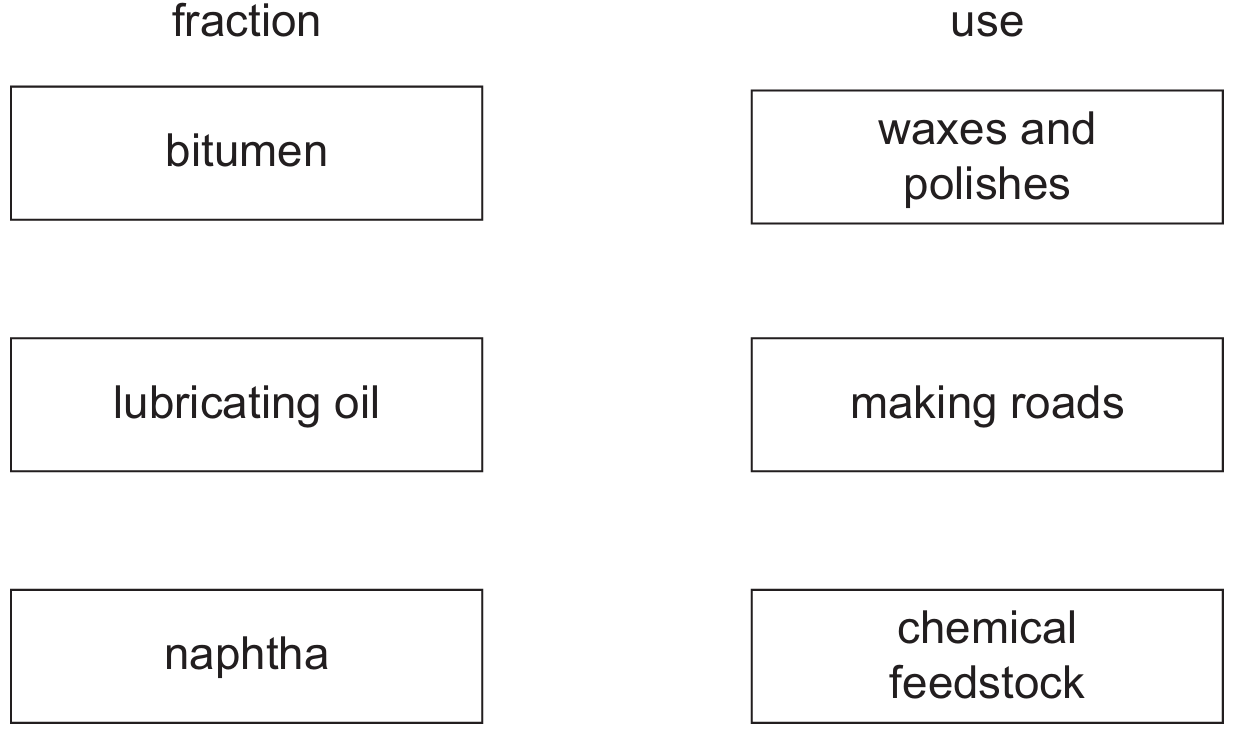
(b) Ethanoic acid is an organic molecule.
(i) Draw the displayed formula of a molecule of ethanoic acid.
(ii) Ethanoic acid reacts with sodium carbonate. Name the salt produced in this reaction.
(c) Ethane is burned in excess oxygen.
Name the two products of this process.
(d) Ethanol is another organic molecule.
State two ways to manufacture ethanol.
(e) Fig. 3.1 shows the displayed formula of an organic molecule.
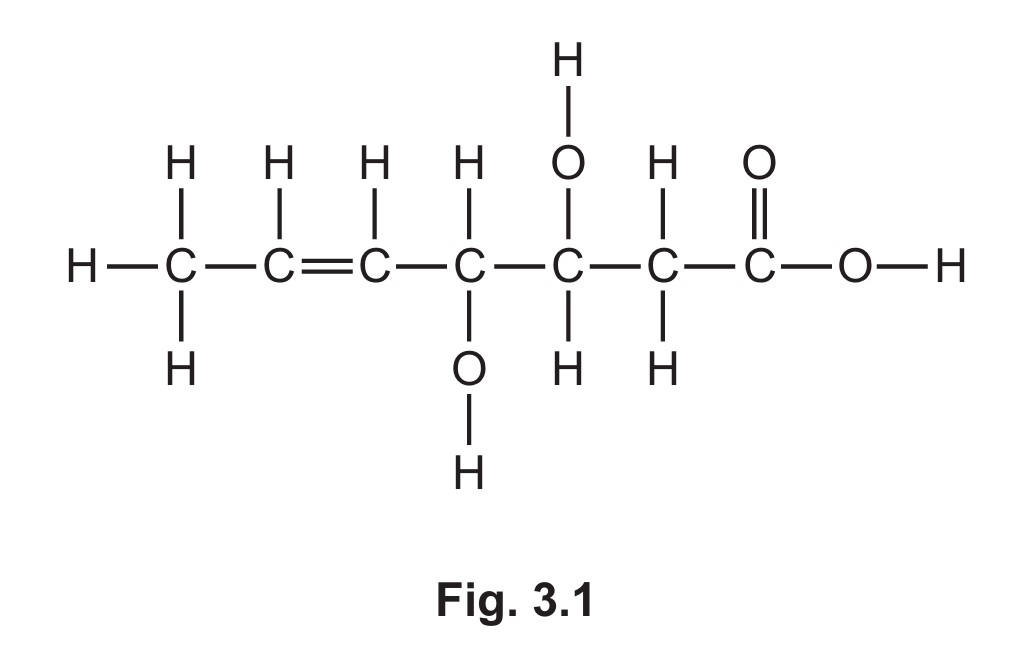
(i) Deduce the molecular formula of the molecule in Fig. 3.1.
(ii) Explain why the molecule in Fig. 3.1 is unsaturated.
Most-appropriate topic codes (Cambridge IGCSE Chemistry 0620):
• Topic 11.3 — Fuels (Parts (a)(i), (a)(ii), (a)(iii), (a)(iv))
• Topic 11.7 — Carboxylic acids (Parts (b)(i), (b)(ii))
• Topic 11.4 — Alkanes (Part (c))
• Topic 11.6 — Alcohols (Part (d))
• Topic 3.3 — The mole and the Avogadro constant (Part (e)(i))
• Topic 11.1 — Formulae, functional groups and terminology (Part (e)(ii))
▶️ Answer/Explanation
(a)(i)
For the correct answer:
different boiling points
Fractional distillation is a physical separation technique. It works because each hydrocarbon molecule in the petroleum mixture has a different chain length and molecular mass, which gives it a unique boiling point. The process separates them based on these differences.
(a)(ii)
For the correct answer:
1. petroleum is heated / vapourised / evaporated
2. fractionating column has a temperature gradient / column is hot at bottom and cold at top
3. fractions condense (when they get to their boiling points)
4. fractions are piped off as liquids
The hot vaporised crude oil enters the fractionating column. The long-chain hydrocarbons with high boiling points condense immediately at the hot bottom, while the short-chain hydrocarbons with low boiling points rise as vapours to the much cooler top before condensing. This allows the continuous collection of different fractions at different levels.
(a)(iii)
For the correct answer:
cracking
Cracking is a thermal decomposition reaction. It uses high temperature and a catalyst to break the strong C-C bonds in large, less useful alkane molecules, converting them into smaller, more useful molecules like short-chain alkanes (for petrol) and alkenes (for making polymers).
(a)(iv)
For the correct answer:
bitumen → making roads
lubricating oil → waxes and polishes
naphtha → chemical feedstock
Each fraction is a complex mixture of hydrocarbons with a specific range of boiling points. Bitumen is the thick, viscous residue, perfect for road surfacing. Lubricating oil is used for lubricants, waxes, and polishes. Naphtha is a vital chemical feedstock used to produce plastics, solvents, and other chemicals.
(b)(i)
For the correct answer:
A displayed formula showing all atoms and bonds: a $\mathrm{CH_3}$ group bonded to a $\mathrm{C}$ atom, which is double-bonded to an $\mathrm{O}$ atom and single-bonded to an $\mathrm{OH}$ group.
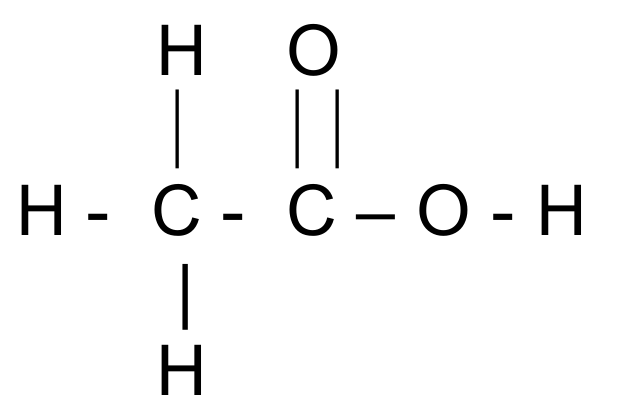
The molecular formula is $\mathrm{CH_3COOH}$. The functional group is the carboxyl group, -$\mathrm{COOH}$. The displayed formula is a 2D drawing that explicitly shows every single atom and every single covalent bond in the molecule. To gain full credit, the bond between the O and H in the hydroxyl group must be drawn.
(b)(ii)
For the correct answer:
sodium ethanoate
The reaction is: ethanoic acid + sodium carbonate → sodium ethanoate + water + carbon dioxide. A salt is formed when the hydrogen ion of the acid is replaced by a metal ion. The metal here is sodium ($\mathrm{Na}^+$), and the acid anion is ethanoate ($\mathrm{CH_3COO}^-$). The salt is therefore sodium ethanoate ($\mathrm{CH_3COONa}$).
(c)
For the correct answer:
carbon dioxide and water
Ethane is an alkane with the formula $\mathrm{C_2H_6}$. The complete combustion of any hydrocarbon in excess oxygen always produces the same two products: carbon dioxide ($\mathrm{CO_2}$) from the carbon, and water ($\mathrm{H_2O}$) from the hydrogen. The balanced equation for this exothermic reaction is $2\mathrm{C_2H_6} + 7\mathrm{O_2} \rightarrow 4\mathrm{CO_2} + 6\mathrm{H_2O}$.
(d)
For the correct answer:
1. Fermentation (of aqueous glucose using yeast)
2. (Catalytic addition of) steam to ethene
Fermentation is a biological process using yeast to anaerobically convert sugars (e.g., glucose) into ethanol and carbon dioxide at $25$-$35^{\circ}\mathrm{C}$. The second, industrial method is an addition reaction: ethene ($\mathrm{C_2H_4}$) is reacted with steam ($\mathrm{H_2O}$) under high pressure ($6000\mathrm{kPa}$) and a moderate temperature ($300^{\circ}\mathrm{C}$) in the presence of a phosphoric acid catalyst.
(e)(i)
For the correct answer:
$\mathrm{C_7H_{12}O_4}$
The empirical formula is the simplest whole-number ratio of the atoms in a compound. To find it, divide the subscripts in the molecular formula by their highest common factor. For $\mathrm{C_7H_{12}O_4}$, the numbers 7, 12, and 4 share no common factor other than 1. Therefore, the empirical formula is identical to the molecular formula: $\mathrm{C_7H_{12}O_4}$.
(e)(ii)
For the correct answer:
unsaturated
An unsaturated compound is defined as an organic molecule that contains one or more carbon-carbon double bonds ($\mathrm{C=C}$) or triple bonds. The presence of a $\mathrm{C=C}$ double bond means the molecule does not have the maximum possible number of hydrogen atoms bonded to the carbon chain. This unsaturation allows for characteristic reactions like the decolorisation of bromine water.
Question 4
This question is about nitrogen and its compounds.
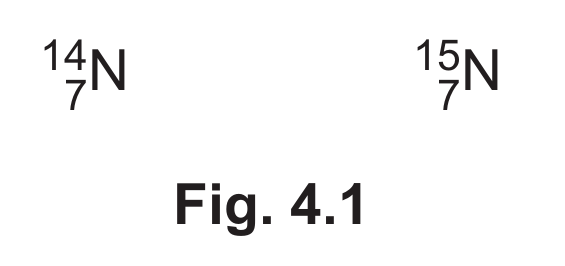
Complete Table 4.1 to show the number of protons, neutrons and electrons in one atom of these isotopes.
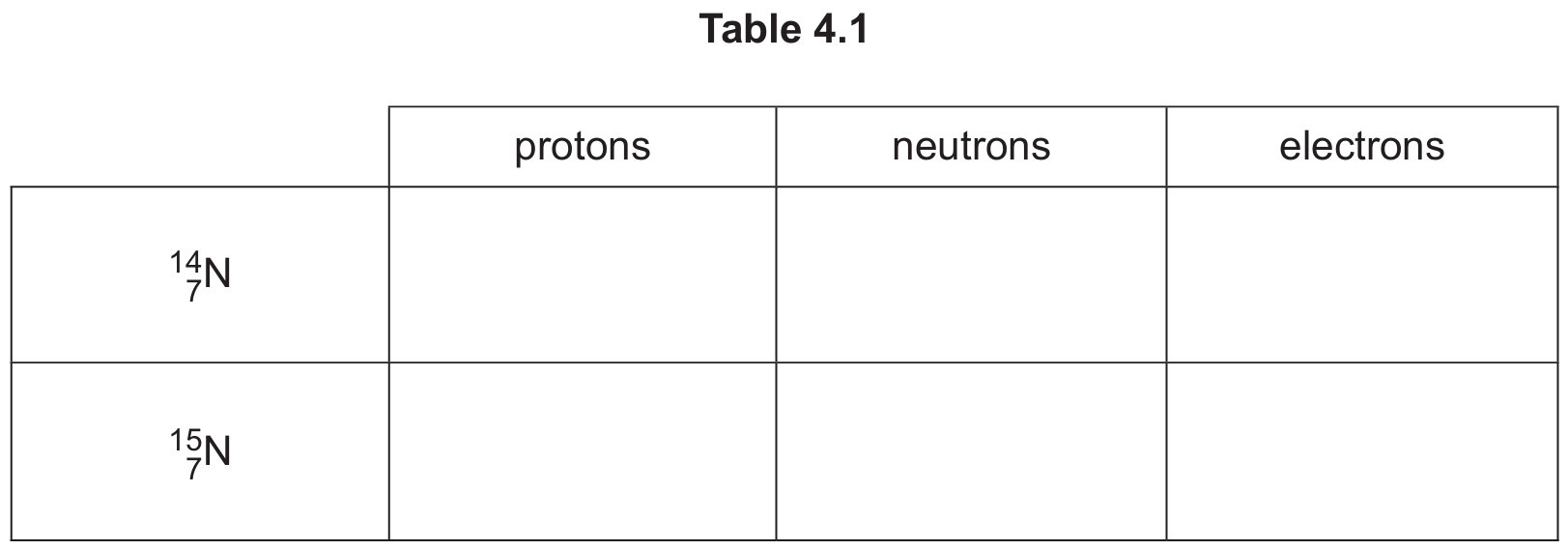
(b) Oxides of nitrogen are air pollutants.
(b)(i) State one source of oxides of nitrogen in the air.
(b)(ii) Ammonia reacts with oxygen to form nitrogen dioxide and water.
Complete the symbol equation for this reaction.
$4\mathrm{NH}_3 + 7\mathrm{O}_2\rightarrow 4\mathrm{NO}_2 + \dots \mathrm{H}_2\mathrm{O}$ [1]
(b)(iii) State the type of bonding between the atoms in nitrogen dioxide.
(b)(iv) State whether nitrogen dioxide is an acidic or basic oxide.
Give a reason for your answer.
(c) A compound of nitrogen has the formula $\mathrm{Al(NO_3)_3}$.
Complete Table 4.2 to calculate the relative formula mass of $\mathrm{Al(NO_3)_3}$.
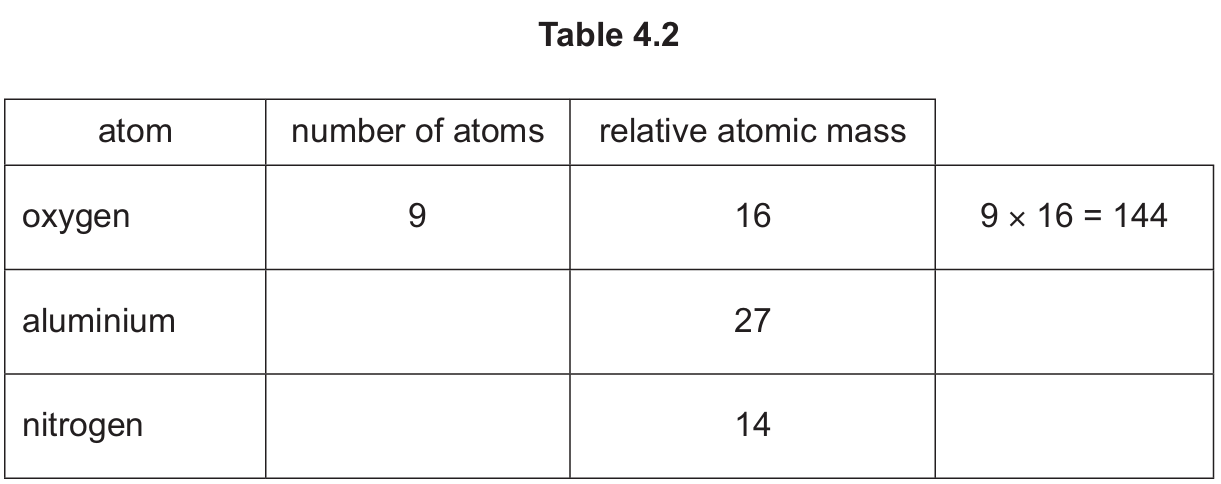
Most-appropriate topic codes (Cambridge IGCSE Chemistry 0620):
• Topic 8.1 — Arrangement of elements (Part (a)(i))
• Topic 2.3 — Isotopes (Part (a)(ii))
• Topic 10.3 — Air quality and climate (Parts (b)(i), (b)(ii), (b)(iv))
• Topic 2.5 — Simple molecules and covalent bonds (Part (b)(iii))
• Topic 3.2 — Relative masses of atoms and molecules (Part (c))
▶️ Answer/Explanation
(a)(i)
For the correct answer:
has 5 electrons in its outer shell
The Periodic Table is organized based on electronic configuration. The group number (for Groups I to VII) is directly equal to the number of electrons in the outermost shell (valence electrons) of an atom of that element. A nitrogen atom has the electronic configuration 2,5, so it belongs in Group V.
(a)(ii)
For the correct answer: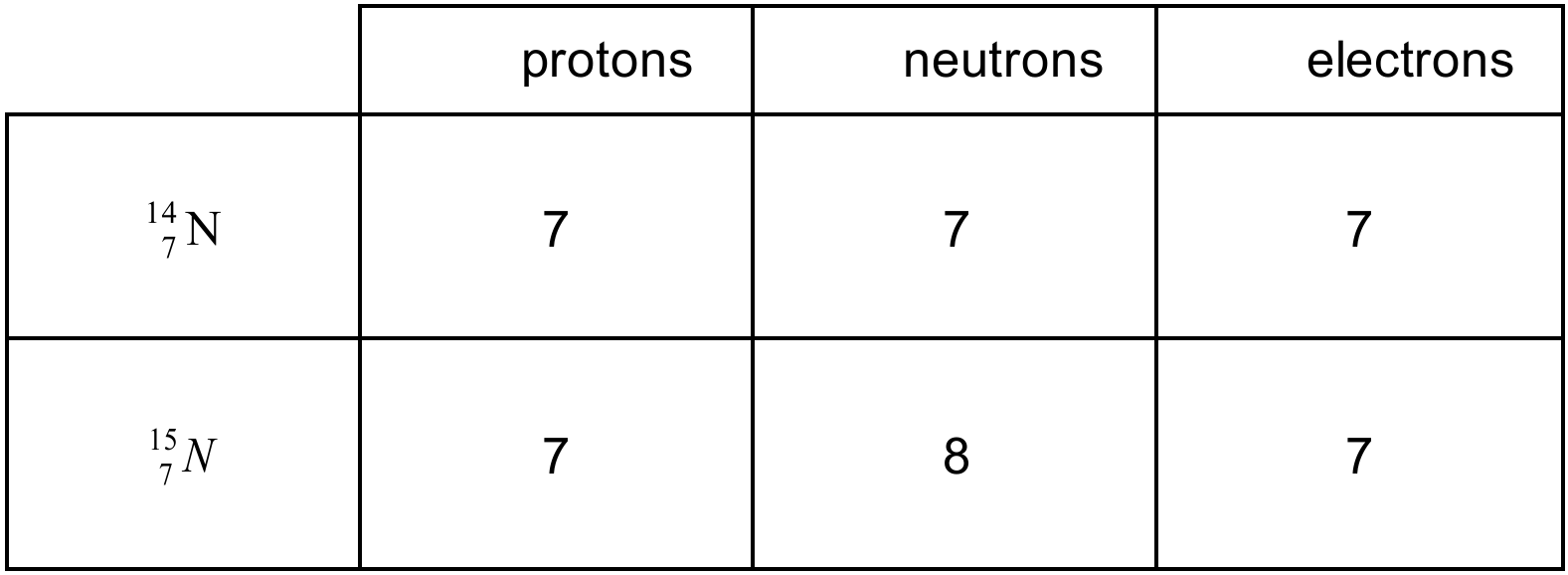
The atomic number of nitrogen is always 7, which defines the element and tells us it has 7 protons. In a neutral atom, the number of electrons exactly equals the number of protons, so each has 7 electrons. The mass number (14 or 15) is the total of protons and neutrons. Therefore, the neutrons are found by subtraction: $14-7=7$ and $15-7=8$.
(b)(i)
For the correct answer:
car engines
Oxides of nitrogen ($\mathrm{NO_x}$), such as nitrogen monoxide ($\mathrm{NO}$) and nitrogen dioxide ($\mathrm{NO_2}$), are formed inside the very hot combustion chambers of car engines. The high temperature causes the nitrogen and oxygen in the air to react together.
(b)(ii)
For the correct answer:
$6\mathrm{H_2O}$
To balance the equation $4\mathrm{NH_3} + 7\mathrm{O_2} \rightarrow 4\mathrm{NO_2} + \underline{6}\mathrm{H_2O}$, you check each atom. Left side: N=4, H=12, O=14. Right side without water: N=4, O=8. We need 12 H atoms and 6 extra O atoms. This requires 6 molecules of water ($6\mathrm{H_2O}$), which supplies $6 \times 2 = 12$ H atoms and 6 O atoms. The right side then has N=4, H=12, O=$8+6=14$, which fully balances.
(b)(iii)
For the correct answer:
covalent
Nitrogen dioxide ($\mathrm{NO_2}$) is a simple molecular compound formed from two non-metal atoms. Non-metal atoms bond together by sharing electrons to achieve a full outer shell. This type of strong electrostatic attraction between the shared electrons and the nuclei is a covalent bond.
(b)(iv)
For the correct answer:
acidic because nitrogen is a non-metal
Generally, metallic elements form basic oxides (e.g., calcium oxide), while non-metallic elements form acidic oxides (e.g., carbon dioxide, sulfur dioxide). Nitrogen is a non-metal, so its oxide, nitrogen dioxide, dissolves in water to form an acidic solution (nitric and nitrous acids).
(c)
For the correct answer:
Al = $1 \times 27 = 27$; N = $3 \times 14 = 42$; relative formula mass = $213$
The formula $\mathrm{Al(NO_3)_3}$ shows one aluminium atom and three nitrate groups. Each nitrate group has one nitrogen and three oxygens. So total atoms: 1 Al, 3 N, 9 O. Mass of Al = $1 \times 27 = 27$. Mass of N = $3 \times 14 = 42$. Mass of O = $9 \times 16 = 144$. Adding these together: $27 + 42 + 144 = 213$. The relative formula mass ($M_r$) is the sum of the relative atomic masses of all the atoms in the formula. No units are used for $M_r$.
Question 5
This question is about ionic compounds and simple molecular compounds.

(b) Aqueous magnesium chloride is prepared by adding excess magnesium oxide powder to dilute hydrochloric acid.
Describe how to prepare a sample of pure, dry magnesium chloride crystals after the reaction is complete.
In your answer describe how to:
- remove the excess magnesium oxide from the reaction mixture
- crystalline the magnesium chloride
- dry the crystals.
(c) Fig. 5.1 shows the apparatus for the electrolysis of molten cobalt(II) bromide using inert electrodes.
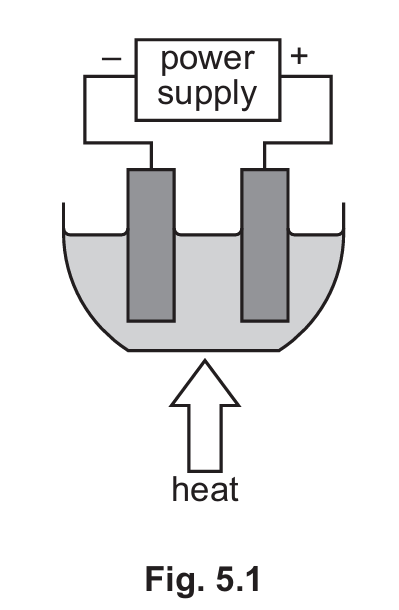
(i) Label Fig. 5.1 to show the:
- anode
- electrolyte.
(ii) Name the products formed at the positive and negative electrodes.
(d) Table 5.1 shows some properties of five compounds, A, B, C, D and E.
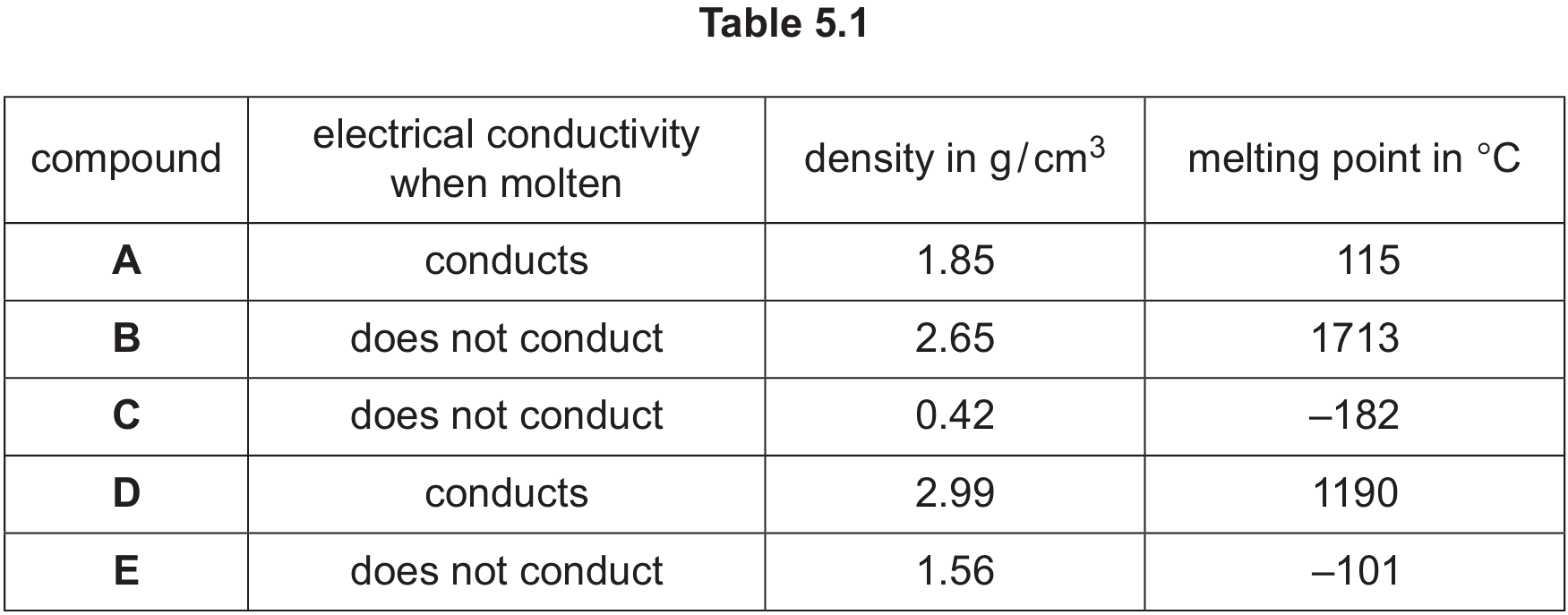
State which two of the compounds, A, B, C, D and E, are simple molecules.
Give two reasons for your answer.
Most-appropriate topic codes (Cambridge IGCSE Chemistry 0620):
• Topic 7.1 — The characteristic properties of acids and bases (Part (a))
• Topic 7.3 — Preparation of salts (Part (b))
• Topic 4.1 — Electrolysis (Parts (c)(i), (c)(ii))
• Topic 2.5 — Simple molecules and covalent bonds (Part (d))
▶️ Answer/Explanation
(a)
For the correct answer:
copper nitrate + carbon dioxide + water
Nitric acid is a strong acid, and copper(II) carbonate is an insoluble metal carbonate. The general reaction is: acid + metal carbonate → salt + water + carbon dioxide. The salt formed is copper(II) nitrate, $\mathrm{Cu(NO_3)_2}$, which is a blue solution. Bubbles of carbon dioxide gas are seen, and water is produced.
(b)
For the correct answer:
remove excess: filtration / filter (off the excess magnesium oxide).
crystallise: evaporate to point of crystallisation OR evaporate until saturated solution is formed OR heat until crystals just appear.
dry: dry with (filter) paper.
The reaction produces aqueous magnesium chloride. Since the magnesium oxide was added in excess, some unreacted solid remains. Filtration separates this insoluble solid from the soluble salt solution (filtrate). The filtrate is heated to evaporate some water until the solution is saturated (point of crystallisation, when crystals just start to form on cooling). The saturated solution is left to cool slowly, allowing larger, purer crystals to form. Finally, the crystals are removed and gently dried by pressing them between pieces of dry filter paper to absorb remaining moisture.
(c)(i)
For the correct answer:
anode labelled on the right hand electrode (1). electrolyte labelled (1).
In an electrolytic cell, the anode is the positive electrode (connected to the positive terminal of the power supply). The electrolyte is the substance that is electrolysed, in this case, the molten cobalt(II) bromide ($\mathrm{CoBr_2}$), which contains mobile ions.
(c)(ii)
For the correct answer:
positive electrode: bromine.
negative electrode: cobalt.
During electrolysis, the positive metal ion (cation) is attracted to the cathode (negative electrode) where it gains electrons (reduction). Here, cobalt ions ($\mathrm{Co}^{2+}$) are reduced to cobalt metal. The negative non-metal ion (anion) is attracted to the anode (positive electrode) where it loses electrons (oxidation). Bromide ions ($\mathrm{Br}^-$) are oxidised to bromine gas ($\mathrm{Br_2}$).
(d)
For the correct answer:
compounds: C and E (1).
reason 1: low melting point.
reason 2: does not conduct electricity (when molten).
Simple molecular compounds consist of small, discrete molecules held together by weak intermolecular forces. These weak forces require little energy to overcome, resulting in characteristically low melting and boiling points (compounds C and E melt at $-182^{\circ}\mathrm{C}$ and $-101^{\circ}\mathrm{C}$). Because there are no free ions or delocalised electrons even when molten (the molecules remain as neutral entities), simple molecular compounds are electrical insulators in all states.
Question 6
This question is about chemical reactions and their energy changes.
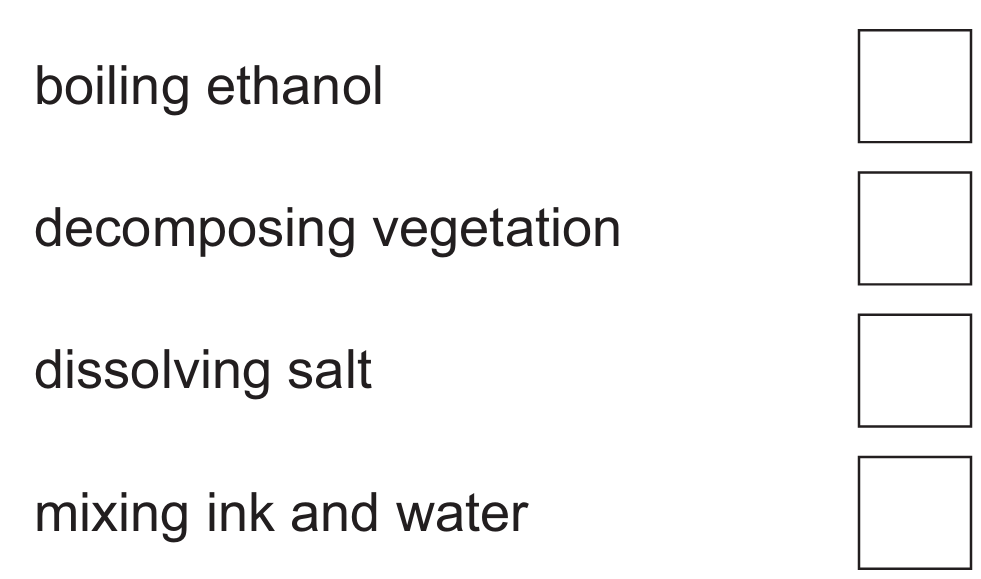
(b) Table 6.1 shows the results of four experiments.
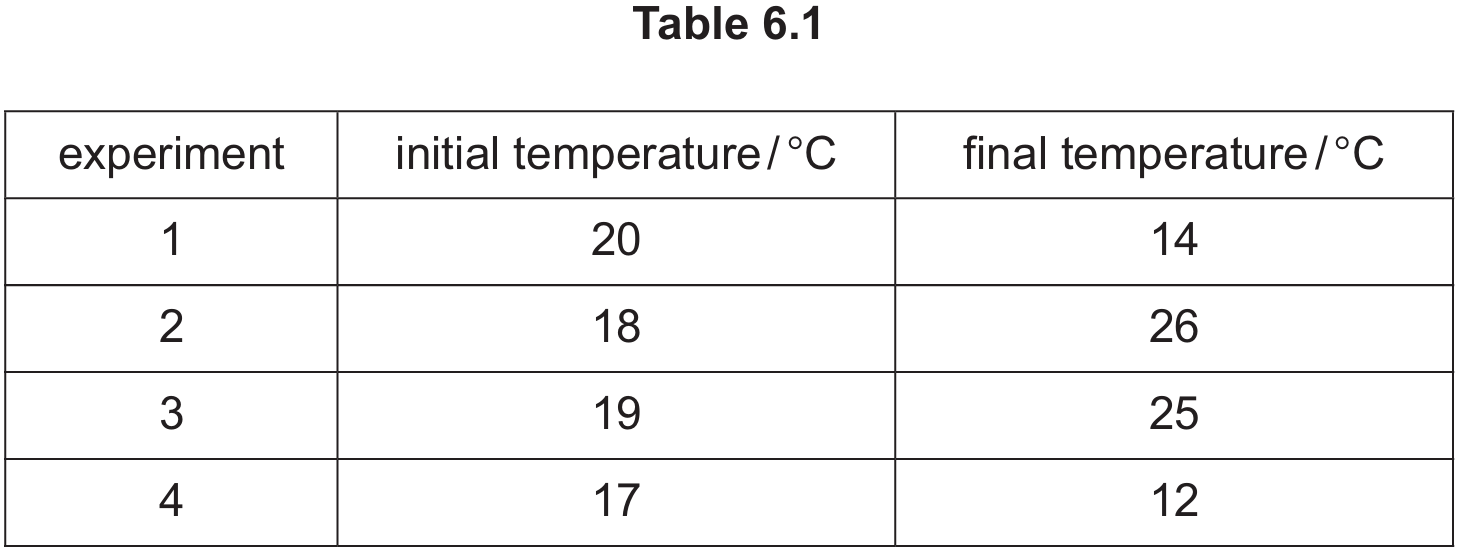
(i) State which experiment shows the greatest temperature change.
(ii) State which experiment is the most endothermic.
(iii) Fig. 6.1 shows an incomplete reaction pathway diagram for an exothermic reaction.
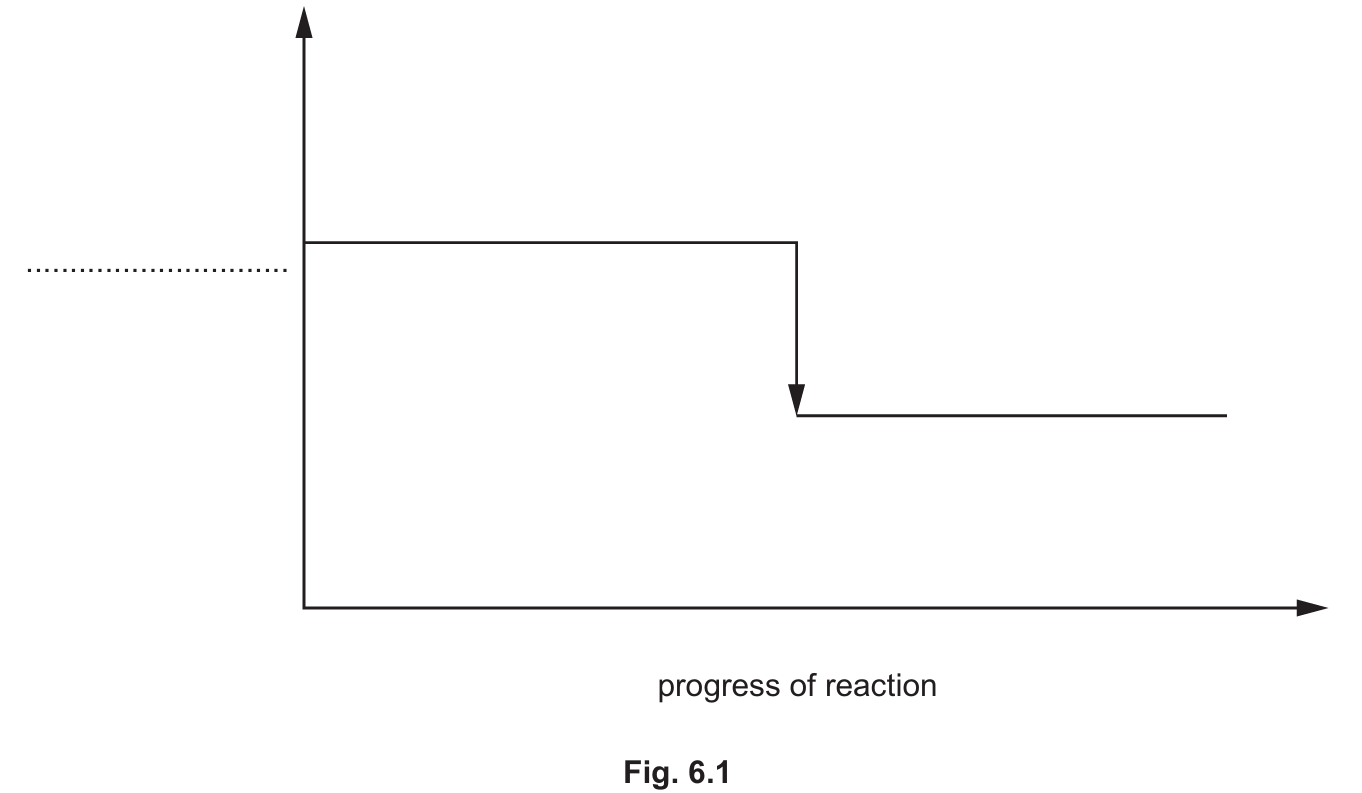
Complete Fig. 6.1 by labelling:
- the vertical axis
- the reactants
- the products.
Most-appropriate topic codes (Cambridge IGCSE Chemistry 0620):
• Topic 6.1 — Physical and chemical changes (Part (a))
• Topic 5.1 — Exothermic and endothermic reactions (Parts (b)(i), (b)(ii), (b)(iii))
▶️ Answer/Explanation
(a)
For the correct answer:
decomposing vegetation (second box down ticked).
A chemical change involves the formation of new chemical substances with different properties from the reactants. Decomposing vegetation is a chemical process breaking down organic matter into simpler substances like humus, carbon dioxide, and water. In contrast, ice melting and boiling water are physical changes (changes of state), and magnetising iron is a physical alignment of domains, none of which produce new substances.
(b)(i)
For the correct answer:
Experiment 2
Temperature change is calculated as final temperature minus initial temperature (ignoring sign for size).
Exp 1: $14 – 20 = -6^{\circ}\mathrm{C}$ (change of $6^{\circ}\mathrm{C}$)
Exp 2: $26 – 18 = +8^{\circ}\mathrm{C}$ (change of $8^{\circ}\mathrm{C}$)
Exp 3: $25 – 19 = +6^{\circ}\mathrm{C}$ (change of $6^{\circ}\mathrm{C}$)
Exp 4: $12 – 17 = -5^{\circ}\mathrm{C}$ (change of $5^{\circ}\mathrm{C}$)
Experiment 2 shows the greatest change in temperature magnitude.
(b)(ii)
For the correct answer:
Experiment 1
An endothermic reaction takes in thermal energy from the surroundings, causing the temperature of the surroundings to decrease. Only experiments 1 and 4 show a temperature drop. Experiment 1 has a decrease of $6^{\circ}\mathrm{C}$ (from $20^{\circ}\mathrm{C}$ to $14^{\circ}\mathrm{C}$), while experiment 4 has a decrease of $5^{\circ}\mathrm{C}$ (from $17^{\circ}\mathrm{C}$ to $12^{\circ}\mathrm{C}$). Therefore, experiment 1 shows the greatest intake of energy, making it the most endothermic.
(b)(iii)
For the correct answer:
label on y-axis: energy (1).
reactants on the left hand higher line and products on the right hand lower line on the graph (1).
A reaction pathway diagram tracks the energy content of the chemicals during a reaction. For an exothermic reaction, the products have a lower energy content than the reactants. The difference in height between reactants and products represents the energy released to the surroundings. The y-axis is always labelled ‘energy’. On the diagram, the left starting point corresponds to reactants, and the right final point corresponds to products.
Question 7
This question is about air and water.

(b) Describe a chemical test for the presence of water.
(c) A sample of air contains carbon dioxide and oxides of nitrogen.
State one harmful effect of each of these air pollutants.
Most-appropriate topic codes (Cambridge IGCSE Chemistry 0620):
• Topic 10.1 — Water (Parts (a), (b))
• Topic 10.3 — Air quality and climate (Part (c))
▶️ Answer/Explanation
(a)
For the correct answer:
Stage 1: sedimentation / filtration
Stage 3: chlorination / adding chlorine
The treatment of domestic water occurs in three main stages. First, large solids are removed by sedimentation, where they settle out, followed by filtration through sand and gravel beds to remove smaller suspended particles. Second (given), further filtration. Third, sterilisation, typically by chlorination, where small amounts of chlorine are added to kill any remaining harmful bacteria and microbes, making the water safe to drink.
(b)
For the correct answer:
test: (anhydrous) copper(II) sulfate / (anhydrous) cobalt(II) chloride
observations: white to blue / blue to pink
Anhydrous copper(II) sulfate is a white powder that turns blue upon the addition of water, forming hydrated copper(II) sulfate ($\mathrm{CuSO_4\cdot 5H_2O}$). Similarly, anhydrous cobalt(II) chloride is blue and turns pink upon hydration ($\mathrm{CoCl_2\cdot 6H_2O}$). These colour changes are definitive chemical tests for the presence of water.
(c)
For the correct answer:
carbon dioxide: global warming / climate change
oxides of nitrogen: acid rain / photochemical smog / respiratory problems
Carbon dioxide is a greenhouse gas; increasing its concentration in the atmosphere traps more infrared radiation, leading to an enhanced greenhouse effect and global climate change. Oxides of nitrogen contribute to acid rain because they dissolve in water to form nitric acid ($\mathrm{HNO_3}$), and they also cause respiratory problems and form photochemical smog, a type of air pollution.
Question 8
This question is about metals.
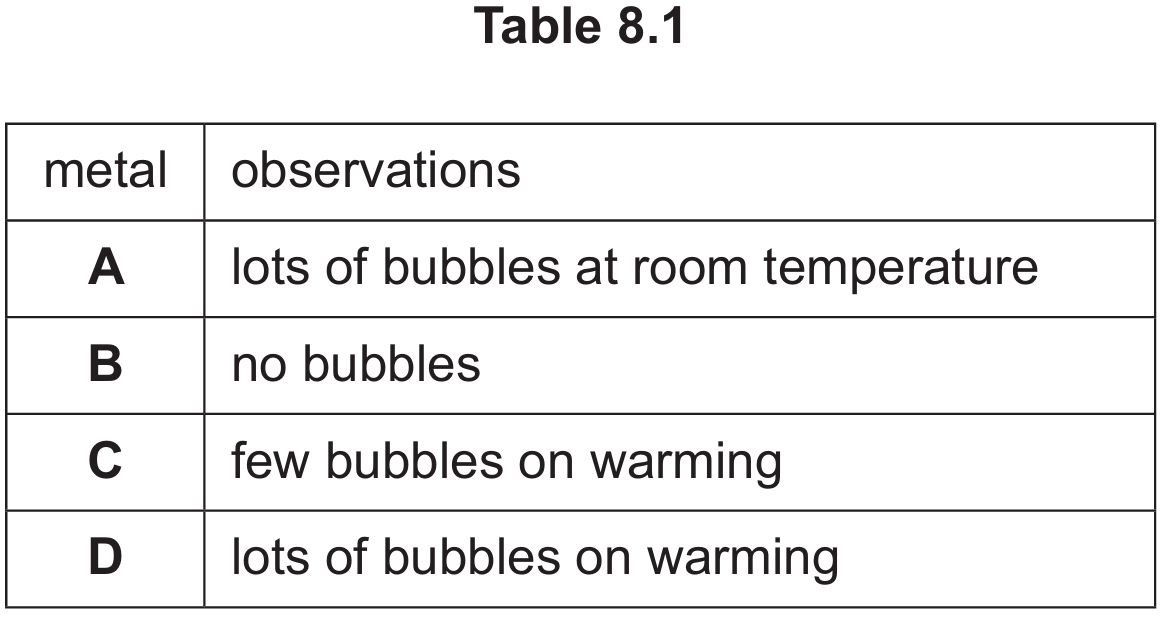
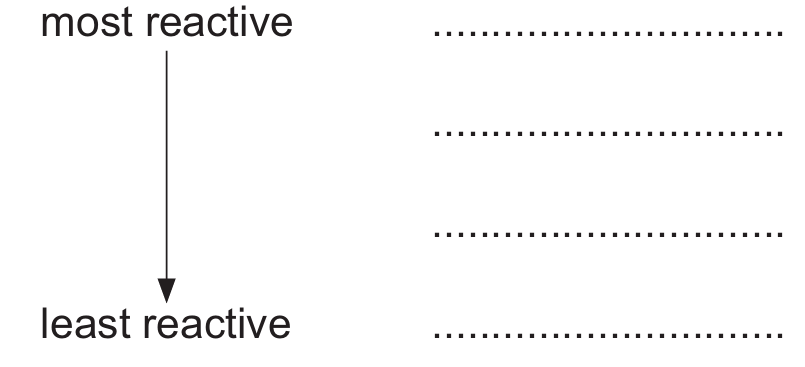
Put the metals, A, B, C and D, in order of their reactivity.
(a)(ii) Increasing the temperature of the acid increases the rate of reaction.
State two other ways to increase the rate of this reaction.
(b) In another experiment, a student adds lithium to water. An alkaline solution is formed.
(b)(i) State the colour seen in the flame test for lithium ions.
(b)(ii) State the ion that all aqueous alkalis contain.
(b)(iii) State the colour of thymolphthalein in an aqueous alkali.
(c) Pewter is an alloy that contains tin.
(c)(i) State which one of these diagrams, A, B, C or D, best represents an alloy.

(c)(ii) Suggest one property of pewter that makes it more useful than pure tin.
(d) Metals are good thermal conductors.
Describe two other physical properties that are typical of metals.
Most-appropriate topic codes (Cambridge IGCSE Chemistry 0620):
• Topic 9.4 — Reactivity series (Part (a)(i))
• Topic 6.2 — Rate of reaction (Part (a)(ii))
• Topic 12.5 — Identification of ions and gases (Parts (b)(i), (b)(ii), (b)(iii))
• Topic 9.3 — Alloys and their properties (Parts (c)(i), (c)(ii))
• Topic 9.1 — Properties of metals (Part (d))
▶️ Answer/Explanation
(a)(i)
For the correct answer:
most reactive A → D → C → B least reactive
The more vigorous the reaction with a dilute acid, the higher the reactivity of the metal. Metal A reacts vigorously (‘lots of bubbles’) at room temperature, indicating the highest reactivity. Metal D also shows ‘lots of bubbles’, but only upon warming, so it is less reactive than A. Metal C produces ‘few bubbles’ even on warming, showing low reactivity. Metal B shows ‘no bubbles’, indicating it is below hydrogen in the reactivity series and does not react with sulfuric acid at all, making it the least reactive.
(a)(ii)
For the correct answer (any two of):
1. increase the concentration (of the acid)
2. add a catalyst
3. increase (surface) area of metal / smaller pieces of metal
The rate of reaction can be increased by raising the frequency of successful collisions between reactant particles. This can be achieved by increasing the concentration of the acid (more particles per unit volume), increasing the surface area of the solid metal (exposing more atoms for reaction), or by adding a catalyst (providing an alternative pathway with lower activation energy).
(b)(i)
For the correct answer:
red
Flame tests are used to identify metal ions. Each metal ion emits a characteristic colour of light when electrons, excited by heat, fall back to their original energy levels. Lithium ions ($\mathrm{Li}^+$) produce a distinctive crimson red flame.
(b)(ii)
For the correct answer:
$\mathrm{OH}^-$
An alkali is defined as a soluble base. All aqueous alkalis contain the hydroxide ion ($\mathrm{OH}^-$). When lithium reacts with water, lithium hydroxide ($\mathrm{LiOH}$) is formed, which dissolves to produce $\mathrm{Li}^+$ and $\mathrm{OH}^-$ ions, giving an alkaline solution with a pH greater than 7.
(b)(iii)
For the correct answer:
blue
Indicators change colour depending on the pH of a solution. Thymolphthalein is colourless in acidic and neutral solutions but turns a distinctive blue in alkaline solutions. This is a specific indicator used to show the presence of a base.
(c)(i)
For the correct answer:
D
An alloy is a mixture of a metal with other elements, often other metals or carbon. In a diagrammatic representation, a pure metal is shown as a regular, ordered lattice of identical sized atoms. An alloy is represented by a lattice with atoms of different sizes. The presence of these differently sized atoms disrupts the regular layers, preventing them from sliding easily. Diagram D shows this structure of different sized atoms.
(c)(ii)
For the correct answer:
harder / stronger
Pewter is an alloy, and alloys are generally harder and stronger than their pure constituent metals. In pure tin, all atoms are the same size, so layers of atoms can slide over one another easily, making it soft. In pewter, the addition of different-sized atoms (like copper, antimony, or bismuth) distorts the regular lattice. This inhibits the sliding of atomic planes, significantly increasing the hardness and strength of the material, making it more suitable for utilitarian objects.
(d)
For the correct answer (any two of):
1. malleable
2. ductile
3. good electrical conductor
4. high melting point / high boiling point
Metals possess a ‘sea’ of delocalised electrons, which accounts for many of their characteristic physical properties. They are excellent electrical conductors because these delocalised electrons can move freely through the lattice carrying charge. They are malleable (can be hammered into shape) and ductile (can be drawn into wires) because the layers of atoms can slide over each other without the metallic bonding being broken. They generally have high melting and boiling points due to the strong electrostatic attraction between the positive metal ions and the negative delocalised electrons.