Home / 0620_w23_qp_21__Shreyashkar1301

Question 1

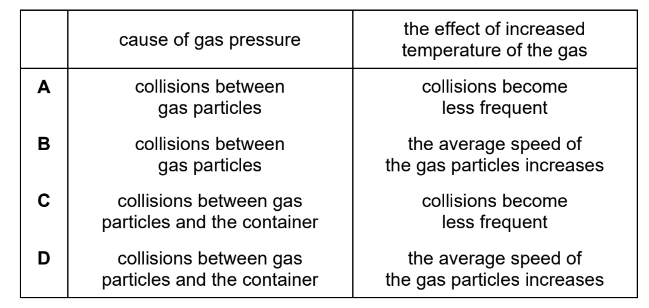
A gas is placed in a sealed container. The gas has a pressure of one atmosphere and a temperature of 50 °C. It is heated to 100 °C.

Which row describes the cause of the pressure of the gas and the effect of increasing the temperature of the gas?

Gas pressure table

Most-appropriate topic codes (Cambridge IGCSE Chemistry 0620):

Topic 1.1: Solids, liquids and gases — Describe the effects of temperature and pressure on the volume of a gas (Core); Explain, in terms of kinetic particle theory, the effects of temperature and pressure on the volume of a gas (Supplement)
▶️ Answer/Explanation
Gas pressure is caused by gas particles colliding with the walls of the container; the more frequent and forceful the collisions, the higher the pressure. When a sealed container of gas is heated, the particles gain kinetic energy, move faster, and collide with the walls more frequently and with greater force, so the pressure increases. Note that temperature must be in Kelvin for quantitative calculations, so 50 °C = 323 K and 100 °C = 373 K, meaning pressure increases proportionally — it does not double. The correct row (D) states that collisions with the walls cause pressure and that pressure increases (but does not double).
Answer: D

Question 2

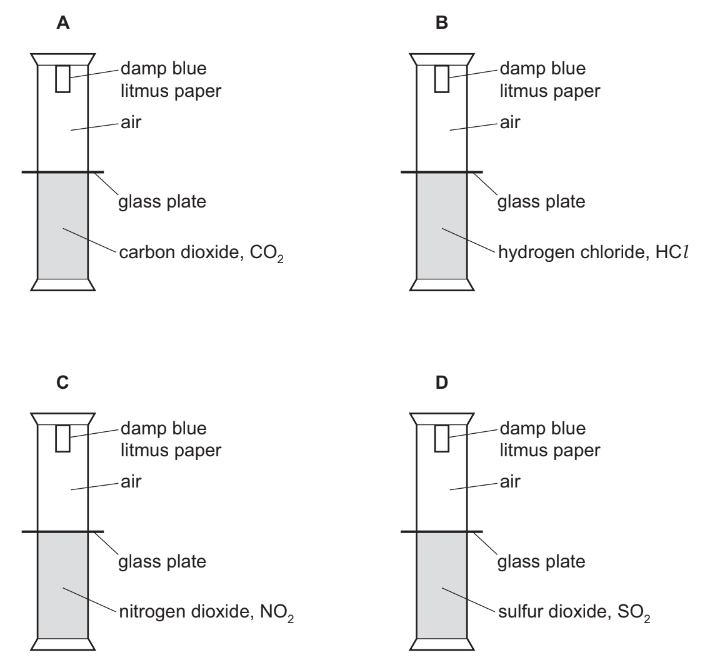
Four experiments, each containing a different acidic gas, are set up as shown.
The dividing glass plates are removed at the same time.
In which set of apparatus does the litmus turn red first?

Diffusion experiment diagram

Most-appropriate topic codes (Cambridge IGCSE Chemistry 0620):

Topic 1.2: Diffusion — Describe and explain the effect of relative molecular mass on the rate of diffusion of gases (Supplement)
▶️ Answer/Explanation
The rate of diffusion of a gas is inversely related to its relative molecular mass (Mr) — lighter gas molecules diffuse faster. The litmus paper will turn red first in the experiment where the acidic gas has the lowest Mr and is therefore nearest to the litmus. HCl has Mr = 36.5, HF has Mr = 20, HBr has Mr = 81, and HI has Mr = 128. HF (Mr = 20) diffuses fastest, but the apparatus that gives the fastest result overall depends on both the Mr and the distance the gas must travel. Experiment B contains the gas with the combination of lowest Mr and shortest diffusion path, so the litmus turns red first there.
Answer: B

Question 3

The Group I element potassium forms an ionic bond with the Group VII element fluorine.

Which two ions are produced?

A. K⁺ and F⁺
B. K⁺ and F⁻
C. K⁻ and F⁻
D. K⁻ and F⁺

Most-appropriate topic codes (Cambridge IGCSE Chemistry 0620):

Topic 2.4: Ions and ionic bonds — Describe the formation of positive ions (cations) and negative ions (anions); Describe the formation of ionic bonds between elements from Group I and Group VII (Core)
▶️ Answer/Explanation
When a Group I metal reacts with a Group VII non-metal, the metal atom loses its single outer electron to form a positive ion (cation), while the non-metal atom gains that electron to complete its outer shell and form a negative ion (anion). Potassium (Group I) has one outer electron it readily donates, forming K⁺, while fluorine (Group VII) needs one electron to achieve a full outer shell, forming F⁻. This electron transfer gives both ions the electronic configuration of a noble gas. Options A, C, and D are incorrect because metals form cations (positive ions) and non-metals form anions (negative ions) in ionic bonding.
Answer: B

Question 4

X and Y are atoms.

  • X and Y have the same number of electron shells.
  • X and Y have the same number of outer electrons.
  • X and Y have different mass numbers.

Which statements about X and Y are correct?

1 X and Y are isotopes.
2 X and Y have the same total number of electrons.
3 X and Y have the same chemical properties.

A. 1, 2 and 3
B. 1 and 2 only
C. 1 and 3 only
D. 2 and 3 only

Most-appropriate topic codes (Cambridge IGCSE Chemistry 0620):

Topic 2.2: Atomic structure and the Periodic Table — Determine the electronic configuration of elements (Core)
Topic 2.3: Isotopes — State that isotopes of the same element have the same chemical properties because they have the same number of electrons and therefore the same electronic configuration (Supplement)
▶️ Answer/Explanation
Same number of electron shells means same period; same number of outer electrons means same group. Both conditions together place X and Y in the same group AND period — meaning they are the same element. Since they have different mass numbers, they must have different numbers of neutrons, making them isotopes of the same element (Statement 1 correct). Isotopes of the same element have the same proton number, hence the same total number of electrons (Statement 2 correct) and the same electronic configuration, giving them identical chemical properties (Statement 3 correct). All three statements are correct.
Answer: A

Question 5

Lithium chloride is an ionic compound and silicon(IV) oxide is a covalent compound.

Which statement about both compounds is correct?

A. They are not soluble in water.
B. They conduct electricity when melted.
C. They do not conduct electricity in solid form.
D. They have low melting points.

Most-appropriate topic codes (Cambridge IGCSE Chemistry 0620):

Topic 2.4: Ions and ionic bonds — Describe the properties of ionic compounds: good electrical conductivity when aqueous or molten and poor when solid (Core)
Topic 2.6: Giant covalent structures — Describe the giant covalent structures of graphite and diamond; silicon(IV) oxide (Supplement)
▶️ Answer/Explanation
In solid ionic compounds, the ions are held in fixed lattice positions and cannot move, so they do not conduct electricity; similarly, giant covalent structures like SiO₂ have no free electrons or mobile ions, so they also cannot conduct electricity in solid form. Option A is wrong because LiCl is soluble in water. Option B is wrong because SiO₂ does not conduct when molten (no ions are released). Option D is wrong because both compounds have very high melting points. Therefore, the only statement true for both is C — neither conducts electricity as a solid.
Answer: C

Question 6

Which equations are balanced?

1 Fe₂O₃ + 3CO → 2Fe + 3CO₂
2 ZnCO₃ + 2HCl → ZnCl₂ + CO₂ + 2H₂O
3 Mg(NO₃)₂ + NaOH → Mg(OH)₂ + 2NaNO₃
4 CaCO₃ + H₂SO₄ → CaSO₄ + H₂O + CO₂

A. 1 and 2
B. 1 and 4
C. 2 and 3
D. 3 and 4

Most-appropriate topic codes (Cambridge IGCSE Chemistry 0620):

Topic 3.1: Formulae — Construct word equations and symbol equations to show how reactants form products (Core); Construct symbol equations with state symbols, including ionic equations (Supplement)
▶️ Answer/Explanation
Equation 1: Fe₂O₃ + 3CO → 2Fe + 3CO₂ — Left: 2Fe, 3O(Fe₂O₃)+3O(CO)=6O total, 3C; Right: 2Fe, 3C, 6O. Balanced ✓. Equation 2: ZnCO₃ + 2HCl → ZnCl₂ + CO₂ + 2H₂O — Right has 2H from 2HCl but 2H₂O needs 4H. Not balanced ✗. Equation 3: Mg(NO₃)₂ + NaOH — needs 2NaOH for 2OH⁻, and would give 2NaNO₃, so left side needs 2NaOH. Not balanced ✗. Equation 4: CaCO₃ + H₂SO₄ → CaSO₄ + H₂O + CO₂ — Left: 1Ca, 1C, 3O+4O+2H+1S=balanced on right. Balanced ✓. So equations 1 and 4 are balanced.
Answer: B

Question 7

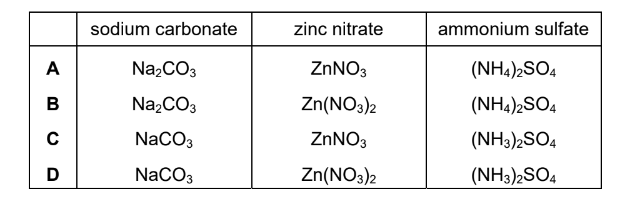
Which row shows the formulae of sodium carbonate, zinc nitrate and ammonium sulfate?

Formulae table

Most-appropriate topic codes (Cambridge IGCSE Chemistry 0620):

Topic 3.1: Formulae — State the formulae of the elements and compounds named in the subject content (Core)
▶️ Answer/Explanation
Sodium carbonate: Na⁺ has charge +1, CO₃²⁻ has charge −2, so two Na⁺ needed → Na₂CO₃. Zinc nitrate: Zn²⁺ has charge +2, NO₃⁻ has charge −1, so two NO₃⁻ needed → Zn(NO₃)₂. Ammonium sulfate: NH₄⁺ has charge +1, SO₄²⁻ has charge −2, so two NH₄⁺ needed → (NH₄)₂SO₄. The correct row B gives Na₂CO₃, Zn(NO₃)₂, and (NH₄)₂SO₄, which matches all three correct formulae.
Answer: B

Question 8

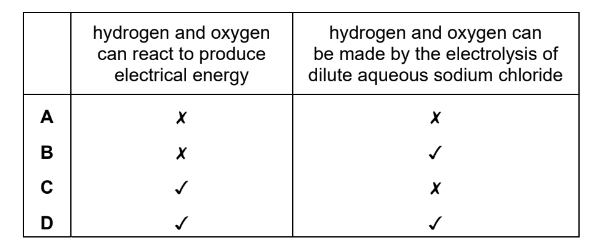
Which statements about hydrogen and oxygen are correct?

Hydrogen and oxygen statements table

Most-appropriate topic codes (Cambridge IGCSE Chemistry 0620):

Topic 3.3: The mole and the Avogadro constant — Use the molar gas volume (24 dm³ at r.t.p.) in calculations involving gases; Calculate stoichiometric reacting masses and volumes of gases at r.t.p. (Supplement)
▶️ Answer/Explanation
For the reaction 2H₂ + O₂ → 2H₂O, the molar ratio is 2:1:2. One mole of any gas occupies 24 dm³ at r.t.p., so 1 mol H₂ = 24 dm³ and 1 mol O₂ = 24 dm³ at the same conditions. The relative molecular masses are H₂ = 2 g/mol and O₂ = 32 g/mol. The correct row D reflects that 2 mol H₂ (48 dm³) reacts with 1 mol O₂ (24 dm³), and the mass ratio is 4 g H₂ to 32 g O₂ — confirming hydrogen has a much smaller molar mass than oxygen but equal molar volume at r.t.p.
Answer: D

Question 9

Graphite has a giant covalent structure.

Which statements about graphite are correct?

1 Carbon atoms form four covalent bonds with neighbouring atoms.
2 There are delocalised electrons between layers of carbon atoms.
3 Graphite is a useful lubricant.
4 Graphite is a good conductor of electricity.

A. 1 and 2
B. 1, 3 and 4
C. 2, 3 and 4
D. 3 and 4 only

Most-appropriate topic codes (Cambridge IGCSE Chemistry 0620):

Topic 2.6: Giant covalent structures — Describe the giant covalent structures of graphite and diamond; Relate the structures and bonding of graphite to its uses as a lubricant and as an electrode (Core)
▶️ Answer/Explanation
In graphite, each carbon atom forms only three covalent bonds with neighbouring atoms in a hexagonal layer, not four (Statement 1 is wrong — diamond has 4 bonds per carbon). Each carbon uses its fourth electron to form delocalised electrons that exist between the layers, enabling electrical conductivity (Statement 2 correct). The weak forces between layers allow them to slide over each other, making graphite a good lubricant (Statement 3 correct). The mobile delocalised electrons allow graphite to conduct electricity (Statement 4 correct). Therefore statements 2, 3, and 4 are all correct.
Answer: C

Question 10

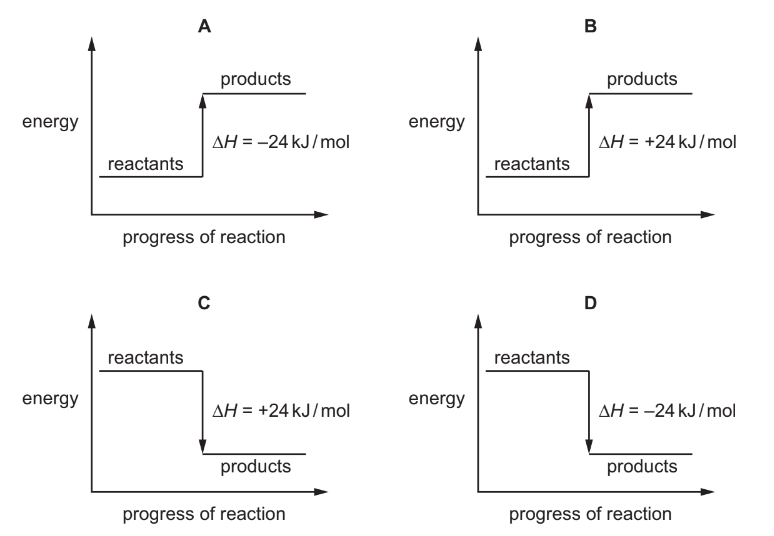
Which reaction pathway diagram represents an endothermic reaction?

Reaction pathway diagrams

Most-appropriate topic codes (Cambridge IGCSE Chemistry 0620):

Topic 5.1: Exothermic and endothermic reactions — Interpret reaction pathway diagrams showing exothermic and endothermic reactions (Core); Draw and label reaction pathway diagrams including ΔH and activation energy Ea (Supplement)
▶️ Answer/Explanation
In an endothermic reaction, the products have more energy than the reactants, so the energy level of the products is higher than that of the reactants on the reaction pathway diagram — this gives a positive ΔH. In an exothermic reaction, the products are at a lower energy level than the reactants (negative ΔH). Diagram B shows the products at a higher energy level than the reactants with a correctly placed activation energy barrier, which is the defining feature of an endothermic reaction pathway diagram.
Answer: B

Question 11

Hydrogen burns in oxygen. The equation for the reaction is shown.

2H₂ + O₂ → 2H₂O

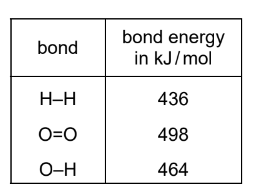
The table shows the bond energies involved.

Bond energies table

What is the energy given out during the reaction?

A. −3226 kJ/mol
B. −884 kJ/mol
C. −486 kJ/mol
D. −442 kJ/mol

Most-appropriate topic codes (Cambridge IGCSE Chemistry 0620):

Topic 5.1: Exothermic and endothermic reactions — State that bond breaking is endothermic and bond making is exothermic; Calculate the enthalpy change of a reaction using bond energies (Supplement)
▶️ Answer/Explanation
Using bond energies: bonds broken = 2×(H–H) + 1×(O=O) = 2×436 + 498 = 1370 kJ/mol (energy absorbed). Bonds made = 4×(O–H) in 2H₂O = 4×463 = 1852 kJ/mol (energy released). ΔH = energy absorbed − energy released = 1370 − 1856 = −486 kJ/mol. The negative sign confirms the reaction is exothermic (energy is given out). The answer is −486 kJ/mol.
Answer: C

Question 12

Which process involves a chemical change?

A. adding sodium to water
B. boiling water
C. dissolving sodium chloride in water
D. producing water from aqueous sodium chloride

Most-appropriate topic codes (Cambridge IGCSE Chemistry 0620):

Topic 6.1: Physical and chemical changes — Identify physical and chemical changes, and describe the differences between them (Core)
▶️ Answer/Explanation
A chemical change involves the formation of one or more new substances with different properties from the original materials, and is often difficult or impossible to reverse. Adding sodium to water produces sodium hydroxide and hydrogen gas — entirely new substances — which is clearly a chemical change. Boiling water is a physical change (water just changes state). Dissolving NaCl is a physical change (it can be recovered by evaporation). Option D is misleading; producing water from electrolysis of aqueous NaCl at the cathode is chemical, but option A is the most direct and straightforward example of a chemical change among those given.
Answer: A

Question 13

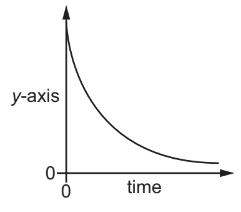
An experiment is carried out to find the rate of reaction between hydrochloric acid and zinc.

Zn(s) + 2HCl(aq) → ZnCl₂(aq) + H₂(g)

The results of the experiment are shown.

Rate of reaction graph

What is the label on the y-axis?

A. amount of ZnCl₂ produced
B. concentration of HCl
C. mass of Zn reacted
D. volume of H₂ produced

Most-appropriate topic codes (Cambridge IGCSE Chemistry 0620):

Topic 6.2: Rate of reaction — Describe practical methods for investigating the rate of a reaction; Interpret data, including graphs, from rate of reaction experiments (Core)
▶️ Answer/Explanation
The graph shows a curve that starts steeply and levels off — this is characteristic of a quantity that is being consumed over time, not produced. The concentration of HCl decreases as it is used up in the reaction; the curve starts high and flattens as the acid is consumed, which matches the typical shape shown. Volume of H₂ produced or ZnCl₂ produced would show an increasing curve (starting from zero and levelling off). Mass of Zn reacted would also increase. Therefore, the y-axis must represent the concentration of HCl decreasing over time.
Answer: B

Question 14

Hydrogen peroxide, H₂O₂, decomposes to form water and oxygen.

2H₂O₂(aq) → 2H₂O(l) + O₂(g)

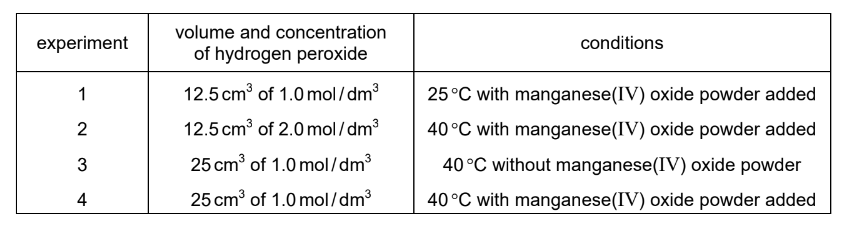
Manganese(IV) oxide catalyses the decomposition reaction. The reaction is investigated in four experiments.

Four experiments table

All reactions go to completion and all measurements of gas volumes are at room temperature and pressure. Which statement is correct?

A. Experiment 1 produces less gas than experiment 4, but at the same rate.
B. Experiment 2 produces more gas than experiment 1, but at the same rate.
C. Experiment 2 and experiment 4 each produce the same volume of gas, but at different rates.
D. Experiment 3 and experiment 4 each produce the same volume of gas and at the same rate.

Most-appropriate topic codes (Cambridge IGCSE Chemistry 0620):

Topic 6.2: Rate of reaction — Describe the effect of adding or removing a catalyst; Describe the effect of changing the concentration of solutions on the rate of reaction (Core)
▶️ Answer/Explanation
The total volume of gas produced depends only on the amount (moles) of H₂O₂, not on the catalyst or concentration (as long as all reactions go to completion). Experiments 2 and 4 have the same number of moles of H₂O₂ (same volume of the same concentration), so they produce the same total volume of O₂. However, experiment 4 has a catalyst (MnO₂) while experiment 2 does not, so experiment 4 reacts faster — same volume of gas, different rates. The catalyst does not change the amount of gas, only the rate. This makes option C correct.
Answer: C

Question 15

Sulfuric acid is produced by the Contact process.

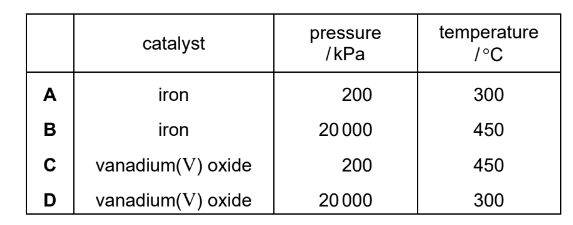
Which row shows the typical conditions used in the process?

Contact process conditions table

Most-appropriate topic codes (Cambridge IGCSE Chemistry 0620):

Topic 6.3: Reversible reactions and equilibrium — State the typical conditions for the conversion of sulfur dioxide to sulfur trioxide in the Contact process as 450 °C, 200 kPa/2 atm and a vanadium(V) oxide catalyst (Supplement)
▶️ Answer/Explanation
The key step in the Contact process is: 2SO₂(g) + O₂(g) ⇌ 2SO₃(g), catalysed by vanadium(V) oxide (V₂O₅). The typical conditions used are a temperature of 450 °C (a compromise between yield and rate) and a pressure of approximately 200 kPa (2 atm) — relatively low pressure since the reaction proceeds well without high pressure and high pressure increases cost and safety risks. Higher temperatures decrease yield (exothermic reaction shifts left), while lower temperatures are too slow. Row C correctly gives 450 °C, 200 kPa, and vanadium(V) oxide catalyst.
Answer: C

Question 16

Which equation shows the reduction of copper?

A. CuO + C → Cu + CO
B. 2CuS + 3O₂ → 2CuO + 2SO₂
C. Cu(g) → Cu(l)
D. Cu(l) → Cu(s)

Most-appropriate topic codes (Cambridge IGCSE Chemistry 0620):

Topic 6.4: Redox — Define oxidation as gain of oxygen and reduction as loss of oxygen; Identify oxidation and reduction in redox reactions (Core)
▶️ Answer/Explanation
Reduction of copper means copper is losing oxygen (or gaining electrons) — the copper compound is converted into copper metal. In equation A, CuO loses its oxygen to form Cu metal; the copper in CuO goes from Cu²⁺ (oxidation state +2) to Cu⁰, gaining electrons. This is reduction of copper. Equation B shows copper being oxidised (CuS → CuO, gaining oxygen). Equations C and D show only state changes, with no change in oxidation state. Therefore, only equation A represents the reduction of copper.
Answer: A

Question 17

Which statement about acids is correct?

A. A weak acid partially dissociates in aqueous solution.
B. An acid accepts protons when added to water.
C. Ethanoic acid acts as a strong acid when added to water.
D. Hydrochloric acid is a strong acid that ionises in water to form H⁻ ions.

Most-appropriate topic codes (Cambridge IGCSE Chemistry 0620):

Topic 7.1: The characteristic properties of acids and bases — Define acids as proton donors and bases as proton acceptors; Define a strong acid as completely dissociated and a weak acid as partially dissociated in aqueous solution (Supplement)
▶️ Answer/Explanation
A weak acid is defined as one that only partially dissociates (ionises) in aqueous solution, establishing an equilibrium between the undissociated acid and its ions — this is statement A, which is correct. Statement B is wrong because acids are proton donors (not acceptors); it is bases that accept protons. Statement C is wrong because ethanoic acid is a weak acid. Statement D is wrong because HCl forms H⁺ ions (not H⁻) in water. Therefore, statement A is the only correct one.
Answer: A

Question 18

Copper(II) sulfate is formed by reacting excess solid copper(II) carbonate with dilute sulfuric acid.

Which processes are part of the preparation of solid copper(II) sulfate?

1 crystallisation
2 distillation
3 filtration
4 titration

A. 1 and 3
B. 1 and 4
C. 2 and 3
D. 2 and 4

Most-appropriate topic codes (Cambridge IGCSE Chemistry 0620):

Topic 7.3: Preparation of salts — Describe the preparation, separation and purification of soluble salts by reaction of an acid with excess insoluble carbonate (Core)
▶️ Answer/Explanation
Since excess insoluble copper(II) carbonate is used, once the reaction is complete there is unreacted solid carbonate mixed with the copper(II) sulfate solution. Filtration (process 3) is needed to remove the excess solid carbonate from the solution. Then the filtrate (copper(II) sulfate solution) is evaporated and allowed to cool so that copper(II) sulfate crystals form — this is crystallisation (process 1). Distillation is not used (no volatile liquids to separate), and titration is not needed when excess solid is used. Therefore, processes 1 and 3 are correct.
Answer: A

Question 19

Which type of reaction is represented by the equation shown?

Pb²⁺(aq) + 2NO₃⁻(aq) + 2Na⁺(aq) + 2I⁻(aq) → PbI₂(s) + 2Na⁺(aq) + 2NO₃⁻(aq)

A. addition
B. redox
C. neutralisation
D. precipitation

Most-appropriate topic codes (Cambridge IGCSE Chemistry 0620):

Topic 7.3: Preparation of salts — Describe the preparation of insoluble salts by precipitation (Supplement)
▶️ Answer/Explanation
In this reaction, Pb²⁺ ions and I⁻ ions combine to form the insoluble solid PbI₂, which precipitates out of solution. The Na⁺ and NO₃⁻ ions are spectator ions that remain in solution unchanged. A precipitation reaction occurs when two soluble ionic compounds are mixed and an insoluble product forms, which is exactly what is shown here. There is no change in oxidation states (not redox), no acid–base neutralisation, and no addition of atoms across a double bond (not addition).
Answer: D

Question 20

Which compound is likely to be coloured?

A. KMnO₄
B. KNO₃
C. K₂CO₃
D. K₂SO₄

Most-appropriate topic codes (Cambridge IGCSE Chemistry 0620):

Topic 8.4: Transition elements — Describe the transition elements as metals that form coloured compounds (Core)
▶️ Answer/Explanation
Transition metal compounds are typically coloured because their d-orbitals allow electrons to absorb specific wavelengths of visible light. KMnO₄ contains manganese (Mn), a transition metal, and is well known for its distinctive deep purple/violet colour. The other three options — KNO₃, K₂CO₃, and K₂SO₄ — all contain potassium (a Group I element, not a transition metal) combined with non-metallic anions; these are all white solids. Therefore, KMnO₄ is the compound most likely to be coloured.
Answer: A

Question 21

Which statements about the metal zinc are correct?

  1. It is extracted from the ore bauxite.
  2. It is used to galvanise steel.
  3. It is used to make the alloy brass.
  4. It reacts with dilute hydrochloric acid to produce hydrogen gas.

A. 1, 2 and 4
B. 1, 3 and 4
C. 2, 3 and 4
D. 2 and 3 only

Most-appropriate topic codes (Cambridge IGCSE Chemistry 0620):

Topic 9.3: Alloys — Describe brass as a mixture of copper and zinc (Core)
Topic 9.4: Reactivity series — reactions of metals with dilute hydrochloric acid (Core)
Topic 9.5: Corrosion — Describe the use of zinc in galvanising (Supplement)
Topic 9.6: Extraction of metals — bauxite is the ore of aluminium, not zinc (Core)
▶️ Answer/Explanation
Statement 1 is wrong — bauxite is the main ore of aluminium, not zinc (zinc is extracted from zinc blende/sphalerite, ZnS). Statement 2 is correct — zinc is used to coat steel in a process called galvanising, protecting it from rusting by both barrier and sacrificial protection. Statement 3 is correct — brass is an alloy of copper and zinc. Statement 4 is correct — zinc is above hydrogen in the reactivity series and reacts with dilute HCl to produce ZnCl₂ and H₂ gas. Therefore, statements 2, 3, and 4 are all correct.
Answer: C

Question 22

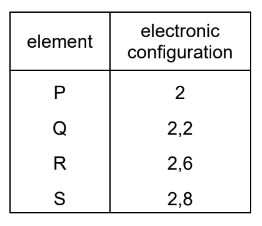
The electronic configurations of four elements, P, Q, R and S, are shown.

Electronic configurations

Which elements are unreactive monatomic gases?

A. P and Q
B. P and S
C. Q and R
D. S only

Most-appropriate topic codes (Cambridge IGCSE Chemistry 0620):

Topic 8.5: Noble gases — Describe the Group VIII noble gases as unreactive, monatomic gases and explain this in terms of electronic configuration (Core)
▶️ Answer/Explanation
Noble gases (Group VIII) are unreactive monatomic gases because they have full outer electron shells, giving them great stability with no tendency to gain, lose, or share electrons. An element is a noble gas if its outermost electron shell is completely filled. P has configuration 2 (just helium — full outer shell), and S has configuration 2,8 (neon — full outer shell). Q with configuration 2,1 is lithium (reactive Group I metal). R with configuration 2,8,1 is sodium (reactive Group I metal). Therefore, P and S are the noble gases.
Answer: B

Question 23

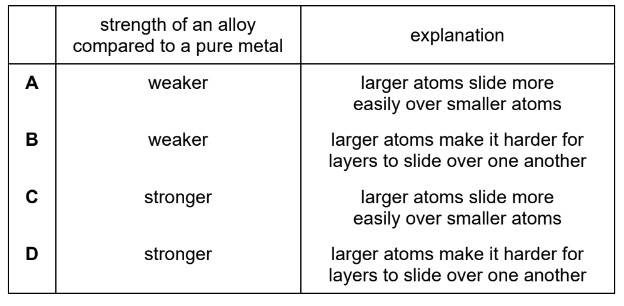
Which row compares the strength of alloys with pure metals and explains the difference in strength?

Alloys vs pure metals table

Most-appropriate topic codes (Cambridge IGCSE Chemistry 0620):

Topic 9.3: Alloys and their properties — State that alloys can be harder and stronger than pure metals; Explain in terms of structure how alloys can be harder and stronger because the different sized atoms mean the layers can no longer slide over each other (Supplement)
▶️ Answer/Explanation
In a pure metal, layers of identical atoms are arranged in regular rows and can slide over each other easily when a force is applied, making the metal relatively soft and malleable. When different-sized atoms are introduced in an alloy, the regular arrangement is disrupted; the differently sized atoms prevent the layers from sliding smoothly, making the alloy harder and stronger than the pure metal. Row D correctly states that alloys are harder and stronger than pure metals because the different-sized atoms distort the lattice and prevent layer sliding.
Answer: D

Question 24

Zinc oxide reacts with carbon to produce zinc.

Which equation represents this reaction?

A. 2ZnO + C → 2Zn + CO
B. 2ZnO + 2C → 2Zn + 2CO₂
C. ZnO + C → Zn + CO
D. ZnO + 2C → Zn + 2CO₂

Most-appropriate topic codes (Cambridge IGCSE Chemistry 0620):

Topic 9.6: Extraction of metals — Describe the ease in obtaining metals related to the reactivity series; State symbol equations for the extraction of metals by reduction with carbon (Supplement)
▶️ Answer/Explanation
When zinc oxide is reduced by carbon, the carbon takes the oxygen from ZnO. The simplest balanced equation is ZnO + C → Zn + CO, where 1 Zn, 1 O, and 1 C on each side balances perfectly. Option A (2ZnO + C → 2Zn + CO) is not balanced — there are 2 O on the left but only 1 O in CO on the right. Option B and D are incorrect in their atom counts or products. Option C (ZnO + C → Zn + CO) is correctly balanced with atoms and charges matching on both sides.
Answer: C

Question 25

When a piece of aluminium foil is added to dilute hydrochloric acid, no effervescence is seen.

Which statement explains why no effervescence is seen?

A. Aluminium does not make a gas when it reacts with an acid.
B. Aluminium has a surface layer of aluminium oxide.
C. Aluminium is less reactive than hydrogen.
D. Aluminium only reacts with concentrated acid.

Most-appropriate topic codes (Cambridge IGCSE Chemistry 0620):

Topic 9.4: Reactivity series — Explain the apparent unreactivity of aluminium in terms of its oxide layer (Supplement)
▶️ Answer/Explanation
Aluminium is actually a reactive metal (above hydrogen in the reactivity series) and would normally react vigorously with dilute hydrochloric acid to produce hydrogen gas and aluminium chloride. However, aluminium rapidly forms a thin, tough, adherent layer of aluminium oxide (Al₂O₃) on its surface when exposed to air. This oxide layer acts as a protective barrier that prevents the acid from contacting the aluminium metal beneath, so no reaction (and no effervescence) is observed. If the oxide layer is removed (e.g. by amalgamating with mercury), aluminium reacts rapidly with acid.
Answer: B

Question 26

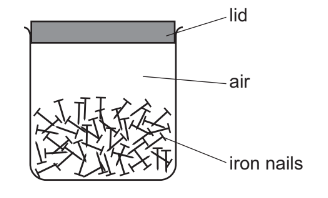
Iron nails are stored in an airtight container.

Iron nails airtight container

The nails begin to rust after a few days. How can the rusting of the nails be prevented?

A. Leave the lid off.
B. Replace the air with argon.
C. Put the container in a warm place.
D. Seal the container in a bag.

Most-appropriate topic codes (Cambridge IGCSE Chemistry 0620):

Topic 9.5: Corrosion of metals — State the conditions required for the rusting of iron and steel; Describe how barrier methods prevent rusting by excluding oxygen or water (Core)
▶️ Answer/Explanation
Rusting of iron requires both oxygen and water to be present simultaneously. Since the nails are rusting inside an airtight container, the air inside (which contains oxygen and possibly moisture) is the source of the problem. Replacing the air with argon (an inert noble gas) removes the oxygen, so even if moisture is present, rusting cannot occur without oxygen. Option A (leaving the lid off) would allow more air in and worsen rusting. Option C (warmth) would accelerate rusting. Option D (sealing in a bag) would still leave air inside and not help. Therefore, replacing the air with argon is the correct answer.
Answer: B

Question 27

Four substances present in the blast furnace during iron extraction are listed.

  1. calcium carbonate
  2. carbon dioxide
  3. carbon monoxide
  4. iron(III) oxide

Which substances are both a reactant and a product during the reactions occurring in the blast furnace?

A. 1 and 2
B. 1 and 4
C. 2 and 3
D. 3 and 4

Most-appropriate topic codes (Cambridge IGCSE Chemistry 0620):

Topic 9.6: Extraction of metals — Describe the extraction of iron from haematite in the blast furnace (Core); State the symbol equations for the extraction of iron (Supplement)
▶️ Answer/Explanation
In the blast furnace: C + O₂ → CO₂ (CO₂ is a product here), then C + CO₂ → 2CO (CO₂ is now a reactant and CO is a product), then Fe₂O₃ + 3CO → 2Fe + 3CO₂ (CO is a reactant and CO₂ is again a product). So CO₂ is both produced (reaction 1 and 3) and consumed (reaction 2) — it is both a reactant and a product. Similarly, CO is produced in reaction 2 and consumed in reaction 3. Calcium carbonate decomposes but is not re-formed; iron(III) oxide is only a reactant. Therefore, CO₂ (substance 2) and CO (substance 3) both act as reactant and product.
Answer: C

Question 28

Aluminium is extracted from purified bauxite by electrolysis.

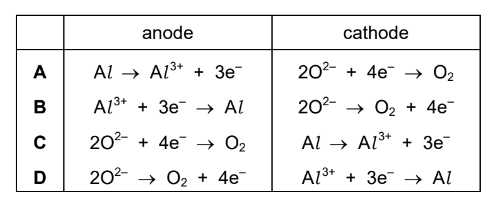
Which row shows the ionic half-equations for the reaction at each electrode?

Electrode half-equations table

Most-appropriate topic codes (Cambridge IGCSE Chemistry 0620):

Topic 9.6: Extraction of metals — Describe the extraction of aluminium including the reactions at the electrodes, including ionic half-equations (Supplement)
Topic 4.1: Electrolysis — Construct ionic half-equations for reactions at the anode (oxidation) and cathode (reduction) (Supplement)
▶️ Answer/Explanation
During electrolysis of molten aluminium oxide (Al₂O₃), Al³⁺ ions are attracted to the cathode (negative electrode) and gain electrons to form aluminium metal: Al³⁺ + 3e⁻ → Al (reduction at cathode). The O²⁻ ions are attracted to the anode (positive electrode) and lose electrons to form oxygen gas: 2O²⁻ → O₂ + 4e⁻ (oxidation at anode). Row D shows the cathode half-equation as Al³⁺ + 3e⁻ → Al and the anode as 2O²⁻ → O₂ + 4e⁻, which are both correctly balanced for charge and atoms.
Answer: D

Question 29

Which test is used to show that a sample of water is pure?

A. Evaporate the water to see if any solids remain.
B. Heat the water to check its boiling point.
C. Test with anhydrous cobalt(II) chloride.
D. Use universal indicator paper to check its pH.

Most-appropriate topic codes (Cambridge IGCSE Chemistry 0620):

Topic 10.1: Water — Describe how to test for the purity of water using melting point and boiling point (Core)
▶️ Answer/Explanation
The purity of water can be determined by checking its boiling point — pure water boils at exactly 100 °C at standard pressure, whereas impure water (containing dissolved substances) boils at a higher temperature (boiling point elevation). Option A (evaporation to check for solids) can detect dissolved solids but not dissolved gases or volatile impurities. Option C (anhydrous cobalt(II) chloride) simply confirms the presence of water (turns blue to pink), not its purity. Option D (pH) tells us about acidity but not overall purity. Checking the boiling point is the correct test for purity.
Answer: B

Question 30

Catalytic converters in car exhausts change polluting gases into non-polluting gases.

Which statements about oxides of nitrogen and car engines are correct?

  1. The nitrogen in oxides of nitrogen comes from compounds in gasoline.
  2. The oxygen in oxides of nitrogen comes from the air in the car engine.
  3. Catalytic converters convert oxides of nitrogen into nitrogen.

A. 1 and 2
B. 2 and 3
C. 2 only
D. 3 only

Most-appropriate topic codes (Cambridge IGCSE Chemistry 0620):

Topic 10.3: Air quality and climate — State the source of oxides of nitrogen from car engines; Explain how oxides of nitrogen form in car engines and describe their removal by catalytic converters (Supplement)
▶️ Answer/Explanation
Oxides of nitrogen (NOₓ) form in car engines when the extreme heat inside the engine causes atmospheric nitrogen (N₂) and oxygen (O₂) from the air to react together — so both the nitrogen and oxygen in NOₓ come from the air, not from compounds in gasoline (Statement 1 is wrong). Statement 2 is correct — the oxygen comes from the air. Statement 3 is correct — catalytic converters contain precious metal catalysts that convert NOₓ back into harmless N₂ and CO₂ via reactions such as 2CO + 2NO → 2CO₂ + N₂. Therefore, statements 2 and 3 are both correct.
Answer: B

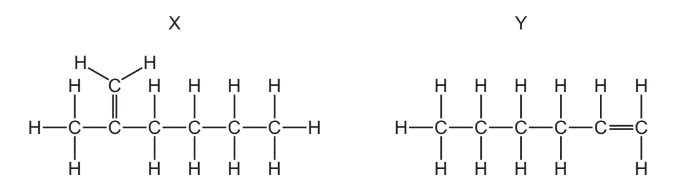
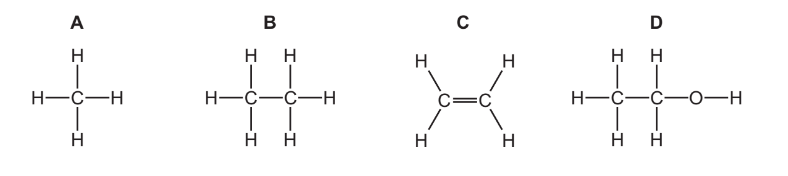
Question 31

The structures of two molecules, X and Y, are shown.

Structures of molecules X and Y

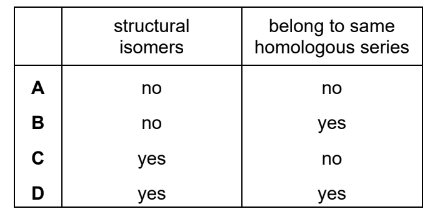
Which row describes X and Y?

Description table for X and Y

Most-appropriate topic codes (Cambridge IGCSE Chemistry 0620):

Topic 11.1: Formulae, functional groups and terminology — State that a saturated compound has molecules in which all carbon–carbon bonds are single bonds; State that an unsaturated compound has molecules in which one or more carbon–carbon bonds are not single bonds (Core)
Topic 11.4: Alkanes — State that alkanes are saturated hydrocarbons (Core)
Topic 11.5: Alkenes — State that alkenes are unsaturated hydrocarbons (Core)
▶️ Answer/Explanation
Molecule X contains only C–C single bonds and C–H bonds, making it a saturated hydrocarbon (alkane). Molecule Y contains a C=C double bond, making it an unsaturated hydrocarbon (alkene). Saturated compounds do not decolourise bromine water (they only react via slow substitution in UV light), while unsaturated compounds rapidly decolourise bromine water via addition reactions across the double bond. Row B correctly identifies X as saturated (does not decolourise bromine water) and Y as unsaturated (decolourises bromine water).
Answer: B

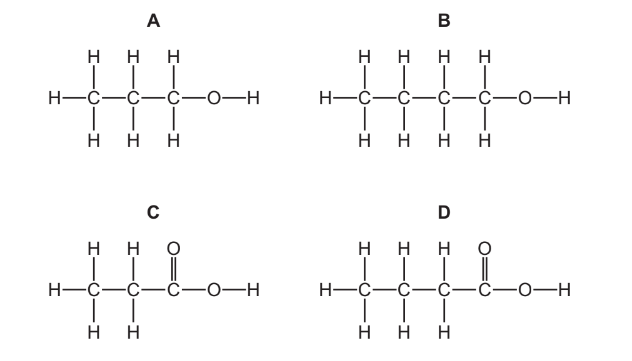
Question 32

What is the structure of butanoic acid?

Butanoic acid structures A B C D

Most-appropriate topic codes (Cambridge IGCSE Chemistry 0620):

Topic 11.2: Naming organic compounds — Name and draw the structural and displayed formulae of unbranched carboxylic acids containing up to four carbon atoms per molecule (Supplement)
▶️ Answer/Explanation
Butanoic acid is a carboxylic acid with four carbon atoms in an unbranched chain, ending with the –COOH functional group. Its molecular formula is C₃H₇COOH or C₄H₈O₂. The displayed structure shows CH₃–CH₂–CH₂–COOH: three CH₂/CH₃ groups attached to a –COOH group, with the terminal carbon being the carboxyl carbon. Option D correctly shows four carbon atoms in a straight chain with the carboxyl (–COOH) group at one end, which is the correct structure of butanoic acid.
Answer: D

Question 33

When a mixture of methane and chlorine is exposed to ultraviolet light, a reaction takes place.

Which statements about this reaction are correct?

  1. It is an addition reaction.
  2. The ultraviolet light provides the activation energy.
  3. An equation for the reaction is CH₄ + Cl₂ → CH₂Cl₂ + H₂.
  4. CH₃Cl is made in the reaction.

A. 1 and 3
B. 1 and 4
C. 2 and 3
D. 2 and 4

Most-appropriate topic codes (Cambridge IGCSE Chemistry 0620):

Topic 11.4: Alkanes — Describe the substitution reaction of alkanes with chlorine as a photochemical reaction, with ultraviolet light providing the activation energy Eₐ; draw the structural or displayed formulae of the products, limited to monosubstitution (Supplement)
▶️ Answer/Explanation
The reaction of methane with chlorine in UV light is a substitution reaction (not addition — addition applies to alkenes), so Statement 1 is wrong. The UV light provides the activation energy to break the Cl–Cl bond and initiate the radical chain reaction (Statement 2 is correct). The monosubstitution product is CH₃Cl (chloromethane), where one H is replaced by Cl, and HCl is the other product: CH₄ + Cl₂ → CH₃Cl + HCl — so Statement 4 is correct. Statement 3 shows disubstitution and formation of H₂, which is incorrect.
Answer: D

Question 34

Esters are formed when a carboxylic acid reacts with an alcohol.

What is the catalyst for this reaction?

A. aqueous potassium manganate(VII)
B. iron
C. sulfuric acid
D. vanadium(V) oxide

Most-appropriate topic codes (Cambridge IGCSE Chemistry 0620):

Topic 11.7: Carboxylic acids — Describe the reaction of a carboxylic acid with an alcohol using an acid catalyst to form an ester (Supplement)
▶️ Answer/Explanation
The esterification reaction between a carboxylic acid and an alcohol is catalysed by a strong acid catalyst. Concentrated sulfuric acid (H₂SO₄) is the standard catalyst used in this reaction; it protonates the carbonyl oxygen to activate it towards nucleophilic attack by the alcohol. Potassium manganate(VII) is an oxidising agent used to oxidise ethanol to ethanoic acid, not for esterification. Iron and vanadium(V) oxide are catalysts for other industrial reactions. Sulfuric acid is the correct catalyst for ester formation.
Answer: C

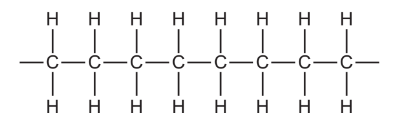
Question 35

The diagram shows part of a polymer.

Polymer structure

Which diagram shows the monomer from which this polymer is made?

Monomer options A B C D

Most-appropriate topic codes (Cambridge IGCSE Chemistry 0620):

Topic 11.8: Polymers — Deduce the structure or repeat unit of an addition polymer from a given alkene and vice versa (Supplement)
▶️ Answer/Explanation
To find the monomer of an addition polymer, look at the repeat unit in the polymer chain and reintroduce the C=C double bond. In an addition polymer, the monomer is always an alkene; the double bond opens up to allow chain formation, and no other atoms are lost. By examining the repeat unit in the polymer shown and converting the two C–C single bonds at the chain ends back into a C=C double bond, the monomer can be identified. Option C shows the correct alkene monomer that, when polymerised by addition, produces the polymer shown.
Answer: C

Question 36

Nylon and PET are polymers.

Which statements about these polymers are correct?

  1. They are both condensation polymers.
  2. HOCH₂CH₂CH₂OH could be a monomer for both polymers.
  3. The complete combustion of both polymers gives two products only.

A. 1 and 2
B. 1 and 3
C. 1 only
D. 2 and 3

Most-appropriate topic codes (Cambridge IGCSE Chemistry 0620):

Topic 11.8: Polymers — Describe the differences between addition and condensation polymerisation; Describe nylon (a polyamide) and PET (a polyester) as condensation polymers (Supplement)
▶️ Answer/Explanation
Statement 1 is correct — both nylon (a polyamide) and PET (a polyester) are formed by condensation polymerisation, in which monomers join together with the elimination of small molecules (water or HCl). Statement 2 is wrong — HOCH₂CH₂CH₂OH (propan-1,3-diol) is a diol that could be used to make polyesters (like PET) but not nylon (which requires a diamine). Statement 3 is wrong — nylon contains nitrogen in addition to C and H, so complete combustion would produce CO₂, H₂O, and nitrogen oxides or N₂ (not just two products). Therefore, only statement 1 is correct.
Answer: C

Question 37

Ethane is used as a fuel.

Which equation shows the complete combustion of ethane?

A. 2C₂H₆ + 7O₂ → 4CO₂ + 6H₂O
B. 2C₂H₆ + 5O₂ → 4CO + 6H₂O
C. C₂H₄ + 3O₂ → 2CO₂ + 2H₂O
D. C₂H₄ + 2O₂ → 2CO + 2H₂O

Most-appropriate topic codes (Cambridge IGCSE Chemistry 0620):

Topic 11.3: Fuels — Name the fossil fuels; State that hydrocarbons are compounds that contain hydrogen and carbon only (Core)
Topic 11.4: Alkanes — Describe the properties of alkanes in terms of combustion (Core)
▶️ Answer/Explanation
Ethane has the formula C₂H₆ (not C₂H₄, which is ethene). Complete combustion means all carbon is converted to CO₂ (not CO) and all hydrogen to H₂O. For ethane: C₂H₆ + O₂ → CO₂ + H₂O. Balancing: 2C₂H₆ + 7O₂ → 4CO₂ + 6H₂O. Check: Left 4C, 12H, 14O; Right 4C, 6×2=12H, 4×2+6=14O. Balanced ✓. Options C and D involve C₂H₄ (ethene, not ethane) and option B shows incomplete combustion (CO product).
Answer: A

Question 38

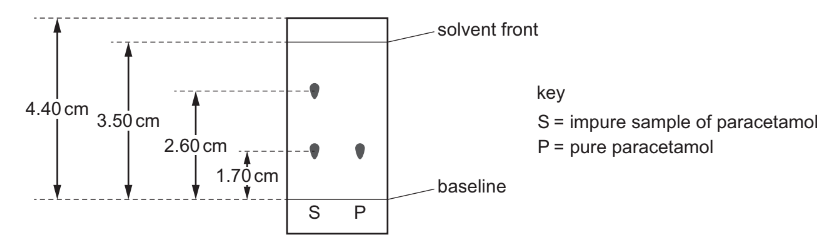
The painkiller paracetamol is synthesised from 4-aminophenol. Chromatography is done on an impure sample of paracetamol. The results are shown. The diagram is not drawn to scale.

Chromatography results

The sample of paracetamol is contaminated with 4-aminophenol only.

What is the Rf value of 4-aminophenol?

A. 0.49
B. 0.65
C. 0.74
D. 1.35

Most-appropriate topic codes (Cambridge IGCSE Chemistry 0620):

Topic 12.3: Chromatography — Interpret simple chromatograms to identify unknown substances; State and use the equation for Rf = distance travelled by substance ÷ distance travelled by solvent (Supplement)
▶️ Answer/Explanation
Rf = distance travelled by substance ÷ distance travelled by solvent. The impure paracetamol sample produces two spots — one for paracetamol and one for the contaminant 4-aminophenol. Rf values cannot exceed 1.00, so option D (1.35) is immediately wrong. The spot that belongs to paracetamol can be identified by comparing with a pure paracetamol reference (if present), and the remaining spot is 4-aminophenol. Using the chromatogram measurements given, 4-aminophenol has an Rf value of 0.74 (option C), which corresponds to the spot travelling a greater distance than paracetamol, indicating it is less polar and interacts less with the stationary phase.
Answer: C

Question 39

The equation for the reaction of aqueous calcium nitrate and aqueous sodium hydroxide is shown.

Ca(NO₃)₂(aq) + 2NaOH(aq) → Ca(OH)₂(s) + 2NaNO₃(aq)

Which process is used to remove calcium hydroxide from the mixture?

A. chromatography
B. crystallisation
C. distillation
D. filtration

Most-appropriate topic codes (Cambridge IGCSE Chemistry 0620):

Topic 12.4: Separation and purification — Describe and explain methods of separation and purification using filtration (Core)
▶️ Answer/Explanation
The equation shows Ca(OH)₂ being produced as a solid precipitate (indicated by the state symbol (s)), while the other product NaNO₃ remains dissolved in solution (aq). To separate an insoluble solid from a solution (in this case, Ca(OH)₂ from the aqueous NaNO₃ solution), filtration is used. The solid Ca(OH)₂ would be trapped on the filter paper as the residue, while the NaNO₃ solution passes through as the filtrate. Chromatography, crystallisation, and distillation are not appropriate for separating a precipitate from a solution.
Answer: D

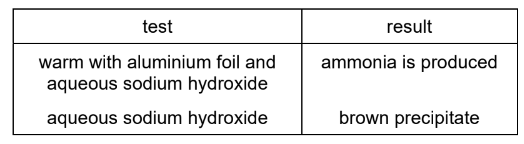
Question 40

The results of two tests on aqueous compound X are given.

Tests on compound X

What is X?

A. iron(III) nitrate
B. iron(II) nitrate
C. iron(III) sulfate
D. iron(II) sulfate

Most-appropriate topic codes (Cambridge IGCSE Chemistry 0620):

Topic 12.5: Identification of ions and gases — Describe tests using aqueous sodium hydroxide and aqueous ammonia to identify aqueous cations including iron(II) and iron(III); Describe tests to identify the anions including sulfate and nitrate (Core)
▶️ Answer/Explanation
From the test results: the first test shows a red-brown precipitate with NaOH, which is the characteristic result for Fe³⁺ ions (iron(III)); iron(II) gives a green precipitate. The second test (for the anion) shows no precipitate with acidified barium nitrate solution — a white precipitate would form if sulfate (SO₄²⁻) were present. The absence of a precipitate rules out sulfate, confirming the anion is nitrate (NO₃⁻). Therefore, compound X contains Fe³⁺ and NO₃⁻ ions, making it iron(III) nitrate.
Answer: A
Scroll to Top