
Question 1
carbon monoxide
copper(II) chloride
ethane
ethene
litmus
methane
methyl orange
sodium chloride
sodium sulfate
sulfur dioxide
thymolphthalein
Most-appropriate topic codes (Cambridge IGCSE Chemistry 0620):
• Topic 7.1 — Characteristic properties of acids and bases (Part (a))
• Topic 10.2 — Fertilisers (Part (b))
• Topic 7.3 — Preparation of salts / solubility rules (Part (c))
• Topic 10.3 — Air quality and climate (Part (d))
• Topic 11.1 — Formulae, functional groups and terminology (Part (e))
• Topic 8.4 — Transition elements (Part (f))
▶️ Answer/Explanation
(a) thymolphthalein
Thymolphthalein is a pH indicator that is blue in alkaline solutions and turns completely colourless when an acid is added, because the indicator changes colour below pH 9.3. This makes it the only substance in the list that fits the description of turning from blue to colourless with acid.
(b) ammonium nitrate
Ammonium nitrate is widely used as a fertiliser because it contains nitrogen in two ionic forms — ammonium (NH₄⁺) and nitrate (NO₃⁻) — both of which are directly available to plants for growth. The syllabus specifically states that ammonium salts and nitrates are used as fertilisers (Topic 10.2).
(c) sodium sulfate
Sodium sulfate (Na₂SO₄) is a salt containing the sulfate ion (SO₄²⁻), which carries a 2− charge. From the list, sodium chloride has a 1− chloride ion, while sodium sulfate uniquely matches a negative ion with a charge of 2−.
(d) methane
Methane (CH₄) is produced during digestion in animals by microorganisms in the gut, and is also released from decomposing vegetation. The syllabus (Topic 10.3) explicitly identifies methane as an air pollutant sourced from waste gases from digestion in animals.
(e) methane
Methane (CH₄) has 1 carbon atom and 4 hydrogen atoms, giving a total of 5 atoms per molecule. Ethane (C₂H₆) has 8 atoms and ethene (C₂H₄) has 6 atoms, so methane is the only hydrocarbon in the list with exactly 5 atoms in a molecule.
(f) copper(II) chloride
Copper is a transition element (found in the d-block of the Periodic Table), so copper(II) chloride is a compound of a transition element. The other compounds in the list (e.g. sodium chloride, sodium sulfate, ammonium nitrate) are compounds of Group I, Group VII or non-metals, not transition elements.
Question 2


Most-appropriate topic codes (Cambridge IGCSE Chemistry 0620):
• Topic 12.4 — Separation and purification — simple distillation (Part (a))
• Topic 11.3 — Fuels — fractional distillation of petroleum (Parts (b)(i) to (b)(iv))
▶️ Answer/Explanation
(a)
Water evaporates / boils from the aqueous copper(II) sulfate solution when heated, but the copper(II) sulfate does not evaporate because it has a much higher boiling point. The water vapour then passes into the condenser, where it cools and condenses back into liquid water, which is collected — leaving the copper(II) sulfate behind in the flask.
(b)(i)
The X should be drawn in the lowest section of the fractionating column (where bitumen collects). Hydrocarbons with the highest viscosity are the longest-chain molecules, which are the heaviest and least volatile — they condense at the bottom of the column where temperatures are highest.
(b)(ii)
The fraction labelled A is kerosene / paraffin. In a typical fractionating column, kerosene is collected in the middle region and is used as jet fuel, making it a key fraction by position relative to the labelling shown.
(b)(iii)
The fraction with the lowest boiling point is refinery gas. It consists of the shortest hydrocarbon chains (mainly C₁–C₄), which have the weakest intermolecular forces, meaning they require the least energy to vaporise and therefore have the lowest boiling points — they exit at the top of the column.
(b)(iv)
Bitumen is used for making / surfacing roads (tarmac). It is the heaviest fraction from petroleum distillation, with very long hydrocarbon chains, giving it a thick, sticky consistency that makes it ideal as a road-surfacing material.
Question 3


(b)(iv) Hydrochloric acid reacts with sodium sulfite. The products are sodium chloride, sulfur dioxide and a liquid which turns anhydrous cobalt(II) chloride pink.
Complete the symbol equation for this reaction.
Na₂SO₃ + ……HCl → 2NaCl + SO₂ + …………
Most-appropriate topic codes (Cambridge IGCSE Chemistry 0620):
• Topic 10.3 — Air quality and climate (Parts (a) and (b)(i), (b)(ii), (b)(iii))
• Topic 12.5 — Identification of ions and gases — test for sulfur dioxide (Part (b)(v))
• Topic 3.1 — Formulae — symbol equations (Part (b)(iv))
• Topic 7.1 — Characteristic properties of acids and bases — pH and OH⁻ ion (Parts (c)(i) and (c)(ii))
▶️ Answer/Explanation
(a)(i) Ammonia
Reading from Table 3.1 in the year 2019, ammonia has the lowest recorded concentration among all the pollutants listed. When comparing values across the row for 2019, ammonia’s figure is smaller than those for particulates, sulfur dioxide, and oxides of nitrogen.
(a)(ii) Particulates
Particulates show a continuous, uninterrupted decrease in concentration from 2019 through to 2022 across all four years listed. No other pollutant in the table shows a consistent downward trend across every single year in this period.
(a)(iii) 5.0 ng
The table gives the concentration of SO₂ in 2020 as 20 ng per 1000 cm³. For a 250 cm³ sample: mass = (20 ÷ 1000) × 250 = 5.0 ng. This is a straightforward proportional calculation using the concentration data from the table.
(b)(i)
One source of sulfur dioxide in the atmosphere is the combustion of fossil fuels (such as coal or oil) that contain sulfur compounds. When these fuels burn, the sulfur reacts with oxygen to form SO₂ gas, which is released into the atmosphere.
(b)(ii)
Sulfur dioxide causes acid rain, as it dissolves in rainwater to form sulfurous and sulfuric acid. Acid rain damages ecosystems, kills aquatic life, erodes limestone buildings and statues, and harms vegetation.
(b)(iii)
The correct answer is calcium oxide (CaO). In flue gas desulfurisation, calcium oxide (or calcium carbonate) is used to react with and neutralise sulfur dioxide, preventing it from being released into the atmosphere from power station chimneys.
(b)(iv)
The balanced equation is: Na₂SO₃ + 2HCl → 2NaCl + SO₂ + H₂O
Two moles of HCl are needed to react with one mole of Na₂SO₃. The liquid product that turns anhydrous cobalt(II) chloride from blue to pink is water (H₂O), which is a chemical test for the presence of water.
(b)(v)
Acidified solution: acidified aqueous potassium manganate(VII)
Observations: the solution turns from purple to colourless (decolourises). Sulfur dioxide acts as a reducing agent, reducing the purple MnO₄⁻ ions to colourless Mn²⁺ ions in the acidic solution.
(c)(i)
The formula of the ion present in all alkaline solutions is OH⁻ (the hydroxide ion). All alkaline solutions contain an excess of hydroxide ions, which is what gives them a pH above 7 and their characteristic alkaline properties.
(c)(ii)
The correct answer is pH 13. Alkaline solutions have a pH greater than 7; pH 13 is strongly alkaline. pH 1 and pH 4 are acidic, and pH 7 is neutral — only pH 13 indicates an alkaline solution.
Question 4

Most-appropriate topic codes (Cambridge IGCSE Chemistry 0620):
• Topic 1.1 — Solids, liquids and gases — distinguishing properties, particle description and changes of state (Parts (a), (b) and (c))
• Topic 1.1 — Solids, liquids and gases — effect of pressure on volume of a gas (Part (d))
▶️ Answer/Explanation
(a)
Any two of the following:
• A liquid has a definite / fixed volume but no fixed shape.
• A liquid takes the shape of its container.
• A liquid flows / can be poured over a surface.
Liquids are distinguished from gases (no fixed volume) and solids (fixed shape) by these macroscopic properties, all arising from the intermediate strength of intermolecular forces.
(b)
A: Freezing — this is the change of state from liquid bromine to solid bromine, occurring when thermal energy is removed and particles slow down enough to lock into fixed positions.
B: Evaporation / Boiling — this is the change of state from liquid bromine to bromine gas, occurring when particles at the surface (or throughout the liquid at boiling point) gain enough energy to overcome intermolecular forces and escape into the gaseous state.
(c)
Liquid bromine:
Arrangement: particles are irregularly / randomly arranged with no long-range order, but close together.
Motion: particles are sliding / moving over each other (vibrational and translational motion), which is why liquids can flow.
Bromine gas:
Arrangement: particles are irregularly / randomly arranged and far apart from each other with large spaces between them.
Motion: particles move rapidly / fast in all directions (random motion), colliding with each other and the walls of the container.
(d)
Decreasing the pressure causes the volume to increase. This is because at a lower external pressure, the gas particles push the walls of the syringe outward more effectively — at constant temperature, pressure and volume are inversely proportional (Boyle’s Law), so halving the pressure doubles the volume.
Question 5

The calcium carbonate undergoes thermal decomposition.
State the meaning of the term thermal decomposition.



Most-appropriate topic codes (Cambridge IGCSE Chemistry 0620):
• Topic 8.2 — Group I properties — trends and predictions (Parts (a)(i) to (a)(iv))
• Topic 6.4 — Redox — oxidation, reduction and redox reactions (Parts (b)(i) and (b)(ii))
• Topic 9.6 — Extraction of metals — blast furnace (Part (b)(iii))
• Topic 9.3 — Alloys and their properties (Parts (c)(i) and (c)(ii))
• Topic 9.4 — Reactivity series (Part (d))
▶️ Answer/Explanation
(a)(i) Between 30°C and 62°C (inclusive)
Rubidium sits between potassium (melting point 63°C) and caesium (melting point 29°C) in Group I. Since melting point decreases down the group, rubidium’s melting point must logically fall between those two values. Any value in the range 30–62°C is acceptable.
(a)(ii) Between 100 and 1100 g/dm³ (inclusive)
Sodium sits between lithium and potassium in Group I. The table shows lithium hydroxide and potassium hydroxide solubilities at the extremes of a range, and sodium hydroxide must fall between these boundary values. Any value in the range 100–1100 g/dm³ is therefore acceptable.
(a)(iii) Bubbles form rapidly AND a flame is produced
Potassium is more reactive than sodium with water. From the trend shown in Table 5.1, potassium reacts vigorously enough to ignite the hydrogen gas produced, so both rapid effervescence (bubbles of hydrogen) and a flame (lilac/purple) are observed simultaneously.
(a)(iv) Physical state: solid
Reason: The melting point of caesium is 29°C, which is above 20°C, so at 20°C caesium has not yet reached its melting point and remains in the solid state. Since temperature (20°C) is below the melting point (29°C), caesium must be solid.
(b)(i)
Carbon dioxide is reduced because it loses oxygen — the CO₂ molecule goes from having two oxygen atoms to forming CO, which has only one oxygen atom per molecule. In the equation, carbon gains oxygen (is oxidised) while CO₂ loses oxygen (is reduced).
(b)(ii)
The type of reaction where oxidation and reduction occur simultaneously is called a redox reaction. In every redox reaction, one species is oxidised (loses oxygen/electrons) at the same time as another is reduced (gains oxygen/electrons).
(b)(iii)
Thermal decomposition is the breakdown of a compound (into simpler substances) by heating / using heat / at high temperature. For example, calcium carbonate decomposes on heating to form calcium oxide and carbon dioxide: CaCO₃ → CaO + CO₂.
(c)(i)
Alloys are more useful than pure metals because they are harder / stronger / more resistant to corrosion. The differently-sized atoms in an alloy disrupt the regular layers of the metal lattice, preventing the layers from sliding over each other easily, which makes the alloy harder than the pure metal.
(c)(ii) Diagram A
Brass is an alloy of copper and zinc — two different metals mixed together. Diagram A shows a lattice of atoms of two different sizes mixed together, which correctly represents the structure of a metallic alloy such as brass.
(d) Correct order (least reactive first):
mercury < tin < iron < magnesium
Mercury shows no reaction with dilute HCl, tin reacts very slowly, iron reacts slowly with bubbles, and magnesium reacts rapidly — placing them in this ascending order of reactivity. Two marks are awarded for the fully correct order; one mark if only one pair is reversed.
Question 6
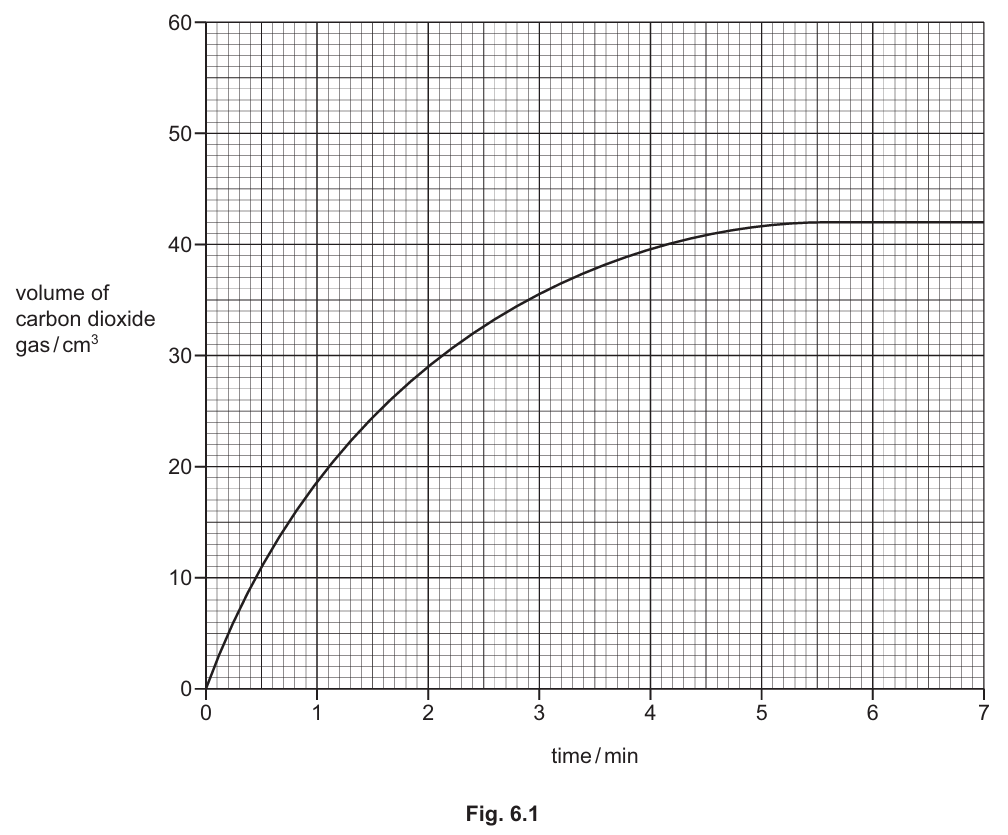
All other conditions stay the same.
Draw a line on the grid in Fig. 6.1 to show the volume of carbon dioxide released when hydrochloric acid with a higher concentration is used.
All other conditions stay the same.
Describe how the rate of reaction differs when smaller pieces of magnesium carbonate are used.
All other conditions stay the same.
Describe how the rate of reaction differs when the temperature is 10°C.
Complete the word equation for this reaction.

State the meaning of the term catalyst.
Most-appropriate topic codes (Cambridge IGCSE Chemistry 0620):
• Topic 6.2 — Rate of reaction — effect of concentration, surface area, temperature and catalysts (Parts (a), (b)(i), (b)(ii) and (d))
• Topic 9.4 — Reactivity series — reactions of metals with dilute acids (Part (c))
▶️ Answer/Explanation
(a)(i) 29 cm³
Reading directly from Fig. 6.1 at the 2-minute mark on the x-axis, the corresponding volume on the y-axis is approximately 29 cm³. This is a graph-reading skill where the value must be interpolated carefully to the nearest half-square on the grid.
(a)(ii)
The new line must show a steeper initial gradient starting from the origin (0, 0), indicating a faster initial rate of reaction due to the higher concentration of hydrochloric acid. Since the acid is the limiting reagent and magnesium carbonate is still in excess, the reaction produces the same total volume of CO₂ as before — but reaches the same final volume more quickly, so the line must level off at the same or higher point above 42 cm³. Two marks: one for steeper gradient, one for levelling off above the original final volume.
(b)(i)
Using smaller pieces of magnesium carbonate increases the rate of reaction. Smaller pieces have a greater total surface area exposed to the acid, which means more reactant particles are available for collisions per unit time, leading to a faster rate without changing the total amount of CO₂ produced.
(b)(ii)
At 10°C the rate of reaction is slower / decreases. A lower temperature means the reactant particles have less kinetic energy, so they collide less frequently and with less energy, meaning fewer collisions exceed the activation energy per unit time — resulting in a reduced rate of reaction.
(c)
iron + hydrochloric acid → iron(II) chloride + hydrogen
Iron reacts with dilute hydrochloric acid to form iron(II) chloride (FeCl₂) and hydrogen gas. Iron is below magnesium in the reactivity series but above copper, so it reacts with dilute acids — but not as vigorously as the more reactive metals.
(d)
A catalyst is a substance that increases the rate of a reaction and is unchanged at the end of the reaction. Catalysts work by providing an alternative reaction pathway with a lower activation energy, allowing more collisions to be successful without being consumed in the process.
Question 7


Describe a test for an unsaturated compound.
State the meaning of the term polymer.

Name the two products formed when ethanol undergoes complete combustion.
Most-appropriate topic codes (Cambridge IGCSE Chemistry 0620):
• Topic 11.1 — Formulae, functional groups and terminology — displayed formulae and molecular formulae (Parts (a)(i) and (a)(ii))
• Topic 3.2 — Relative masses of atoms and molecules — calculating relative molecular mass (Part (b)(i))
• Topic 11.5 — Alkenes — test for unsaturation using bromine water (Part (b)(ii))
• Topic 11.8 — Polymers — definition of polymer and addition polymerisation (Parts (b)(iii) and (b)(iv))
• Topic 11.7 — Carboxylic acids — reaction with bases (Part (c))
• Topic 11.6 — Alcohols — combustion of ethanol (Part (d))
▶️ Answer/Explanation
(a)(i)
The circle should be drawn around the –COOH group on the displayed formula of compound S. The carboxylic acid functional group consists of a carbon atom double-bonded to an oxygen atom and single-bonded to an –OH group, and it is this combination that defines the carboxylic acid homologous series.
(a)(ii) C₃H₆O₃
By counting all the atoms shown in the displayed formula of compound S — 3 carbon atoms, 6 hydrogen atoms, and 3 oxygen atoms — the molecular formula is deduced as C₃H₆O₃. The displayed formula shows every single bond and atom explicitly, making it straightforward to count each element directly.
(b)(i) Relative molecular mass = 72
Using the molecular formula C₃H₄O₂: carbon contributes 3 × 12 = 36, hydrogen contributes 4 × 1 = 4, and oxygen contributes 2 × 16 = 32. Adding these together: 36 + 4 + 32 = 72. One mark is awarded if only two of the three element contributions are correctly calculated.
(b)(ii)
Test: add aqueous bromine (bromine water) to the compound.
Observations: the bromine water decolourises / turns from orange-brown to colourless. Unsaturated compounds contain carbon–carbon double bonds (C=C) that react rapidly with bromine by addition, breaking the double bond and removing the bromine’s colour.
(b)(iii)
A polymer is a large molecule / long chain molecule that is formed from many small molecules called monomers joining together in a repeating pattern. The process of forming a polymer from monomers is called polymerisation, and the resulting polymer chain can contain thousands of repeating monomer units.
(b)(iv) Addition
Poly(ethene) is made by addition polymerisation, in which the double bonds (C=C) in ethene monomers open up and join together to form a long polymer chain with no other products formed. This distinguishes addition polymerisation from condensation polymerisation, which releases a small molecule (such as water) for each bond formed.
(c)
ethanoic acid + sodium hydroxide → sodium ethanoate + water
This is a neutralisation reaction between a weak acid (ethanoic acid) and an alkali (sodium hydroxide). The carboxylic acid reacts with the base to produce a salt — sodium ethanoate (CH₃COONa) — and water, following the general pattern: acid + alkali → salt + water.
(d)
The two products of complete combustion of ethanol are carbon dioxide and water. During complete combustion, ethanol (C₂H₅OH) reacts with excess oxygen so that all the carbon atoms are fully oxidised to CO₂ and all the hydrogen atoms are fully oxidised to H₂O, with no carbon monoxide or soot produced.
Question 8
(b) Complete Fig. 8.1 to show:
- the electronic configuration of a lithium ion
- the charge on the ion

(d) Molten lithium bromide is electrolysed using graphite electrodes.
State the names of the product at each electrode and give the observations at the positive electrode.

State one use of diamond.
Most-appropriate topic codes (Cambridge IGCSE Chemistry 0620):
• Topic 2.4 — Ions and ionic bonds — definition of ionic bond and ion formation (Parts (a) and (b))
• Topic 2.3 — Isotopes — proton number and nucleon number (Part (c))
• Topic 4.1 — Electrolysis — products at electrodes for molten ionic compounds (Part (d))
• Topic 2.6 — Giant covalent structures — graphite and diamond structure, bonding and uses (Parts (e)(i), (e)(ii) and (e)(iii))
▶️ Answer/Explanation
(a)
An ionic bond is a strong electrostatic attraction between oppositely charged ions. It forms when a metal atom transfers one or more electrons to a non-metal atom, creating a positively charged cation and a negatively charged anion that are held together by the electrostatic force of attraction between their opposite charges.
(b)
The lithium ion (Li⁺) has lost its one outer electron, leaving it with only the first electron shell containing 2 electrons. The diagram should show a nucleus with only the inner shell filled with 2 electrons and no outer shell electrons remaining. The charge outside the brackets should be shown as + or 1+, since lithium loses one electron to form a singly positive ion.
(c)
Number of protons = 35 — the proton number (atomic number) shown at the bottom left of the symbol is 35, and this is always equal to the number of protons in the nucleus regardless of whether the atom is neutral or an ion.
Number of neutrons = 44 — the mass number is 79 and the number of protons is 35, so the number of neutrons = 79 − 35 = 44. Note: the bromide ion has one extra electron compared to a neutral bromine atom, but the number of neutrons in the nucleus is unaffected by ionic charge.
(d)
Product at the negative electrode (cathode): lithium — positively charged Li⁺ ions are attracted to the negative electrode, where they each gain one electron and are discharged as lithium metal.
Product at the positive electrode (anode): bromine — negatively charged Br⁻ ions are attracted to the positive electrode, where they each lose one electron and are discharged.
Observations at the positive electrode: a red-brown vapour / gas is produced, as bromine is formed and immediately vaporises at the temperature of the molten electrolyte.
(e)(i)
The type of bonding within each layer in graphite is covalent bonding. Each carbon atom forms three covalent bonds with three neighbouring carbon atoms in a flat hexagonal layer, with the fourth electron from each carbon atom becoming delocalised between the layers.
(e)(ii)
Graphite is used as a lubricant because its structure consists of layers that can slide over each other easily. As seen in Fig. 8.2, the layers are held together only by weak forces between them, so they can move past one another with minimal resistance, reducing friction between surfaces.
(e)(iii)
Diamond is used in cutting tools (e.g. drill bits, glass cutters, saw blades). This is because every carbon atom in diamond forms four strong covalent bonds in a giant three-dimensional lattice, making diamond the hardest natural substance — ideal for cutting through other hard materials.