
Question 1
A list of gases is shown.
ammonia
carbon dioxide
carbon monoxide
ethene
fluorine
oxygen
sulfur dioxide
xenon
Most-appropriate topic codes (Cambridge IGCSE Chemistry 0620):
• Topic 10.3 — Air quality and climate (Parts \(\mathrm{(a)}\), \(\mathrm{(d)}\))
• Topic 7.1 — Characteristic properties of acids and bases (Part \(\mathrm{(b)}\))
• Topic 8.5 — Noble gases (Part \(\mathrm{(c)}\))
• Topic 11.8 — Polymers (Part \(\mathrm{(e)}\))
• Topic 12.5 — Identification of ions and gases (Part \(\mathrm{(f)}\))
▶️ Answer/Explanation
(a) sulfur dioxide
\(\mathrm{SO_2}\) is released from the combustion of fossil fuels containing sulfur compounds. It dissolves in atmospheric moisture to form sulfurous acid (\(\mathrm{H_2SO_3}\)) and can be oxidised to sulfuric acid (\(\mathrm{H_2SO_4}\)), both of which lower the pH of rain, causing acid rain.
(b) ammonia
Ammonia (\(\mathrm{NH_3}\)) dissolves readily in water to form an alkaline solution according to: \(\mathrm{NH_3(g) + H_2O(l) \rightleftharpoons NH_4^+(aq) + OH^-(aq)}\). The production of hydroxide ions (\(\mathrm{OH^-}\)) makes the solution alkaline, turning litmus paper blue.
(c) xenon
Xenon (\(\mathrm{Xe}\)) belongs to Group VIII (the noble gases), which have a full outer electron shell (8 electrons). This complete configuration means xenon has no tendency to gain, lose, or share electrons, making it chemically inert and unreactive under normal conditions.
(d) oxygen
Photosynthesis follows the equation: \(\mathrm{6CO_2 + 6H_2O \rightarrow C_6H_{12}O_6 + 6O_2}\). Oxygen (\(\mathrm{O_2}\)) is a product of this process, released as plants use light energy and chlorophyll to convert carbon dioxide and water into glucose.
(e) ethene
Ethene (\(\mathrm{CH_2{=}CH_2}\)) is an alkene containing a \(\mathrm{C{=}C}\) double bond, which allows it to undergo addition polymerisation. Many ethene monomers join together, breaking the double bond to form the addition polymer poly(ethene): \(\mathrm{n\,CH_2{=}CH_2 \rightarrow (-CH_2-CH_2-)_n}\).
(f) ammonia
The test for nitrate ions (\(\mathrm{NO_3^-}\)) involves adding aqueous sodium hydroxide and aluminium foil, then warming carefully. The nitrate ion is reduced to ammonia (\(\mathrm{NH_3}\)) by the aluminium in alkaline conditions; the ammonia gas produced turns damp red litmus paper blue.
Question 2
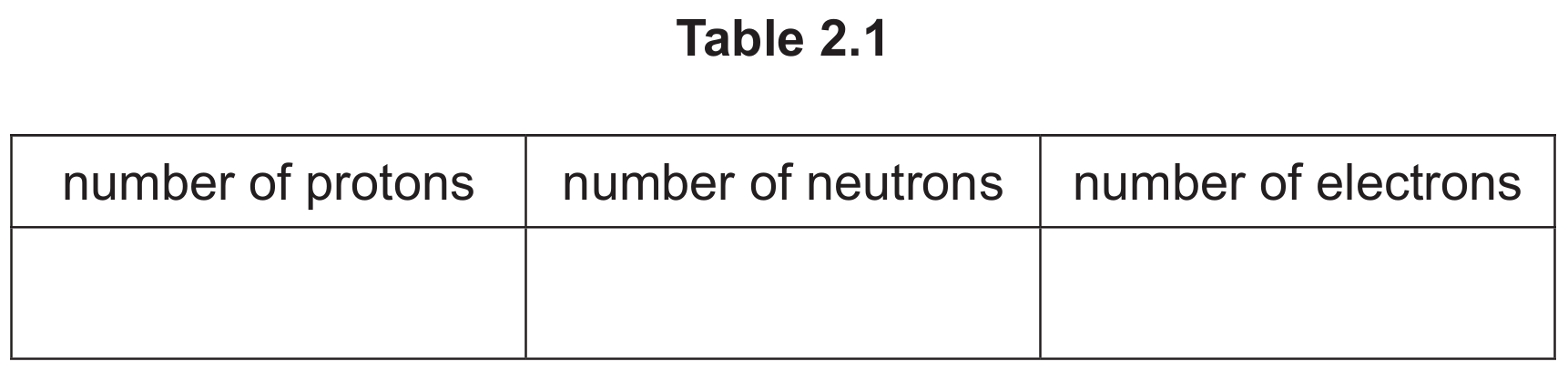
Complete the Table 2.1 to show the numbers of protons, neutrons and electrons in an atom of \(^{11}\mathrm{B}\).
(d) State two physical properties of aluminium that make it suitable for use in overhead electrical cables.
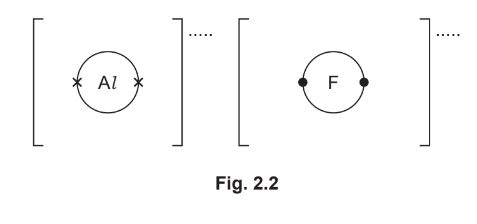
Show the charges on the ions.
Most-appropriate topic codes (Cambridge IGCSE Chemistry 0620):
• Topic 2.2 — Atomic structure and the Periodic Table (Part \(\mathrm{(a)}\))
• Topic 2.3 — Isotopes (Parts \(\mathrm{(b)(i)}\), \(\mathrm{(b)(ii)}\))
• Topic 9.6 — Extraction of metals (Parts \(\mathrm{(c)(i)}\) to \(\mathrm{(c)(iv)}\))
• Topic 9.2 — Uses of metals (Part \(\mathrm{(d)}\))
• Topic 9.4 — Reactivity series (Part \(\mathrm{(e)}\))
• Topic 2.4 — Ions and ionic bonds (Parts \(\mathrm{(f)(i)}\), \(\mathrm{(f)(ii)}\))
▶️ Answer/Explanation
(a)
For the correct answer: Protons = 5, Neutrons = 6, Electrons = 5.
The proton number of boron is 5, so there are 5 protons and 5 electrons in a neutral atom. The mass number of \(^{11}\mathrm{B}\) is 11, and since neutrons = mass number \(-\) proton number, we get \(11 – 5 = 6\) neutrons.
(b)(i)
For the correct answer: \(20\%\).
Let the abundance of \(^{10}\mathrm{B}\) be \(x\%\); then \(^{11}\mathrm{B}\) has abundance \((100-x)\%\). Setting up the weighted average: \(\dfrac{10x + 11(100-x)}{100} = 10.8\), which gives \(1100 – x = 1080\), so \(x = 20\%\).
(b)(ii)
For the correct answer: \(3.01 \times 10^{22}\) atoms.
\(\text{moles of B} = \dfrac{0.540}{10.8} = 0.0500\,\mathrm{mol}\). Number of atoms \(= 0.0500 \times 6.02 \times 10^{23} = 3.01 \times 10^{22}\) atoms.
(c)(i)
For the correct answer: bauxite.
Bauxite is the principal ore of aluminium, consisting mainly of aluminium oxide (\(\mathrm{Al_2O_3}\)) along with impurities. It is first purified before undergoing electrolysis to extract the aluminium metal.
(c)(ii)
For the correct answer: cryolite; it lowers the operating temperature (or improves electrical conductivity).
Pure aluminium oxide has a very high melting point (~2050°C), making direct electrolysis extremely costly. Dissolving \(\mathrm{Al_2O_3}\) in molten cryolite (\(\mathrm{Na_3AlF_6}\)) reduces the operating temperature to around \(950\,^\circ\mathrm{C}\), greatly reducing energy costs.
(c)(iii)
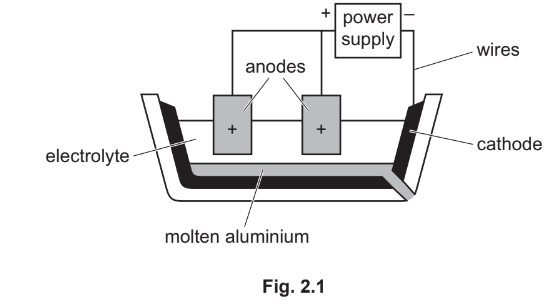
For the correct answer: $$\mathrm{Al^{3+} + 3e^- \rightarrow Al}$$ At the cathode (negative electrode), aluminium ions gain three electrons each and are reduced to aluminium metal. The cathode reaction is a reduction half-equation showing electron gain.
(c)(iv)
For the correct answer: the carbon anodes react with oxygen produced at the anode to form carbon dioxide, gradually burning away.
At the anode, \(\mathrm{O^{2-}}\) ions are oxidised to oxygen gas: \(2\mathrm{O^{2-}} \rightarrow \mathrm{O_2} + 4\mathrm{e^-}\). The hot oxygen then reacts with the carbon electrodes: \(\mathrm{C + O_2 \rightarrow CO_2}\), causing them to erode and requiring frequent replacement.
(d)
For the correct answer: (1) good electrical conductor; (2) low density.
Aluminium conducts electricity well due to its delocalised electrons, making it suitable for carrying current. Its low density (approximately \(2.7\,\mathrm{g/cm^3}\)) keeps the cables lightweight, reducing the structural demands on pylons.
(e)
For the correct answer: aluminium is coated with an unreactive aluminium oxide layer that prevents further reaction.
When aluminium is exposed to air, it rapidly forms a thin, hard layer of \(\mathrm{Al_2O_3}\) on its surface. This oxide layer is chemically inert and adheres strongly to the metal, acting as a protective barrier that prevents further oxidation or reaction with acids and water.
(f)(i)
For the correct answer: $$2\mathrm{Al} + 3\mathrm{F_2} \rightarrow 2\mathrm{AlF_3}$$ Aluminium atoms each lose 3 electrons (forming \(\mathrm{Al^{3+}}\)) and fluorine molecules each gain electrons (forming \(\mathrm{F^-}\)). The equation must be balanced with 2 moles of Al reacting with 3 moles of \(\mathrm{F_2}\) to give 2 moles of \(\mathrm{AlF_3}\).
(f)(ii)
For the correct answer: \(\mathrm{Al^{3+}}\) ion shown with 8 electrons in its second shell (empty outer shell); \(\mathrm{F^-}\) ion shown with 8 electrons in its outer shell; charges of \(3+\) and \(-\) shown respectively.
Aluminium loses all 3 outer electrons to give the configuration \(2,8\) with a \(3+\) charge. Each fluorine atom gains 1 electron to achieve the configuration \(2,8\) with a \(-\) charge, satisfying the noble gas electronic configuration.
Question 3
(i) Table 3.1 shows some of the results.
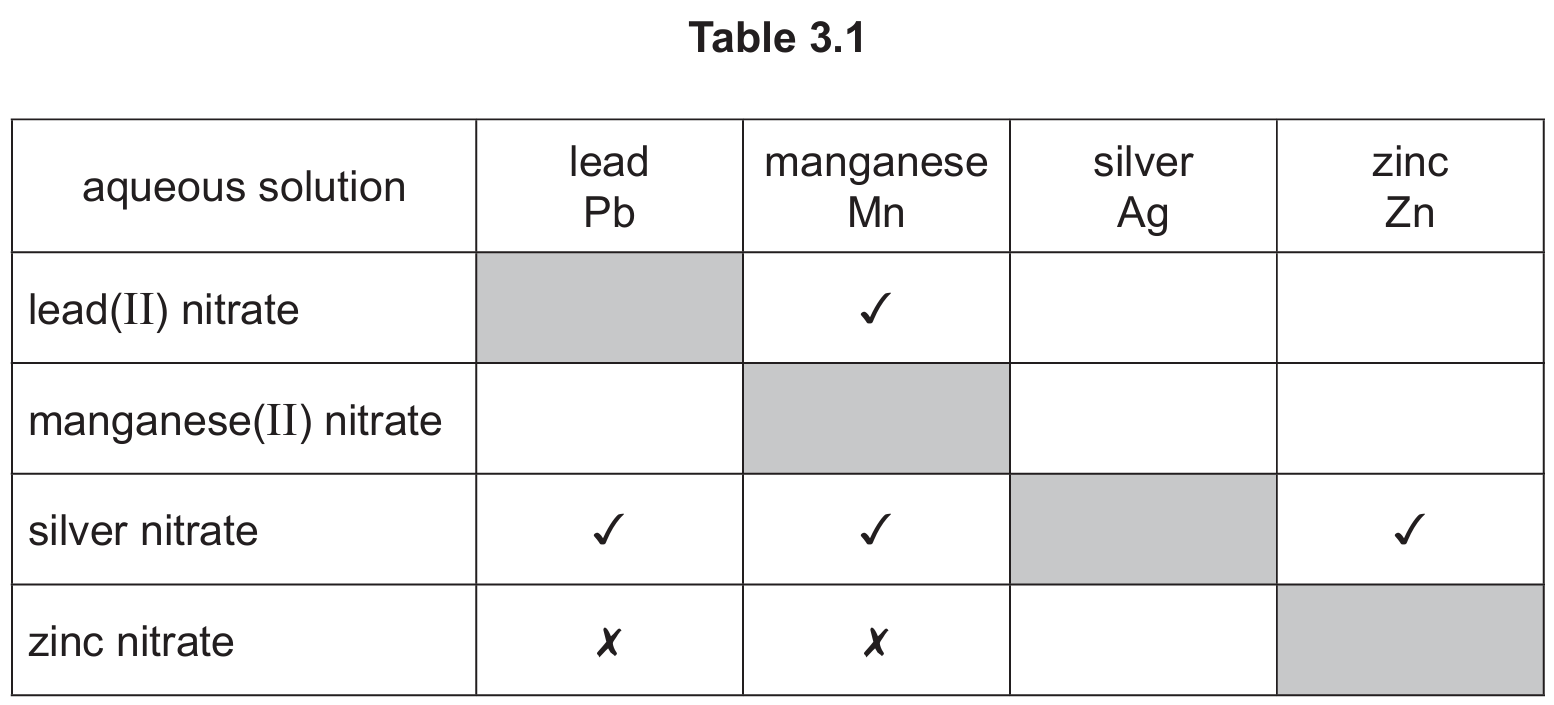
Complete Table 3.1 and place the four metals in their order of reactivity with the most reactive first.
A student bubbles chlorine gas into a test-tube containing aqueous potassium bromide.
Include state symbols.
$$\ldots\ldots + \ldots\ldots\,\mathrm{Br^-(aq)} \rightarrow \ldots\ldots + \ldots\ldots$$
Use the Periodic Table to identify the Group VII element which cannot displace any other Group VII element.
Most-appropriate topic codes (Cambridge IGCSE Chemistry 0620):
• Topic 9.4 — Reactivity series (Parts \(\mathrm{(a)(i)}\), \(\mathrm{(a)(ii)}\), \(\mathrm{(a)(iii)}\))
• Topic 7.3 — Preparation of salts / solubility rules (Part \(\mathrm{(a)(ii)}\))
• Topic 8.3 — Group VII properties (Parts \(\mathrm{(b)(i)}\), \(\mathrm{(b)(ii)}\), \(\mathrm{(b)(iii)}\))
▶️ Answer/Explanation
(a)(i)
For the correct answer: silver column all ✗; zinc row shows ✓ for lead and ✗ for manganese; order: manganese, zinc, lead, silver.
A more reactive metal displaces a less reactive one from its salt solution. Silver cannot displace any metal (least reactive), while manganese displaces all three others (most reactive). Zinc displaces lead and silver but not manganese, placing it second; lead displaces only silver, placing it third.
(a)(ii)
For the correct answer: all nitrates are soluble, whereas lead sulfate (\(\mathrm{PbSO_4}\)) is insoluble.
According to the solubility rules, sulfates of lead are insoluble, so using lead sulfate solution would not be possible. All nitrate salts are soluble, ensuring valid aqueous solutions can be prepared for all four metals.
(a)(iii)
For the correct answer: $$\mathrm{Zn + 2AgNO_3 \rightarrow Zn(NO_3)_2 + 2Ag}$$ Zinc is more reactive than silver and displaces it from silver nitrate solution. One zinc atom loses 2 electrons to form \(\mathrm{Zn^{2+}}\), while two \(\mathrm{Ag^+}\) ions each gain one electron to form silver metal; the equation must be balanced accordingly.
(b)(i)
For the correct answer: from colourless to orange (or orange-brown).
The aqueous potassium bromide solution is colourless. Chlorine, being more reactive than bromine, displaces bromide ions to produce bromine (\(\mathrm{Br_2}\)), which gives the solution its characteristic orange colour.
(b)(ii)
For the correct answer: $$\mathrm{Cl_2(g) + 2Br^-(aq) \rightarrow Br_2(aq) + 2Cl^-(aq)}$$ Chlorine molecules are reduced (gain electrons) while bromide ions are oxidised (lose electrons) to form bromine. State symbols are required: chlorine is a gas \(\mathrm{(g)}\), and the ionic species and bromine product are in aqueous solution \(\mathrm{(aq)}\).
(b)(iii)
For the correct answer: tennessine (\(\mathrm{Ts}\)), element 117.
Reactivity in Group VII decreases going down the group, as the outer electrons are further from the nucleus and shielded by more inner shells, making it harder to attract electrons. Tennessine is the heaviest Group VII element and therefore the least reactive, unable to displace any other halogen.
Question 4
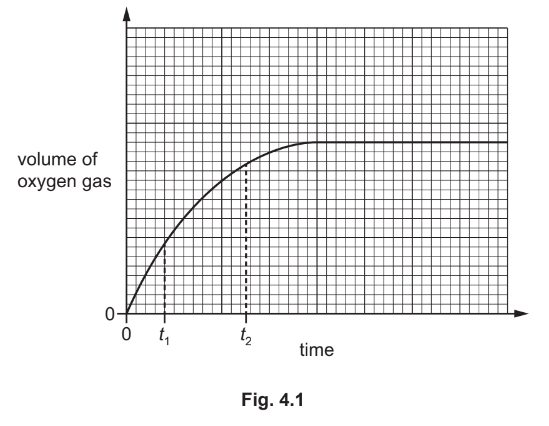
The volume of oxygen gas formed is measured at regular time intervals at r.t.p. The results are plotted onto the graph in Fig. 4.1.
(c) Manganese(IV) oxide is added to \(20\,\mathrm{cm^3}\) of aqueous hydrogen peroxide. The total volume of oxygen gas produced is \(72\,\mathrm{cm^3}\) at r.t.p.
$$2\mathrm{H_2O_2(aq)} \rightarrow 2\mathrm{H_2O(l)} + \mathrm{O_2(g)}$$
Calculate the concentration of the aqueous hydrogen peroxide in \(\mathrm{g/dm^3}\) using the following steps.
- Calculate the number of moles of oxygen gas produced.
- Determine the number of moles of hydrogen peroxide which reacts.
- Calculate the concentration of aqueous hydrogen peroxide in \(\mathrm{mol/dm^3}\).
- Calculate the concentration of aqueous hydrogen peroxide in \(\mathrm{g/dm^3}\).
Most-appropriate topic codes (Cambridge IGCSE Chemistry 0620):
• Topic 6.2 — Rate of reaction (Parts \(\mathrm{(a)}\), \(\mathrm{(b)(i)}\), \(\mathrm{(b)(ii)}\), \(\mathrm{(b)(iii)}\), \(\mathrm{(d)}\))
• Topic 3.3 — The mole and the Avogadro constant (Part \(\mathrm{(c)}\))
• Topic 8.4 — Transition elements (Part \(\mathrm{(d)}\))
▶️ Answer/Explanation
(a)
For the correct answer: place a glowing splint into the gas; the splint relights.
Oxygen supports combustion, so a glowing (not burning) splint is relit when placed into a sample of the gas. This is the standard confirmatory test for oxygen used in qualitative analysis.
(b)(i)
For the correct answer: the gradient (slope) of the graph at time \(t_2\) is lower (less steep) than at time \(t_1\).
On a volume-versus-time graph, the rate of reaction at any point is represented by the gradient of the curve at that point. A shallower gradient at \(t_2\) compared to \(t_1\) indicates a lower rate of oxygen production at the later time.
(b)(ii)
For the correct answer: as the reaction proceeds, the concentration of \(\mathrm{H_2O_2}\) decreases, so the frequency of successful collisions between reacting particles decreases.
According to collision theory, a lower concentration of \(\mathrm{H_2O_2}\) means fewer \(\mathrm{H_2O_2}\) particles per unit volume at time \(t_2\). This reduces the frequency of collisions between reacting particles, and therefore fewer collisions per unit time exceed the activation energy \(E_a\), resulting in a lower rate of reaction.
(b)(iii)
For the correct answer: a steeper curve that levels off earlier but reaches the same final total volume of oxygen.
A higher temperature increases the kinetic energy of particles, so a greater proportion of collisions exceed the activation energy \(E_a\). The reaction proceeds faster (steeper initial gradient), but the total amount of oxygen produced is unchanged since the same quantity of \(\mathrm{H_2O_2}\) is used, so the curve must plateau at the same final volume.
(c)
For the correct answer: \(10.2\,\mathrm{g/dm^3}\).
Step 1 — moles of \(\mathrm{O_2}\): \(\dfrac{72}{24000} = 0.00300\,\mathrm{mol}\).
Step 2 — moles of \(\mathrm{H_2O_2}\): from the equation, mole ratio \(\mathrm{H_2O_2 : O_2} = 2:1\), so \(0.00300 \times 2 = 0.00600\,\mathrm{mol}\).
Step 3 — concentration in \(\mathrm{mol/dm^3}\): \(\dfrac{0.00600 \times 1000}{20} = 0.300\,\mathrm{mol/dm^3}\).
Step 4 — \(M_r\) of \(\mathrm{H_2O_2} = (2 \times 1) + (2 \times 16) = 34\); concentration in \(\mathrm{g/dm^3} = 0.300 \times 34 = 10.2\,\mathrm{g/dm^3}\).
(d)
For the correct answer: any transition metal oxide, e.g. iron(III) oxide (\(\mathrm{Fe_2O_3}\)), copper(II) oxide (\(\mathrm{CuO}\)), or lead(IV) oxide (\(\mathrm{PbO_2}\)).
Transition metal oxides frequently act as heterogeneous catalysts because the transition metal ions can readily change their oxidation state, allowing them to provide an alternative reaction pathway with a lower activation energy \(E_a\) for the decomposition of \(\mathrm{H_2O_2}\).
Question 5
(a) The reaction is reversible and reaches an equilibrium in a closed system. State two features of an equilibrium.
Most-appropriate topic codes (Cambridge IGCSE Chemistry 0620):
• Topic 6.3 — Reversible reactions and equilibrium (Parts \(\mathrm{(a)}\), \(\mathrm{(b)(i)}\), \(\mathrm{(b)(ii)}\), \(\mathrm{(b)(iii)}\))
• Topic 10.3 — Air quality and climate (Parts \(\mathrm{(c)(i)}\), \(\mathrm{(c)(ii)}\))
▶️ Answer/Explanation
(a)
For the correct answer:
1. The rate of the forward reaction equals the rate of the reverse reaction.
2. The concentrations of reactants and products are no longer changing.
At dynamic equilibrium, both forward and reverse reactions continue to occur simultaneously at equal rates, so no net change in the concentrations of any species is observed, even though the reaction has not stopped.
(b)(i)
For the correct answer: the concentration of hydrogen decreases; the position of equilibrium shifts to the left.
The left-hand side of the equation has \(1 + 1 = 2\) moles of gas, while the right-hand side has \(1 + 3 = 4\) moles of gas. Increasing pressure shifts the equilibrium towards the side with fewer moles of gas (the left), so the reverse reaction is favoured and the concentration of \(\mathrm{H_2}\) decreases.
(b)(ii)
For the correct answer: the concentration of hydrogen increases; the position of equilibrium shifts to the right.
Since \(\Delta H = +200\,\mathrm{kJ/mol}\), the forward reaction is endothermic. Increasing the temperature supplies more thermal energy, favouring the endothermic (forward) reaction to absorb the extra energy. The equilibrium position shifts to the right, producing more \(\mathrm{H_2}\) and increasing its concentration.
(b)(iii)
For the correct answer: no change in the concentration of hydrogen; a catalyst does not affect the position of equilibrium.
A catalyst increases the rate of both the forward and reverse reactions equally by providing an alternative reaction pathway with a lower activation energy \(E_a\). Since both rates increase by the same factor, the equilibrium position is unchanged, and the concentration of \(\mathrm{H_2}\) at equilibrium remains the same.
(c)(i)
For the correct answer: carbon dioxide (\(\mathrm{CO_2}\)).
Clean, dry air is composed of approximately \(78\%\) nitrogen, \(21\%\) oxygen, and the remainder consisting of noble gases and carbon dioxide. Carbon dioxide, though present only in small amounts (~0.04%), is the principal naturally occurring greenhouse gas in clean air.
(c)(ii)
For the correct answer: greenhouse gases absorb thermal energy emitted by the Earth’s surface, reducing the amount of thermal energy lost to space, thereby raising atmospheric temperature.
Solar radiation passes through the atmosphere and is absorbed by the Earth’s surface, which then emits thermal (infrared) energy. Greenhouse gas molecules such as \(\mathrm{CO_2}\) and \(\mathrm{CH_4}\) absorb and re-emit this thermal energy in all directions, including back towards Earth. This reduces the rate of thermal energy loss to space, causing the lower atmosphere to warm — a process known as the enhanced greenhouse effect.
Question 6
Ethanol is manufactured by two methods:
Method 1 — fermentation of aqueous glucose
Method 2 — catalytic addition of steam to an alkene
(a) Method 1 takes place at room temperature and pressure. State two other conditions needed in method 1.
(i) State the typical temperature and pressure used in method 2.
(iii) Determine the oxidation number of phosphorus in the \(\mathrm{PO_4^{3-}}\) ion. Show your working.
(d) Give one advantage of each method of production of ethanol.
Most-appropriate topic codes (Cambridge IGCSE Chemistry 0620):
• Topic 11.6 — Alcohols (Parts \(\mathrm{(a)}\), \(\mathrm{(b)(i)}\), \(\mathrm{(b)(ii)}\), \(\mathrm{(b)(iii)}\), \(\mathrm{(d)}\))
• Topic 11.5 — Alkenes (Part \(\mathrm{(b)(ii)}\), \(\mathrm{(b)(iii)}\))
• Topic 7.1 — Characteristic properties of acids and bases (Parts \(\mathrm{(c)(i)}\), \(\mathrm{(c)(ii)}\))
• Topic 6.4 — Redox (Parts \(\mathrm{(c)(iii)}\), \(\mathrm{(e)(ii)}\))
• Topic 11.7 — Carboxylic acids (Parts \(\mathrm{(e)(i)}\), \(\mathrm{(f)(i)}\), \(\mathrm{(f)(ii)}\), \(\mathrm{(f)(iii)}\))
▶️ Answer/Explanation
(a)
For the correct answer: yeast; absence of air (anaerobic conditions).
Fermentation is the enzyme-catalysed breakdown of glucose by yeast: \(\mathrm{C_6H_{12}O_6 \rightarrow 2C_2H_5OH + 2CO_2}\). Yeast provides the enzymes (zymase) needed to catalyse this reaction, and the absence of oxygen (anaerobic conditions) ensures that the ethanol product is not further oxidised to carbon dioxide and water.
(b)(i)
For the correct answer: temperature \(= 300\,^\circ\mathrm{C}\); pressure \(= 6000\,\mathrm{kPa}\).
These conditions are chosen as a compromise: \(300\,^\circ\mathrm{C}\) gives a sufficiently fast reaction rate with acceptable catalyst activity, while \(6000\,\mathrm{kPa}\) (60 atm) favours the forward reaction since there are 2 moles of gas on the left (\(\mathrm{CH_2{=}CH_2 + H_2O}\)) combining to give 1 mole of gas on the right (\(\mathrm{C_2H_5OH}\)).
(b)(ii)
For the correct answer: ethene (\(\mathrm{CH_2{=}CH_2}\)).
Ethene is the simplest alkene and is produced in large quantities by the cracking of petroleum fractions. It contains the reactive \(\mathrm{C{=}C}\) double bond necessary for the addition reaction with steam, and is the industrial feedstock for ethanol production by method 2.
(b)(iii)
For the correct answer: only one product is formed.
In an addition reaction, two reactant molecules combine across the \(\mathrm{C{=}C}\) double bond of the alkene to form a single product with no other by-products. Here, ethene and steam react: \(\mathrm{CH_2{=}CH_2 + H_2O \rightarrow C_2H_5OH}\), giving ethanol as the sole product.
(c)(i)
For the correct answer: an acid is a proton (\(\mathrm{H^+}\)) donor.
According to the Brønsted–Lowry definition, an acid is any species capable of donating a proton (\(\mathrm{H^+}\)) to another species (a base). For example, \(\mathrm{H_3PO_4}\) donates \(\mathrm{H^+}\) ions in aqueous solution, acting as a proton donor and thereby behaving as an acid.
(c)(ii)
For the correct answer: a weak acid is only partially dissociated in aqueous solution.
Unlike strong acids which dissociate completely into ions, weak acids such as \(\mathrm{H_3PO_4}\) establish an equilibrium in water: \(\mathrm{H_3PO_4(aq) \rightleftharpoons H^+(aq) + H_2PO_4^-(aq)}\). Only a small fraction of the acid molecules are ionised at any one time, resulting in a lower \(\mathrm{H^+}\) concentration compared to a strong acid of the same concentration.
(c)(iii)
For the correct answer: oxidation number of phosphorus \(= +5\).
Each oxygen in \(\mathrm{PO_4^{3-}}\) has an oxidation number of \(-2\), giving a total of \(4 \times (-2) = -8\). Since the overall charge of the ion is \(-3\), using the rule that the sum of oxidation numbers equals the charge on the ion: $$P + (-8) = -3 \implies P = -3 + 8 = +5$$
(d)
For the correct answer: method 1 — uses renewable resources (glucose from plants); method 2 — faster rate of reaction / produces ethanol continuously.
Method 1 uses glucose derived from crops, a renewable biological source, making it more sustainable. Method 2, however, is a continuous industrial process operating at high temperature and pressure, giving a much higher rate of ethanol production and a purer product, though it relies on non-renewable petroleum-derived ethene.
(e)(i)
For the correct answer: acidified aqueous potassium manganate(VII) (\(\mathrm{KMnO_4}\)).
Acidified potassium manganate(VII) is a powerful oxidising agent that oxidises ethanol (\(\mathrm{C_2H_5OH}\)) to ethanoic acid (\(\mathrm{CH_3COOH}\)). The characteristic colour change from purple to colourless indicates the reduction of \(\mathrm{MnO_4^-}\) as it acts as the oxidising agent in this redox reaction.
(e)(ii)
For the correct answer: ethanol is a reducing agent.
In this reaction, ethanol is oxidised (it loses hydrogen / gains oxygen, or its oxidation number increases) to form ethanoic acid. Since ethanol causes the reduction of the potassium manganate(VII) while being oxidised itself, it acts as the reducing agent in this redox reaction.
(f)(i)
For the correct answer: calcium ethanoate.
When ethanoic acid reacts with calcium metal, the acid donates protons (\(\mathrm{H^+}\)) which oxidise the metal. The calcium ion (\(\mathrm{Ca^{2+}}\)) combines with two ethanoate ions (\(\mathrm{CH_3COO^-}\)) to form the ionic salt calcium ethanoate, following the general pattern: acid + metal → salt + hydrogen.
(f)(ii)
For the correct answer: \(\mathrm{(CH_3COO)_2Ca}\).
Calcium forms a \(2+\) ion (\(\mathrm{Ca^{2+}}\)), and the ethanoate ion has a \(1-\) charge (\(\mathrm{CH_3COO^-}\)). To achieve overall electrical neutrality, two ethanoate ions are required per calcium ion, giving the formula \(\mathrm{(CH_3COO)_2Ca}\), also written as \(\mathrm{Ca(CH_3COO)_2}\).
(f)(iii)
For the correct answer: hydrogen gas (\(\mathrm{H_2}\)).
The reaction between ethanoic acid and calcium follows the general equation: \(2\mathrm{CH_3COOH + Ca \rightarrow (CH_3COO)_2Ca + H_2}\). Calcium is oxidised from oxidation state \(0\) to \(+2\), while the \(\mathrm{H^+}\) ions from the acid are reduced to hydrogen gas (\(\mathrm{H_2}\)), which is released as bubbles.