
Question 1
The table shows the melting and boiling points of four elements.
Which element is a gas at room temperature and pressure?
| melting point/°C | boiling point/°C | |
|---|---|---|
| A | −101 | −35 |
| B | −7 | 59 |
| C | 10 | 100 |
| D | 113 | 445 |
Most-appropriate topic codes (Cambridge IGCSE Chemistry 0620):
▶️ Answer/Explanation
✅ Answer: (A)
Question 2
Four statements about the arrangement or movement of particles are given.
- Particles are packed in a regular arrangement.
- Particles are randomly arranged.
- Particles move over each other.
- Particles vibrate about fixed points.
Which statements describe the particles in a pure solid?
A. 1 and 3
B. 1 and 4
C. 2 and 3
D. 2 and 4
Most-appropriate topic codes (Cambridge IGCSE Chemistry 0620):
▶️ Answer/Explanation
✅ Answer: (B)
Question 3
One atom of an element contains 12 electrons, 12 protons and 13 neutrons.
How many nucleons does this atom contain?
A. 12
B. 13
C. 24
D. 25
Most-appropriate topic codes (Cambridge IGCSE Chemistry 0620):
▶️ Answer/Explanation
✅ Answer: (D)
Question 4
A diagram representing a mixture of four particles is shown.

Which statement describes the mixture of particles?
A. It is a mixture of two different compounds.
B. It is a mixture of two different elements.
C. It is a mixture of four different compounds.
D. It is a mixture of four different elements.
Most-appropriate topic codes (Cambridge IGCSE Chemistry 0620):
▶️ Answer/Explanation
✅ Answer: (A)
Question 5
Chlorine reacts with sodium to form sodium chloride.
What happens to the sodium atoms during this reaction?
A. They gain electrons to form anions.
B. They lose electrons to form anions.
C. They gain electrons to form cations.
D. They lose electrons to form cations.
Most-appropriate topic codes (Cambridge IGCSE Chemistry 0620):
▶️ Answer/Explanation
✅ Answer: (D)
Question 6
Nitrogen monoxide, NO, is a simple molecular compound.
Which row shows the properties of nitrogen monoxide?
| boiling point | electrical conductivity | |
|---|---|---|
| A | high | good |
| B | high | poor |
| C | low | good |
| D | low | poor |
Most-appropriate topic codes (Cambridge IGCSE Chemistry 0620):
▶️ Answer/Explanation
✅ Answer: (D)
Question 7
Metal X is in Group II of the Periodic Table.
X is reacted separately with dilute sulfuric acid and with oxygen.
Which row identifies the products of each reaction?
| products with dilute sulfuric acid | product with oxygen | |
|---|---|---|
| A | XSO4 and H2 | XO |
| B | XSO4 and H2 | XO2 |
| C | X2SO4 and H2 | XO |
| D | X2SO4 and H2 | XO2 |
Most-appropriate topic codes (Cambridge IGCSE Chemistry 0620):
▶️ Answer/Explanation
✅ Answer: (A)
Question 8
What is the relative molecular mass, Mr, of sulfuric acid, H2SO4?
A. 81
B. 82
C. 97
D. 98
Most-appropriate topic codes (Cambridge IGCSE Chemistry 0620):
▶️ Answer/Explanation
✅ Answer: (D)
Question 9
The equation for the production of ammonia, NH3, is shown.
N2(g) + 3H2(g) → 2NH3(g)
Which mass of nitrogen is required to make 51 tonnes of ammonia?
A. 21 tonnes
B. 25.5 tonnes
C. 42 tonnes
D. 84 tonnes
Most-appropriate topic codes (Cambridge IGCSE Chemistry 0620):
▶️ Answer/Explanation
✅ Answer: (C)
Question 10
The diagram shows the apparatus used to electroplate a nickel shape with silver.
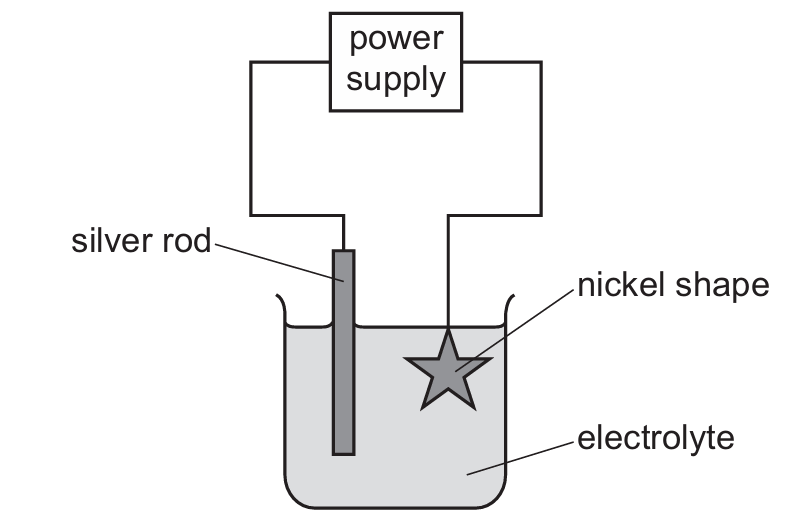
Which row identifies the negative electrode, the positive electrode and the electrolyte?
| negative electrode | positive electrode | electrolyte | |
|---|---|---|---|
| A | silver rod | nickel shape | aqueous nickel nitrate |
| B | nickel shape | silver rod | aqueous silver nitrate |
| C | nickel shape | silver rod | aqueous nickel nitrate |
| D | silver rod | nickel shape | aqueous silver nitrate |
Most-appropriate topic codes (Cambridge IGCSE Chemistry 0620):
▶️ Answer/Explanation
✅ Answer: (B)
Question 11
Concentrated aqueous sodium chloride and dilute sulfuric acid are each electrolysed separately using inert electrodes.
Three statements about the electrolysis of these electrolytes are listed.
- A gas is produced at each electrode for both electrolytes.
- Oxygen is produced at the cathode for both electrolytes.
- Hydrogen is produced at the cathode for both electrolytes.
Which statements are correct?
A. 1 and 3
B. 1 only
C. 2 only
D. 3 only
Most-appropriate topic codes (Cambridge IGCSE Chemistry 0620):
▶️ Answer/Explanation
✅ Answer: (A)
Question 12
Which reaction pathway diagram represents an endothermic reaction?
A. 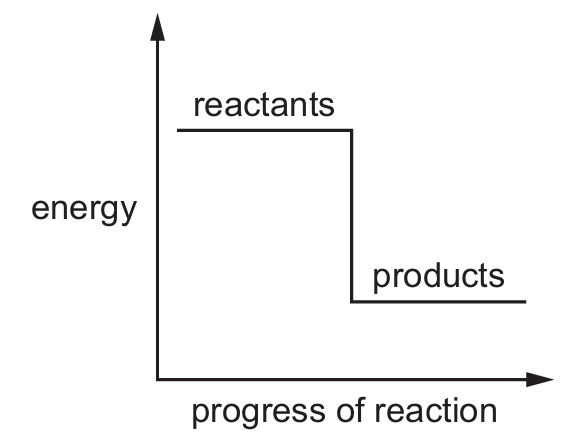
B. 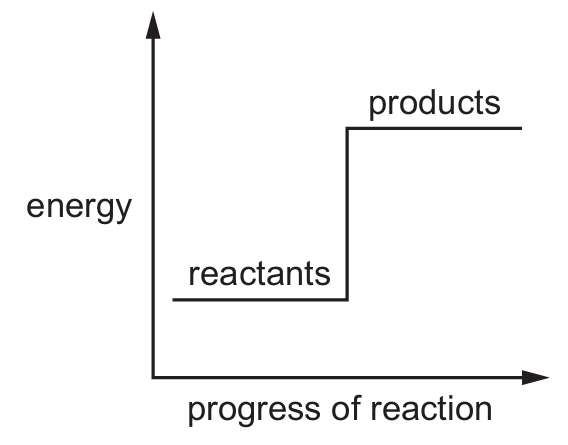
C. 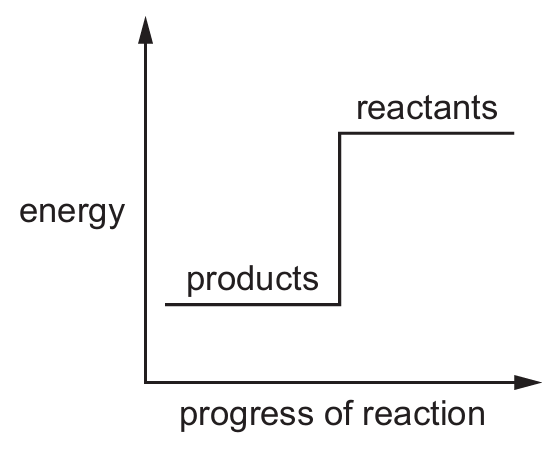
D. 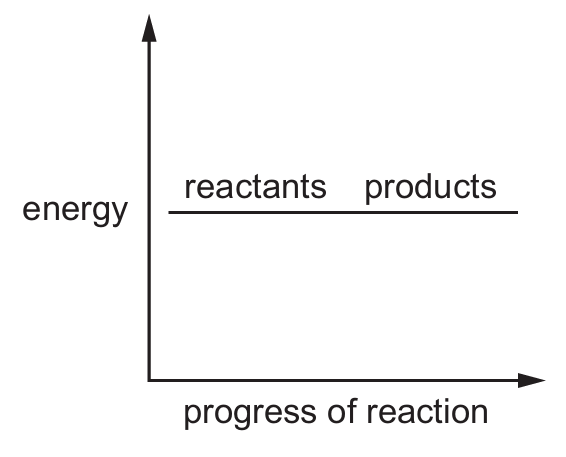
Most-appropriate topic codes (Cambridge IGCSE Chemistry 0620):
▶️ Answer/Explanation
✅ Answer: (B)
Question 13
The diagram shows a match.
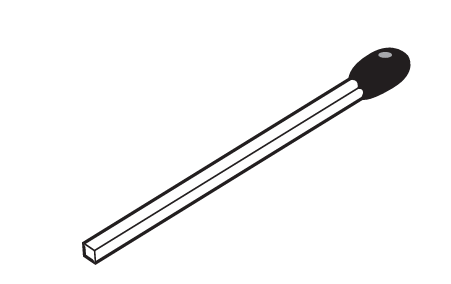
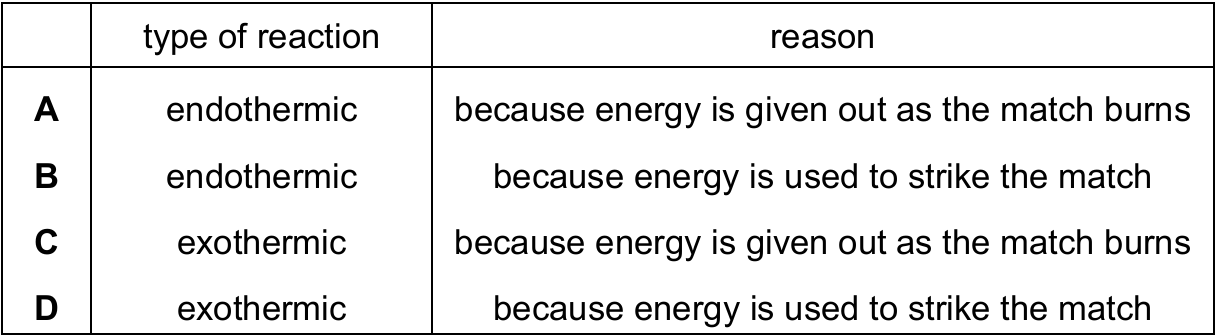
By striking the match, a chemical reaction takes place.
Which row describes the chemical reaction?
Most-appropriate topic codes (Cambridge IGCSE Chemistry 0620):
▶️ Answer/Explanation
✅ Answer: (C)
Question 14
Hydrogen peroxide decomposes to form water and oxygen. The equation is shown.
$$2H_2O_2(l) \rightarrow 2H_2O(l) + O_2(g)$$
Manganese(IV) oxide catalyses this reaction.
Which statements about manganese(IV) oxide are correct?
- It increases the rate of the reaction.
- It increases the total volume of oxygen gas produced at the end of the reaction.
- It will have the same mass at the end of the reaction as it does at the start of the reaction.
A. 1, 2 and 3
B. 1 and 2 only
C. 1 and 3 only
D. 2 and 3 only
Most-appropriate topic codes (Cambridge IGCSE Chemistry 0620):
▶️ Answer/Explanation
✅ Answer: (C)
Question 15
Four students collect the gas produced from the reaction of calcium carbonate with dilute hydrochloric acid. Each student records the time taken to collect a volume of gas.
Which results show the highest average rate of reaction?
A. 15 cm3 of gas collected in 20 seconds
B. 50 cm3 of gas collected in 40 seconds
C. 75 cm3 of gas collected in 80 seconds
D. 90 cm3 of gas collected in 100 seconds
Most-appropriate topic codes (Cambridge IGCSE Chemistry 0620):
▶️ Answer/Explanation
✅ Answer: (B)
Question 16
The equation for the reaction between hydrogen and oxygen is shown.
$$2H_2(g) + O_2(g) \rightarrow 2H_2O(g)$$
Which statement explains why this is a redox reaction?
A. Both oxidation and reduction take place.
B. Heat energy is released to the surroundings.
C. Hydrogen is a reactant.
D. The reaction can be reversed.
Most-appropriate topic codes (Cambridge IGCSE Chemistry 0620):
▶️ Answer/Explanation
✅ Answer: (A)
Question 17
Which statements about dilute ethanoic acid are correct?
- It has a pH of 8.
- It is an organic compound.
- It turns universal indicator orange-yellow.
- It reacts with magnesium to produce carbon dioxide.
A. 1 and 3
B. 1 and 4
C. 2 and 3
D. 2 and 4
Most-appropriate topic codes (Cambridge IGCSE Chemistry 0620):
▶️ Answer/Explanation
✅ Answer: (C)
Question 18
An aqueous solution of Z turns universal indicator paper purple.
Which row identifies the colour of methyl orange and of thymolphthalein when they are added separately to an aqueous solution of Z?
| methyl orange | thymolphthalein | |
|---|---|---|
| A | yellow | blue |
| B | yellow | colourless |
| C | red | blue |
| D | red | colourless |
Most-appropriate topic codes (Cambridge IGCSE Chemistry 0620):
▶️ Answer/Explanation
✅ Answer: (A)
Question 19
Which row describes the solubility of lead(II) chloride and lead(II) sulfate in water?
| lead(II) chloride | lead(II) sulfate | |
|---|---|---|
| A | soluble | soluble |
| B | soluble | insoluble |
| C | insoluble | soluble |
| D | insoluble | insoluble |
Most-appropriate topic codes (Cambridge IGCSE Chemistry 0620):
▶️ Answer/Explanation
✅ Answer: (D)
Question 20
Four different groups of oxides are shown.
- MgO FeO CuO
- CaO SO2 TiO2
- PbO CaO Cl2O
- NO2 Br2O P2O5
Which statement about these groups of oxides is correct?
A. 1, 2 and 3 contain basic oxides only.
B. 2, 3 and 4 contain basic oxides only.
C. 1 contains basic oxides only, and 4 contains acidic oxides only.
D. 1 contains acidic oxides only, and 4 contains basic oxides only.
Most-appropriate topic codes (Cambridge IGCSE Chemistry 0620):
▶️ Answer/Explanation
✅ Answer: (C)
Question 21
Four steps in the preparation of a soluble salt from a dilute acid and a solid metal oxide are listed.
- Warm the dilute acid.
- Evaporate the solution to half of its volume and allow to cool.
- Add excess metal oxide.
- Filter to remove any unreacted solid.
What is the correct order for these steps?
A. 1 → 2 → 3 → 4
B. 1 → 3 → 4 → 2
C. 3 → 1 → 2 → 4
D. 3 → 4 → 1 → 2
Most-appropriate topic codes (Cambridge IGCSE Chemistry 0620):
▶️ Answer/Explanation
✅ Answer: (B)
Question 22
Which pair of elements react together most violently?
A. chlorine and lithium
B. chlorine and potassium
C. iodine and lithium
D. iodine and potassium
Most-appropriate topic codes (Cambridge IGCSE Chemistry 0620):
• Topic 8.3: Group VII properties — Describe the Group VII halogens, chlorine, bromine and iodine, as diatomic non-metals with general trends down the group, limited to: decreasing reactivity.
▶️ Answer/Explanation
✅ Answer: (B)
Question 23
Rubidium is an element in Group I of the Periodic Table.
Which row describes a physical property and a chemical property of rubidium?
| physical property | chemical property | |
|---|---|---|
| A | hard | reacts with water |
| B | hard | does not react with water |
| C | soft | reacts with water |
| D | soft | does not react with water |
Most-appropriate topic codes (Cambridge IGCSE Chemistry 0620):
▶️ Answer/Explanation
✅ Answer: (C)
Question 24
Which row describes the state and colour of bromine at room temperature and pressure?
| state | colour | |
|---|---|---|
| A | liquid | red-brown |
| B | liquid | grey-black |
| C | solid | red-brown |
| D | solid | grey-black |
Most-appropriate topic codes (Cambridge IGCSE Chemistry 0620):
▶️ Answer/Explanation
✅ Answer: (A)
Question 25
Part of the Periodic Table is shown.
Which element is a metal?

Most-appropriate topic codes (Cambridge IGCSE Chemistry 0620):
▶️ Answer/Explanation
✅ Answer: (A)
Question 26
Which compound is made from elements that are all in the same period?
A. Al2(SO4)3
B. C2H5OH
C. LiNO3
D. Na3AlF6
Most-appropriate topic codes (Cambridge IGCSE Chemistry 0620):
▶️ Answer/Explanation
✅ Answer: (C)
Question 27
Silver metal is separately tested with cold water, with steam and with dilute hydrochloric acid.
Which row identifies the tests that show the chemical reactivity of silver?
| cold water | steam | dilute hydrochloric acid | |
|---|---|---|---|
| A | ✓ | ✓ | ✓ |
| B | ✗ | ✓ | ✓ |
| C | ✗ | ✗ | ✓ |
| D | ✗ | ✗ | ✗ |
| key: ✓ = reaction, ✗ = no reaction | |||
Most-appropriate topic codes (Cambridge IGCSE Chemistry 0620):
▶️ Answer/Explanation
✅ Answer: (D)
Question 28
Which statement about the extraction of iron from hematite is correct?
A. Air is blown into the blast furnace to oxidise the molten iron.
B. Carbon dioxide is reduced by coke to carbon monoxide.
C. Hematite is oxidised by carbon to molten iron.
D. The slag produced is denser than molten iron.
Most-appropriate topic codes (Cambridge IGCSE Chemistry 0620):
▶️ Answer/Explanation
✅ Answer: (B)
Question 29
What is an alloy?
A. a compound of two metallic elements
B. a compound of metallic and non-metallic elements
C. a mixture of a metal and at least one other element
D. a pure metallic element
Most-appropriate topic codes (Cambridge IGCSE Chemistry 0620):
▶️ Answer/Explanation
✅ Answer: (C)
Question 30
The diagram shows an experiment to investigate how paint affects the rusting of iron.
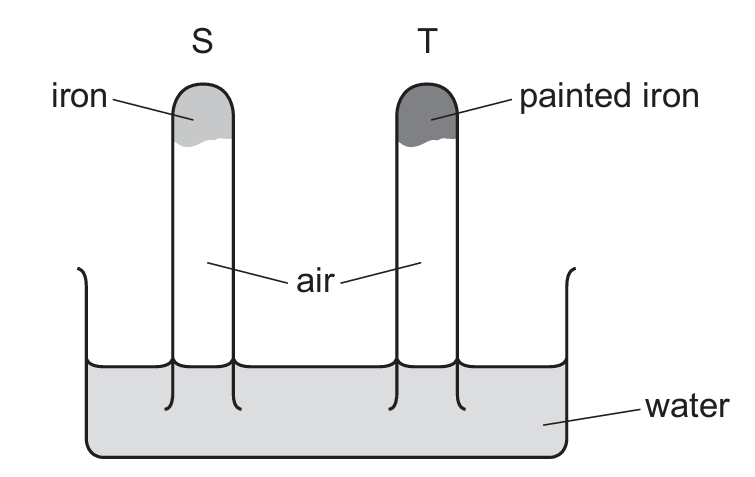
What happens to the water level in tubes S and T?
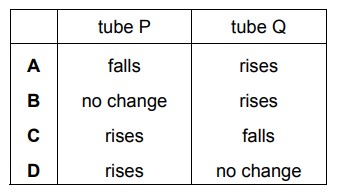
Most-appropriate topic codes (Cambridge IGCSE Chemistry 0620):
▶️ Answer/Explanation
✅ Answer: (D)
Question 31
Which statement describes clean, dry air?
A. It is a compound containing about 78% nitrogen and 21% oxygen only.
B. It is a mixture of about 21% nitrogen and 78% oxygen only.
C. It is a mixture of several gases, including nitrogen and oxygen.
D. It is a compound containing nitrogen, oxygen, carbon dioxide and other gases.
Most-appropriate topic codes (Cambridge IGCSE Chemistry 0620):
▶️ Answer/Explanation
✅ Answer: (C)
Question 32
Which word equation describes photosynthesis?
A. carbon dioxide + water → glucose + oxygen
B. glucose + water → carbon dioxide + oxygen
C. carbon dioxide + oxygen → glucose + water
D. glucose + oxygen → carbon dioxide + water
Most-appropriate topic codes (Cambridge IGCSE Chemistry 0620):
▶️ Answer/Explanation
✅ Answer: (A)
Question 33
Some adverse effects caused by air pollutants are listed.
- acid rain
- photochemical smog
- respiratory problems
Which air pollutant contributes to all three of these adverse effects?
A. carbon monoxide
B. oxides of nitrogen
C. methane
D. particulates
Most-appropriate topic codes (Cambridge IGCSE Chemistry 0620):
▶️ Answer/Explanation
✅ Answer: (B)
Question 34
Petroleum is an important raw material that is separated into useful products.
Which terms describe petroleum and the method used to separate it?

Most-appropriate topic codes (Cambridge IGCSE Chemistry 0620):
▶️ Answer/Explanation
✅ Answer: (D)
Question 35
Which statements about homologous series are correct?
- All carboxylic acids have similar chemical properties.
- All alcohols have the same molecular mass.
- Ethane and ethene are members of the same homologous series.
- Ethane and propane are members of the same homologous series.
A. 1 and 3
B. 1 and 4
C. 2 and 3
D. 2 and 4
Most-appropriate topic codes (Cambridge IGCSE Chemistry 0620):
▶️ Answer/Explanation
✅ Answer: (B)
Question 36
The formulae of two organic compounds, P and Q, are shown.

Which type of organic compounds are P and Q?
| P | Q | |
|---|---|---|
| A | alcohol | alkane |
| B | alcohol | alkene |
| C | carboxylic acid | alkane |
| D | carboxylic acid | alkene |
Most-appropriate topic codes (Cambridge IGCSE Chemistry 0620):
▶️ Answer/Explanation
✅ Answer: (B)
Question 37
Which fuel is manufactured by fermentation?
A. diesel
B. ethanol
C. hydrogen
D. kerosene
Most-appropriate topic codes (Cambridge IGCSE Chemistry 0620):
▶️ Answer/Explanation
✅ Answer: (B)
Question 38
Which statement about the disposal of waste plastics is correct?
A. They are put in landfill sites, where they quickly decompose.
B. They are burned to produce non-toxic products.
C. They accumulate in oceans, where they are harmful to aquatic life.
D. They are dissolved in water and pumped into the sea.
Most-appropriate topic codes (Cambridge IGCSE Chemistry 0620):
▶️ Answer/Explanation
✅ Answer: (C)
Question 39
Dyes are coloured substances.
The chromatogram of substance X and four different dyes, 1, 2, 3 and 4, is shown.
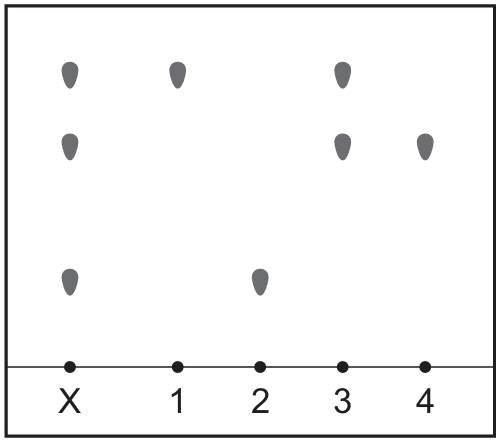
Substance X contains only two of the dyes 1, 2, 3 and 4.
Which two dyes are present in substance X?
A. 1 and 2
B. 1 and 4
C. 2 and 3
D. 3 and 4
Most-appropriate topic codes (Cambridge IGCSE Chemistry 0620):
▶️ Answer/Explanation
✅ Answer: (C)
Question 40
The results of two tests on substance G are listed.
- A flame test produces a yellow flame.
- Substance G is added to aqueous sodium hydroxide and powdered aluminium and warmed carefully. A gas is given off which turns damp red litmus paper blue.
What is G?
A. potassium chloride
B. potassium nitrate
C. sodium chloride
D. sodium nitrate
Most-appropriate topic codes (Cambridge IGCSE Chemistry 0620):
▶️ Answer/Explanation
✅ Answer: (D)