Home / 0620_w24_qp_13

Question 1

Which conditions cause gas particles to move the fastest and the furthest apart?

 temperaturepressure
Ahighhigh
Blowhigh
Chighlow
Dlowlow

Most-appropriate topic codes (Cambridge IGCSE Chemistry 0620):

Topic 1.1: States of matter — Describe the structures of solids, liquids and gases in terms of particle separation, arrangement and motion; Describe the effects of temperature and pressure on the volume and movement of particles of a gas
▶️ Answer/Explanation
According to the kinetic particle theory, temperature is a direct measure of the average kinetic energy of gas molecules. Elevating the temperature causes particles to absorb thermal energy and convert it into mechanical motion, forcing them to travel at their fastest velocities. Conversely, gas particle separation is heavily dictated by external pressure: a high pressure compresses gas into a smaller volume, packing particles tightly together, whereas a low pressure minimizes constraints, allowing the rapidly moving molecules to expand into the available space and stay furthest apart. Therefore, the perfect pairing to maximize both speed and distance is high temperature and low pressure, rendering row C correct.
Answer: (C)

Question 2

Which statement describes a liquid at room temperature?

A. A sample of a liquid has a fixed volume and shape.
B. A sample of a liquid does not have a fixed volume or shape.
C. The particles are touching but can move by sliding over each other.
D. The particles spread out and fill all available space.

Most-appropriate topic codes (Cambridge IGCSE Chemistry 0620):

Topic 1.1: States of matter — Describe the structures of solids, liquids and gases in terms of particle separation, arrangement and motion
▶️ Answer/Explanation
The kinetic particle theory defines the macroscopic properties of a liquid through its microscopic particle dynamics. In a liquid state, the attractive intermolecular forces are strong enough to keep the particles close together and touching (maintaining a fixed volume), yet weak enough to prevent them from staying in a rigid structural position. This configuration allows particles to continuously change positions by sliding past or over one another, enabling the fluid to flow and adapt to the shape of its container, validating option C. Statements A and B are macroscopically incorrect descriptions of volume and shape dynamics, while option D uniquely defines a gaseous state.
Answer: (C)

Question 3

A compound, X, has a melting point of 71°C and a boiling point of 375°C.

Which statement about X is correct?

A. It is a liquid at 52°C and a gas at 175°C.
B. It is a liquid at 69°C and a gas at 380°C.
C. It is a liquid at 75°C and a gas at 350°C.
D. It is a liquid at 80°C and a gas at 400°C.

Most-appropriate topic codes (Cambridge IGCSE Chemistry 0620):

Topic 1.1: States of matter — Identify and draw the structures of solids, liquids and gases; Interpret the heating/cooling curves and state changes of a substance in terms of melting point and boiling point
▶️ Answer/Explanation
To determine the physical state of a compound at any temperature, its current condition is compared directly to its fixed transition parameters: below the melting point ($< 71^\circ\text{C}$), it remains a solid; between the melting and boiling points ($71^\circ\text{C}$ to $375^\circ\text{C}$), it exists as a liquid; and above the boiling point ($> 375^\circ\text{C}$), it converts into a gas. Evaluating option D, $80^\circ\text{C}$ lies firmly within the liquid range ($71^\circ\text{C} < 80^\circ\text{C} < 375^\circ\text{C}$) and $400^\circ\text{C}$ sits completely above the vaporization threshold ($400^\circ\text{C} > 375^\circ\text{C}$), satisfying both conditions perfectly. The other choices present incorrect physical states for the specified thermal values, establishing row D as the only entirely correct statement.
Answer: (D)

Question 4

What is the nucleon number of an atom?

A. the number of neutrons
B. the number of protons
C. the total number of protons and neutrons
D. the total number of protons and electrons

Most-appropriate topic codes (Cambridge IGCSE Chemistry 0620):

Topic 2.2: Atomic structure and the Periodic Table — State the relative masses and relative charges of a proton, a neutron and an electron; Define proton number/atomic number and nucleon number/mass number
▶️ Answer/Explanation
By syllabus definition, the term “nucleon” refers collectively to any subatomic particle located securely inside the dense central core, or nucleus, of an atom. Since the atomic nucleus is composed strictly of protons and neutrons (while electrons occupy the vast outer shells or energy levels), the nucleon number—also widely referred to as the mass number—is calculated as the sum of these two specific heavy particles inside the core, validating choice C. Protons alone define the atomic/proton number (B), while electrons are excluded from mass calculations due to their negligible relative mass, ruling out option D.
Answer: (C)

Question 5

An atom has three electron shells. There are three electrons in the outer shell.

How many protons and how many neutrons are in this atom?

 protonsneutrons
A1314
B1327
C1413
D2124

Most-appropriate topic codes (Cambridge IGCSE Chemistry 0620):

Topic 2.2: Atomic structure and the Periodic Table — Describe the significance of the noble gas electronic configurations and the outer-shell electrons; Deduce the electron configuration, proton number and neutron number of given elements
▶️ Answer/Explanation
For a neutral atom, the number of protons equals its total number of electrons. Given that the atom has three electron shells, its inner shells must be entirely filled under standard electronic configuration rules, yielding a structure of $2, 8, 3$. Summing these values ($2 + 8 + 3 = 13$) determines a proton number of 13, identifying the element as Aluminium ($\text{Al}$) in Period 3, Group III. A proton count of 13 rules out options C and D. Between rows A and B, a value of 27 represents the total mass/nucleon number of a standard Aluminium nucleus ($\text{Mass} = \text{Protons} + \text{Neutrons}$), rather than the standalone neutron count. Subtracting the proton count from the mass number ($27 – 13 = 14$) yields exactly 14 neutrons, identifying row A as correct.
Answer: (A)

Question 6

Which row gives the number of covalent bonds in one molecule of ammonia and in one molecule of hydrogen chloride?

 ammoniahydrogen chloride
A31
B32
C41
D42

Most-appropriate topic codes (Cambridge IGCSE Chemistry 0620):

Topic 2.5: Covalent bonding — State that a covalent bond is formed when a pair of electrons is shared between two atoms leading to noble gas electronic configurations; Describe the formation of covalent bonds in simple molecules, including ammonia ($\text{NH}_3$) and hydrogen chloride ($\text{HCl}$)
▶️ Answer/Explanation
Covalent bonding involves the sharing of pairs of valence electrons between non-metal atoms to achieve stable, full outer shells resembling noble gas configurations. In a molecule of ammonia ($\text{NH}_3$), the central nitrogen atom has 5 outer-shell electrons and shares 1 electron with each of the three hydrogen atoms, creating exactly 3 single covalent bonds (leaving 1 unshared lone pair). In a molecule of hydrogen chloride ($\text{HCl}$), the chlorine atom has 7 valence electrons and shares a single pair of electrons with a single hydrogen atom, resulting in exactly 1 single covalent bond. This establishes that row A correctly identifies the number of shared bonding pairs for both chemical species.
Answer: (A)

Question 7

Which statements about the structure and bonding in diamond are correct?

  1. Each carbon atom in diamond is bonded to three other carbon atoms only.
  2. Diamond contains many strong covalent bonds.
  3. Diamond contains layers of carbon atoms, which can slide over each other.
  4. Diamond has a giant structure.

A. 1, 2 and 3
B. 2 and 3 only
C. 2 and 4
D. 4 only

Most-appropriate topic codes (Cambridge IGCSE Chemistry 0620):

Topic 2.6: Giant covalent structures — Describe the giant covalent structures of diamond and graphite; Relate their structures and bonding to their uses and properties
▶️ Answer/Explanation
To determine the correct descriptions, let’s look at the specific macromolecular features of diamond. Diamond is an allotrope of carbon characterized by a rigid, three-dimensional giant covalent lattice structure (Statement 4 is correct). Within this network, each individual carbon atom uses all four of its valence electrons to form strong covalent bonds with four other neighboring carbon atoms in a uniform tetrahedral shape (Statement 1 is incorrect; Statement 2 is correct). Because the atoms are interlocked in a continuous 3D matrix rather than separate parallel planes, diamond does not contain layers that slide over one another—a property unique to graphite (Statement 3 is incorrect). Since only statements 2 and 4 are scientifically accurate, option C is the correct choice.
Answer: (C)

Question 8

Magnesium burns in oxygen to form magnesium oxide.

The equation for the reaction is shown.

$$2\text{Mg} + \text{O}_2 \rightarrow 2\text{MgO}$$

Which mass of magnesium oxide is formed when 48 g of magnesium is burned?

A. 20 g
B. 40 g
C. 80 g
D. 160 g

Most-appropriate topic codes (Cambridge IGCSE Chemistry 0620):

Topic 3.3: Stoichiometric calculations — Calculate reacting masses from chemical equations using relative atomic mass, $A_r$, and relative molecular/formula mass, $M_r$
▶️ Answer/Explanation
To compute the reacting mass, we first evaluate the moles of reacting Magnesium using its relative atomic mass ($A_r(\text{Mg}) = 24$). Dividing the given mass by its atomic mass ($\text{moles} = 48\text{ g} / 24\text{ g/mol}$) yields exactly $2\text{ moles}$ of $\text{Mg}$. According to the balanced stoichiometric equation, the molar ratio between $\text{Mg}$ and $\text{MgO}$ is a direct $2:2$ (or $1:1$) relationship, meaning $2\text{ moles}$ of $\text{Mg}$ will yield exactly $2\text{ moles}$ of $\text{MgO}$. The relative formula mass of magnesium oxide is calculated as $M_r(\text{MgO}) = 24 + 16 = 40$. Multiplying the number of moles by this formula mass ($\text{mass} = 2\text{ moles} \times 40\text{ g/mol}$) results in $80\text{ g}$ of $\text{MgO}$, making option C the correct answer.
Answer: (C)

Question 9

Propane, $\text{C}_3\text{H}_8$, is burned in a limited amount of oxygen.

Which equation represents this reaction?

A. $\text{C}_3\text{H}_8 + 5\text{O}_2 \rightarrow 3\text{CO}_2 + 4\text{H}_2\text{O}$
B. $\text{C}_3\text{H}_8 + 4\text{O}_2 \rightarrow 3\text{CO} + 4\text{H}_2\text{O}$
C. $\text{C}_3\text{H}_8 + 4\text{O}_2 \rightarrow 3\text{CO}_2 + 2\text{H}_2\text{O} + 2\text{H}_2$
D. $2\text{C}_3\text{H}_8 + 7\text{O}_2 \rightarrow 6\text{CO} + 8\text{H}_2\text{O}$

Most-appropriate topic codes (Cambridge IGCSE Chemistry 0620):

Topic 11.4: Alkanes — Describe the properties of alkanes as being generally unreactive, except in terms of burning; Distinguish between complete combustion and incomplete combustion of hydrocarbons when oxygen is limited
▶️ Answer/Explanation
When hydrocarbons burn in a “limited amount of oxygen,” incomplete combustion takes place. Unlike complete combustion which yields non-toxic carbon dioxide ($\text{CO}_2$), incomplete combustion produces toxic carbon monoxide ($\text{CO}$) gas along with water vapor ($\text{H}_2\text{O}$). This chemical rule immediately eliminates option A (which shows complete combustion) and option C (which incorrectly yields elemental $\text{H}_2$). To choose between B and D, we must check for correct stoichiometric balancing. In option B, the right side has $3 \times 1 = 3$ oxygen atoms from $\text{CO}$ and $4 \times 1 = 4$ from $\text{H}_2\text{O}$, totaling 7 oxygen atoms, which cannot be formed from an even number of atoms in $4\text{O}_2$ (8 oxygen atoms). Option D is perfectly balanced on both sides with 6 carbon atoms, 16 hydrogen atoms, and 14 oxygen atoms ($2\text{C}_3\text{H}_8 + 7\text{O}_2 \rightarrow 6\text{CO} + 8\text{H}_2\text{O}$), making it the correct equation.
Answer: (D)

Question 10

The isotope of which element is used to define the relative atomic mass of other elements?

A. sulfur
B. oxygen
C. nitrogen
D. carbon

Most-appropriate topic codes (Cambridge IGCSE Chemistry 0620):

Topic 3.1: Formula masses, relative atomic mass and relative molecular mass — Define relative atomic mass, $A_r$, as the average mass of naturally occurring atoms of an element on a scale where the ${}^{12}\text{C}$ atom has a mass of exactly 12 units
▶️ Answer/Explanation
By international convention and syllabus definition, the relative atomic mass ($A_r$) of any element is calibrated against a single, universally accepted baseline. The standard reference framework is an atom of the Carbon-12 isotope (${}^{12}\text{C}$), which is assigned an absolute mass of exactly 12 arbitrary mass units. Consequently, one atomic mass unit is defined precisely as $\frac{1}{12}\text{th}$ the mass of a single Carbon-12 atom, and all other atomic masses on the Periodic Table are calculated relative to this standard, establishing option D as the correct answer.
Answer: (D)

Question 11

What is the definition of electrolysis?

A. the formation of a positive ion by the removal of electrons using an electric current
B. the decomposition of an ionic compound, when molten or in aqueous solution, by the passage of an electric current
C. the substance containing ions through which an electric current can pass
D. the coating of a metal with a different metal by passing an electric current through an aqueous solution of an ionic salt

Most-appropriate topic codes (Cambridge IGCSE Chemistry 0620):

Topic 4.1: Electrolysis — Define electrolysis as the decomposition of an ionic compound, when molten or in aqueous solution, by the passage of an electric current
▶️ Answer/Explanation
By literal syllabus definition, electrolysis means the breaking down (“-lysis”) of a substance using electricity (“electro-“). For this process to take place, the target substance must be an ionic compound containing free-moving ions, which is achieved only when it is in a molten state or dissolved in an aqueous solution. Passing a direct electric current through this medium forces the migration of ions to oppositely charged electrodes, where redox reactions decompose the compound into its constituent elements, making row B the exact definition. Option A describes simple ionization, row C defines the “electrolyte” itself, and row D describes “electroplating,” which is a specific application rather than the core definition.
Answer: (B)

Question 12

Which statement about electroplating a copper spoon with silver is correct?

A. Both the anode and cathode are made of carbon.
B. The copper spoon is the anode.
C. Aqueous copper(II) sulfate is the electrolyte.
D. Silver is formed at the negative electrode.

Most-appropriate topic codes (Cambridge IGCSE Chemistry 0620):

Topic 4.1: Electrolysis — State that metal objects are electroplated to improve their appearance and resistance to corrosion (Core); Describe how metals are electroplated (Core)
▶️ Answer/Explanation
In electroplating, the object to be coated (the copper spoon) must be placed at the cathode, which is the negative electrode, so that positively charged metal ions migrate to it and get reduced. To coat the spoon with silver, the electrolyte must contain silver ions (such as aqueous silver nitrate), and a silver anode is used to replenish those ions in solution. At the negative electrode, silver ions gain electrons to form solid silver metal on the spoon, making option D correct. Options A, B, and C are incorrect because the anode should be pure silver, the spoon must be the cathode, and a silver-containing solution must serve as the electrolyte.
Answer: (D)

Question 13

Which row describes the reaction pathway diagram and energy change in an exothermic reaction?

 reaction pathway diagramenergy is
Areactants higher than productsabsorbed
Breactants higher than productsreleased
Creactants lower than productsabsorbed
Dreactants lower than productsreleased

Most-appropriate topic codes (Cambridge IGCSE Chemistry 0620):

Topic 5.1: Exothermic and endothermic reactions — State that an exothermic reaction transfers thermal energy to the surroundings leading to an increase in the temperature of the surroundings (Core); Interpret reaction pathway diagrams showing exothermic and endothermic reactions (Supplement)
▶️ Answer/Explanation
In an exothermic reaction, thermal energy is transferred from the chemical system to the surroundings, meaning the total potential energy of the products is lower than that of the reactants. Consequently, a reaction pathway diagram shows the line for reactants drawn higher than the line for products. Since energy is net-released during this process, the correct row pairing these properties is row B. Options C and D are incorrect because they describe a profile where reactants are lower than products, which represents an endothermic process.
Answer: (B)

Question 14

The table shows the initial and final temperatures for four different reactions.

reactioninitial temperature/°Cfinal temperature/°C
11928
21816
32020
41819

Which reactions are endothermic?

A. 1 and 4
B. 2 and 3
C. 2 only
D. 4 only

Most-appropriate topic codes (Cambridge IGCSE Chemistry 0620):

Topic 5.1: Exothermic and endothermic reactions — State that an exothermic reaction transfers thermal energy to the surroundings leading to an increase in the temperature of the surroundings (Core); State that an endothermic reaction takes in thermal energy from the surroundings leading to a decrease in the temperature of the surroundings (Core)
▶️ Answer/Explanation
In an endothermic reaction, thermal energy is absorbed from the surroundings, causing the temperature of the surroundings to decrease — so the final temperature will be lower than the initial temperature. Examining the data: Reaction 1 shows a temperature rise (19°C → 28°C), making it exothermic; Reaction 3 shows no temperature change (20°C → 20°C), indicating neither type under these conditions; and Reaction 4 shows a slight temperature increase (18°C → 19°C), also classifying it as exothermic. Only Reaction 2 shows a temperature decrease (18°C → 16°C), confirming that it alone absorbs heat from the surroundings and is therefore endothermic.
Answer: (C)

“`

Question 15

Which process is a chemical change?

A. boiling water
B. cooking an egg
C. dissolving sugar
D. melting ice cubes

Most-appropriate topic codes (Cambridge IGCSE Chemistry 0620):

Topic 6.1: Physical and chemical changes — Identify physical and chemical changes, and describe the differences between them (Core)
▶️ Answer/Explanation
A chemical change produces one or more new substances with different chemical properties, and the process is generally irreversible. Cooking an egg causes the proteins within it to permanently denature and change structure, forming new substances — a clear sign of a chemical change. In contrast, boiling water and melting ice are physical changes because only the state of matter changes while the chemical identity of water (H₂O) remains the same. Dissolving sugar is equally a physical change, since the sugar molecules remain chemically intact and can be fully recovered by evaporating the water.
Answer: (B)

Question 16

A student reacts strips of zinc with dilute sulfuric acid and measures the time taken to produce 100 cm3 of hydrogen.

The experiment is repeated using different conditions.

The results are shown in the table.

experimenttime to produce 100 cm3 of hydrogen/s
1250
2100

Which changes in conditions produce the results shown in experiment 2?

  1. Add a catalyst.
  2. Dilute the acid.
  3. Use zinc powder.
  4. Heat the acid.

A. 1, 3 and 4
B. 1 and 4 only
C. 2 and 3
D. 2 and 4

Most-appropriate topic codes (Cambridge IGCSE Chemistry 0620):

Topic 6.2: Rate of reaction — Describe the effect on the rate of reaction of changing the concentration of solutions, changing the surface area of solids, changing the temperature, and adding or removing a catalyst (Core); Describe and explain the effect on the rate of reaction of these factors using collision theory (Supplement)
▶️ Answer/Explanation
Experiment 2 produces 100 cm³ of hydrogen in only 100 s compared to 250 s in Experiment 1, meaning the rate of reaction has increased. Adding a catalyst (1) lowers the activation energy and speeds up the reaction; using zinc powder (3) greatly increases the surface area exposed to the acid, raising the frequency of effective collisions; and heating the acid (4) gives particles more kinetic energy, increasing both the frequency and energy of collisions. Diluting the acid (2), however, reduces the concentration of H⁺ ions, which decreases the collision frequency and therefore slows the reaction — so condition 2 cannot be responsible for the faster result seen in Experiment 2.
Answer: (A)

Question 17

When blue copper(II) sulfate is heated, a white solid and water are formed.

The white solid turns blue and gives out heat when water is added to it.

Which terms describe the blue copper(II) sulfate and the reactions?

 blue copper(II) sulfate isreactions
Aa mixturecan be reversed
Ba mixturecannot be reversed
Chydratedcan be reversed
Dhydratedcannot be reversed

Most-appropriate topic codes (Cambridge IGCSE Chemistry 0620):

Topic 6.3: Reversible reactions and equilibrium — State that some chemical reactions are reversible as shown by the symbol ⇌ (Core); Describe how changing the conditions can change the direction of a reversible reaction for the effect of heat on hydrated compounds and the addition of water to anhydrous compounds, limited to copper(II) sulfate and cobalt(II) chloride (Core)
Topic 7.3: Preparation of salts — Define a hydrated substance as a substance that is chemically combined with water and an anhydrous substance as a substance containing no water (Core)
▶️ Answer/Explanation
Blue copper(II) sulfate is correctly described as hydrated (CuSO₄·5H₂O) because it contains water molecules chemically combined within its crystal structure — it is not merely a mixture of copper sulfate and water. When heated, it loses this water of crystallisation to form white anhydrous copper(II) sulfate (CuSO₄). The fact that adding water back to the white solid restores the blue colour and releases heat confirms that the reaction is reversible — the forward reaction (dehydration by heating) can be undone by the reverse reaction (rehydration by adding water). Both options A and B are incorrect because copper(II) sulfate is a pure compound, not a mixture, and option D is eliminated because the reaction clearly can be reversed.
Answer: (C)

Question 18

Which statements about a redox reaction are correct?

  1. Oxidation is the gain of oxygen.
  2. Both oxidation and reduction take place in a redox reaction.
  3. Reduction is the gain of oxygen.

A. 1 and 2
B. 1 only
C. 2 and 3
D. 3 only

Most-appropriate topic codes (Cambridge IGCSE Chemistry 0620):

Topic 6.4: Redox — Define oxidation as gain of oxygen and reduction as loss of oxygen (Core); Define redox reactions as involving simultaneous oxidation and reduction (Core); Identify oxidation and reduction in redox reactions (Core)
▶️ Answer/Explanation
Statement 1 is correct: oxidation is defined at Core level as the gain of oxygen by a substance during a reaction. Statement 2 is also correct: the defining feature of a redox reaction is that oxidation and reduction always occur simultaneously — one substance gains oxygen while another loses it, so neither process can happen independently. Statement 3 is incorrect: reduction is the loss of oxygen (not the gain), which is the exact opposite of what is stated. Since only statements 1 and 2 are accurate descriptions of redox reactions, option A is the correct choice.
Answer: (A)

Question 19

Which row identifies a basic oxide and describes an alkali?

 basic oxidedescription of an alkali
Asodium oxideinsoluble base
Bsodium oxidesoluble base
Csulfur dioxideinsoluble base
Dsulfur dioxidesoluble base

Most-appropriate topic codes (Cambridge IGCSE Chemistry 0620):

Topic 7.1: The characteristic properties of acids and bases — State that bases are oxides or hydroxides of metals and that alkalis are soluble bases (Core)
Topic 7.2: Oxides — Classify oxides as acidic, including SO₂ and CO₂, or basic, including CuO and CaO, related to metallic and non-metallic character (Core)
▶️ Answer/Explanation
Sodium oxide (Na₂O) is a basic oxide because it is the oxide of a metal (sodium) and reacts with acids to form a salt and water. Sulfur dioxide (SO₂), on the other hand, is an acidic oxide — it is formed by a non-metal and dissolves in water to produce sulfurous acid — so options C and D are immediately eliminated. An alkali is precisely defined as a soluble base, meaning a base that dissolves in water to produce hydroxide ions (OH⁻) in solution. Option A incorrectly describes an alkali as an insoluble base, which would instead describe an ordinary base that cannot form an alkaline solution. Therefore, sodium oxide as the basic oxide paired with the correct definition of an alkali as a soluble base makes option B the only correct row.
Answer: (B)

Question 20

Which indicators turn blue when added to aqueous ammonia?

  1. litmus
  2. thymolphthalein
  3. universal indicator

A. 1, 2 and 3
B. 1 and 2 only
C. 1 and 3 only
D. 2 and 3 only

Most-appropriate topic codes (Cambridge IGCSE Chemistry 0620):

Topic 7.1: The characteristic properties of acids and bases — Describe alkalis in terms of their effect on litmus, thymolphthalein, and methyl orange (Core); Describe how to compare hydrogen ion concentration, neutrality, relative acidity and relative alkalinity in terms of colour and pH using universal indicator paper (Core)
▶️ Answer/Explanation
Aqueous ammonia is a weak alkali with a pH of approximately 11, so any indicator that responds to alkaline conditions will give a blue colour in it. Litmus turns blue in any alkaline solution (pH above 7), confirming statement 1. Thymolphthalein is colourless in acidic and neutral solutions but turns blue in alkaline solutions above pH 9.3 — aqueous ammonia comfortably exceeds this threshold, confirming statement 2. Universal indicator produces a blue to violet colour in alkaline solutions, with the exact shade depending on the pH, so it too turns blue in aqueous ammonia, confirming statement 3. Since all three indicators show a blue colour in the presence of aqueous ammonia, all three statements are correct.
Answer: (A)

Question 21

Ammonium chloride reacts with solution X to produce alkaline gas Y. The equation is shown.

ammonium chloride + solution X → alkaline gas Y

Which row identifies X and Y?

 XY
Ahydrochloric acidammonia
Bhydrochloric acidchlorine
Csodium hydroxideammonia
Dsodium hydroxidechlorine

Most-appropriate topic codes (Cambridge IGCSE Chemistry 0620):

Topic 7.1: The characteristic properties of acids and bases — Describe the characteristic properties of bases in terms of their reactions with ammonium salts (Core)
Topic 12.5: Identification of ions and gases — Describe tests using aqueous sodium hydroxide to identify the ammonium ion NH₄⁺, and describe the test for ammonia gas using damp red litmus paper (Core)
▶️ Answer/Explanation
The question specifies that an alkaline gas is produced, which immediately identifies gas Y as ammonia (NH₃) — the only common alkaline gas — eliminating options B and D where chlorine is suggested, since chlorine is an acidic gas, not alkaline. To release ammonia from an ammonium salt, the salt must be heated with a base such as sodium hydroxide, following the reaction: NH₄Cl + NaOH → NaCl + H₂O + NH₃. Hydrochloric acid (options A and B) is an acid and would simply react with ammonium chloride to form a salt solution rather than releasing any gas. Therefore, solution X must be sodium hydroxide and gas Y must be ammonia.
Answer: (C)

Question 22

The solubility of some salts is shown.

 chloridenitratesulfatecarbonate
bariumsolublesolubleinsolubleinsoluble
lead(II)insolublesolubleinsolubleinsoluble
potassiumsolublesolublesolublesoluble
zincsolublesolublesolubleinsoluble

Which two aqueous solutions produce an insoluble salt when mixed together?

A. barium chloride and zinc nitrate
B. barium nitrate and lead(II) nitrate
C. lead(II) nitrate and potassium carbonate
D. potassium nitrate and zinc sulfate

Most-appropriate topic codes (Cambridge IGCSE Chemistry 0620):

Topic 7.3: Preparation of salts — Describe the general solubility rules for salts, including that carbonates are insoluble except sodium, potassium and ammonium (Core); Describe the preparation of insoluble salts by precipitation (Supplement)
▶️ Answer/Explanation
When two aqueous solutions are mixed, an insoluble salt (precipitate) forms only if the ions from the two solutions combine to give a product that is insoluble. Mixing lead(II) nitrate and potassium carbonate produces lead(II) carbonate and potassium nitrate: the table confirms that lead(II) carbonate is insoluble, so it immediately precipitates out of solution, while potassium nitrate remains dissolved. For the other options: A produces barium nitrate (soluble) and zinc chloride (soluble); B involves two nitrate solutions whose ions cannot combine to form any new salt; and D produces potassium nitrate (soluble) and zinc sulfate (soluble) — none of these yield a precipitate. Only option C results in the formation of an insoluble salt.
Answer: (C)

Question 23

The table shows some properties of the halogens.

halogenmelting point /°Ccolour at room temperaturestate at room temperature
chlorine−101yellow-greengas
bromine−7red-brownliquid
iodine114grey-blacksolid
astatine   

Which statement describes astatine?

A. It is a yellow gas at room temperature.
B. It is a black liquid at room temperature.
C. Its melting point is higher than the melting point of bromine but lower than that of chlorine.
D. Its melting point is higher than the melting point of both iodine and bromine.

Most-appropriate topic codes (Cambridge IGCSE Chemistry 0620):

Topic 8.3: Group VII properties — Describe the Group VII halogens with general trends down the group, limited to increasing density and decreasing reactivity (Core); Predict the properties of other elements in Group VII, given information about the elements (Core)
▶️ Answer/Explanation
Going down Group VII, melting points increase consistently: chlorine (−101°C) → bromine (−7°C) → iodine (114°C). Since astatine is below iodine in the group, this trend predicts its melting point must be higher than iodine’s 114°C, which is already higher than both bromine and chlorine — making option D correct. The trend in physical states also shows that as melting points rise, halogens progress from gas to liquid to solid; astatine must therefore be a solid at room temperature, eliminating options A and B. Option C is clearly wrong because it incorrectly places astatine’s melting point below chlorine’s, which contradicts the downward trend entirely.
Answer: (D)

Question 24

J, L and M are elements in the Periodic Table.

  • J has the highest density.
  • L has the highest reactivity with water.
  • M has the highest atomic number.

Which row identifies the elements J, L and M?

 JLM
Acopperlithiumbromine
Blithiumcopperbromine
Cbrominecopperlithium
Dcopperbrominelithium

Most-appropriate topic codes (Cambridge IGCSE Chemistry 0620):

Topic 8.2: Group I properties — Describe the Group I alkali metals with general trends down the group, including increasing density and increasing reactivity (Core)
Topic 8.1: Arrangement of elements — Describe the Periodic Table as an arrangement of elements in periods and groups and in order of increasing proton number/atomic number (Core)
▶️ Answer/Explanation
Each clue can be matched to one element by applying knowledge of physical properties and periodic trends. For J (highest density): copper has a density of approximately 8.96 g/cm³, far greater than bromine (~3.12 g/cm³) and lithium (~0.53 g/cm³), so J = copper. For L (highest reactivity with water): lithium is a Group I alkali metal that reacts readily with cold water to produce hydrogen gas, whereas copper does not react with water at all and bromine is a non-metal halogen — so L = lithium. For M (highest atomic number): bromine has atomic number 35, compared to copper (29) and lithium (3), so M = bromine. This matches option A perfectly.
Answer: (A)

Question 25

Which statement about elements in Group I of the Periodic Table is correct?

A. Rubidium has a greater density than caesium.
B. Lithium has a higher melting point than potassium.
C. Potassium is more reactive than rubidium.
D. Rubidium atoms have more outer shell electrons than sodium atoms.

Most-appropriate topic codes (Cambridge IGCSE Chemistry 0620):

Topic 8.2: Group I properties — Describe the Group I alkali metals, lithium, sodium and potassium, as relatively soft metals with general trends down the group, limited to decreasing melting point, increasing density, and increasing reactivity (Core); Predict the properties of other elements in Group I, given information about the elements (Core)
▶️ Answer/Explanation
Going down Group I, three key trends apply: melting point decreases, density increases, and reactivity increases. Option B is correct because melting point decreases down the group, meaning lithium (at the top) has a higher melting point than potassium (further down) — lithium melts at approximately 180°C while potassium melts at approximately 63°C. Option A is incorrect because density increases down the group, so caesium has a greater density than rubidium, not the other way round. Option C is incorrect because reactivity increases down the group, making rubidium more reactive than potassium. Option D is incorrect because all Group I elements have exactly one outer shell electron — this is the defining feature of the group and does not change going down it.
Answer: (B)

Question 26

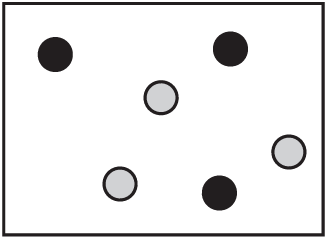
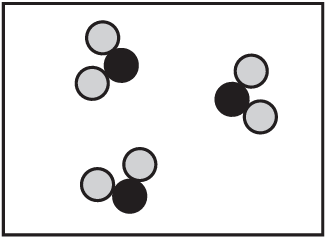
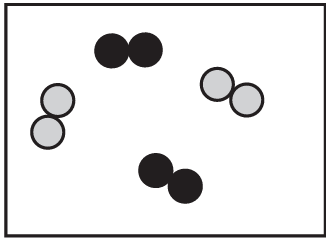
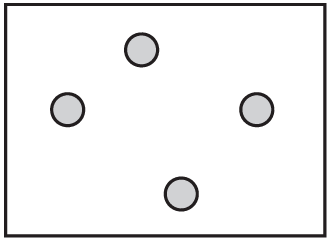
Which diagram shows a mixture of noble gases?

A)  
B)  
C)  
D)  
Most-appropriate topic codes (Cambridge IGCSE Chemistry 0620):

Topic 8.5: Noble gases — Describe the Group VIII noble gases as unreactive, monatomic gases and explain this in terms of electronic configuration (Core)
Topic 2.1: Elements, compounds and mixtures — Describe the differences between elements, compounds and mixtures (Core)
▶️ Answer/Explanation
Noble gases are monatomic — each particle consists of a single atom that exists entirely on its own, never bonded to any other atom. A mixture of noble gases must therefore be represented by individual, unbonded atoms of more than one size (representing different noble gas elements such as helium, neon, and argon) moving freely and independently. Diagram A shows exactly this: separate single atoms of two or more different sizes with no bonds between them, confirming it is a mixture of monatomic noble gas particles. Diagrams showing paired or grouped atoms would suggest diatomic molecules or compounds, which noble gases do not form due to their full outer electron shells and consequent chemical unreactivity.
Answer: (A)

Question 27

Which statements about the alloy brass are correct?

  1. It is harder than pure copper.
  2. It does not conduct electricity.
  3. It is a mixture of copper and nickel.
  4. It is stronger than pure copper.

A. 1 and 2
B. 1 and 4
C. 2 and 3
D. 3 and 4

Most-appropriate topic codes (Cambridge IGCSE Chemistry 0620):

Topic 9.3: Alloys and their properties — Describe an alloy as a mixture of a metal with other elements, including brass as a mixture of copper and zinc (Core); State that alloys can be harder and stronger than the pure metals and are more useful (Core); Explain in terms of structure how alloys can be harder and stronger than the pure metals because the different sized atoms in alloys mean the layers can no longer slide over each other (Supplement)
▶️ Answer/Explanation
Brass is an alloy of copper and zinc — not copper and nickel — so statement 3 is factually incorrect and eliminates options C and D. Statement 2 is also wrong: brass, like all metals and metallic alloys, contains delocalised electrons that allow it to conduct electricity freely. Statements 1 and 4 are both correct: when zinc atoms (of a different size to copper atoms) are introduced into the copper lattice, they distort the regular layered structure, preventing the layers from sliding easily over one another — this makes brass both harder and stronger than pure copper. Since only statements 1 and 4 are correct, option B is the right answer.
Answer: (B)

Question 28

The bodies of aircraft are often made using aluminium.

Which two properties of aluminium make it suitable for this use?

Most-appropriate topic codes (Cambridge IGCSE Chemistry 0620):

Topic 9.2: Uses of metals — Describe the uses of metals in terms of their physical properties, including aluminium in the manufacture of aircraft because of its low density (Core)
▶️ Answer/Explanation
Aircraft bodies must be made from a material that is both lightweight and structurally strong — minimising the aircraft’s total mass is essential for fuel efficiency and the ability to achieve flight, while sufficient strength is needed to withstand the mechanical stresses experienced during flight. Aluminium’s low density means aircraft bodies weigh far less than they would if made from denser metals such as steel or copper, and its notable strength (especially when alloyed) ensures the structure remains safe and intact under pressure. Although aluminium does conduct electricity and heat, these properties are not relevant to its use in aircraft bodywork and are therefore not the reason for its selection in this application.
Answer: (D)

Question 29

Four metals, P, Q, R and S, are added separately to water and to dilute hydrochloric acid.

The table shows the results.

 observation with waterobservation with dilute hydrochloric acid
Pno reactionfizzes slowly
Qfizzes rapidlyfizzes rapidly
Rno reactionno reaction
Sfizzes slowlyfizzes rapidly

Which conclusion can be made from these observations?

A. P is the least reactive of the four metals.
B. Q is more reactive than S.
C. Q is less reactive than P.
D. R is the most reactive of the four metals.

Most-appropriate topic codes (Cambridge IGCSE Chemistry 0620):

Topic 9.4: Reactivity series — Describe the reactions, if any, of metals with cold water and dilute hydrochloric acid and explain these reactions in terms of the position of the metals in the reactivity series (Core); Deduce an order of reactivity from a given set of experimental results (Core)
▶️ Answer/Explanation
The observations allow a clear reactivity order to be deduced. Q reacts rapidly with both water and dilute acid, placing it at the top as the most reactive. S reacts slowly with water but rapidly with acid, indicating it is less reactive than Q but still reactive enough to displace hydrogen from both reagents. P shows no reaction with water but fizzes slowly with acid, so it is less reactive than S. R shows no reaction with either water or acid, making it the least reactive of the four — eliminating option D. The correct reactivity order is Q > S > P > R, which directly confirms that option B is correct: Q is more reactive than S. Options A and C contradict this established order entirely.
Answer: (B)

Question 30

Iron is extracted from its ore in the blast furnace.

Which statement about one of the reactions in the blast furnace is correct?

A. Carbon monoxide is reduced to carbon dioxide.
B. Iron(III) oxide is reduced by carbon dioxide.
C. Slag is produced when calcium carbonate reacts with carbon dioxide.
D. The reaction that heats the blast furnace produces carbon dioxide.

Most-appropriate topic codes (Cambridge IGCSE Chemistry 0620):

Topic 9.6: Extraction of metals — Describe the extraction of iron from hematite in the blast furnace, including the burning of carbon (coke) to provide heat and produce carbon dioxide, the reduction of carbon dioxide to carbon monoxide, the reduction of iron(III) oxide by carbon monoxide, the thermal decomposition of calcium carbonate to produce calcium oxide, and the formation of slag (Core)
▶️ Answer/Explanation
The blast furnace involves a carefully sequenced set of reactions. The heat needed to sustain the process comes from the combustion of coke (carbon) in the hot air blast: C + O₂ → CO₂. This exothermic reaction produces carbon dioxide, making option D correct. Option A is wrong because carbon monoxide is not reduced — it is actually oxidised (it gains oxygen) as it reduces iron(III) oxide to iron, forming CO₂. Option B is incorrect because it is carbon monoxide, not carbon dioxide, that acts as the reducing agent for iron(III) oxide: Fe₂O₃ + 3CO → 2Fe + 3CO₂. Option C is wrong because slag forms when calcium oxide (produced by thermal decomposition of limestone) reacts with silicon dioxide impurities, not when calcium carbonate reacts with carbon dioxide.
Answer: (D)

Question 31

Which pollutants found in river water lead to deoxygenation?

  1. nitrates
  2. harmful microbes
  3. metal compounds
  4. phosphates

A. 1 and 2
B. 1 and 4
C. 2 and 3
D. 3 and 4

Most-appropriate topic codes (Cambridge IGCSE Chemistry 0620):

Topic 10.1: Water — State that water from natural sources may contain nitrates from fertilisers and phosphates from fertilisers and detergents (Core); State that nitrates and phosphates lead to deoxygenation of water and damage to aquatic life (Core)
▶️ Answer/Explanation
Nitrates (from fertilisers) and phosphates (from fertilisers and detergents) are both nutrients that, when present in excess in river water, stimulate the rapid and uncontrolled growth of algae on the water surface. This algal bloom blocks sunlight from reaching plants below, causing them to die; when the large mass of algae and plants subsequently decomposes, the bacteria responsible consume vast amounts of dissolved oxygen from the water, leading to deoxygenation and the death of aquatic life. Harmful microbes (statement 2) cause disease in living organisms but do not directly deplete dissolved oxygen in this way. Metal compounds (statement 3) may be toxic to aquatic organisms but are not responsible for deoxygenation through this nutrient-driven process.
Answer: (B)

Question 32

Three effects of air pollutants are listed.

  1. photochemical smog
  2. respiratory problems
  3. acid rain

Which effects are caused by oxides of nitrogen?

A. 1, 2 and 3
B. 1 and 3 only
C. 1 only
D. 2 and 3 only

Most-appropriate topic codes (Cambridge IGCSE Chemistry 0620):

Topic 10.3: Air quality and climate — State the source of oxides of nitrogen from car engines (Core); State the adverse effects of oxides of nitrogen: acid rain, photochemical smog and respiratory problems (Core)
▶️ Answer/Explanation
Oxides of nitrogen (NOₓ), produced mainly by high-temperature combustion in car engines, are responsible for all three of the listed adverse effects. They react with volatile organic compounds in the presence of sunlight to generate photochemical smog (effect 1), a brownish haze that reduces visibility and irritates the eyes. They also directly irritate the lining of the lungs and airways, causing and worsening respiratory problems such as asthma (effect 2). Furthermore, oxides of nitrogen dissolve in atmospheric moisture to form nitric acid, which falls as acid rain (effect 3), damaging ecosystems, buildings, and statues. Since NOₓ is linked to all three effects, all three statements are correct.
Answer: (A)

Question 33

Fractional distillation is used to separate petroleum into its fractions.

Which statement about the fractional distillation of petroleum is correct?

A. The kerosene fraction is used as a fuel for ships.
B. The fractions with the highest boiling points are extracted from the top of the fractionating column.
C. The naphtha fraction contains larger hydrocarbon molecules than the lubricating oil fraction.
D. The refinery gas fraction contains hydrocarbon molecules which consist of five atoms.

Most-appropriate topic codes (Cambridge IGCSE Chemistry 0620):

Topic 11.3: Fuels — Describe the separation of petroleum into useful fractions by fractional distillation (Core); Describe how the properties of fractions obtained from petroleum change from the bottom to the top of the fractionating column, including decreasing chain length, higher volatility, lower boiling points and lower viscosity (Core); Name the uses of the fractions, including refinery gas for heating and cooking, kerosene for jet fuel, and fuel oil for ships and home heating (Core)
▶️ Answer/Explanation
Option A is incorrect because kerosene is used as jet fuel, not as a fuel for ships — ship fuel comes from the heavier fuel oil fraction. Option B is incorrect because fractions with the highest boiling points have the longest chains and condense at the hottest part of the column, which is at the bottom, not the top. Option C is incorrect because naphtha contains smaller hydrocarbon molecules (roughly C₅–C₁₀) than the lubricating oil fraction (roughly C₂₀–C₅₀). Option D is correct: the refinery gas fraction consists of the smallest hydrocarbon molecules, including methane (CH₄), which contains exactly five atoms in total (one carbon and four hydrogen atoms), making this a valid description of molecules found in that fraction.
Answer: (D)

Question 34

Fertilisers are mixtures of different compounds used to increase the growth of crops.

Which pair of substances contain the three essential elements for plant growth?

A. ammonium nitrate and calcium phosphate
B. ammonium nitrate and potassium chloride
C. ammonium phosphate and potassium chloride
D. potassium nitrate and calcium carbonate

Most-appropriate topic codes (Cambridge IGCSE Chemistry 0620):

Topic 10.2: Fertilisers — State that ammonium salts and nitrates are used as fertilisers (Core); Describe the use of NPK fertilisers to provide the elements nitrogen, phosphorus and potassium for improved plant growth (Core)
▶️ Answer/Explanation
NPK fertilisers must supply all three essential elements: nitrogen (N), phosphorus (P), and potassium (K). Checking each option against this requirement: option A provides N (from ammonium nitrate) and P (from calcium phosphate) but no K; option B provides N (from ammonium nitrate) and K (from potassium chloride) but no P; option D provides N and K (both from potassium nitrate) but calcium carbonate contributes neither P nor K. Only option C supplies all three elements — ammonium phosphate [(NH₄)₃PO₄] provides both N and P, while potassium chloride (KCl) supplies K — making it the only pair that satisfies the complete NPK requirement for plant growth.
Answer: (C)

Question 35

Which row gives the relative molecular mass, \( M_r \), of the first member of the named homologous series?

 homologous series\( M_r \)
Aalkanes12
Balkenes14
Calcohols32
Dcarboxylic acids60

Most-appropriate topic codes (Cambridge IGCSE Chemistry 0620):

Topic 11.4: Alkanes — State that the bonding in alkanes is single covalent and that alkanes are saturated hydrocarbons (Core)
Topic 11.1: Formulae, functional groups and terminology — Write and interpret general formulae of compounds in the same homologous series, limited to alkanes (CₙH₂ₙ₊₂), alkenes (CₙH₂ₙ), alcohols (CₙH₂ₙ₊₁OH), and carboxylic acids (CₙH₂ₙ₊₁COOH) (Core)
Topic 3.2: Relative masses of atoms and molecules — Define relative molecular mass, Mᵣ, as the sum of the relative atomic masses (Core)
▶️ Answer/Explanation
Each option can be checked by identifying the first member of the series and calculating its Mᵣ. For alkanes (A), the first member is methane (CH₄): Mᵣ = 12 + (4×1) = 16, not 12. For alkenes (B), the first member is ethene (C₂H₄): Mᵣ = (2×12) + (4×1) = 28, not 14. For alcohols (C), the first member is methanol (CH₃OH): Mᵣ = 12 + (3×1) + 16 + 1 = 32 — this matches exactly. For carboxylic acids (D), the first member is methanoic acid (HCOOH): Mᵣ = 1 + 12 + 16 + 16 + 1 = 46, not 60. Only option C gives the correct relative molecular mass for the first member of its series.
Answer: (C)

Question 36

A hydrocarbon decolourises bromine water.

Which statement about the hydrocarbon is correct?

A. It is an alkane.
B. Its molecular formula is \( C_2H_6 \).
C. It is a saturated hydrocarbon.
D. It has the general formula \( C_nH_{2n} \).

Most-appropriate topic codes (Cambridge IGCSE Chemistry 0620):

Topic 11.5: Alkenes — State that the bonding in alkenes includes a double carbon–carbon covalent bond and that alkenes are unsaturated hydrocarbons (Core); Describe the test to distinguish between saturated and unsaturated hydrocarbons by their reaction with aqueous bromine (Core)
Topic 11.1: Formulae, functional groups and terminology — Write and interpret general formulae of compounds in the same homologous series, including alkenes CₙH₂ₙ (Core)
▶️ Answer/Explanation
The ability to decolourise bromine water is the standard chemical test for an unsaturated hydrocarbon. Unsaturated hydrocarbons contain at least one carbon-carbon double bond (C=C), which undergoes an addition reaction with bromine, breaking the orange-brown colour and producing a colourless dibromo compound. This immediately identifies the hydrocarbon as an alkene, eliminating options A and C since alkanes are saturated and do not react with bromine water under normal conditions. Option B (C₂H₆) is the formula for ethane, a saturated alkane. Option D is correct: alkenes follow the general formula CₙH₂ₙ, and only alkenes (unsaturated hydrocarbons) decolourise bromine water through addition reactions.
Answer: (D)

Question 37

Which statement describes how ethanol is manufactured from ethene?

A. Steam is added to ethene using an acid catalyst at 30 °C.
B. Steam is added to ethene using an acid catalyst at 300 °C.
C. Ethene is fermented using yeast at 30 °C.
D. Ethene is fermented using yeast at 300 °C.

Most-appropriate topic codes (Cambridge IGCSE Chemistry 0620):

Topic 11.6: Alcohols — Describe the manufacture of ethanol by: (a) fermentation of aqueous glucose at 25–35 °C in the presence of yeast and in the absence of oxygen; (b) catalytic addition of steam to ethene at 300 °C and 6000 kPa/60 atm in the presence of an acid catalyst (Core)
▶️ Answer/Explanation
The industrial manufacture of ethanol from ethene involves a hydration reaction, where steam is added across the double bond of ethene in the presence of an acid catalyst (typically phosphoric acid, H₃PO₄) at a high temperature of 300 °C and a pressure of 6000 kPa/60 atm. Option A is incorrect because 30 °C is far too low for this reaction to proceed at a useful rate. Options C and D are both wrong because fermentation uses glucose (a sugar) as the starting material — not ethene — and proceeds at 25–35 °C with yeast in the absence of oxygen. Option D is doubly incorrect as 300 °C would destroy the yeast enzymes needed for fermentation.
Answer: (B)

Question 38

Ethanoic acid reacts with aqueous sodium carbonate.

Which gas is given off in this reaction?

A. hydrogen
B. carbon dioxide
C. carbon monoxide
D. oxygen

Most-appropriate topic codes (Cambridge IGCSE Chemistry 0620):

Topic 11.7: Carboxylic acids — Describe the reaction of ethanoic acid with: (a) metals; (b) bases; (c) carbonates, including names and formulae of the salts produced (Core)
▶️ Answer/Explanation
When any acid reacts with a carbonate, the carbonate ion (CO₃²⁻) is decomposed by the acid’s hydrogen ions, releasing carbon dioxide gas, along with water and the corresponding salt. In this case, ethanoic acid reacts with sodium carbonate to produce sodium ethanoate (CH₃COONa), water, and carbon dioxide: 2CH₃COOH + Na₂CO₃ → 2CH₃COONa + H₂O + CO₂. Hydrogen gas would only be produced if an acid reacted with a metal, not a carbonate. Carbon monoxide and oxygen are not products of any acid–carbonate reaction under these conditions.
Answer: (B)

Question 39

A mixture containing an aqueous salt, sand and hot water is stirred.

The mixture is then poured into the apparatus shown.
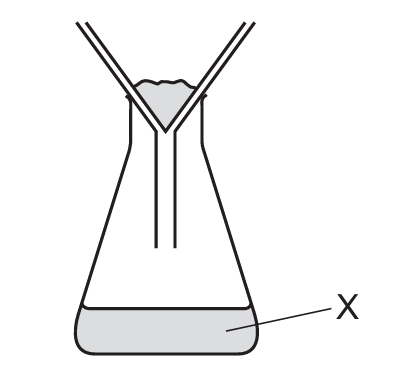
Filtration apparatus diagram

What is X?

A. a filtrate only
B. a residue only
C. a solute only
D. a solvent only

Most-appropriate topic codes (Cambridge IGCSE Chemistry 0620):

Topic 12.4: Separation and purification — Describe and explain methods of separation and purification using filtration (Core); Topic 12.1: Experimental design — Describe a filtrate as a liquid or solution that has passed through a filter; residue as a substance that remains after filtration (Core)
▶️ Answer/Explanation
The apparatus shown is a filtration setup, where the filter paper separates an insoluble solid from a liquid. Sand is insoluble in water and is therefore retained by the filter paper as the residue, while the aqueous salt solution passes through the filter paper and is collected as X — the filtrate. X cannot be described as just the solvent, because the dissolved salt is also present in the liquid that passes through; nor can it be the solute alone, as that would imply dry salt crystals rather than a solution. The term “filtrate” correctly describes the entire liquid fraction (water plus dissolved salt) that passes through the filter.
Answer: (A)

Question 40

A scientist uses a titration to calculate the concentration of acid in a sample of lemon juice.

A measured volume of aqueous lemon juice and a few drops of an indicator are added to a flask.

The aqueous lemon juice is then titrated against 0.1 mol/dm³ aqueous sodium hydroxide.

Which piece of apparatus is used to add the aqueous sodium hydroxide to the flask?

A. a burette
B. a delivery tube
C. a measuring cylinder
D. a volumetric pipette

Most-appropriate topic codes (Cambridge IGCSE Chemistry 0620):

Topic 12.2: Acid–base titrations — Describe an acid–base titration to include the use of: (a) a burette; (b) a volumetric pipette; (c) a suitable indicator; Describe how to identify the end-point of a titration using an indicator (Core)
▶️ Answer/Explanation
In a titration, the solution of known concentration — here the 0.1 mol/dm³ sodium hydroxide — is the titrant and is always delivered from a burette, because a burette can dispense variable volumes with high precision (readable to ±0.05 cm³), which is essential for locating the exact end-point. A volumetric pipette is used to transfer a fixed, precise volume of the analyte (the lemon juice) into the flask, not to add the titrant. A measuring cylinder lacks the precision required for titration work, and a delivery tube is used for directing gases in gas-collection experiments, not for liquid addition in titrations.
Answer: (A)
Scroll to Top