Home / 0620_w24_qp_21

Question 1

Which row describes the arrangement and motion of the particles in a liquid?

 arrangementmotion
Arandom and particles are touchingmoving slowly
Brandom with space between all particlesmoving slowly
Can ordered lattice with all particles touchingmoving slowly
Dan ordered lattice with space between all particlesmoving quickly

Most-appropriate topic codes (Cambridge IGCSE Chemistry 0620):

Topic 1.1: Solids, liquids and gases — Describe the structures of solids, liquids and gases in terms of particle separation, arrangement and motion (Core)
▶️ Answer/Explanation
In a liquid, particles are close enough to be touching one another (unlike gas particles which have significant space between them), but they are arranged randomly rather than in any ordered or fixed lattice structure. Liquid particles can move past each other and flow, but their motion is relatively slow compared to the rapid, free movement of gas particles. Option B is incorrect because liquids do not have spaces between all particles — that describes a gas. Options C and D both describe ordered lattice arrangements, which apply only to solids, not liquids.
Answer: (A)

Question 2

Which gas has the lowest rate of diffusion at room temperature and pressure?

A. the gas produced when ammonium chloride is heated with aqueous sodium hydroxide
B. the gas which makes up approximately 78% of clean, dry air
C. the gas produced when sodium carbonate is added to dilute hydrochloric acid
D. the gas produced when zinc is added to dilute sulfuric acid

Most-appropriate topic codes (Cambridge IGCSE Chemistry 0620):

Topic 1.2: Diffusion — Describe and explain the effect of relative molecular mass on the rate of diffusion of gases (Supplement)
▶️ Answer/Explanation
According to Graham’s Law, the rate of diffusion of a gas is inversely proportional to the square root of its molar mass, meaning the heavier the gas, the more slowly it diffuses. Identifying each gas: A produces ammonia, NH₃ (M = 17 g/mol); B is nitrogen, N₂ (M = 28 g/mol); C produces carbon dioxide, CO₂ (M = 44 g/mol); and D produces hydrogen, H₂ (M = 2 g/mol). Since carbon dioxide has the greatest molar mass of the four options, it will have the lowest rate of diffusion at room temperature and pressure.
Answer: (C)

Question 3

Which diagram represents one helium atom?

A.  
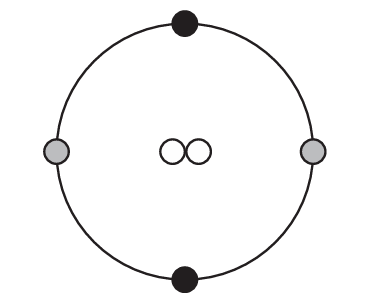
B.  
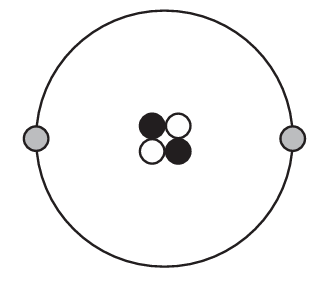
C.  
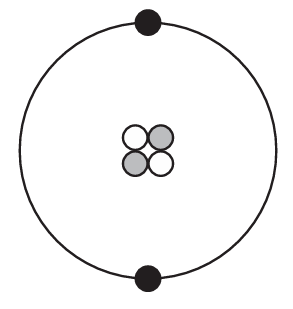
D.  
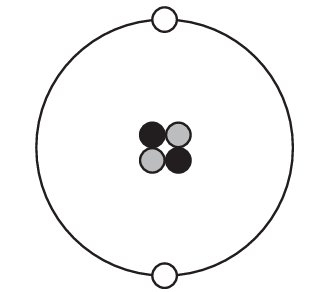
Most-appropriate topic codes (Cambridge IGCSE Chemistry 0620):

Topic 2.2: Atomic structure and the Periodic Table — Describe the structure of the atom as a central nucleus containing neutrons and protons surrounded by electrons in shells; State the relative charges and relative masses of a proton, a neutron and an electron (Core)
▶️ Answer/Explanation
Helium has an atomic number of 2, which means its nucleus contains exactly 2 protons; the most common isotope, helium-4, also contains 2 neutrons in the nucleus, giving a mass number of 4. Since helium is a neutral atom, it must have 2 electrons to balance the 2 protons, and both electrons occupy the first (and only) electron shell, which has a maximum capacity of 2. The correct diagram must therefore show a nucleus with 2 protons and 2 neutrons, surrounded by a single shell containing exactly 2 electrons — all other options show an incorrect number of nuclear particles or an incorrect electron arrangement.
Answer: (B)

Question 4

The diagram shows part of an ionic lattice structure.
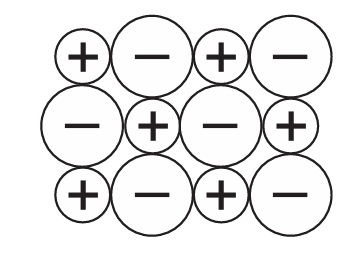
Which compound does the diagram represent?

A. potassium bromide
B. sodium oxide
C. magnesium chloride
D. carbon monoxide

Most-appropriate topic codes (Cambridge IGCSE Chemistry 0620):

Topic 2.4: Ions and ionic bonds — Describe the giant lattice structure of ionic compounds as a regular arrangement of alternating positive and negative ions (Supplement)
▶️ Answer/Explanation
The diagram shows an ionic lattice with equal numbers of positive and negative ions in a 1:1 ratio, which is the hallmark of compounds formed between a singly charged cation and a singly charged anion. Potassium bromide (KBr) fits this perfectly, as K⁺ and Br⁻ both carry a single charge, producing an equal 1:1 arrangement. Sodium oxide (Na₂O) has a 2:1 ratio of Na⁺ to O²⁻, and magnesium chloride (MgCl₂) has a 1:2 ratio of Mg²⁺ to Cl⁻, so neither matches the diagram. Carbon monoxide is a covalent molecule and does not form an ionic lattice at all.
Answer: (A)

Question 5

Which statement about nitrogen molecules and ethene molecules is correct?

A. A nitrogen molecule has 2 more shared electrons than an ethene molecule.
B. An ethene molecule has 3 more shared electrons than a nitrogen molecule.
C. A nitrogen molecule has 4 more shared electrons than an ethene molecule.
D. An ethene molecule has 6 more shared electrons than a nitrogen molecule.

Most-appropriate topic codes (Cambridge IGCSE Chemistry 0620):

Topic 2.5: Simple molecules and covalent bonds — Describe the formation of covalent bonds in simple molecules, including N₂ and C₂H₄; use dot-and-cross diagrams to show the electronic configurations in these and similar molecules (Supplement)
▶️ Answer/Explanation
A nitrogen molecule (N≡N) contains a triple bond, meaning 3 shared pairs, giving a total of 6 shared electrons. An ethene molecule (C₂H₄) contains one C=C double bond (4 shared electrons) and four C–H single bonds (4 × 2 = 8 shared electrons), giving a total of 12 shared electrons. The difference is 12 − 6 = 6, so ethene has 6 more shared electrons than nitrogen. Options A and C are incorrect because nitrogen does not have more shared electrons than ethene, and option B understates the difference by counting only bond pairs rather than all shared electrons.
Answer: (D)

Question 6

Sulfur is a simple molecule with the formula \( S_8 \).

Which row describes and explains the melting point of sulfur?

 melting pointexplanation
Ahighthe covalent bonds between sulfur atoms are strong
Bhighthe covalent bonds between sulfur molecules are strong
Clowthe forces of attraction between sulfur atoms are weak
Dlowthe forces of attraction between sulfur molecules are weak

Most-appropriate topic codes (Cambridge IGCSE Chemistry 0620):

Topic 2.5: Simple molecules and covalent bonds — Explain in terms of structure and bonding the properties of simple molecular compounds: low melting points and boiling points in terms of weak intermolecular forces (Supplement)
▶️ Answer/Explanation
Sulfur exists as discrete S₈ molecules, making it a simple molecular substance. When a simple molecular substance melts, it is the weak intermolecular forces between the molecules that are overcome — the strong covalent bonds within each S₈ molecule remain intact throughout melting. Because these intermolecular forces are weak, only a small amount of energy is needed to separate the molecules, resulting in a relatively low melting point. Option C is incorrect because it incorrectly refers to forces between individual atoms rather than between molecules, and options A and B wrongly suggest a high melting point, which would only apply to giant covalent or ionic structures.
Answer: (D)

Question 7

Which row identifies a property and an explanation of the property for both diamond and silicon(IV) oxide?

 propertyexplanation of property
Avery harddiamond has a giant covalent structure and silicon(IV) oxide has a giant ionic structure
Bhigh melting pointboth have giant covalent structures with many strong bonds between the atoms
Cgood lubricantboth have layers of atoms, which can slide over each other
Dpoor conductorboth contain only non-metal elements and are simple molecules

Most-appropriate topic codes (Cambridge IGCSE Chemistry 0620):

Topic 2.6: Giant covalent structures — Describe the giant covalent structure of silicon(IV) oxide, SiO₂; Describe the similarity in properties between diamond and silicon(IV) oxide, related to their structures (Supplement)
▶️ Answer/Explanation
Both diamond and silicon(IV) oxide possess giant covalent structures in which every atom is bonded to its neighbours by strong covalent bonds extending throughout the entire lattice, requiring a very large amount of energy to break these bonds and therefore giving both substances very high melting points. Option A is wrong because silicon(IV) oxide is a giant covalent structure, not ionic. Option C is incorrect because neither diamond nor silicon(IV) oxide has a layered structure — that property belongs to graphite alone. Option D is wrong because describing them as simple molecules is factually incorrect; they are giant structures, not discrete small molecules.
Answer: (B)

Question 8

Which statement about the structure of metals explains why metals are malleable?

A. The electrons can move freely throughout the lattice.
B. The layers of metal ions can slide over each other.
C. The metal ions are positively charged.
D. There is a strong force of attraction between the metal ions and the electrons.

Most-appropriate topic codes (Cambridge IGCSE Chemistry 0620):

Topic 2.7: Metallic bonding — Explain in terms of structure and bonding the properties of metals: malleability and ductility (Supplement)
▶️ Answer/Explanation
Malleability in metals is explained by the ability of layers of positive metal ions to slide over one another when a force is applied, while the sea of delocalised electrons moves with them to maintain the electrostatic attraction throughout the structure — so the metallic bonding is preserved even after deformation. Option A describes the basis of electrical conductivity, not malleability. Option C merely states that ions are positive, which alone does not account for any specific physical property. Option D describes the origin of the strength of metallic bonding but does not explain why the shape can be changed without the structure breaking apart.
Answer: (B)

Question 9

What is the formula of iron(III) oxide?

A. FeO
B. Fe3O4
C. FeO2
D. Fe2O3

Most-appropriate topic codes (Cambridge IGCSE Chemistry 0620):

Topic 3.1: Formulae — State the formulae of the elements and compounds named in the subject content; Deduce the formula of an ionic compound from the relative numbers of the ions present or from the charges on the ions (Supplement)
▶️ Answer/Explanation
The Roman numeral III in iron(III) oxide indicates that iron carries an oxidation state (charge) of +3, written as Fe³⁺, while oxygen always carries a charge of −2, written as O²⁻. To produce an electrically neutral compound, the total positive charge must equal the total negative charge: two Fe³⁺ ions give a total of +6, and three O²⁻ ions give a total of −6, balancing perfectly to give the formula Fe₂O₃. Option A (FeO) corresponds to iron(II) oxide where iron is +2, option B (Fe₃O₄) is a mixed-valence oxide containing both Fe²⁺ and Fe³⁺, and option C (FeO₂) does not represent a standard iron oxide.
Answer: (D)

Question 10

Calcium carbonate is heated. Calcium oxide and carbon dioxide gas are formed.

The equation for the reaction is shown.

\[ \text{CaCO}_3 \rightarrow \text{CaO} + \text{CO}_2 \]

225 kg of calcium carbonate is heated until there is no further change in mass.

The yield of calcium oxide is 85 kg.

What is the percentage yield?

A. 37.8%
B. 47.2%
C. 67.5%
D. 85.0%

Most-appropriate topic codes (Cambridge IGCSE Chemistry 0620):

Topic 3.3: The mole and the Avogadro constant — Calculate percentage yield, percentage composition by mass and percentage purity, given appropriate data (Supplement)
▶️ Answer/Explanation
The molar mass of CaCO₃ is 40 + 12 + (3 × 16) = 100 g/mol, so 225 000 g gives 2250 mol of CaCO₃; since the equation shows a 1:1 mole ratio, 2250 mol of CaO is also expected. The molar mass of CaO is 40 + 16 = 56 g/mol, so the theoretical yield is 2250 × 56 = 126 000 g = 126 kg. Applying the percentage yield formula: (actual yield ÷ theoretical yield) × 100 = (85 ÷ 126) × 100 ≈ 67.5%. The other options arise from common errors such as dividing by the mass of CaCO₃ directly or using incorrect molar masses.
Answer: (C)

Question 11

The apparatus used for electrolysis is shown.

Which statement is correct?

A. Copper forms at the anode in some electrolysis reactions.
B. Hydrogen forms at the cathode in some electrolysis reactions.
C. Oxygen forms at the cathode in some electrolysis reactions.
D. Sodium forms at the anode in some electrolysis reactions.

Most-appropriate topic codes (Cambridge IGCSE Chemistry 0620):

Topic 4.1: Electrolysis — State that metals or hydrogen are formed at the cathode and that non-metals (other than hydrogen) are formed at the anode (Core)
▶️ Answer/Explanation
During electrolysis, reduction takes place at the cathode (the negative electrode), where positive ions gain electrons. Hydrogen ions (H⁺) present in aqueous solutions are commonly discharged at the cathode to produce hydrogen gas (H₂), for example during the electrolysis of dilute sulfuric acid or dilute sodium chloride solution, making option B correct. Option A is wrong because copper is deposited at the cathode, not the anode. Option C is incorrect because oxygen is a non-metal product that forms at the anode through oxidation, not at the cathode. Option D is wrong because sodium, being a metal, would form at the cathode if discharged, and it is not produced at the anode under any standard electrolysis condition.
Answer: (B)

Question 12

Which statement about the electrolysis of aqueous copper(II) sulfate is correct?

A. When copper electrodes are used, the solution turns from blue to colourless.
B. When graphite electrodes are used, bubbles of gas are formed at the cathode.
C. When copper electrodes are used, the anode gets smaller.
D. When graphite electrodes are used, the colour of the solution does not change.

Most-appropriate topic codes (Cambridge IGCSE Chemistry 0620):

Topic 4.1: Electrolysis — Identify the products formed at the electrodes and describe the observations made during the electrolysis of aqueous copper(II) sulfate using inert carbon/graphite electrodes and when using copper electrodes (Supplement)
▶️ Answer/Explanation
When copper electrodes are used in the electrolysis of copper(II) sulfate solution, the copper anode undergoes oxidation and dissolves into the solution as Cu²⁺ ions (Cu → Cu²⁺ + 2e⁻), so the anode gradually decreases in size — making option C correct. Option A is wrong because the concentration of Cu²⁺ ions stays roughly constant (copper dissolves from the anode at the same rate it deposits at the cathode), so the blue colour is maintained. Option B is incorrect because with graphite electrodes, copper metal is deposited at the cathode rather than hydrogen gas being released. Option D is incorrect because with graphite electrodes the copper ions are steadily removed from solution without being replaced, so the blue colour gradually fades.
Answer: (C)

Question 13

Which statement describes an advantage of using a hydrogen–oxygen fuel cell in a car compared to a gasoline engine?

A. The hydrogen is difficult to store.
B. The hydrogen is highly flammable.
C. The hydrogen used is made from hydrocarbons.
D. The only chemical product is water.

Most-appropriate topic codes (Cambridge IGCSE Chemistry 0620):

Topic 4.2: Hydrogen–oxygen fuel cells — Describe the advantages and disadvantages of using hydrogen–oxygen fuel cells in comparison with gasoline/petrol engines in vehicles (Supplement)
▶️ Answer/Explanation
A hydrogen–oxygen fuel cell combines hydrogen and oxygen electrochemically to generate electricity, with water being the only chemical product released, meaning no carbon dioxide, carbon monoxide, oxides of nitrogen, or particulates are emitted at the point of use — a significant environmental advantage over gasoline engines. Options A and B are both genuine disadvantages of hydrogen fuel cells, as the gas is hard to store safely and poses a flammability risk. Option C is not an advantage because producing hydrogen from hydrocarbons still involves fossil fuels and generates carbon dioxide, partially undermining the environmental benefit of the fuel cell itself.
Answer: (D)

Question 14

Two reaction pathway diagrams are shown.

Which arrow represents the activation energy for a reaction which releases thermal energy?

Most-appropriate topic codes (Cambridge IGCSE Chemistry 0620):

Topic 5.1: Exothermic and endothermic reactions — Define activation energy, Ea, as the minimum energy that colliding particles must have to react; Draw and label reaction pathway diagrams for exothermic and endothermic reactions, to include activation energy, Ea (Supplement)
▶️ Answer/Explanation
A reaction that releases thermal energy is an exothermic reaction, identified on a reaction pathway diagram by the products being at a lower energy level than the reactants. The activation energy (Ea) is defined as the minimum energy that colliding particles must possess in order to react, and is represented on the diagram by the arrow pointing from the energy level of the reactants up to the peak (transition state) of the curve. In the exothermic diagram, this upward arrow from the reactants to the peak corresponds to option A. The other arrows either represent the overall enthalpy change of the reaction or belong to the endothermic pathway where products are at a higher energy level than the reactants.
Answer: (A)

Question 15

Which statements about the Haber process are correct?

  1. A high temperature is used because the reaction is slow at room temperature.
  2. A high pressure is used because there are more moles of gaseous reactants than moles of gaseous product.
  3. A nickel catalyst is used to increase the rate of reaction.
  4. An iron catalyst is used to increase the equilibrium yield of ammonia.

A. 1 and 2
B. 1 and 4
C. 2 and 3
D. 4 only

Most-appropriate topic codes (Cambridge IGCSE Chemistry 0620):

Topic 6.3: Reversible reactions and equilibrium — State the typical conditions in the Haber process as 450°C, 20000 kPa/200 atm and an iron catalyst; Explain, in terms of rate of reaction and position of equilibrium, why the typical conditions stated are used in the Haber process, including safety considerations and economics (Supplement)
▶️ Answer/Explanation
Statement 1 is correct: at room temperature the reaction N₂ + 3H₂ ⇌ 2NH₃ proceeds far too slowly to be economically viable, so a high temperature of 450°C is used to increase the rate, even though it reduces the equilibrium yield. Statement 2 is also correct: the reaction has 4 moles of gaseous reactants (1 + 3) but only 2 moles of gaseous product, so high pressure (200 atm) shifts the equilibrium to the right towards fewer moles of gas, increasing the yield. Statement 3 is incorrect because the catalyst used in the Haber process is iron, not nickel. Statement 4 is incorrect because a catalyst speeds up both the forward and reverse reactions equally, reaching equilibrium faster without altering the equilibrium position or yield.
Answer: (A)

Question 16

Which substance is a raw material used to manufacture sulfuric acid?

A. vanadium(V) oxide
B. sulfur
C. sulfur dioxide
D. sulfur trioxide

Most-appropriate topic codes (Cambridge IGCSE Chemistry 0620):

Topic 6.3: Reversible reactions and equilibrium — State the sources of the sulfur dioxide (burning sulfur or roasting sulfide ores) and oxygen (air) in the Contact process (Supplement)
▶️ Answer/Explanation
In the Contact Process for manufacturing sulfuric acid, sulfur is the starting raw material: it is first burned in air to produce sulfur dioxide (S + O₂ → SO₂), which is then oxidised to sulfur trioxide over a vanadium(V) oxide catalyst, and finally absorbed into water to yield sulfuric acid. Sulfur dioxide and sulfur trioxide are both intermediate products formed during the process, not raw materials. Vanadium(V) oxide serves only as a catalyst, which is neither consumed nor classified as a raw material in the manufacturing process.
Answer: (B)

Question 17

Which colours are seen when litmus and methyl orange are added to separate samples of aqueous sodium hydroxide?

 litmusmethyl orange
Ablueorange
Bblueyellow
Cpurpleorange
Dpurpleyellow

Most-appropriate topic codes (Cambridge IGCSE Chemistry 0620):

Topic 7.1: The characteristic properties of acids and bases — Describe alkalis in terms of their effect on litmus and methyl orange (Core)
▶️ Answer/Explanation
Aqueous sodium hydroxide is a strong alkali with a high pH, so it turns litmus blue — red litmus turns blue in alkaline conditions, while purple is the colour of litmus in a neutral solution, not an alkaline one. Methyl orange has a pH range of 3.1–4.4, appearing red/orange in acid and yellow in neutral or alkaline conditions; since sodium hydroxide is strongly alkaline, methyl orange turns yellow. Option A is wrong because orange methyl orange indicates acidic conditions. Options C and D are wrong because purple litmus indicates neutrality, not alkalinity.
Answer: (B)

Question 18

Information about the solubility in water of four oxides is shown.

Which oxide, when added to water, gives a solution with a pH less than pH 7?

 name of oxidesolubility in water
Anitrogen dioxidesoluble
Bcopper(II) oxideinsoluble
Csilicon(IV) oxideinsoluble
Dbarium oxidesoluble

Most-appropriate topic codes (Cambridge IGCSE Chemistry 0620):

Topic 7.2: Oxides — Classify oxides as acidic, including SO₂ and CO₂, or basic, including CuO and CaO, related to metallic and non-metallic character (Core)
▶️ Answer/Explanation
To produce a solution with pH less than 7, the oxide must be acidic and soluble in water. Nitrogen dioxide (NO₂) is a non-metal oxide and therefore an acidic oxide; when it dissolves in water it forms nitrous acid and nitric acid, both of which are acidic, giving a pH below 7. Options B and C (copper(II) oxide and silicon(IV) oxide) are both insoluble in water, so they cannot change the pH of the solution. Option D (barium oxide) is soluble but is a metal oxide, making it a basic oxide that dissolves to form barium hydroxide — a strongly alkaline solution with pH well above 7.
Answer: (A)

Question 19

Copper(II) sulfate is made when copper(II) carbonate reacts with dilute sulfuric acid.

\[ \text{CuCO}_3 + \text{H}_2\text{SO}_4 \rightarrow \text{CuSO}_4 + \text{H}_2\text{O} + \text{CO}_2 \]

Pure copper(II) sulfate crystals are obtained.

Which reagent is in excess and how are the crystals obtained?

 reagent in excesshow the crystals are obtained
Acopper(II) carbonatefilter and evaporate the solution to dryness
Bcopper(II) carbonatefilter, evaporate the solution to crystallising point and then cool
Cdilute sulfuric acidevaporate the solution to dryness
Ddilute sulfuric acidevaporate the solution to crystallising point and then cool

Most-appropriate topic codes (Cambridge IGCSE Chemistry 0620):

Topic 7.3: Preparation of salts — Describe the preparation, separation and purification of soluble salts by reaction of an acid with excess insoluble carbonate (Core)
▶️ Answer/Explanation
Since copper(II) carbonate is an insoluble solid, it is added in excess to ensure that all the sulfuric acid is completely used up, guaranteeing no acid remains in the final product; the excess unreacted carbonate is then removed by filtration, leaving a pure copper(II) sulfate solution. To obtain well-formed crystals, the filtrate is evaporated carefully only until the crystallising point (when a few drops placed on a cold surface solidify quickly), then allowed to cool slowly so that large, pure crystals of CuSO₄·5H₂O form. Evaporating to complete dryness (options A and C) would destroy the water of crystallisation and produce an impure powder rather than proper crystals, and using excess acid (options C and D) would leave acid contaminating the final product.
Answer: (B)

Question 20

Which statement about elements in Group I or Group VII of the Periodic Table is correct?

A. Bromine reacts with potassium chloride to produce chlorine.
B. Iodine is a monatomic non-metal.
C. Lithium has a higher melting point than potassium.
D. Sodium is more reactive with water than potassium.

Most-appropriate topic codes (Cambridge IGCSE Chemistry 0620):

Topic 8.2: Group I properties — Describe the Group I alkali metals with general trends down the group: decreasing melting point and increasing reactivity (Core)
Topic 8.3: Group VII properties — Describe the Group VII halogens as diatomic non-metals with general trends: decreasing reactivity down the group; describe displacement reactions of halogens with other halide ions (Core)
▶️ Answer/Explanation
In Group I, melting point decreases going down the group, so lithium (at the top) has a higher melting point than potassium (further down), making option C correct. Option A is wrong because halogen displacement reactions only occur when a more reactive halogen displaces a less reactive one — bromine is less reactive than chlorine and therefore cannot displace chloride ions from solution. Option B is incorrect because iodine, like all halogens, exists as diatomic molecules (I₂), not as monatomic atoms. Option D is incorrect because reactivity increases down Group I, meaning potassium is more reactive with water than sodium, not the other way around.
Answer: (C)

Question 21

Some information about an element from Group VII of the Periodic Table is shown.

melting point/°C–7
boiling point/°C59

What is the element?

A. fluorine
B. chlorine
C. bromine
D. iodine

Most-appropriate topic codes (Cambridge IGCSE Chemistry 0620):

Topic 8.3: Group VII properties — Describe the Group VII halogens as diatomic non-metals with general trends down the group: increasing density and decreasing reactivity; state the appearance of the halogens at r.t.p. (Core)
▶️ Answer/Explanation
Melting and boiling points increase going down Group VII as the molecules become larger and intermolecular forces become stronger. Fluorine has a boiling point of −188°C and chlorine −34°C — both are gases well below room temperature. Iodine melts at 114°C and boils at 184°C — a solid at room temperature with values far higher than those given. Bromine is the only halogen that is a liquid at room temperature, with a melting point of −7°C and a boiling point of 59°C, matching the data in the table exactly, and it is recognised as a red-brown liquid at r.t.p.
Answer: (C)

Question 22

Manganese(IV) oxide, MnO2, is a black solid.

The equation for the reaction between manganese(IV) oxide and dilute hydrochloric acid is shown.

\[ \text{MnO}_2 + 4\text{HCl} \rightarrow \text{MnCl}_2 + 2\text{H}_2\text{O} + \text{Cl}_2 \]

The reaction produces a pale pink solution.

Which properties of transition elements does this reaction show?

  1. They can act as catalysts.
  2. They form coloured compounds.
  3. They have high melting points.
  4. They have variable oxidation numbers.

A. 1 and 3
B. 1 and 4
C. 2 and 3
D. 2 and 4

Most-appropriate topic codes (Cambridge IGCSE Chemistry 0620):

Topic 8.4: Transition elements — Describe the transition elements as metals that form coloured compounds and often act as catalysts; describe transition elements as having ions with variable oxidation numbers, including iron(II) and iron(III) (Core and Supplement)
▶️ Answer/Explanation
The pale pink solution formed contains MnCl₂, in which manganese exists as Mn²⁺ ions — this demonstrates that transition metal compounds are coloured (property 2). In MnO₂ the oxidation number of manganese is +4, while in MnCl₂ it is +2, showing that manganese can exist in more than one oxidation state — demonstrating variable oxidation numbers (property 4). Property 1 (catalysis) is not shown because MnO₂ is consumed as a reactant in this reaction, not regenerated as a catalyst. Property 3 (high melting points) is a physical property of the metal itself and cannot be observed from a chemical equation.
Answer: (D)

Question 23

Part of a steel ship is protected from rusting using a sacrificial metal.

What is a suitable sacrificial metal?

A. copper
B. zinc
C. silver
D. potassium

Most-appropriate topic codes (Cambridge IGCSE Chemistry 0620):

Topic 9.5: Corrosion of metals — Describe the use of zinc in galvanising as an example of a barrier method and sacrificial protection; explain sacrificial protection in terms of the reactivity series and in terms of electron loss (Supplement)
▶️ Answer/Explanation
Sacrificial protection works by attaching a metal that is more reactive than iron to the steel structure; the more reactive metal preferentially loses electrons (oxidises) and corrodes instead of the iron, thereby protecting it. Zinc sits above iron in the reactivity series, making it an ideal sacrificial metal — it is reactive enough to protect the steel but sufficiently stable in water and air for practical long-term use. Copper and silver are both less reactive than iron and would offer no sacrificial protection. Potassium, although more reactive than iron, reacts violently and dangerously with water, making it completely unsuitable for use on a ship.
Answer: (B)

Question 24

Which row gives a use for the named metal and two properties which both explain this use?

 metaluseproperty 1property 2
Aaluminiumaircraft constructionhigh densityresistant to corrosion
Bcopperelectrical wiringgood electrical conductivityductile
Caluminiumfood containersresistant to corrosionnot malleable
Dcopperaircraft constructionmalleablelow density

Most-appropriate topic codes (Cambridge IGCSE Chemistry 0620):

Topic 9.2: Uses of metals — Describe the uses of metals in terms of their physical properties, including copper in electrical wiring because of its good electrical conductivity and ductility; aluminium in the manufacture of aircraft because of its low density (Core)
▶️ Answer/Explanation
Copper is the ideal metal for electrical wiring because it has excellent electrical conductivity, allowing current to flow with minimal resistance, and it is highly ductile, meaning it can be drawn out into long, thin wires without breaking. Option A is wrong because aluminium is used in aircraft due to its low density, not high density — a high density metal would make the aircraft too heavy. Option C is incorrect because aluminium is in fact malleable, which is actually a useful property for shaping food containers, so listing “not malleable” as a property is factually wrong. Option D is incorrect because copper has a relatively high density and is not used in aircraft construction for that reason.
Answer: (B)

Question 25

The apparatus used for the extraction of aluminium by electrolysis is shown.
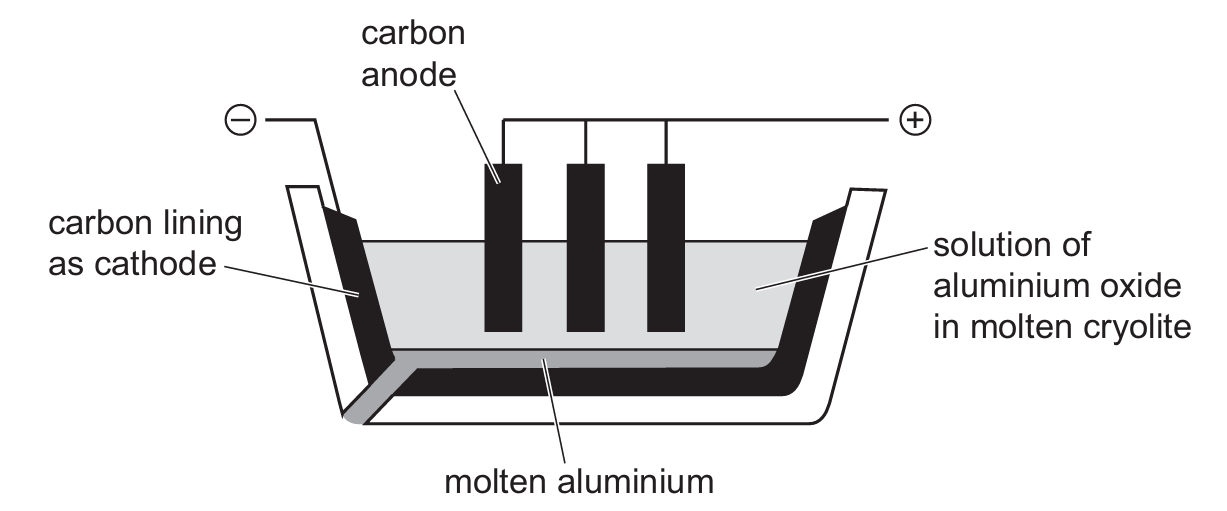
Which equation represents the reaction at the anode?

A. \( O + 2e^- \rightarrow O^{2-} \)
B. \( 2O^{2-} \rightarrow O_2 + 4e^- \)
C. \( Al^{3-} \rightarrow Al + 3e^- \)
D. \( Al^{3+} + 3e^- \rightarrow Al \)

Most-appropriate topic codes (Cambridge IGCSE Chemistry 0620):

Topic 9.6: Extraction of metals — Describe the extraction of aluminium from purified bauxite/aluminium oxide, including the reactions at the electrodes with ionic half-equations (Supplement)
▶️ Answer/Explanation
The anode is the positive electrode where oxidation occurs, meaning species lose electrons. In the electrolysis of molten aluminium oxide, the oxide ions (O²⁻) migrate to the anode and are oxidised, releasing electrons and forming oxygen gas: 2O²⁻ → O₂ + 4e⁻, which is option B. Option A is incorrect because it shows reduction (gain of electrons), which is the process that occurs at the cathode, not the anode. Option C is wrong because Al³⁻ is not a real ion — aluminium forms Al³⁺ cations, not anions. Option D correctly represents the cathode reaction where Al³⁺ ions are reduced to aluminium metal, but this is the cathode half-equation, not the anode.
Answer: (B)

Question 26

Which gas is both an element and present in clean, dry air?

A. argon
B. carbon dioxide
C. chlorine
D. water vapour

Most-appropriate topic codes (Cambridge IGCSE Chemistry 0620):

Topic 8.5: Noble gases — Describe the Group VIII noble gases as unreactive, monatomic gases and explain this in terms of electronic configuration (Core)
Topic 10.3: Air quality and climate — State the composition of clean, dry air as approximately 78% nitrogen, 21% oxygen, and the remainder as a mixture of noble gases and carbon dioxide (Core)
▶️ Answer/Explanation
Clean, dry air consists of approximately 78% nitrogen, 21% oxygen, and the remainder is a mixture of noble gases (including argon at about 0.93%) and carbon dioxide. Argon is a Group VIII noble gas and therefore an element — it consists of single argon atoms and is not chemically combined with any other element, satisfying both conditions in the question. Carbon dioxide (CO₂) and water vapour (H₂O) are compounds made of more than one element, so they cannot be classified as elements. Chlorine, while an element, is not a normal component of clean, dry air and would only be present as a pollutant.
Answer: (A)

Question 27

Oxides of nitrogen formed in a car’s engine are removed using a catalytic converter.

What happens to the oxides of nitrogen in the catalytic converter?

A. They are hydrated.
B. They are neutralised.
C. They are oxidised.
D. They are reduced.

Most-appropriate topic codes (Cambridge IGCSE Chemistry 0620):

Topic 10.3: Air quality and climate — Explain how oxides of nitrogen form in car engines and describe their removal by catalytic converters, e.g. 2CO + 2NO → 2CO₂ + N₂ (Supplement)
▶️ Answer/Explanation
In a catalytic converter, oxides of nitrogen (NOₓ) react with carbon monoxide in the presence of a platinum/rhodium catalyst: 2CO + 2NO → 2CO₂ + N₂. In this reaction, nitrogen in NO has an oxidation number of +2 and is converted to N₂ where the oxidation number is 0 — a decrease in oxidation number, which means the nitrogen is reduced (gains electrons). Option A (hydration) involves the addition of water, which does not occur here. Option B (neutralisation) is an acid-base reaction and is not applicable. Option C (oxidation) would increase the oxidation number of nitrogen, producing more harmful nitrogen oxides rather than removing them.
Answer: (D)

Question 28

What is the equation for photosynthesis?

A. \(6CO_2 + 6H_2O \rightarrow C_6H_{12}O_6 + 6O_2\)
B. \(2CO_2 + 2H_2O \rightarrow 2C_2H_5OH + 3O_2\)
C. \(C_6H_{12}O_6 \rightarrow 2CO_2 + 2C_2H_5OH\)
D. \(C_2H_5OH + 3O_2 \rightarrow 2CO_2 + 3H_2O\)

Most-appropriate topic codes (Cambridge IGCSE Chemistry 0620):

Topic 10.3: Air quality and climate — Describe photosynthesis as the reaction between carbon dioxide and water to produce glucose and oxygen in the presence of chlorophyll and using energy from light (Core); State the symbol equation for photosynthesis, 6CO₂ + 6H₂O → C₆H₁₂O₆ + 6O₂ (Supplement)
▶️ Answer/Explanation
Photosynthesis is the biological process by which green plants use energy from sunlight to convert carbon dioxide and water into glucose and oxygen, represented by the balanced equation 6CO₂ + 6H₂O → C₆H₁₂O₆ + 6O₂, making option A correct. Option B represents fermentation of glucose into ethanol and carbon dioxide. Option C shows anaerobic respiration, where glucose is broken down without oxygen to produce ethanol and carbon dioxide. Option D is the combustion of ethanol, an entirely different chemical reaction unrelated to photosynthesis.
Answer: (A)

Question 29

Four statements about members of the same homologous series are listed.

  1. They have the same volatility.
  2. They have the same molecular formula.
  3. They have the same functional group.
  4. They have the same general formula.

Which statements are correct?

A. 1 and 2
B. 1 and 4
C. 2 and 3
D. 3 and 4

Most-appropriate topic codes (Cambridge IGCSE Chemistry 0620):

Topic 11.1: Formulae, functional groups and terminology — State that a homologous series is a family of similar compounds with similar chemical properties due to the presence of the same functional group (Core); Describe the general characteristics of a homologous series as having the same functional group, the same general formula, differing by a –CH₂– unit, displaying a trend in physical properties, and sharing similar chemical properties (Supplement)
▶️ Answer/Explanation
A homologous series is defined as a family of compounds that share the same functional group (statement 3) and conform to the same general formula (statement 4), with each successive member differing by a –CH₂– unit. Statement 2 is incorrect because each member has a different molecular formula — for example, in the alkane series, methane is CH₄ and ethane is C₂H₆. Statement 1 is also incorrect because volatility decreases as chain length and molecular mass increase, so members of the same series display a trend in physical properties rather than identical ones.
Answer: (D)

Question 30

Ethene reacts with steam to produce ethanol.

Which row describes each compound?

 etheneethanol
Asaturatedsaturated
Bsaturatedunsaturated
Cunsaturatedsaturated
Dunsaturatedunsaturated

Most-appropriate topic codes (Cambridge IGCSE Chemistry 0620):

Topic 11.5: Alkenes — State that the bonding in alkenes includes a double carbon–carbon covalent bond and that alkenes are unsaturated hydrocarbons (Core); Describe the properties of alkenes in terms of addition reactions with steam in the presence of an acid catalyst (Supplement)
Topic 11.1: Formulae, functional groups and terminology — State that a saturated compound has molecules in which all carbon–carbon bonds are single bonds; State that an unsaturated compound has molecules in which one or more carbon–carbon bonds are not single bonds (Core)
▶️ Answer/Explanation
Ethene (C₂H₄) is an alkene and is classified as unsaturated because it contains a carbon–carbon double bond (C=C). When ethene undergoes an addition reaction with steam in the presence of an acid catalyst, the double bond breaks and a single bond forms with the –OH group, producing ethanol (C₂H₅OH). Ethanol contains only single carbon–carbon bonds and is therefore classified as saturated. Options A and B are incorrect because ethene cannot be saturated, and option D is incorrect because the addition of steam across the double bond converts the unsaturated ethene into a fully saturated product.
Answer: (C)

Question 31

Which process is used to make an alkene from a long-chain alkane?

A. combustion
B. condensation
C. cracking
D. polymerisation

Most-appropriate topic codes (Cambridge IGCSE Chemistry 0620):

Topic 11.5: Alkenes — Describe the manufacture of alkenes and hydrogen by the cracking of larger alkane molecules using a high temperature and a catalyst; Describe the reasons for the cracking of larger alkane molecules (Core)
▶️ Answer/Explanation
Cracking is the industrial process in which large, long-chain alkane molecules are broken down into smaller, more useful molecules including alkenes, by heating them to a high temperature in the presence of a catalyst. Combustion (A) is ruled out because it reacts hydrocarbons with oxygen to produce carbon dioxide and water, destroying the carbon chain entirely. Condensation (B) is the opposite process — it joins molecules together with the elimination of a small molecule such as water. Polymerisation (D) also joins small alkene monomers together to build large polymer chains, rather than breaking chains apart.
Answer: (C)

Question 32

Which fraction obtained from petroleum has the lowest boiling point?

A. diesel oil
B. fuel oil
C. kerosene
D. naphtha

Most-appropriate topic codes (Cambridge IGCSE Chemistry 0620):

Topic 11.3: Fuels — Describe the separation of petroleum into useful fractions by fractional distillation; Describe how the properties of fractions obtained from petroleum change from the bottom to the top of the fractionating column, limited to decreasing chain length, higher volatility, lower boiling points, and lower viscosity (Core)
▶️ Answer/Explanation
In the fractional distillation of petroleum, fractions are collected at different levels of the fractionating column based on their boiling points — fractions with shorter carbon chains and lower boiling points rise higher up the column before condensing. Among the four options, naphtha has the shortest carbon chain length and therefore the lowest boiling point, collected near the top of the column. Kerosene, diesel oil, and fuel oil all have progressively longer carbon chains and correspondingly higher boiling points, with fuel oil being the heaviest fraction among the options, collected near the bottom of the column.
Answer: (D)

Question 33

Alkanes undergo substitution reactions with chlorine in the presence of ultraviolet light.

Which equation shows a reaction of this type?

A. \( C_3H_6 + Cl_2 \rightarrow C_3H_6Cl_2 \)
B. \( C_3H_8 + Cl_2 \rightarrow C_3H_6Cl_2 + H_2 \)
C. \( C_3H_8 + Cl_2 \rightarrow C_3H_7Cl + HCl \)
D. \( C_3H_6 + Cl_2 \rightarrow C_3H_5Cl + HCl \)

Most-appropriate topic codes (Cambridge IGCSE Chemistry 0620):

Topic 11.4: Alkanes — Describe the properties of alkanes as being generally unreactive, except in terms of combustion and substitution by chlorine (Core); State that in a substitution reaction one atom or group of atoms is replaced by another atom or group of atoms; Describe the substitution reaction of alkanes with chlorine as a photochemical reaction, with ultraviolet light providing the activation energy, and draw the structural or displayed formulae of the products, limited to monosubstitution (Supplement)
▶️ Answer/Explanation
In a substitution reaction of an alkane with chlorine, one hydrogen atom is replaced by one chlorine atom, producing a chloroalkane and hydrogen chloride (HCl) as the byproduct. Option C correctly shows propane (C₃H₈, a true alkane with general formula CₙH₂ₙ₊₂) reacting with Cl₂ to give chloropropane (C₃H₇Cl) and HCl. Options A and D are eliminated immediately because C₃H₆ is an alkene, not an alkane, so it undergoes addition rather than substitution. Option B is incorrect because the products include H₂, which is not formed in chlorine substitution — HCl is always the hydrogen-containing byproduct.
Answer: (C)

Question 34

Information about two reactions of ethene is listed.

  • Reaction 1 requires a nickel catalyst.
  • Reaction 2 requires an acid catalyst.

Which substance reacts with ethene in each reaction?

 reaction 1reaction 2
Abrominesteam
Bbrominehydrogen
Chydrogenbromine
Dhydrogensteam

Most-appropriate topic codes (Cambridge IGCSE Chemistry 0620):

Topic 11.5: Alkenes — Describe the properties of alkenes in terms of addition reactions with hydrogen in the presence of a nickel catalyst, and with steam in the presence of an acid catalyst, and draw the structural or displayed formulae of the products (Supplement)
▶️ Answer/Explanation
Ethene undergoes addition reactions across its C=C double bond with different reagents under specific conditions. Reaction 1 uses a nickel catalyst, which is the hallmark of hydrogenation — the addition of hydrogen (H₂) to ethene to produce ethane. Reaction 2 uses an acid catalyst, which is characteristic of hydration — the addition of steam (H₂O) to ethene to produce ethanol, carried out at 300°C and 60 atm with a phosphoric acid catalyst. Bromine reacts with ethene readily at room temperature without any catalyst at all, so it cannot be associated with either reaction described, eliminating options A, B, and C.
Answer: (D)

Question 35

Which process converts \( CH_3CH_2OH \) to \( CH_3COOH \)?

A) bacterial oxidation
B) fermentation
C) catalytic addition of steam
D) catalytic addition of hydrogen

Most-appropriate topic codes (Cambridge IGCSE Chemistry 0620):

Topic 11.7: Carboxylic acids — Describe the formation of ethanoic acid by the oxidation of ethanol: (a) with acidified aqueous potassium manganate(VII) (b) by bacterial oxidation during vinegar production (Supplement)
▶️ Answer/Explanation
Converting \( CH_3CH_2OH \) (ethanol) to \( CH_3COOH \) (ethanoic acid) is an oxidation reaction.
Bacterial oxidation occurs when wine or cider is left exposed to air, allowing bacteria to oxidise the ethanol into ethanoic acid, which is how vinegar is produced.
Fermentation is incorrect because it converts glucose into ethanol and carbon dioxide, not ethanol into an acid.
Catalytic addition of steam is incorrect because that reaction hydrates an alkene such as ethene to form ethanol, not an acid.
Catalytic addition of hydrogen is incorrect because it is a reduction reaction, the opposite of the oxidation required here.
Answer: (A)

Question 36

The structure of an ester is shown.

Ester structure diagram

Which row identifies the name of the ester and the two compounds from which it is made?

 namecompound 1compound 2
Aethyl propanoateethanolpropanoic acid
Bethyl propanoatepropanolethanoic acid
Cpropyl ethanoateethanolpropanoic acid
Dpropyl ethanoatepropanolethanoic acid

Most-appropriate topic codes (Cambridge IGCSE Chemistry 0620):

Topic 11.7: Carboxylic acids — Describe the reaction of a carboxylic acid with an alcohol using an acid catalyst to form an ester (Supplement)
Topic 11.2: Naming organic compounds — Name and draw the displayed formulae of the unbranched esters which can be made from unbranched alcohols and carboxylic acids, each containing up to four carbon atoms (Supplement)
▶️ Answer/Explanation
Esters are named by combining the alkyl group from the alcohol (first part) with the acid-derived name ending in -anoate (second part). The structure shown contains a 2-carbon alkyl group on the oxygen side, originating from ethanol, and a 3-carbon acyl group on the carbonyl side, originating from propanoic acid — giving the name ethyl propanoate. Option B is incorrect because although the name is right, it wrongly assigns propanol and ethanoic acid as the parent compounds, which would produce propyl ethanoate instead. Options C and D both give the name propyl ethanoate, which would require propanol and ethanoic acid, not the 3-carbon acid group visible in the structure.
Answer: (A)

Question 37

Which statements about monomers or polymers are correct?

  1. Monomers are always joined together by addition reactions.
  2. A polymer can be formed from a single type of monomer.
  3. A polymer can be formed by joining two different types of monomer.
  4. Water is always produced when monomer molecules join together.

A. 1 and 2
B. 1 and 4
C. 2 and 3
D. 3 and 4

Most-appropriate topic codes (Cambridge IGCSE Chemistry 0620):

Topic 11.8: Polymers — Define polymers as large molecules built up from many smaller molecules called monomers; Describe the formation of poly(ethene) as an example of addition polymerisation using ethene monomers (Core); Describe the differences between addition and condensation polymerisation; Deduce the structure or repeat unit of a condensation polymer from given monomers, limited to polyamides from a dicarboxylic acid and a diamine, and polyesters from a dicarboxylic acid and a diol (Supplement)
▶️ Answer/Explanation
Statement 2 is correct because addition polymers such as poly(ethene) are formed entirely from one type of monomer — ethene — with no other product formed. Statement 3 is also correct because condensation polymers such as nylon are built from two different monomer types, a dicarboxylic acid and a diamine, joined alternately along the chain. Statement 1 is false because monomers can also join by condensation polymerisation, not exclusively by addition reactions. Statement 4 is false because water is only eliminated during condensation polymerisation; in addition polymerisation, no small molecule is produced at all.
Answer: (C)

Question 38

The diagram shows the structure of a naturally occurring polymer, Q.
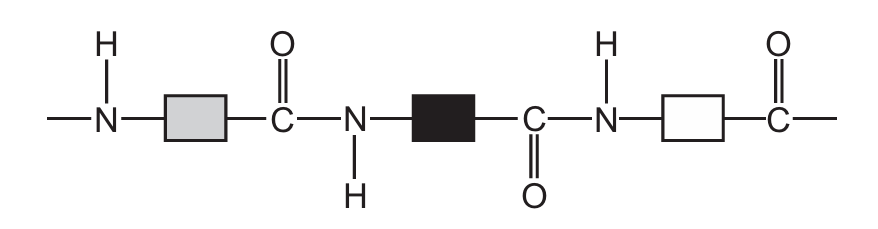
Naturally occurring polymer structure diagram

What is Q?

A. an amino acid
B. nylon
C. a protein
D. PET

Most-appropriate topic codes (Cambridge IGCSE Chemistry 0620):

Topic 11.8: Polymers — Describe proteins as natural polyamides and that they are formed from amino acid monomers; Describe and draw the structure of proteins showing the repeating peptide linkage –NH–CO– (Supplement)
▶️ Answer/Explanation
The structure shown displays repeating –NH–CO– (peptide/amide) linkages with varying side-chain groups (R groups), which is the characteristic backbone of a protein formed when amino acid monomers join together through condensation reactions. Option A is incorrect because an amino acid is the monomer unit, not the polymer itself. Option B (nylon) is ruled out because, although nylon also contains amide linkages, it is a synthetic polymer manufactured industrially — not naturally occurring. Option D (PET) is eliminated because it is a polyester containing –COO– ester linkages, not amide linkages, and is also synthetic.
Answer: (C)

Question 39

Which row shows how the boiling point and the melting point of water change when a soluble impurity is added to the water?

 boiling pointmelting point
Aincreasesincreases
Bdecreasesdecreases
Cincreasesdecreases
Ddecreasesincreases

Most-appropriate topic codes (Cambridge IGCSE Chemistry 0620):

Topic 12.4: Separation and purification — Identify substances and assess their purity using melting point and boiling point information (Core)
Topic 10.1: Water — Describe how to test for the purity of water using melting point and boiling point (Core)
▶️ Answer/Explanation
When a soluble impurity is dissolved in water, it affects both transition temperatures in opposite directions. The boiling point increases because the dissolved particles interfere with water molecules escaping to the gas phase, requiring a higher temperature to achieve boiling — a phenomenon known as boiling point elevation. The melting point decreases because the impurity particles disrupt the formation of the regular crystalline lattice structure of ice, meaning a lower temperature is needed before freezing can occur — known as freezing point depression. A practical example of both effects is the use of salt on icy roads, which lowers the melting point, and the slightly elevated boiling point of salted cooking water.
Answer: (C)

Question 40

X is a white powder. The following tests are done on X.

  • When a few drops of aqueous sodium hydroxide are added to a solution of X, no precipitate is seen.
  • When X is heated with aqueous sodium hydroxide, no gas is formed.
  • X gives a lilac colour when put into a flame.
  • When acidified aqueous silver nitrate is added to a solution of X, a yellow precipitate is seen.

What is X?

A. ammonium bromide
B. ammonium iodide
C. potassium bromide
D. potassium iodide

Most-appropriate topic codes (Cambridge IGCSE Chemistry 0620):

Topic 12.5: Identification of ions and gases — Describe tests to identify the anions chloride, bromide, and iodide by acidifying with dilute nitric acid then adding aqueous silver nitrate; Describe tests using aqueous sodium hydroxide to identify ammonium ions; Describe the use of a flame test to identify potassium (lilac flame) (Core)
▶️ Answer/Explanation
Each test eliminates options systematically: the lilac flame colour is the definitive test for potassium ions (K⁺), immediately ruling out both ammonium salts in options A and B. This is further confirmed by the second test — heating with aqueous sodium hydroxide produces no gas, whereas ammonium compounds would release ammonia gas. The yellow precipitate formed with acidified aqueous silver nitrate identifies iodide ions (I⁻) as the anion, since silver iodide (AgI) is yellow; silver bromide would give a cream precipitate, ruling out option C (potassium bromide). Together, the lilac flame and yellow precipitate conclusively identify X as potassium iodide.
Answer: (D)
Scroll to Top