Home / 0620_w24_qp_22

Question 1

Oxygen melts at –219°C and boils at –183°C.

At which temperature is oxygen a liquid?

A. –225°C
B. –189°C
C. –175°C
D. 25°C

Most-appropriate topic codes (Cambridge IGCSE Chemistry 0620):

Topic 1.1: Solids, liquids and gases — State the distinguishing properties of solids, liquids and gases; Describe changes of state in terms of melting, boiling, evaporating, freezing and condensing (Core)
▶️ Answer/Explanation
A substance exists as a liquid only when its temperature is above its melting point and below its boiling point. For oxygen, this liquid range lies between –219°C and –183°C. Option A (–225°C) is below the melting point, so oxygen would be a solid at that temperature. Option B (–189°C) falls within the liquid range, making it the correct answer. Options C (–175°C) and D (25°C) are both above the boiling point of –183°C, meaning oxygen would exist as a gas at those temperatures.
Answer: (B)

Question 2

The pressure of a sample of gas is decreased. The temperature is kept constant.

Which row describes the effects on the particles?

 movement of particlescollisions between particles
Asloweroccur less often
Bsloweroccur with more force
Cno change in speedoccur less often
Dno change in speedoccur with more force

Most-appropriate topic codes (Cambridge IGCSE Chemistry 0620):

Topic 1.1: Solids, liquids and gases — Describe the effects of temperature and pressure on the volume of a gas (Core); Explain, in terms of kinetic particle theory, the effects of temperature and pressure on the volume of a gas (Supplement)
▶️ Answer/Explanation
Since temperature is kept constant, the average kinetic energy of the gas particles remains unchanged, meaning their speed does not change — eliminating options A and B. When pressure decreases at constant temperature, the gas expands and occupies a larger volume, so the particles are more spread out and travel greater distances between collisions, causing collisions to occur less frequently. Option D is incorrect because the force of collisions depends on particle speed, which has not changed; only the frequency of collisions is reduced due to the increased separation between particles.
Answer: (C)

Question 3

Rubidium has two isotopes, \( _{37}^{85}\textrm{Rb}\) and \( _{37}^{87}\textrm{Rb}\).

Which statement explains why both isotopes have the same chemical properties?

A. They have the same number of protons.
B. They have the same electronic configuration.
C. They have different numbers of neutrons.
D. They have different mass numbers.

Most-appropriate topic codes (Cambridge IGCSE Chemistry 0620):

Topic 2.3: Isotopes — Define isotopes as different atoms of the same element that have the same number of protons but different numbers of neutrons (Core); State that isotopes of the same element have the same chemical properties because they have the same number of electrons and therefore the same electronic configuration (Supplement)
▶️ Answer/Explanation
Chemical properties are determined entirely by how electrons are arranged around the nucleus, since it is the electrons that participate in chemical bonding and reactions. Both isotopes of rubidium have 37 protons and therefore 37 electrons arranged in the same electronic configuration, which is why they behave identically in chemical reactions. Option A is true but does not directly explain chemical behaviour — it is the electrons, not the protons, that govern reactivity. Options C and D describe the differences between the isotopes (neutron number and mass number), which affect physical properties such as mass and density but have no influence on chemical properties whatsoever.
Answer: (B)

Question 4

Which pair of elements react to form a compound with a strong attraction between oppositely charged ions?

A. carbon and bromine
B. carbon and nitrogen
C. sodium and oxygen
D. sodium and potassium

Most-appropriate topic codes (Cambridge IGCSE Chemistry 0620):

Topic 2.4: Ions and ionic bonds — State that an ionic bond is a strong electrostatic attraction between oppositely charged ions; Describe the formation of ionic bonds between elements from Group I and Group VII, and between ions of metallic and non-metallic elements (Core/Supplement)
▶️ Answer/Explanation
Ionic bonds — characterised by a strong electrostatic attraction between oppositely charged ions — form when a metal transfers electrons to a non-metal. Sodium (Group I metal) readily loses one electron to form Na⁺, while oxygen (Group VI non-metal) gains two electrons to form O²⁻, producing the ionic compound sodium oxide (Na₂O) with strong ionic bonding. Options A and B are eliminated because carbon, bromine, and nitrogen are all non-metals that share electrons to form covalent bonds rather than transferring them. Option D is ruled out because sodium and potassium are both metals; metals do not form ionic compounds with each other as neither element readily accepts electrons.
Answer: (C)

Question 5

Four substances, P, Q, R and S, are described.

  • P is diatomic.
  • Q is a good conductor of electricity when solid and when molten.
  • R is a silver solid with a very high melting point.
  • S reacts with oxygen to form a brown gas.

Which substances are metals?

A. P and Q
B. P and S
C. Q and R
D. R and S

Most-appropriate topic codes (Cambridge IGCSE Chemistry 0620):

Topic 2.7: Metallic bonding — Describe metallic bonding as the electrostatic attraction between positive ions in a giant metallic lattice and a ‘sea’ of delocalised electrons; Explain in terms of structure and bonding the properties of metals including good electrical conductivity and malleability (Supplement)
Topic 9.1: Properties of metals — Compare the general physical properties of metals and non-metals including electrical conductivity and melting points (Core)
▶️ Answer/Explanation
Q conducts electricity in both the solid and molten states, which is a defining characteristic of metals — their delocalised electrons allow charge to flow regardless of state. R is a silver-coloured solid with a very high melting point, consistent with the strong metallic bonding and typical lustre of metals such as iron or tungsten. P is diatomic, a property associated with non-metallic elements such as nitrogen (N₂) or oxygen (O₂), not metals. S reacts with oxygen to produce a brown gas, which points to nitrogen reacting to form nitrogen dioxide (NO₂) — a non-metallic behaviour — rather than the oxide formation typical of metals.
Answer: (C)

Question 6

Which diagram shows the covalent bonding in a molecule of carbon dioxide?

A. O–C–O
B. O=C–O
C. O=C=O
D. O≡C≡O

Most-appropriate topic codes (Cambridge IGCSE Chemistry 0620):

Topic 2.5: Simple molecules and covalent bonds — State that a covalent bond is formed when a pair of electrons is shared between two atoms; Describe the formation of covalent bonds in simple molecules including CO₂, and use dot-and-cross diagrams to show the electronic configurations in these and similar molecules (Supplement)
▶️ Answer/Explanation
Carbon has 4 electrons in its outer shell and needs to share 4 more to achieve a full outer shell, while each oxygen atom has 6 outer electrons and needs to share 2 more. To satisfy both atoms, carbon forms two double bonds — one with each oxygen atom — by sharing two pairs of electrons with each, giving the symmetrical linear structure O=C=O. Option A is incorrect because single bonds would leave carbon and both oxygen atoms with incomplete outer shells. Option B is incorrect as it shows an asymmetrical arrangement with one double and one single bond. Option D is wrong because triple bonds in CO₂ would give carbon more electrons than its outer shell can hold.
Answer: (C)

Question 7

The bonding, structure and melting point of sodium chloride and sulfur dichloride are shown.

compoundbondingstructuremelting point / °C
sodium chlorideionicgiant lattice801
sulfur dichloridecovalentsimple molecular-121

Why does sulfur dichloride have a lower melting point than sodium chloride?

A. The covalent bonds in sulfur dichloride are weaker than the attractive forces between molecules in sodium chloride.
B. The covalent bonds in sulfur dichloride are weaker than the ionic bonds in sodium chloride.
C. The attractive forces between molecules in sulfur dichloride are weaker than the attractive forces between molecules in sodium chloride.
D. The attractive forces between molecules in sulfur dichloride are weaker than the ionic bonds in sodium chloride.

Most-appropriate topic codes (Cambridge IGCSE Chemistry 0620):

Topic 2.5: Simple molecules and covalent bonds — Explain in terms of structure and bonding the properties of simple molecular compounds: low melting points and boiling points in terms of weak intermolecular forces (Supplement)
Topic 2.4: Ions and ionic bonds — Explain in terms of structure and bonding the properties of ionic compounds: high melting points and boiling points (Supplement)
▶️ Answer/Explanation
When a simple molecular substance like sulfur dichloride melts, it is the weak intermolecular forces between SCl₂ molecules that are overcome — the covalent bonds within the molecules remain intact. In contrast, melting sodium chloride requires breaking the strong ionic bonds that hold the entire giant ionic lattice together, which demands far more energy. Options A and B are incorrect because it is not the covalent bonds themselves that are broken during melting of SCl₂. Option C is incorrect because sodium chloride does not have molecules or intermolecular forces — it has a giant ionic lattice — so comparing intermolecular forces between the two is the wrong comparison to make.
Answer: (D)

Question 8

Diamond and graphite have giant covalent structures of carbon atoms.

Which statement describes graphite?

A. It has a strong, rigid three-dimensional structure.
B. It has four strong covalent bonds between each carbon atom.
C. It has layers, which can slide over each other.
D. It has no delocalised electrons so does not conduct electricity.

Most-appropriate topic codes (Cambridge IGCSE Chemistry 0620):

Topic 2.6: Giant covalent structures — Describe the giant covalent structures of graphite and diamond; Relate the structures and bonding of graphite and diamond to their uses, limited to graphite as a lubricant and as an electrode, and diamond in cutting tools (Core)
▶️ Answer/Explanation
In graphite, each carbon atom forms three covalent bonds with neighbouring carbon atoms, creating flat hexagonal layers; the weak forces between these layers allow them to slide over one another, which is why graphite is soft and used as a lubricant and in pencils. Option A describes diamond, which has a strong, rigid three-dimensional tetrahedral network. Option B is also characteristic of diamond, where each carbon forms four covalent bonds. Option D is incorrect because graphite does possess delocalised electrons — the fourth electron from each carbon atom is free to move between layers — giving graphite its ability to conduct electricity, which is why it is used as an electrode.
Answer: (C)

Question 9

Which row explains the malleability and electrical conductivity of a solid metal?

 malleabilityelectrical conductivity
ADelocalised electrons can move freely through the structure.Delocalised electrons can move freely through the structure.
BDelocalised electrons can move freely through the structure.Positive ions can move freely through the structure.
CRows of positive ions can slide over each other.Delocalised electrons can move freely through the structure.
DRows of positive ions can slide over each other.Positive ions can move freely through the structure.

Most-appropriate topic codes (Cambridge IGCSE Chemistry 0620):

Topic 2.7: Metallic bonding — Describe metallic bonding as the electrostatic attraction between the positive ions in a giant metallic lattice and a ‘sea’ of delocalised electrons; Explain in terms of structure and bonding the properties of metals: good electrical conductivity, and malleability and ductility (Supplement)
▶️ Answer/Explanation
In a solid metal, the positive ions are arranged in regular layers held together by a sea of delocalised electrons; when a force is applied, these layers of positive ions can slide over one another without breaking the overall metallic bonding, which explains malleability. Electrical conductivity arises because the delocalised electrons are free to move through the entire metallic structure and carry charge when a potential difference is applied. Options B and D are incorrect because positive ions in a solid metal are fixed in the lattice and cannot move freely — it is only in the molten state or in solution that ions become mobile. Option A incorrectly attributes malleability to electron movement rather than the sliding of ionic layers.
Answer: (C)

Question 10

The equation for the decomposition of ammonium carbonate, \((\text{NH}_4)_2\text{CO}_3\), is shown.

\[(\text{NH}_4)_2\text{CO}_3(s) \rightarrow 2\text{NH}_3(g) + \text{CO}_2(g) + \text{H}_2\text{O}(l)\]

[\(M_r: (\text{NH}_4)_2\text{CO}_3 = 96\)]

The total volume of gas produced is 360 cm\(^3\) at r.t.p.

Which mass of ammonium carbonate, \((\text{NH}_4)_2\text{CO}_3\), is decomposed?

A. 0.24 g
B. 0.48 g
C. 0.96 g
D. 1.44 g

Most-appropriate topic codes (Cambridge IGCSE Chemistry 0620):

Topic 3.3: The mole and the Avogadro constant — Use the molar gas volume, taken as 24 dm³ at r.t.p., in calculations involving gases; Calculate stoichiometric reacting masses, limiting reactants, volumes of gases at r.t.p., and concentrations of solutions (Supplement)
▶️ Answer/Explanation
From the equation, 1 mole of (NH₄)₂CO₃ produces 3 moles of gas (2 mol NH₃ + 1 mol CO₂); water is liquid at r.t.p. and does not contribute to the gas volume. Converting the total gas volume: 360 cm³ = 0.360 dm³, so moles of gas = 0.360 ÷ 24 = 0.015 mol. Since 3 moles of gas are produced per mole of (NH₄)₂CO₃, moles of (NH₄)₂CO₃ decomposed = 0.015 ÷ 3 = 0.005 mol. Mass = moles × Mr = 0.005 × 96 = 0.48 g.
Answer: (B)

Question 11

What is the empirical formula of a compound that contains 3.66 g of hydrogen, 37.8 g of phosphorus and 58.5 g of oxygen?

A. H6P2O6
B. H4PO4
C. H3PO3
D. HPO

Most-appropriate topic codes (Cambridge IGCSE Chemistry 0620):

Topic 3.1: Formulae — Define the empirical formula of a compound as the simplest whole number ratio of the different atoms or ions in a compound (Supplement)
Topic 3.3: The mole and the Avogadro constant — Calculate empirical formulae and molecular formulae, given appropriate data (Supplement)
▶️ Answer/Explanation
To find the empirical formula, divide each mass by its relative atomic mass to obtain moles: H = 3.66 ÷ 1 = 3.66 mol; P = 37.8 ÷ 31 = 1.22 mol; O = 58.5 ÷ 16 = 3.66 mol. Dividing each by the smallest value (1.22) gives the ratio H : P : O = 3 : 1 : 3, so the empirical formula is H₃PO₃. Option A (H₆P₂O₆) is not in its simplest ratio as it simplifies to H₃PO₃. Option B (H₄PO₄) would require a different ratio of approximately 4 : 1 : 4, and option D (HPO) gives a ratio of 1 : 1 : 1, neither of which matches the calculated values.
Answer: (C)

Question 12

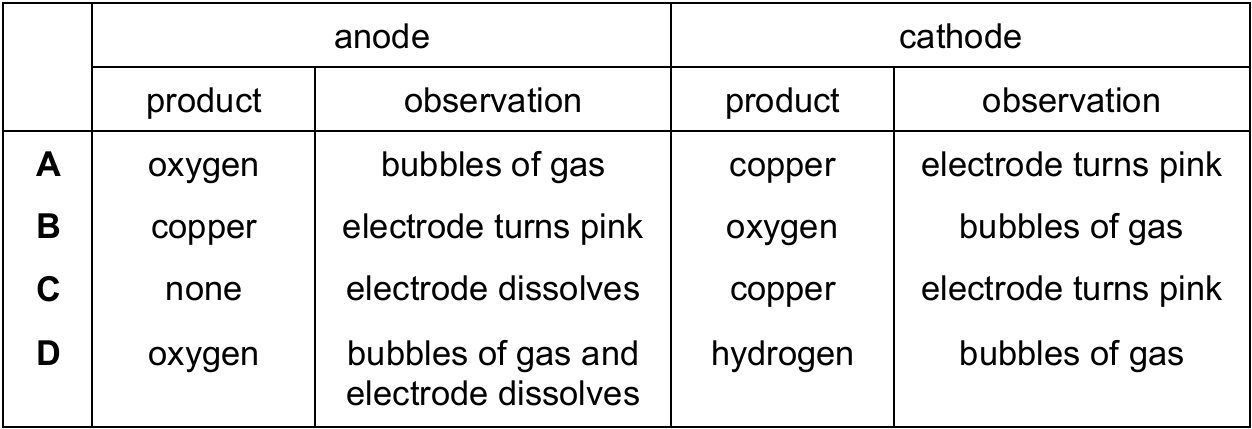
Aqueous copper(II) sulfate is electrolysed using graphite electrodes.

Which row identifies the product and observations at each electrode during the electrolysis?
Most-appropriate topic codes (Cambridge IGCSE Chemistry 0620):

Topic 4.1: Electrolysis — Identify the products formed at the electrodes and describe the observations made during the electrolysis of aqueous copper(II) sulfate using inert carbon/graphite electrodes (Supplement)
▶️ Answer/Explanation
During the electrolysis of aqueous copper(II) sulfate with inert graphite electrodes, copper(II) ions (Cu²⁺) are preferentially discharged at the cathode over hydrogen ions, causing a pink/brown copper deposit to form on the electrode surface via the half-equation Cu²⁺ + 2e⁻ → Cu. At the anode, hydroxide ions (OH⁻) from water are preferentially discharged over sulfate ions, releasing oxygen gas as colourless bubbles via 4OH⁻ → O₂ + 2H₂O + 4e⁻. Since graphite is an inert electrode material, it does not dissolve or react, so the anode simply produces gas rather than any solid deposit. This combination — copper deposited at the cathode and oxygen gas evolved at the anode — corresponds to option A.
Answer: (A)

Question 13

Molten sodium chloride is electrolysed using inert electrodes.

Which row shows the products formed at the cathode and anode?

 cathodeanode
Achlorinehydrogen
Bchlorinesodium
Chydrogenchlorine
Dsodiumchlorine

Most-appropriate topic codes (Cambridge IGCSE Chemistry 0620):

Topic 4.1: Electrolysis — Predict the identity of the products at each electrode for the electrolysis of a binary compound in the molten state (Core); Construct ionic half-equations for reactions at the anode (to show oxidation) and at the cathode (to show reduction) (Supplement)
▶️ Answer/Explanation
In molten sodium chloride, the only ions present are Na⁺ and Cl⁻, as there is no water to provide H⁺ or OH⁻ ions. At the cathode (negative electrode), Na⁺ ions are attracted and gain electrons to form sodium metal via Na⁺ + e⁻ → Na. At the anode (positive electrode), Cl⁻ ions are attracted and lose electrons to form chlorine gas via 2Cl⁻ → Cl₂ + 2e⁻. The key distinction from aqueous sodium chloride is that the absence of water eliminates any competition at the cathode, so sodium metal — not hydrogen — is always the cathode product in the molten state.
Answer: (D)

Question 14

The equation for the formation of ammonia is shown.

N2 + 3H2 → 2NH3

The reaction pathway diagram for the reaction is shown.

What is the enthalpy change for the reaction?

A. −592 kJ/mol
B. −92 kJ/mol
C. +92 kJ/mol
D. +592 kJ/mol

Most-appropriate topic codes (Cambridge IGCSE Chemistry 0620):

Topic 5.1: Exothermic and endothermic reactions — State that the transfer of thermal energy during a reaction is called the enthalpy change, ΔH; Draw and label reaction pathway diagrams for exothermic and endothermic reactions, including enthalpy change of the reaction ΔH and activation energy Ea (Supplement)
▶️ Answer/Explanation
The enthalpy change (ΔH) of a reaction is defined as the energy difference between the products and the reactants, and can be read from a reaction pathway diagram as the vertical gap between the reactant energy level and the product energy level. From the diagram, the activation energy (energy from reactants to the peak) is +250 kJ/mol, and the energy released from the peak down to the products is 342 kJ/mol, so ΔH = 250 − 342 = −92 kJ/mol. The negative sign confirms this is an exothermic reaction, meaning the products sit at a lower energy level than the reactants and thermal energy is released to the surroundings. Options A and D are numerically incorrect, and C gives the wrong sign, as the products are lower in energy than the reactants.
Answer: (B)

Question 15

Sulfur dioxide is converted to sulfur trioxide in the Contact process.

The conditions used are 450 °C and 200 kPa with a vanadium(V) oxide catalyst.

Which row describes and explains the effect of changing conditions on the rate of reaction?

 change in conditionseffect on rateexplanation
Ano catalystlowerthe activation energy is higher
Bhigher pressurehigherthe particles have more kinetic energy
Clower temperaturelowerthe particles collide more frequently
Dlower pressurehigherthere are more particles per unit volume

Most-appropriate topic codes (Cambridge IGCSE Chemistry 0620):

Topic 6.2: Rate of reaction — Describe and explain the effect on the rate of reaction of changing the pressure of gases, adding or removing a catalyst, and changing the temperature using collision theory; State that a catalyst decreases the activation energy Ea of a reaction (Supplement)
▶️ Answer/Explanation
A catalyst works by providing an alternative reaction pathway with a lower activation energy, meaning more colliding particles possess sufficient energy to react, thereby increasing the rate. Removing the catalyst therefore raises the activation energy back to its uncatalysed value, causing fewer collisions to be successful and lowering the rate — making option A both correct in its stated effect and its explanation. Option B is wrong because higher pressure increases the rate by increasing the frequency of collisions (more particles per unit volume), not by giving particles more kinetic energy. Option C states the correct effect of lower temperature but gives the wrong explanation — lower temperature reduces the kinetic energy of particles, leading to less frequent and less energetic collisions, not more frequent ones. Option D is entirely incorrect since lower pressure reduces the number of particles per unit volume, decreasing collision frequency and thus lowering the rate.
Answer: (A)

Question 16

Hydrogen gas reacts with iodine gas to form hydrogen iodide gas in an equilibrium reaction.

\[ H_2(g) + I_2(g) \rightleftharpoons 2HI(g) \quad \Delta H = +26.5 \, kJ/mol \]

Which changes increase the yield of HI at equilibrium?

  1. adding a catalyst
  2. adding more hydrogen gas
  3. increasing the pressure
  4. increasing the temperature

A. 1 and 3
B. 1 and 4
C. 2 and 3
D. 2 and 4

Most-appropriate topic codes (Cambridge IGCSE Chemistry 0620):

Topic 6.3: Reversible reactions and equilibrium — Predict and explain, for a reversible reaction, how the position of equilibrium is affected by changing temperature, changing pressure, changing concentration, and using a catalyst (Supplement)
▶️ Answer/Explanation
A catalyst only speeds up the rate at which equilibrium is reached but does not shift the position of equilibrium, so change 1 has no effect on the yield of HI. Adding more hydrogen gas (change 2) increases the concentration of a reactant, which shifts the equilibrium position to the right to oppose the change, producing more HI. Since there are equal numbers of moles of gas on both sides of the equation (2 mol on each side), changing pressure (change 3) has no effect on the position of equilibrium. Since the forward reaction is endothermic (ΔH = +26.5 kJ/mol), increasing the temperature (change 4) shifts the equilibrium to the right to absorb the extra energy, increasing the yield of HI. Only changes 2 and 4 therefore increase the yield of HI at equilibrium.
Answer: (D)

Question 17

The equation for the reaction of carbon with carbon dioxide is shown.

\[ C + CO_2 \rightarrow 2CO \]

Which row identifies the carbon atom that is reduced and its change in oxidation number?

 atom that is reducedchange in oxidation number
Acarbon in CO2+2 → +4
Bcarbon in CO2+4 → +2
Celemental carbon, C0 → +2
Delemental carbon, C+2 → 0

Most-appropriate topic codes (Cambridge IGCSE Chemistry 0620):

Topic 6.4: Redox — Define reduction in terms of a decrease in oxidation number; Identify redox reactions by changes in oxidation number using the rules for assigning oxidation numbers (Supplement)
▶️ Answer/Explanation
Oxidation numbers are assigned using the rule that oxygen always takes −2; in CO₂ the carbon must be +4 (since +4 + 2×(−2) = 0), and in CO the carbon must be +2 (since +2 + (−2) = 0), while elemental carbon C has an oxidation number of 0. Reduction is defined as a decrease in oxidation number, so the carbon in CO₂ is reduced as its oxidation number falls from +4 to +2 when it becomes CO. Simultaneously, elemental carbon is oxidised as its oxidation number rises from 0 to +2, also forming CO, making this a redox reaction where carbon acts as both the oxidising and reducing agent. Option A gives the wrong direction of change, and options C and D both incorrectly identify elemental carbon as the species being reduced.
Answer: (B)

Question 18

Aqueous iron(II) sulfate is added to acidified potassium manganate(VII). The purple colour of the potassium manganate(VII) disappears.

Aqueous potassium iodide is added to acidified potassium dichromate(VI). A dark brown solution forms.

Which row identifies the role of the iron(II) sulfate and the potassium dichromate(VI) in these reactions?

 iron(II) sulfatepotassium dichromate(VI)
Aoxidising agentoxidising agent
Boxidising agentreducing agent
Creducing agentreducing agent
Dreducing agentoxidising agent

Most-appropriate topic codes (Cambridge IGCSE Chemistry 0620):

Topic 6.4: Redox — Define an oxidising agent as a substance that oxidises another substance and is itself reduced; Define a reducing agent as a substance that reduces another substance and is itself oxidised; Identify redox reactions by the colour changes involved when using acidified aqueous potassium manganate(VII) or aqueous potassium iodide (Supplement)
▶️ Answer/Explanation
In the first reaction, the decolourisation of acidified potassium manganate(VII) from purple to colourless shows that MnO₄⁻ is being reduced; the Fe²⁺ ions from iron(II) sulfate are therefore being oxidised to Fe³⁺, confirming that iron(II) sulfate is acting as the reducing agent. In the second reaction, the dark brown colour that forms when potassium iodide is added to acidified potassium dichromate(VI) is due to iodine (I₂) being produced, meaning the iodide ions (I⁻) have been oxidised from −1 to 0; the dichromate(VI) ion is therefore being reduced and acting as the oxidising agent. A reducing agent is defined as a substance that reduces another and is itself oxidised, while an oxidising agent reduces another and is itself oxidised — confirming iron(II) sulfate as the reducing agent and potassium dichromate(VI) as the oxidising agent.
Answer: (D)

Question 19

Which row shows the difference between a weak acid and a strong acid?

 weak acidstrong acid
Afully dissociatedpartially dissociated
Bconcentrateddilute
Cdiluteconcentrated
Dpartially dissociatedfully dissociated

Most-appropriate topic codes (Cambridge IGCSE Chemistry 0620):

Topic 7.1: The characteristic properties of acids and bases — Define a strong acid as an acid that is completely dissociated in aqueous solution and a weak acid as an acid that is partially dissociated in aqueous solution; State that hydrochloric acid is a strong acid and ethanoic acid is a weak acid (Supplement)
▶️ Answer/Explanation
The distinction between strong and weak acids is entirely about the degree of dissociation in aqueous solution, not about concentration, which is a common but critical misconception. A strong acid such as hydrochloric acid dissociates completely in water (HCl → H⁺ + Cl⁻), producing the maximum possible number of H⁺ ions, whereas a weak acid such as ethanoic acid only partially dissociates, establishing a reversible equilibrium (CH₃COOH ⇌ H⁺ + CH₃COO⁻) with most molecules remaining undissociated. Options B and C incorrectly equate acid strength with concentration — a weak acid can be concentrated and a strong acid can be dilute. Option A reverses the correct definitions, making D the only row that accurately describes both terms.
Answer: (D)

Question 20

Which substance turns methyl orange red?

A. aqueous ammonia
B. dilute hydrochloric acid
C. aqueous sodium hydroxide
D. distilled water

Most-appropriate topic codes (Cambridge IGCSE Chemistry 0620):

Topic 7.1: The characteristic properties of acids and bases — Describe acids in terms of their effect on methyl orange; Describe alkalis in terms of their effect on methyl orange (Core)
▶️ Answer/Explanation
Methyl orange is a pH indicator with a colour range from red in acidic conditions to yellow in alkaline conditions, with the colour change occurring between approximately pH 3.1 and 4.4. Dilute hydrochloric acid is a strong acid that completely dissociates to produce a high concentration of H⁺ ions, giving a pH well below 3, which turns methyl orange red. Aqueous ammonia and aqueous sodium hydroxide are both alkaline substances with a pH above 7, so they would turn methyl orange yellow. Distilled water is neutral at pH 7 and would leave methyl orange in its intermediate orange colour, not red. Only dilute hydrochloric acid provides sufficiently acidic conditions to produce the red colour.
Answer: (B)

Question 21

Which row describes zinc oxide and calcium oxide?

 zinc oxidecalcium oxide
Abasicacidic
Bacidicbasic
Camphotericacidic
Damphotericbasic

Most-appropriate topic codes (Cambridge IGCSE Chemistry 0620):

Topic 7.2: Oxides — Classify oxides as acidic or basic, related to metallic and non-metallic character; Describe amphoteric oxides as oxides that react with both acids and bases to produce a salt and water; Classify Al2O3 and ZnO as amphoteric oxides (Supplement)
▶️ Answer/Explanation
Zinc oxide (ZnO) is classified as an amphoteric oxide because it can react with both acids and bases to produce a salt and water — for example, it reacts with hydrochloric acid to form zinc chloride, and with sodium hydroxide to form sodium zincate. Calcium oxide (CaO) is a basic oxide, as it is the oxide of a metal (calcium) with strongly metallic character, and it reacts with acids to form a salt and water but does not react with bases. Options A and B are incorrect because zinc oxide is neither purely basic nor acidic, and option C incorrectly classifies calcium oxide as acidic when it is in fact basic. Only option D correctly pairs the amphoteric nature of ZnO with the basic nature of CaO.
Answer: (D)

Question 22

Which row shows the properties of a transition element?

 catalystcolour of oxideelectrical conductivity
Ayesredgood
Byesgreenpoor
Cnoyellowgood
Dnowhitepoor

Most-appropriate topic codes (Cambridge IGCSE Chemistry 0620):

Topic 8.4: Transition elements — Describe the transition elements as metals that have high densities, high melting points, form coloured compounds, and often act as catalysts as elements and in compounds (Core)
▶️ Answer/Explanation
Transition elements have three key characteristic properties that distinguish them from other metals: they frequently act as catalysts (for example, iron in the Haber process and vanadium(V) oxide in the Contact process), they form coloured compounds and oxides (such as red iron(III) oxide and green chromium(III) oxide), and they are good electrical conductors due to their metallic bonding with a sea of delocalised electrons. Option A satisfies all three criteria — the element acts as a catalyst, its oxide is coloured (red), and it has good electrical conductivity. Options B is eliminated because transition metals are good conductors, not poor ones; options C and D are eliminated because transition elements do act as catalysts, ruling out any row where “catalyst” is marked as no.
Answer: (A)

Question 23

Fluorine is the element at the top of Group VII of the Periodic Table.

Which statement describes fluorine?

A. It is inert.
B. It is monatomic.
C. It is non-metallic.
D. It is a solid at room temperature.

Most-appropriate topic codes (Cambridge IGCSE Chemistry 0620):

Topic 8.3: Group VII properties — Describe the Group VII halogens, chlorine, bromine and iodine, as diatomic non-metals with general trends down the group; State the appearance of the halogens at r.t.p.; Predict the properties of other elements in Group VII, given information about the elements (Core)
▶️ Answer/Explanation
All Group VII halogens are non-metallic elements, and this is a universal property of the group regardless of position — fluorine, being at the very top, is no exception and is correctly described as non-metallic. Option A is incorrect because fluorine is far from inert; it is in fact the most reactive of all the halogens, as reactivity decreases going down Group VII. Option B is incorrect because halogens exist as diatomic molecules (F₂), not as monatomic species — it is the noble gases in Group VIII that are monatomic. Option D is incorrect because fluorine is a pale yellow gas at room temperature, and the trend in Group VII shows that only iodine, further down the group, is a solid at r.t.p.
Answer: (C)

Question 24

When aluminium is placed in dilute hydrochloric acid, there is no reaction.

When zinc is placed in dilute hydrochloric acid, bubbles of gas are immediately given off.

Which statement correctly explains these observations?

A. Aluminium is coated with a layer of aluminium oxide.
B. Aluminium is more reactive than hydrogen.
C. Aluminium is less reactive than zinc.
D. Zinc is less reactive than hydrogen.

Most-appropriate topic codes (Cambridge IGCSE Chemistry 0620):

Topic 9.4: Reactivity series — Explain the apparent unreactivity of aluminium in terms of its oxide layer; Describe the reactions of magnesium, zinc, iron, copper, silver and gold with dilute hydrochloric acid and explain these reactions in terms of the position of the metals in the reactivity series (Supplement)
▶️ Answer/Explanation
Although aluminium sits above zinc in the reactivity series and is therefore intrinsically more reactive, it appears unreactive in dilute hydrochloric acid because its surface is coated with a thin but tough layer of aluminium oxide (Al₂O₃) that forms spontaneously when aluminium is exposed to air. This oxide layer acts as a protective barrier, preventing the acid from making contact with the aluminium metal beneath and stopping any visible reaction from occurring. Zinc, by contrast, does not form such a protective oxide layer under normal conditions, so the acid can immediately attack the zinc surface, displacing hydrogen gas and producing the observed bubbles. Option B is true but does not explain the lack of reaction, option C is factually incorrect as aluminium is above zinc in the reactivity series, and option D is also incorrect since zinc is more reactive than hydrogen and readily displaces it from acids.
Answer: (A)

Question 25

Which statements about the use of sacrificial protection to prevent iron from rusting are correct?

  1. A more reactive metal than iron is used as a sacrificial protector because it undergoes reduction before iron.
  2. Zinc is used as a sacrificial protector because it gains electrons more readily than iron.
  3. Copper is not used as a sacrificial protector because it is less reactive than iron.
  4. Magnesium is used as a sacrificial protector because it loses electrons more readily than iron.

A. 1 and 2
B. 1 and 4
C. 2 and 3
D. 3 and 4

Most-appropriate topic codes (Cambridge IGCSE Chemistry 0620):

Topic 9.5: Corrosion of metals — Describe the use of zinc in galvanising as an example of a barrier method and sacrificial protection; Explain sacrificial protection in terms of the reactivity series and in terms of electron loss (Supplement)
▶️ Answer/Explanation
Sacrificial protection works by attaching a more reactive metal to iron so that the more reactive metal preferentially loses electrons (is oxidised) in place of the iron, thereby protecting it from rusting. Statement 1 is incorrect because the sacrificial metal undergoes oxidation — not reduction — as it loses electrons more readily than iron. Statement 2 is incorrect because zinc acts as a sacrificial protector precisely because it loses electrons more readily than iron (not gains them), as it sits higher in the reactivity series. Statement 3 is correct because copper sits below iron in the reactivity series, meaning it is less reactive and loses electrons less readily than iron, so it would offer no sacrificial protection. Statement 4 is correct because magnesium is above iron in the reactivity series and loses electrons more readily, making it corrode preferentially and protect the iron from oxidation.
Answer: (D)

Question 26

Aluminium is extracted from its ore by electrolysis.

What is the role of cryolite in this process?

A. to lower the operating temperature
B. to lower the boiling point of bauxite
C. to raise the melting point of bauxite
D. to act as a catalyst

Most-appropriate topic codes (Cambridge IGCSE Chemistry 0620):

Topic 9.6: Extraction of metals — Describe the extraction of aluminium from purified bauxite/aluminium oxide, including the role of cryolite and the reactions at the electrodes (Supplement)
▶️ Answer/Explanation
Pure aluminium oxide (Al₂O₃) has an extremely high melting point of approximately 2072°C, which would make electrolysis prohibitively expensive and energy-intensive if the ore had to be heated to that temperature. Cryolite (Na₃AlF₆) is added to dissolve the aluminium oxide, forming a molten mixture that melts at around 950°C, dramatically lowering the operating temperature of the electrolytic cell and making the process economically viable. Option B is incorrect because cryolite affects the melting point, not the boiling point, and the relevant process is melting not boiling. Option C is entirely the opposite of what cryolite does — it lowers, not raises, the melting point. Option D is incorrect because cryolite is not a catalyst; it is consumed as a solvent and does not speed up the reaction by providing an alternative pathway.
Answer: (A)

Question 27

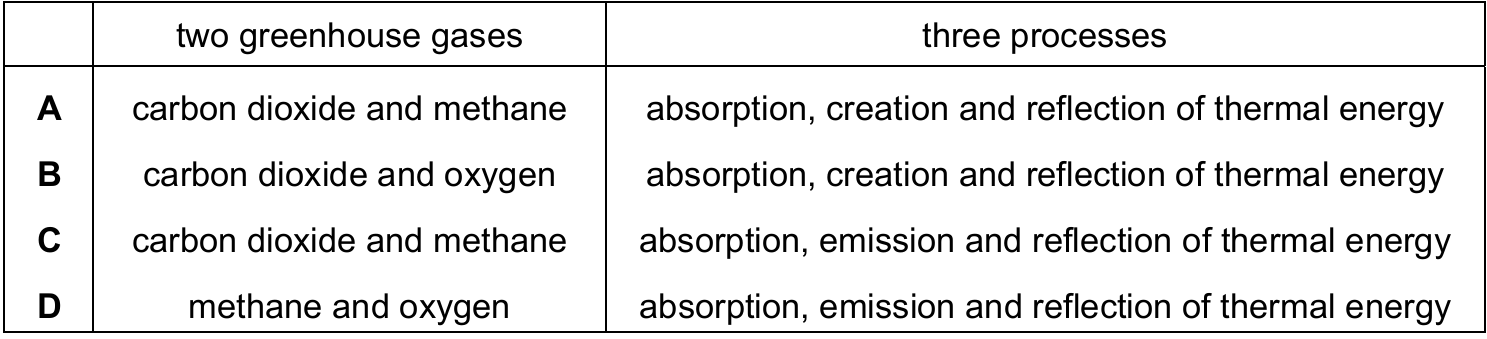
Which row identifies two greenhouse gases and three processes by which they contribute to global warming?
Most-appropriate topic codes (Cambridge IGCSE Chemistry 0620):

Topic 10.3: Air quality and climate — Describe how the greenhouse gases carbon dioxide and methane cause global warming, limited to the absorption, reflection and emission of thermal energy, and reducing thermal energy loss to space (Supplement)
▶️ Answer/Explanation
The two recognised greenhouse gases responsible for global warming are carbon dioxide (CO₂) and methane (CH₄); oxygen (O₂) is not a greenhouse gas as it does not absorb infrared radiation in the same way. Greenhouse gases contribute to global warming through three specific processes: absorption of thermal (infrared) energy radiated by the Earth’s surface, reflection of some of this thermal energy back toward the Earth, and emission of thermal energy in all directions including back downward, thereby reducing the amount of energy lost to space. The term “creation” of thermal energy, which may appear in incorrect options, is scientifically inaccurate — greenhouse gases do not create energy but simply trap and redirect it. Only option C correctly identifies both CO₂ and CH₄ as the greenhouse gases and lists absorption, reflection, and emission as the three processes.
Answer: (C)

Question 28

Which mixture contains all of the elements in a typical NPK fertiliser?

A. ammonium nitrate and calcium phosphate
B. ammonium phosphate and potassium chloride
C. potassium nitrate and ammonium chloride
D. potassium carbonate and ammonium nitrate

Most-appropriate topic codes (Cambridge IGCSE Chemistry 0620):

Topic 10.2: Fertilisers — Describe the use of NPK fertilisers to provide the elements nitrogen, phosphorus and potassium for improved plant growth (Core)
▶️ Answer/Explanation
An NPK fertiliser must supply all three essential elements for plant growth: nitrogen (N), phosphorus (P), and potassium (K). Option B contains ammonium phosphate, which provides both nitrogen (from the ammonium, NH₄⁺, ion) and phosphorus (from the phosphate, PO₄³⁻, ion), and potassium chloride, which supplies potassium — together covering all three required elements. Option A contains ammonium nitrate (N) and calcium phosphate (P) but has no potassium source, so it is not a complete NPK fertiliser. Option C contains potassium nitrate (K and N) and ammonium chloride (N) but no phosphorus source. Option D contains potassium carbonate (K) and ammonium nitrate (N) but again lacks any phosphorus-containing compound. Only option B provides all three elements N, P, and K.
Answer: (B)

Question 29

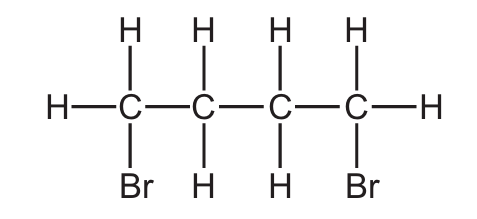
Bromine reacts with but-2-ene.

What is the displayed formula of the product of this reaction?

A.  

B.  

C.  

D.  
Most-appropriate topic codes (Cambridge IGCSE Chemistry 0620):

Topic 11.5: Alkenes — Describe the properties of alkenes in terms of addition reactions with bromine or aqueous bromine, and draw the structural or displayed formulae of the products (Supplement)
▶️ Answer/Explanation
But-2-ene (CH₃CH=CHCH₃) undergoes an addition reaction with bromine (Br₂), where the double bond between C2 and C3 breaks and one bromine atom adds to each of those two carbon atoms. This produces 2,3-dibromobutane, in which the two CH₃ groups remain on C1 and C4, while each of C2 and C3 now carries one bromine atom and one hydrogen atom. The correct displayed formula must therefore show four carbon atoms in a chain, with Br on C2 and C3 and no remaining double bond. Options A and B are incorrect because they show bromine atoms added to the wrong positions or the wrong number of atoms, and option D is incorrect as it represents a substitution product rather than an addition product.
Answer: (C)

Question 30

Which statement is correct?

A. Bitumen is used as a fuel for ships.
B. Coal, natural gas and oxygen are all fuels.
C. Hydrogen is the main constituent of natural gas.
D. Petroleum is separated into useful substances by fractional distillation.

Most-appropriate topic codes (Cambridge IGCSE Chemistry 0620):

Topic 11.3: Fuels — State that petroleum is a mixture of hydrocarbons; Describe the separation of petroleum into useful fractions by fractional distillation; Name the uses of the fractions (Core)
▶️ Answer/Explanation
Petroleum (crude oil) is a complex mixture of hydrocarbons that cannot be used directly; it must first be separated into useful fractions such as gasoline, kerosene, diesel, and fuel oil through fractional distillation, which exploits the differing boiling points of the components. Option A is incorrect because bitumen, the heaviest fraction collected at the base of the fractionating column, is used for road surfacing — it is fuel oil that powers ships. Option B is incorrect because oxygen is an oxidiser that supports combustion rather than a fuel itself, so only coal and natural gas qualify as fuels. Option C is incorrect because methane (CH₄), not hydrogen, is the main constituent of natural gas.
Answer: (D)

Question 31

Which statement explains why ethanoic acid is saturated?

A. The molecule dissociates completely in water.
B. There is a carbon-oxygen double bond in the molecule.
C. The carbon-carbon bond in the molecule is a single bond.
D. All the carbon-hydrogen bonds in the molecule are single bonds.

Most-appropriate topic codes (Cambridge IGCSE Chemistry 0620):

Topic 11.4: Alkanes — State that the bonding in alkanes is single covalent and that alkanes are saturated hydrocarbons (Core)
Topic 11.1: Formulae, functional groups and terminology — State that a saturated compound has molecules in which all carbon–carbon bonds are single bonds (Core)
▶️ Answer/Explanation
A saturated compound is defined as one in which all carbon–carbon bonds are single bonds, with no carbon–carbon double or triple bonds present anywhere in the molecule. Ethanoic acid (CH₃COOH) contains two carbon atoms joined by a single C–C bond, which satisfies the definition of saturation. Option A is incorrect because the extent of dissociation in water is a measure of acid strength, not saturation. Option B is incorrect because the C=O double bond in the carboxyl group is a carbon–oxygen bond, not a carbon–carbon bond, and saturation is defined solely in terms of carbon–carbon bonding. Option D is incorrect because saturation makes no reference to carbon–hydrogen bonds — those are single bonds in virtually all organic compounds regardless of saturation.
Answer: (C)

Question 32

Which statement about compounds in the same homologous series is correct?

A. They have the same chemical properties because they have the same number of carbon atoms.
B. They have the same physical properties because they have the same number of carbon atoms.
C. They have different chemical properties because they have different numbers of carbon atoms.
D. They have different physical properties because they have different numbers of carbon atoms.

Most-appropriate topic codes (Cambridge IGCSE Chemistry 0620):

Topic 11.1: Formulae, functional groups and terminology — State that a homologous series is a family of similar compounds with similar chemical properties due to the presence of the same functional group (Core); Describe the general characteristics of a homologous series as displaying a trend in physical properties and sharing similar chemical properties (Supplement)
▶️ Answer/Explanation
Compounds in a homologous series possess the same functional group, which ensures they share similar chemical properties regardless of their chain length. However, as the number of carbon atoms increases from one member to the next, the molecular size increases, causing a systematic change or trend in physical properties such as boiling points and viscosity. Therefore, different numbers of carbon atoms lead to different physical properties while maintaining similar chemical characteristics. Options A and B are structurally flawed because members within a series explicitly have different numbers of carbon atoms, and Option C is incorrect because their chemical properties remain similar, not different.
Answer: (D)

Question 33

Which row shows the properties of methane?

 soluble in waterstate at room temperaturegives a positive test with aqueous bromine
Anogasno
Bnogasyes
Cyesliquidno
Dyesliquidyes

Most-appropriate topic codes (Cambridge IGCSE Chemistry 0620):

Topic 11.4: Alkanes — State that the bonding in alkanes is single covalent and that alkanes are saturated hydrocarbons; Describe the properties of alkanes as being generally unreactive, except in terms of combustion and substitution by chlorine
Topic 11.5: Alkenes — Describe the test to distinguish between saturated and unsaturated hydrocarbons by their reaction with aqueous bromine
▶️ Answer/Explanation
Methane is a small, non-polar covalent molecule, making it insoluble in polar solvents like water and ensuring it exists as a gas at room temperature. Because it is an alkane, it is a saturated hydrocarbon that contains only single bonds and remains generally unreactive. Consequently, methane will not decolorize or yield a positive test with aqueous bromine, as that reaction requires an unsaturated carbon-carbon double bond. This rules out rows B, C, and D, leaving row A as the correct combination of properties.
Answer: (A)

Question 34

The table shows two methods used to make ethanol.
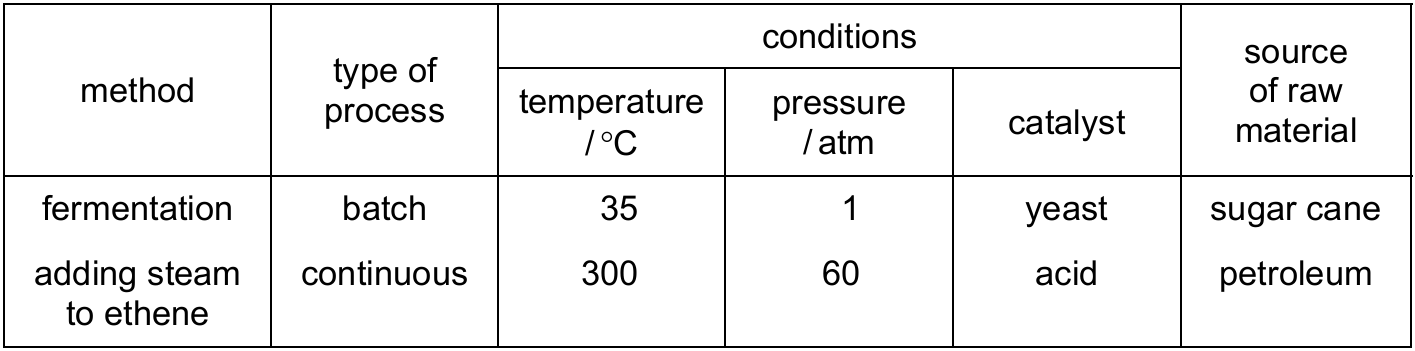
Comparison table of ethanol production methods

Which statement gives an advantage of preparing ethanol by fermentation rather than by adding steam to ethene?

A. Fermentation takes several days to complete.
B. Little energy is used in the fermentation process.
C. The fermentation of glucose from sugar cane produces pure ethanol.
D. Fermentation uses a non-renewable raw material.

Most-appropriate topic codes (Cambridge IGCSE Chemistry 0620):

Topic 11.6: Alcohols — Describe the manufacture of ethanol by fermentation and by catalytic addition of steam to ethene; Describe the advantages and disadvantages of the manufacture of ethanol by fermentation and catalytic addition of steam to ethene
▶️ Answer/Explanation
Fermentation runs at a low ambient temperature range of 25–35°C under normal atmospheric pressure, requiring significantly less energy than the direct hydration of ethene, which demands 300°C and 60 atm. While options A and D describe disadvantages (fermentation is slow and uses renewable resources, not non-renewable), option C is factually incorrect because fermentation produces an impure aqueous mixture that requires fractional distillation to obtain pure ethanol. Thus, the minimal energy consumption makes option B a distinct operational advantage.
Answer: (B)

Question 35

Which equation represents an addition reaction?

A. CH3CHO + HCN → CH3CH(OH)CN
B. C6H6 + Br2 → C6H5Br + HBr
C. NH4Br → NH3 + HBr
D. C14H30 → C2H4 + C8H18 + C4H8

Most-appropriate topic codes (Cambridge IGCSE Chemistry 0620):

Topic 11.5: Alkenes — State that in an addition reaction only one product is formed (Supplement)
Topic 11.4: Alkanes — State that in a substitution reaction one atom or group of atoms is replaced by another atom or group of atoms (Supplement)
▶️ Answer/Explanation
An addition reaction is characterized by two or more reactant molecules combining directly to form a single, unique product containing all of the starting atoms. Equation A satisfies this criterion perfectly, as ethanal and hydrogen cyanide bond together into a single product molecule with no side products. In contrast, equation B represents a substitution reaction yielding a primary product and a small molecule byproduct, equation C outlines a thermal decomposition, and equation D displays catalytic cracking.
Answer: (A)

Question 36

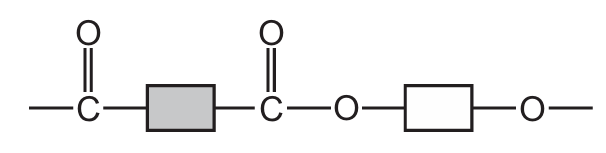
The structure of part of a polymer is shown.
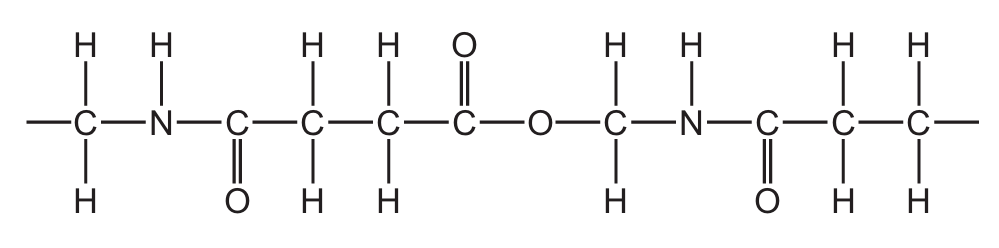
Polymer section showing functional links

How many amide and ester linkages are included in the structure shown?

 amide linkagesester linkages
A10
B11
C21
D22

Most-appropriate topic codes (Cambridge IGCSE Chemistry 0620):

Topic 11.8: Polymers — Identify the repeat units and/or linkages in addition polymers and in condensation polymers; Describe and draw the structure of nylon (a polyamide) and PET (a polyester)
▶️ Answer/Explanation
To find the total number of linkages, we inspect the molecular segment from left to right to locate the distinct carbonyl-based linkages. An amide linkage consists of a covalent bond between a carbonyl carbon and a nitrogen atom (–CONH–), which appears exactly twice in this structural diagram. An ester linkage consists of a bond between a carbonyl carbon and an oxygen atom (–COO–), which occurs exactly once near the center of the chain. This gives a total of 2 amide linkages and 1 ester linkage, confirming row C as the correct option.
Answer: (C)

Question 37

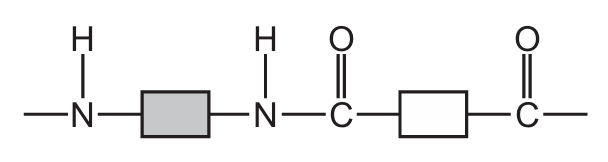
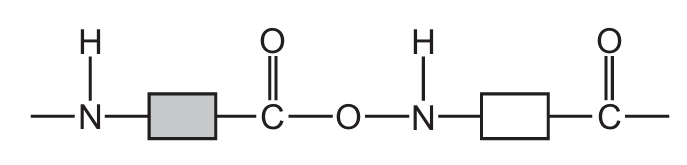
Which structure represents part of a protein?

A.
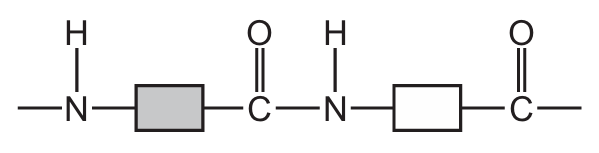
Polymer structure option A

B.
Polymer structure option B

C.
Polymer structure option C

D.
Polymer structure option D

Most-appropriate topic codes (Cambridge IGCSE Chemistry 0620):

Topic 11.8: Polymers — Describe proteins as natural polyamides and that they are formed from amino acid monomers with the general structure; Deduce the structure or repeat unit of a condensation polymer from given monomers and vice versa
▶️ Answer/Explanation
Proteins are natural condensation polymers classificationally called polyamides, which are built from amino acid monomers. The signature backbone of a protein features alternating amide links (–CONH–) where every single central carbon atom alternates its orientation, bearing side chains or showing distinct single amine and carbonyl pairings across consecutive links. Option A accurately portrays this polyamidic arrangement with correct structural link direction and side-group distribution. Meanwhile, option B represents a synthetic polyester with ester linkages (–COO–), and options C and D demonstrate inaccurate structural connectivity for natural protein backbones.
Answer: (A)

Question 38

Which piece of apparatus can only measure a single fixed volume?

A. a 250 cm3 beaker
B. a 50 cm3 burette
C. a 100 cm3 measuring cylinder
D. a 25 cm3 volumetric pipette

Most-appropriate topic codes (Cambridge IGCSE Chemistry 0620):

Topic 12.1: Experimental design — Name appropriate apparatus for the measurement of time, temperature, mass and volume, including: burettes, volumetric pipettes, measuring cylinders
▶️ Answer/Explanation
A volumetric pipette is specifically calibrated and designed with a single graduation mark to accurately measure and transfer one exact, fixed volume of liquid. Conversely, burettes and measuring cylinders feature variable graduations along their length, allowing them to measure a range of continuous volumes. Beakers are used primarily for holding or mixing liquids rather than precise measurements, as their markings provide only broad approximations. Therefore, only the volumetric pipette is restricted to measuring a single predetermined volume.
Answer: (D)

Question 39

Pure solid copper(II) nitrate can be obtained from a mixture of copper(II) nitrate and copper powder.

Three stages in the method are listed.

X – add water and stir
Y – crystallise
Z – filter

After the three stages, the copper(II) nitrate is washed and dried.

What is the correct order of stages X, Y and Z to obtain pure solid copper(II) nitrate from the mixture?

A. X → Y → Z
B. X → Z → Y
C. Y → X → Z
D. Z → X → Y

Most-appropriate topic codes (Cambridge IGCSE Chemistry 0620):

Topic 12.4: Separation and purification — Describe and explain methods of separation and purification using: a suitable solvent, filtration, crystallisation; Suggest suitable separation and purification techniques, given information about the substances involved
▶️ Answer/Explanation
According to the general solubility rules, all nitrates are soluble in water, meaning copper(II) nitrate dissolves completely during stage X, while uncombined transition metal powder remains insoluble. Filtering the mixture next in stage Z cleanly traps the insoluble copper metal residue on the filter paper while letting the aqueous copper(II) nitrate pass through as the filtrate. Finally, stage Y allows the pure salt crystals to be recovered by heating and cooling the isolated filtrate. This establishes X → Z → Y as the only logically sound purification pathway.
Answer: (B)

Question 40

Which row describes a test and the observation for aqueous sulfate ions?

 testobservation
Aadd dilute nitric acida gas is produced which turns limewater cloudy
Badd dilute nitric acid and aqueous barium nitratewhite precipitate forms
Cadd dilute nitric acid and aqueous potassium manganate(VII)solution decolourises
Dadd dilute nitric acid and aqueous silver nitratewhite precipitate forms

Most-appropriate topic codes (Cambridge IGCSE Chemistry 0620):

Topic 12.5: Identification of ions and gases — Describe tests to identify the anions: carbonate, chloride, bromide, iodide, nitrate, sulfate, sulfite
▶️ Answer/Explanation
The standard analytical test to identify aqueous sulfate ions (SO42-) requires acidifying the test sample with dilute nitric acid followed by the addition of aqueous barium nitrate. The nitric acid prevents false-positive interpretations from carbonate or sulfite ions, while the barium ions (Ba2+) react directly with the target sulfate ions to form an insoluble, dense white precipitate of barium sulfate (BaSO4). Row A represents a characteristic test for carbonates, row C describes a redox validation for reducing agents like sulfites, and row D shows the halide precipitation pathway.
Answer: (B)
Scroll to Top