Home / 0620_w24_qp_23

Question 1

A sample of ethanol is left in an open beaker at room temperature.

After 24 hours, no ethanol remains in the beaker.

What has happened to the ethanol?

A. It has boiled.
B. It has condensed.
C. It has evaporated.
D. It has frozen.

Most-appropriate topic codes (Cambridge IGCSE Chemistry 0620):

Topic 1.1: Solids, liquids and gases — Describe changes of state in terms of melting, boiling, evaporating, freezing and condensing
▶️ Answer/Explanation
Evaporation is the slow, spontaneous phase change of a liquid into a gas that occurs directly from the surface of the liquid at temperatures below its boiling point. Because the beaker is left open to the atmosphere at room temperature, the surface molecules with sufficient kinetic energy escape continuously into the surrounding air until no liquid remains. In contrast, boiling occurs rapidly throughout the entire liquid volume only at a specific boiling point temperature, while condensation and freezing describe changes into liquid or solid phases respectively.
Answer: (C)

Question 2

A gas is in a sealed container with a fixed volume.

Which statements describe what happens to the molecules in the gas when the temperature is increased?

1 They move more slowly.
2 They collide with the walls of the container more frequently.
3 They collide with the walls of the container with less force.
4 They have greater kinetic energy.

A. 1 and 3
B. 1 and 4
C. 2 and 3
D. 2 and 4

Most-appropriate topic codes (Cambridge IGCSE Chemistry 0620):

Topic 1.1: Solids, liquids and gases — Describe the effects of temperature and pressure on the volume of a gas (Core); Explain, in terms of kinetic particle theory, the effects of temperature and pressure on the volume of a gas (Supplement)
▶️ Answer/Explanation
Increasing the temperature of a gas supplies thermal energy to the system, directly increasing the average kinetic energy of the molecules and causing them to move faster. Because the gas is confined within a sealed container of fixed volume, these rapidly moving particles strike the container walls more frequently and with greater impact force. Therefore, statements 2 and 4 are completely accurate, while statements 1 and 3 describe behaviors contrary to kinetic particle theory.
Answer: (D)

Question 3

What happens when sodium atoms combine with chlorine atoms to form sodium chloride?

A. Sodium atoms each gain one electron, and chlorine atoms each lose one electron.
B. Sodium atoms each lose one electron, and chlorine atoms each gain one electron.
C. Sodium atoms and chlorine atoms share one electron with each other.
D. Sodium atoms and chlorine atoms share two electrons with each other.

Most-appropriate topic codes (Cambridge IGCSE Chemistry 0620):

Topic 2.4: Ions and ionic bonds — Describe the formation of positive ions, known as cations, and negative ions, known as anions (Core); Describe the formation of ionic bonds between elements from Group I and Group VII, including the use of dot-and-cross diagrams (Core)
▶️ Answer/Explanation
Sodium is a metal in Group I that achieves a stable noble gas configuration by losing its single valence electron, thereby forming a positive cation (Na+). Chlorine is a non-metal in Group VII that simultaneously gains this electron to complete its outer shell, resulting in a negative anion (Cl). This complete transfer of electrons creates oppositely charged ions held together by a strong electrostatic attraction, defining an ionic bond rather than the sharing of electrons found in covalent structures.
Answer: (B)

Question 4

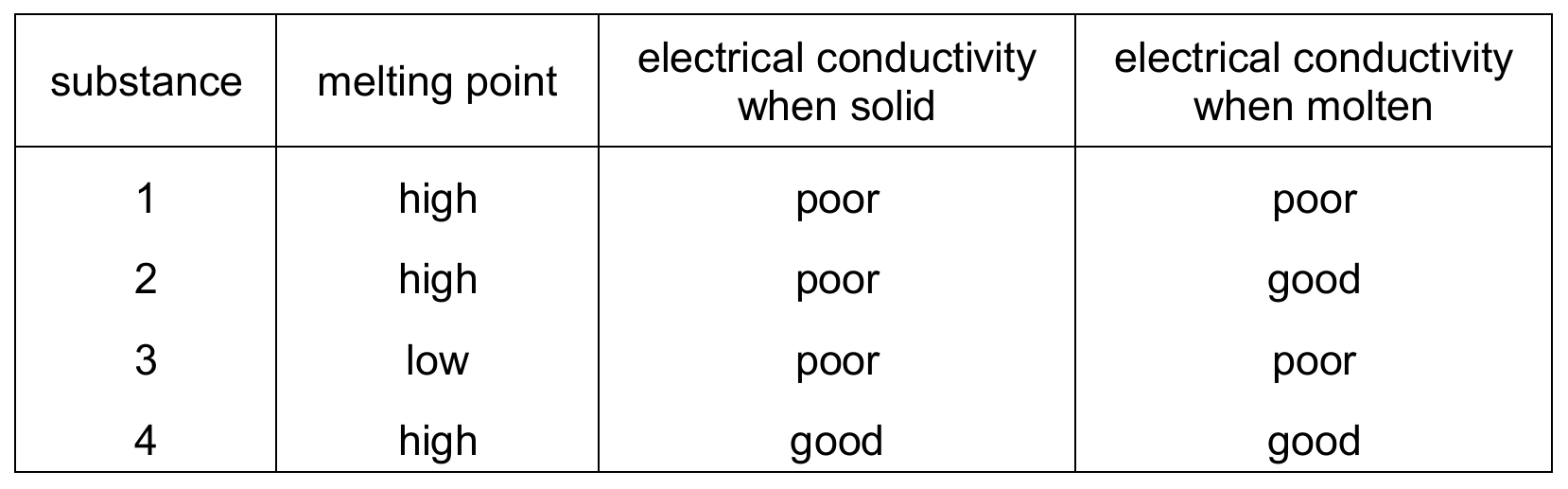
The table shows some properties of four substances.

Properties of four substances table

Which substances are ionic?

A. 1, 3 and 4
B. 1 and 3 only
C. 2 and 4
D. 2 only

Most-appropriate topic codes (Cambridge IGCSE Chemistry 0620):

Topic 2.4: Ions and ionic bonds — Describe the properties of ionic compounds: high melting points and boiling points (Core); good electrical conductivity when aqueous or molten and poor when solid (Core); Explain in terms of structure and bonding the properties of ionic compounds (Supplement)
▶️ Answer/Explanation
Ionic compounds possess high melting points due to a giant lattice structure held together by strong electrostatic attractions. In the solid state, their component ions are locked in fixed positions and cannot move to carry charge, making them poor electrical conductors. Once molten, however, this lattice breaks down so that mobile ions are completely free to migrate, resulting in good electrical conductivity. Evaluating the grid, only substance 2 satisfies every single one of these criteria; substance 1 behaves like a covalent molecule, substance 3 features too low a melting point, and substance 4 conducts when solid, identifying it as metallic.
Answer: (D)

Question 5

Which statement about methane is correct?

A. In methane, positive hydrogen ions are attracted to negative carbon ions.
B. In methane, electrons are shared between carbon atoms and hydrogen atoms.
C. Methane has a high boiling point.
D. Methane is a good conductor of electricity.

Most-appropriate topic codes (Cambridge IGCSE Chemistry 0620):

Topic 2.5: Simple molecules and covalent bonds — State that a covalent bond is formed when a pair of electrons is shared between two atoms leading to noble gas electronic configurations; Describe the formation of covalent bonds in simple molecules, including $\text{CH}_4$; Describe/explain in terms of structure and bonding the properties of simple molecular compounds: low melting points and boiling points, poor electrical conductivity
▶️ Answer/Explanation
Methane ($\text{CH}_4$) is a simple molecular compound formed exclusively by non-metal atoms that share valence electrons to achieve stable noble gas electronic configurations. Because it is a covalent substance, no ions are present in its assembly, ruling out option A. Furthermore, simple molecular structures feature weak intermolecular forces between neutral molecules, resulting in low melting and boiling points and a lack of mobile charged particles to carry an electric current. This makes options C and D incorrect, confirming option B as the only accurate description.
Answer: (B)

Question 6

A sample of iridium has a relative atomic mass of 192.29.

The sample contains two isotopes only.

64.50% of the sample is 193Ir.

What is the other isotope in the sample?

A. 189Ir
B. 190Ir
C. 191Ir
D. 192Ir

Most-appropriate topic codes (Cambridge IGCSE Chemistry 0620):

Topic 2.3: Isotopes — Calculate the relative atomic mass of an element from the relative masses and abundances of its isotopes
▶️ Answer/Explanation
Since the sample contains only two isotopes, the abundance of the unknown isotope is calculated as 100% − 64.50% = 35.50%. Setting up the weighted average equation for the relative atomic mass gives [(193 × 64.50) + (A × 35.50)] / 100 = 192.29, which simplifies to 12448.5 + 35.50A = 19229. Isolating the mass number reveals 35.50A = 6780.5, which yields a mass number A = 191 for the companion isotope. This mathematically satisfies the atomic mass parameter given in the Periodic Table for iridium, corresponding precisely to option C.
Answer: (C)

Question 7

Ammonium iron(III) citrate contains in its formula:

  • more than one ammonium ion
  • one iron ion
  • two C6H4O74- ions.

What is the formula of ammonium iron(III) citrate?

A. (NH4)4Fe(C6H4O7)2
B. (NH4)5Fe(C6H4O7)2
C. (NH4)6Fe(C6H4O7)2
D. (NH4)7Fe(C6H4O7)2

Most-appropriate topic codes (Cambridge IGCSE Chemistry 0620):

Topic 3.1: Formulae — Deduce the formula of an ionic compound from the relative numbers of the ions present in a model or a diagrammatic representation or from the charges on the ions
▶️ Answer/Explanation
An ionic compound must be overall electrically neutral, meaning the sum of its positive charges must exactly equal the sum of its negative charges. Two citrate ions ($\text{C}_6\text{H}_4\text{O}_7^{4-}$) provide a total negative charge of $2 \times 4- = 8-$, while a single iron(III) cation ($\text{Fe}^{3+}$) contributes a positive charge of $3+$. To cancel out the remaining negative valence ($8 – 3 = 5$), exactly five monovalent ammonium cations ($\text{NH}_4^+$) are required since $5 \times 1+ = 5+$. This yields a balanced ratio of $\text{(NH}_4\text{)}_5\text{Fe(C}_6\text{H}_4\text{O}_7\text{)}_2$, rendering option B correct.
Answer: (B)

Question 8

Silicon(IV) oxide reacts with chlorine and carbon to form liquid silicon(IV) chloride, SiCl4, and carbon dioxide gas.

If the reaction is carried out at r.t.p., which symbol equation represents this reaction?

A. SiO2(l) + 2Cl2(g) + C(s) → SiCl4(l) + CO2(g)
B. SiO2(l) + 2Cl2(g) + C(g) → SiCl4(l) + CO2(g)
C. SiO2(s) + 2Cl2(g) + C(s) → SiCl4(g) + CO2(g)
D. SiO2(s) + 2Cl2(g) + C(s) → SiCl4(l) + CO2(g)

Most-appropriate topic codes (Cambridge IGCSE Chemistry 0620):

Topic 3.1: Formulae — Construct word equations and symbol equations to show how reactants form products, including state symbols; Deduce the symbol equation with state symbols for a chemical reaction, given relevant information
▶️ Answer/Explanation
Constructing symbol equations requires allocating the correct state symbols based on physical properties at room temperature and pressure (r.t.p.). Silicon(IV) oxide ($\text{SiO}_2$) is a giant covalent macromolecule that exists as a solid ($\text{s}$), and carbon ($\text{C}$) is also a solid ($\text{s}$) under ambient conditions, which instantly eliminates options A and B. The problem explicitly specifies that silicon(IV) chloride ($\text{SiCl}_4$) is obtained as a liquid ($\text{l}$) and carbon dioxide ($\text{CO}_2$) as a gas ($\text{g}$), leaving option D as the only equation that accurately maps the stoichiometry and physical phases.
Answer: (D)

Question 9

The structure of ethene is shown.

Ethene molecular structure

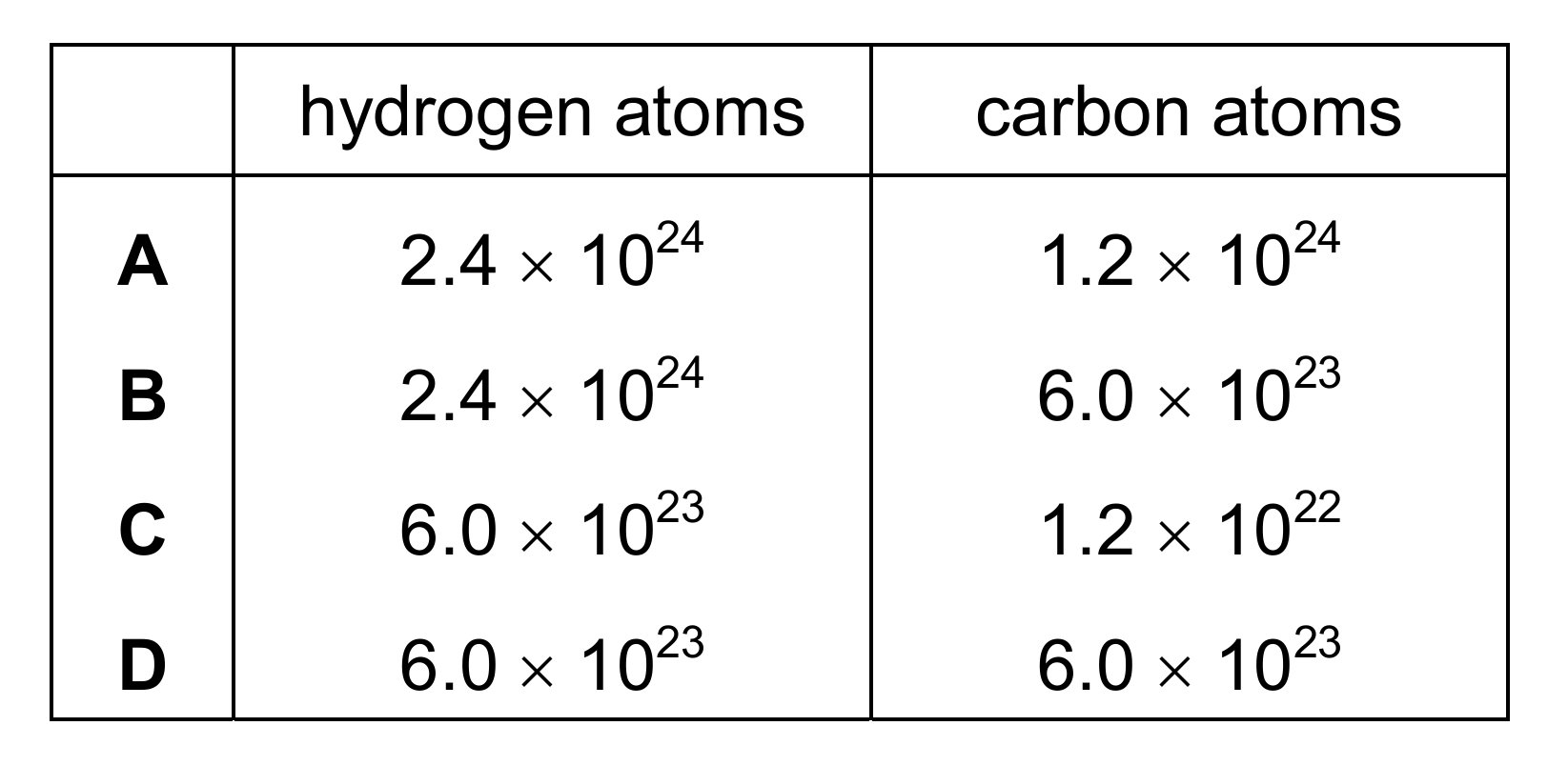
How many hydrogen atoms and how many carbon atoms are in one mole of ethene?

Options grid for atoms in ethene

Most-appropriate topic codes (Cambridge IGCSE Chemistry 0620):

Topic 3.3: The mole and the Avogadro constant — State that the mole, mol, is the unit of amount of substance and that one mole contains $6.02 \times 10^{23}$ particles; Use the relationship to calculate number of particles, using the value of the Avogadro constant
▶️ Answer/Explanation
One mole of any substance contains exactly Avogadro’s constant ($6.02 \times 10^{23}$) of its constituent units. Since a single molecule of ethene contains $2$ carbon atoms and $4$ hydrogen atoms ($\text{C}_2\text{H}_4$), one mole of ethene molecules must yield $2$ moles of carbon atoms and $4$ moles of hydrogen atoms. Computing the absolute quantities gives $2 \times (6.0 \times 10^{23}) = 1.2 \times 10^{24}$ carbon atoms and $4 \times (6.0 \times 10^{23}) = 2.4 \times 10^{24}$ hydrogen atoms. This aligns with row A, making it the correct option.
Answer: (A)

Question 10

A known volume and concentration of aqueous sodium hydroxide is titrated against dilute hydrochloric acid.

The volume of dilute hydrochloric acid needed to exactly neutralise the sodium hydroxide is measured.

Five calculation steps are shown.

  1. Calculate the amount of hydrochloric acid in moles.
  2. Calculate the relative formula mass of hydrochloric acid.
  3. Calculate the concentration of hydrochloric acid in g/dm3.
  4. Calculate the amount of sodium hydroxide in moles.
  5. Calculate the concentration of hydrochloric acid in mol/dm3.

What is the order of these steps to calculate the concentration of the hydrochloric acid in g/dm3?

A. 1 → 4 → 3 → 5 → 2
B. 1 → 2 → 4 → 5 → 3
C. 4 → 1 → 5 → 2 → 3
D. 4 → 2 → 1 → 3 → 5

Most-appropriate topic codes (Cambridge IGCSE Chemistry 0620):

Topic 3.3: The mole and the Avogadro constant — Use experimental data from a titration to calculate the moles of solute, or the concentration or volume of a solution; Calculate stoichiometric reacting masses, limiting reactants, volumes of solutions and concentrations of solutions expressed in $\text{g/dm}^3$ and $\text{mol/dm}^3$
Topic 12.2: Acid-base titrations — Describe an acid-base titration to include the use of a burette, volumetric pipette, and suitable indicator
▶️ Answer/Explanation
To find the final concentration, you must progress logically from the completely known standard solution to the unknown analyte. First, calculate the moles of the known reactant, sodium hydroxide (Step 4), and apply the stoichiometric reaction ratio to determine the reacting moles of hydrochloric acid (Step 1). Next, use the measured neutralization volume to find the acid’s concentration in $\text{mol/dm}^3$ (Step 5). Finally, determine the relative formula mass of $\text{HCl}$ (Step 2) to scale this molar concentration into mass per unit volume, yielding the final value in $\text{g/dm}^3$ (Step 3). This sequential pathway corresponds exactly to 4 → 1 → 5 → 2 → 3.
Answer: (C)

Question 11

Two different substances are electrolysed using inert electrodes in two separate experiments.

Hydrogen is produced in both experiments.

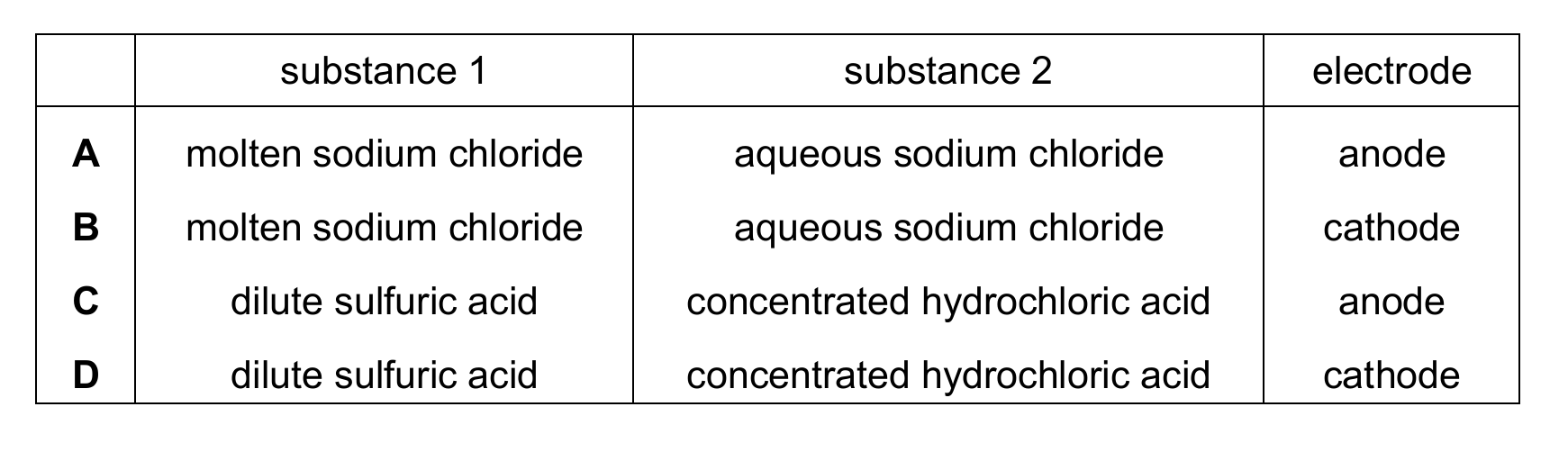
Which row identifies the two substances and the electrode at which hydrogen is produced?

Electrolysis options grid table

Most-appropriate topic codes (Cambridge IGCSE Chemistry 0620):

Topic 4.1: Electrolysis — State that metals or hydrogen are formed at the cathode and that non-metals (other than hydrogen) are formed at the anode[cite: 345]; Identify the products formed at the electrodes during the electrolysis of concentrated aqueous sodium chloride and dilute sulfuric acid using inert electrodes [cite: 340, 342, 343, 344]
▶️ Answer/Explanation
During electrolysis, positively charged hydrogen ions ($\text{H}^+$) migrate toward the negative electrode, known as the cathode, where they gain electrons to produce hydrogen gas ($\text{H}_2$)[cite: 328, 345, 350]. Dilute sulfuric acid contains aqueous $\text{H}^+$ ions [cite: 496], and concentrated hydrochloric acid also releases $\text{H}^+$ ions [cite: 501], meaning both solutions will evolve hydrogen gas exclusively at the cathode[cite: 340, 343, 345]. Conversely, the electrolysis of molten sodium chloride produces elemental sodium metal at the cathode rather than hydrogen [cite: 345, 346], which eliminates rows A and B, while row C inaccurately places hydrogen formation at the positive anode[cite: 327, 345]. This confirms row D as the only valid chemical description[cite: 340, 343, 345].
Answer: (D)

Question 12

Aqueous copper(II) sulfate can be electrolysed using either carbon electrodes or copper electrodes.

Which statement describes what happens at the positive electrode?

A. Copper is deposited if the electrode is made from carbon.
B. Copper is deposited if the electrode is made from copper.
C. Oxygen gas is produced if the electrode is made from carbon.
D. Oxygen gas is produced if the electrode is made from copper.

Most-appropriate topic codes (Cambridge IGCSE Chemistry 0620):

Topic 4.1: Electrolysis — Identify the products formed at the electrodes and describe the observations made during the electrolysis of aqueous copper(II) sulfate using inert carbon/graphite electrodes and when using copper electrodes [cite: 348]
▶️ Answer/Explanation
At the positive electrode (anode), oxidation occurs[cite: 327, 350]. When using inert carbon electrodes, hydroxide ions ($\text{OH}^-$) from water are preferentially discharged to form oxygen gas[cite: 345, 348]. However, if reactive copper anodes are used instead, the copper metal electrode itself dissolves by losing electrons to form aqueous copper(II) ions ($\text{Cu}^{2+}$)[cite: 348]. Options A and B are incorrect because copper deposition always happens at the negative cathode [cite: 328, 345], while option D is incorrect because the copper anode dissolves rather than producing gas[cite: 348].
Answer: (C)

Question 13

Which statement about a hydrogen-oxygen fuel cell is not correct?

A. Chemical energy is converted into electrical energy.
B. Hydrogen is oxidised.
C. The reaction that takes place is endothermic.
D. Water is the only chemical product.

Most-appropriate topic codes (Cambridge IGCSE Chemistry 0620):

Topic 4.2: Hydrogen-oxygen fuel cells — State that a hydrogen-oxygen fuel cell uses hydrogen and oxygen to produce electricity with water as the only chemical product [cite: 355]
▶️ Answer/Explanation
A hydrogen-oxygen fuel cell generates electricity by combining hydrogen gas and oxygen gas through a spontaneous electrochemical process[cite: 355], making option A correct. During this process, hydrogen loses electrons to undergo oxidation at the negative electrode, which confirms option B. Because the combination reaction releases significant energy as electrical power and heat, the system is fundamentally exothermic, making option C false and therefore the correct answer. Water is generated as the sole chemical output[cite: 355], which rules out option D.
Answer: (C)

Question 14

Which reaction pathway diagram is correctly labelled?

A.
Reaction pathway diagram option A

B.
Reaction pathway diagram option B

C.
Reaction pathway diagram option C

D.
Reaction pathway diagram option D

Most-appropriate topic codes (Cambridge IGCSE Chemistry 0620):

Topic 5.1: Exothermic and endothermic reactions — Interpret reaction pathway diagrams showing exothermic and endothermic reactions[cite: 369]; Draw and label reaction pathway diagrams for exothermic and endothermic reactions using information provided, to include: reactants, products, enthalpy change of the reaction, $\Delta H$, and activation energy, $E_a$ [cite: 371, 372, 373, 374]
▶️ Answer/Explanation
A standardized reaction pathway diagram must measure absolute chemical energy on the vertical axis and the pathway progression along the horizontal axis. Activation energy ($E_a$) is explicitly defined as the minimum energy barrier that colliding particles require to initiate a chemical reaction[cite: 370], visually mapped as an upward arrow pointing from the base reactant baseline up to the peak transition state. Option A correctly isolates an exothermic system because the products sit below the initial reactant baseline, showing a downward enthalpy arrow ($-\Delta H$) alongside an accurate $E_a$ arrow mapping[cite: 368, 369]. Misaligned arrow heads or reversed axis boundaries render options B, C, and D structurally flawed under formal IUPAC conventions.
Answer: (A)

Question 15

Which row describes a reaction where the overall energy change is exothermic?

Energy changes and temperature variations table

Most-appropriate topic codes (Cambridge IGCSE Chemistry 0620):

Topic 5.1: Exothermic and endothermic reactions — State that an exothermic reaction transfers thermal energy to the surroundings leading to an increase in the temperature of the surroundings[cite: 364]; State that bond breaking is an endothermic process and bond making is an exothermic process and explain the enthalpy change of a reaction in terms of bond breaking and bond making [cite: 375]
▶️ Answer/Explanation
An exothermic reaction transfers thermal energy to its surroundings [cite: 364], which inherently causes the measured temperature of the surroundings to increase[cite: 364]. From a molecular perspective, the chemical system behaves exothermically when the energy released during bond-making processes exceeds the energy absorbed to break the initial reactant bonds[cite: 375]. Row D represents this dynamic perfectly, showing that more total energy is released ($\text{1200 kJ}$) than is taken in ($\text{900 kJ}$), while correctly reporting an increase in temperature[cite: 364]. Rows A and C represent net energy absorption (endothermic), and row B lists an impossible thermodynamic contradiction where a net energy release accompanies a temperature drop.
Answer: (D)

Question 16

Which process involves a physical change only?

A. heating calcium carbonate strongly
B. burning wood
C. melting an ice cube
D. mixing an acid and a base

Most-appropriate topic codes (Cambridge IGCSE Chemistry 0620):

Topic 6.1: Physical and chemical changes — Identify physical and chemical changes, and describe the differences between them [cite: 381, 383]
▶️ Answer/Explanation
A physical change alters the physical state or appearance of a substance without modifying its underlying chemical identity or forming new products[cite: 381, 383]. Melting an ice cube transforms solid water into liquid water, meaning the chemical composition remains completely unchanged as $\text{H}_2\text{O}$ molecules[cite: 208]. Conversely, strongly heating calcium carbonate causes thermal decomposition [cite: 653], burning wood is a combustion reaction, and mixing an acid and a base results in a chemical neutralization reaction that produces a salt and water[cite: 505]. Therefore, only option C represents a purely physical process.
Answer: (C)

Question 17

In the Haber process, an equilibrium is established.

$$\text{N}_2(g) + 3\text{H}_2(g) \rightleftharpoons 2\text{NH}_3(g)$$

The forward reaction is exothermic.

Which change to the reaction conditions will move the position of equilibrium to the left?

A. decreasing the pressure by 100 atm
B. decreasing the temperature by 100 °C
C. adding more nitrogen gas to the mixture
D. removing the iron catalyst

Most-appropriate topic codes (Cambridge IGCSE Chemistry 0620):

Topic 6.3: Reversible reactions and equilibrium — Predict and explain, for a reversible reaction, how the position of equilibrium is affected by changing temperature, changing pressure, changing concentration, and using a catalyst[cite: 425, 426, 427, 428, 429]; State the symbol equation for the production of ammonia in the Haber process [cite: 431]
▶️ Answer/Explanation
According to Le Chatelier’s principle, decreasing the overall pressure of a system at equilibrium shifts the reaction dynamic toward the side that possesses a greater number of gas molecules to oppose the change[cite: 425, 427]. In this chemical equation, the left side has a total of 4 moles of gas ($1\text{ N}_2 + 3\text{ H}_2$) while the right side features only 2 moles of gas ($2\text{ NH}_3$)[cite: 432], so a drop in pressure pushes the equilibrium position to the left. Option B is incorrect because cooling favors the exothermic forward direction [cite: 426, 432], option C is incorrect because introducing more nitrogen shifts the equilibrium right to consume the added reactant [cite: 428], and option D is incorrect because catalysts alter the rate but have no effect on the final position of equilibrium[cite: 429].
Answer: (A)

Question 18

The flow chart shows some properties of a metal oxide.

Metal oxide chemical reactions flow chart

What is the metal oxide?

A. aluminium oxide
B. copper(II) oxide
C. iron(III) oxide
D. zinc oxide

Most-appropriate topic codes (Cambridge IGCSE Chemistry 0620):

Topic 7.2: Acid-base character — Classify oxides as either acidic or basic, related to metallic and non-metallic character; Describe amphoteric oxides as oxides that react with acids and with bases to produce a salt and water; Group zinc oxide and aluminium oxide as examples of amphoteric oxides
Topic 9.4: Alloys and properties — Name brass as an alloy of copper and zinc
▶️ Answer/Explanation
The flow chart identifies a dual-natured compound that undergoes neutralization with both hydrochloric acid and sodium hydroxide to yield a salt and water, a definitive trait of amphoteric oxides. Both zinc oxide and aluminium oxide possess this amphoteric quality, which eliminates basic oxides like copper(II) oxide and iron(III) oxide. The final constraint notes that the parent metal is a vital constituent of brass, an alloy specifically engineered by mixing copper and zinc. Consequently, the combination of amphoteric reactivity and alloy composition confirms zinc oxide as the correct chemical candidate.
Answer: (D)

Question 19

Which statement about reactants in redox reactions is correct?

A. An oxidising agent donates electrons, and a reducing agent accepts electrons.
B. When one element gains electrons, the oxidation number of a different element increases.
C. When the oxidation number of one element increases, a different element gains oxygen.
D. When the oxidation number of one element increases, a different element loses electrons.

Most-appropriate topic codes (Cambridge IGCSE Chemistry 0620):

Topic 6.4: Redox — Define redox reactions as involving simultaneous oxidation and reduction; Define oxidation and reduction in terms of: electron loss/gain and changes in oxidation number
▶️ Answer/Explanation
In a redox reaction, reduction and oxidation take place simultaneously because free electrons cannot exist independently in solution. When a particular element gains electrons (undergoes reduction), another companion element must explicitly supply those electrons by losing them (undergoes oxidation), which systematically increases its overall oxidation number. Option A incorrectly switches the definitions of electronic agents, whereas options C and D represent flawed thermodynamic generalizations because redox reactions frequently proceed without any oxygen transfer or localized internal particle loss. This leaves option B as the only logically balanced choice.
Answer: (B)

Question 20

Aluminium is extracted from aluminium oxide by electrolysis. The ionic half-equation for the reaction at one of the electrodes is shown.

$$\text{Al}^{3+} + 3\text{e}^- \rightarrow \text{Al}$$

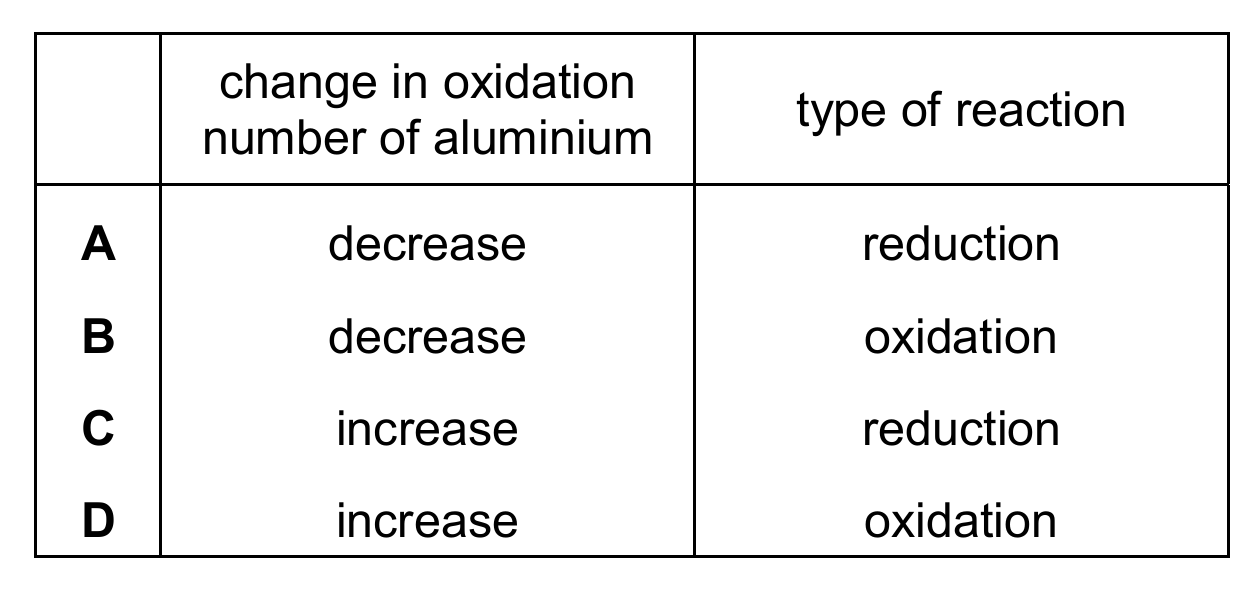
Which row describes the change in oxidation number of the aluminium and the type of reaction at this electrode?

Oxidation number and reaction type options table

Most-appropriate topic codes (Cambridge IGCSE Chemistry 0620):

Topic 6.4: Redox — Define oxidation and reduction in terms of: electron loss/gain and changes in oxidation number
Topic 4.1: Electrolysis — Describe the extraction of aluminium from purified aluminium oxide in molten cryolite
▶️ Answer/Explanation
In this ionic half-equation, the trivalent aluminium cation ($\text{Al}^{3+}$) explicitly captures three electrons to produce neutral, elemental aluminium metal ($\text{Al}$). The direct gain of electrons defines a chemical reduction process, which always corresponds directly with a decrease in the oxidation number from $+3$ down to $0$. This mechanical reduction sequence rules out rows B and D entirely, while row C contains a flawed description asserting that an oxidation number increases during reduction. Consequently, row A stands as the only thermodynamically consistent choice.
Answer: (A)

Question 21

Which statement about dilute hydrochloric acid is correct?

A. It is a strong acid as it fully dissociates.
B. It is a strong acid as it partially dissociates.
C. It is a weak acid as it fully dissociates.
D. It is a weak acid as it partially dissociates.

Most-appropriate topic codes (Cambridge IGCSE Chemistry 0620):

Topic 7.1: Characteristic properties of acids and bases — Define a strong acid as an acid that is completely dissociated in aqueous solution and a weak acid as an acid that is partially dissociated in aqueous solution (Supplement)
▶️ Answer/Explanation
By chemical definition, the strength of an acid is determined exclusively by its degree of ionization or dissociation in water. Hydrochloric acid is classified as a strong mineral acid because its covalent hydrogen chloride molecules break apart completely into independent hydronium and chloride ions when dissolved in an aqueous environment. This full dissociation leaves no intact neutral acid molecules behind, separating it from weak acids which only reach equilibrium after partial dissociation. This rules out choices B, C, and D, making option A the only accurate correlation.
Answer: (A)

Question 22

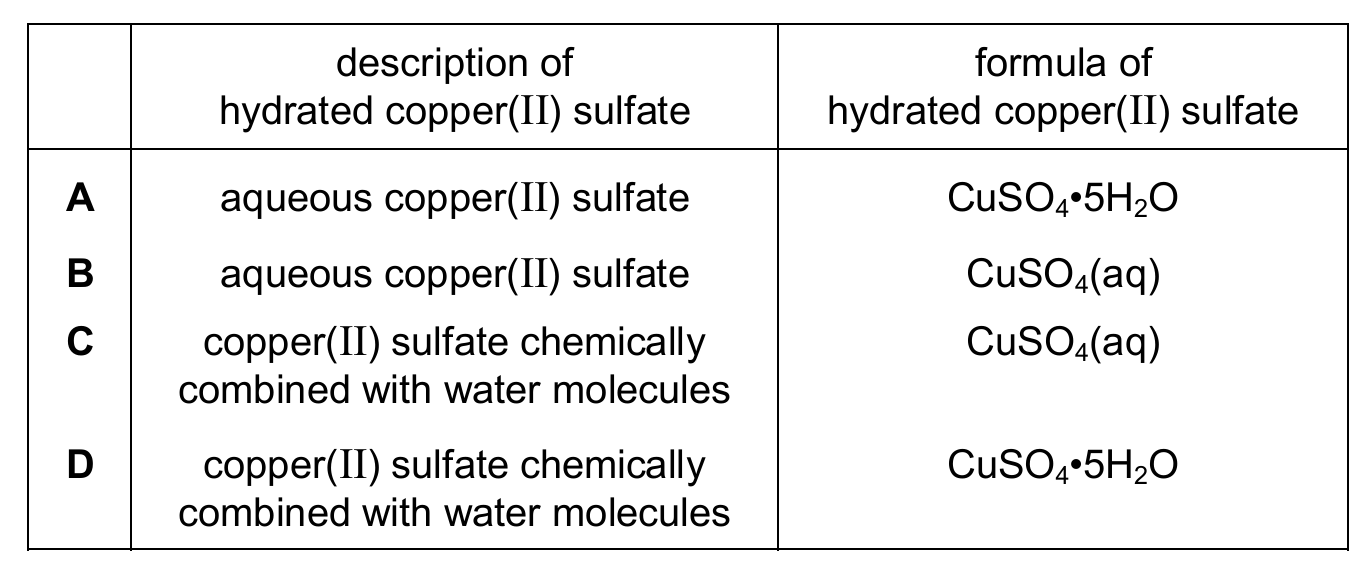
Which row describes and gives the formula of hydrated copper(II) sulfate?

Hydrated copper(II) sulfate options grid table

Most-appropriate topic codes (Cambridge IGCSE Chemistry 0620):

Topic 7.3: Preparation of salts — Describe the terms anhydrous and hydrated; Describe water of crystallization as the water molecules present in hydrated crystals, including $\text{CuSO}_4 \cdot 5\text{H}_2\text{O}$
▶️ Answer/Explanation
Hydrated copper(II) sulfate is a solid crystalline salt containing chemically bound water molecules within its lattice framework, known as water of crystallization. By chemical definition, a hydrated substance is a solid rather than an aqueous solution ($\text{aq}$), which immediately eliminates rows A and B that inaccurately label the physical state as dissolved in water. The specific stoichiometric formula for these bright blue crystals contains five moles of water for every one mole of copper(II) sulfate, properly denoted as $\text{CuSO}_4 \cdot 5\text{H}_2\text{O}\text{ (s)}$. This rules out the incorrect chemical proportion in row C, leaving row D as the only correct choice.
Answer: (D)

Question 23

The equations for three reactions are shown.

1 Pb(NO3)2(aq) + 2KI(aq) → PbI2(s) + 2KNO3(aq)
2 2AgNO3(aq) + CuI2(aq) → Cu(NO3)2(aq) + 2AgI(s)
3 CuO(s) + H2SO4(aq) → CuSO4(aq) + H2O(l)

Which reactions are suitable for making a salt by precipitation?

A. 1 and 2 only
B. 1 and 3 only
C. 2 and 3 only
D. 1, 2 and 3

Most-appropriate topic codes (Cambridge IGCSE Chemistry 0620):

Topic 7.3: Preparation of salts — Describe the preparation of insoluble salts by precipitation, using two soluble salts as starting materials
▶️ Answer/Explanation
A salt preparation via precipitation fundamentally requires mixing two separate, fully soluble aqueous solutions ($\text{aq}$) to form an insoluble solid product, denoted by the state symbol ($\text{s}$). Looking at the equations, reaction 1 yields insoluble lead(II) iodide ($\text{PbI}_2\text{(s)}$) and reaction 2 produces insoluble silver iodide ($\text{AgI}\text{(s)}$) from completely soluble reactants, making both classic precipitation setups. Reaction 3, however, describes a neutralization method where an insoluble base is added to an acid to synthesize a soluble salt ($\text{CuSO}_4\text{(aq)}$) dissolved in water, meaning no precipitate is generated. This eliminates choices B, C, and D, leaving option A as the correct answer.
Answer: (A)

Question 24

Acidified potassium dichromate(VI), K2Cr2O7, is used to oxidise ethanol, C2H5OH.

The ionic equation for the reaction is shown.

$$3\text{C}_2\text{H}_5\text{OH} + 2\text{Cr}_2\text{O}_7^{2-} + 16\text{H}^+ \rightarrow 3\text{CH}_3\text{COOH} + 4\text{Cr}^{3+} + 11\text{H}_2\text{O}$$

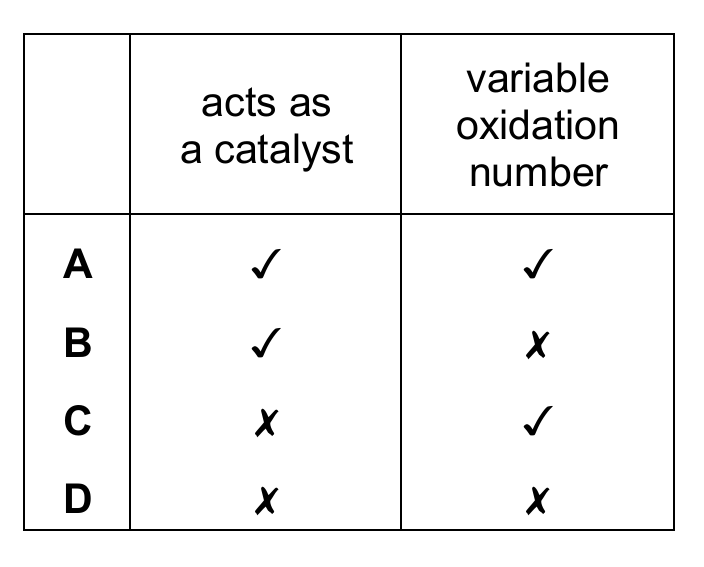
Which properties of transition elements are shown by chromium in this reaction?

Transition metal properties options table

Most-appropriate topic codes (Cambridge IGCSE Chemistry 0620):

Topic 8.4: Transition elements — State that transition elements are metals with specific properties, including: variable oxidation numbers and acting as catalysts
Topic 11.6: Alcohols — Describe the oxidation of ethanol by reaction with acidified aqueous potassium manganate(VII) or acidified aqueous potassium dichromate(VI)
▶️ Answer/Explanation
During this redox mechanism, chromium transitions from a orange dichromate anion ($\text{Cr}_2\text{O}_7^{2-}$), where it possesses an oxidation number of $+6$, down to a green chromium(III) cation ($\text{Cr}^{3+}$). This explicit transformation directly validates the characteristic transition element property of exhibiting variable oxidation numbers. However, because potassium dichromate acts as a primary reactant that is chemically consumed over the course of the reaction rather than emerging structurally unaltered at the end, it does not function as a catalyst in this specific system. This confirms that column 1 is correct ($\checkmark$) and column 2 is incorrect ($\times$), identifying row C as the accurate option.
Answer: (C)

Question 25

Which statements describe the Periodic Table?

1 The elements are arranged in order of their nucleon number.
2 The elements are arranged in order of their proton number.
3 It is used to predict the properties of elements.

A. 1 and 3
B. 1 only
C. 2 and 3
D. 2 only

Most-appropriate topic codes (Cambridge IGCSE Chemistry 0620):

Topic 8.1: Arrangement of elements — Describe the Periodic Table as an arrangement of elements in order of increasing proton number / atomic number; Describe the relationship between group number and the charge of the ions or valency electrons; Explain how the position of an element in the Periodic Table can be used to predict its properties
▶️ Answer/Explanation
The modern Periodic Table arranges chemical elements in ascending order of their atomic number, which corresponds exactly to their internal proton number. This makes statement 2 completely correct and rules out statement 1, as sequencing by nucleon number (mass number) would cause structural inconsistencies due to varying isotopic abundances. Because elements situated within the same vertical column share identical counts of valence electrons, the table exhibits periodic recurring trends that allow scientists to reliably predict physical and chemical properties based on an element’s localized coordinates. Since statements 2 and 3 are correct, option C is the accurate choice.
Answer: (C)

Question 26

Which row shows the correct order of reactivity of the four named metals?

Reactivity order of four metals options table

Most-appropriate topic codes (Cambridge IGCSE Chemistry 0620):

Topic 9.2: The reactivity series — Place the metals: calcium, copper, iron, hydrogen, magnesium, potassium, silver, sodium and zinc, in order of reactivity
▶️ Answer/Explanation
According to the standard Cambridge IGCSE chemistry reactivity series, metals are prioritized by their relative ease of losing valence electrons to form positive cations. Magnesium easily releases electrons and sits above zinc, while both of these base metals easily displace hydrogen from cold water or dilute mineral acids. Conversely, the transition elements copper and silver are unreactive noble-type metals located below hydrogen, with copper being slightly more susceptible to oxidation than silver. Arranging them from most reactive to least reactive yields the sequence: magnesium > zinc > copper > silver, which matches row B perfectly.
Answer: (B)

Question 27

Four iron nails are added to four different metal sulfate solutions.

In which solution does a displacement reaction occur?

A. copper(II) sulfate
B. magnesium sulfate
C. sodium sulfate
D. zinc sulfate

Most-appropriate topic codes (Cambridge IGCSE Chemistry 0620):

Topic 9.2: The reactivity series — Describe the relative reactivity of metals in terms of their tendency to form positive ions, as illustrated by their reactions, if any, with the aqueous ions of other metals (displacement reactions)
▶️ Answer/Explanation
A metal displacement reaction can only take place if a more reactive elemental metal is introduced into a solution containing the aqueous ions of a less reactive metal. According to the reactivity series, iron ($\text{Fe}$) is less reactive than sodium ($\text{Na}$), magnesium ($\text{Mg}$), and zinc ($\text{Zn}$), meaning it lacks the thermodynamic drive to displace their ions from solution, ruling out options B, C, and D. However, iron sits above copper ($\text{Cu}$) in the reactivity sequence, allowing the elemental iron atoms to readily lose electrons and displace the less reactive copper(II) ions ($\text{Cu}^{2+}$) to form a brown copper coating on the nail. This makes option A the correct choice.
Answer: (A)

Question 28

A fertiliser contains ammonium nitrate and potassium phosphate.

Why is the fertiliser described as an NPK fertiliser?

A. It provides nitrogen, which is an essential element for improved plant growth.
B. It contains the element oxygen, which neutralises acidic soil.
C. It contains the elements nitrogen and phosphorus.
D. It provides the three main elements needed for improved plant growth.

Most-appropriate topic codes (Cambridge IGCSE Chemistry 0620):

Topic 10.2: Fertilisers — State that ammonium salts and nitrates are used as fertilisers; Describe NPK fertilisers as mixtures of substances containing nitrogen, phosphorus and potassium essential for improved plant growth
▶️ Answer/Explanation
The designation “NPK” explicitly refers to the chemical symbols of the three macro-nutrients essential for healthy, maximized plant development: Nitrogen ($\text{N}$), Phosphorus ($\text{P}$), and Potassium ($\text{K}$). Looking at the fertilizer’s ingredients, ammonium nitrate acts as a rich source of nitrogen ($\text{N}$), while potassium phosphate provides both potassium ($\text{K}$) and phosphorus ($\text{P}$). Because this specific formulation simultaneously delivers all three critical elements required to optimize agricultural yields, it fits the complete profile of an NPK fertilizer, confirming option D as the correct answer. Options A and C are incomplete as they overlook the necessary inclusion of potassium.
Answer: (D)

Question 29

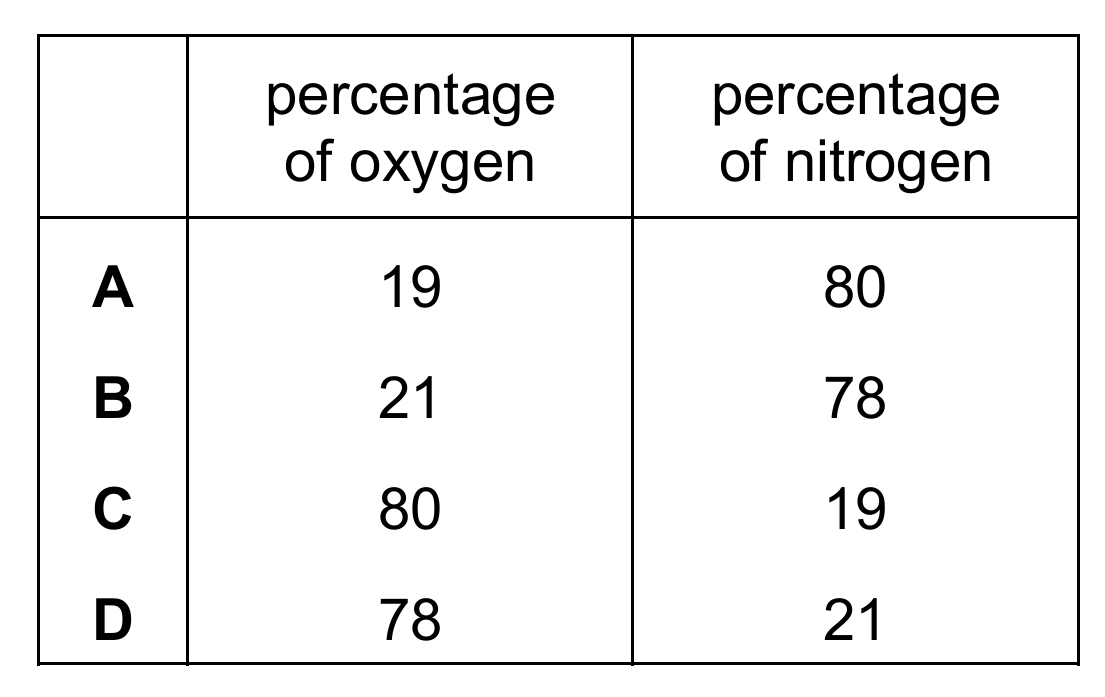
What are the approximate percentages of oxygen and nitrogen in clean, dry air?

Percentage of oxygen and nitrogen in air options table

Most-appropriate topic codes (Cambridge IGCSE Chemistry 0620):

Topic 10.3: Air quality and climate — State the composition of clean, dry air as being approximately 78% nitrogen, 21% oxygen and the remainder as being a mixture of noble gases and carbon dioxide
▶️ Answer/Explanation
Clean, dry air is a gaseous mixture whose chemical baseline composition is highly conserved across the globe. By fractional volume, nitrogen gas ($\text{N}_2$) is the most abundant component, accounting for approximately 78% of the atmosphere, while oxygen gas ($\text{O}_2$) is the second most abundant component at approximately 21%. The remaining 1% consists of a small combination of argon, carbon dioxide, and tracking traces of other noble gases. Evaluating the options grid, row B accurately pairs oxygen at 21% and nitrogen at 78%, making it the correct option.
Answer: (B)

Question 30

Which compounds have similar chemical properties?

A. butanol and butanoic acid
B. ethane and ethene
C. methane and butane
D. propene and propanol

Most-appropriate topic codes (Cambridge IGCSE Chemistry 0620):

Topic 11.1: Formulae, functional groups and terminology — State that a homologous series is a family of similar compounds with similar chemical properties due to the presence of the same functional group
▶️ Answer/Explanation
Compounds share similar chemical properties if they belong to the same homologous series, which is defined by the presence of an identical functional group. Methane and butane are both members of the alkane homologous series, meaning they possess only saturated single carbon-carbon and carbon-hydrogen bonds and share equivalent reaction pathways. The remaining pairings span completely different functional families: option A pairs an alcohol with a carboxylic acid, option B matches an alkane with an alkene, and option D contrasts an alkene with an alcohol. This makes option C the only correct response.
Answer: (C)

Question 31

Four statements about organic compounds P, Q, R and S are listed.

P is a saturated hydrocarbon.
The formula of Q is CH3CH3.
A molecule of R contains only one oxygen atom.
Compound S is a carboxylic acid.

Which statement about these compounds is correct?

A. P and Q are members of different homologous series.
B. P and S are members of the same homologous series.
C. Q and S are members of the same homologous series.
D. Q, R and S are all members of different homologous series.

Most-appropriate topic codes (Cambridge IGCSE Chemistry 0620):

Topic 11.1: Formulae, functional groups and terminology — Name and characterize different homologous series: alkanes, alkenes, alcohols and carboxylic acids; Identify functional groups present in organic structures
▶️ Answer/Explanation
To evaluate the statements correctly, we must determine the homologous series for each organic compound:
  • P is a saturated hydrocarbon, which by definition classifies it as an alkane.
  • Q ($\text{CH}_3\text{CH}_3$) is ethane, which also belongs to the alkane homologous series.
  • R contains exactly one oxygen atom per molecule, classifying it as an alcohol (possessing an $-\text{OH}$ group).
  • S is explicitly stated to be a carboxylic acid (possessing a $-\text{COOH}$ functional group).
Based on this analysis, compounds P and Q belong to the same family, while compounds Q, R, and S each contain entirely distinct functional groups and properties. Therefore, statements A, B, and C are chemical mischaracterizations, leaving option D as the only correct statement.
Answer: (D)

Question 32

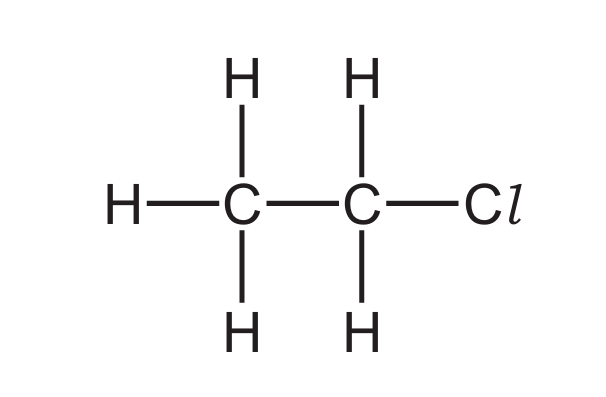
The structure of an organic compound is shown.

Organic compound displayed chemical structure

What is the name of the compound?

A. chloroethane
B. chloroethene
C. chloroethanol
D. chloroethanoic acid

Most-appropriate topic codes (Cambridge IGCSE Chemistry 0620):

Topic 11.2: Naming compounds — Name and draw the structural and displayed formulae of unbranched alkanes, alkenes, alcohols and carboxylic acids containing up to four carbon atoms; Identify and name halogenoalkanes up to four carbon atoms
▶️ Answer/Explanation
To systematically determine the IUPAC name of the displayed structural formula, we break it down into its constituent parts:
  • Carbon backbone: The molecule contains a chain of two carbon atoms linked entirely by a saturated single covalent bond, which establishes the root alkane name as ethane.
  • Substituent group: One hydrogen atom has been replaced by a chlorine atom ($\text{-Cl}$), adding the prefix chloro-.
Combining these features yields chloroethane ($\text{CH}_3\text{CH}_2\text{Cl}$). Option B is incorrect because there is no carbon-carbon double bond ($\text{C=C}$), option C is incorrect due to the absence of an alcohol hydroxyl group ($\text{-OH}$), and option D is incorrect because the structure lacks a carboxylic acid functional group ($\text{-COOH}$). This leaves option A as the correct designation.
Answer: (A)

Question 33

Which statement about the manufacture of ethene from larger alkane molecules is correct?

A. A low temperature is required.
B. The process is called cracking.
C. The process requires an excess of oxygen.
D. Water is also a product.

Most-appropriate topic codes (Cambridge IGCSE Chemistry 0620):

Topic 11.5: Alkenes — Describe the manufacture of alkenes and hydrogen by the cracking of larger alkane molecules obtained from petroleum fractions; State the conditions used in catalytic cracking, to include: an alumina/silica catalyst and a high temperature
▶️ Answer/Explanation
The industrial thermal decomposition of long-chain hydrocarbons into smaller, economically valuable fractions like ethene is known as cracking. This reaction requires high thermal energies ($\text{600–700 °C}$) and a catalyst like silica/alumina, which rules out option A. Because the objective is to break down bonds without allowing combustion to occur, the process must take place in an environment entirely absent of oxygen, ruling out option C. The typical reaction products are simply a mixture of shorter-chain alkanes, alkenes, and hydrogen gas rather than water, which removes option D. Therefore, option B is the only accurate chemical choice.
Answer: (B)

Question 34

Which processes are used to make ethanoic acid?

1 heating ethanol with acidified aqueous potassium manganate(VII)
2 bacterial oxidation of ethanol
3 distilling ethanol using a fractionating column

A. 1 and 2
B. 1 only
C. 2 and 3
D. 3 only

Most-appropriate topic codes (Cambridge IGCSE Chemistry 0620):

Topic 11.7: Carboxylic acids — Describe the formation of ethanoic acid by: the bacterial oxidation of ethanol (vinegar process) and with acidified aqueous potassium manganate(VII)
▶️ Answer/Explanation
Ethanoic acid ($\text{CH}_3\text{COOH}$) is synthesized from ethanol ($\text{CH}_3\text{CH}_2\text{OH}$) through two primary oxidation pathways:
  • Process 1 (Chemical Oxidation): Heating ethanol with a strong oxidizing agent like acidified aqueous potassium manganate(VII) forces a rapid laboratory conversion, visible by a color change from purple ($\text{MnO}_4^-$) to colorless ($\text{Mn}^{2+}$).
  • Process 2 (Biological Oxidation): Exposing ethanol to atmospheric oxygen in the presence of specific aerobic bacteria (such as Acetobacter) induces a slow fermentation process that naturally yields vinegar.
Conversely, process 3 describes fractional distillation, which is a purely physical separation technique used to purify alcohol mixtures based on boiling points without modifying chemical structures. Because only processes 1 and 2 are chemical synthesis routes, option A is the accurate choice.
Answer: (A)

Question 35

Which statement about propene, C3H6, is correct?

A. Propene reacts with bromine in the dark in a substitution reaction.
B. Propene reacts with steam in the presence of an alkaline catalyst, forming an alcohol.
C. Propene undergoes addition polymerisation, forming poly(ethene).
D. Propene undergoes an addition reaction to form an alkane.

Most-appropriate topic codes (Cambridge IGCSE Chemistry 0620):

Topic 11.5: Alkenes — Describe the properties of alkenes in terms of addition reactions with: bromine, hydrogen in the presence of a nickel catalyst, steam in the presence of an acid catalyst
▶️ Answer/Explanation
Propene ($\text{C}_3\text{H}_6$) contains an unsaturated carbon-carbon double bond ($\text{C=C}$), which dictates its characteristic addition chemistry:
  • Option A is incorrect: Propene reacts rapidly with bromine even in the dark via an addition reaction, not substitution, decolorizing the orange bromine water.
  • Option B is incorrect: The industrial hydration of propene with steam to form propanol requires an acidic catalyst (concentrated phosphoric acid), not an alkaline one.
  • Option C is incorrect: The addition polymerization of propene assembles repeating monomer units to yield poly(propene), not poly(ethene).
  • Option D is correct: Propene readily undergoes an addition reaction with hydrogen gas ($\text{H}_2$) in the presence of a heated nickel catalyst (hydrogenation) to saturate the double bond and produce propane, which belongs to the alkane family.
Answer: (D)

Question 36

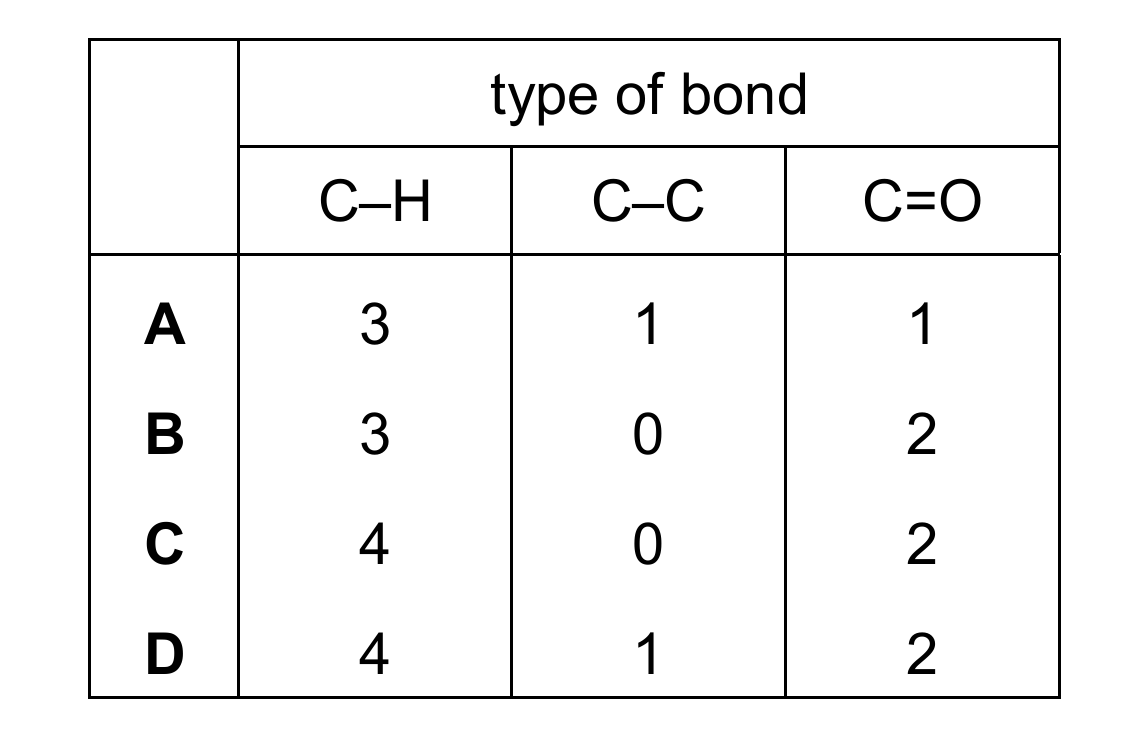
How many of each type of bond are present in ethanoic acid, CH3COOH?

Bond type counting options table

Most-appropriate topic codes (Cambridge IGCSE Chemistry 0620):

Topic 11.1: Formulae, functional groups and terminology — Draw and interpret the displayed formulae of carboxylic acids showing all atoms and all bonds
To find the correct number of bonds, we look at the fully displayed structural formula of an ethanoic acid molecule ($\text{CH}_3\text{COOH}$):
  • The methyl carbon is single-bonded to three hydrogen atoms, giving exactly 3 $\text{C-H}$ bonds.
  • The methyl carbon is linked to the carbonyl carbon via a single covalent bond, giving 1 $\text{C-C}$ bond.
  • The carboxyl group ($\text{-COOH}$) contains a double bond linking the carbon to the top oxygen atom, giving 1 $\text{C=O}$ bond (along with 1 $\text{C-O}$ bond and 1 $\text{O-H}$ bond).
Comparing these specific counts against the values provided in the grid, row A correctly lists 3 $\text{C-H}$ bonds, 1 $\text{C-C}$ bond, and 1 $\text{C=O}$ bond. This identifies row A as the correct response.
Answer: (A)

Question 37

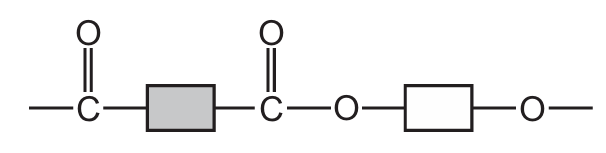
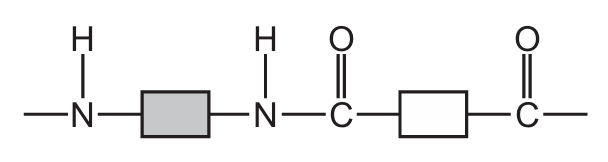
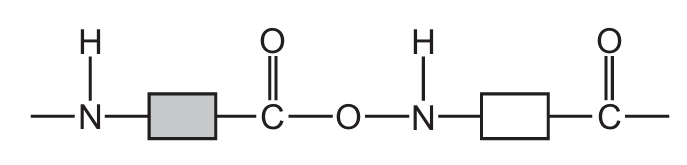
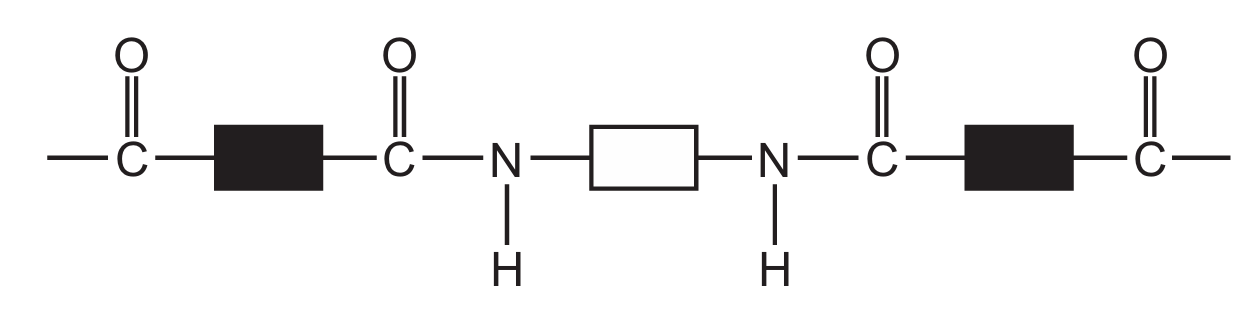
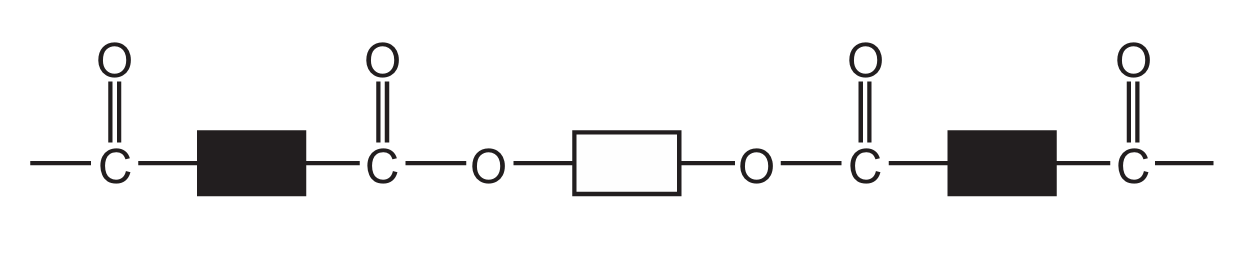
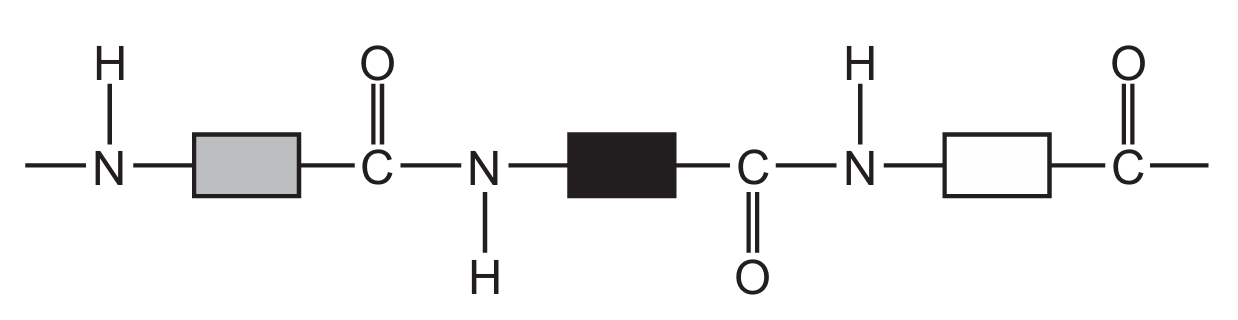
Which diagram represents the structure of a protein?

A.
Polymer structure option A

B.
Polymer structure option B

C.
Polymer structure option C

D.
Polymer structure option D

Most-appropriate topic codes (Cambridge IGCSE Chemistry 0620):

Topic 11.8: Polymers — Describe proteins as natural polyamides formed from amino acid monomers; Describe the continued linkages in proteins as amide / peptide linkages
▶️ Answer/Explanation
Proteins are complex natural condensation polymers classified structurally as polyamides. They are formed when different amino acid monomers link together, eliminating water molecules to establish consecutive amide linkages, also formally designated as peptide bonds ($\text{-CONH-}$). A structurally precise diagram of a protein must alternate between distinct, variable side-chain residues (typically symbolized by alternating shaded blocks or shapes) interconnected by these specific carbon-to-nitrogen ($\text{C-N}$) amide single bonds. Diagram D correctly captures this structural sequence, featuring the proper repeating amide connectivity pattern combined with alternating amino acid units. This establishes option D as the only chemically valid choice.
Answer: (D)

Question 38

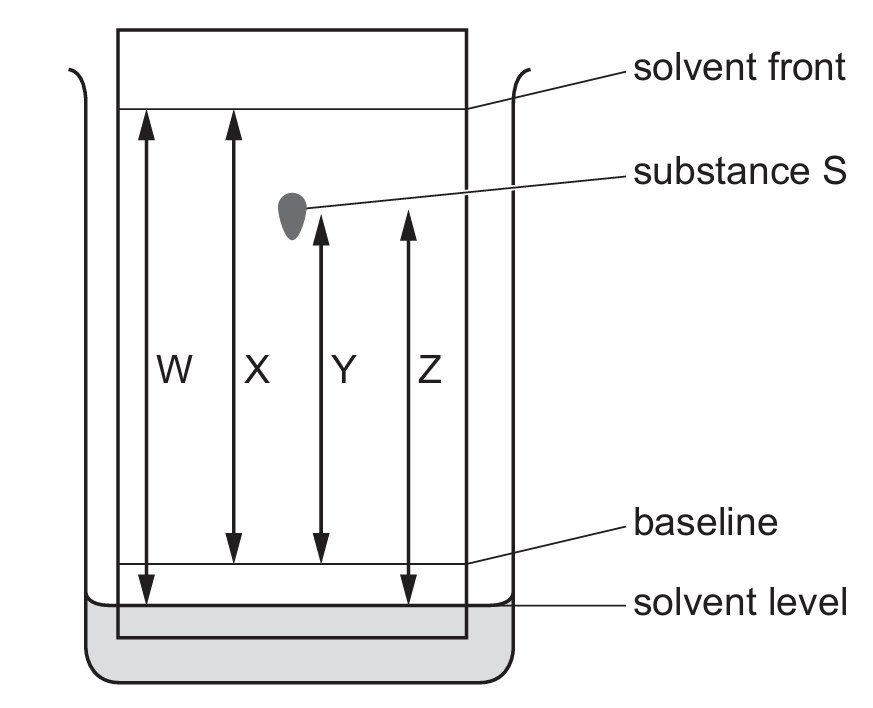
The chromatogram of substance S is shown.

Some distances, W, X, Y and Z, are labelled on the diagram.

Chromatography RF value distance measurements diagram

How is the $R_f$ value of substance S calculated?

A. $\frac{X}{Y}$
B. $\frac{W}{Z}$
C. $\frac{Y}{X}$
D. $\frac{Y}{W}$

Most-appropriate topic codes (Cambridge IGCSE Chemistry 0620):

Topic 12.3: Chromatography — Identify and describe the use of a locating agent in the chromatography of colorless compounds; State and use the equation for retention factor, $R_f$
▶️ Answer/Explanation
The retention factor ($R_f$) value in paper chromatography is a mathematical ratio used to characterize and identify substances. It is formally calculated using the standard formula: $$\text{R}_\text{f} = \frac{\text{distance travelled by the substance from the baseline}}{\text{distance travelled by the solvent front from the baseline}}$$ By analyzing the labeled dimensions on the chromatogram:
  • Dimension Y measures the net displacement of substance S from the pencil baseline to the center of the spot.
  • Dimension X measures the total migration height achieved by the solvent front starting up from that same baseline.
Substituting these measurements into the ratio yields $\frac{Y}{X}$. Distances W and Z are completely irrelevant because they misalign with the baseline datum line. This isolates option C as the only correct operational setup.
Answer: (C)

Question 39

Some information about solid silver chloride and solid sodium chloride is shown.

  • Silver chloride and sodium chloride do not dissolve in kerosene.
  • Silver chloride is insoluble in water, but sodium chloride is soluble in water.
  • The boiling point of silver chloride is 1547°C and the boiling point of sodium chloride is 1413°C.

Which processes are used to separate a mixture of solid silver chloride and solid sodium chloride?

A. add kerosene, stir and then filter
B. add water, stir and then filter
C. add water, stir and then leave to crystallise
D. add water, stir and then perform fractional distillation

Most-appropriate topic codes (Cambridge IGCSE Chemistry 0620):

Topic 12.4: Identification of ions and gases — Describe how to perform and evaluate methods of separation using a suitable solvent, filtration and crystallization
▶️ Answer/Explanation
To separate a mixture composed of two distinct solids, we must exploit a divergent physical property, such as their differential solubilities in a specific solvent. The data highlights that while silver chloride ($\text{AgCl}$) is entirely insoluble in water, sodium chloride ($\text{NaCl}$) readily dissolves in it. Introducing water to the mixture and stirring causes the sodium chloride to dissolve into an aqueous solution ($\text{NaCl}\text{ (aq)}$), while the silver chloride remains behind as a suspended solid precipitate ($\text{AgCl}\text{ (s)}$). Pouring this mixture through a filter paper apparatus isolates the insoluble silver chloride as the residue on the paper, allowing the clear sodium chloride solution to pass through into the flask as the filtrate. This isolates option B as the correct operational sequence.
Answer: (B)

Question 40

Which statement describes how a flame test is done?

A. The tip of a clean wire is dipped into the substance and the wire is placed in a blue Bunsen burner flame.
B. The tip of a clean wire is dipped into the substance and the wire is placed in a yellow Bunsen burner flame.
C. A wooden splint is lit and is placed above a test-tube containing the gas being tested.
D. A wooden splint is lit, blown out and the glowing splint put into a test-tube of the gas being tested.

Most-appropriate topic codes (Cambridge IGCSE Chemistry 0620):

Topic 12.5: Identification of ions and gases — Describe the technique of a flame test and state the characteristic flame colors of metal cations (e.g., lithium, sodium, potassium, calcium, copper(II))
▶️ Answer/Explanation
The formal analytical procedure for conducting a flame test requires using an unreactive, high-melting-point wire loop (such as nichrome or platinum). The loop is thoroughly cleaned, typically by dipping it into concentrated hydrochloric acid and heating it until it imparts no background coloration. It is then dipped into the test substance and introduced directly into a non-luminous, roaring blue Bunsen burner flame. The high thermal energy excites the metal cations, causing them to emit characteristic optical wavelengths. A blue flame is essential because its transparency prevents interfering background colors; a yellow safety flame is soot-rich and luminescent, which would mask the emission color. Options C and D describe tests for gases (such as hydrogen and oxygen) rather than solid cation verification, validating option A as the correct choice.
Answer: (A)
Scroll to Top