
Question 1
Fig. 1.1 shows part of the Periodic Table.
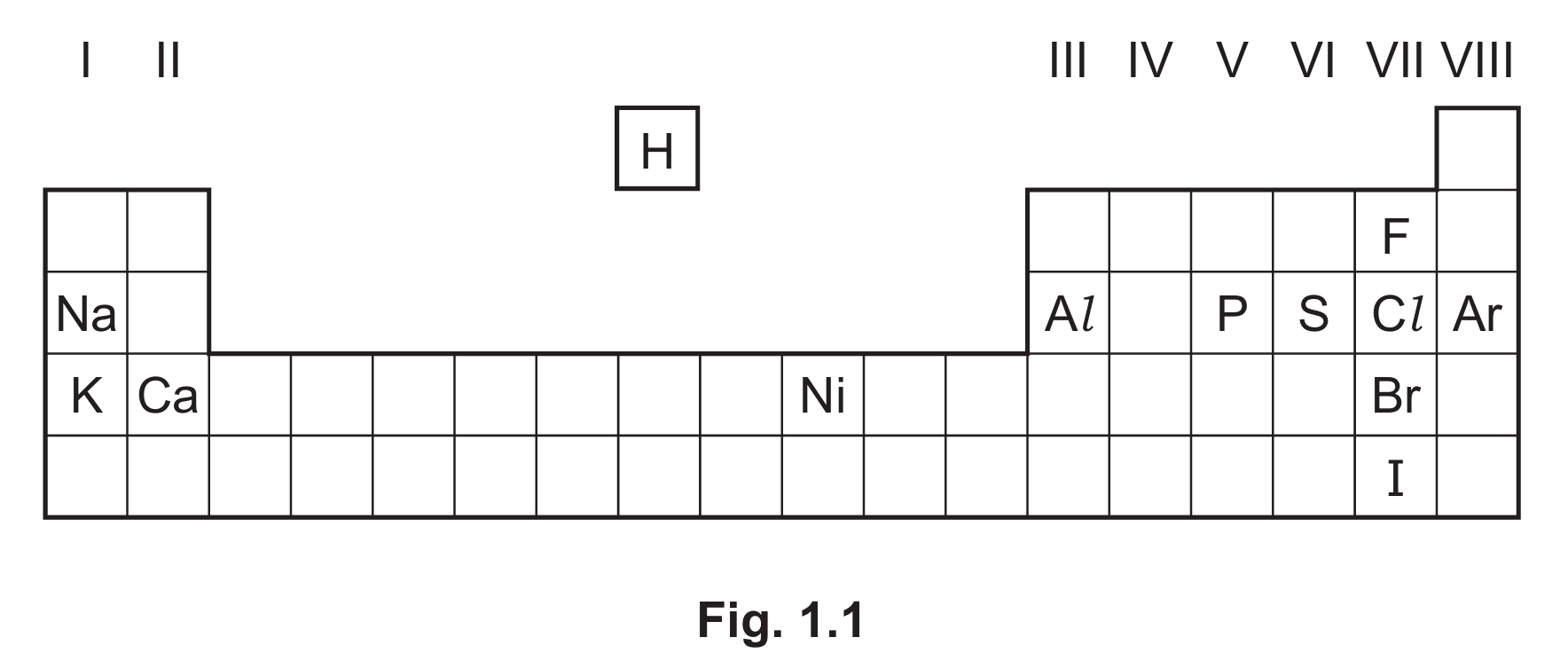
Answer the following questions using only the elements in Fig. 1.1. Each symbol of the element may be used once, more than once or not at all.
Give the symbol of the element that:
(a)(i) produces a lilac colour in a flame test
(a)(ii) has an atom with only two occupied electron shells
(a)(iii) is an unreactive gas
(a)(iv) forms an ion that gives a white precipitate after the addition of excess sodium hydroxide
(a)(v) forms an ion with a charge of 2-
(a)(vi) is added to iron to make stainless steel.
(b) Stainless steel is a mixture. State two characteristics of a mixture.
Most-appropriate topic codes (Cambridge IGCSE Chemistry 0620):
• Topic 8.1 — Arrangement of elements (Parts (a)(ii), (a)(iii), (a)(v))
• Topic 12.5 — Identification of ions and gases (Part (a)(i))
• Topic 7.1 — Characteristic properties of acids and bases (Part (a)(iv))
• Topic 9.3 — Alloys and their properties (Part (a)(vi))
• Topic 2.1 — Elements, compounds and mixtures (Part (b))
▶️ Answer/Explanation
(a)(i) K
Potassium ions (K⁺) produce a characteristic lilac (pale purple) flame colour in the flame test, as specified in the syllabus’s ‘Flame tests for metal ions’ table.
(a)(ii) F
Fluorine (atomic number 9) has the electronic configuration 2,7, meaning its electrons occupy only the first two shells (K and L shells).
(a)(iii) Ar
Argon is a noble gas (Group VIII) with a full outer electron shell (2,8,8), making it chemically unreactive and monatomic.
(a)(iv) Ca
Calcium ions (Ca²⁺) react with sodium hydroxide to form a white precipitate of calcium hydroxide, Ca(OH)₂, which remains insoluble even when excess NaOH is added.
(a)(v) S
Sulfur (atomic number 16) gains two electrons to achieve a stable octet, forming the sulfide ion (S²⁻) with a 2- charge.
(a)(vi) Ni
Nickel is a transition element added to iron along with chromium to produce stainless steel, making it harder and resistant to rusting.
(b) Any two of:
• Contains two or more different substances not chemically bonded.
• Does not have a fixed composition (variable composition).
• Substances in a mixture can be separated by physical methods.
• Each substance in the mixture retains its own chemical properties.
Question 2
Nitrogen molecules are diatomic.
(a) (i) State the meaning of the term diatomic.
(ii) State the percentage of nitrogen in clean, dry air.
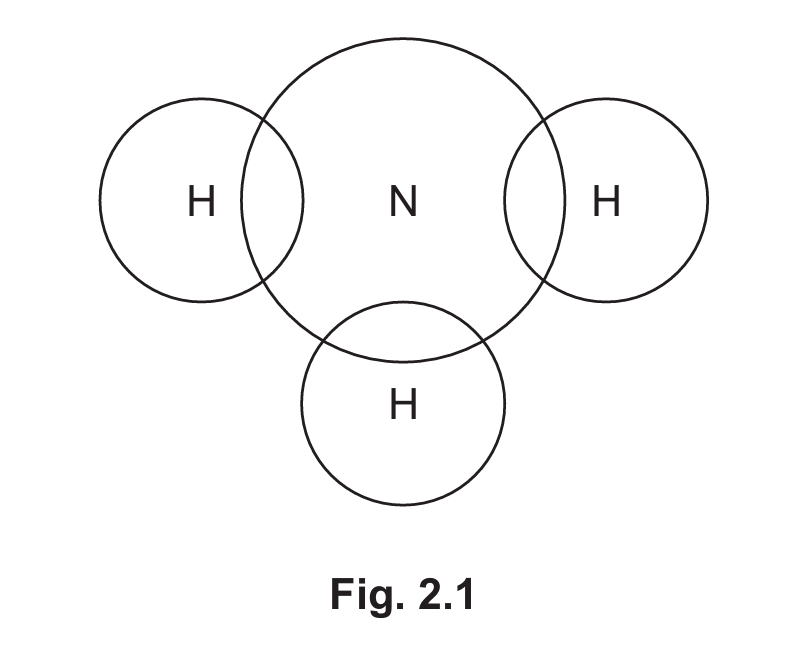
(b) Ammonia has a simple molecular structure. Complete Fig. 2.1 to show the dot-and-cross diagram for a molecule of ammonia. Show outer shell electrons only.
(c) Sodium chloride has a giant ionic structure of positive and negative ions.
(i) State the general name given to any positive ion.
(ii) State one physical property of an ionic compound.
(d) Graphite is used as an electrode.
(i) State one other use of graphite.
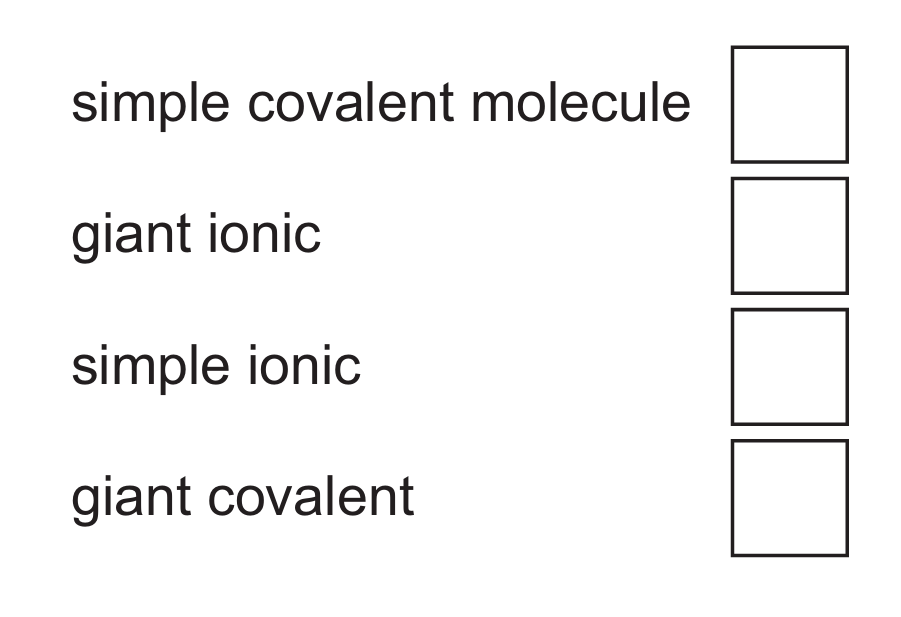
(ii) Choose the correct statement that describes the structure and bonding in graphite.
Most-appropriate topic codes (Cambridge IGCSE Chemistry 0620):
• Topic 2.5 — Simple molecules and covalent bonds (Part (a)(i), (b))
• Topic 8.1 — Arrangement of elements / 10.3 Air quality (Part (a)(ii))
• Topic 2.4 — Ions and ionic bonds (Part (c))
• Topic 2.6 — Giant covalent structures (Part (d))
▶️ Answer/Explanation
(a) (i) A diatomic molecule consists of exactly two atoms chemically bonded together. Elements like hydrogen (H₂), oxygen (O₂), and nitrogen (N₂) exist as diatomic molecules in their standard states.
(a) (ii) 78% (or 78.08%). Clean, dry air is composed of approximately 78% nitrogen, 21% oxygen, and the remaining 1% consists of noble gases (mainly argon) and carbon dioxide.
(b) The diagram should show a central Nitrogen atom with 5 outer electrons. It shares three single covalent bonds with three Hydrogen atoms (each contributing 1 electron). This uses 6 electrons (3 bonds), leaving one lone pair (2 electrons) on the Nitrogen.
(c) (i) Cation. When an atom loses one or more electrons, it becomes positively charged and is known as a cation (e.g., Na⁺, Ca²⁺).
(c) (ii) High melting point / Conducts electricity when molten or in aqueous solution. Ionic compounds have high melting points because strong electrostatic forces (ionic bonds) between oppositely charged ions require significant energy to overcome.
(d) (i) Lubricant / Pencil lead / Nuclear reactor moderator. The weak forces between graphene layers allow them to slide over each other, making graphite an excellent dry lubricant.
(d) (ii) giant covalent. Graphite is a giant covalent structure (a macromolecule) where each carbon atom is covalently bonded to three others in hexagons, forming layers.
Question 3


Most-appropriate topic codes (Cambridge IGCSE Chemistry 0620):
• Topic 10.1 — Water (Parts (a), (c), (d))
• Topic 12.5 — Identification of ions and gases (Part (b))
• Topic 3.1 — Formulae (Part (e))
▶️ Answer/Explanation
(a)
metal compounds, sewage, nitrates (any two).
These are common water pollutants. Metal compounds (e.g., lead, mercury) are toxic, sewage contains harmful microbes causing disease, and nitrates from fertilizers cause deoxygenation of water, harming aquatic life as stated in syllabus section 10.1.
(b)(i)
bromide.
From Table 3.1, the negative ions (anions) listed are chloride, bromide, nitrate, and sulfate. The bromide ion (Br–) has a mass of 0.3 mg, which is the lowest value among them.
(b)(ii)
nitrate.
The chemical formula NO3– corresponds to the polyatomic ion called nitrate, a common anion in fertilisers and industrial waste.
(b)(iii)
2.3 mg.
The table shows 9.2 mg of Na+ in 1000 cm3. For 250 cm3, the mass is (9.2 mg / 1000 cm3) × 250 cm3 = 2.3 mg.
(c)(i)
chlorination.
According to syllabus section 10.1, the treatment of domestic water supply includes sedimentation and filtration to remove solids, use of carbon to remove tastes and odours, and finally chlorination to kill microbes.
(c)(ii)
to remove tastes and odours.
Activated carbon is used in water treatment because it adsorbs organic compounds and residual chlorine that cause unpleasant tastes and smells, making the water more palatable.
(d)
Heat (or freeze) the sample and note the melting point. Pure water melts exactly at 0°C, whereas impure water melts below 0°C and over a range.
This is based on the principle that impurities depress the melting/freezing point. A sharp, constant melting point at 0°C indicates pure water, whereas a lower or variable point indicates impurities.
(e)
2PCl5 + 8H2O → 2H3PO4 + 10HCl.
Balancing the equation: Phosphorus: 2 on left and right. Chlorine: Left has 10, so 10 HCl on right. Hydrogen: Left 16, Right (2×3=6 from H3PO4) + (10 from HCl) = 16. Oxygen: Left 8, Right (2×4=8 from H3PO4).
Question 4
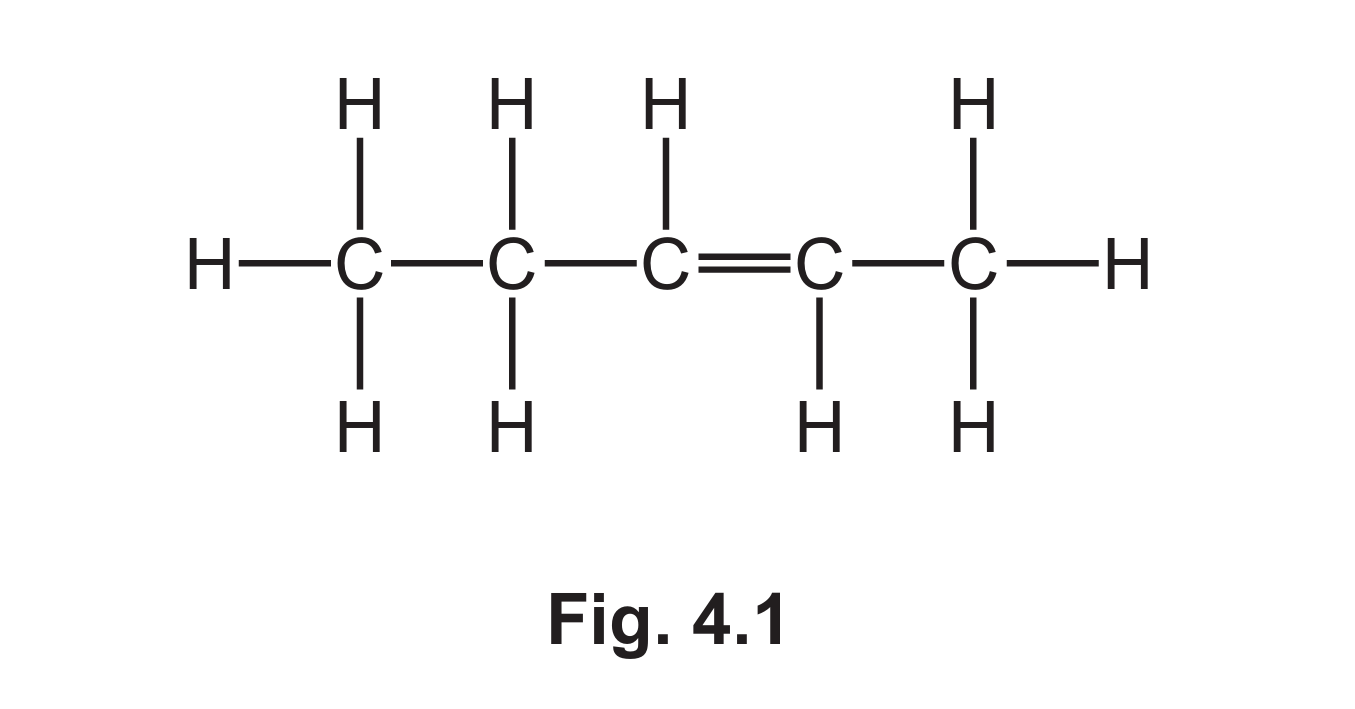
(a) Fig. 4.1 shows the displayed formula of compound A.
(i) Explain why compound A is described as unsaturated.
(ii) Explain why compound A is a hydrocarbon.
(iii) Deduce the molecular formula of compound A.
(b) Compound A reacts with steam to produce an alcohol.
(i) State the general formula for the homologous series of alcohols.
(ii) Ethanol is an alcohol which can be manufactured by fermentation.
– Name two substances needed for fermentation.
– Give two conditions needed for fermentation.
(iii) State one use of ethanol.
(c) A compound in the same homologous series as compound A reacts with ozone, \( O_3 \), to form compound B.
(i) Define the term homologous series.
(ii) The molecular formula for compound B is \( C_6H_{12}O_3 \).
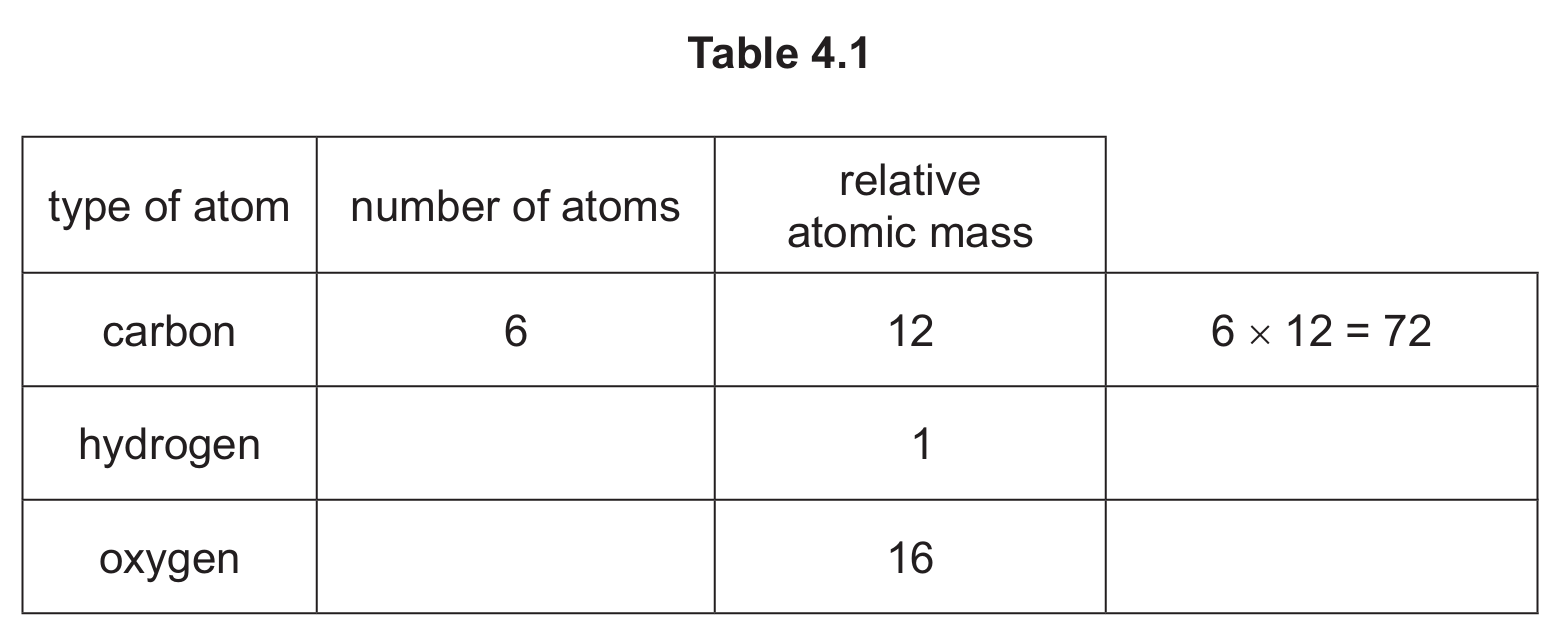
Complete Table 4.1 to calculate the relative molecular mass of \( C_6H_{12}O_3 \).
Most-appropriate topic codes (Cambridge IGCSE Chemistry 0620):
• Topic 11.5 — Alkenes (Part (a)(i))
• Topic 11.3 — Fuels (Part (a)(ii))
• Topic 11.1 — Formulae (Parts (a)(iii), (b)(i))
• Topic 11.6 — Alcohols (Parts (b)(ii), (b)(iii))
• Topic 11.1 — Homologous series (Part (c)(i))
• Topic 3.2 — Relative masses (Part (c)(ii))
▶️ Answer/Explanation
(a)(i)
C=C bond / carbon-carbon double bond
Detailed explanation: An unsaturated compound contains at least one double or triple bond between carbon atoms. The presence of a C=C double bond (as shown in Fig. 4.1) means the compound is unsaturated because it can undergo addition reactions where atoms add across the double bond.
(a)(ii)
contains carbon and hydrogen only / contains carbon and hydrogen and no other element
Detailed explanation: A hydrocarbon is defined as any compound that consists exclusively of carbon and hydrogen atoms. Since compound A only contains these two elements (as evident from its displayed formula), it qualifies as a hydrocarbon.
(a)(iii)
\( C_6H_{10} \)
Detailed explanation: By counting the atoms in the displayed formula (Fig. 4.1), we can determine the molecular formula. The structure shows 6 carbon atoms and 10 hydrogen atoms, giving the molecular formula \( C_6H_{10} \).
(b)(i)
\( C_nH_{2n+1}OH \)
Detailed explanation: The general formula for alcohols is \( C_nH_{2n+1}OH \), where n represents the number of carbon atoms. This formula accounts for the hydroxyl (-OH) functional group characteristic of alcohols.
(b)(ii)
substances needed: (aqueous) glucose and yeast
conditions: any two of: absence of oxygen (anaerobic), 25-45°C, aqueous/in water
Detailed explanation: Fermentation requires glucose as the substrate and yeast as the microorganism that carries out the process. The optimal conditions include: anaerobic conditions (absence of oxygen), warm temperatures (25-45°C) that allow yeast enzymes to function efficiently, and an aqueous environment for the reaction to occur.
(b)(iii)
solvent / fuel / alcoholic drinks
Detailed explanation: Ethanol has multiple uses including as a solvent in various industries (perfumes, medicines), as a biofuel or fuel additive due to its combustible properties, or as the intoxicating agent in beverages.
(c)(i)
family of similar chemical compounds / compounds with similar chemical properties with same functional group
Detailed explanation: A homologous series is a group of organic compounds that share: 1) the same general formula, 2) similar chemical properties, and 3) a gradual change in physical properties. Members differ by a \( CH_2 \) unit and have the same functional group.
(c)(ii)
132
Detailed explanation: To calculate the relative molecular mass of \( C_6H_{12}O_3 \):
Carbon: 6 atoms × 12 = 72
Hydrogen: 12 atoms × 1 = 12
Oxygen: 3 atoms × 16 = 48
Total = 72 + 12 + 48 = 132.
The completed table would show 12 hydrogen atoms and 3 oxygen atoms in the respective rows.
Question 5
(a) Table 5.1 shows some properties of five halogens.

Use the information in Table 5.1 to predict:
(i) the melting point of iodine
(ii) the atomic radius of fluorine
(iii) the physical state of bromine at 0°C. Give a reason for your answer.
(b) Aqueous chlorine reacts with aqueous potassium iodide.
(i) Complete the word equation for this reaction.
chlorine + potassium iodide → ………………………………………….. + …………………………………………..
(ii) Explain why aqueous iodine does not react with aqueous potassium bromide.
(c) Fluorine reacts with hot concentrated sodium hydroxide to produce sodium fluoride, water and oxygen.
(i) Complete the symbol equation for this reaction.
\( 2F_2 + 4NaOH \rightarrow ….NaF + 2H_2O + …… \)
(ii) Describe a test for oxygen.
Most-appropriate topic codes (Cambridge IGCSE Chemistry 0620):
• Topic 8.3 — Group VII properties (Parts (a), (b))
• Topic 12.5 — Identification of ions and gases (Part (c)(ii))
▶️ Answer/Explanation
(a)(i) Between −5°C and 180°C inclusive
Melting points increase down Group VII due to stronger intermolecular forces. Since bromine melts at −7°C and astatine at 302°C, iodine’s melting point must lie between these values.
(a)(ii) Between 0.098 nm and 0.01 nm
Atomic radius decreases up the group as the number of electron shells decreases. Chlorine has a radius of 0.099 nm, so fluorine above it must be smaller (typically around 0.064-0.072 nm).
(a)(iii) liquid (1)
temperature between −7°C and +59°C / 0°C is between the melting and boiling point (1)
Bromine’s melting point is −7°C and boiling point is 59°C. At 0°C, which falls between these values, the substance exists in its liquid state.
(b)(i) iodine (1)
potassium chloride (1)
Chlorine is more reactive than iodine and displaces it from the salt. The products are elemental iodine and potassium chloride, following the pattern Cl₂ + 2KI → I₂ + 2KCl.
(b)(ii) iodine is less reactive than bromine / bromine is more reactive than iodine
A halogen will only displace another if it is above it in the reactivity series. Since iodine is below bromine, it lacks the strength to displace bromine from potassium bromide.
(c)(i) 4(NaF) (1)
\( O_2 \) (1)
Balancing the equation shows 4 sodium atoms require 4 NaF. The 4 oxygen atoms from NaOH form 2 H₂O and one O₂ molecule, giving: 2F₂ + 4NaOH → 4NaF + 2H₂O + O₂.
(c)(ii) glowing splint (1)
relights (1)
The test for oxygen involves inserting a glowing (but not burning) splint into the gas. If oxygen is present, it supports rapid combustion, causing the splint to relight brightly.
Question 6
This question is about metals.
- □ has a low density
- □ forms coloured compounds
- □ has a low melting point
- □ does not act as a catalyst

Most-appropriate topic codes (Cambridge IGCSE Chemistry 0620):
• Topic 9.1 — Properties of metals (Part a)
• Topic 2.2 — Atomic structure and the Periodic Table (Part b)
• Topic 8.4 — Transition elements (Part c)
• Topic 6.4 — Redox (Part d)
• Topic 9.4 — Reactivity series (Part e)
▶️ Answer/Explanation
(a)
Malleable (can be hammered into sheets), ductile (can be drawn into wires), high melting point.
Metals have a giant lattice of positive ions surrounded by a ‘sea’ of delocalised electrons. The layers can slide (malleability/ductility), and strong metallic bonds require significant energy to overcome (high melting point).
(b)(i)
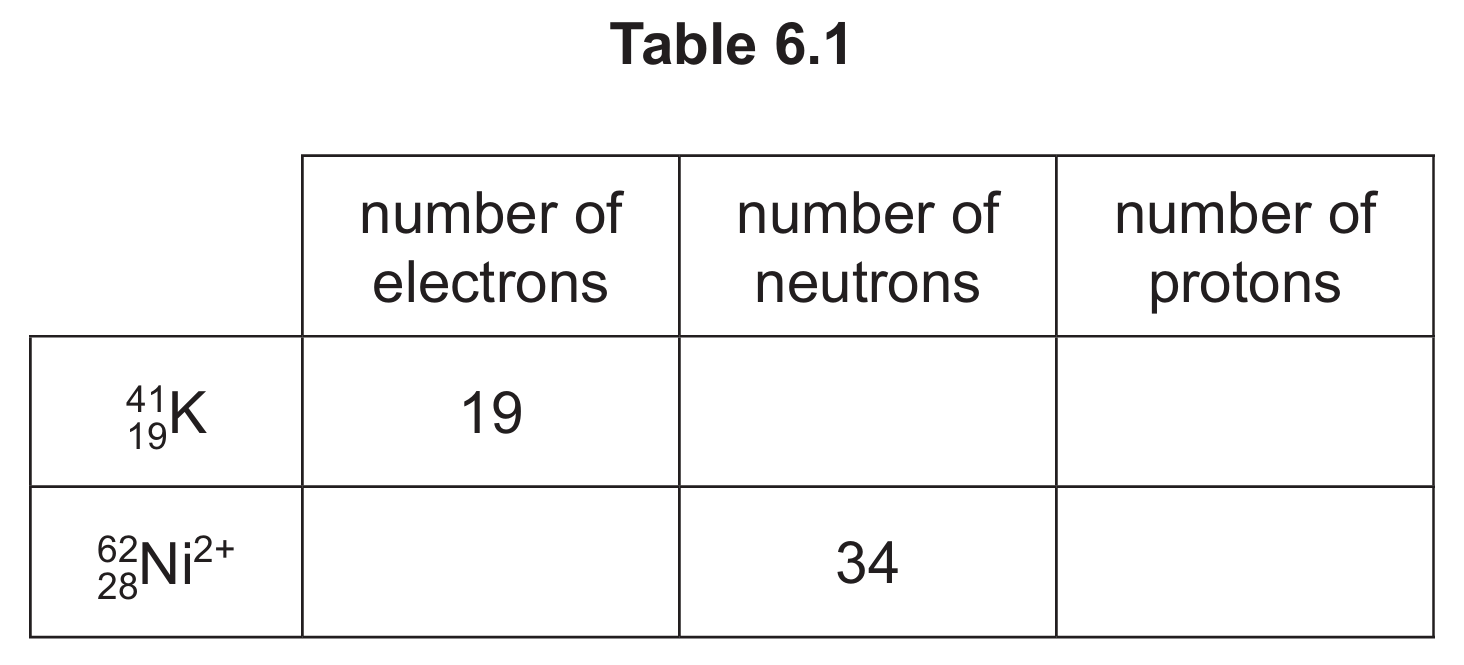
⁴¹K: electrons = 19, neutrons = 22, protons = 19.
⁶²Ni²⁺: electrons = 26, neutrons = 34, protons = 28.
For neutral ⁴¹K, protons (atomic number 19) equals electrons. Neutrons = mass number (41) – protons (19) = 22. For ⁶²Ni²⁺, protons = atomic number 28. The 2+ charge means it has lost 2 electrons (28 – 2 = 26). Neutrons = 62 – 28 = 34.
(b)(ii)
2,8,8,1
Potassium has atomic number 19. The first shell holds 2 electrons, the second holds 8, the third holds 8, and the remaining 1 electron occupies the fourth shell.
(c)
□ forms coloured compounds (✓)
Transition elements like nickel have partially filled d-orbitals. Electrons can jump between these d-orbitals by absorbing visible light, giving rise to characteristic colours in their compounds.
(d)
Nickel(II) oxide loses oxygen to become nickel (NiO → Ni).
Reduction is defined as the loss of oxygen or gain of electrons. In this reaction, oxygen is removed from nickel(II) oxide (NiO), forming elemental nickel (Ni), so NiO is reduced.
(e)
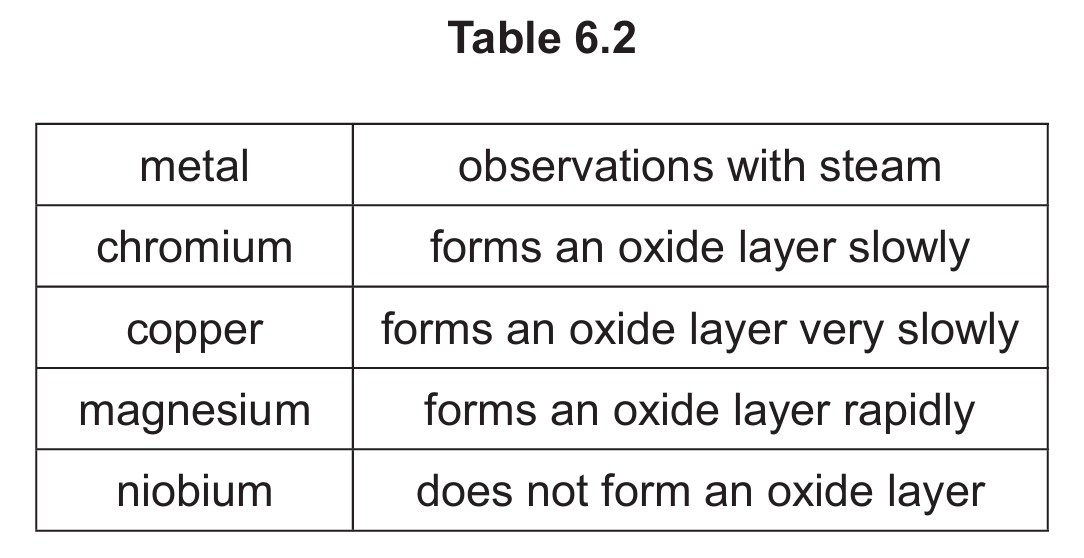
niobium < copper < chromium < magnesium
Reactivity with steam is based on how readily the metal reacts and the rate of oxide formation. Magnesium reacts rapidly, chromium reacts slowly, copper shows slight tarnishing, and niobium shows no reaction, making it the least reactive.
Question 7
This question is about acids, bases and salts.
(a) Crystals of potassium chloride can be made by reacting an acid with an alkali.
(i) Name the acid and the alkali used.
(ii) Choose from the list the type of reaction that takes place when an acid reacts with an alkali.
Draw a circle around your chosen answer.
addition neutralisation redox substitution
(iii) Thymolphthalein is an acid-base indicator.
State the colour of thymolphthalein at pH2 and at pH12.
(iv) Describe how to make dry crystals of potassium chloride from an aqueous solution of potassium chloride.
(b) Crystals of potassium chloride dissolve in water. This process is endothermic.
(i) Define the term endothermic.
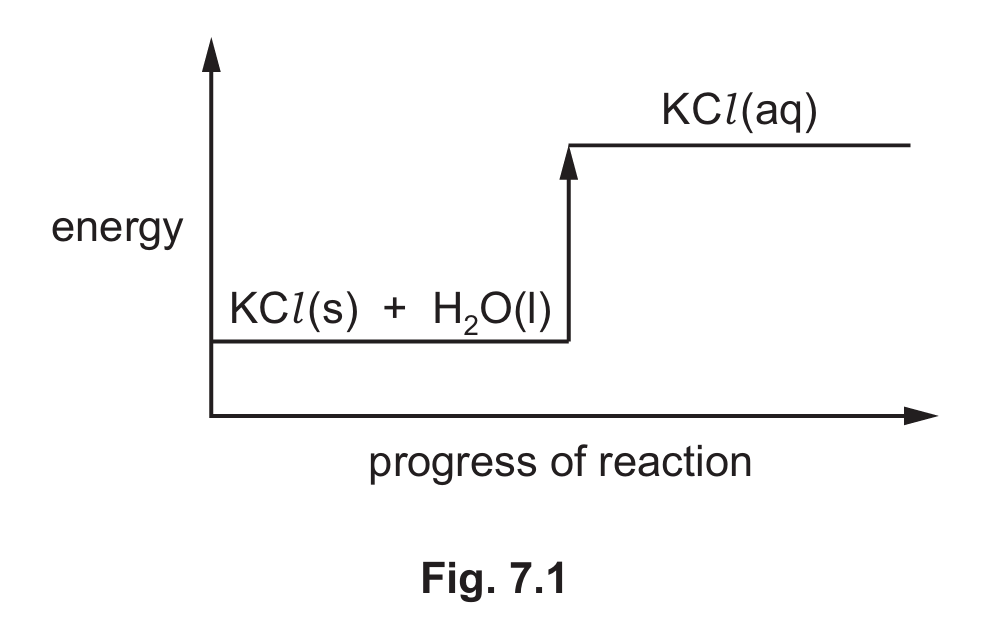
(ii) Fig. 7.1 shows the reaction pathway diagram for dissolving potassium chloride in water.
Answer the following questions using the information in Fig. 7.1.
– State the meaning of the state symbol (l).
– Explain how Fig. 7.1 shows that dissolving potassium chloride in water is endothermic.
Most-appropriate topic codes (Cambridge IGCSE Chemistry 0620):
• Topic 7.1 — Characteristic properties of acids and bases (Parts (a)(i)-(iv))
• Topic 5.1 — Exothermic and endothermic reactions (Part (b)(i))
• Topic 5.1 — Reaction pathway diagrams (Part (b)(ii))
▶️ Answer/Explanation
(a)(i)
acid: hydrochloric acid
alkali: potassium hydroxide
Detailed solution: Potassium chloride (KCl) is a salt formed from the chloride ion (Cl⁻) and the potassium ion (K⁺). The acid must provide the chloride ion (hydrochloric acid, HCl), and the alkali must provide the potassium ion (potassium hydroxide, KOH). The reaction is \( \text{HCl} + \text{KOH} \rightarrow \text{KCl} + \text{H}_2\text{O} \).
(a)(ii)
neutralisation
Detailed solution: The reaction between an acid and an alkali is specifically defined as a neutralisation reaction. In this process, hydrogen ions (H⁺) from the acid react with hydroxide ions (OH⁻) from the alkali to form water, while the remaining ions form the salt.
(a)(iii)
pH 2: colourless
pH 12: blue
Detailed solution: Thymolphthalein is a common indicator that is colourless in acidic and neutral solutions (below pH 9.3). It undergoes a sharp colour change to blue in basic conditions (above pH 10.5), making it ideal for detecting strong alkalis like at pH 12.
(a)(iv)
One method: heat the solution to evaporate some water until crystals start to form / the point of crystallisation, then filter off the crystals, and finally dry them between filter papers.
Detailed solution: To obtain dry crystals from a solution, first concentrate the solution by heating until a saturated solution is formed and crystals appear upon cooling. Then separate the solid crystals from the remaining liquid via filtration. Finally, gently dry the collected crystals by pressing them between sheets of filter paper to remove excess water.
(b)(i)
An endothermic process absorbs thermal energy from the surroundings.
Detailed solution: An endothermic process is one where the system absorbs heat energy from its surroundings. In the context of dissolving, if the solution feels cooler to the touch, the process is endothermic because thermal energy is taken in to break the solute-solute and solvent-solvent interactions.
(b)(ii)
– (l) means liquid.
– The diagram shows that the products (KCl in solution) have a higher energy level than the reactants (solid KCl + liquid water). This positive energy change (ΔH > 0) indicates that energy is absorbed, which is the definition of an endothermic process.
Detailed solution: The symbol (l) stands for the liquid physical state. The reaction pathway diagram clearly shows the products (KCl in aqueous solution) at a higher energy level than the reactants (solid KCl and liquid water). This positive change in energy (ΔH > 0) is the defining characteristic of an endothermic process.
Question 8
- 0.2 mol/dm3
- 0.4 mol/dm3
- 0.8 mol/dm3

calcium magnesium platinum sodium
Most-appropriate topic codes (Cambridge IGCSE Chemistry 0620):
• Topic 6.2 — Rate of reaction (Parts (a)(i)-(iii))
• Topic 4.1 — Electrolysis (Parts (b)(i)-(ii))
• Topic 2.2 — Atomic structure and the Periodic Table / Topic 9.1 — Properties of metals (Part (c))
▶️ Answer/Explanation
(a)(i)
The concentrations in order of increasing reaction time (slowest to fastest) are: 0.2 mol/dm³ (92 s), 0.4 mol/dm³ (46 s), and 0.8 mol/dm³ (23 s). Higher concentration increases the number of acid particles per unit volume, leading to more frequent successful collisions with the zinc surface per second, thus reducing the reaction time.
(a)(ii)
The presence of a catalyst would decrease the time taken for the reaction to finish. A catalyst provides an alternative reaction pathway with a lower activation energy (Eₐ), allowing a greater proportion of collisions to result in a reaction without the catalyst being consumed, thereby speeding up the process.
(a)(iii)
Using larger pieces of zinc would increase the time taken for the reaction to finish. Larger pieces have a smaller total surface area to volume ratio compared to small pieces, which reduces the frequency of collisions between the solid zinc atoms and the acid particles, slowing the reaction rate.
(b)(i)
Positive electrode (anode): oxygen (O₂); Negative electrode (cathode): hydrogen (H₂). In the electrolysis of dilute sulfuric acid, water molecules are preferentially discharged. At the anode, hydroxide ions (OH⁻) lose electrons to form oxygen, while at the cathode, hydrogen ions (H⁺) gain electrons to form hydrogen.
(b)(ii)
Platinum. Platinum is an inert electrode because it is a transition metal that does not readily participate in chemical reactions. It does not react with the dilute sulfuric acid electrolyte or with the gaseous products (hydrogen and oxygen), simply acting as a surface for electron transfer.
(c)
In solid zinc, the particles (atoms) are arranged in a regular, repeating three-dimensional giant metallic lattice structure. The separation between particles is extremely small as they are closely packed together and touching, with strong metallic bonds holding them in fixed positions, which gives zinc its definite shape and volume at room temperature.